




Overview
Oil Cartel Reshaped
On 28 April 2026 the UAE quit OPEC after 59 years, fracturing the Gulf consensus on quota-managed crude.
The UAE exits OPEC on 28 April 2026, announcing its withdrawal from the Organization of the Petroleum Exporting Countries after 59 years of membership, fracturing the Gulf consensus on quota-managed crude pricing and forcing India to reread its long-running energy and remittance relationship with the bloc.
Why this is in the news on 29 April 2026
UAE withdrawal and the immediate OPEC Plus response
Trigger event: On 28 April 2026, the United Arab Emirates announced its withdrawal from the Organization of the Petroleum Exporting Countries after 59 years of membership. The withdrawal took effect on Friday, 1 May 2026.
Definition: OPEC is a 12-member intergovernmental cartel formed in 1960 to coordinate petroleum production and pricing among its members. The broader OPEC Plus grouping adds 11 non-OPEC producers including Russia. Before the UAE departure, OPEC Plus accounted for roughly half of global oil production.
- 28 April 2026: UAE announces its OPEC and OPEC Plus exit.
- 1 May 2026: Withdrawal takes formal effect.
- 3 May 2026: Seven remaining OPEC Plus producers raise the June quota by 188,000 barrels per day without naming the UAE in their joint statement.
Cartel power, market signals, and the India read-across
Quota slippage, market reaction, and India exposure
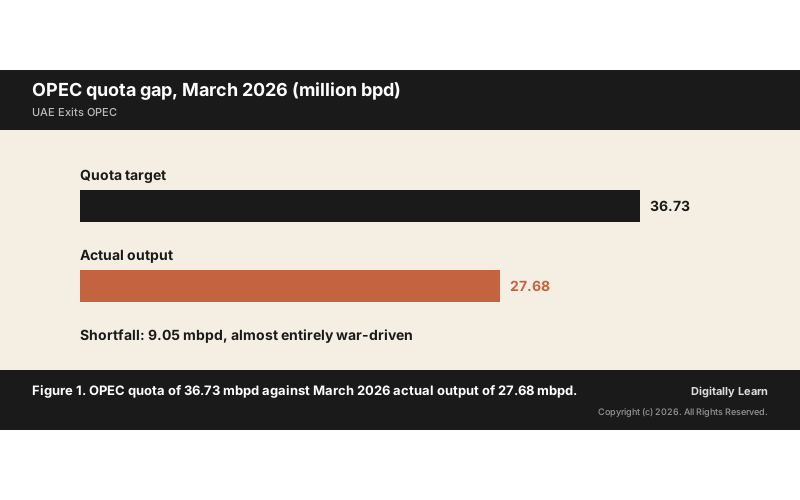
Why it matters: The UAE exit removes about 4 to 5 per cent of OPEC Plus output from the quota system. The cartel's ability to manage global supply through spare capacity weakens at the margin, with downstream effects for crude pricing and for India.
Market reaction was mixed: Brent crude rose about 3 per cent immediately after the announcement, but analysts told the press that investor focus remained on the Strait of Hormuz blockade rather than the UAE exit itself.
For India, three exposures matter: stability of nine million migrants across Gulf states, annual remittance inflows above USD 50 billion from the region, and the continuity of investment commitments from Gulf sovereign wealth funds that have suspended deals during the conflict.
What the exit signals for cartel architecture
Saudi-UAE divergence and the limits of quota discipline
What is the significance of this UAE withdrawal: The exit lays bare a long-running divergence between Saudi Arabia, which favours constraining supply for a high-price environment, and the UAE, which seeks production growth on the strength of low per-barrel extraction costs.
In policy terms: When a producer with one of the region's lowest production costs walks out, the quota becomes a constraint that disciplined countries bear alone. Untapped OPEC Plus reserves in the Gulf are also trapped behind the Hormuz blockade, so the cartel's paper quota gain delivers little real supply.
- Saudi Arabia: prefers low output, high prices, defensive of OPEC discipline.
- UAE: low extraction costs, prefers volume over price preservation.
- Russia: OPEC Plus partner, second-largest producer, struggling to meet quota due to Ukraine war disruption.
- Iran: OPEC member, not subject to quotas, exports trapped by US retaliatory blockade.
What sets this exit apart from prior departures
Three architectural features of the April 2026 exit
Distinguishing features: Three architectural features separate the UAE departure from earlier OPEC exits by Indonesia, Qatar, Ecuador and Angola.
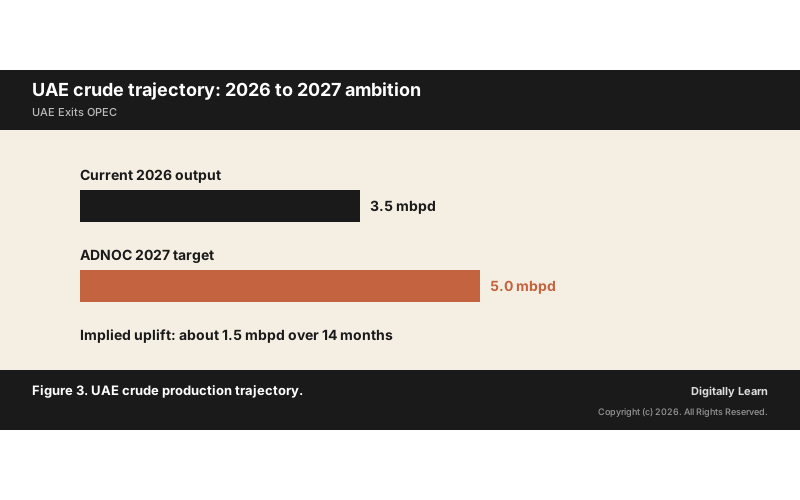
- (i) Size and scale. The UAE produced about 3.5 million bpd at exit, with ADNOC planning 5 million bpd by 2027; prior leavers (Qatar 2019, Angola 2023) were materially smaller producers.
- (ii) Strategic timing. The exit lands during an active Iran war and a Strait of Hormuz blockade, when the cartel’s coordination role is under maximum stress.
- (iii) Bilateral context. Saudi-Emirati rifts in Sudan and Yemen, the UAE’s closer alignment with the United States and Israel, and Abu Dhabi’s calls for a stronger line against Tehran together signal a broader realignment beyond oil quotas.
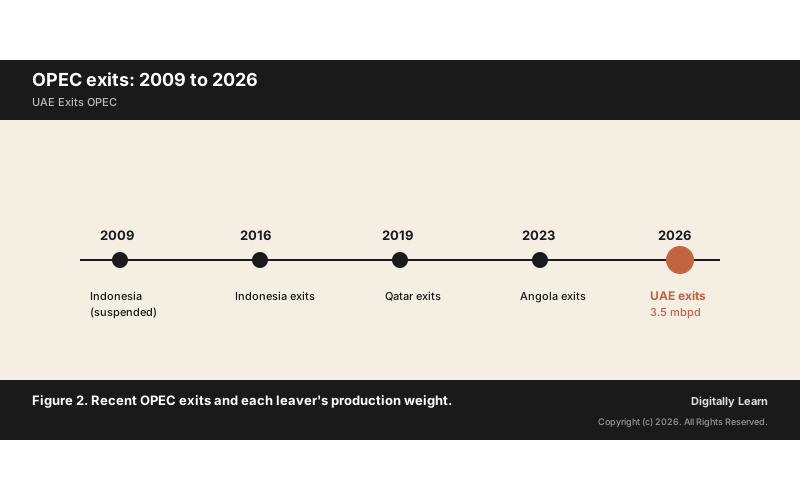
| Country | Year of exit | Output at exit (mbpd) | Stated reason |
|---|---|---|---|
| Indonesia | 2016 (final) | ~0.7 | Net oil importer status |
| Qatar | 2019 | ~0.6 | Focus on natural-gas production |
| Angola | 2023 | ~1.1 | Quota disagreements |
| UAE | 2026 | ~3.5 | Quota constraints, regional realignment |
Outcomes the post-exit cycle is producing
Four trackable consequences for global oil markets and India
Observable outcomes: The first ten days after the announcement show four trackable consequences across cartel signalling, production data, capital flows and Indian policy posture.
- (a) OPEC Plus continuity signal: the 188,000 bpd June quota raise, framed as collective stability rather than UAE-driven, projects cartel cohesion without acknowledging the exit.
- (b) ADNOC capital commitment: Abu Dhabi National Oil Company pledged USD 55 billion for new projects over two years, signalling that the production ramp to 5 million bpd is funded.
- (c) Brent crude moved up about 3 per cent at announcement; analysts attributed the move largely to the Hormuz blockade backdrop rather than the UAE departure.
- (d) India must read both fronts: nine million migrants in the Gulf, more than USD 50 billion in annual remittances, and Gulf sovereign-fund deal suspensions all flag a more uncertain investment and labour-flow horizon.
Connections to recent West Asia briefings
Connecting the UAE exit to the active Hormuz arc
Contemporary linkages: The UAE exit sits inside a broader West Asia disruption arc. Earlier briefings traced the closure and reopening of the Strait of Hormuz and the supply-chain stress on India.
- Iran closes the Strait of Hormuz, April 2026: the closure framing that sets the chokepoint stakes.
- Strait of Hormuz reopens after Iran-US truce, April 2026: the post-ceasefire transit cycle and the toll dispute.
- CII and World Bank supply-chain response, April 2026: India’s industrial-policy reaction to West Asia disruption.
- West Asia war and India economic slowdown, May 2026: the macro slowdown channels.
UPSC Relevance
GS Paper II and Paper III mapping for this topic
Where it fits: The UAE OPEC exit sits at the intersection of GS Paper II on International Relations (bilateral, regional and global groupings) and GS Paper III on Energy Security and the External Sector.
For Prelims, the high-yield facts cluster around OPEC composition, OPEC Plus versus OPEC, prior exits (Indonesia, Qatar, Angola), the role of the IEA as the producer-consumer counterweight, and India's associate membership in the IEA.
- OPEC headquarters: Vienna, Austria; founded 1960 in Baghdad.
- OPEC Plus adds 11 non-OPEC producers, including Russia, to the original cartel.
- IEA: created 1974 as a consumer-side counterweight; coordinates Strategic Petroleum Reserve releases.
- India: associate IEA member; not a voting participant in SPR-release decisions.
For Mains, two framings recur. First, the India energy-security question (drawn from the GS-II 2017 prompt): how should New Delhi engage with West Asian producers when the cartel architecture itself is being reshaped. Second, the GCC-cohesion question: whether the UAE departure from OPEC presages a wider Emirati realignment away from Gulf regionalism.
Past-year questions linked to this briefing
Prelims 2024 Sumed pipeline and Mains 2017 energy-policy questions
How this links to PYQs: The UAE OPEC exit activates two related past-year items: a Prelims 2024 Q88 on the Sumed pipeline as the Persian-Gulf-to-Europe alternative, and a Mains 2017 GS-II question on India energy-policy cooperation with West Asia. Both fit the cartel-restructuring context.
Previous Year UPSC-CSE Questions By the end you will be able to draft model answers for the following UPSC questions. Each question carries a collapsible framework showing how to approach it in the exam.
- UPSC Prelims 2024Consider the following statements:
- Statement-I: Sumed pipeline is a strategic route for Persian Gulf oil and natural gas shipments to Europe.
- Statement-II: Sumed pipeline connects the Red Sea with the Mediterranean Sea.
Which one of the following is correct in respect of the above statements?
How to approach this Prelims question
Approach: Verify each statement separately, then test whether II is the causal mechanism behind I.
Trap to watch: All four options are plausible; rule out incorrect-pair options first, then confirm the explanatory link.
Key facts to recall:
- Sumed pipeline runs through Egypt, connecting the Red Sea coast to the Mediterranean.
- It is the strategic alternative for Persian Gulf oil bound for Europe.
- Statement-II explains Statement-I; the answer is option (a).
Answer signal: Both statements are correct and Statement-II explains Statement-I; option (a).
- UPSC Mains 2017 GS-IIThe question of India’s Energy Security constitutes the most important part of India’s economic progress. Analyze India’s energy policy cooperation with West Asian countries.
How to structure the answer in the exam
Introduction: India imports roughly 88 per cent of its crude oil; West Asia accounts for the majority of that flow. Energy-policy cooperation with the region is the foundation of India's external-sector resilience.
Body (sub-themes to develop):
- Institutional architecture: GCC, OPEC, OPEC Plus, IEA associate membership.
- Bilateral channels: India-UAE Comprehensive Strategic Partnership; LNG cooperation with Qatar; long-term contracts with Saudi Arabia.
- Investment dimension: Gulf sovereign-wealth-fund commitments to Indian infrastructure and energy projects.
- 2026 inflection: UAE OPEC exit, ADNOC 5 mbpd ambition, Hormuz disruption, sovereign-fund deal suspensions.
- Policy options for India: diversification of supply, strategic petroleum reserves, IEA upgrade discussion, bilateral term contracts.
Conclusion: The 2026 cycle confirms that West Asia cooperation needs both a redundancy layer (non-Gulf supply, SPR, IEA) and a deepened bilateral architecture that survives cartel restructuring.
Sources and Further Reading
- Indian Express Opinion: End of the oil cartel? Why the UAE exit from OPEC changes everything for India (29 April 2026)
- Indian Express Editorial: With UAE split from OPEC, another oil market churn is in the offing (30 April 2026)
- Hindu International: OPEC Plus hikes oil production quotas without mentioning UAE pull-out (3 May 2026)
- LiveMint Economy: OPEC members increase oil production quota by 188,000 bpd, no word on UAE withdrawal (3 May 2026)
- International Energy Agency: India and the IEA partnership
- Petroleum Planning and Analysis Cell: Petroleum Statistics
- Wikipedia: OPEC (Organization of the Petroleum Exporting Countries)
- Wikipedia: Abu Dhabi National Oil Company (ADNOC)
Editorial Disclaimer
This article is compiled from the reference materials listed in the Sources section. It is an explainer for UPSC preparation and is not a substitute for primary documents (NCERTs, GoI ministry releases, IMD bulletins, RBI / CEA / MoEFCC publications, and Standing-Committee reports).


