


Overview
India's Energy Security Exposed
An 18 April re-closure and firing on India-flagged ships laid bare India's crude import exposure
The Strait of Hormuz is the narrow maritime chokepoint between Iran and Oman that connects the Persian Gulf to the Gulf of Oman and the Arabian Sea. Roughly one-fifth of global oil and liquefied natural gas flows transit through it. On 18 April 2026, Iran's Revolutionary Guard navy reversed an earlier reopening and announced a fresh closure in retaliation for the United States' blockade of Iranian ports. Iranian forces fired on commercial vessels including two India-flagged ships, the oil tanker Sanmar Herald and the bulk carrier Jag Arnav, on Saturday 18 April.
Why this is in the news on 22 April 2026
Closure, reopening, and fresh closure across one weekend
Trigger event: On 18 April 2026, Iran's Revolutionary Guard navy reversed a brief reopening of the Strait of Hormuz and announced a fresh closure, warning that "no vessel should make any movement from its anchorage in the Persian Gulf and the Sea of Oman, and approaching the Strait of Hormuz will be considered as cooperation with the enemy" and would be targeted.
Definition: The Strait of Hormuz is the narrow maritime corridor between Iran and Oman, connecting the Persian Gulf to the Gulf of Oman and the Arabian Sea. In peacetime, about one-fifth of global oil and LNG flows transit through it. The strait is geographically narrow (about 33 km at its narrowest) and lacks shipping alternatives at scale; closing the chokepoint is therefore one of Iran's most potent pressure tools in the region.
Three trigger events define the 18-22 April cycle:
- (i) 17 April reopening: Iran announced the strait’s reopening to commercial vessels during the US-Iran war ceasefire that Pakistan had brokered on 8 April, which the Islamabad Talks of 11-12 April tried to extend into a settlement.
- (ii) 18 April reversal: Iran’s Revolutionary Guard fired on a tanker without prior warning; an unknown projectile hit a container vessel. Two India-flagged ships, oil tanker Sanmar Herald and bulk carrier Jag Arnav, came under fire.
- (iii) India’s diplomatic response: India’s Foreign Secretary called on Iran’s ambassador over the “serious incident” of firing on the India-flagged merchant ship, especially after Iran had earlier let several India-bound ships through.
Why Hormuz is India's energy-security pressure point
Chokepoint geography and India's import dependence
Why it matters: India imports nearly 88 percent of its crude requirement (about 88.2 percent in 2024-25 per official data), and a substantial share of that import transits the Strait of Hormuz. A sustained chokepoint closure is not a price-volatility issue alone; it is a physical-flow disruption that risks delays at refineries, stockpile drawdown, and forced sourcing from longer routes at higher freight cost. India's strategic petroleum reserves cover only about 9 to 10 days of imports on their own (about 5.33 million tonnes of capacity), so the buffer against a long closure is thin.
The supplier exposure is concentrated: The strait is the principal export route for the Gulf monarchies that supply India: Saudi Arabia, Iraq, the United Arab Emirates, Kuwait, and Qatar all dispatch crude and LNG through Hormuz. Iran's ability to close the strait places these supplier flows under threat without Iran needing to attack any single supplier directly. This asymmetric position is the source of Iran's bargaining power.
Macro feedback: The cycle is already feeding into India's wider economic picture. Since the war began on 28 February 2026, Brent crude has risen about 60 percent, from roughly 74 US dollars per barrel before the war to above 108 US dollars by late April, touching a wartime high near 126 US dollars, widening India's import bill, weakening the rupee, and prompting the RBI's April forex tightening covered separately on this site.

Significance for India's energy-security policy
Chokepoint vulnerability, West Asia balancing, and the diversification thesis
What is the significance of this closure for India: The Hormuz disruption pulls three policy threads tight at once: the chokepoint-vulnerability thread, the West-Asia-relations balancing thread, and the longer-running energy-security diversification thread.
- (i) Chokepoint vulnerability is now a hard fact, not a theoretical risk. India had long modelled Hormuz disruption as a contingency; the 18 April fire on Sanmar Herald and Jag Arnav converts the contingency into a documented incident, raising insurance premia, freight surcharges, and the political cost of inaction.
- (ii) West Asia balancing tested. India maintains working relations with Iran, the Gulf monarchies, Israel, and the United States simultaneously; the closure forces a sequence of bilateral calls (India’s Foreign Secretary summoned Iran’s ambassador) while keeping the larger West-Asia partnerships intact. This is the principle of strategic autonomy applied to a moving target.
- (iii) Diversification thesis vindicated. India has progressively reduced its supplier concentration through Russian crude, US LNG, and African and Latin-American sources. The 2017 GS-II Mains question on India’s energy-policy cooperation with West Asia is being re-examined in the field; the 2026 cycle suggests the answer must combine Gulf relationships with structurally diversified supply.
Distinguishing features of the April 2026 cycle
Indian-vessel incidents in one view
India-flagged shipping incidents: The 18-22 April cycle produced a string of confirmed and reported incidents around Indian vessels. The table below logs the named ships, the operator, and the action.
| Vessel | Vessel type | Operator | Action / outcome |
|---|---|---|---|
| Sanmar Herald | Oil tanker | Sanmar Shipping (Chennai) | Fired upon by Iranian Revolutionary Guard navy on 18 April 2026; captain reported authorisation to cross |
| Jag Arnav | Bulk carrier | Great Eastern Shipping Company (Mumbai) | Fired upon by Iranian navy on 18 April 2026 |
| Desh Garima | Oil tanker | Indian operator (per Shipping Ministry) | Last Indian ship to cross safely, on 18 April before the firing incidents |
| Desh Vaibhav | Oil tanker | Indian operator | Aborted attempt to cross; returned to Persian Gulf on 18 April |
| Desh Vibhor | Oil tanker | Indian operator | Aborted attempt to cross; returned to Persian Gulf on 18 April |
Distinguishing features: Three architectural features separate the 2026 closure cycle from earlier Strait-of-Hormuz scares:
- (i) Direct fire on India-flagged ships, rather than diplomatic threat alone. Earlier cycles produced statements and inspections; the 18 April cycle produced documented fire by Iranian gunboats on named Indian vessels.
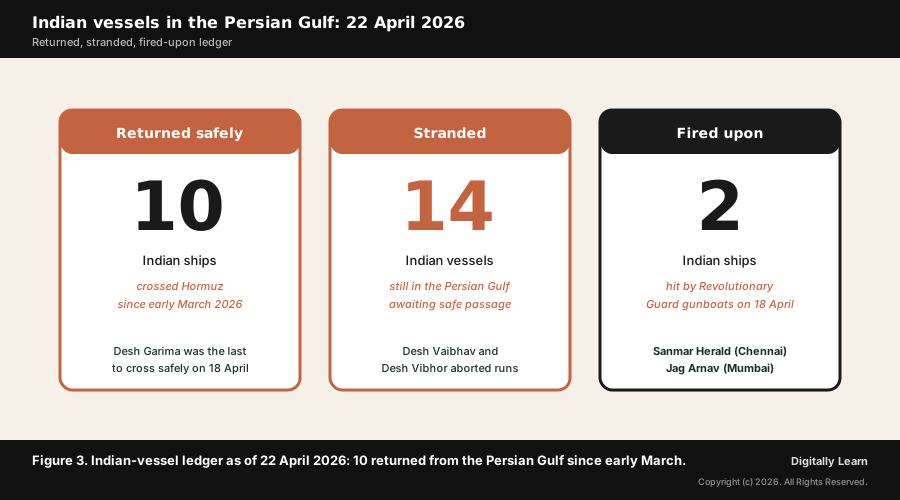
- (ii) Active Indian government engagement: India’s Foreign Secretary summoned Iran’s ambassador to convey deep concern; the Shipping Ministry confirmed 10 Indian ships returned and 14 still stranded, and dismissed payment-for-passage speculation.
- (iii) Coupling with the rupee and macro file: the Hormuz cycle is directly upstream of the oil-price shock that pushed the rupee to a record low and triggered the RBI’s April forex regulatory tightening.
Observable outcomes the cycle is producing
Vessel evacuations, oil-price pass-through, and the Pakistan-mediated peace track
Observable outcomes: The Hormuz cycle is producing three trackable outcomes for India through the financial year.
- (a) Vessel evacuations and stranded-ship count. 10 Indian ships returned from the Persian Gulf since early March 2026; 14 Indian vessels remained stranded as of 22 April. The Shipping Ministry continues to engage Iran at the diplomatic level for safe passage.
- (b) Oil price and rupee pass-through. Brent crude rose above 108 US dollars per barrel by late April, touching a wartime high near 126 US dollars, feeding directly into the rupee’s slide past 95 per US dollar in late March on its way to fresh record lows, and triggering the RBI’s net-open-position cap on banks. Tracked separately on this site at the RBI forex briefing.
- (c) Pakistan-mediated US-Iran negotiations. Pakistani Foreign Minister Ishaq Dar’s mediation effort continued through the cycle; a second round of negotiations was expected. Iran said negotiations would not resume unless the US blockade was lifted, indicating the chokepoint disruption is now a bargaining card inside the broader peace track.
Contemporary linkages
How Hormuz threads through India's 2026 macro file
Contemporary linkages: The Hormuz cycle is one node in a larger 2026 macro file that an aspirant should connect.
- (i) West Asia war (28 February 2026): the closure was imposed after the US and Israel launched the war during talks over Tehran’s nuclear programme. Brent crude rose about 60 percent, from roughly 74 US dollars before the war to above 108 US dollars by late April and a wartime high near 126 US dollars, with about one-fifth of global oil flows transiting the chokepoint.
- (ii) RBI’s April forex tightening: the rupee crossing 95 per US dollar in late March, on its way to fresh record lows, prompted the late-March net-open-position cap and the April corporate-treasury data call. Read the RBI forex-lens briefing for the wider response.
- (iii) Operation Sindoor anniversary (May 2026): India’s earlier cross-border response, which similarly tested measured use of force in a high-stakes setting, is a useful precedent for how India calibrates its posture in West Asia. See the Operation Sindoor anniversary briefing for that wider frame.
UPSC Relevance
Where this fits in the UPSC-CSE syllabus
This topic sits at the intersection of General Studies Paper II: International Relations (India and its neighbourhood, bilateral relations, regional groupings) and General Studies Paper III: Internal Security and External Sector (energy security, maritime security, sea lanes of communication, security challenges in border and coastal areas).
For Prelims, the high-yield facts cluster across the chokepoint, the incidents, and the macro pass-through:
- Strait of Hormuz: connects the Persian Gulf with the Gulf of Oman / Arabian Sea; about 33 km at its narrowest; carries roughly 20 percent of global oil and LNG flows.
- Closure event: 18 April 2026, by Iran’s Revolutionary Guard navy; reversed an earlier 17 April reopening.
- India-flagged ships fired upon: Sanmar Herald (Sanmar Shipping, Chennai) and Jag Arnav (Great Eastern Shipping, Mumbai).
- Indian shipping ledger (22 April): 10 Indian ships returned since early March; 14 stranded in the Persian Gulf.
- Oil price pass-through: Brent crude above 108 US dollars per barrel by late April, with a wartime high near 126 US dollars; rupee past 95 per US dollar in late March on its way to fresh record lows.
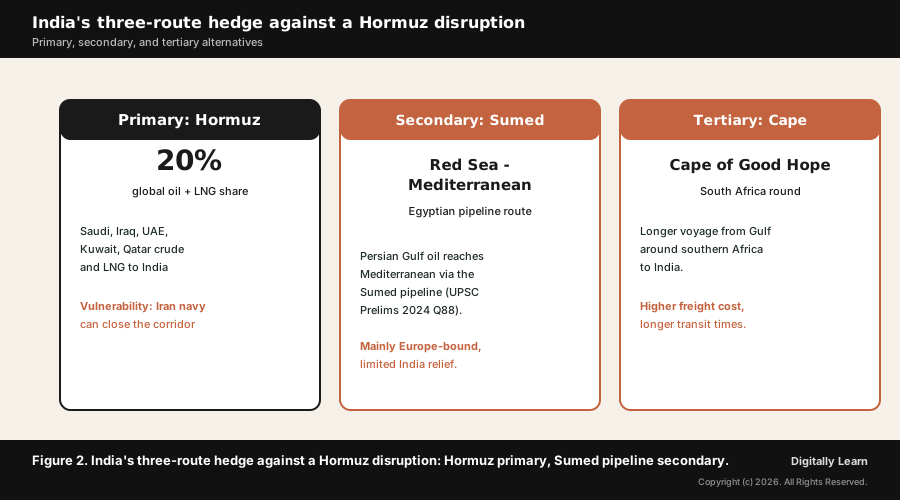
- Alternative routes: Sumed pipeline (Red Sea to Mediterranean, mainly Europe-bound, UPSC Prelims 2024 Q88); Cape of Good Hope round (longer, costlier).
- Diplomatic engagement: India’s Foreign Secretary summoned Iran’s ambassador; Pakistan’s Foreign Minister Ishaq Dar mediating US-Iran negotiations.
- War start: 28 February 2026 (US and Israel launched the war during talks over Tehran’s nuclear programme).
For Mains, two framings recur. First, the India energy-security question under a chokepoint stress test: how a country importing nearly 88 percent of its crude responds when a single 33-km corridor carries the bulk of its inflow. The 2017 GS-II Mains question on India's energy cooperation with West Asia is being re-examined in the field; the answer must now combine traditional Gulf relationships with structurally diversified supply and active diplomatic management. Second, the strategic-autonomy approach in West Asia: the call on Iran's ambassador, the working relationships with Saudi Arabia and the UAE, and the simultaneous US engagement together show how India operationalises strategic autonomy on a moving target.
- Common Prelims trap. Hormuz connects the Persian Gulf to the Gulf of Oman and the Arabian Sea, not the Red Sea. Bab el-Mandeb connects the Red Sea to the Gulf of Aden; Hormuz is a separate chokepoint.
- Common Mains trap. Treating Hormuz as a one-off tactical event misses the structural point. The recommended framing is structural: chokepoint vulnerability is a long-run condition that requires diversification, strategic petroleum reserves, and active diplomatic management with adversarial as well as friendly states.
- Cross-cutting trap. The Sumed pipeline carries Persian Gulf oil to the Mediterranean via Egypt; it is mainly a Europe-bound route and offers limited relief to India. Substituting Sumed for Hormuz in answers is the natural error.
Previous Year UPSC-CSE Questions By the end you will be able to draft model answers for the following UPSC questions. Each question carries a collapsible framework showing how to approach it in the exam.
- UPSC Prelims 2024Consider the following statements:
- Statement-I: Sumed pipeline is a strategic route for Persian Gulf oil and natural gas shipments to Europe.
- Statement-II: Sumed pipeline connects the Red Sea with the Mediterranean Sea.
Which one of the following is correct in respect of the above statements?
How to approach this Prelims question
Approach: Verify each statement separately, then test whether II is the causal mechanism behind I.
Trap to watch: All four options are plausible; rule out incorrect-pair options first, then confirm the explanatory link.
Key facts to recall:
- The Sumed (Suez-Mediterranean) pipeline runs through Egypt, connecting the Red Sea coast to the Mediterranean.
- It is a strategic alternative for Persian Gulf oil bound for Europe when Suez Canal capacity or chokepoint risk is a concern.
- Statement-II (the Red-Sea-to-Mediterranean connection) is the explanation for Statement-I (the strategic-route status for Europe-bound oil).
Answer signal: Both statements are correct and Statement-II explains Statement-I; option (a) is the answer.
- UPSC Mains 2017 GS-IIThe question of India's Energy Security constitutes the most important part of India's economic progress. Analyze India's energy policy cooperation with West Asian countries.
How to structure the answer in the exam
Introduction: One-line statement on India's nearly 88 percent crude-import dependence and the centrality of West Asia in that import basket, with the April 2026 Hormuz closure as the topical opening.
Body (sub-themes to develop):
- Pillars of India-West Asia energy cooperation: long-term crude contracts with Saudi Aramco, Iraq, UAE, Kuwait; LNG offtake from Qatar; strategic petroleum reserve agreements; refinery joint ventures.
- Chokepoint vulnerability: 20 percent of global oil and LNG flows transit the Strait of Hormuz, exposing India to a single corridor risk that Iran can close at short notice (18 April 2026 is the documented incident).
- Diversification and hedging: Russian crude purchases, US LNG offtake, Africa and Latin America sourcing, strategic petroleum reserves; the Sumed pipeline as a Europe-relief route (UPSC Prelims 2024 Q88) and the Cape of Good Hope round as a tertiary alternative.
- Strategic-autonomy diplomacy: simultaneous working relations with Iran, the Gulf monarchies, Israel and the United States, demonstrated by India's Foreign Secretary calling on Iran's ambassador on 18 April while maintaining Gulf and US engagement.
Conclusion: Two-line synthesis arguing that India's energy security must be read as a portfolio of supplier diversification, route diversification, and active strategic-autonomy diplomacy, not as a single Gulf relationship.
Sources and Further Reading
- The Hindu: Iran fully closes Strait of Hormuz over U.S. blockade (19 April 2026)
- Indian Express: Govt rejects claims Indian oil tanker fired at by Iran had paid to cross Hormuz (22 April 2026)
- Indian Express: Iran fires on 3 ships, seizes 2 in Strait of Hormuz after Trump extends ceasefire (22 April 2026)
- Ministry of External Affairs: India-Iran relations and India in West Asia
- Ministry of Petroleum and Natural Gas: India's energy security and import dependence
- Press Information Bureau: Shipping Ministry releases and external sector statements
- Wikipedia: Strait of Hormuz (chokepoint geography and shipping statistics)
- Wikipedia: Sumed pipeline (Persian Gulf to Mediterranean alternative route)
Editorial Disclaimer
This article is compiled from the reference materials listed in the Sources section. It is an explainer for UPSC preparation and is not a substitute for primary documents (NCERTs, GoI ministry releases, IMD bulletins, RBI / CEA / MoEFCC publications, and Standing-Committee reports).


