


Overview
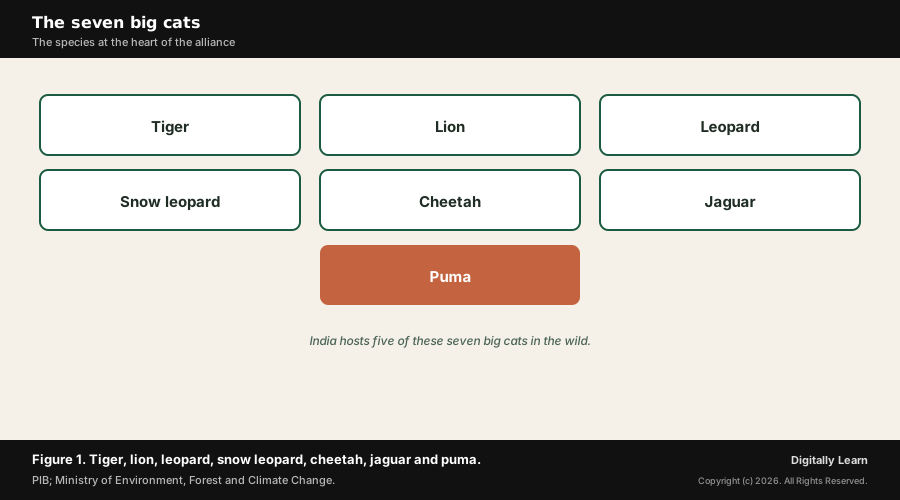
The International Big Cat Alliance (IBCA) is an India-led coalition for the conservation of the world's seven big cats: the tiger, lion, leopard, snow leopard, cheetah, jaguar and puma. Launched by Prime Minister Modi in 2023 to mark fifty years of Project Tiger, it is headquartered in India and has since become a treaty-based inter-governmental organisation. In May 2026, Saudi Arabia joined as the 26th member, expanding the alliance ahead of an IBCA summit in New Delhi.
Why the IBCA is in focus
A new member for a young alliance
In May 2026, Saudi Arabia joined the International Big Cat Alliance (IBCA) as its 26th member. The entry came ahead of an IBCA summit that India is set to host in New Delhi.
The IBCA is an India-led coalition for big-cat conservation. It brings together range countries that host big cats, non-range countries that support the cause, and scientific and conservation partners.
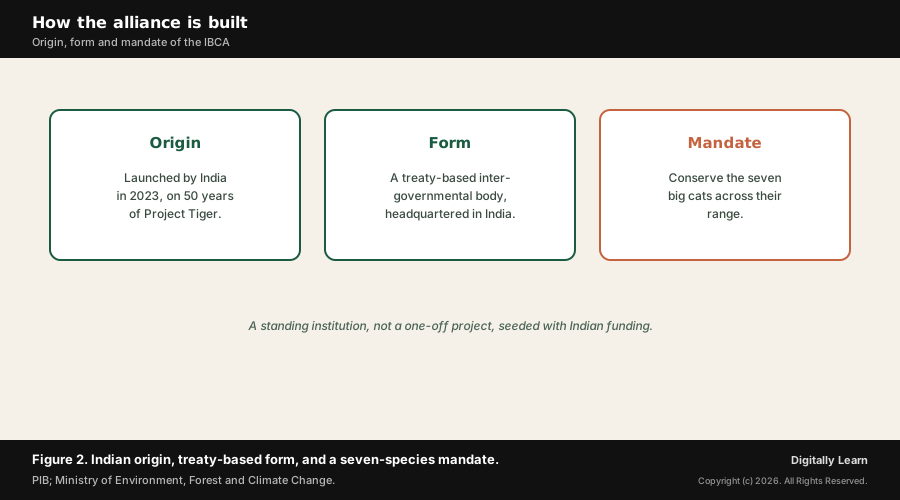
The alliance was launched by Prime Minister Modi in 2023 to mark fifty years of Project Tiger. It is headquartered in India and has since become a treaty-based inter-governmental organisation.
The headline facts about the IBCA are:
- Membership: Saudi Arabia is the 26th member, alongside several observer nations.
- Mandate: conservation of the seven big cats across their range.
- Origin: launched by India in 2023, marking fifty years of Project Tiger.
- Status: a treaty-based international organisation headquartered in India.
Why the alliance matters
Conservation at a global scale
Big cats are apex predators whose survival signals the health of whole ecosystems. A global alliance lets countries pool knowledge, funds and protection efforts across the species' range.
A wider membership strengthens the coalition. Each new country brings habitat, data and resources, so Saudi Arabia's entry adds reach and momentum to a still-young organisation.
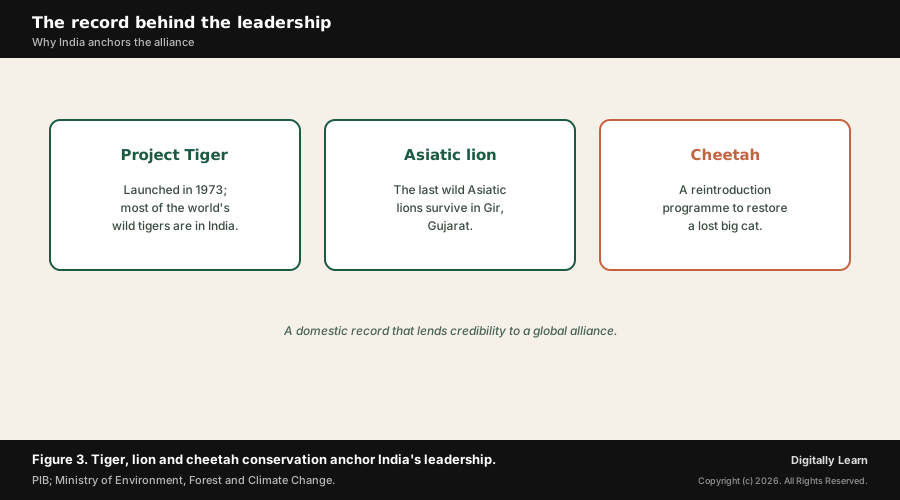
It also reflects India's conservation leadership. By hosting the alliance and its summit, India turns its domestic record on tigers and lions into a platform for global wildlife diplomacy.
What the alliance signifies
Diplomacy, funding and shared knowledge
Three threads carry the weight: India's wildlife diplomacy, pooled funding for conservation, and the sharing of expertise across borders.
First, diplomacy. Leading a treaty-based body lets India set the agenda on big-cat conservation and convene range and non-range countries around a shared cause.
Second, funding. The Government of India provided one-time support of Rs 150 crore for the alliance's early years, anchoring a platform that can mobilise more resources over time.
Third, shared knowledge. Members can exchange survey methods, anti-poaching practice and habitat management, helping countries with fewer resources protect their big cats.
Distinguishing features of the IBCA
The alliance at a glance
The table sets out the key facts of the IBCA, so its origin, mandate and scope are visible at a glance.
| Feature | Detail |
|---|---|
| Launched | 2023, marking 50 years of Project Tiger |
| Headquarters | India |
| Mandate | Conservation of the seven big cats |
| Status | Treaty-based inter-governmental organisation |
| Early funding | One-time support of Rs 150 crore from India |
Three features that define the alliance
Three elements set the IBCA apart from a one-off conservation project:
- (i) Multi-species and multi-country. It spans seven big cats across range and non-range countries, not a single species in one nation.
- (ii) Treaty-based. It has become a formal inter-governmental organisation, giving it standing and continuity.
- (iii) India-anchored. Headquartered in India and seeded with Indian funding, it builds on the country’s Project Tiger legacy.
Observable outcomes
Three trackable outcomes
The widening alliance translates into three developments to watch.
- (a) A larger coalition. Each new member adds habitat, data and resources to the conservation effort.
- (b) The New Delhi summit. India’s hosting of the IBCA summit can set joint priorities and projects.
- (c) Cross-border programmes. Members can launch shared work on monitoring, anti-poaching and habitat corridors.
Membership is the start, not the finish. The test of the IBCA is whether it mobilises real funding and projects rather than remaining a declaration of intent.
Big-cat conservation and India's record
Project Tiger, Cheetah reintroduction and wildlife diplomacy
The IBCA builds on India's long conservation record, above all Project Tiger, which has made India home to a large share of the world's wild tigers.
It connects to the Cheetah reintroduction programme, India's effort to bring back a big cat that had gone extinct locally, which gives the alliance a flagship restoration story.
The alliance also advances wildlife diplomacy. By convening countries around charismatic species, India links conservation to its broader soft-power and Global South engagement.
UPSC relevance and exam focus
Where this fits in the UPSC-CSE syllabus
This topic maps to General Studies Paper III: conservation, biodiversity and environmental institutions, with a link to India's role in international groupings under Paper II.
For Prelims, hold the high-yield facts: the seven big cats, the IBCA's 2023 launch and Indian headquarters, its treaty-based status, and Saudi Arabia as the 26th member.
For Mains, two framings recur: the role of protected areas and alliances in conserving wildlife, and how India uses conservation for soft power and diplomacy.
Recurring linked concepts an aspirant should keep in working memory:
- Project Tiger: India’s flagship tiger-conservation programme, launched in 1973.
- Seven big cats: tiger, lion, leopard, snow leopard, cheetah, jaguar and puma.
- Cheetah reintroduction: India’s effort to restore a locally extinct big cat.
- In-situ conservation: protecting species in their natural habitat through reserves.
The puma, not the cheetah alone, completes the seven big cats; and the IBCA is India-led, not a body of the United Nations. Mixing these up is a frequent error.
Do not present the IBCA as a finished success. It is a young institution, so the analysis should weigh its promise against the funding and projects it must still deliver.
Previous Year UPSC-CSE Questions By the end you will be able to draft model answers for the following UPSC questions. Each question carries a collapsible framework showing how to approach it in the exam.
- UPSC Prelims 2024Consider the following statements about big cats:
- Lions do not have a particular breeding season.
- Unlike most other big cats, cheetahs do not roar.
- Unlike male lions, male leopards do not proclaim their territory by scent marking.
Which of the statements given above are correct?
How to approach this Prelims question
Approach: Check each statement against the known biology of lions, cheetahs and leopards.
Trap to watch: Statement 3 is the trap: leopards do scent-mark their territory, so the statement is incorrect.
Key facts to recall:
- Lions breed year-round, with no fixed season.
- Cheetahs cannot roar; they chirp and purr.
- Leopards mark their territory by scent, so statement 3 is wrong.
Answer signal: Statements 1 and 2 are correct; statement 3 is not. Correct answer: 1 and 2 only.
- UPSC Mains 2023 GS-IIdentify and discuss the factors responsible for diversity of natural vegetation in India. Assess the significance of wildlife sanctuaries in rain forest regions of India.
How to structure the answer in the exam
Introduction: Open with India's climatic and physiographic diversity as the basis of its varied natural vegetation.
Body (sub-themes to develop):
- Factors: climate, rainfall, soil, altitude and latitude shaping vegetation.
- Sanctuaries as in-situ conservation that protect habitat and species together.
- Rainforest sanctuaries safeguarding endemic and threatened wildlife.
- Habitat protection as the foundation for big-cat and broader conservation.
- Institutions and alliances, such as the IBCA, building on this habitat base.
Conclusion: Conclude that habitat protection through sanctuaries underpins all higher conservation efforts.
Sources and Further Reading
- Press Information Bureau: Cabinet approves establishment of the International Big Cat Alliance
- Press Information Bureau: IBCA comes into force as a treaty-based inter-governmental organisation
- Press Information Bureau: India to host the IBCA summit in New Delhi
- Ministry of Environment, Forest and Climate Change
- National Tiger Conservation Authority (Project Tiger)
- Wikipedia: International Big Cat Alliance
Editorial Disclaimer
This article is compiled from the reference materials listed in the Sources section. It is an explainer for UPSC preparation and is not a substitute for primary documents (NCERTs, GoI ministry releases, IMD bulletins, RBI / CEA / MoEFCC publications, and Standing-Committee reports).


