


Overview
CII's 20-Point Crisis Plan
A 6.6 percent FY27 upgrade tempered by West Asia drag, alongside CII's relief agenda for industry
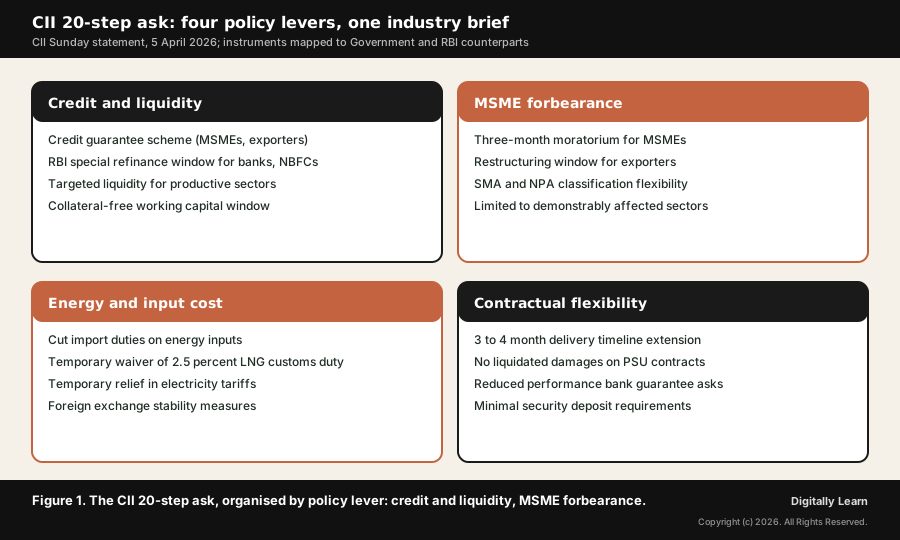
India's industry response to the West Asia war, which began on 28 February 2026, took shape across three institutional threads in early to mid April. The Confederation of Indian Industry (CII) on 5 April issued a statement outlining 20 steps for the Government and the Reserve Bank of India, centred on targeted liquidity, a credit guarantee scheme, a three-month moratorium for MSMEs, and exchange-rate stability. The World Bank on 8 to 9 April raised India's FY27 growth forecast to 6.6 percent from 6.3 percent in October 2025, a deceleration from FY26's 7.6 percent that it attributed to conflict-driven energy and trade drag. India's major ports on 15 April moved to extend relief to end-April for stranded export cargo, after backlogs cleared to about 90 percent.
Why this is in the news on 15 April 2026
Three institutional readings stack on industry's lap
Why in news: Between 5 April and 15 April 2026, three institutional readings of the West Asia war's impact on Indian industry accumulated. On 5 April, the Confederation of Indian Industry released a Sunday statement detailing 20 steps for Government and the Reserve Bank of India to address the spillover. On 8 to 9 April, the World Bank raised India's FY27 growth forecast to 6.6 percent in both its South Asia Economic Update and its India Development Update, while flagging the West Asia war as the main downside risk. On 15 April, the Ministry of Ports, Shipping and Waterways moved to extend operational relief for export cargo stranded by Strait of Hormuz bottlenecks. Together these readings define an industry-led response stack distinct from the macroeconomic-data thread carried through May.
Definition: The Confederation of Indian Industry is India's leading business-membership organisation; its policy statements function as a structured channel through which manufacturing, services, and MSME concerns reach the Department of Economic Affairs, the RBI, and line ministries. The World Bank India Development Update is the companion document to the multilateral lender's twice-yearly South Asia Economic Update, both of which carry forecast and policy guidance for the Indian economy. Major ports here covers six central-government-administered authorities including Jawaharlal Nehru Port Authority (JNPA), Deendayal, Chennai, and Cochin.
The three threads that framed April's industry conversation are these:
- (i) Industry lobbying via CII. The CII directly named MSMEs, exporters, and energy-intensive industries as facing operational and financial stress. Chandrajit Banerjee, Director General, framed the situation as one where the Government’s and the RBI’s early measures helped stabilise sentiment, but where energy, logistics, and trade channels remained under pressure.
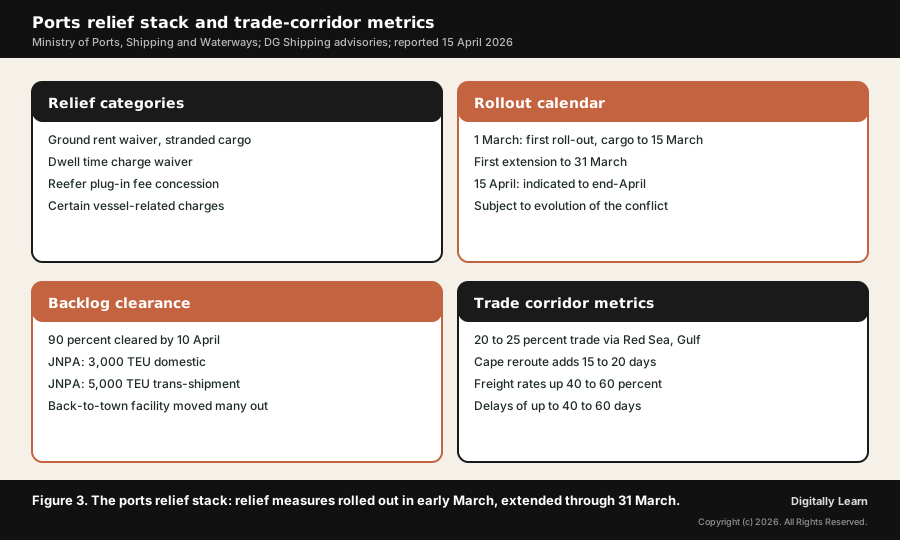
- (ii) Multilateral forecast revision. The World Bank’s FY27 projection of 6.6 percent is an upgrade from its October 2025 reading of 6.3 percent, yet sits below the RBI’s 6.9 percent. It marks a deceleration from FY26’s 7.6 percent, which the Bank attributed to conflict-driven energy and trade disruption, with industrial activity expected to slow and remittance risk running through the 38-percent-Gulf-share channel.
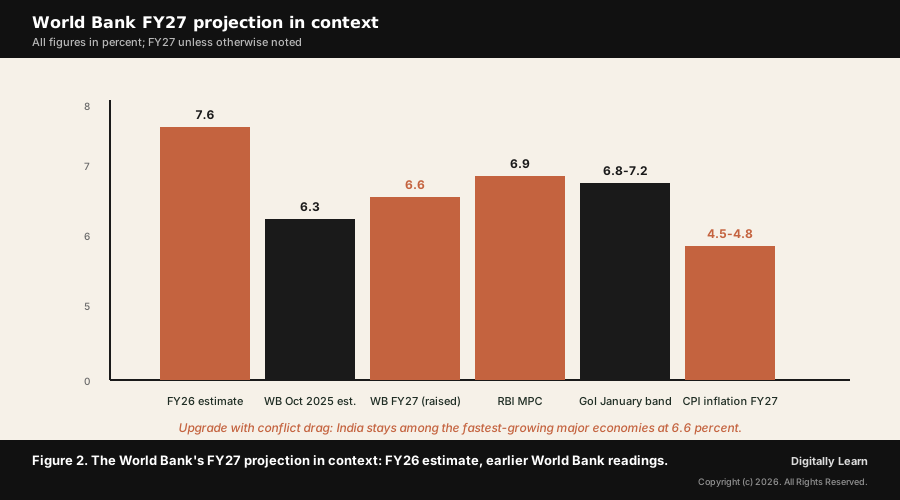
- (iii) Ports-level operational relief. The Ministry first rolled out waivers on 1 March for cargo affected till 15 March, extended to 31 March, and, on 15 April, indicated a further extension to end-April. The Directorate General of Shipping issued advisories to ensure transparent pass-through of concessions and to flag concerns over diversion fees and war-risk premiums.
Why these three readings matter together
From industry stress to policy instruments, with MSMEs in the middle
Why it matters: The three readings are not parallel; they are a single transmission line. The industry-stress signal from CII feeds the case for instruments such as the credit guarantee and refinance window; the multilateral forecast sets the macro frame within which those instruments are calibrated; and the port-level relief converts the macro frame into immediate operational support. MSMEs sit at the centre of every layer, since the sector contributes about 36 percent of manufacturing output and roughly 45 percent of exports according to the Ministry of MSME.
The MSME-to-large-factory channel: The CII's emphasis on MSMEs is structural, not rhetorical. Many large factories source raw materials and ancillary inputs from MSMEs; stress in the smaller layer therefore feeds into final-output schedules, with second-round effects on order books, employment, and tax collections. The proposed three-month moratorium with calibrated flexibility in asset-classification rules (Special Mention Account and Non-Performing Asset recognition) is intended to keep otherwise-viable MSMEs from being classified as stressed during the disruption window. The CII also asked for extending delivery timelines for central and state public sector unit contracts by 3 to 4 months without invoking liquidated damages, plus reduced performance bank guarantee and security deposit requirements for the same reason.
Why the World Bank's number matters: The Bank's 6.6 percent FY27 projection is an upgrade from its October 2025 reading of 6.3 percent, lifted on strong domestic demand and resilient exports, yet it sits below the RBI's 6.9 percent and marks a deceleration from FY26's 7.6 percent. The Bank framed the West Asia war as the dominant downside risk that capped the upside rather than as a structural downgrade of India's growth story; it is best read as a measurement of imported geopolitical drag on an otherwise improving path. The Bank underlined that India would remain among the world's fastest-growing major economies, supported by robust foreign exchange reserves, predominantly domestically held public debt, a well-capitalised banking system, low inflation, and net energy imports at only about 2.8 percent of GDP.
Significance for India's growth path through FY27
World Bank framing of exogenous shock against domestic buffers
What is the significance of this industry-response stack: The April readings carry three implications for the UPSC-CSE economy syllabus that aspirants should be able to articulate without confusion. The first is the doctrinal framing of the shock as exogenous and energy-driven, not as structural weakness, with the World Bank still raising its FY27 number even as the conflict capped the upside. The second is the multilateral comparison: India remains among the fastest-growing major economies. The third is the two-track instrument map, with the CII ask sitting on the immediate-relief side and the structural reforms on the medium-term side.
- (i) Exogenous-shock framing. Analysts framed the World Bank reading as a geoeconomic recalibration arising from sustained 90 to 100 US dollars per barrel oil priced into FY27, not from fundamental weaknesses; a common rule of thumb is that every 10 percent rise in oil prices shaves roughly 30 basis points off GDP. The headwinds are widely read as transient and concentrated in the near term, leaving room for stronger momentum if conditions stabilise.
- (ii) Comparative-resilience reading. The Bank’s South Asia Economic Update projected the South Asia region to slow to 6.3 percent in 2026 from 7 percent in 2025, and to recover toward 2027. India remains the regional mainstay, with the Bank stating that even at the 6.6 percent projection, India would remain among the fastest-growing economies globally.
- (iii) Two-track instrument map. The CII ask is the immediate-relief track: liquidity, moratorium, duty waivers, contractual easing. The World Bank’s policy emphasis sits on the medium-term track: private-sector-led growth, business-enabling environment, regulatory predictability, and state capacity. Mains answers should distinguish the two without collapsing them into one undifferentiated reform list.
Cross-sector slowdown the Bank flagged: The Bank's India Development Update reported that industrial activity was expected to slow in 2026-27, with manufacturing in electronics, automobiles, and other tradable goods propping up overall growth. Higher input costs and decreased export demand from the Gulf region would weigh on industrial growth, while business services would absorb global slowdown effects and food and accommodation services would face higher input costs, particularly from LPG. The Bank also noted that energy-source diversification and policy buffers provide some insulation, but persistently high global energy prices would eventually translate into higher retail inflation and weigh on overall growth.
Distinguishing features of the April industry response
Five features that set this response apart
Toolkit architecture: The April industry response is best read as a matrix of demand-side asks from CII mapped to supply-side instruments held by the Government and the RBI. The table below maps each CII demand to the institutional counterparty and the operational instrument.
| CII demand | Counterparty | Operational instrument | Reference |
|---|---|---|---|
| Credit guarantee scheme for MSMEs and exporters | Government of India | Government-backed guarantee; collateral-free working capital | CII Sunday statement, 5 April 2026 |
| Three-month moratorium plus restructuring window | Reserve Bank of India | Calibrated flexibility in SMA and NPA classification rules | CII statement, 5 April 2026 |
| Special refinance window for small businesses | Reserve Bank of India | Refinance to banks and NBFCs at concessional cost | CII statement, 5 April 2026 |
| Customs duty cut on energy inputs (LNG waiver) | Ministry of Finance, Department of Revenue | Temporary waiver of 2.5 percent customs duty on LNG | CII statement, 5 April 2026 |
| PSU contract delivery timelines extended 3 to 4 months | Ministry of Finance and state PSUs | No liquidated damages; lower performance guarantees | CII statement, 5 April 2026 |
| Multilateral growth projection | World Bank Group | FY27 raised to 6.6 percent (from 6.3 percent in October 2025) | India Development Update, 9 April 2026 |
| Port-level relief for stranded export cargo | Ministry of Ports, Shipping and Waterways | Ground rent, dwell time, reefer plug-in and vessel charge waivers | Ministry of Ports relief, reported 15 April 2026 |
Distinguishing features: Five features set this industry-led response apart from the macro-data thread that runs in parallel, and bear directly on Mains framing:
- (i) Demand-side voice routed institutionally. The CII statement is the structured industry voice; aspirants should treat it as the formal lobbying channel, not informal commentary. The MSME-share statistics (36 percent of manufacturing output, 45 percent of exports) are sourced to the Ministry of MSME, giving the ask a statistical footing.
- (ii) Exogenous-shock doctrine in the multilateral text. The World Bank raised its FY27 number even while flagging the conflict as the dominant downside risk, treating the war as a cap on the upside rather than a structural decline. That framing, an upgrade tempered by geopolitical drag, is the doctrinal line; Mains answers should quote it rather than the headline number alone.
- (iii) Operational relief at terminal level. The ports relief is the first instance of terminal-level operational concessions being explicitly extended through a war-disruption window in this cycle. Sarbananda Sonowal, Union Minister for Ports, Shipping and Waterways, directed authorities to pass on financial relief directly to exporters without procedural delays and warned against profiteering, placing the concession within administrative discipline.
- (iv) Differentiated FY26 versus FY27 reading. The Government’s internal assessment on 14 April kept FY26 growth largely insulated at 7.6 percent while estimating that the situation could shave 0.3 to 0.4 percentage points off FY27 if prolonged. Aspirants must hold the two financial years separately when constructing answer arithmetic.
- (v) Coordination layer: DGS plus port authorities. The Directorate General of Shipping issued fresh advisories on transparency in shipping charges and flagged diversion fees and war-risk premiums as documentation areas to be disclosed and justified. That coordination layer between port authorities and the DGS is itself a feature of the April response.
Observable outcomes the April response is producing
Cargo clearance, freight cost movement, and contract pipeline
Observable outcomes: The April response is already converting into measurable operational outcomes at the ports and on freight corridors. Five outcomes can be tracked through the rest of the financial year, each mapping to a different policy layer.
- (a) Cargo backlog cleared to about 90 percent. A government statement of 10 April indicated that nearly 90 percent of backlog cargo at major ports had been cleared following coordinated intervention. The extension of concessions through end-April supports the remaining cargo plus any fresh consignments affected by ongoing disruptions.
- (b) Transit-time and freight-cost impact tracked. Industry estimates put the Cape of Good Hope reroute at 15 to 20 days additional transit, with freight rates on key corridors up 40 to 60 percent; insurance premiums and delays of up to 40 to 60 days compound the drag. JNPA alone was saddled with 3,000 TEU domestic plus 5,000 TEU trans-shipment cargo facing rerouting.
- (c) Contract pipeline rebuilding. If the CII’s three-month moratorium and PSU-contract timeline extension asks are taken up, the immediate pressure on MSME order books eases; if they are not, the Special Mention Account to NPA recognition pipeline will begin to register stress later in the year. The trackable outcome is the share of MSME loans that move from standard to SMA-1 in successive RBI Financial Stability Reports.
- (d) Forecast triangulation downstream. The World Bank’s 6.6 percent for FY27 will be triangulated against the RBI’s 6.9 percent and the Government’s January 6.8 to 7.2 percent; subsequent updates from the Asian Development Bank and the International Monetary Fund will refine the range. Aspirants should track convergence or divergence in successive releases.
- (e) Pass-through risk on auto fuels. A government official cited by the financial press flagged that if the average oil price stayed at 80 to 90 US dollars, there was nothing to worry about, but if the conflict ran for three to four months or more, some retail-level pass-through could become necessary. The excise-duty cut announced in late March is the buffer that may narrow further.
Contemporary linkages
How the April industry response threads into the broader macro file
Contemporary linkages: The April industry response is one node in the multi-front 2026 macro file. Aspirants must connect it to the sibling readings authored on this site so that exam answers carry the full transmission line rather than a single point.
- (i) West Asia macro slowdown reading. The May 2026 reading on the Index of Eight Core Industries, fertilizer subsidy escalation, and the Mint EM Tracker drop is the macro-data thread parallel to this industry-response thread. See the sibling West Asia macro slowdown briefing.
- (ii) Strait of Hormuz closure and energy security. The chokepoint that drives the ports-relief leg is read in full in the Strait of Hormuz briefing, including the route-rerouting and insurance-cost mechanics behind the freight-rate jump.
- (iii) RBI April forex playbook. The CII’s foreign exchange stability demand sits alongside the RBI’s own April playbook on the net-open-position cap on banks and corporate-treasury data call; see the RBI forex-lens briefing.
- (iv) LPG diversion and pharma supply chain. The propylene and propane diversion to LPG plus the IGoM-monitored vessel transit of Hormuz is the industrial-feedstock leg of the same shock that the CII ask flags. See the LPG-pharma briefing.
- (v) Operation Sindoor strategic backdrop. The economic readings sit alongside India’s strategic posture under the 28 February shock window; the Operation Sindoor briefing reads the security-doctrine response.
UPSC Relevance
Where this fits in the UPSC-CSE syllabus
Where it fits: This topic sits primarily under General Studies Paper III: Indian Economy, specifically growth, development and employment, government budgeting, effects of liberalisation on the economy, changes in industrial policy and their effects on industrial growth, and infrastructure: roads, ports, etc. It also touches GS-II through the multilateral-institution channel (World Bank Group) and GS-III internal security adjacencies through war-driven trade disruption.
For Prelims, the high-yield facts cluster across the CII institutional perimeter, the World Bank forecast arithmetic, the ports-relief stack, and the MSME-share statistics:
- Confederation of Indian Industry: industry-membership organisation; Director General Chandrajit Banerjee; the 20-step statement of 5 April 2026 covered targeted liquidity, credit facilitation, trade cost management, and foreign exchange stability.
- MSME architecture: 36 percent of India’s manufacturing output, 45 percent of exports, and the second-largest employer after agriculture per the MSME Ministry; Special Mention Account (SMA) and Non-Performing Asset (NPA) are RBI asset-classification categories.
- World Bank documents: South Asia Economic Update (8 April 2026) and India Development Update (9 April 2026); FY27 India forecast raised to 6.6 percent from 6.3 percent in October 2025, a deceleration from FY26’s 7.6 percent; South Asia region slowing to 6.3 percent in 2026 from 7 percent in 2025.
- Forecast triangulation: RBI MPC 6.9 percent; CPI inflation projected in the 4.5 to 4.8 percent range for FY27; industrial activity expected to slow; net energy imports about 2.8 percent of GDP.
- Ports relief stack: ground rent, dwell time, reefer plug-in, and vessel-charge waivers; first rolled out 1 March, extended to 31 March, then to end-April; 90 percent of backlog cargo cleared by 10 April; JNPA backlog 3,000 TEU plus 5,000 TEU trans-shipment.
- Operational metrics: Cape of Good Hope reroute adds 15 to 20 days; freight rates on key corridors up 40 to 60 percent; 20 to 25 percent of India’s merchandise trade moves through Red Sea and Persian Gulf routes; about 38 percent of remittances flow from Gulf labour markets.
- FY26 versus FY27 reading: FY26 growth largely insulated at 7.6 percent per Government internal assessment of 14 April; an extended conflict could shave 0.3 to 0.4 percentage points off FY27.
- Oil arithmetic: India imports about 85 to 90 percent of its crude requirement; the Indian crude basket averaged roughly 114 US dollars per barrel through April 2026 after spiking to about 146 US dollars on 18 March; sustained high prices are the main channel through which the conflict reaches retail inflation and the import bill.
- Directorate General of Shipping: issued advisories on transparent pass-through of concessions; flagged diversion fees and war-risk premiums as documentation areas; Sarbananda Sonowal, Union Minister for Ports, Shipping and Waterways, directed authorities to avoid procedural delays.
For Mains, three framings recur and should be drilled. First, industry lobbying as a structured channel: aspirants should describe how the CII's institutional statement converts industry stress into instrument-specific asks, with MSMEs at the centre of the proposal architecture. Second, exogenous shock versus structural growth: the World Bank raised its FY27 number to 6.6 percent while flagging the conflict as the dominant downside risk, so the answer must lead with the framing that India's underlying demand dynamics remain robust, with the war measured as geopolitical drag that capped the upside rather than fundamental weakness. Third, operational versus structural relief: the ports-relief stack is operational and time-bound, while the World Bank's policy emphasis on private-sector-led growth, business-enabling environment, and energy diversification sits on the structural side.
- Common Prelims trap. The World Bank’s 6.6 percent figure applies to India’s FY27, while the 6.3 percent for 2026 applies to the South Asia region. The two are distinct scopes (country versus regional aggregate) and distinct time bases (financial year versus calendar year). Mixing them is the frequent error.
- Common Mains trap. Treating the CII’s 20-step ask as a list of demands without mapping each demand to the specific Government or RBI instrument loses the institutional discipline. The doctrinal answer pairs each ask with its counterparty, as in the toolkit table above.
- Cross-cutting trap. The three-month moratorium for MSMEs is a CII proposal, not an announced policy; aspirants should describe it as an industry ask, not as an active scheme. The SMA-NPA flexibility would require RBI prudential-norm adjustments to take effect.
- Direction-of-change trap. The headline revision is an upgrade: the World Bank lifted FY27 to 6.6 percent from 6.3 percent in October 2025 on strong domestic demand. The conflict does not reverse that upgrade; it caps the upside and skews risks to the downside, with FY27 still a deceleration from FY26’s 7.6 percent. The doctrinal answer holds both ideas together: an upgraded forecast tempered by geopolitical drag, not an outright cut.
Previous Year UPSC-CSE Questions By the end you will be able to draft model answers for the following UPSC questions. Each question carries a collapsible framework showing how to approach it in the exam.
- UPSC Prelims 2021Which one of the following is likely to be the most inflationary in its effects?
How to approach this Prelims question
Approach: Rank the four options by the size of their direct money-supply impact. Creation of new money expands M0 directly and is the most inflationary; borrowing from banks crowds out private credit but is less inflationary; borrowing from the public is the standard non-monetary deficit-financing route; repayment of public debt is contractionary.
Trap to watch: Option (c) borrowing from banks looks similar to monetisation but is less inflationary because the new credit substitutes for private credit rather than expanding reserve money. Option (d) is the textbook most-inflationary because it directly expands high-powered money.
Key facts to recall:
- Creation of new money (monetisation) directly expands reserve money M0 and is therefore the most inflationary financing mode.
- Borrowing from the public via bonds finances the deficit without expanding money supply; broadly non-inflationary.
- Borrowing from banks expands deposit money but crowds out private credit, with a moderate inflation effect.
- Repayment of public debt absorbs liquidity from the system and is contractionary, not inflationary.
Answer signal: Option (d) Creation of new money to finance a budget deficit is the answer.
- UPSC Mains 2023 GS-IIIFaster economic growth requires increased share of the manufacturing sector in GDP, particularly of MSMEs. Comment on the present policies of the Government in this regard.
How to structure the answer in the exam
Introduction: Open with a one-line statement on the MSME architecture (36 percent of manufacturing output, 45 percent of exports per the MSME Ministry) and the April 2026 industry-stress signal sent through CII under the West Asia war shock.
Body (sub-themes to develop):
- Why MSME share matters: employment generation (second-largest employer after agriculture), backward linkages to large factories, and export competitiveness.
- Present policy stack: Production Linked Incentive (PLI) schemes for select manufacturing sectors, the Emergency Credit Line Guarantee Scheme (ECLGS) legacy, the Udyam registration push, and infrastructure access through PM Gati Shakti.
- Gaps that the April CII ask exposes: working-capital access for export-linked MSMEs, asset-classification flexibility during shocks, and contractual easing on PSU orders.
- World Bank-flagged constraints: slowing industrial activity in FY27, higher input costs from energy disruption, decreased export demand from the Gulf region.
Conclusion: Two-line synthesis arguing that present policies cover capital-investment and registration layers well but under-cover shock-period working-capital and contractual easing, areas where the April 2026 CII ask becomes the policy frontier.
Sources and Further Reading
- World Bank Group: India remains among the fastest-growing economies even as growth slows amid Middle East conflict (press release, 9 April 2026)
- Business Standard: World Bank raises India FY27 growth forecast to 6.6 percent amid headwinds (8 April 2026)
- Business Standard: CII 20-point agenda calls for coordinated response amid West Asia crisis (5 April 2026)
- LiveMint Economy: CII seeks urgent support as West Asia war-led supply chain crisis deepens (5 April 2026)
- LiveMint Economy: India's growth may slow to 6.6 percent in FY27 due to West Asia war, World Bank (8 April 2026)
- The Hindu Business: World Bank raises India's FY27 GDP growth projection to 6.6 percent, flags West Asia conflict (9 April 2026)
- LiveMint Economy: India to remain among fastest-growing economies in FY27 despite the West Asia war, World Bank (9 April 2026)
- LiveMint Economy: West Asia war, India FY26 growth to see limited hit, but oil price pass-through looms (14 April 2026)
- LiveMint News: Ports may extend export relief till April-end as shipping delays persist (15 April 2026)
- Confederation of Indian Industry: industry-membership organisation; press releases and policy briefs
- World Bank Group: India Development Update and South Asia Economic Update (April 2026)
- Reserve Bank of India: Monetary Policy Statement and prudential norms framework
- Ministry of Ports, Shipping and Waterways: major-ports administration and DG Shipping advisories
- Ministry of Finance, Department of Economic Affairs: customs duty notifications and PSU contracting circulars
- Ministry of Micro, Small and Medium Enterprises: MSME share of manufacturing output and exports
Editorial Disclaimer
This article is compiled from the reference materials listed in the Sources section. It is an explainer for UPSC preparation and is not a substitute for primary documents (NCERTs, GoI ministry releases, IMD bulletins, RBI / CEA / MoEFCC publications, and Standing-Committee reports).


