


Overview
Special Strategic Partnership
Modi and Meloni raise ties to a Special Strategic Partnership in Rome; Italy the first European state at this tier.
A Special Strategic Partnership in Indian diplomatic vocabulary is a tier of bilateral relationship above the generic Strategic Partnership, signalling intensified high-level political engagement, dedicated implementation mechanisms, and time-bound sectoral targets across defence, technology, trade, and energy cooperation. On 20 May 2026, in Rome, Prime Minister Narendra Modi and Italian Prime Minister Giorgia Meloni elevated bilateral ties from a Strategic Partnership (established 2023) to this Special Strategic Partnership tier, making Italy the second country after South Korea to reach this level with India.
Why this is in the news on 21 May 2026
The Rome summit and the headline outcome
On 20 May 2026, Prime Minister Narendra Modi held official talks with Italian Prime Minister Giorgia Meloni in Rome. Rome was the second leg of a five-nation tour that also covered Norway (the 3rd India-Nordic Summit), Sweden, Finland, and Iceland.
The leaders elevated India-Italy relations from the existing Strategic Partnership tier (signed in 2023) to a Special Strategic Partnership. This is the highest level the two nations have reached, and it makes Italy the second country, after South Korea (elevated in 2015), to hold a Special Strategic Partnership with India, and the first European state at this level.
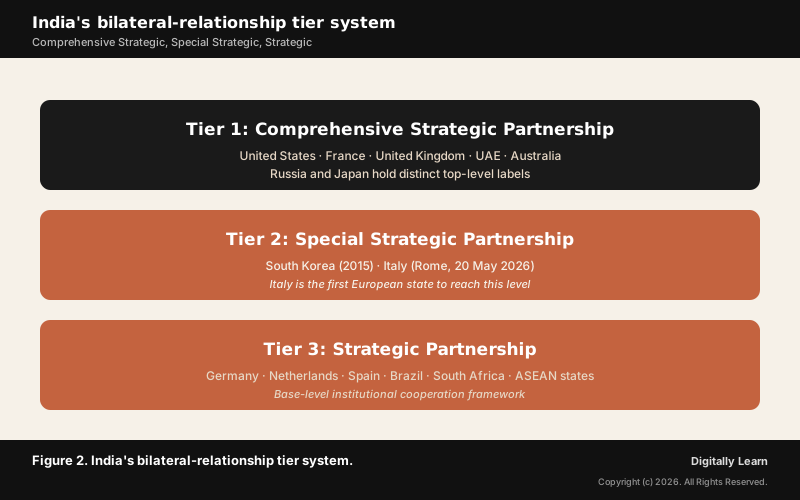
Definition: A Special Strategic Partnership in Indian diplomatic vocabulary sits above the generic Strategic Partnership and signals dedicated implementation mechanisms, time-bound sectoral targets, and high-level oversight. Each label India uses (Comprehensive Strategic, Special and Privileged Strategic with Russia, Special Strategic and Global with Japan, and Special Strategic) signals the institutional depth of engagement, the breadth of sectoral working groups, and the cadence of summit-level meetings.
Three headline outcomes define the Rome declaration:
- (i) Bilateral trade target of 20 billion euros annually by 2029, against current flows of approximately 14 billion euros.
- (ii) Memorandum of Understanding on critical minerals covering lithium, cobalt, and rare earths essential for electric vehicles, semiconductors, and renewable-energy hardware.
- (iii) Defence-industrial roadmap for co-design, co-development, and co-production of defence platforms, built on India’s Defence Industrial Corridor with Italy’s Leonardo and Fincantieri as institutional partners.
Why this elevation matters for India-EU bilateral architecture
India's tier-system diplomacy
Why it matters: India calibrates each bilateral relationship through a graded set of labels that signal institutional depth. The most intense is the Comprehensive Strategic Partnership, held with the United States, France, the United Kingdom, and the UAE, alongside the Special and Privileged Strategic Partnership with Russia and the Special Strategic and Global Partnership with Japan.
The Italy elevation places it at the Special Strategic Partnership level, the same tier South Korea has held since 2015, and the first time a European state sits at this level. The signal is intentional: Italy now ranks above the generic Strategic Partnership that Germany and the Netherlands occupy, and the partnership carries a dedicated five-year action plan rather than declaratory intent.
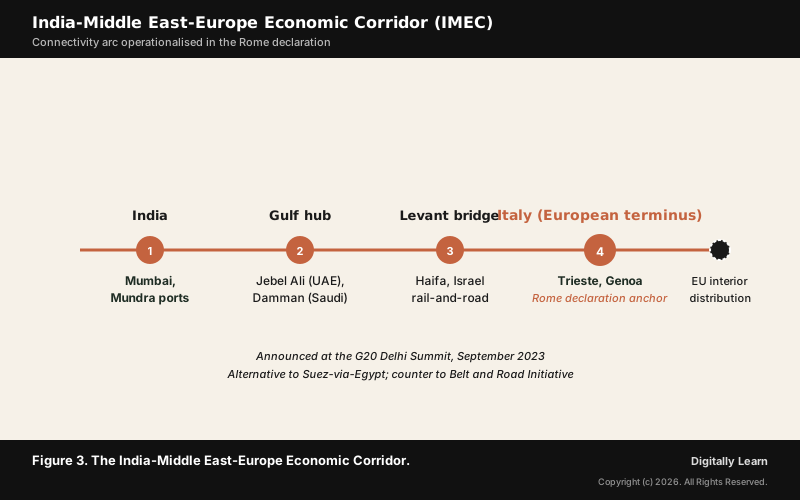
The elevation also matters because Italy is the principal Mediterranean terminus of the India-Middle East-Europe Economic Corridor (IMEC), announced at the September 2023 G20 Delhi Summit. The IMEC arc moves goods from India through the Arabian Sea to the UAE and Saudi Arabia, across the Israeli land bridge, and into Europe through Italy and Greece.
The Rome partnership operationalises Italy's role at the European terminus of this corridor, with the leaders calling for the first IMEC ministerial meeting in 2026. The arc bypasses the Suez-via-Egypt route and offers an alternative to Chinese-led Belt and Road connectivity through the Mediterranean basin.
Significance for India's wider European strategy
The significance of this elevation
What is the significance of this issue: The Rome elevation reflects three converging pressures on Indian external policy:
- (i) European Union architecture. India and the EU concluded their Free Trade Agreement in January 2026, now moving through ratification; the Italy partnership secures an EU-member-state ally with strong intra-EU influence on the agreement’s implementation and on chapters of mutual interest.
- (ii) Mediterranean security. Italian and Indian naval forces co-operate on Indian Ocean and Mediterranean anti-piracy patrols; the Italian carrier strike group led by ITS Cavour made a port call at Goa in October 2024 and held the first India-Italy carrier exercises off the Indian coast, deepening the maritime-domain partnership.
- (iii) Defence-industry depth. Italy hosts world-class defence companies (Leonardo, Fincantieri, Iveco Defence Vehicles) whose technology and integration capability the Indian defence-industrial ecosystem needs for the Make in India programme.
Structural reading: India has been systematically building a network of European bilaterals that run alongside the EU-as-a-bloc track. The 3rd India-Nordic Summit (Oslo, 19 May 2026) created a five-state minilateral. The Italy Special Strategic Partnership (Rome, 20 May 2026) consolidates the Southern European track.
France's Comprehensive Strategic Partnership has been intensified through Rafale, Scorpene submarine, and Jaitapur civil-nuclear projects. Germany's Strategic Partnership remains active through the Indo-German Strategic Dialogue. The pattern is a hub-and-spoke European architecture with India at the centre, and the concluded India-EU FTA moving to ratification in parallel.
Distinguishing features of the Rome declaration
The three pillars of the Rome declaration
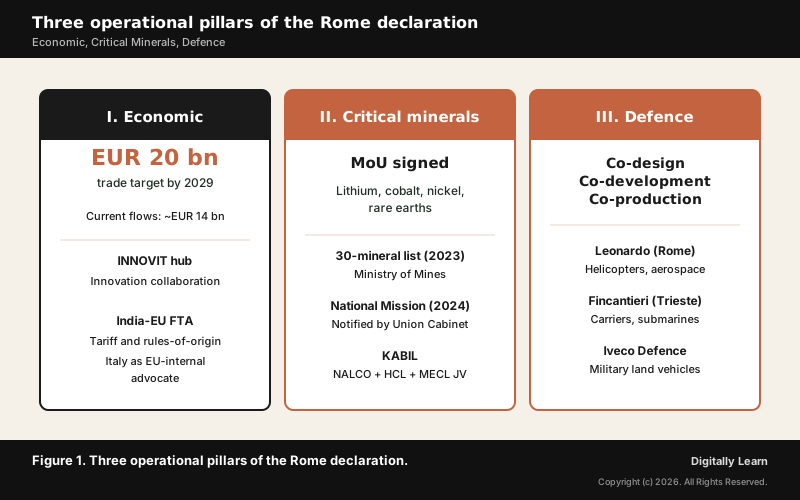
Distinguishing features: Three pillars give the Rome declaration its operational shape, with named instruments rather than generic intent.
- (i) Economic and trade pillar. The headline target is 20 billion euros of bilateral trade by 2029. The INNOVIT India technology hub anchors the innovation collaboration. The pillar rides on the broader India-EU Free Trade Agreement, concluded in January 2026, for the underlying tariff and rules-of-origin architecture, with Italy positioned as an EU-internal advocate during ratification and implementation.
- (ii) Critical-minerals and supply-chain pillar. A Memorandum of Understanding on critical minerals structures cooperation on lithium, cobalt, nickel, rare earths, and other strategic resources. The MoU sits within India’s wider critical-minerals strategy that the 30-critical-minerals list of 2023 and the National Critical Mineral Mission of 2024 underpin, alongside the Khanij Bidesh India Ltd (KABIL) overseas-acquisition vehicle.
- (iii) Defence and maritime pillar. A joint declaration of intent on a defence-industrial roadmap covers co-design, co-development, and co-production. Italy’s Leonardo and Fincantieri are positioned as integration partners with Indian defence public-sector undertakings and private-sector integrators. The pillar pairs with bilateral Maritime Security Dialogues that cover Indian Ocean and Mediterranean co-operation.
The India-Italy Special Strategic Partnership at a glance
| Partnership element | Detail | Significance |
|---|---|---|
| Summit date and venue | 20 May 2026, Rome | Reference date in India-Italy bilateral chronology |
| Leaders | PM Modi (India), PM Giorgia Meloni (Italy) | Heads-of-government level |
| Partnership tier | Special Strategic Partnership | Between Comprehensive Strategic and generic Strategic tiers |
| Predecessor tier | Strategic Partnership (2023) | Elevation reflects three years of intensified engagement |
| Bilateral trade target | 20 billion euros annually by 2029 | Against approximately 14 billion euros at present |
| Critical-minerals MoU | Lithium, cobalt, rare earths, supply-chain resilience | Grounded in the 30-critical-minerals list and National Critical Mineral Mission |
| Defence roadmap | Co-design, co-development, co-production | Leonardo, Fincantieri as Italian integration partners |
| Connectivity link | India-Middle East-Europe Economic Corridor (IMEC) | Italy as European terminus of the corridor |
| Broader European framework | India-EU Free Trade Agreement (concluded January 2026) | Italy as EU-internal advocate through ratification |
Observable outcomes to track
What to watch through 2029 in Indo-Italian relations
Observable outcomes: Six outcomes connect the Rome declaration to the broader India-Italy trajectory between now and 2029.
- (a) Trade-target trajectory. Bilateral trade volumes against the 20 billion euro by 2029 target, with annual milestones tracked through Department of Commerce data and Italian foreign-ministry data.
- (b) INNOVIT India hub. Operational launch timeline, initial cohort of partner institutions, and first research-collaboration announcements.
- (c) Critical-minerals MoU operationalisation. Specific joint ventures or off-take agreements signed under the MoU; involvement of KABIL and Indian private-sector miners.
- (d) Defence co-production projects. Specific Leonardo or Fincantieri platforms entering Indian co-production; integration with the Defence Industrial Corridors in Tamil Nadu and Uttar Pradesh.
- (e) IMEC operational milestones. Container-handling capacity built at Mediterranean ports (Trieste, Genoa) and inland connectivity into central Europe.
- (f) Italy’s EU-internal advocacy. Italian positions on India-EU FTA chapters (services, data, geographical indications, market access) as a leading indicator of agreement progress.
Wider European architecture and Indo-Pacific posture
How the Rome declaration connects to the EU FTA, IMEC, and the Indo-Pacific posture
Contemporary linkages: Three threads connect the Rome declaration to wider Indian external-policy currents. The first is the European bilateral architecture: France's Comprehensive Strategic Partnership, Italy's new Special Strategic Partnership, Germany's Strategic Partnership, and the India-Nordic minilateral together compose the European spoke-and-hub model.
The second is the Indo-Pacific posture: Italy's deepening Indo-Pacific engagement, advanced through its parliamentary fact-finding on the region and its 2024 carrier deployment, aligns with Indian framings on maritime security, freedom of navigation, and a rules-based order. The ITS Cavour carrier strike group's 2024 deployment and Italian participation in Indian-Ocean naval exercises operationalise the alignment.
The third is the connectivity track: IMEC operationalises Italy's role as the European terminus of the trans-Arabian corridor. The route is an alternative to the Suez-via-Egypt shipping lane and a strategic counter to China's Belt and Road Initiative.
UPSC Relevance
Where the partnership sits in the UPSC syllabus
UPSC context: The Rome declaration falls within General Studies Paper II under the head bilateral, regional and global groupings and agreements involving India and / or affecting India's interests, and under effect of policies and politics of developed and developing countries on India's interests. The topic also touches General Studies Paper III on the critical-minerals dimension under indigenisation of technology and developing new technology.
Prelims relevance: The Prelims surface includes the Special Strategic Partnership tier position, the 2023 prior Strategic Partnership with Italy, the 20 billion euro by 2029 trade target, the INNOVIT hub, and the India-Middle East-Europe Economic Corridor announced at the G20 Delhi Summit in September 2023.
Prelims also covers the 30-critical-minerals list of 2023, the National Critical Mineral Mission of 2024, Khanij Bidesh India Ltd (KABIL) as a joint venture of NALCO, HCL, and MECL, and the Italian defence-industrial partners Leonardo (Rome) and Fincantieri (Trieste).
Mains relevance: Three framings dominate the Mains-paper surface:
- (i) European-bilateral-architecture framing. How does India build a hub-and-spoke European network that complements the India-EU FTA concluded in January 2026, and what does the new Special Strategic Partnership tier signal in that network.
- (ii) IMEC operationalisation framing. How does the Rome declaration translate the September 2023 IMEC announcement into operational connectivity between India and Mediterranean Europe.
- (iii) Critical-minerals diplomacy framing. How does the Italy MoU sit within India’s wider critical-minerals strategy that the 30-mineral list and the National Critical Mineral Mission define.
Mains practice question: A focused fifteen-mark question would read: The May 2026 elevation of India-Italy ties to a Special Strategic Partnership is the latest instance of India's hub-and-spoke European bilateral architecture. Examine its economic, defence, and connectivity pillars with reference to the IMEC, the India-EU FTA, and the critical-minerals strategy.
A well-constructed answer would treat the three pillars, the IMEC operationalisation, and the EU-FTA leverage as the three spokes. The conclusion can frame the elevation as the Southern-European pillar of the spoke-and-hub model.
- Past Mains linkage. 2023 GS-II: ‘The expansion and strengthening of NATO and a stronger US-Europe strategic partnership works well for India.’ What is your opinion about this statement? Give reasons and examples to support your answer. The Rome declaration with Italy (a NATO and EU member) is the strongest contemporary example of how a stronger US-Europe-India alignment translates into bilateral architecture.
- Past Mains linkage. 2019 GS-II: ‘The long-sustained image of India as a leader of the oppressed and marginalised Nations has disappeared on account of its new found role in the emerging global order’ Elaborate. The shift from non-aligned posture to active partnership-tier architecture (Comprehensive Strategic / Special Strategic / Strategic) is the institutional evidence the question asks examinees to elaborate.
- Prelims linkage. Prelims questions on the G20 Delhi Summit and the IMEC announcement of September 2023 test the institutional surface that the Rome declaration sits within.
Previous Year UPSC-CSE Questions By the end you will be able to draft model answers for the following UPSC questions. Each question carries a collapsible framework showing how to approach it in the exam.
- UPSC Mains 2019 GS-II“The long-sustained image of India as a leader of the oppressed and marginalised Nations has disappeared on account of its new found role in the emerging global order” Elaborate
How to structure the answer in the exam
Introduction: Open with the 1955 Bandung Conference and 1961 NAM founding as the high point of India's leadership of post-colonial oppressed and marginalised nations, name the 1991 liberalisation and 1998 nuclear tests as the inflection points, and frame the elaboration through the four-decade trajectory to the present tier-system architecture.
Body (sub-themes to develop):
- NAM-era posture: 1955 Bandung Conference; 1961 Belgrade NAM founding; Panchsheel and India's positioning as a moral voice of the decolonising world.
- 1991 inflection: liberalisation, end of Cold War, Look East Policy (1991), Look West Policy, gradual shift to issue-based diplomacy.
- Post-2014 tier system: Comprehensive Strategic Partnership (US, France, UK, UAE), with Russia held as a Special and Privileged Strategic Partnership and Japan as a Special Strategic and Global Partnership; Special Strategic Partnership (South Korea since 2015, Italy from May 2026); Strategic Partnership (Germany, Netherlands, Spain, Brazil, South Africa).
- Minilateral architecture: Quadrilateral Security Dialogue, I2U2, India-Nordic Summit, IBSA, BRICS, India-CARICOM; institutional architecture beyond NAM-era multilateralism.
- Global-South trade-off: G20 Delhi Presidency 2023 (African Union admission, Voice of Global South Summit); the Rome declaration of May 2026 fits the strategic-partner tier architecture, not the NAM moral-voice framing.
Conclusion: Conclude that India's new role in the emerging global order is institutionally denser than the NAM-era posture, that the tier-system of bilaterals (Comprehensive Strategic, Special Strategic, Strategic) is the operative architecture, and that the Special Strategic Partnership with Italy at Rome on 20 May 2026 is the latest evidence of the shift the question asks examinees to elaborate.
The Rome elevation is the most recent and direct instance of the institutional evidence the 2019 question asks examinees to cite. The tier system of bilaterals (the three rings of Comprehensive Strategic, Special Strategic, and Strategic) is the operative architecture that has displaced the NAM-era moral-voice framing. The body sub-theme on the post-2014 tier system supplies the connection from the question to the article.
- UPSC Mains 2023 GS-II‘The expansion and strengthening of NATO and a stronger US-Europe strategic partnership works well for India.’ What is your opinion about this statement? Give reasons and examples to support your answer.
How to structure the answer in the exam
Introduction: Open with the post-Cold-War expansion of NATO from twelve to thirty-two members, the 2022 transatlantic re-alignment after the Ukraine conflict, and a one-line position: a stronger US-Europe strategic partnership works well for India provided strategic autonomy on Russia and on Indo-Pacific framings is preserved.
Body (sub-themes to develop):
- Reason 1: Lower strategic costs in the Indo-Pacific. A stronger US-Europe partnership translates into European Indo-Pacific Strategies (EU 2021, France 2018, Germany 2020, Netherlands 2020) and Italy's growing Indo-Pacific engagement that align with Indian framings on maritime security, freedom of navigation, and rules-based order.
- Reason 2: Bilateral architecture translates the alignment. France Comprehensive Strategic Partnership (Rafale, Scorpene, Jaitapur civil-nuclear); Italy Special Strategic Partnership (Rome, 20 May 2026); UK Comprehensive Strategic Partnership; Germany Strategic Partnership (Indo-German Strategic Dialogue). The Rome declaration is the most recent example.
- Reason 3: Connectivity dimension. IMEC announced at G20 Delhi Summit September 2023 connects India to Europe via Italy as the European terminus; this becomes operationally feasible only with a stable US-Europe-India alignment.
- Caveat 1: Russia and strategic autonomy. India's continued defence and energy ties with Russia, and abstentions in the United Nations General Assembly on Ukraine, indicate that a stronger US-Europe alignment cannot be unconditional.
- Caveat 2: Indo-Pacific framing differences. European powers diverge from US framings on China-balancing intensity; India's careful framing of strategic-autonomy provides space across both readings.
Conclusion: Conclude that a stronger US-Europe strategic partnership and NATO consolidation works well for India on the Indo-Pacific, bilateral-architecture, and connectivity tracks (Rome Special Strategic Partnership of May 2026 being the latest evidence), but that the alignment is most useful when India preserves strategic autonomy on the Russia and China-balancing tracks.
The Rome declaration with Italy (a NATO and EU member) is the most recent and most direct example of how a stronger US-Europe strategic alignment translates into Indian bilateral architecture. The body sub-theme on bilateral architecture supplies the European-spoke evidence the 2023 question asks examinees to provide.
Sources
- Ministry of External Affairs briefing on PM's Italy visit, May 2026
- Press Information Bureau release on India-Italy Special Strategic Partnership
- Government of Italy press readout on Modi-Meloni meeting
- India-Middle East-Europe Economic Corridor (IMEC) MoU, G20 Delhi Summit September 2023
- India-EU Free Trade Agreement negotiation framework
- Ministry of Mines: National Critical Mineral Mission and 30-critical-minerals list
- Wikipedia: India-Italy relations
Editorial Disclaimer
This article is compiled from the reference materials listed in the Sources section. It is an explainer for UPSC preparation and is not a substitute for primary documents (NCERTs, GoI ministry releases, IMD bulletins, RBI / CEA / MoEFCC publications, and Standing-Committee reports).


