


Overview
Strategic Partnership
Modi and Christodoulides elevated ties in New Delhi on 22 May 2026, signing six pacts and a defence roadmap.
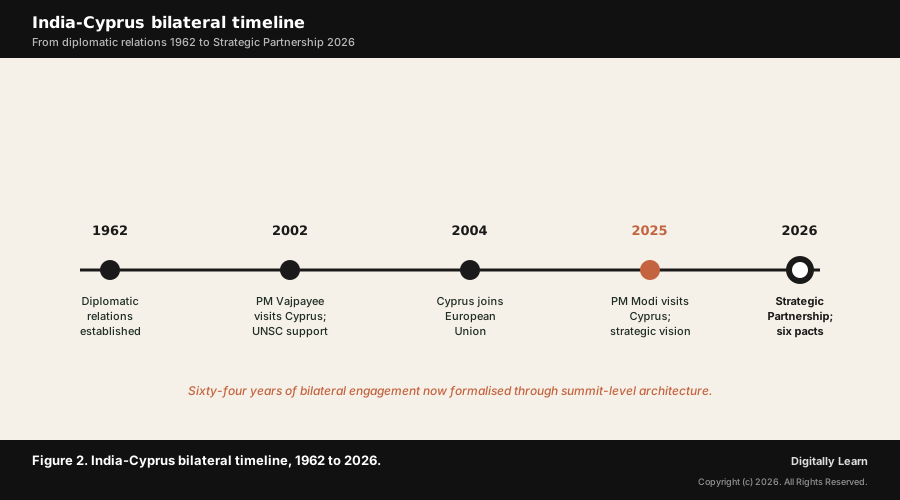
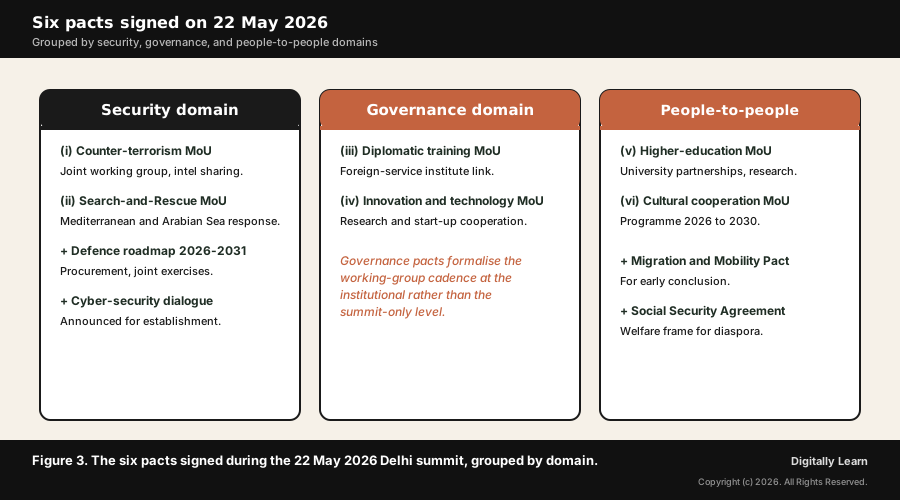
A Strategic Partnership in Indian diplomatic vocabulary is the base institutional tier of a structured bilateral relationship, formalised through summit-level meetings, sectoral working groups, and named cooperation roadmaps. On 22 May 2026 in New Delhi, Prime Minister Narendra Modi and Cyprus President Nikos Christodoulides elevated India-Cyprus bilateral ties to this Strategic Partnership tier and signed six cooperation pacts across counter-terrorism, diplomatic training, innovation and technology, search-and-rescue, higher education, and culture, alongside a five-year defence roadmap and a newly announced cyber-security dialogue.
Why this is in the news on 22 May 2026
The New Delhi summit and the headline outcomes
On 22 May 2026, Prime Minister Narendra Modi received Cyprus President Nikos Christodoulides in New Delhi for official bilateral talks. The visit followed PM Modi's June 2025 trip to Cyprus, which had been the first prime-ministerial visit from India to Nicosia in more than two decades.
The two leaders elevated bilateral ties to a Strategic Partnership, the formal institutional tier in India's diplomatic vocabulary. The elevation was framed against two coincident geopolitical conditions: Cyprus holds the rotating Presidency of the Council of the European Union from 1 January to 30 June 2026, and India and the European Union are negotiating a Free Trade Agreement after years of stalled engagement.
Definition: A Strategic Partnership in Indian practice sits at the base of a four-tier bilateral architecture. Above it sit the Special Strategic Partnership (Italy, since 20 May 2026) and the Comprehensive Strategic Partnership (France, the United Kingdom, the United States, Russia, Japan, and others). Each tier signals the cadence of summit meetings, the breadth of sectoral working groups, and the depth of defence and technology cooperation.
Six headline outcomes define the Delhi declaration:
- (i) Strategic Partnership upgrade and a five-year defence cooperation roadmap (2026-2031) with named working groups on procurement, training and joint exercises.
- (ii) Cyber-security dialogue announced for establishment as a formal track, alongside cooperation on maritime transport, space, and health.
- (iii) Counter-terrorism MoU setting up a joint working group, signed during the visit.
- (iv) Search-and-Rescue (SAR) coordination MoU for Mediterranean and Arabian-Sea response.
- (v) MoUs on diplomatic training, innovation and technology, higher education and research, and cultural cooperation (2026-2030).
- (vi) Migration and Mobility Partnership and a Social Security Agreement to be concluded “at the earliest”, consolidating the welfare frame for Indian professionals and students in Cyprus.
Why the Cyprus elevation matters for India's European architecture
Cyprus, IMEEC, and the EU Council presidency
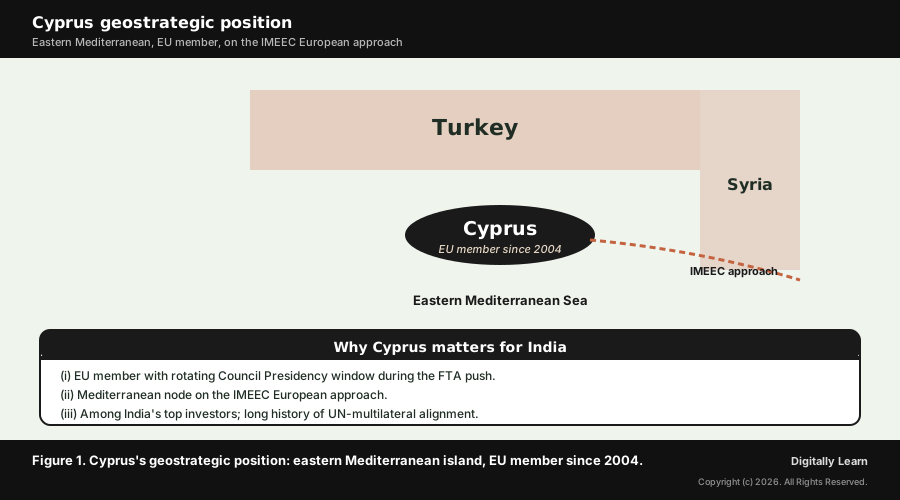
Why it matters: Cyprus is a small EU member state with an outsized strategic position. It sits in the eastern Mediterranean, close to Turkey and Syria, despite being geographically located in West Asia. Its membership of the European Union since 2004 gives India a friendly entry point into the Union's institutional and economic space.
The elevation lands at a sensitive moment for India-EU ties. The India-European Union Free Trade Agreement negotiations have re-accelerated after their 2013 collapse, and Cyprus holding the rotating Presidency of the Council of the European Union means it carries the agenda-setting baton inside the Council during this window. A friendly Council Presidency can move dossiers like the FTA, mobility partnerships, and digital-services cooperation more quickly through the EU machinery.
Cyprus also matters because it occupies a node on the India-Middle East-Europe Economic Corridor (IMEEC), announced at the September 2023 G20 Delhi Summit. IMEEC is designed to move Indian goods through the Arabian Sea to the United Arab Emirates and Saudi Arabia, across the West Asian land bridge, and into Europe through Mediterranean ports. Cyprus's geography puts it astride the maritime approach to that European terminus.
The Delhi declaration explicitly named the corridor: PM Modi committed to "work in tandem" with Cyprus on the Indo-Pacific Oceans Initiative and the IMEEC. The Cyprus President in turn framed Cyprus as the "gateway to Europe" for connectivity initiatives, drawing the corridor's European terminus onto Cypriot agenda.
Significance for India's wider European and Mediterranean strategy
How Cyprus serves three Indian objectives
What is the significance of this Strategic Partnership: The Delhi declaration carries weight across three converging tracks: the European trade architecture, the Mediterranean connectivity corridor, and the West Asian security balance.
- (i) European trade architecture. Cyprus holding the rotating EU Council Presidency offers India a sympathetic agenda-setter inside the Council. The India-EU Free Trade Agreement negotiations re-launched in June 2022 after a nine-year freeze, and a friendly Council chair can move closure-stage dossiers without procedural delay.
- (ii) Mediterranean connectivity corridor. The India-Middle East-Europe Economic Corridor announced at the G20 Delhi Summit in September 2023 needs reliable terminus states in Europe. Italy was elevated to a Special Strategic Partnership on 20 May 2026 precisely because of its role at the corridor’s European end. Cyprus, two days later, completes the Mediterranean-arc framing by adding an eastern-Mediterranean island gateway.
- (iii) West Asian security balance. Cyprus has a strained relationship with Turkey, which had backed Pakistan during the May 2025 Operation Sindoor cycle. The Delhi declaration therefore lands as a quiet hedge: India and Cyprus share an interest in restraining Turkish influence across the eastern Mediterranean and West Asian theatre.
Definition of IMEEC: The India-Middle East-Europe Economic Corridor is a connectivity initiative announced at the 9-10 September 2023 G20 Delhi Summit and signed by India, the United States, the United Arab Emirates, Saudi Arabia, the European Union, France, Germany, and Italy. The corridor combines an eastern shipping route from India to the Gulf and a northern rail-road route from the Gulf through Jordan and Israel to the Mediterranean, with ferry links to Europe through Italy and Greece.
Cyprus is not a signatory to the IMEEC memorandum of understanding, but its geography places it on the European approach. Bringing Cyprus into the strategic architecture insures the eastern leg of that approach against any disruption around the Turkish coast or the Suez chokepoint.
Distinguishing features of the 2026 Delhi declaration
India's four-tier bilateral architecture in one view
India's bilateral architecture: India ranks partner states across four named tiers. The table below maps each tier to its current roster and to the structural cadence of summit-level engagement, so aspirants can place the Cyprus 2026 elevation against the Italy 20 May 2026 elevation and the older Comprehensive Strategic Partnerships.
| Tier | Representative partners | Summit cadence | Working-group breadth |
|---|---|---|---|
| Comprehensive Strategic Partnership | United States, Russia, Japan, France, United Kingdom, United Arab Emirates, Australia | Annual or biennial summit-level meetings | Defence, technology, energy, trade, mobility, climate, multilateral coordination |
| Special Strategic Partnership | Italy (Rome elevation, 20 May 2026) | Annual summit + biennial review | Defence-industrial corridor, critical minerals, IMEEC terminus role, innovation |
| Strategic Partnership | Cyprus (Delhi elevation, 22 May 2026), Germany, Netherlands, Spain, Brazil, South Africa, ASEAN states | Periodic summit-level meetings; named sectoral roadmaps | Defence cooperation, counter-terrorism, cyber, mobility, education, culture |
| Named cooperation agreements (sub-strategic) | Various states with thematic MoUs | Issue-specific consultations | Single sector or thematic engagement |
Note: the Italy elevation to a Special Strategic Partnership tier is reported by the sibling 20 May 2026 Rome briefing on this site. The framing of a tier between Comprehensive Strategic and base Strategic reflects how India's Ministry of External Affairs has communicated the elevation publicly.
Three distinguishing features of the upgraded architecture
Distinguishing features: Three architectural moves separate the 2026 Delhi declaration from earlier high-level India-Cyprus engagements:
- (i) Named multi-year defence cooperation roadmap. The five-year roadmap covering 2026 to 2031 institutionalises procurement discussions, joint training, and exercise calendars. It opens space for Indian defence exports of platforms tested in Operation Sindoor, including drones and missiles, where Cyprus has expressed procurement interest.
- (ii) Cyber-security dialogue as a standing track. The two sides agreed to establish a cyber dialogue, moving the digital domain from ad-hoc consultation toward a formal structured track. It is designed to sit alongside the maritime-security and counter-terrorism tracks and to give the relationship a standing digital-domain pillar.
- (iii) Migration and Mobility Partnership in pipeline. A Migration and Mobility Partnership plus a Social Security Agreement are slated for early conclusion. These two instruments together codify protections for Indian professionals and students in Cyprus and formalise return-migration provisions.
Observable outcomes the partnership is expected to produce
Three trackable outcomes by 2031
Observable outcomes: The Delhi declaration sets up three trackable outcomes that should be visible by the end of the five-year horizon.
- (a) Doubling of Cyprus-origin investment into India over the next five years. Cyprus already ranks among India’s top investors on a cumulative basis since 2000. The Delhi declaration sets a new doubling target on top of the doubling that has already occurred over the past decade.
- (b) Conclusion of the Migration and Mobility Partnership and Social Security Agreement. Both instruments are scheduled for “early” conclusion. Their signing would put Cyprus in a small cohort of EU states with full mobility-and-welfare coverage for Indian professionals.
- (c) First Indian defence-platform exports to Cyprus. Cyprus has expressed procurement interest in drones and missiles tested during Operation Sindoor. The 2026-2031 defence roadmap is the formal vehicle through which any such procurement would be channelled, with deliveries expected within the roadmap window.
Contemporary linkages across India's diplomatic agenda
How this links to the wider 2026 diplomatic calendar
Contemporary linkages: The Cyprus elevation is the second strategic-tier upgrade with an EU member state inside seventy-two hours. On 20 May 2026 in Rome, PM Modi and Italian PM Giorgia Meloni signed off on the Special Strategic Partnership. On 22 May the Delhi declaration placed Cyprus at the base Strategic Partnership tier.
Read together, the Italy and Cyprus moves frame an explicit Mediterranean strategy built around the IMEEC corridor. The corridor needs reliable partner states at both the Western Mediterranean terminus (Italy) and the eastern Mediterranean approach (Cyprus). Two upgrades inside one week is not coincidence but architecture.
The elevation also links to the broader India-European Union Free Trade Agreement push, the third India-Nordic Summit held in Oslo on 19-20 May 2026, and the September 2023 G20 Delhi Summit IMEEC announcement. The cumulative effect is a tightened India-Europe institutional surface during the very window when the EU Council Presidency rotates to a friendly capital.
UPSC relevance and exam focus
Where this fits in the UPSC-CSE syllabus
Where it fits: This topic maps directly to General Studies Paper II: International Relations, specifically Bilateral relations with countries and India and the Indian diaspora. It also touches General Studies Paper II: Effect of policies and politics of developed and developing countries on India's interests.
For Prelims, the high-yield facts are: the bilateral tier name (Strategic Partnership), the date (22 May 2026), the named pacts (six), the defence roadmap window (2026-2031), the IMEEC linkage, and the Cyprus EU Council Presidency rotation. The Strategic Partnership tier sits below the Special Strategic Partnership tier created two days earlier with Italy.
For Mains, two framings recur. First, what Cyprus offers India inside the EU when the Council Presidency rotates to it during the India-EU Free Trade Agreement push. Second, how IMEEC's European-end partner states (Italy, Cyprus) reshape India's Mediterranean strategy as a hedge against the Suez chokepoint and the Belt and Road Initiative.
Recurring linked concepts that an aspirant should keep in working memory:
- India’s four-tier bilateral architecture: Comprehensive Strategic Partnership, Special Strategic Partnership, Strategic Partnership, and named cooperation agreements.
- IMEEC signatories: India, the United States, the United Arab Emirates, Saudi Arabia, the European Union, France, Germany, and Italy (8 September 2023, G20 Delhi).
- India-EU Free Trade Agreement: negotiations launched 2007, frozen 2013, resumed June 2022 under the India-EU Trade and Technology Council framework.
- Cyprus EU presidency: rotating Council Presidency held in six-month cycles.
Common Prelims trap: The Strategic Partnership signed on 22 May 2026 is the base tier in India's tier system, not the top. Italy at the Special Strategic Partnership tier (20 May 2026) sits a notch above; France, the United States, Russia, Japan and others at the Comprehensive Strategic Partnership tier sit at the top. Students often invert the hierarchy.
Common Mains trap: Avoid framing Cyprus as a peripheral EU state. The Council Presidency rotation, the IMEEC approach, the diaspora-mobility track, and the West-Asia security balance combine into a substantive bilateral file that punches above the country's economic size.
Previous Year UPSC-CSE Questions By the end you will be able to draft model answers for the following UPSC questions. Each question carries a collapsible framework showing how to approach it in the exam.
- UPSC Prelims 2017The term 'Domestic Content Requirement' is sometimes seen in the news with reference to
How to approach this Prelims question
Approach: Identify the policy domain in which the term originated, not the field where it superficially fits.
Trap to watch: All four options sound plausible because each carries a domestic-vs-foreign tension. The trap is to pick option (b) or (d) by association with the word 'Domestic'.
Key facts to recall:
- Domestic Content Requirements were prominent in the Jawaharlal Nehru National Solar Mission solar-cell procurement clauses.
- The WTO ruled against India's solar-cell Domestic Content Requirement in 2016 in the United States complaint.
- Connects to current 'critical minerals' and 'rare earth' supply-chain debates, which the India-EU FTA and Cyprus Council Presidency window inherit.
Answer signal: The term appeared in news during the WTO dispute over solar-panel sourcing under the National Solar Mission; option (a) is correct.
- UPSC Mains 2023 GS-II'The expansion and strengthening of NATO and a stronger US-Europe strategic partnership works well for India.' What is your opinion about this statement? Give reasons and examples to support your answer.
How to structure the answer in the exam
Introduction: One-line position on whether stronger US-Europe strategic architecture serves India's interests.
Body (sub-themes to develop):
- Why a stronger US-Europe partnership creates downstream openings for India (IMEEC corridor, India-EU FTA momentum, EU Council Presidency rotation through friendly capitals like Cyprus).
- Three concrete examples of India's gain (Italy elevation, Cyprus Strategic Partnership, Nordic Summit 2026).
- Costs and caveats (strategic-autonomy questions, Russia balance, escalation in Eastern Europe spillover).
Conclusion: Two-line synthesis arguing the architecture works well for India when treated as a portfolio choice, not a binary alignment.
Sources and Further Reading
- Indian Express: India, Cyprus upgrade ties to Strategic Partnership (22 May 2026 report)
- Ministry of External Affairs: India-Cyprus bilateral brief and joint declarations
- Ministry of External Affairs: official homepage and press-release index
- Press Information Bureau: India-Cyprus joint statement search portal
- Press Information Bureau: India-Middle East-Europe Economic Corridor (IMEEC) announcement at the G20 Delhi Summit
- Wikipedia: Cyprus-India relations (bilateral history since 1962)
- European Union: Council of the European Union institutional overview
- European Commission: India-EU Free Trade Agreement negotiations status
Editorial Disclaimer
This article is compiled from the reference materials listed in the Sources section. It is an explainer for UPSC preparation and is not a substitute for primary documents (NCERTs, GoI ministry releases, IMD bulletins, RBI / CEA / MoEFCC publications, and Standing-Committee reports).


