


Overview
Jag Vikram Leads India's Tankers
After a US-Iran ceasefire reopened Hormuz, the India-flagged Jag Vikram was the first vessel through
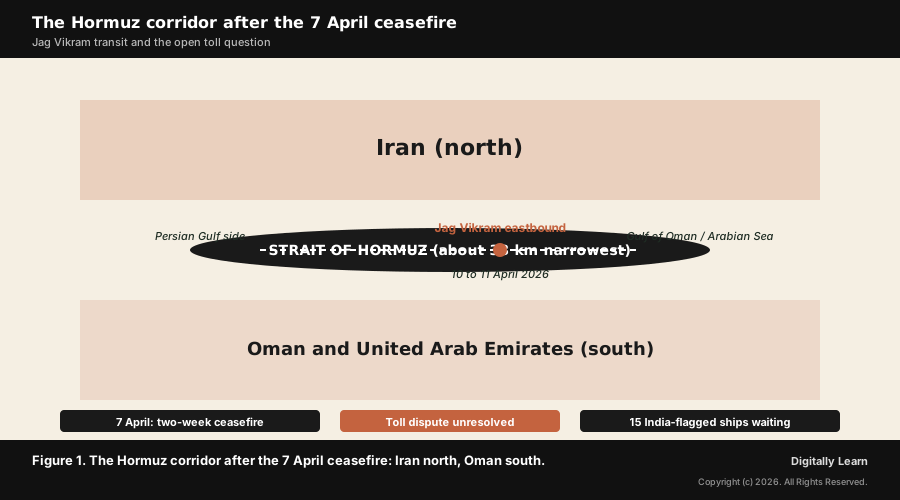
The Strait of Hormuz is the narrow maritime corridor between Iran and Oman that links the Persian Gulf to the Gulf of Oman and the Arabian Sea. About one-fifth of global oil and liquefied natural gas (LNG) flows transit through it. On 7 April 2026, the United States and Iran agreed to a two-week conditional ceasefire that included a reopening of the strait. Between Friday night 10 April and Saturday morning 11 April, the India-flagged LPG tanker Jag Vikram, owned by Great Eastern Shipping Company of Mumbai, became the first Indian vessel to transit the corridor after the truce, with about 15 India-flagged ships still awaiting safe passage.
Why this is in the news on 11 April 2026
Ceasefire, traffic buildup, and the first India-flagged transit
Trigger event: An India-flagged LPG tanker, Jag Vikram, crossed the Strait of Hormuz between Friday night 10 April 2026 and Saturday morning 11 April, becoming the first Indian vessel to transit the corridor since the United States and Iran announced a two-week ceasefire on 7 April. Ship-tracking data placed the tanker in the Gulf of Oman, east of the strait, by Saturday afternoon, proceeding eastwards toward an Indian discharge port.
Definition: The Strait of Hormuz is the narrow maritime corridor between Iran and Oman, connecting the Persian Gulf to the Gulf of Oman and the Arabian Sea. About 20 percent of global oil and LNG shipments pass through it in peacetime.
The strait is geographically narrow, and the chokepoint is therefore one of the most concentrated levers in international energy diplomacy. The April 2026 cycle reopened the corridor under a conditional ceasefire while leaving the toll-system question and the broader peace settlement still under negotiation.
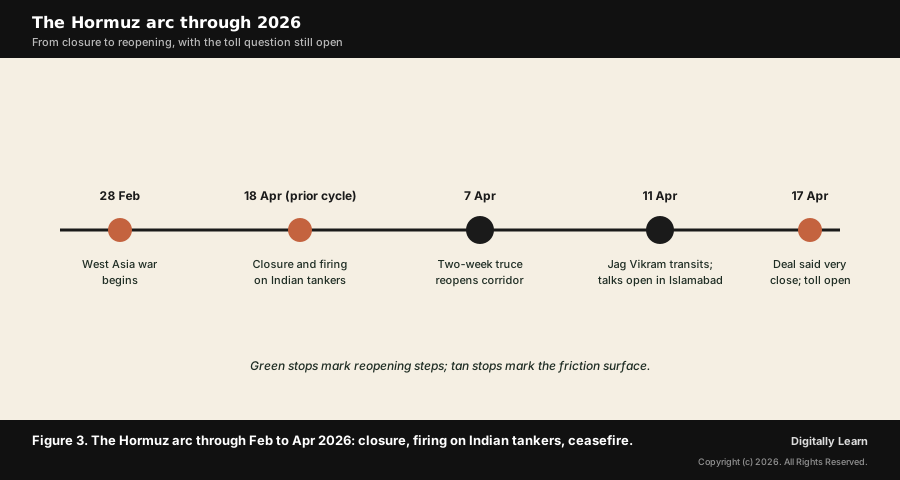
Three sequenced trigger events frame the 7 to 17 April window:
- (i) 7 April ceasefire: the United States and Iran agreed to a conditional two-week truce barely an hour before President Donald Trump‘s deadline expired. Tehran said it had agreed to safe passage in the strait; Iran’s Foreign Minister Abbas Araghchi said the passage would be possible via coordination with Iran’s Armed Forces and with due consideration of technical limitations.
- (ii) 8 to 10 April traffic-buildup talk: Trump said on Truth Social that the United States would help with the traffic buildup in Hormuz, suggested a US-Iran joint venture to run a proposed toll, and on 10 April told reporters the strait would reopen fairly soon. NATO Secretary-General Mark Rutte conveyed Trump’s demand for concrete commitments within days.
- (iii) 10 to 11 April Jag Vikram transit: the India-flagged LPG tanker owned by Great Eastern Shipping Company moved through the strait under the truce; it became the ninth India-flagged vessel to exit the Persian Gulf since early March, with about 15 India-flagged ships still awaiting passage.
Why this reopening matters for India
LPG exposure, vessel evacuation, and the legal status of the corridor
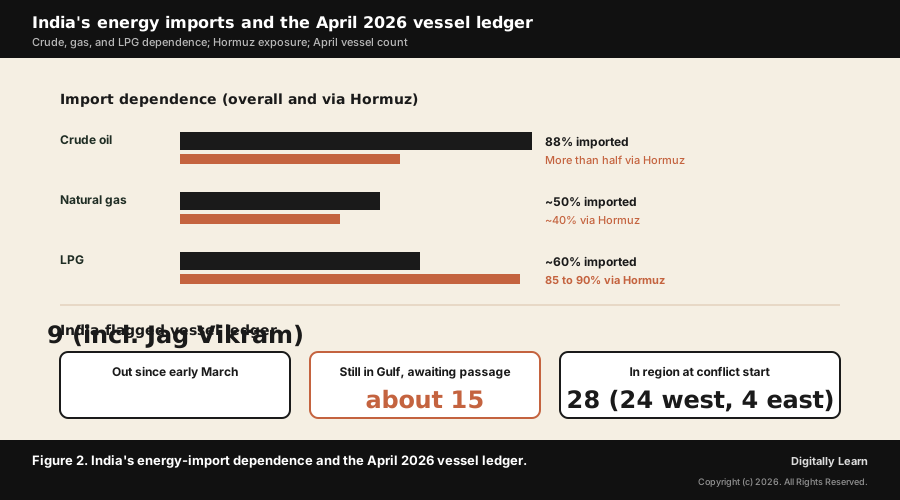
Why it matters: India is the world's third-largest energy consumer and fourth-largest gas user. The country imports about 88 percent of its crude oil, around half of its natural gas needs, and nearly 60 percent of its LPG requirement.
More than half of crude imports, about 40 percent of gas, and up to 85 to 90 percent of LPG shipments come from Gulf countries and pass through Hormuz. A reopening even on uncertain terms is therefore a direct relief for the household and commercial cooking-gas system.
The Jag Vikram transit is a vessel-level proof of life: Owned by Mumbai-based Great Eastern Shipping Company, the ship is a mid-sized gas carrier with a deadweight of over 26,000 tonnes, carrying about 20,400 tonnes of LPG and 24 seafarers on this run, and is expected to reach Mumbai on 15 April.
- About 88 per cent of India crude oil is imported.
- About 60 per cent of India LPG demand is imported.
- Approximately 85 to 90 per cent of LPG shipments transit the Strait of Hormuz.
The transit signals to underwriters, charterers, and the broader fleet that the corridor is again usable, even as 15 India-flagged ships remain inside the Gulf and a wider international fleet, including 426 tankers, 34 LPG carriers, and 19 LNG vessels per MarineTraffic data, stays in the region.
The legal status of the corridor is at stake: Iran has proposed a toll system to fund reconstruction; Trump has floated a US-Iran joint venture to operate it; the European Union has rejected the idea outright.
EU spokesman Anouar El Anouni said international law provides for the freedom of navigation, meaning no payment or toll whatsoever. For India, a paid-passage regime would set a precedent that other chokepoints could imitate, raising the cost of the entire seaborne energy bill.
Significance for India's energy-security strategy
Vessel-by-vessel resumption, sovereignty of the corridor, and the LPG lifeline
What is the significance of this Hormuz reopening for India: The reopening is not a binary on or off; it is a graded resumption being tested vessel by vessel under a fragile ceasefire. The cycle pulls three policy threads tight simultaneously: a near-term vessel evacuation thread that recovers stranded Indian ships, a medium-term sovereignty-of-the-corridor thread that turns on the toll dispute, and a longer-term LPG-lifeline thread that shapes household energy security.
Why it matters in policy terms: A toll regime, even one framed as a reconstruction levy, would convert a customary international waterway into a managed-access channel. India's exposure runs through the cooking-gas supply chain that millions of households rely on. The CGS distributor directive to prioritise piped gas for commercial users (hotels, restaurants, canteens) is the visible domestic-side proof of this dependence.
- (i) Vessel-by-vessel resumption is now the operative posture. The Jag Vikram transit is the ninth India-flagged ship out of the Gulf since early March; about 15 India-flagged ships still wait. The Shipping Ministry will continue diplomatic engagement to clear the residual stock under a graduated, insurance-cleared cadence.
- (ii) Sovereignty of the corridor is the underlying question. Iran’s proposed toll, Trump’s joint-venture suggestion, and the EU’s freedom-of-navigation pushback together expose a contest over who controls a strait used by many states. India’s posture aligns with the freedom-of-navigation principle on which its own seaborne trade depends.
- (iii) The LPG lifeline is now visible policy. Authorities curtailed LPG supplies to commercial users such as hotels and restaurants, before restoring about 70 percent of pre-crisis volumes through alternative sources. Natural-gas allocation to operating urea plants was restored to about 80 percent of recent average consumption, with overall allocation to the fertiliser sector lifted to roughly 95 percent.
Distinguishing features of the April 2026 reopening
Truce, transit, and the contested toll in one view
The graded April reopening: The 7 to 17 April window can be read as a sequence of confidence-building moves stitched together by an unresolved sovereignty question. The table below logs the dated steps.
| Date | Actor | Step | Outcome |
|---|---|---|---|
| 7 April 2026 | United States and Iran | Two-week conditional ceasefire announced | Reopening of the Strait included in the package |
| 8 April 2026 | Donald Trump (Truth Social) | Said the United States will help with traffic buildup | Floated US-Iran joint venture to operate a toll |
| 9 April 2026 | European Commission (Anouar El Anouni) | Said freedom of navigation means no payment or toll | Public EU rejection of Iran's toll proposal |
| 10 April 2026 | Trump | Said strait will open fairly soon; other countries to help | NATO SG Mark Rutte sought concrete commitments within days |
| 10 to 11 April 2026 | Great Eastern Shipping (Jag Vikram) | India-flagged LPG tanker transits the strait | Ninth Indian vessel out since early March; about 15 still awaiting |
| 11 April 2026 | VP J.D. Vance | Led US delegation to Islamabad for talks with Iran | Pakistan-mediated track formally opened |
| 17 April 2026 | Trump | Said Iran deal is very close; may go to Pakistan to sign | Tehran said the Strait would never return to previous status |
Distinguishing features: Three architectural features separate the April 2026 reopening cycle from a standard chokepoint-relief story:
- (i) A managed-access reopening, not a free-flow restoration. The truce reopens the corridor but Iran’s foreign minister conditioned safe passage on coordination with the Armed Forces and on technical limitations. Traffic remained extremely limited through most of the window despite the ceasefire.
- (ii) A toll proposal that turns the corridor into a sovereignty question. Iran’s reconstruction-fund toll, Trump’s US-Iran joint-venture floor, and the EU’s freedom-of-navigation rejection together stage a public legal dispute over how an international waterway is to be governed.
- (iii) An India-flagged tanker as the operational test case. The Jag Vikram transit is the first India-flagged crossing under the truce; it doubles as a market signal to underwriters and charterers about the corridor’s working risk profile.
Observable outcomes the cycle is producing
Vessel cadence, domestic LPG calibration, and the Islamabad talks
Observable outcomes: The reopening is producing three trackable outcomes for India through the second half of April.
- (a) Vessel evacuation cadence and stranded-ship ledger. The Jag Vikram brings Indian-vessel exits since early March to nine; about 15 India-flagged ships remain in the Persian Gulf. 28 India-flagged vessels were in the region when the conflict erupted, with 24 on the western side and 4 on the eastern side. Prior to Jag Vikram, eight western-side and two eastern-side vessels had managed to sail to safety. The cadence is now vessel-by-vessel, not fleet-wide.
- (b) Domestic LPG and gas calibration. India curtailed LPG supplies to hotels and restaurants during the disruption, then restored about 70 percent of pre-crisis volumes through alternative sources. Natural gas was cut to fertiliser plants; allocation to operating urea plants was restored to roughly 80 percent of recent average consumption, with overall fertiliser-sector allocation lifted to about 95 percent in the reporting week. City gas distributors were directed to prioritise piped natural gas for commercial users to shift demand away from LPG.
- (c) Pakistan-mediated US-Iran talks open. US Vice-President J.D. Vance led the US delegation to Islamabad on 11 April for talks with Iran; the White House later said it was in discussions about a second round. Trump on 17 April said the deal was very close and that he might travel to Pakistan to sign it, while Tehran said the Strait would never return to its previous status.
Energy-security Connections to recent briefings
Where the reopening sits inside the larger 2026 macro file
Contemporary linkages: The April reopening is one node in a sequenced chain that runs from the West Asia war start to the macroeconomic spillover and back through the supply-chain response, and it links forward to the toll-system and uranium negotiations under the Islamabad track.
- (i) The Hormuz closure cycle that preceded this reopening. The strait was effectively shut for weeks before the 7 April truce. The Iran Closes the Strait of Hormuz briefing covers that closure phase, the firing on India-flagged tankers, and the chokepoint geography in full.
- (ii) The macroeconomic spillover. The West Asia war’s growth and inflation pass-through is read separately in the West Asia war and India’s economic slowdown briefing, which tracks the FY27 cut and the inflation drift through the conflict window.
- (iii) The industry-led supply-chain response. The CII, World Bank, and Ports relief briefing tracks the policy-ask, the multilateral forecast, and the port-level operational relief that wrapped around the same conflict window.
UPSC Relevance
Where this fits in the UPSC-CSE syllabus
This topic sits at the intersection of General Studies Paper II: International Relations (India and the world, bilateral and multilateral relations, regional groupings) and General Studies Paper III: Internal Security and the External Sector (energy security, maritime security, sea lanes of communication, security challenges in border and coastal areas).
For Prelims, the high-yield facts cluster across the chokepoint geography, the truce sequence, and India's import composition:
- Strait of Hormuz: connects the Persian Gulf with the Gulf of Oman / Arabian Sea; carries roughly 20 percent of global oil and LNG shipments.
- Ceasefire: 7 April 2026, two-week conditional, with reopening of the strait part of the package.
- Jag Vikram transit: 10 to 11 April 2026; mid-sized LPG carrier; deadweight over 26,000 tonnes; cargo about 20,400 tonnes of LPG with 24 seafarers; owner Great Eastern Shipping Company (Mumbai); due at Mumbai on 15 April.
- Vessel ledger: 28 India-flagged ships in the region at conflict start (24 west, 4 east); 9 out since early March (including Jag Vikram); about 15 still awaiting passage.
- India’s import dependence: crude about 88 percent; natural gas about 50 percent; LPG nearly 60 percent. Hormuz carries more than half of crude, about 40 percent of gas, and 85 to 90 percent of LPG.
- Toll dispute: Iran proposed a toll for reconstruction; Trump suggested a US-Iran joint venture; the EU spokesman Anouar El Anouni said international law allows for no toll on freedom of navigation.
- Islamabad track: US delegation led by VP J.D. Vance on 11 April; on 17 April Trump said the deal was very close and may go to Pakistan to sign.
- Domestic calibration: LPG to commercial users curtailed then restored to about 70 percent of pre-crisis volumes; fertiliser-sector gas allocation lifted to about 95 percent.
For Mains, two framings recur. First, the India energy-security strategy under a graded reopening: how a country importing nearly 60 percent of its LPG (with 85 to 90 percent of LPG shipments via Hormuz) reads a vessel-by-vessel resumption as policy.
The 2017 GS-II Mains question on India's energy-policy cooperation with West Asia is re-examined here through the lens of corridor sovereignty. Second, the freedom of navigation question: the EU's rejection of a toll is grounded in the body of customary law that frames international waterways, and India's diplomatic posture has consistently aligned with that principle.
- Common Prelims trap. The Sumed pipeline connects the Red Sea to the Mediterranean and serves Europe-bound flows; it does not relieve India’s eastward route from the Persian Gulf. UPSC Prelims 2024 Q88 tests this exact geographic point.
- Common Mains trap. Treating the reopening as a binary on or off misses the policy point. The reopening is graded, conditional on coordination with Iran’s Armed Forces, and overshadowed by an open toll question. Answer scripts should read it as an evolving sovereignty contest.
- Cross-cutting trap. India’s domestic LPG calibration (curtailment of commercial supply, then restoration to about 70 percent) is the visible policy effect; substituting macro headlines without this household-level detail is the common slip.
PYQ Linkage
How this connects to past UPSC questions
How this links to PYQs: The reopening cycle activates two related past-year questions: a Prelims 2024 statement-pair on the Sumed pipeline that frames alternative routes, and a Mains 2017 GS-II question on India's energy-policy cooperation with West Asia. The Sumed pipeline is the Europe-bound alternative; for India, the Hormuz corridor itself remains the binding constraint. The Mains framework is provided below as a structured answer template.
Previous Year UPSC-CSE Questions By the end you will be able to draft model answers for the following UPSC questions. Each question carries a collapsible framework showing how to approach it in the exam.
- UPSC Prelims 2024Consider the following statements:
- Statement-I: Sumed pipeline is a strategic route for Persian Gulf oil and natural gas shipments to Europe.
- Statement-II: Sumed pipeline connects the Red Sea with the Mediterranean Sea.
Which one of the following is correct in respect of the above statements?
How to approach this Prelims question
Approach: Verify each statement separately, then test whether II is the causal mechanism behind I.
Trap to watch: All four options are plausible; rule out incorrect-pair options first, then confirm the explanatory link.
Key facts to recall:
- The Sumed (Suez-Mediterranean) pipeline runs through Egypt, connecting the Red Sea coast to the Mediterranean.
- It is a strategic alternative for Persian Gulf oil bound for Europe when Suez Canal capacity or chokepoint risk is a concern.
- Statement-II (the Red-Sea-to-Mediterranean connection) is the explanation for Statement-I (the strategic-route status for Europe-bound oil).
Answer signal: Both statements are correct and Statement-II explains Statement-I; option (a) is the answer.
- UPSC Mains 2017 GS-IIThe question of India's Energy Security constitutes the most important part of India's economic progress. Analyze India's energy policy cooperation with West Asian countries.
How to structure the answer in the exam
Introduction: One-line statement on India's heavy crude and LPG import dependence (88 percent crude, nearly 60 percent LPG, with 85 to 90 percent of LPG shipments via Hormuz) and the centrality of West Asia in that import basket, with the April 2026 Hormuz reopening as the topical lead-in.
Body (sub-themes to develop):
- Pillars of India-West Asia energy cooperation: long-term crude contracts with Saudi Aramco, Iraq, UAE, Kuwait; LNG offtake from Qatar; strategic petroleum reserve agreements; refinery joint ventures.
- Chokepoint vulnerability and corridor sovereignty: about 20 percent of global oil and LNG flows transit the Strait of Hormuz; the April 2026 reopening cycle exposed the question of who governs the corridor, with Iran's proposed toll, Trump's US-Iran joint-venture suggestion, and the European Union's freedom-of-navigation rejection on the record.
- Vessel-by-vessel resumption: the Jag Vikram transit on 10 to 11 April is the operational proof of life under the truce; about 15 India-flagged ships still await passage; the cadence is graduated and insurance-cleared.
- Strategic-autonomy diplomacy: simultaneous working relations with Iran, the Gulf monarchies, Israel, and the United States; alignment with freedom-of-navigation principle; consistent diplomatic engagement under the Islamabad track.
Conclusion: Two-line synthesis arguing that India's energy security must be read as a portfolio of supplier diversification, route diversification, corridor-sovereignty diplomacy, and household-level calibration of LPG and gas, not as a single Gulf relationship.
Sources and Further Reading
- The Hindu: Trump says U.S. will help with traffic buildup in Hormuz Strait (8 April 2026)
- The Hindu: EU slams Hormuz toll idea, urges unrestricted freedom of navigation (9 April 2026)
- The Hindu: Iran has no cards beyond Strait of Hormuz control, says Trump ahead of talks in Islamabad (10 April 2026)
- The Hindu: Trump says U.S. will have Strait of Hormuz open fairly soon (11 April 2026)
- The Hindu: LPG tanker Jag Vikram crosses Strait of Hormuz; first India-flagged vessel after Iran-U.S. ceasefire (11 April 2026)
- The Hindu: Trump says Iran deal very close, may go to Pakistan to sign (17 April 2026)
- Ministry of External Affairs: India and West Asia foreign-relation briefs
- Ministry of Petroleum and Natural Gas: India's energy security and import dependence
- International Maritime Organization: UNCLOS and freedom of navigation framework
- Wikipedia: Strait of Hormuz (chokepoint geography and shipping statistics)
- Wikipedia: Great Eastern Shipping Company (Indian shipping operator)
- Petroleum Planning and Analysis Cell (PPAC): Petroleum Statistics
Editorial Disclaimer
This article is compiled from the reference materials listed in the Sources section. It is an explainer for UPSC preparation and is not a substitute for primary documents (NCERTs, GoI ministry releases, IMD bulletins, RBI / CEA / MoEFCC publications, and Standing-Committee reports).


