


Overview
The May 2026 Slowdown Reading
Four institutional readings between 21 April and 5 May 2026 trace the war's drag on growth, prices, and the rupee.
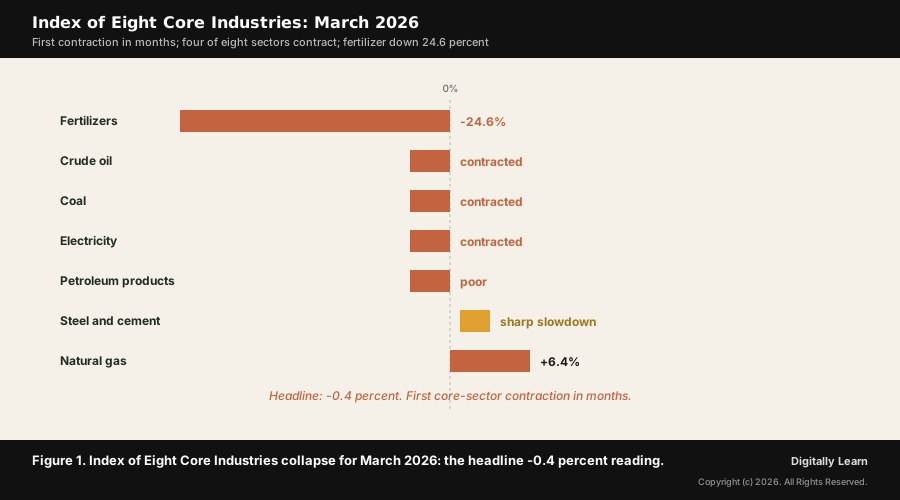
The West Asia war, which began on 28 February 2026, has accumulated four data signatures on India's economy by early May. The Index of Eight Core Industries contracted by 0.4 percent year-on-year in March 2026, its first contraction in months, with the fertilizer sector down 24.6 percent. The fertilizer subsidy bill reached 2.17 trillion rupees in FY26 and is projected at 2.05 to 2.25 trillion rupees for FY27. The rupee averaged 92.8 per US dollar in March (low of 94.8) and FPIs pulled about 1.8 trillion rupees from Indian equities. Nomura trimmed FY27 GDP growth to about 7.0 percent, against 7.6 percent estimated for FY26.
Why this is in the news on 5 May 2026
Four readings of the war land on India's economy
Trigger event: Between 21 April and 5 May 2026, four institutional readings of the West Asia war on India's economy accumulated in quick succession. The Hindu Editorial of 21 April flagged the Index of Eight Core Industries collapse for March. The RBI State of the Economy report on 24 April warned of a supply shock turning into a demand shock. The Finance Ministry Monthly Economic Review on 29 April tilted risks to the downside for growth and to the upside for inflation. The Mint Emerging Markets Tracker the same day showed India slipping three places to sixth. Together these readings frame the macro question for May.
Definition: The Index of Eight Core Industries measures the combined output of coal, crude oil, natural gas, petroleum refinery products, fertilizers, steel, cement, and electricity; it carries a 40.27 percent weight in the Index of Industrial Production. The Mint Emerging Markets Tracker, launched in September 2019, ranks twelve emerging-market economies on seven high-frequency indicators (real GDP growth, manufacturing PMI, export growth, retail inflation, import cover, exchange-rate movement, stock-market performance).
Four data readings define the May map of the war on India's economy:
- (i) Industrial output collapse. The Index of Eight Core Industries contracted 0.4 percent y-o-y in March 2026, its first contraction in months and the sharpest pullback since the previous year. Fertilizer output fell 24.6 percent, while coal, crude oil, petroleum products, and electricity all weakened. Manufacturing PMI fell to a near-four-year low, while Services PMI slowed to a 14-month low.
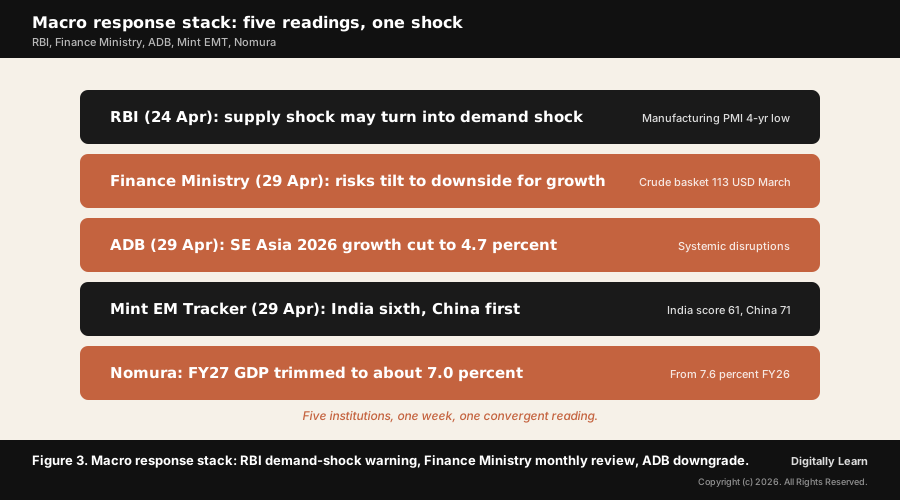
- (ii) Macro response stack. The RBI’s State of the Economy (24 April) warned that the supply crunch could turn into a demand shock; the Finance Ministry’s Monthly Economic Review (29 April) tilted risks to the downside for growth and to the upside for inflation; the Asian Development Bank held developing Asia and the Pacific at 5.1 percent for 2026 while cutting developing Southeast Asia to 4.7 percent for 2026.
- (iii) External-sector stress. The rupee averaged 92.8 per US dollar in March (low of 94.8 late March); FPIs pulled about 1.8 trillion rupees from Indian equities in March; merchandise exports contracted 7.4 percent y-o-y; Gulf shipments to Saudi Arabia and the UAE dropped as much as 58 percent (Nomura).
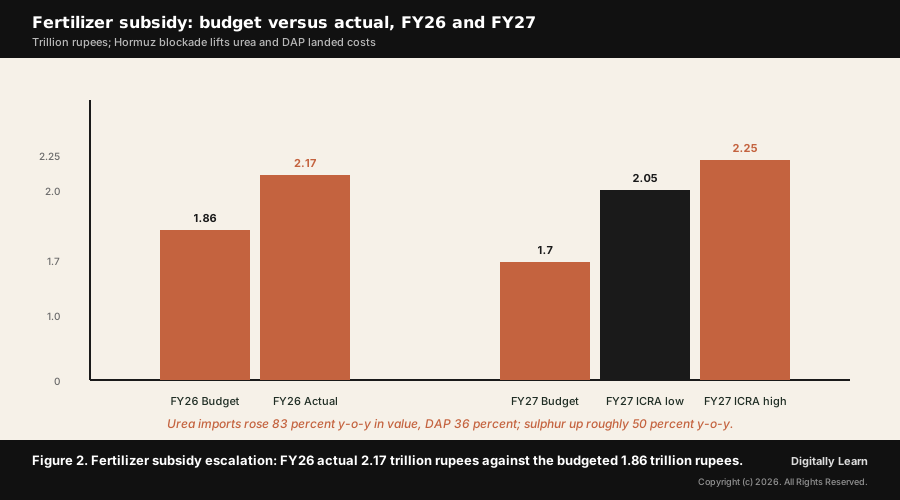
- (iv) Fertilizer-subsidy escalation. The FY26 subsidy bill reached 2.17 trillion rupees, exceeding the 1.86 trillion rupees revised allocation in the Union Budget. ICRA projects FY27 in the range of 2.05 to 2.25 trillion rupees; Crisil expects it to surpass 2.2 trillion rupees, more than 25 percent above the FY27 budget estimate of 1.7 trillion rupees.
Why these four readings matter together
Supply shock, demand shock, and import dependence
Why it matters: The four readings are not independent shocks. They trace a single transmission line from the West Asia war to India's domestic economy: an energy and feedstock supply shock feeds into industrial output, currency pressure, and fiscal stress, with each leg amplifying the next. India imports about 88 percent of its crude requirement, depends on West Asia for the bulk of LPG and natural gas, and runs a fertilizer sector where roughly half of DAP and a third of urea imports came from West Asia in FY25.
The supply-to-demand transmission: The RBI noted that high-frequency indicators showed divergent trends in March: automobile sales and GST collections held up, but Manufacturing PMI fell to a near-four-year low while cost pressures rose. Forward-looking surveys pointed to softening consumer confidence and moderation in business optimism. The central bank warned that the possibility of the supply crunch turning into a demand shock warrants careful and continuous assessment, a second-round effect that aspirants must distinguish from the first-order supply shock.
Why the fertilizer subsidy matters disproportionately: Agriculture and allied activities contribute 15.6 percent of national income and account for 46.1 percent of the country's workforce. India is the world's second-largest fertilizer consumer and the world's largest importer of DAP and urea. It imports 60 percent of its DAP needs and 15 percent of urea and NPK demand. The Hormuz blockade choked West Asian supply, driving urea import prices to 935 to 959 US dollars per tonne (more than twice FY26's average of 442 dollars per tonne) and sulphur up roughly 50 percent year-on-year to about 630 dollars per tonne. The IMD's prediction of an El Nino-impacted below-normal monsoon adds a second weight on rural demand.
Significance for India's macro file in FY27
Fiscal arithmetic, growth downgrade, and the LNG storage push
What is the significance of this slowdown reading: The May data carries three policy implications that map directly onto the UPSC-CSE economy syllabus: a fiscal-deficit risk as fertilizer subsidy outruns the budget estimate, a growth downgrade across multilateral and private forecasters, and a structural storage push on LNG to insulate against the next Hormuz-type chokepoint.
- (i) Fiscal-deficit arithmetic. The FY27 fiscal deficit is budgeted at 4.3 percent of GDP versus 4.4 percent in FY26. A fertilizer-subsidy overshoot of 2.05 to 2.25 trillion rupees against the budgeted 1.7 trillion rupees lifts borrowing pressure. Crisil’s Pushan Sharma expects the FY27 subsidy bill to surpass 2.2 trillion rupees, more than 25 percent above the FY27 budget estimate. Higher fertilizer subsidy widens the deficit unless revenue keeps pace, increasing market borrowing and crowding out infrastructure and capital expenditure.
- (ii) Growth downgrade triangulated. The ADB April 2026 outlook held developing Asia and the Pacific at 5.1 percent for 2026 while cutting developing Southeast Asia to 4.7 percent for 2026 and 4.8 percent for 2027; South Asia was eased to 6.3 percent for 2026 against 6.8 percent the year before. Nomura trimmed India’s FY27 GDP growth to about 7.0 percent y-o-y, against 7.6 percent estimated for FY26, citing fuel-supply spillovers. The Finance Ministry’s April Monthly Review tilted risks to the upside for inflation, fiscal and external deficits, and to the downside for growth.
- (iii) Structural storage push. India currently has 23 LNG tanks across various terminals; Petronet LNG alone holds 10. The Strait of Hormuz blockade stopped Persian Gulf LNG cargoes for over two months. Petronet’s CEO A K Singh signalled firm plans to expand cryogenic tanks by about 70 percent, adding four tanks at the Dahej terminal (currently 8 tanks), one at Kochi (currently 2), and two at the under-execution Gopalpur terminal. A new cryogenic tank takes at least three years to build from approval to commissioning.
Why China stayed first: On the Mint EM Tracker, China held the top rank with a score of 71 on the back of currency appreciation of 0.1 percent month-on-month in March and a smallest-decline-in-class equity-market correction of 1.6 percent. India scored 61, with merchandise exports contracting 7.4 percent year-on-year and the rupee weakening 2.3 percent. Vietnam climbed to second on the back of double-digit export growth. The divergence underlines that the West Asia shock is being defined by a country's exposure and resilience to oil and shipping routes, not by aggregate GDP scale.
Distinguishing features of the May macro response
Six institutional readings in one view
Toolkit architecture: The May response is not a single instrument; it is six institutional findings stacked on top of one another. The table maps each reading to the date, the source, and the headline finding.
| Reading | Date | Source | Headline finding |
|---|---|---|---|
| Index of Eight Core Industries | 21 April 2026 | The Hindu Editorial; MoSPI Index of Eight Core Industries | -0.4 percent y-o-y in March 2026; first contraction in months; fertilizer -24.6 percent |
| RBI State of the Economy report | 24 April 2026 | RBI Bulletin | Supply shock may turn into demand shock; Manufacturing PMI at near-four-year low; Services PMI at 14-month low |
| Finance Ministry Monthly Review | 29 April 2026 | Department of Economic Affairs, Ministry of Finance | Risks tilted to upside for inflation, fiscal and external deficits; downside for growth; crude basket 113 USD per barrel in March |
| ADB Asian Development Outlook (April 2026) | 29 April 2026 | Asian Development Bank | Developing Asia and the Pacific held at 5.1 percent (2026); developing Southeast Asia cut to 4.7 percent (2026) and 4.8 percent (2027); South Asia eased to 6.3 percent (2026) |
| Mint Emerging Markets Tracker | 29 April 2026 | Mint EMT March 2026 data | India slipped three places to sixth (score 61); China first (71); India exports -7.4 percent y-o-y; FPI outflows 1.8 trillion rupees |
| LNG storage expansion call | 5 May 2026 | Petronet LNG CEO A K Singh (Indian Express) | Cryogenic tank expansion of about 70 percent; new tanks require at least three years to build |
| Fertilizer subsidy update | 5 May 2026 | LiveMint; ICRA; Crisil | FY26 actual 2.17 trillion rupees against 1.86 trillion rupees budget; FY27 projected 2.05 to 2.25 trillion rupees against 1.7 trillion rupees budget |
Distinguishing features: Five features distinguish this reading of the West Asia shock from earlier cycles and bear directly on Mains framing of macro responses:
- (i) Multi-source triangulation. Four independent institutional readings (RBI, Finance Ministry, ADB, Mint EMT) within a single week converged on the same picture: supply-side stress with second-round demand risk. Aspirants should use this triangulation rather than a single source as evidence in answers.
- (ii) Resilience and exposure. The RBI emphasised strong macroeconomic fundamentals (rural automobile sales, GST, digital payments, e-way bills) even as core industries contracted. The official reading is not pure crisis: India is described as holding ground despite a major supply shock. The Mint EM Tracker confirms relative resilience by global EM comparison (India at sixth, not bottom).
- (iii) Currency cushion through regulatory action. The RBI’s NOP cap on banks (27 March) and the corporate-treasury data call (1 April) belong to a parallel regulatory thread, separately documented in the RBI forex sibling briefing. Treat that thread as the active currency-management leg complementing the macro readings above.
- (iv) Structural storage as a policy shift. Adding cryogenic LNG storage is the first major structural response since the war began, not an emergency measure. India’s strategic and commercial stockpiles cover crude oil, but hardly any LNG; the May call is to close that gap.
- (v) Fiscal-deficit channel newly visible. The fertilizer subsidy is now the channel through which the West Asia war reaches the Centre’s borrowing programme. Earlier supply shocks ran through CAD; this one runs through subsidy and CAD simultaneously, an unusually concentrated stress on fiscal stability.
Observable outcomes the May reading is producing
Subsidy outlay, growth revision, LNG capacity, currency drag
Observable outcomes: The May reading converts into five trackable outcomes across the financial year. Each maps to a different policy layer, from immediate fiscal accommodation to multi-year storage construction.
- (a) Subsidy outlay confirmed. The FY26 fertilizer subsidy at 2.17 trillion rupees has been ringfenced through tied-up imports of 3.8 million tonnes since 28 February, ensuring continuity of all grades of subsidised fertilizers. FY27 is being budgeted with a Crisil and ICRA range of 2.05 to 2.25 trillion rupees.
- (b) Growth revision triangulated downward. Nomura: FY27 GDP about 7.0 percent y-o-y, against 7.6 percent estimated for FY26. ADB: developing Southeast Asia 4.7 percent for 2026 (developing Asia and the Pacific held at 5.1 percent). Finance Ministry: risks tilted to the downside for growth.
- (c) LNG storage capacity to grow about 70 percent. Petronet LNG firm plan to add tanks across Dahej (currently 8, adding 4), Kochi (currently 2, adding 1), and Gopalpur (under execution, adding 2). Each cryogenic tank requires at least three years to build; the May call kicks off a multi-year programme.
- (d) External-sector drag persistent. Merchandise exports contracted 7.4 percent y-o-y in March; Gulf shipments to Saudi Arabia and the UAE dropped up to 58 percent; war-risk insurance premiums for Gulf shipping raised transaction costs on the Suez Canal route. The Nomura outlook expects pipeline price pressures to keep input costs rising faster than output prices, squeezing corporate margins if the conflict prolongs.
- (e) Pipeline-grid densification queued. Petronet flagged that several LNG terminals operate at sub-optimal capacity because pipeline connectivity is limited; densifying the gas-grid is the next structural lever after storage. Capacity use at terminals improves only when more consumers are linked through pipelines.
Contemporary linkages
How the May reading threads into the broader macro file
Contemporary linkages: The May reading is one node in a multi-front 2026 macro response. Aspirants must connect it to the earlier sibling readings authored on this site.
- (i) Strait of Hormuz closure and India’s energy security. About 60 percent of India’s LNG imports normally transit Hormuz; the closure made the LNG storage push physical, not theoretical. For the chokepoint architecture, see the sibling Strait of Hormuz briefing.
- (ii) RBI April forex playbook. The 27 March net-open-position cap on banks and the 1 April corporate-treasury data call describe the currency-management leg that runs alongside this reading; the 8 April MPC held the repo rate at 5.25 percent. See the RBI forex-lens briefing.
- (iii) LPG-pharma supply-chain cycle. The April propylene-and-propane diversion to LPG, the 11-chemical audit, and the IGoM-monitored vessel transit of Hormuz are the industrial-feedstock leg of the same shock. See the LPG-pharma briefing.
- (iv) Operation Sindoor strategic posture. The economic readings sit alongside India’s strategic response under the 28 February shock window; for the security reading, see the Operation Sindoor briefing.
UPSC Relevance
Where this fits in the UPSC-CSE syllabus
This topic sits primarily under General Studies Paper III: Indian Economy, specifically growth, development and employment, government budgeting, major crops and cropping patterns, issues related to subsidies, and effects of liberalisation on the economy. It also touches GS-II: Effect of policies and politics of developed and developing countries on India's interests through the West Asia war channel.
For Prelims, the high-yield facts cluster across the index, the subsidy arithmetic, the EM-tracker structure, and the LNG storage matrix:
- Index of Eight Core Industries: coal, crude oil, natural gas, petroleum refinery products, fertilizers, steel, cement, electricity; 40.27 percent weight in IIP; March 2026 reading -0.4 percent y-o-y (first contraction in months).
- Sectoral split March 2026: fertilizer -24.6 percent; coal, crude oil, petroleum products, electricity all contracted; steel and cement sharp slowdown; natural gas robust at +6.4 percent.
- RBI State of the Economy (24 April): Manufacturing PMI at near-four-year low; Services PMI at 14-month low (still expansionary); cost pressures and uncertainty took a toll on new orders.
- Finance Ministry Monthly Review (29 April): India’s crude oil basket averaged 113 US dollars per barrel in March, 115 US dollars in April through the 24th.
- ADB (April 2026 outlook): developing Asia and the Pacific held at 5.1 percent for 2026; developing Southeast Asia cut to 4.7 percent for 2026 and 4.8 percent for 2027; South Asia eased to 6.3 percent for 2026; ADB President Masato Kanda flagged systemic long-lasting disruptions.
- Mint Emerging Markets Tracker: launched September 2019; compares 12 EM economies on seven indicators; India sixth in March 2026 (score 61); China first (71); India exports -7.4 percent y-o-y, rupee -2.3 percent month-on-month.
- Nomura forecast: FY27 GDP growth trimmed to about 7.0 percent y-o-y, against 7.6 percent estimated for FY26, on fuel-supply spillovers; Gulf shipments to Saudi Arabia and UAE down up to 58 percent in March.
- Fertilizer subsidy: FY26 at 2.17 trillion rupees against budgeted 1.86 trillion rupees; FY27 ICRA range 2.05 to 2.25 trillion rupees against budgeted 1.7 trillion rupees; Crisil expects FY27 above 2.2 trillion rupees.
- Import dependence: India is the second-largest fertilizer consumer; imports 60 percent of DAP and 15 percent of urea and NPK; West Asia accounted for ~50 percent of FY25 DAP imports and ~33 percent of urea imports.
- Fertilizer prices: urea imports +83 percent y-o-y in volume at 442 US dollars per tonne (now 935 to 959 US dollars per tonne); DAP +36 percent at 732 US dollars per tonne; sulphur +50 percent at 630 US dollars per tonne.
- LNG matrix: India has 23 LNG tanks (Petronet 10); ~50 percent of natural gas demand met by LNG imports; ~60 percent of LNG imports transit Hormuz; one tank holds one shipload; India consumes about 1.25 tanks of LNG a day.
- Petronet expansion: cryogenic tanks to grow ~70 percent; Dahej 8 tanks (adding 4), Kochi 2 tanks (adding 1), Gopalpur 2 tanks under execution; each new tank requires at least three years.
- FY27 fiscal deficit: budgeted at 4.3 percent of GDP, versus 4.4 percent in FY26.
For Mains, three framings recur. First, supply shock turning into demand shock: the RBI's 24 April warning sets the analytical frame; Mains answers should distinguish the first-round supply hit (core industries, fertilizer prices, LNG outages) from the second-round demand compression (Manufacturing PMI fall, consumer-confidence softening, business-optimism moderation). Second, fiscal cushion against external shock: the fertilizer subsidy overshoot is the price India pays to insulate farmers from international price volatility; aspirants must weigh that against the fiscal-deficit constraint and the medium-term borrowing pressure. Third, structural resilience versus immediate relief: the LNG storage expansion takes at least three years to build, while the fertilizer subsidy is an immediate fiscal accommodation. The stronger answer distinguishes building absorptive capacity from cushioning the present.
- Common Prelims trap. The Index of Eight Core Industries carries an IIP weight of 40.27 percent, not 100 percent; the Index of Industrial Production has additional categories (manufacturing, mining, electricity grouped differently). Mixing the two indices is a frequent error.
- Common Mains trap. Treating the rupee depreciation as the structural problem misreads the cause. The rupee is a symptom of the combined oil-shock and FPI-outflow pressure; the structural problems are import dependence on West Asia (crude, LPG, LNG, fertilizers) and limited storage buffers. The answer must lead with the structural driver, not the headline number.
- Cross-cutting trap. The fertilizer subsidy and the food subsidy are separate budget heads. The fertilizer subsidy goes to input pricing (urea price-controlled, non-urea under the nutrient-based subsidy regime); the food subsidy goes to PDS off-take. Do not collapse them into a single subsidy bill.
- Direction-of-change trap. The ADB held developing Asia and the Pacific at 5.1 percent for 2026 and cut developing Southeast Asia to 4.7 percent; these are sub-regional figures, not India’s. ADB’s India-specific forecast eased to about 6.9 percent for FY2026. Nomura separately trimmed India’s FY27 growth to about 7.0 percent. These are distinct figures at different scopes; do not conflate them.
Previous Year UPSC-CSE Questions By the end you will be able to draft model answers for the following UPSC questions. Each question carries a collapsible framework showing how to approach it in the exam.
- UPSC Prelims 2022With reference to the Indian economy, consider the following statements:
- If the inflation is too high, Reserve Bank of India (RBI) is likely to buy government securities.
- If the rupee is rapidly depreciating, RBI is likely to sell dollars in the market.
- If interest rates in the USA or European Union were to fall, that is likely to induce RBI to buy dollars.
Which of the statements given above are correct?
How to approach this Prelims question
Approach: Verify each statement against the textbook direction of the RBI's instrument response: open-market operations, foreign-exchange intervention, and dollar reserves management.
Trap to watch: Statement 1 inverts the direction of open-market operations: high inflation prompts the RBI to sell (not buy) government securities to drain liquidity. The other two statements are textbook-correct.
Key facts to recall:
- Open-market operations: high inflation prompts the RBI to sell government securities, which absorbs liquidity from the banking system.
- Forex intervention: rupid rupee depreciation prompts the RBI to sell dollars from reserves to support the rupee, which is exactly what was visible in March 2026.
- Reserves management: when US or EU interest rates fall, dollar assets become less attractive abroad; the RBI may accumulate dollar reserves at these lower yields, which is consistent with the 'buy dollars' framing.
Answer signal: Statements 2 and 3 are correct; option (b) is the answer.
- UPSC Mains 2017 GS-IIIHow do subsidies affect the cropping pattern, crop diversity and economy of farmers? What is the significance of crop insurance, minimum support price and food processing for small and marginal farmers?
How to structure the answer in the exam
Introduction: Open with a one-line statement on India's fertilizer-subsidy architecture (urea price-controlled, non-urea under nutrient-based subsidy) and the May 2026 reading of 2.17 trillion rupees subsidy outlay under West Asia war conditions.
Body (sub-themes to develop):
- Effect on cropping pattern: heavy urea subsidy biases farmers toward urea-intensive crops (paddy, wheat) over pulses, oilseeds, and millets; the FY26 subsidy concentration on urea (urea imports +83 percent y-o-y in volume) entrenches this skew.
- Effect on crop diversity: input subsidies indirectly discourage diversification; coupled with MSP procurement concentration on paddy and wheat, the pattern reinforces a two-crop economy in the irrigated belt while rain-fed regions stay underserved.
- Effect on farmer economy: subsidies insulate input costs from global volatility (urea $442 to $935-959 per tonne, DAP +36 percent), but the cumulative overshoot above budget estimates across FY26 and FY27 sits at roughly 0.66 to 0.86 lakh crore rupees, which widens the fiscal-deficit channel.
- Crop insurance for small and marginal farmers: PMFBY transfers production-risk burden to insurance pools; matters more when an El Nino monsoon and a war shock co-occur as in 2026.
- MSP and food processing: MSP for paddy and wheat anchors a guaranteed-floor income; food processing connects small and marginal farmers to higher-value chains, reducing dependence on input subsidies alone.
Conclusion: Two-line synthesis arguing that the fertilizer-subsidy architecture must be paired with crop diversification, MSP rationalisation, and food-processing scale-up to convert input-cost insulation into structural farmer-income gains, particularly under shocks like the West Asia war.
Sources and Further Reading
- The Hindu Editorial: Lustre or bluster, on West Asia, slowdown in the Indian economy (21 April 2026)
- The Hindu Business: RBI highlights mixed economic trends as West Asia crisis impacts demand and supply (24 April 2026)
- LiveMint Economy: West Asia war, weak monsoon pose downside risk to growth, says finance ministry (29 April 2026)
- LiveMint Economy: China stays on top, India slips 3 spots, How the West Asia war changed EM ranks (29 April 2026)
- Indian Express Explained: Why LNG supply disruption due to West Asia war has pushed India to consider raising storage capacity (5 May 2026)
- LiveMint Economy: India's fertilizer subsidy reaches 2.17 trillion rupees in FY26 due to West Asia war (5 May 2026)
- Reserve Bank of India: State of the Economy report and monthly bulletin
- Ministry of Finance, Department of Economic Affairs: Monthly Economic Review
- Asian Development Bank: Asian Development Outlook April 2026
- Ministry of Statistics and Programme Implementation: Index of Eight Core Industries
- Department of Fertilizers, Ministry of Chemicals and Fertilizers
- Petronet LNG Limited: company information and projects
Editorial Disclaimer
This article is compiled from the reference materials listed in the Sources section. It is an explainer for UPSC preparation and is not a substitute for primary documents (NCERTs, GoI ministry releases, IMD bulletins, RBI / CEA / MoEFCC publications, and Standing-Committee reports).


