


Overview
A Green-Technology Strategic Partnership
On 19 May 2026 India and the five Nordic states elevated ties to a green-technology and innovation strategic partnership.
A minilateral summit, in the framework that has come to define India's expanding diplomatic architecture, refers to a heads-of-government meeting between India and a defined small group of like-minded states convened around a shared strategic agenda. The India-Nordic Summit is the standing minilateral forum convened among India and the five Nordic states of Denmark, Finland, Iceland, Norway, and Sweden. The third India-Nordic Summit was held in Oslo on 19 May 2026 under the host-presidency of the Prime Minister of Norway.
What the Oslo Summit decided on 19 May 2026
The meeting and its principal outcome
Prime Minister Narendra Modi joined the Prime Minister of Norway as the host on Tuesday, 19 May 2026, with the Prime Ministers of Denmark, Finland, Iceland, and Sweden completing the round table. The leaders elevated the bilateral framework to a trusted Green Technology and Innovation Strategic Partnership. The new label is the central diplomatic instrument of the meeting and the operative reference for every cooperation pillar that followed.
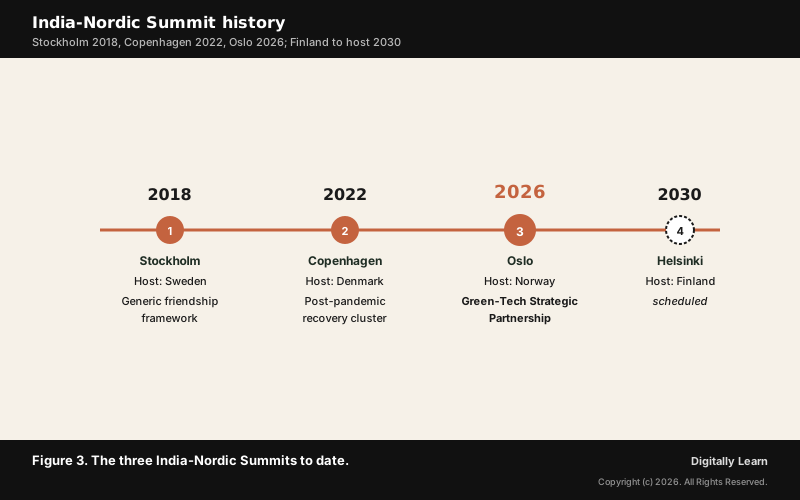
Definition: A minilateral summit, in the framework that has come to define India's expanding diplomatic architecture, refers to a heads-of-government meeting between India and a defined small group of like-minded states convened around a shared strategic agenda. The India-Nordic Summit is the standing minilateral forum among India and the five Nordic states of Denmark, Finland, Iceland, Norway, and Sweden. The first Summit was held at Stockholm in 2018 and the second at Copenhagen in 2022.
The Ministry of External Affairs briefed the press the same evening through the Secretary (West). The briefing recorded that the five Nordic economies together exceed two trillion US dollars in combined gross domestic product, that more than seven hundred Nordic companies operate in India, and that around one hundred and fifty Indian companies have a presence across the Nordic region. The next Summit will be hosted by Finland.
The two trade tracks that structure the partnership
The Oslo declaration rests on two trade tracks that operate in parallel. The first is the India-European Union Free Trade Agreement, on which negotiations between India and the European Union are advancing toward a conclusion. The second is the India-European Free Trade Association Trade and Economic Partnership Agreement, signed in 2024 and operationalised in 2025, which carries a binding investment target of one hundred billion US dollars and an undertaking to create one million direct jobs in India over a fifteen-year horizon.
Why the Oslo upgrade matters for India
The minilateral architecture India has been building
Why it matters: The Oslo upgrade fits inside an architecture India has been building deliberately since 2014. The architecture has three layers. First, large institutional forums where India is one voice among many: the United Nations, the Group of Twenty, the World Trade Organization. Second, classical bilaterals with partners with whom India runs full-spectrum agendas: the United States, Russia, Japan, France. Third, a growing tier of issue-aligned minilateral groups: the Quadrilateral Security Dialogue, I2U2, BRICS, the India-CARICOM Summit, and now the India-Nordic Summit.
Each minilateral does what the larger forums cannot. The smaller membership permits faster decisions, the narrower agenda permits specialised outputs, and the like-minded composition permits the partnership to advance on shared priorities without the lowest-common-denominator drag of universal bodies. The Nordic group offers India a like-minded cluster on green technology, on sustainable industrial policy, and on the maritime dimension of the Indo-Pacific.
What makes the Nordic grouping distinctive
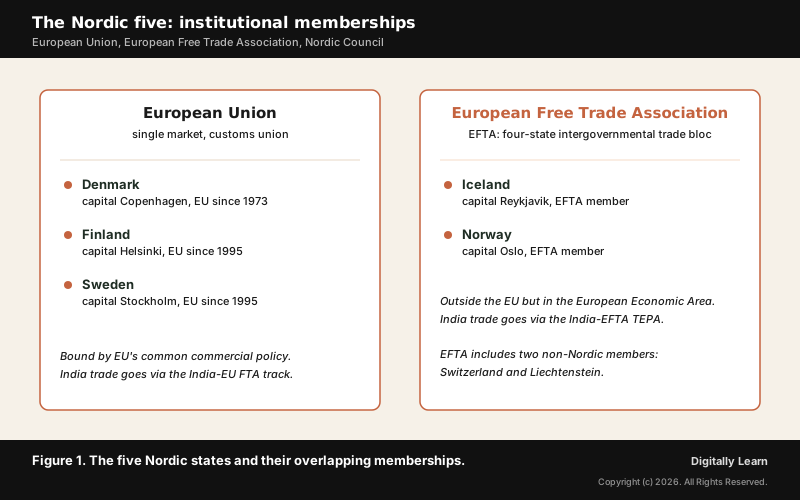
The Nordic five are not a federation, not a customs union, and not a single legal personality. They are bound together through the Nordic Council for parliamentary cooperation and the Nordic Council of Ministers for executive coordination, both with secretariats in Copenhagen. Three of the five, namely Denmark, Finland, and Sweden, are members of the European Union and act within its common commercial policy. The other two, Iceland and Norway, are members of the European Free Trade Association and participate in the European Economic Area without being European Union members.
The split membership matters for India because it explains why two trade tracks are required to engage the group commercially. The India-European Union Free Trade Agreement covers trade with the three European Union states, while the India-European Free Trade Association Trade and Economic Partnership Agreement covers trade with the two European Free Trade Association states. The Oslo Summit operationalises both tracks under a single political umbrella so that the bilateral relationship is coherent even where the legal vehicles differ.
Significance of the Green-Technology Strategic Partnership
The significance of this issue for Indian foreign policy
What is the significance of this issue: The upgrade is the first time India has accepted a thematic label as the headline descriptor of a minilateral partnership. The earlier two India-Nordic Summits described the relationship in generic terms of friendship and cooperation. The Oslo descriptor reads, in its operative wording, as a trusted Green Technology and Innovation Strategic Partnership. The descriptor signals that the relationship is no longer treated as a residual cluster of bilateral ties but as a defined cooperation domain centred on the climate and clean-energy transition.
Three reinforcing reasons explain the choice of the green-technology framing. The first is that the Nordic five together hold a disproportionate share of the world's most mature offshore wind, green hydrogen, green steel, and carbon-capture industrial bases. The second is that India's clean-energy transition will need patient industrial capital of the kind these economies are best placed to provide. The third is alignment with India's own domestic flagship instruments: the National Green Hydrogen Mission, the Production Linked Incentive schemes for solar modules and advanced chemistry cells, and the Mission LiFE framework launched in 2022.
Structural reading: The Oslo upgrade reads, on closer inspection, as a deliberate pairing of two complementary industrial bases. India brings manufacturing scale, a young technical workforce, a digital public infrastructure layer that is already serving over a billion users, and a domestic market large enough to absorb capital at meaningful unit economics. The Nordic five bring frontier industrial expertise in green hydrogen, green steel, carbon capture, offshore wind, deep-water shipping, polar-region science, and the regulatory architecture for industrial decarbonisation. The partnership is therefore structured as interdependence, not as a classical aid relationship, and the policy instruments at Oslo reflect that orientation.
Pillars and their operational instruments
Distinguishing features of the Oslo declaration
The three pillars of the India-Nordic partnership
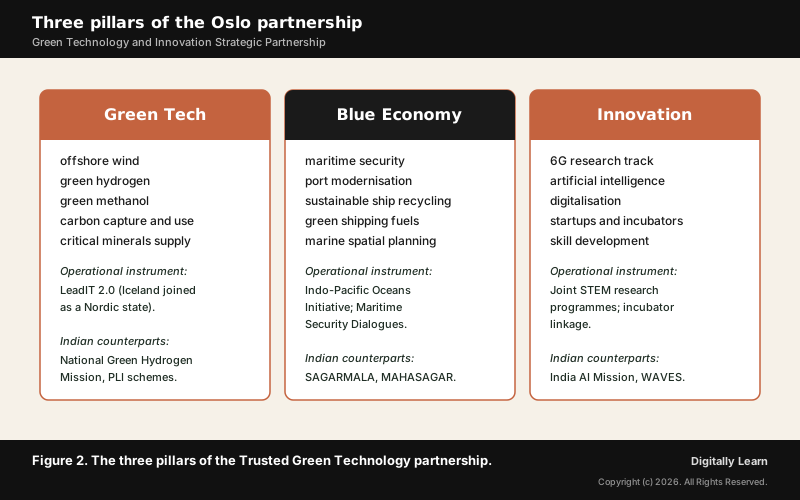
Distinguishing features: Three pillars give the Oslo upgrade its operational shape, and each comes with named instruments rather than generic language.
- (i) Green technology and energy. The pillar gathers offshore wind, green hydrogen, green methanol, carbon capture and utilisation, and critical-minerals cooperation under one head. The operational vehicle is the Leadership Group for Industry Transition, the Sweden-led platform of which India is a co-founding member; Iceland joined the upgraded LeadIT 2.0 phase at the Oslo Summit, completing the Nordic presence on the platform.
- (ii) Blue economy and maritime. The pillar covers maritime security, port modernisation, sustainable ship recycling, green shipping fuels, and marine spatial planning. The operational vehicle is the Indo-Pacific Oceans Initiative, on which Norway and Denmark are among the Nordic partners engaging India on its connectivity and shipping work streams, supported by the bilateral Maritime Security Dialogues India runs with each Nordic state.
- (iii) Innovation and technology. The pillar bundles a joint 6G research track, artificial-intelligence cooperation, digitalisation of public services, a startup and incubator linkage, and a skill-development corridor for industrial talent. The operational vehicle is a set of joint STEM research programmes and a startup bridge that runs through Indian missions in the five capitals.
The summit numbers in one table
The headline figures the Ministry of External Affairs reported at the Oslo briefing place the relationship in scale.
| India-Nordic metric | Reported value | Source authority |
|---|---|---|
| Combined Nordic gross domestic product | Over two trillion US dollars | MEA briefing, 19 May 2026 |
| Nordic companies operating in India | More than seven hundred | MEA briefing, 19 May 2026 |
| Indian companies in the Nordic region | Around one hundred and fifty | MEA briefing, 19 May 2026 |
| India-Nordic bilateral trade, 2024 | Around nineteen billion US dollars | Joint Statement, Oslo Summit |
| India-EFTA TEPA investment target | One hundred billion US dollars over fifteen years | India-EFTA TEPA, signed 2024 |
| India-EFTA TEPA direct-jobs commitment | One million direct jobs in India | India-EFTA TEPA, signed 2024 |
Observable outcomes from Oslo
What the Joint Statement specifically promised
Observable outcomes: The Joint Statement and the MEA briefing together record six concrete outcomes that allow the partnership to be tracked beyond rhetoric.
- (a) LeadIT 2.0 expansion. Iceland formally joined the Leadership Group for Industry Transition in its upgraded 2.0 phase, completing Nordic presence on the platform alongside Sweden, Norway, Denmark, and Finland.
- (b) India-EFTA TEPA operationalisation. The leaders reaffirmed that the India-EFTA Trade and Economic Partnership Agreement, which entered into force in 2025, is now operational with all chapters in motion, including investment and intellectual property.
- (c) Maritime Security Dialogue cycle. Bilateral Maritime Security Dialogues are placed on a regularised cycle with each of the five Nordic capitals, linking the Indian Navy’s Indo-Pacific deployments with Nordic forces operating in the High North.
- (d) 6G research track. A joint 6G research programme was launched, building on the international cooperation framework of the Bharat 6G Vision document released in 2023.
- (e) Sustainable ship recycling. Cooperation begins under the framework of the Hong Kong International Convention for the Safe and Environmentally Sound Recycling of Ships, with India’s Alang shipyard cluster identified as a candidate site for Nordic-supported upgrades to HKC standards.
- (f) ISRO-Norwegian Space Agency framework cooperation agreement. A bilateral framework agreement was signed between the Indian Space Research Organisation and the Norwegian Space Agency, covering peaceful uses of space, satellite-based climate monitoring, and Arctic-Indian Ocean data sharing. Norway also reaffirmed support for the operations of India’s Arctic research station Himadri at Ny-Aalesund, Svalbard.
- (g) Green hydrogen maritime corridor. Exploratory work begins on a green-hydrogen and ammonia-based shipping corridor between Indian ports and Nordic terminals, with the goal of demonstrating an early commercial route for zero-carbon bunker fuels before the fourth Summit at Helsinki.
- (h) WAVES Summit and Bharat Mandapam linkage. The Nordic Prime Ministers accepted invitations to a future edition of the World Audio Visual and Entertainment Summit, whose first edition India hosted at Mumbai in 2025, locating cultural and creative-economy cooperation on the Oslo agenda.
Contemporary linkages
Climate, Arctic, and the wider plurilateral architecture
Contemporary linkages: Three larger threads connect Oslo to current Indian foreign-policy priorities. The first is the climate negotiation track. The five Nordic states are among the most ambitious parties to the United Nations Framework Convention on Climate Change, and an India-Nordic agreement that operationalises industrial decarbonisation gives both sides a credible joint posture at COP-31 and beyond.
The second thread is the Arctic. India is an observer at the Arctic Council, the high-level intergovernmental forum that addresses the eight Arctic states, and India released its Arctic Policy in March 2022. All five Nordic states are full members of the Arctic Council, alongside Canada, Russia, and the United States. The Oslo agenda places the Indian presence on Arctic science cooperation, polar logistics, and high-latitude renewable energy on a clearer footing.
The third thread is the institutional reform of the United Nations. The Joint Statement formally records Nordic support for India's permanent membership of a reformed United Nations Security Council and for India's bid for membership of the Nuclear Suppliers Group. The endorsement carries weight because two of the five Nordic states, Norway and Iceland, are members of the Nuclear Suppliers Group and three, Denmark, Finland, and Sweden, are members of the European Union that decides as a bloc on the question.
Frictions to manage between Oslo and Helsinki
The partnership operates against five frictions that the Joint Statement signals but does not resolve. Each is structural rather than incidental, and each will need bilateral handling between now and the fourth Summit at Helsinki.
- (i) The Ukraine question. The Nordic five hold firm positions on the Russia-Ukraine war, with Sweden and Finland having joined the North Atlantic Treaty Organization in 2024 and 2023 respectively in direct response to the 2022 invasion. India has maintained a non-aligned posture and continues to import Russian crude. The Joint Statement frames the convergence on the rules-based order without papering over the divergence on the operative case.
- (ii) The European Union Carbon Border Adjustment Mechanism. CBAM, which entered its definitive phase in January 2026, imposes carbon costs on imports of cement, iron and steel, aluminium, fertilisers, electricity, and hydrogen. India has formally flagged the mechanism as inconsistent with the principle of common but differentiated responsibilities and as a non-tariff barrier on Indian steel and fertiliser exporters. Three of the five Nordic states implement CBAM as European Union members.
- (iii) Intellectual property in technology transfer. Nordic firms hold patents on green-hydrogen electrolysers, carbon-capture chemistry, offshore-wind turbine designs, and pharmaceutical molecules that India would prefer to license on terms friendlier to volume manufacture. The Trade and Economic Partnership Agreement contains an intellectual-property chapter that is more demanding than India’s domestic framework, and the practical operation of that chapter remains the variable to watch.
- (iv) Maritime corridor disruption. Sea-lane attacks in the Red Sea and tension at the Strait of Hormuz raise the risk premium on Indian exports to Europe and on Nordic shipping carrying capital goods to India. The India-Middle East-Europe Economic Corridor is the strategic alternative under construction; its operationalisation will materially shape the cost-economics of the India-Nordic trade and investment flow.
- (v) Labour mobility asymmetry. Nordic capital flowing into India is welcomed; reciprocal labour mobility for Indian skilled professionals into the Nordic region is constrained by national immigration frameworks tighter than the corresponding flows into other European destinations. The mobility chapter in the Trade and Economic Partnership Agreement is therefore a closely-watched test of how far the partnership reciprocates.
What to watch in the year ahead
Three observables will signal whether the Oslo upgrade is producing operational results between now and the fourth Summit at Helsinki. The first is the pace of India-European Union Free Trade Agreement negotiations: an agreement closed before Helsinki would lock in trade with three of the five Nordic states. The second is the investment drawdown under the India-EFTA TEPA, which has staged milestones at five-year, ten-year, and fifteen-year markers. The third is the volume of bilateral Maritime Security Dialogues India runs annually with each Nordic capital, which is the metric most sensitive to operational depth.
UPSC Relevance
Where the Oslo Summit sits in the UPSC syllabus
UPSC context: The Oslo Summit falls within General Studies Paper II, under the syllabus head India and its neighbourhood, bilateral, regional and global groupings and agreements involving India and / or affecting India's interests. The topic also touches General Studies Paper III through the climate and energy-transition dimension, specifically under the head conservation, environmental pollution and degradation, environmental impact assessment, and the head on indigenisation of technology and developing new technology for the 6G research track and the green-shipping component.
Prelims relevance: The factual surface that Prelims tests on this topic includes the five Nordic states with their capitals, the distinction between European Union membership (Denmark, Finland, Sweden) and European Free Trade Association membership (Iceland, Norway) among the Nordics, the institutional role of the Nordic Council, India's observer status at the Arctic Council since 2013, the year India released its Arctic Policy (March 2022), the year India signed the India-EFTA TEPA (2024) and the year it entered into force (2025), and the operational name of the platform Iceland joined at Oslo, namely LeadIT 2.0.
Mains relevance: The Mains angle most likely to be tested is the structural one: how does India's expanding minilateral architecture (Quad, I2U2, BRICS, India-Nordic, India-CARICOM) complement classical bilaterals and large institutional forums, and what are the trade-offs in agenda specialisation, decision speed, and like-minded clustering. A second Mains angle is the climate-diplomacy linkage: how do plurilateral partnerships of the Oslo type strengthen India's position at the United Nations Framework Convention on Climate Change negotiations and at COP-31. A third angle is the Arctic and polar dimension: the strategic and scientific implications of a sharper Indian presence in High-North research and logistics.
Mains practice question: A focused fifteen-mark question on this topic would read: Examine the rationale for India's elevation of the India-Nordic partnership to a Green Technology and Innovation Strategic Partnership at the Oslo Summit, with reference to India's industrial-decarbonisation pathway and its Arctic interests. What are the principal frictions to operationalise the partnership before the fourth Summit at Helsinki? A well-constructed answer would treat the green-technology framing, the EFTA TEPA investment commitment, the Arctic-cooperation dimension via the ISRO-NOSA framework agreement, and the Ukraine, CBAM, and intellectual-property frictions as the five spokes of the response.
- Past Mains linkage 1. 2018 GS-II: What are the key areas of reform if the United Nations has to survive in the present context of the global challenges? Discuss critically. The Oslo Joint Statement records Nordic support for India’s permanent UNSC membership and NSG membership.
- Past Mains linkage 2. 2022 GS-II: maritime-security and energy-flow questions on Indian Ocean partners. The blue-economy pillar of the Oslo declaration extends the same logic to the High North and the Indo-Pacific connectivity arc.
- Past Prelims linkage. 2017 Prelims tested on India’s Arctic Council observer status. The Oslo agenda places further Indian presence on Arctic scientific and economic cooperation.
Previous Year UPSC-CSE Questions By the end you will be able to draft model answers for the following UPSC questions. Each question carries a collapsible framework showing how to approach it in the exam.
- UPSC Mains 2018 GS-IIWhat are the key areas of reform if the United Nations has to survive in the present context of the global challenges? Discuss critically.
How to structure the answer in the exam
Introduction: Open with the United Nations' 1945 founding as a post-war collective-security architecture, name the four organs, and frame the reform question as a structural-versus-political challenge that India has pressed since the 1990s.
Body (sub-themes to develop):
- Security Council reform: permanent-membership expansion to include India, Brazil, Germany, Japan, South Africa (G4 plus Africa); the P5 veto question and the Razali, Annan, and Open-Ended Working Group proposals.
- General Assembly reform: financial-vote alignment with capacity-to-pay; revitalisation under Resolution 60/286; the question of binding-versus-advisory General Assembly resolutions.
- Secretariat reform: gender and geographical representation; the Secretary-General selection process; whistleblower-protection and accountability mechanisms.
- Specialised-Agency coherence: the One UN initiative; coordination between the United Nations Development Programme, the World Health Organization, the Food and Agriculture Organization, and the United Nations Environment Programme on cross-cutting agendas such as climate and sustainable development.
- Financing and assessed-contribution reform: bilateral support for India's permanent seat from the Group of Twenty members and the European Union; voluntary-contribution dependency as a leverage instrument.
Conclusion: Conclude that reform is procedurally hard but substantively urgent, that India's permanent-seat candidacy has accumulated explicit backing from major democracies including the Nordic states at Oslo, and that the Pact for the Future agreed at the Summit of the Future in September 2024 offers the institutional window the next decade will use.
The Oslo Joint Statement formally records Nordic support for India's permanent United Nations Security Council membership and for India's Nuclear Suppliers Group bid. Two of the five Nordic states (Norway, Iceland) are NSG members and three (Denmark, Finland, Sweden) act through the European Union on NSG questions, which makes the Oslo endorsement materially significant for India's candidacy. The body sub-theme on Security Council reform is the one directly supplied by this article's evidence, with the Joint Statement's wording on a 'reformed and inclusive' Security Council as the load-bearing line.
- UPSC Mains 2022 GS-IIDiscuss the geopolitical and geostrategic importance of Maldives for India with a focus on global trade and energy flows. Furthermore, also discuss how this relationship affects India's maritime security and regional stability.
How to structure the answer in the exam
Introduction: Open with Maldives' location astride the Indian-Ocean shipping lanes (about 50 per cent of India's external trade traverses the western Indian Ocean), frame the geostrategic importance through three lenses (trade routes, energy flows, and naval presence), and signal that the analytical template generalises to other partner states on the Indo-Pacific maritime arc.
Body (sub-themes to develop):
- Trade routes: Maldives' position on the East-West Indian Ocean Sea Lane; petroleum and container traffic from West Asia and Africa; choke-point dependence on the Bab-el-Mandeb and the Strait of Hormuz; comparable role of Nordic states on the High-North arc.
- Energy flows: Indian crude imports through the western Indian Ocean; the Liquefied Natural Gas trade with Qatar and Russia transiting these lanes; Maldivian airspace and exclusive economic zone as supporting infrastructure for the energy corridor.
- Maritime security: India's SAGAR (Security and Growth for All in the Region) doctrine; the Indian Navy's Mission Based Deployment in the Indian Ocean Region; the Information Fusion Centre at Gurugram as a maritime-domain-awareness hub; the comparable Indo-Pacific Oceans Initiative arc into the Atlantic-Arctic that the Nordic states populate.
- Regional stability: bilateral assistance programmes; the Colombo Security Conclave with Sri Lanka and Mauritius; HADR (humanitarian assistance and disaster relief) cooperation under Operation Vanilla 2020.
- Strategic-competition layer: China's Belt and Road Initiative engagement with Maldives; debt-sustainability concerns; the broader Indo-Pacific strategy of competing infrastructure-finance models.
Conclusion: Conclude that Maldives is a microcosm of India's wider Indian-Ocean strategy, that the SAGAR doctrine and the Indo-Pacific Oceans Initiative together extend this logic from the Indian Ocean Region to the North Atlantic and the Arctic, and that the Oslo Summit elevation of India-Nordic ties to a Green Technology and Innovation Strategic Partnership is the latest operational instantiation of the same architecture.
The blue-economy pillar of the Oslo declaration applies the same maritime-security and trade-corridor logic that the 2022 Mains question used for Maldives to the Indo-Pacific connectivity arc and the High North. Both Norway (host of the Summit) and Denmark contribute to maritime-domain awareness on lanes that India's Indian-Ocean strategy already covers, and the Indo-Pacific Oceans Initiative is the standing instrument that ties the two regions together. The body sub-theme on maritime security is directly supplied by the article's blue-economy pillar discussion and by the bilateral Maritime Security Dialogues India runs with each Nordic capital.
Sources
- Special briefing by Secretary (West) on PM's visit to Norway for the 3rd India-Nordic Summit
- Norway and India to strengthen cooperation
- India-EFTA Trade and Economic Partnership Agreement
- Leadership Group for Industry Transition
- Carbon Border Adjustment Mechanism (CBAM)
- Arctic Council: non-Arctic observer states
- India and the Arctic: Building a Partnership for Sustainable Development
- India-Nordic relations
- Joint Statement: 3rd India-Nordic Summit, Oslo
Editorial Disclaimer
This article is compiled from the reference materials listed in the Sources section. It is an explainer for UPSC preparation and is not a substitute for primary documents (NCERTs, GoI ministry releases, IMD bulletins, RBI / CEA / MoEFCC publications, and Standing-Committee reports).


