


Overview
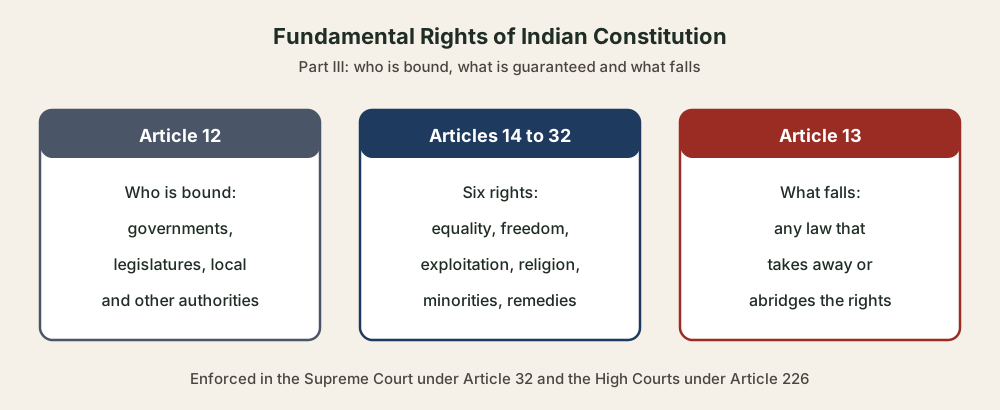
Fundamental Rights are the rights in Part III of the Constitution of India, Articles 12 to 35, that the Constitution itself guarantees and the courts enforce. The Fundamental Rights of Indian Constitution number six today: equality, freedom, the right against exploitation, freedom of religion, cultural and educational rights, and the right to constitutional remedies. Article 12 says which bodies they bind, and Article 13 makes any law that takes them away void.
Fundamental Rights of Indian Constitution: Meaning and Origins
What Are Fundamental Rights and Why They Are Called Fundamental
Part III of the Constitution, from Article 12 to Article 35, lists the rights that the Constitution itself guarantees to the people of India. The framers drew their inspiration from the Bill of Rights of the United States, and Part III is often called the Magna Carta of India. Its list of justiciable rights is longer and more detailed than the bill of rights of any other country, the United States included.
These rights are called fundamental for two reasons. They are guaranteed and protected by the Constitution, which is the fundamental law of the land, and they are the conditions a person needs for all-round development: material, intellectual, moral and spiritual. Together they aim at what has been called a government of laws and not of men, in which the State cannot act against a person's liberty merely because those in power wish to.
The difference from an ordinary legal right lies in how each can be changed. An ordinary legal right is created by an ordinary law, so the legislature can change it by the ordinary process of law-making. A Fundamental Right can be changed only by amending the Constitution, and no organ of the government may act against it. The courts can declare both legislative and executive action invalid when it violates a Fundamental Right or restricts it unreasonably.
Origins of Fundamental Rights: From the Swaraj Bill to the Constituent Assembly
The demand for written rights grew with the national movement. The Constitution of India Bill of 1895, known as the Swaraj Bill, spoke of freedom of speech, privacy and the franchise. The Rowlatt Act of 1919, which allowed indefinite detention and censorship, turned the demand into a mass campaign for guaranteed civil freedoms.
- Nehru Report, 1928: The All Parties Conference under Motilal Nehru asked for dominion status, a bill of fundamental rights, and joint electorates with reservation of seats for minorities.
- Karachi session, 1931: The Congress adopted a Resolution on Fundamental Rights and Economic Programme, committing itself to civil rights and to social and economic rights such as a minimum wage and the abolition of untouchability and serfdom.
- Constituent Assembly: The Advisory Committee on Fundamental Rights, Minorities and Tribal and Excluded Areas was chaired by Sardar Patel, and its Fundamental Rights Sub-Committee by J.B. Kripalani.
- Universal Declaration of Human Rights: The United Nations General Assembly adopted it on 10 December 1948, while the Assembly was still at work; the rights were already in the First Draft of February 1948.
The making of Part III is part of the larger story of the Constituent Assembly and its committees. The Fundamental Rights came through the First Draft of February 1948 and the Second Draft of October 1948 into the final text adopted on 26 November 1949.
List of Fundamental Rights With Articles
Six Fundamental Rights in Part III: Articles 14 to 32
The Constitution as adopted contained seven groups of Fundamental Rights. Six remain today, because the right to property was taken out of Part III in 1978. Each group covers a set of articles, and the articles of the first group are explained in detail on the page on the Right to Equality, Articles 14 to 18.
| Fundamental Right | Articles | What it covers |
|---|---|---|
| Right to equality | 14 to 18 | Equality before law, no discrimination, equal opportunity in public employment, abolition of untouchability and titles |
| Right to freedom | 19 to 22 | Six freedoms of citizens, protection in conviction, life and personal liberty, elementary education, safeguards on arrest |
| Right against exploitation | 23 and 24 | No traffic in human beings or forced labour; no child labour in factories and hazardous work |
| Right to freedom of religion | 25 to 28 | Conscience and religion, religious affairs, no tax for a religion, religious instruction |
| Cultural and educational rights | 29 and 30 | Language, script and culture of minorities; minority educational institutions |
| Right to constitutional remedies | 32 | The right to move the Supreme Court, which issues writs to enforce the rights |
Article 21A, the right to elementary education, was added later. The 86th Amendment Act of 2002 made elementary education a fundamental right and changed Article 45 in Part IV to deal with early childhood care. Article 32 is the right that gives all the others force: B. R. Ambedkar called it the heart and soul of the Constitution, and the Supreme Court's writ jurisdiction is how it works in practice.
Right to Property: From Fundamental Right to Article 300A
The right to property sat in Part III through Article 19(1)(f), the right of citizens to acquire, hold and dispose of property, and Article 31, which protected every person against being deprived of property except by authority of law. It caused more conflict between Parliament and the Supreme Court than any other right, mainly over the compensation the State had to pay when it acquired land.
The 44th Amendment Act of 1978, enacted by the Janata Party Government headed by Morarji Desai, repealed both provisions. It inserted Article 300A in Part XII, which says that no person shall be deprived of property save by authority of law. Property is now a constitutional or legal right, open to every person and not only to citizens, but it is no longer a Fundamental Right.
- It can be regulated by an ordinary law of Parliament, without a constitutional amendment.
- It protects property against executive action but not against legislative action.
- A person whose property is taken cannot move the Supreme Court under Article 32, though the High Court can be approached under Article 226.
- There is no guaranteed right to compensation when the State acquires private property.
Features of Fundamental Rights
Features of Fundamental Rights: Justiciable, Qualified and Amendable
The Fundamental Rights share a set of features that explain how they work in court and how far they can be limited. The most important is that they are not absolute: the State can impose reasonable restrictions, and the courts decide whether a restriction is reasonable. In this way the rights balance the liberty of the individual against the needs of society.
- Some are available only to citizens; others to all persons, including foreigners and legal persons such as companies.
- Most protect a person against the State; a few, such as Articles 15(2), 17 and 23, also operate against private individuals.
- Some are negative, limiting the State, while others are positive, conferring a privilege on the person.
- They are justiciable and are guaranteed by the Supreme Court, which can be approached directly.
- They can be curtailed only by a constitutional amendment, never by an ordinary law, and never so as to damage the basic structure.
- They can be suspended during a National Emergency, except the rights in Articles 20 and 21.
- Most are self-executing; a few need a law to give them effect, and Article 35 reserves that law to Parliament.
The point about amendment is the subject of the long contest described under Article 13 below. The point about emergencies has its own rules, because the Constitution treats Article 19 differently from the other rights.
Fundamental Rights Available to Foreigners and to Citizens Only
Five rights belong only to citizens of India. The rest are available to every person on Indian territory, citizen or foreigner, except an enemy alien. The line follows the nature of each right: rights tied to membership of the political community, such as public employment or settling anywhere in India, go to citizens; rights that protect any human being, such as life and liberty, go to all.
| Available only to citizens | Available to all persons (except enemy aliens) |
|---|---|
| Article 15: no discrimination on grounds of religion, race, caste, sex or place of birth | Article 14: equality before law and equal protection of laws |
| Article 16: equality of opportunity in public employment | Articles 20, 21 and 21A: protection in conviction, life and personal liberty, elementary education |
| Article 19: the six freedoms of speech, assembly, association, movement, residence and profession | Articles 22, 23 and 24: safeguards on arrest, and protection from trafficking, forced labour and child labour |
| Articles 29 and 30: cultural and educational rights of minorities | Articles 25 to 28: freedom of religion |
The rights of citizens depend on who is a citizen, which is settled by Part II and the law described on the page on citizenship in India.
Fundamental Rights During Emergency: Articles 358 and 359
A National Emergency affects the rights in two different ways, and the 44th Amendment narrowed both after the Emergency of 1975 to 1977. The idea of suspending rights in an emergency came from the Weimar Constitution of Germany.
| Point | Article 358 | Article 359 |
|---|---|---|
| What happens | Article 19 stops restricting the State, so laws and executive action may limit the six freedoms | The President may by order suspend the right to move any court to enforce the rights named in the order |
| When | Only when the Emergency is declared on the ground of war or external aggression | During any Proclamation of Emergency |
| Rights protected | Applies only to Article 19 | Articles 20 and 21 can never be named in the order |
| Limit | Only laws that recite their link to the Emergency are covered | Only laws that recite their link to the Emergency are covered |
The protection of Articles 20 and 21 is the lesson of 1975. Since the 44th Amendment took effect on 20 June 1979, the right to life and personal liberty and the protections in conviction stay enforceable even in a National Emergency. The powers themselves are explained on the page on the President's emergency powers.
Limits on Fundamental Rights: Articles 31A to 31C and 33 to 35
Several provisions limit the reach of Part III. Three saving clauses protect particular laws, and three more articles let Parliament adjust the rights for special situations.
- Article 31A: Saves laws for the acquisition of estates and similar purposes.
- Article 31B: Validates the Acts and Regulations placed in the Ninth Schedule.
- Article 31C: Saves laws that give effect to certain Directive Principles.
- Article 33: Lets Parliament restrict or abrogate the rights of the armed forces, para-military forces, police and intelligence agencies.
- Article 34: Allows restrictions while martial law is in force in an area, which is different from a National Emergency.
- Article 35: Reserves to Parliament, not the State Legislatures, the laws needed to give effect to certain rights, so that they are uniform across India.
Article 31B is the widest of the saving clauses, because it shields a law placed in the Ninth Schedule from every Fundamental Right. In I. R. Coelho v. State of Tamil Nadu, decided in January 2007, the Supreme Court held that there can be no blanket immunity: laws added to the Ninth Schedule after 24 April 1973, the date of the Kesavananda Bharati judgment, can be challenged if they violate Articles 14, 15, 19 and 21 or the basic structure.
Article 12: Definition of State
Article 12 of Indian Constitution: Who Counts as the State
Most Fundamental Rights are claims against the State, so Part III must say who the State is. Article 12 does so for Parts III and IV: unless the context otherwise requires, the State includes the Government and Parliament of India, the Government and the Legislature of each State, and all local or other authorities within the territory of India or under the control of the Government of India.
- The Union executive and legislature, that is, the Government and Parliament of India.
- The executive and legislature of each State.
- Local authorities such as municipalities, panchayats, district boards and improvement trusts.
- Other authorities, meaning statutory or non-statutory bodies such as LIC, ONGC and SAIL.
The definition is drawn wide on purpose. For most rights, only an action of the State, or of an agency that counts as the State, can be challenged as a violation of a Fundamental Right. Article 13(2) uses the same definition when it forbids the State to make a law that takes away the rights.
Other Authorities Under Article 12: From Ejusdem Generis to the Instrumentality Test
The phrase "other authorities" has been read more widely over time. The courts first read it narrowly, then brought in every statutory body, and finally asked whether a body is in substance an arm of the government.
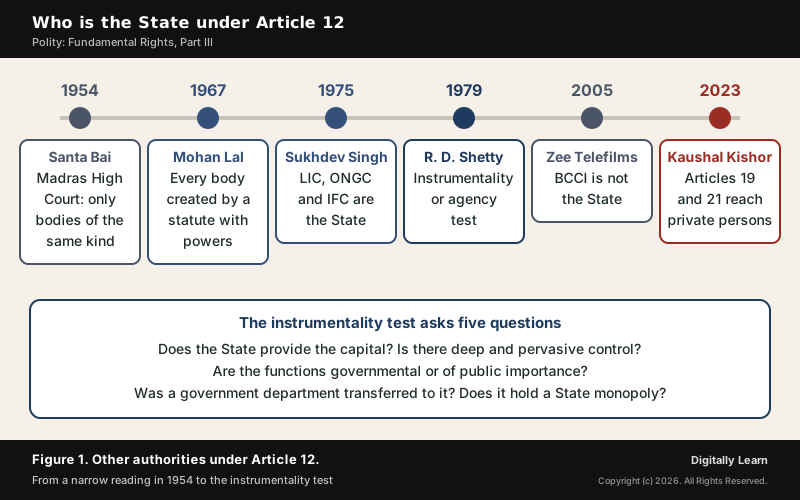
- University of Madras v. Santa Bai (1954): The Madras High Court applied the rule of ejusdem generis (things of the same kind) and held that other authorities must be like the governments and legislatures named before them, so a university was not the State.
- Rajasthan State Electricity Board v. Mohan Lal (1967): The Supreme Court rejected that rule and held that every body created by a statute and given powers is an other authority, whether its work is sovereign or commercial.
- Sukhdev Singh v. Bhagatram (1975): Statutory corporations such as LIC, ONGC and the Industrial Finance Corporation are the State, because they make binding rules for their employees.
- Ramana Dayaram Shetty v. International Airport Authority (1979): Justice P. N. Bhagwati laid down the instrumentality or agency test, under which even a registered society or government company is the State if it is an agency of the government.
The instrumentality test looks at several indicators, none decisive on its own: whether the State provides the capital, whether it has deep and pervasive control, whether the functions are of public importance or governmental in character, whether a government department was transferred to the body, and whether it enjoys a monopoly conferred or protected by the State.
The Board of Control for Cricket in India shows the test at work. The Supreme Court held in Zee Telefilms (2005) that the BCCI is not the State: it is autonomous, not financially dependent on the government, and not under deep and pervasive control. Because it performs a public duty in selecting the national team, it is still answerable to the High Courts under Article 226, but a petition against it cannot be filed under Article 32.
Article 13: Laws Inconsistent With Fundamental Rights
Article 13 of Indian Constitution: Old Laws, New Laws and Judicial Review
Article 13 makes the Fundamental Rights superior to ordinary law. It deals separately with laws already in force when the Constitution began and with laws made afterwards, and it is the clearest statement in the Constitution of the power of judicial review.
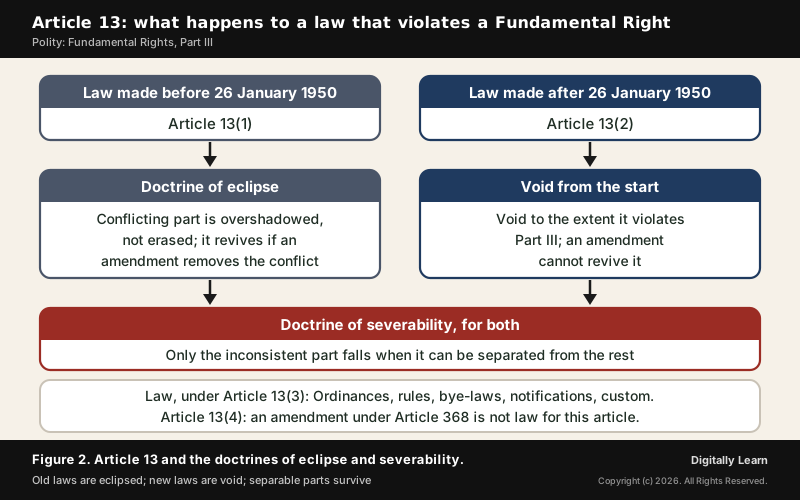
- Article 13(1): Laws in force before 26 January 1950 are void to the extent that they are inconsistent with Part III.
- Article 13(2): The State shall not make any law that takes away or abridges these rights; a law made in contravention is void to the extent of the contravention.
- Article 13(3): Defines “law” and “laws in force” for the article.
- Article 13(4): Inserted by the 24th Amendment of 1971, it says that nothing in Article 13 applies to an amendment made under Article 368.
The power to declare a law void under Article 13 belongs to the Supreme Court under Article 32 and to the High Courts under Article 226. That is why judicial review in India rests on Article 13 together with Articles 32 and 226.
Law Under Article 13(3): Ordinances, Rules, Bye-laws and Custom
Article 13(3)(a) gives the word law a wide meaning, so that rights cannot be evaded by acting through some other instrument. Any of the following can be struck down for violating a Fundamental Right.
- Permanent laws made by Parliament or the State Legislatures.
- Temporary laws, that is, Ordinances issued by the President or the Governors.
- Delegated legislation such as orders, bye-laws, rules, regulations and notifications.
- Custom or usage having the force of law.
Ordinances show why this matters. An Ordinance has the force of an Act of Parliament: it may modify or repeal an Act and, like any other law, may come into force from a back date. But because it is law under Article 13, it is bound by the same limits as an Act and cannot abridge or take away a Fundamental Right.
Doctrine of Eclipse and Doctrine of Severability
Two doctrines explain what "void to the extent of the inconsistency" means in practice. Both follow from the words of Article 13 itself.
The doctrine of eclipse applies to laws in force before the Constitution. A pre-constitutional law that conflicts with a Fundamental Right is not wiped out; its conflicting part is overshadowed by the right and becomes ineffective. If the Constitution is later amended so that the conflict ends, the eclipse is removed and the law operates again. A law made after the Constitution is different: one that violates Part III is void from the start, so there is nothing for an amendment to revive.
The doctrine of severability follows from the words "to the extent of". When only part of a law is inconsistent with Part III and that part can be separated from the rest, the court strikes down only the inconsistent part and lets the remainder stand. The whole law falls only when the bad part cannot be separated.
Is a Constitutional Amendment Law? Article 13(4) and the Basic Structure
The hardest question under Article 13 was whether Parliament could amend the Fundamental Rights themselves. If an amendment is a law, Article 13(2) would make any amendment that abridges a right void. The Supreme Court answered the question three different ways before it settled.
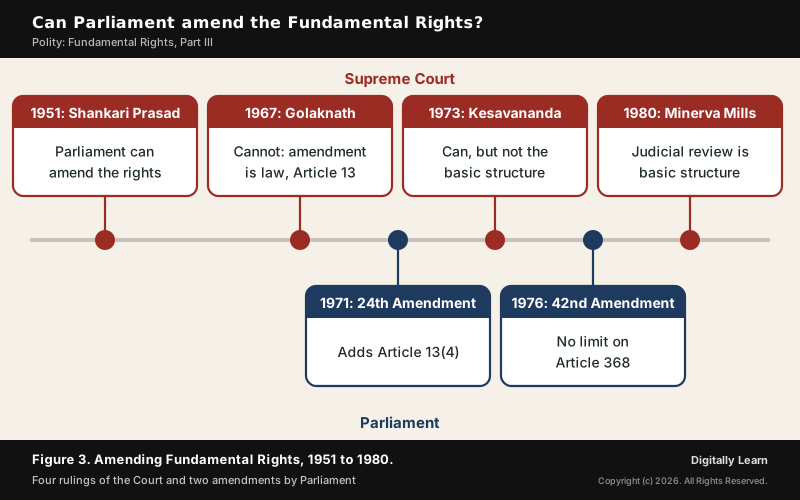
- Shankari Prasad (1951): Upholding the First Amendment, the Court held that law in Article 13 means only ordinary law, so Parliament can amend Fundamental Rights under Article 368.
- Golaknath (1967): The Court reversed itself, gave the rights a transcendental and immutable position, and held that an amendment is law under Article 13 and void if it abridges them.
- 24th Amendment (1971): Parliament added Article 13(4) and changed Article 368 to declare that an amendment is not law under Article 13.
- Kesavananda Bharati (1973): The Court upheld the 24th Amendment but held that Parliament cannot alter the basic structure, so a right that is part of that structure cannot be taken away.
- 42nd Amendment (1976): Parliament amended Article 368 again to declare that there is no limit on its constituent power and that no amendment can be questioned in any court.
- Minerva Mills (1980): The Court struck down the clauses of the 42nd Amendment that tried to exclude amendments from review, holding judicial review itself to be part of the basic structure.
The doctrine has its critics. The Constitution does not list its basic features, the courts have never defined them exhaustively, and only the judiciary decides what belongs, so critics see unelected judges setting limits on an elected Parliament. The Court's reply in Minerva Mills was that a limited amending power is itself a basic feature: the donee of a limited power cannot convert it into an unlimited one.
The result is that Article 13(4) is valid, but amendments are still tested against the basic structure. The doctrine is traced in full on the page on judicial review and the basic structure.
Significance and Criticism of Fundamental Rights
Significance of Fundamental Rights in Indian Democracy
The Fundamental Rights are the bedrock of democracy in India. They give the individual a shield against the majority of the day, protect minorities and weaker sections, and lay the foundation of social equality and social justice. By limiting what the government may do, they make the rule of law real rather than formal.
- They are a strong bulwark of individual liberty and of the dignity of the individual.
- They strengthen the secular character of the State and protect the interests of minorities.
- They check any claim of the government to absolute authority.
- They let people take part in the political and administrative process with confidence.
Criticism of Fundamental Rights: Limitations, Emergency and Clarity
Critics have found several weaknesses in Part III. Most of them concern how far the rights can be limited.
- Excessive limitations: So many exceptions qualify the rights that Jaspat Roy Kapoor suggested renaming the chapter as limitations on Fundamental Rights.
- No social and economic rights: The list is mainly political and leaves out the right to work, social security and rest.
- Vague wording: Terms such as public order and reasonable restriction are not defined, and Sir Ivor Jennings called the Constitution a paradise for lawyers.
- No permanency: Parliament can curtail them by amendment, as the abolition of the right to property in 1978 showed.
- Suspension and detention: Their suspension in an Emergency and preventive detention under Article 22 weaken them, and the judicial remedy is expensive for the poor.
B. R. Ambedkar answered the first criticism in the Constituent Assembly on 4 November 1948. Critics said the exceptions had eaten up the rights, and that rights are real only if absolute, as in the American Bill of Rights. He replied that the rights in America are not absolute either: the United States Supreme Court invented the doctrine of police power to uphold limits on them, so the difference is one of form, not of substance.
The courts have answered some of these points over the years. The basic structure doctrine limits amendment, the 44th Amendment protected Articles 20 and 21 in an Emergency, and public interest litigation lets anyone go to court on behalf of people who cannot afford to go themselves.
Difference Between Fundamental Rights and DPSP, and Rights Outside Part III
Part III sits beside two other parts that speak about rights and duties. The Directive Principles of State Policy in Part IV are instructions to the State that the courts cannot enforce, and the Fundamental Duties in Part IVA are obligations of citizens. Part III alone is justiciable.
| Point | Fundamental Rights (Part III) | Directive Principles (Part IV) |
|---|---|---|
| Enforceable in court | Yes, under Articles 32 and 226 | No; Article 37 says they are fundamental in governance but not enforceable |
| Nature | Mostly limits on the State | Positive goals the State must pursue |
| Aim | Political democracy | Social and economic democracy |
| Source of inspiration | Bill of Rights of the United States | Constitution of Ireland |
Some rights are justiciable but lie outside Part III. They are constitutional or legal rights, enforced through the High Courts and ordinary law rather than through Article 32.
- Article 265: No tax shall be levied or collected except by authority of law.
- Article 300A: No person shall be deprived of property save by authority of law.
- Article 301: Trade, commerce and intercourse throughout India shall be free.
- Article 326: Elections to the Lok Sabha and the Legislative Assemblies on the basis of adult suffrage.
Previous Year UPSC-CSE Questions
Previous Year UPSC-CSE Questions By the end you will be able to draft model answers for the following UPSC questions. Each question carries a collapsible framework showing how to approach it in the exam.
- UPSC Mains 2019 GS-II“Parliament’s power to amend the Constitution is a limited power and it cannot be enlarged into absolute power.” In the light of this statement explain whether Parliament under Article 368 of the Constitution can destroy the Basic Structure of the Constitution by expanding its amending power?
Answer outline: how to structure the answer
What the question asks, the main arguments, relevant examples and the direction of the conclusion. This is not a full model answer.
Introduction: Article 368 lets Parliament amend the Constitution, but the Supreme Court has held since 1973 that the power does not extend to altering the basic structure.
Body (sub-themes to develop):
- The contest: Shankari Prasad (1951) allowed amendment of rights; Golaknath (1967) forbade it; the 24th Amendment (1971) added Article 13(4).
- Kesavananda Bharati (1973): Parliament may amend any part, including rights, but not the basic structure.
- The 42nd Amendment (1976) claimed unlimited power; Minerva Mills (1980) held a limited amending power is itself a basic feature, and judicial review part of the basic structure.
- Coelho (2007): laws placed in the Ninth Schedule after 24 April 1973 remain open to review.
Conclusion: Conclude that Parliament can amend but not destroy: the donee of a limited power cannot convert it into an unlimited one.
- UPSC Mains 2016 GS-IIWhat was held in the Coelho case? In this context, can you say that judicial review is of key importance amongst the basic features of the Constitution?
Answer outline: how to structure the answer
What the question asks, the main arguments, relevant examples and the direction of the conclusion. This is not a full model answer.
Introduction: In I. R. Coelho v. State of Tamil Nadu (2007) the Supreme Court held that there can be no blanket immunity for laws in the Ninth Schedule.
Body (sub-themes to develop):
- Holding: laws added after 24 April 1973 can be tested against Articles 14, 15, 19 and 21 and the basic structure.
- Why judicial review matters: Article 13 voids laws that abridge rights; Articles 32 and 226 give the remedy; without review, Article 31B could shield any law.
- Minerva Mills (1980) had already held judicial review part of the basic structure.
Conclusion: Conclude that judicial review is the feature that keeps every other basic feature enforceable.
- UPSC Mains 2013 GS-II‘The Supreme Court of India keeps a check on arbitrary power of the Parliament in amending the Constitution.’ Discuss critically.
Answer outline: how to structure the answer
What the question asks, the main arguments, relevant examples and the direction of the conclusion. This is not a full model answer.
Introduction: The Supreme Court checks Parliament's amending power through Article 13 and the basic structure doctrine.
Body (sub-themes to develop):
- The check: Kesavananda (1973), Minerva Mills (1980) and Coelho (2007) limited amendments that damaged the basic structure.
- For: it guards rights, judicial review and limited government against a passing majority, a lesson of the 42nd Amendment.
- Against: the Constitution does not list basic features, they are defined case by case, and unelected judges set the limits.
- Balance: Parliament can still amend almost every provision; only the core is protected.
Conclusion: Conclude that the check is real but narrow, and its legitimacy rests on restraint in using it.
- UPSC Prelims 2025 Prelims-GSWith reference to the Indian polity, consider the following statements:
- I. An Ordinance can amend any Central Act.
- II. An Ordinance can abridge a Fundamental Right.
- III. An Ordinance can come into effect from a back date.
Which of the statements given above are correct?
How to approach this Prelims question
Approach: Test each power against Article 13. Statement I: an Ordinance has the force of an Act of Parliament and may modify or repeal an Act, so it can amend a Central Act. Statement II: an Ordinance is law under Article 13(3)(a), so Article 13(2) makes it void to the extent it abridges a Fundamental Right; it cannot validly do so. Statement III: like any other law an Ordinance may be retrospective and come into force from a back date. I and III stand.
Trap to watch: Statement II sounds plausible because an Ordinance is strong; the definition of law in Article 13(3)(a) decides it.
Key facts to recall:
- (a) I and II only: wrong. Statement II fails because an Ordinance is law under Article 13 and cannot abridge a Fundamental Right.
- (b) II and III only: wrong. Statement II is incorrect, and statement I, which is correct, is left out.
- (c) I and III only: right. An Ordinance can amend a Central Act and can operate from a back date.
- (d) I, II and III: wrong. Statement II is incorrect.
Answer signal: Option (c): Article 13(3)(a) counts an Ordinance as law, so it cannot abridge a Fundamental Right.
- UPSC Prelims 2021 Prelims-GSWhat is the position of the Right to Property in India?
How to approach this Prelims question
Approach: First, status: the 44th Amendment of 1978 removed property from Part III and placed it in Article 300A, so it is a legal or constitutional right, not a Fundamental Right. Second, who holds it: Article 300A says no person shall be deprived of property save by authority of law, so it is available to any person, not only citizens. A legal right available to any person.
Trap to watch: Citizens only is tempting because Article 19(1)(f) once gave the right to citizens; Article 300A speaks of any person.
Key facts to recall:
- (a) Legal right available to citizens only: wrong. Article 300A protects every person, not only citizens.
- (b) Legal right available to any person: right. Article 300A says no person shall be deprived of property save by authority of law.
- (c) Fundamental Right available to citizens only: wrong. Property left Part III in 1978.
- (d) Neither Fundamental Right nor legal right: wrong. Article 300A makes it a legal, constitutional right.
Answer signal: Option (b): Article 300A, 'no person', outside Part III.
- UPSC Prelims 2005 Prelims-GSConsider the following statements:
- Article 301 pertains to the Right to Property.
- Right to Property is a legal right but not a Fundamental Right.
- Article 300 A was inserted in the Constitution of India by the Congress Government at the Centre by the 44th Constitutional Amendment.
Which of the statements given above is/are correct?
How to approach this Prelims question
Approach: Statement 1: Article 301 deals with freedom of trade, commerce and intercourse, not property, so it is wrong. Statement 2: property is a legal right under Article 300A and no longer a Fundamental Right, so it is right. Statement 3: Article 300A was inserted by the 44th Amendment, but that amendment was enacted by the Janata Party Government headed by Morarji Desai, not a Congress Government, so it is wrong. Only 2 stands.
Trap to watch: Statement 3 gets the amendment right and the government wrong; read the whole statement.
Key facts to recall:
- (a) 2 only: right. Only the statement that property is a legal right, not a Fundamental Right, is correct.
- (b) 2 and 3: wrong. The 44th Amendment was enacted by the Janata Party Government, not the Congress.
- (c) 1 and 3: wrong. Article 301 is about trade, and statement 3 names the wrong government.
- (d) 1, 2 and 3: wrong. Statements 1 and 3 are incorrect.
Answer signal: Option (a): Article 301 is trade, and the 44th Amendment came from the Janata Party Government.
- UPSC Prelims 1999 Prelims-GSA British citizen staying in India cannot claim Right to
How to approach this Prelims question
Approach: A British citizen is a foreigner in India. Ask which of the four rights is limited to citizens. Article 19, which includes the freedom to practise any profession or carry on any trade, is available only to citizens. Equality before law (Article 14), life and personal liberty (Article 21) and freedom of religion (Article 25) are available to all persons.
Trap to watch: Freedom of religion sounds like a citizen's right, but Articles 25 to 28 protect every person.
Key facts to recall:
- (a) Freedom of trade and profession: right. It is part of Article 19, which only citizens can claim.
- (b) Equality before the Law: wrong. Article 14 protects any person, citizen or foreigner.
- (c) Protection of life and personal liberty: wrong. Article 21 protects every person.
- (d) Freedom of religion: wrong. Articles 25 to 28 are available to all persons.
Answer signal: Option (a): Article 19 freedoms belong to citizens only.
- UPSC Prelims 2011 Prelims-GSWith reference to the period of Indian freedom struggle, which of the following was/were recommended by the Nehru report?
- Complete Independence for India.
- Joint electorates for reservation of seats for minorities.
- Provision of fundamental rights for the people of India in the Constitution.
Select the correct answer using the codes given below:
How to approach this Prelims question
Approach: Statement 1: the Nehru Report asked for dominion status, not complete independence; complete independence became the Congress goal later, so it is wrong. Statement 2: the Report proposed joint electorates with reservation of seats for minorities, so it is right. Statement 3: it proposed a bill of fundamental rights, so it is right. 2 and 3 stand.
Trap to watch: Complete independence is the trap: the Report's demand was dominion status.
Key facts to recall:
- (a) 1 only: wrong. The Report did not ask for complete independence.
- (b) 2 and 3 only: right. Joint electorates with reserved seats and fundamental rights were both in the Report.
- (c) 1 and 3 only: wrong. Statement 1 is incorrect and statement 2 is left out.
- (d) 1, 2 and 3: wrong. Statement 1 is incorrect.
Answer signal: Option (b): dominion status, not complete independence.
- UPSC Prelims 2003 Prelims-GSMatch List I (Item in the Indian Constitution) with List II (Country from which it was derived) and select the correct answer using the codes given below the list. List I (Item in the Indian Constitution) A. Directive Principles of State Policy B. Fundamental Rights C. Concurrent List in Union-State Relations D. India as a Union of States with greater powers to the Union List II (Country from which it was derived)
- Australia
- Canada
- Ireland
- United Kingdom
- USA Codes: A B C D
How to approach this Prelims question
Approach: Match each item in turn. A, Directive Principles: Ireland (3). B, Fundamental Rights: the United States (5). C, the Concurrent List: Australia (1). D, a Union of States with greater powers to the Union, a federation with a strong Centre: Canada (2). The code is 3 5 1 2.
Trap to watch: Australia and Canada are easily swapped; the Concurrent List is Australian and the strong Centre Canadian.
Key facts to recall:
- (a) 5 4 1 2: wrong. Directive Principles are not from the United States, nor Fundamental Rights from the United Kingdom.
- (b) 3 5 2 1: wrong. It swaps Australia and Canada for C and D.
- (c) 5 4 2 1: wrong. A, B, C and D are all mismatched.
- (d) 3 5 1 2: right. Ireland, United States, Australia, Canada.
Answer signal: Option (d): Ireland, USA, Australia, Canada.
Sources and Further Reading
- Legislative Department, Ministry of Law and Justice: The Constitution of India
- NCERT: Indian Constitution at Work, Class 11, Chapter 2, Rights in the Indian Constitution
- Supreme Court of India: In Re Section 6A of the Citizenship Act, judgment of 17 October 2024
- Supreme Court of India: Property Owners Association v. State of Maharashtra, judgment of 5 November 2024
- Constituent Assembly Debates, Volume VII: B. R. Ambedkar introducing the Draft Constitution, 4 November 1948
- United Nations: Universal Declaration of Human Rights
- Wikipedia: Fundamental rights in India
- Wikipedia: Basic structure doctrine
- Wikipedia: Article 12 of the Constitution of India
- Wikipedia: Nehru Report
- Wikipedia: Golaknath v. State of Punjab
- Wikipedia: Kesavananda Bharati v. State of Kerala
- Wikipedia: Twenty-fourth Amendment of the Constitution of India
- Wikipedia: Minerva Mills v. Union of India
- Wikipedia: Ninth Schedule to the Constitution of India
Editorial Disclaimer
This article explains Part III from the text of the Constitution, Supreme Court judgments, NCERT and the other sources listed. It is study material, not legal advice.


