


Overview
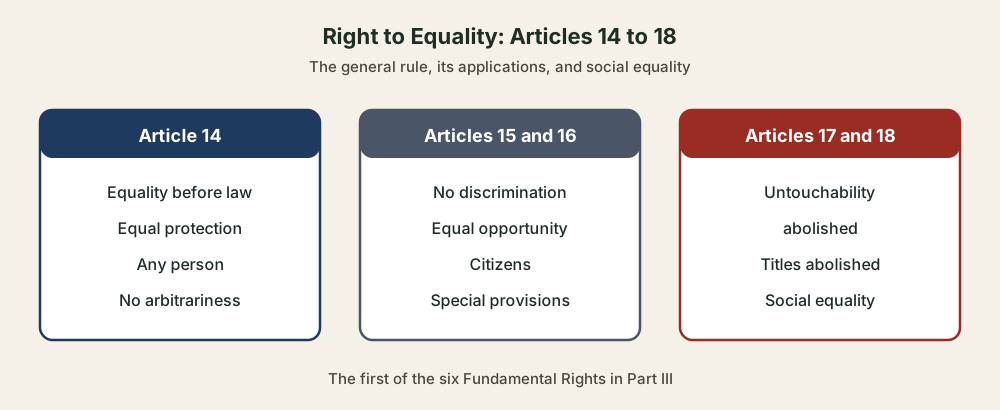
The right to equality is the first Fundamental Right in Part III of the Constitution, set out in Articles 14 to 18. Article 14 guarantees equality before law and the equal protection of the laws to every person; Articles 15 and 16 forbid discrimination and allow special provisions; Article 17 abolishes untouchability; and Article 18 abolishes titles.
Right to Equality: Articles 14 to 18 at a Glance
What Is the Right to Equality? Five Articles and Who Can Claim Them
The right to equality is the first of the six Fundamental Rights of the Indian Constitution. It runs across five articles, from Article 14 to Article 18. Article 14 states the general rule for every person, and the next four apply it to the places where inequality was sharpest in India: discrimination in public places, government jobs, untouchability and titles of nobility.
| Article | What it says | Who can claim it |
|---|---|---|
| 14 | Equality before law and equal protection of the laws | Any person, citizen or foreigner, including companies |
| 15 | No discrimination on grounds only of religion, race, caste, sex or place of birth; special provisions allowed | Citizens |
| 16 | Equality of opportunity in public employment; reservation allowed | Citizens |
| 17 | Untouchability abolished and its practice in any form forbidden | Everyone; it binds private persons too |
| 18 | Titles abolished, except military and academic distinctions | Binds the State, citizens and office-holders |
Two kinds of equality run through these articles. Articles 14 to 16 are about legal equality and equal opportunity, while Articles 17 and 18 carry the idea of social equality, ending practices that ranked people by birth. That is why untouchability, a social evil, sits inside the right to equality rather than the right against exploitation.
Article 14: Equality Before Law and Equal Protection of Laws
Equality Before Law and Equal Protection of Laws: British and American Roots
Article 14 says that the State shall not deny to any person equality before the law or the equal protection of the laws within the territory of India. It protects every person, citizen or foreigner, and the word person includes legal persons such as companies, statutory corporations and registered societies.
The article joins two ideas from two traditions. Equality before law is of British origin and is a negative idea: no one has special privileges, and everyone, rich or poor, official or not, is subject to the ordinary law in the ordinary courts. Equal protection of laws comes from the American Constitution and is a positive idea: people in similar circumstances must be treated alike, both in the privileges the law gives and the liabilities it imposes.
Reasonable Classification: The Two-Prong Test Under Article 14
Article 14 forbids class legislation, a law that favours or burdens a group for no good reason, but it allows reasonable classification of persons, objects and transactions. The classification must not be arbitrary, artificial or evasive. In State of West Bengal v. Anwar Ali Sarkar (1952) the Supreme Court said there must be a yardstick that separates those included in a class from those left out.
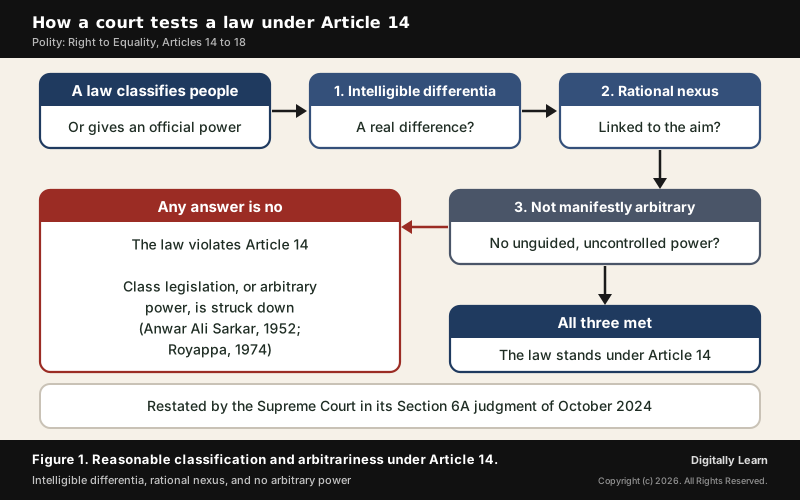
- Intelligible differentia: There must be a real, understandable difference between those in the group and those left out.
- Rational nexus: The difference must have a reasonable connection with the object the law seeks to achieve.
The Supreme Court restated this two-prong test in its Section 6A judgment of October 2024. It added that the standard is stricter where a law touches constitutional rights, and that courts give the legislature more room in fiscal matters.
Arbitrariness and the Rule of Law Under Article 14
The classification test asks whether a law groups people sensibly. A second line of cases asks whether an act is arbitrary at all. In E. P. Royappa v. State of Tamil Nadu (1974) the Supreme Court held that equality is the opposite of arbitrariness: an arbitrary act is unequal by its nature and so violates Article 14. Later cases, among them Shayara Bano (2017) and Navtej Singh Johar (2018), struck down laws as manifestly arbitrary.
Equality before law is also part of the rule of law, as the British jurist A. V. Dicey described it. His idea has three elements, and the first two apply in India.
- Absence of arbitrary power: No one can be punished except for a breach of law.
- Equality before the law: Everyone, of whatever rank, is subject to the ordinary law administered by the ordinary courts.
- Primacy of individual rights: In Britain the constitution results from rights enforced by the courts. In India the reverse holds, because the Constitution is the source of the rights.
The Supreme Court has held that the rule of law in Article 14 is a basic feature of the Constitution, so even an amendment cannot destroy it. The absence of arbitrary power also explains why a law that gives an official an unguided and uncontrolled discretion fails: such a power is arbitrary power.
Exceptions to Equality Before Law: Article 361 and Other Immunities
Equality before law is not absolute. The Constitution and international law create a few exceptions, each tied to an office or a function rather than to a person's rank.
- President and Governors (Article 361): They are not answerable to any court for the exercise of their powers. No criminal case can be started or continued against them during their term of office, and no process for their arrest can issue. Civil cases for personal acts need two months’ notice.
- Reports of legislatures (Article 361A): No one can be sued for publishing a substantially true report of proceedings in Parliament or a State Legislature.
- Members of legislatures (Articles 105 and 194): No member is liable in court for anything said or any vote given in the House or its committees.
- Article 31C: Laws giving effect to Article 39(b) or (c) cannot be challenged under Article 14; the Supreme Court put it as “where Article 31-C comes in, Article 14 goes out”.
- Foreign sovereigns, diplomats and the United Nations: They enjoy immunity from civil and criminal proceedings.
These immunities protect the working of an office. The President's powers and immunities show how the line is drawn: the office is shielded, but its acts remain open to review in other ways.
Article 15: Prohibition of Discrimination and Special Provisions
Article 15(1) and 15(2): Discrimination by the State and in Public Places
Article 15(1) forbids the State to discriminate against any citizen on grounds only of religion, race, caste, sex, place of birth or any of them. Two words carry the meaning. Discrimination means an adverse distinction, treating someone unfavourably. Only means that discrimination on other grounds, such as residence, is not barred by this clause.
Article 15(2) goes further. No citizen may be denied access, on those grounds, to shops, public restaurants, hotels and places of public entertainment, or the use of wells, tanks, bathing ghats, roads and places of public resort maintained by the State or dedicated to the public. Clause (1) binds only the State; clause (2) binds private persons as well.
The courts have read the grounds in light of present-day equality. Article 15 has been used to protect people against discrimination on grounds of sexual orientation and gender identity, and the Supreme Court has said that it should be read with an eye to intersectionality, where several grounds of disadvantage meet in one person.
Special Provisions Under Article 15(3), 15(4) and 15(5)
The rule against discrimination is followed by clauses that allow the State to help groups that need it. They turn formal equality into equality in fact, and each was added when a case showed the need.
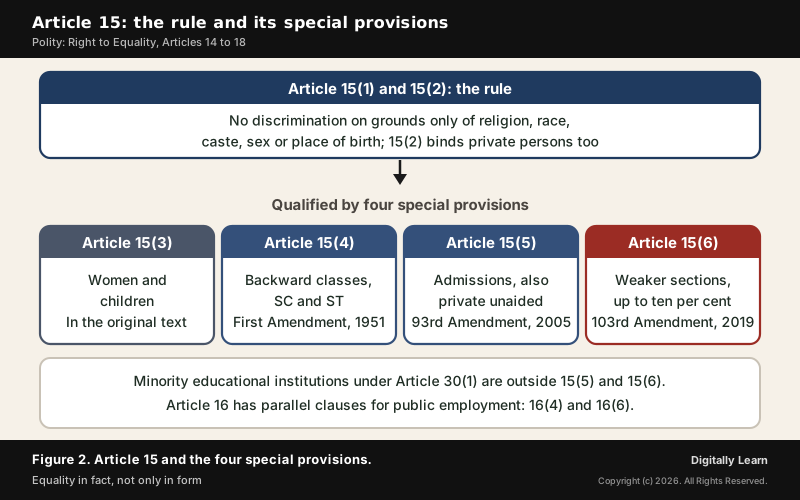
- Article 15(3): Special provisions for women and children, such as reserved seats for women in local bodies or free education for children.
- Article 15(4): Added by the First Amendment of 1951 after State of Madras v. Champakam Dorairajan, in which the Supreme Court upheld the striking down of a Madras order of 1927 that reserved government jobs and college seats by caste. It allows special provisions for socially and educationally backward classes and for Scheduled Castes and Scheduled Tribes.
- Article 15(5): Added by the 93rd Amendment of 2005 and in force from 20 January 2006. It allows reservation in admission to educational institutions, including private unaided ones, but not minority institutions under Article 30(1).
To give effect to Article 15(5), Parliament passed the Central Educational Institutions (Reservation in Admission) Act, 2006, which reserved 27 per cent of seats for Other Backward Classes in central institutions, including the IITs and IIMs. In April 2008, in Ashoka Kumar Thakur v. Union of India, the Supreme Court upheld both the amendment and the Act, but directed that the creamy layer be excluded from the OBC quota.
Economically Weaker Sections: Articles 15(6), 16(6) and the 103rd Amendment
The 103rd Amendment Act of 2019, in force from 14 January 2019, added Articles 15(6) and 16(6). They allow special provisions, including reservation, for economically weaker sections of citizens other than the classes already covered by Articles 15(4), 15(5) and 16(4). The reservation is in addition to the existing quotas and subject to a maximum of ten per cent.
Who counts as economically weaker is left to the State, which notifies it from time to time on the basis of family income and other indicators of economic disadvantage. For central government jobs, the Department of Personnel and Training's order of 31 January 2019 counts a family as economically weaker if its gross annual income is below 8 lakh rupees, unless it owns 5 acres of agricultural land or more or a residential flat of 1,000 square feet or more. The amendment was challenged as breaking the basic structure, because it rests on economic criteria alone and leaves out the backward classes already covered. In Janhit Abhiyan v. Union of India the Supreme Court upheld it.
Article 16: Equality of Opportunity in Public Employment
Article 16 Clauses: Equal Opportunity and Its Exceptions
Article 16 guarantees equality of opportunity for all citizens in matters of employment or appointment to any office under the State. Clause (2) lists the grounds on which no citizen can be ineligible or discriminated against: religion, race, caste, sex, descent, place of birth and residence. Descent and residence are not in Article 15, so Article 16 is wider on its own subject.
- Article 16(3): Parliament may prescribe residence as a condition for certain jobs in a State or Union Territory. The Public Employment (Requirement as to Residence) Act of 1957 expired in 1974.
- Article 16(4): The State may reserve appointments or posts for any backward class of citizens that is not adequately represented in its services.
- Article 16(4A) and 16(4B): Reservation in promotion for Scheduled Castes and Scheduled Tribes, and carrying unfilled reserved vacancies forward.
- Article 16(5): An office connected with a religious or denominational institution may be reserved for a person of that religion or denomination.
- Article 16(6): Up to ten per cent of posts for economically weaker sections.
Article 16 has to be read with Article 335, which says that the claims of Scheduled Castes and Scheduled Tribes to services and posts shall be taken into consideration consistently with the maintenance of efficiency of administration. Article 335 names efficiency of administration but does not define it.
Mandal Commission and the Indra Sawhney Judgment, 1992
In 1979 the Morarji Desai Government appointed the Second Backward Classes Commission under B. P. Mandal, under Article 340. Its report of 1980 identified 3,743 castes as socially and educationally backward, about 52 per cent of the population excluding Scheduled Castes and Scheduled Tribes, and recommended 27 per cent of government jobs for them, so that total reservation would come to 50 per cent.
The V. P. Singh Government declared the 27 per cent quota in 1990. In 1991 the Narasimha Rao Government added a preference for the poorer among the OBCs and a further 10 per cent for economically backward people outside existing quotas. In Indra Sawhney v. Union of India (1992) the Supreme Court upheld the 27 per cent quota and struck down the extra 10 per cent, laying down conditions that still shape reservation.
- The creamy layer, the advanced sections among the OBCs, must be excluded.
- There is no reservation in promotions; existing reservation in promotions could continue for five years.
- Total reservation should not exceed 50 per cent, except in extraordinary situations.
- The carry-forward of unfilled vacancies is valid, within the 50 per cent rule.
- A permanent statutory body should examine inclusion in and exclusion from the OBC lists.
The government followed with the Ram Nandan Committee on the creamy layer, whose 1993 report was accepted, and the National Commission for Backward Classes, set up by law in 1993. The broader policy story is told on the page on reservation in India.
Reservation in Promotions and Backlog: 77th, 81st and 85th Amendments
Parliament amended Article 16 three times to answer Indra Sawhney. Each amendment reversed one part of the ruling, and each was then tested in court.
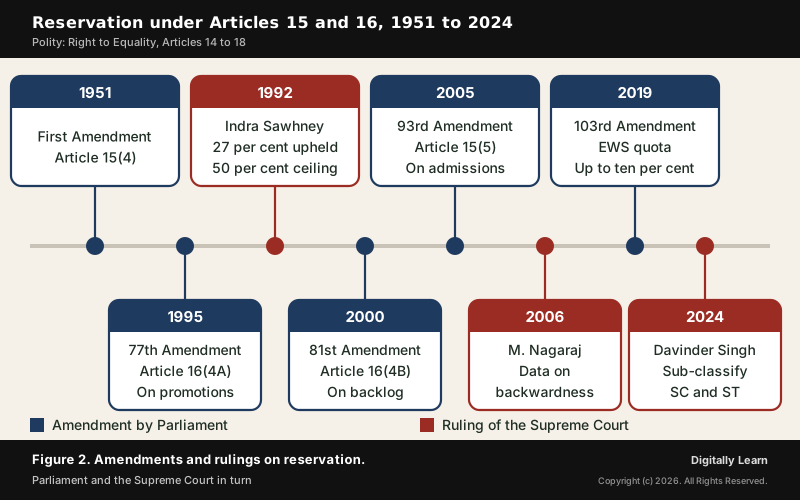
- 77th Amendment (1995): Added Article 16(4A), allowing reservation in promotion for Scheduled Castes and Scheduled Tribes who are not adequately represented.
- 81st Amendment (2000): Added Article 16(4B), so that unfilled reserved vacancies of a year form a separate class and are not counted against the 50 per cent ceiling of the year in which they are filled.
- 85th Amendment (2001): Gave consequential seniority to those promoted through reservation, with effect from 17 June 1995.
- 76th Amendment (1994): Placed Tamil Nadu’s law providing 69 per cent reservation in the Ninth Schedule, beyond the 50 per cent ceiling.
In M. Nagaraj v. Union of India (2006) the Supreme Court upheld these amendments but called them enabling provisions. A State that wishes to reserve posts in promotion must show compelling reasons: backwardness, inadequacy of representation and overall administrative efficiency, supported by quantifiable data.
Creamy Layer and Sub-Classification: From 1993 to Davinder Singh, 2024
The creamy layer is the better-off section of a backward class, kept out of reservation so that the benefit reaches those still disadvantaged. It covers the children of holders of constitutional posts, senior officers, professionals and people above an income limit. The income ceiling, first set in 1993, has been raised several times and has stood at 8 lakh rupees since 2017.
A newer question is whether reserved groups can be divided further. In State of Punjab v. Davinder Singh (2024) a seven-judge bench of the Supreme Court held, by a 6:1 majority, that States may sub-classify the Scheduled Castes and Scheduled Tribes so that the most disadvantaged among them receive a fair share of the reservation.
Article 17: Abolition of Untouchability
Article 17 and the Protection of Civil Rights Act, 1955
Article 17 abolishes untouchability and forbids its practice in any form. Enforcing any disability arising out of untouchability is an offence punishable in accordance with law. The Constitution does not define untouchability, and neither does the law made under the article.
The Mysore High Court held that Article 17 refers not to untouchability in a literal sense but to the practice as it developed historically in India: the social disabilities imposed on some classes because of their birth in certain castes. So it does not cover the social boycott of a few individuals or their exclusion from religious services.
Parliament gave effect to the article through the Untouchability (Offences) Act, 1955, amended and renamed in 1976 as the Protection of Civil Rights Act, 1955. A person convicted of an untouchability offence is disqualified from election to Parliament or a State Legislature. The Act treats these acts as offences, among others:
- Preventing a person from entering or worshipping in a place of public worship.
- Justifying untouchability on traditional, religious, philosophical or other grounds, or preaching it.
- Denying access to shops, hotels or places of public entertainment, or refusing to sell goods or render services.
- Insulting a member of a Scheduled Caste on the ground of untouchability.
- Refusing admission to hospitals, educational institutions or hostels established for public benefit.
Untouchability Beyond the State: Private Persons and the Atrocities Act, 1989
Most Fundamental Rights protect a person against the State, but Article 17 binds everyone. The Supreme Court has held that the right under Article 17 is available against private individuals, and that the State has a constitutional duty to take the steps needed to stop its violation.
The Scheduled Castes and Scheduled Tribes (Prevention of Atrocities) Act, 1989 carries this duty further. Parliament passed it because the existing law, the Protection of Civil Rights Act and the Indian Penal Code, had proved inadequate to check caste-based hate crimes. Passed on 11 September 1989 and notified on 30 January 1990, it was comprehensively amended in 2015 and amended again in 2018 and 2019.
Article 18: Abolition of Titles
Article 18: Four Rules on Titles, and Why Bharat Ratna Is Not a Title
Article 18 removes titles that set some people above others. Hereditary titles of the colonial era, such as Maharaja, Rai Bahadur and Dewan Bahadur, went against the equal status of all and are banned. The article makes four rules.
- The State shall confer no title, except a military or academic distinction, on anyone, citizen or foreigner.
- No citizen of India shall accept a title from any foreign State.
- A foreigner holding an office of profit or trust under the State cannot accept a title from a foreign State without the consent of the President.
- No one holding an office of profit or trust under the State may accept any present, emolument or office from a foreign State without the consent of the President.
The national awards, the Bharat Ratna, Padma Vibhushan, Padma Bhushan and Padma Shri, were instituted in 1954. They have been suspended twice: from July 1977 to January 1980, when the Janata Party Government discontinued them, and from August 1992 to December 1995, when public interest litigations in the Kerala and Madhya Pradesh High Courts questioned whether they were titles under Article 18(1).
In Balaji Raghavan v. Union of India (1996) the Supreme Court upheld the awards. It held that Article 18 bans only hereditary titles of nobility, and that equality does not require merit to go unrecognised. It also said the awards must not be used as a prefix or suffix to a name; an awardee who does so should forfeit the award.
Right to Equality in India and the United States Compared
Equality in the Indian and American Constitutions: Same Root, Different Paths
India took the idea of equal protection from the United States, where the Equal Protection Clause of the Fourteenth Amendment, in force since 1868, says that no State shall deny to any person the equal protection of the laws. Both require people in similar situations to be treated alike. The paths part on what equality may do for disadvantaged groups.
| Point | India | United States |
|---|---|---|
| Text of the guarantee | Equality before law and equal protection (Article 14), with specific articles 15 to 18 | Equal protection of the laws (Fourteenth Amendment, 1868) |
| Help for disadvantaged groups | Written into the text: Articles 15(3) to 15(6) and 16(4) to 16(6) | The clause itself is silent; in 2023 race-based admissions were held to violate it |
| Whom it binds | The State; Articles 15(2) and 17 also bind private persons | The clause is addressed to the States |
| Origin | Equality before law from Britain; equal protection from the United States | The Fourteenth Amendment of 1868, one of the Reconstruction Amendments |
In Students for Fair Admissions v. Harvard (2023) the United States Supreme Court held that race-based affirmative action in most college admissions violates the Equal Protection Clause. In India the opposite question cannot arise in that form, because the Constitution itself says that Articles 15 and 16 shall not prevent special provisions and reservation. Indian equality is substantive by design: it allows unequals to be treated differently so that they can become equal.
The Directive Principles add a further layer, asking the State to reduce inequalities of income and opportunity. Their relation with Part III is explained on the page on the Directive Principles of State Policy.
Previous Year UPSC-CSE Questions
Previous Year UPSC-CSE Questions By the end you will be able to draft model answers for the following UPSC questions. Each question carries a collapsible framework showing how to approach it in the exam.
- UPSC Mains 2021 GS-IIAnalyze the distinguishing features of the notion of Right to Equality in the Constitutions of the USA and India.
Answer outline: how to structure the answer
What the question asks, the main arguments, relevant examples and the direction of the conclusion. This is not a full model answer.
Introduction: India took equal protection of the laws from the Fourteenth Amendment of the United States and equality before law from Britain, but built a different idea of equality on them.
Body (sub-themes to develop):
- Common ground: like cases treated alike; classification tested by the courts (Article 14; the Equal Protection Clause of 1868).
- India writes substantive equality into the text: Articles 15(3) to 15(6) and 16(4) to 16(6) allow special provisions and reservation; Indra Sawhney (1992) and Davinder Singh (2024) shape them.
- India reaches social inequality and private conduct: Article 17 abolishes untouchability and binds private persons; Article 15(2) covers shops and public places; Article 18 abolishes titles.
- The United States: the clause is silent on special help, and Students for Fair Admissions v. Harvard (2023) held race-based admissions to violate equal protection.
Conclusion: Conclude that Indian equality is substantive by design, allowing unequals to be treated differently so that they can become equal.
- UPSC Prelims 2021 Prelims-GSA legislation which confers on the executive or administrative authority an unguided and uncontrolled discretionary power in the matter of application of law violates which one of the following Articles of the Constitution of India?
How to approach this Prelims question
Approach: Unguided and uncontrolled discretion means an official can treat like cases differently at will. That is arbitrary power, and since Royappa (1974) arbitrariness is treated as the opposite of equality under Article 14; the first element of the rule of law, absence of arbitrary power, says the same. The other articles concern religious instruction, the remedy in the Supreme Court and a Directive Principle.
Trap to watch: Article 32 sounds right because it is about enforcing rights, but it is the remedy, not the right that is violated.
Key facts to recall:
- (a) Article 14: right. Unguided discretion is arbitrary power, which violates equality before law.
- (b) Article 28: wrong. It deals with religious instruction in educational institutions.
- (c) Article 32: wrong. It is the right to move the Supreme Court, the remedy, not the right violated.
- (d) Article 44: wrong. It is a Directive Principle on a uniform civil code.
Answer signal: Option (a): arbitrary power violates Article 14.
- UPSC Prelims 2018 Prelims-GSWhich of the following are regarded as the main features of the 'Rule of Law'?
- Limitation of powers
- Equality before law
- People's responsibility to the Government
- Liberty and civil rights
Select the correct answer using the code given below:
How to approach this Prelims question
Approach: Match each item with Dicey's elements. 1, limitation of powers: the absence of arbitrary power. 2, equality before law: the second element. 4, liberty and civil rights: the primacy of individual rights. 3, the people's responsibility to the Government, inverts the idea; the rule of law binds the government to law, not the people to the government. 1, 2 and 4.
Trap to watch: Item 3 sounds civic but reverses the direction of the rule of law.
Key facts to recall:
- (a) 1 and 3 only: wrong. Item 3 is not a feature, and items 2 and 4 are left out.
- (b) 2 and 4 only: wrong. Limitation of powers, item 1, is left out.
- (c) 1, 2 and 4 only: right. Limited power, equality before law and liberty are the features.
- (d) 1, 2, 3 and 4: wrong. The people's responsibility to the Government is not a feature of the rule of law.
Answer signal: Option (c): the rule of law limits power, makes all equal before law and protects liberty.
- UPSC Prelims 2023 Prelims-GSConsider the following statements :
- Statement-I : The Supreme Court of India has held in some judgements that the reservation policies made under Article 16(4) of the Constitution of India would be limited by Article 335 for maintenance of efficiency of administration.
- Statement-II : Article 335 of the Constitution of India defines the term 'efficiency of administration'.
Which one of the following is correct in respect of the above statements?
How to approach this Prelims question
Approach: Statement I: the Supreme Court has tied reservation to efficiency of administration; in M. Nagaraj (2006) a State must show backwardness, inadequate representation and overall administrative efficiency, which is the concern of Article 335. Correct. Statement II: Article 335 says claims shall be considered consistently with the maintenance of efficiency of administration, but it does not define the phrase. Incorrect. So I is correct and II is not.
Trap to watch: The phrase efficiency of administration appears in Article 335, which makes Statement II look true; appearing is not defining.
Key facts to recall:
- (a) Both correct and II explains I: wrong. Statement II is incorrect.
- (b) Both correct but II does not explain I: wrong. Statement II is incorrect.
- (c) Statement-I is correct but Statement-II is incorrect: right. The courts link reservation to efficiency; Article 335 does not define it.
- (d) Statement-I is incorrect but Statement-II is correct: wrong. It reverses the two.
Answer signal: Option (c): Article 335 names efficiency of administration but does not define it.
- UPSC Prelims 2020 Prelims-GSWhich one of the following categories of Fundamental Rights incorporates protection against untouchability as a form of discrimination?
How to approach this Prelims question
Approach: Article 17 abolishes untouchability, a practice that ranked people by birth. It belongs with Articles 14 to 18, the right to equality, which carry the idea of social equality. The right against exploitation, Articles 23 and 24, deals with trafficking, forced labour and child labour.
Trap to watch: Untouchability feels like exploitation, but the Constitution places it in the right to equality.
Key facts to recall:
- (a) Right against Exploitation: wrong. Articles 23 and 24 deal with trafficking, forced labour and child labour.
- (b) Right to Freedom: wrong. Articles 19 to 22 deal with freedoms and personal liberty.
- (c) Right to Constitutional Remedies: wrong. Article 32 is the remedy, not a right against untouchability.
- (d) Right to Equality: right. Article 17 is one of Articles 14 to 18.
Answer signal: Option (d): Article 17 is part of the right to equality.
- UPSC Prelims 2002 Prelims-GSIn the Indian Constitution, the Right to Equality is granted by Five Articles. They are
How to approach this Prelims question
Approach: The right to equality runs from Article 14, equality before law, to Article 18, abolition of titles. Article 19 begins the right to freedom, so any range that includes 19 or 20 is wrong, and Article 13 is about void laws, not equality.
Trap to watch: Neighbouring ranges differ by one article; anchor on 14 to 18.
Key facts to recall:
- (a) Article 16 to Article 20: wrong. Articles 19 and 20 belong to the right to freedom.
- (b) Article 15 to Article 19: wrong. It leaves out Article 14 and adds Article 19.
- (c) Article 14 to Article 18: right. These five articles form the right to equality.
- (d) Article 13 to Article 17: wrong. Article 13 is about laws inconsistent with Part III, and Article 18 is left out.
Answer signal: Option (c): Articles 14 to 18.
- UPSC Prelims 1995 Prelims-GSProhibition of discrimination on grounds of religion, etc. (Article 15 of the Constitution of India) is a Fundamental Right classifiable under
How to approach this Prelims question
Approach: Article 15 forbids discrimination on grounds of religion, race, caste, sex or place of birth. It is one of Articles 14 to 18, the right to equality. The word religion in it does not make it part of the freedom of religion, Articles 25 to 28.
Trap to watch: The word religion in Article 15 pulls towards the freedom of religion.
Key facts to recall:
- (a) the Right to Freedom of Religion: wrong. That is Articles 25 to 28.
- (b) the Right against Exploitation: wrong. That is Articles 23 and 24.
- (c) the Cultural and Educational Rights: wrong. That is Articles 29 and 30.
- (d) the Right to Equality: right. Article 15 is one of Articles 14 to 18.
Answer signal: Option (d): Article 15 is in the right to equality.
- UPSC Prelims 2004 Prelims-GSMatch List I (Articles of the Constitution of India) with List II (Provision) and select the correct answer using the codes given below the lists: List I (A) Article 14 (B) Article 15 (C) Article 16 (D) Article 17 List II
- The State shall not discriminate against any citizen on grounds only of religion, race, caste, sex, place of birth or any of them
- The State shall not deny to any person equality before the law or the equal protection of laws within the territory of India
- “Untouchability” is abolished and its practice in any form is forbidden
- There shall be equality of opportunity for all citizens in matters relating to employment or appointment to any office under the State Codes: A B C D
How to approach this Prelims question
Approach: Match each article with its text. A, Article 14: equality before the law and equal protection of laws (2). B, Article 15: no discrimination on grounds of religion, race, caste, sex or place of birth (1). C, Article 16: equality of opportunity in public employment (4). D, Article 17: untouchability abolished (3). The code is 2 1 4 3.
Trap to watch: Articles 15 and 16 both speak of discrimination; employment is the word that marks Article 16.
Key facts to recall:
- (a) 2 4 1 3: wrong. It swaps Articles 15 and 16.
- (b) 3 1 4 2: wrong. It swaps Articles 14 and 17.
- (c) 2 1 4 3: right. Equality before law, non-discrimination, public employment, untouchability.
- (d) 3 4 1 2: wrong. Every pair is mismatched.
Answer signal: Option (c): 14-2, 15-1, 16-4, 17-3.
Sources and Further Reading
- Legislative Department, Ministry of Law and Justice: The Constitution of India
- NCERT: Indian Constitution at Work, Class 11, Chapter 2, Rights in the Indian Constitution
- Supreme Court of India: In Re Section 6A of the Citizenship Act, judgment of 17 October 2024
- Department of Personnel and Training: Office Memorandum on reservation for Economically Weaker Sections, 31 January 2019
- Constituent Assembly Debates, Volume XI: B. R. Ambedkar's reply to the debate, 25 November 1949
- Wikipedia: Indra Sawhney and Others v. Union of India
- Wikipedia: Reservation in India
- Wikipedia: Creamy layer
- Wikipedia: One Hundred and Third Amendment of the Constitution of India
- Wikipedia: Janhit Abhiyan v. Union of India
- Wikipedia: State of Punjab v. Davinder Singh
- Wikipedia: Ashoka Kumar Thakur v. Union of India
- Wikipedia: State of Madras v. Champakam Dorairajan
- Wikipedia: Article 15 of the Constitution of India
- Wikipedia: Scheduled Castes and Scheduled Tribes (Prevention of Atrocities) Act, 1989
- Wikipedia: Bharat Ratna
- Wikipedia: Equal Protection Clause
- Wikipedia: Students for Fair Admissions v. Harvard
Editorial Disclaimer
This article explains the right to equality from the text of the Constitution, Supreme Court judgments, NCERT and the other sources listed. It is study material, not legal advice.


