


Overview
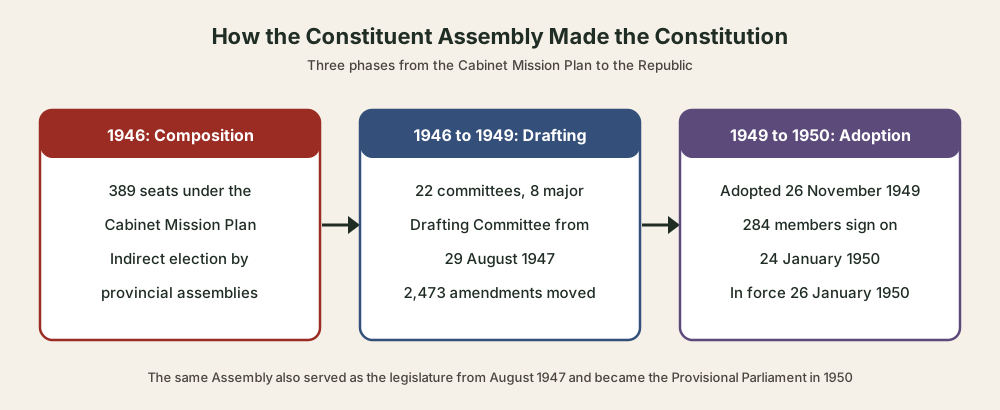
The Constituent Assembly of India was the body that framed the Constitution. Formed under the Cabinet Mission Plan of 1946 with 389 seats, its provincial members were elected indirectly by the provincial legislative assemblies. It first met on 9 December 1946, worked through committees and a Drafting Committee chaired by B. R. Ambedkar, and adopted the Constitution on 26 November 1949.
Constituent Assembly of India: Meaning and Role
The Body That Framed and Adopted the Constitution
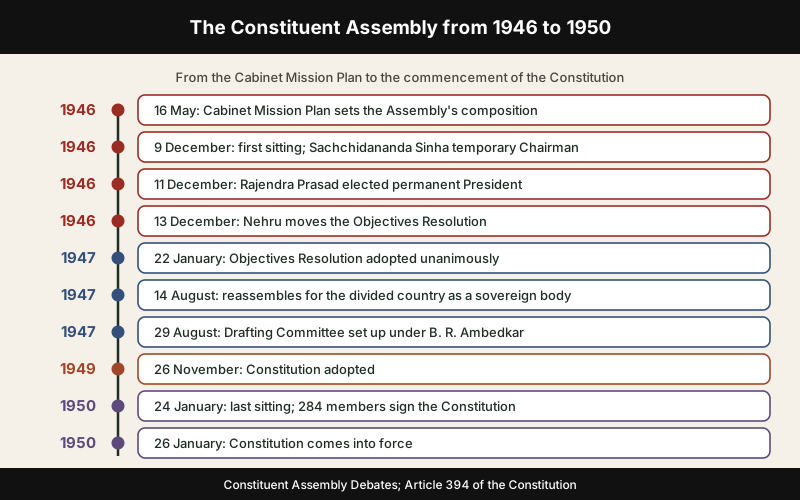
The Constituent Assembly of India was the body of indirectly elected representatives that framed the Constitution of India. It first met on 9 December 1946, adopted the Constitution on 26 November 1949 and held its last sitting on 24 January 1950, when members signed the text that came into force two days later.
The Assembly matters because the authority of the Constitution rests on how it was made. Its members were chosen by the Provincial Legislative Assemblies rather than by universal suffrage, yet it debated every clause in sessions open to the press and the public, and the recorded debates of that public reason are still used to read the text.
The significance of the Constituent Assembly lies in four roles it performed between 1946 and 1950, which together explain why its record is studied so closely:
- Constitution-making body: It drafted, debated and adopted the Constitution, dealing with 2,473 amendments actually moved out of about 7,635 tabled.
- Legislature: After independence it also legislated for the Dominion, and on 26 January 1950 it became the Provisional Parliament.
- Self-rule in law: It replaced the Government of India Act, 1935, which the Congress had rejected in 1936 as an imposition on the people.
- Forum of consensus: Eight major committees, usually chaired by Nehru, Prasad, Patel or Ambedkar, drafted provisions that the whole Assembly then debated.
Why a Constitution Framed by Indians Mattered in 1946
Before independence, the principal framework of government was the Government of India Act, 1935, a statute of the British Parliament. A constitution adopted by an assembly of Indian representatives would draw its authority from the people rather than from London, which is why the national movement demanded such an assembly.
The Assembly also inherited a background consensus. Principles such as democracy, equality, liberty and sovereignty had been debated for decades during the freedom struggle, and the Objectives Resolution of 1946 gave them their clearest summary before drafting began.
The political story of how the Assembly fitted into nation-building is told in Making of the Constitution: The Constituent Assembly. This article concentrates on the constitutional record: the demand, composition, officers, committees, drafting, adoption, the debt to the 1935 Act and the criticisms of the Assembly.
Demand for a Constituent Assembly: From 1936 to the Cabinet Mission
Congress Demand of 1936 and the Call for Adult Franchise
The Indian National Congress raised the official demand for a Constituent Assembly at its Lucknow session of April 1936, presided over by Jawaharlal Nehru. The same session rejected the Government of India Act, 1935 as an imposition on the people of India.
The demand was renewed as war approached. On 15 November 1939, C. Rajagopalachari again called for a Constituent Assembly based on adult franchise, a principle that the eventual Assembly wrote into the Constitution even though its own members were chosen indirectly.
August Offer of 1940 and the Cripps Proposals of 1942
The British first conceded the principle in the August Offer. On 8 August 1940, Viceroy Lord Linlithgow announced an expanded Executive Council and a War Advisory Council, and the offer included giving full weight to minority opinions and allowing Indians to draft their own constitution.
The Cripps Mission of late March 1942, led by Sir Stafford Cripps, went further. It offered full dominion status at the end of the war, with a constituent assembly to frame the constitution, but it also allowed provinces to opt out of a future Indian Constituent Assembly.
Both major parties rejected the proposals. The Congress signalled its opposition on 2 April 1942 because the opt-out clause opened the way to partition, while the Muslim League rejected them because they did not clearly accept the demand for Pakistan.
Cabinet Mission Plan of 1946: The Scheme Behind the Assembly
The Assembly was finally created under the Cabinet Mission Plan of 1946. Formed at the initiative of Prime Minister Clement Attlee, the mission consisted of three Cabinet ministers, Lord Pethick-Lawrence, Sir Stafford Cripps and A. V. Alexander, and the Viceroy, Lord Wavell, took part in some of its discussions.
The plan of 16 May 1946 laid down the composition and structure of the Constituent Assembly. It also proposed a three-tier scheme for British India: a Union at the top, provinces at the bottom and three groups of provinces, called A, B and C, in the middle.
The grouping scheme proved divisive. The Congress held that a sovereign constituent assembly would not be bound by the plan, Jinnah insisted it was binding once accepted, and the Muslim League withdrew its earlier approval of the plan on 29 July 1946.
Composition of the Constituent Assembly Under the Cabinet Mission Plan
Allocation of 389 Seats in Proportion to Population
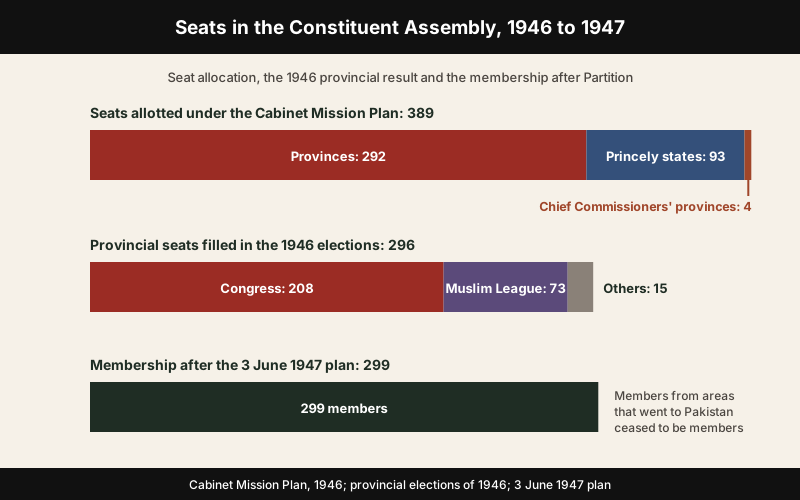
Seats were allotted to each province and to each princely state or group of states in proportion to population, at about one seat for every ten lakh people, a ratio of 1:10,00,000. The total membership was fixed at 389.
| Category | Seats | How the members were chosen |
|---|---|---|
| Provinces under direct British rule | 292 | Elected by the Provincial Legislative Assemblies |
| Chief Commissioners' provinces: Delhi, Ajmer-Merwara, Coorg and British Baluchistan | 4 | Elected in 1946 as part of the 296 seats for British Indian provinces |
| Princely states | 93 (minimum) | Method to be settled by consultation |
| Total | 389 | Reduced to 299 after Partition |
After the 3 June 1947 plan, members elected from territories that went to Pakistan ceased to be members, and the Assembly's strength fell to 299. The figure shows the allocation, the result of the provincial elections and the membership after Partition.
Indirect Election by Proportional Representation and Single Transferable Vote
Members from the provinces were not directly elected by the people. They were chosen by indirect election by the members of the Provincial Legislative Assemblies that had been established under the Government of India Act, 1935.
The seats in each province were divided among three communities, Muslims, Sikhs and general, in proportion to their populations. The members of each community in the Provincial Legislative Assembly then elected their own representatives by proportional representation with single transferable vote, while the method for the princely states was left to consultation.
This design explains a frequent point of confusion. The Assembly was representative but not directly elected: communities were represented in proportion to population, yet no provincial member faced a popular vote for a seat in the Assembly itself.
The 1946 Elections: Congress Majority and the Muslim League Boycott
Elections for the 296 seats assigned to the British Indian provinces were completed by August 1946. The Indian National Congress won 208 seats, about 69 per cent, the Muslim League won 73, and the remaining 15 went to smaller parties and independents.
The League then refused to cooperate, boycotted the Assembly and demanded a separate constituent assembly for Muslims. Published accounts record that 28 of its 73 members later joined the Assembly, and after Partition the Congress held about 82 per cent of the seats.
Representation of Scheduled Castes, Women and Minorities
There was a serious attempt to make the Assembly representative despite indirect election. Members of all religions were represented under the scheme, and the Assembly had twenty-eight members from the Scheduled Castes.
Women formed a smaller but distinct group. Published accounts record 17 women members by 1948, among them Hansa Mehta, Rajkumari Amrit Kaur, Sucheta Kripalani and G. Durgabai, and two of them, Hansa Mehta and Amrit Kaur, sat on the twelve-member Fundamental Rights Sub-Committee.
Minorities were also represented among the Assembly's officers. H. C. Mookerjee, a Christian from Bengal and a former vice-chancellor of Calcutta University, was elected Vice-President and chaired the Minorities Sub-Committee.
First Sessions and Officers of the Constituent Assembly, 1946
First Sitting on 9 December 1946 and the Temporary Chairman
The Assembly held its first sitting in the Constitution Hall, New Delhi, now the Central Hall of Parliament House, on 9 December 1946 at eleven in the morning. Published accounts record 207 members attending, while the Muslim League boycotted the meeting.
Acharya J. B. Kripalani invited Dr Sachchidananda Sinha to take the chair as temporary Chairman, describing him as the oldest member and the oldest parliamentarian in India. Sinha had served on the Imperial Legislative Council from 1910 to 1920, and he presided from 9 to 11 December 1946.
Sinha then had Frank Anthony nominated as Deputy Chairman, because on medical advice he could not work in the afternoons, and members began presenting their credentials and signing the register. The temporary office is also described as that of provisional President.
Election of Rajendra Prasad and the Assembly's Principal Officers
On 11 December 1946, the Assembly elected Dr Rajendra Prasad as its permanent President. H. C. Mookerjee became Vice-President, and V. T. Krishnamachari was elected a second Vice-President on 16 July 1948.
The Assembly's principal legal adviser was Sir B. N. Rau, its Constitutional Adviser, appointed in 1946. Rau travelled that year to the United States, Canada, Ireland and the United Kingdom to consult judges and scholars, and he prepared the initial draft on which the Drafting Committee later worked.
| Office | Holder | Note |
|---|---|---|
| Temporary Chairman | Dr Sachchidananda Sinha | 9 to 11 December 1946; the oldest member |
| President | Dr Rajendra Prasad | Elected on 11 December 1946 |
| Vice-Presidents | H. C. Mookerjee; V. T. Krishnamachari | Krishnamachari elected on 16 July 1948 |
| Constitutional Adviser | Sir B. N. Rau | Prepared the initial draft of 243 articles and 13 Schedules |
| Secretary | H. V. R. Iengar | Listed in the official report of the debates |
| Chairman, Drafting Committee | Dr B. R. Ambedkar | From 29 August 1947 |
Objectives Resolution: The Assembly's Statement of Aims
On 13 December 1946, Jawaharlal Nehru moved the Objectives Resolution, which defined the aims of the Assembly. The Assembly adopted it unanimously on 22 January 1947, and its principles later took shape in the Preamble.
The resolution declared India an independent, sovereign republic in which all power flowed from the people, and it promised justice, equality and fundamental freedoms, with adequate safeguards for minorities and for backward and tribal areas. Its text and its link to the Preamble are explained in Preamble to the Indian Constitution.
Independence and Partition: The Assembly Becomes Sovereign
The 3 June 1947 Plan and the Indian Independence Act
On 3 June 1947, Lord Mountbatten, the last Governor-General of British India, announced a plan that accepted the partition of British India and set aside the Cabinet Mission Plan. Each successor state could make its own constitution, and a separate Constituent Assembly was set up for Pakistan.
The Indian Independence Act, 1947 received Royal Assent on 18 July 1947 and created the two dominions of India and Pakistan from 15 August 1947. Members elected from territories that went to Pakistan ceased to belong to the Assembly, whose strength fell to 299 members.
Reassembly on 14 August 1947 as a Sovereign Body
The Assembly reassembled on 14 August 1947 as the Constituent Assembly for divided India. Published accounts describe it as meeting as a sovereign body and successor to the British Parliament's authority in India.
Partition also ended an old dispute. The Congress had argued in 1946 that a sovereign constituent assembly would not be bound by the Cabinet Mission Plan, while Jinnah held it binding; once Mountbatten set that plan aside in June 1947, the question no longer arose.
The Independence Act also let the Governor-General adapt the Government of India Act, 1935 until 31 March 1948, after which it was open to the Constituent Assembly to modify or adopt that Act. The Dominion was therefore governed under an adapted form of the old framework while the new one was drafted.
Dual Role: Constitution-Making Body and Legislature of the Dominion
From independence the Assembly carried two functions. It was given sovereign powers to legislate for the Dominion after the Imperial Legislative Council was abolished under the Independence Act, and it continued to frame the Constitution alongside ordinary law-making.
G. V. Mavalankar chaired the Committee on the Functions of the Constituent Assembly. He later became the first Speaker of the Lok Sabha after India became a republic, one of several links between the Assembly and the Parliament that followed it.
The dual role continued after the Constitution took effect. On 26 January 1950 the Assembly ceased to exist and transformed itself into the Provisional Parliament, whose members served until the first Parliament elected under the Constitution met in 1952.
Committees of the Constituent Assembly and Their Chairpersons
Twenty-Two Committees: The Eight Major Committees and Their Chairs
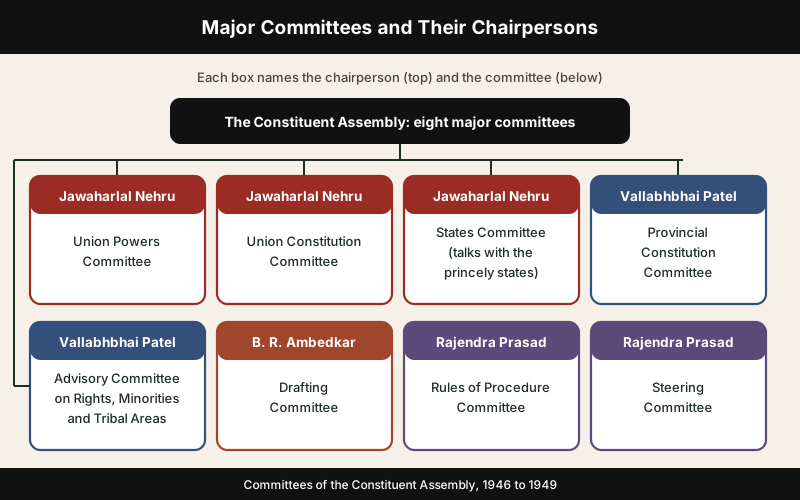
The Assembly divided its work among committees. Published accounts count 22 committees, of which eight were major committees, and these were usually chaired by Jawaharlal Nehru, Rajendra Prasad, Sardar Patel or B. R. Ambedkar.
Each committee usually drafted particular provisions, which the full Assembly then debated. The leaders who chaired them often disagreed, yet they worked together, and the Assembly generally tried to reach a consensus so that agreed provisions would not harm any particular interest.
| Committee | Chairperson |
|---|---|
| Union Powers Committee | Jawaharlal Nehru |
| Union Constitution Committee | Jawaharlal Nehru |
| States Committee (committee for negotiating with the states) | Jawaharlal Nehru |
| Provincial Constitution Committee | Vallabhbhai Patel |
| Advisory Committee on Fundamental Rights, Minorities and Tribal and Excluded Areas | Vallabhbhai Patel |
| Drafting Committee | B. R. Ambedkar |
| Rules of Procedure Committee | Rajendra Prasad |
| Steering Committee | Rajendra Prasad |
Nehru chaired three of the eight, including the Union Constitution Committee and the Union Powers Committee, while Ambedkar chaired only the Drafting Committee among the major bodies. The figure sets out the pattern.
Sub-Committees on Fundamental Rights, Minorities and Tribal Areas
The Advisory Committee chaired by Patel, which covered rights, minorities and tribal and excluded areas, had four sub-committees:
- Fundamental Rights Sub-Committee: J. B. Kripalani.
- Minorities Sub-Committee: H. C. Mookerjee.
- North-East Frontier Tribal Areas and Assam Excluded and Partially Excluded Areas Sub-Committee: Gopinath Bordoloi.
- Excluded and Partially Excluded Areas (other than those in Assam) Sub-Committee: Thakkar Bapa.
The Fundamental Rights Sub-Committee first met on 27 February 1947 with 12 members. Its report went to the Advisory Committee on 16 April 1947, and the Minorities Sub-Committee examined it over the following days before the Advisory Committee debated it.
Minor Committees: Procedure, Flag, Language and the House
Several minor committees dealt with the Assembly's own working. Prasad also chaired the Ad hoc Committee on the National Flag, and the national flag was adopted on 22 July 1947. Other chairs are listed below:
- Committee on the Functions of the Constituent Assembly: G. V. Mavalankar.
- House Committee: B. Pattabhi Sitaramayya.
- Order of Business Committee: K. M. Munshi.
- Language Committee: Moturi Satyanarayana.
Committee chairs are a tested point, as the linked question on the Union Constitution Committee shows, and one pattern is worth fixing: Nehru for the Union bodies and the States Committee, Patel for the provinces and rights, Prasad for procedure and the flag, and Ambedkar for drafting.
The Drafting Committee and the Draft Constitution
Drafting Committee of 29 August 1947: Chairman and Members
The Assembly set up the Drafting Committee on 29 August 1947, with Dr B. R. Ambedkar as Chairman, to prepare a Draft Constitution. The committee held its first meeting on 30 August 1947 and, by Ambedkar's account, sat for 141 days on the draft.
Its mandate was to scrutinise the draft prepared by the Constitutional Adviser, give effect to decisions already taken in the Assembly and submit the text of a Draft Constitution. The committee had seven members including the Chairman:
- B. R. Ambedkar (Chairman).
- K. M. Munshi.
- Muhammed Sadulla.
- Alladi Krishnaswami Ayyar.
- N. Gopalaswami Ayyangar.
- N. Madhava Rao, who replaced B. L. Mitter after he resigned owing to ill health.
- T. T. Krishnamachari, who replaced D. P. Khaitan after his death in 1948.
From the Adviser's Draft to 395 Articles: The Drafting Process
Published accounts describe five stages in the Assembly's work: committee reports on issues, an initial draft by B. N. Rau, a detailed draft by the Drafting Committee published for public discussion, debate with amendments, and final adoption. Ambedkar's figures show how the text grew.
| Stage | Size of the text |
|---|---|
| Draft prepared by the Constitutional Adviser | 243 articles and 13 Schedules |
| First Draft Constitution presented by the Drafting Committee | 315 articles and 8 Schedules |
| End of the consideration stage | 386 articles |
| Final form adopted on 26 November 1949 | 395 articles and 8 Schedules |
The debate on the draft was intense. About 7,635 amendments were tabled and 2,473 were actually moved in the House, and of the Assembly's eleven sessions covering 165 days, 114 days were spent considering the Draft Constitution.
Speaking in the Assembly on 4 November 1948, Ambedkar asked whether there could be anything new in a constitution framed so late in the history of the world. The only new things, he answered, could be the variations made to remove the faults and to accommodate it to the needs of the country.
Ambedkar's Role and the Credit He Shared With B. N. Rau
Ambedkar carried much of the drafting burden. T. T. Krishnamachari told the Assembly that of the seven members nominated, one had resigned and been replaced, one had died, one was in America and others were busy or unwell, so the burden fell on Dr Ambedkar.
Ambedkar himself shared the credit. On 25 November 1949 he said that the credit given to him did not really belong to him, attributing part of it to Sir B. N. Rau, who had prepared a rough draft, and part to the members of the Drafting Committee.
The President of the Assembly paid his own tribute on 26 November 1949. Rajendra Prasad said the Assembly could never have made a better decision than when it put Ambedkar on the Drafting Committee and made him its Chairman, adding that the other members deserved the thanks of the country.
Adoption, Signing and Commencement of the Constitution
Adoption on 26 November 1949 and Provisions in Force at Once
The Assembly adopted the Constitution on 26 November 1949, the date the Preamble records. Not every provision waited for the Republic: under Article 394, a small group of provisions came into force at once.
Those provisions were Article 394 itself and Articles 5 to 9, 60, 324, 366 and 367, 379 and 380, 388, and 391 to 393. They include the citizenship provisions of Articles 5 to 9, explained in Citizenship in India, the Election Commission provision of Article 324 and the definitions in Article 366.
Final Sitting on 24 January 1950: Signatures of 284 Members
The Assembly met for the last time on 24 January 1950. That day, 284 members who were present appended their signatures to the Constitution as finally passed, which contained 395 articles and 8 Schedules.
The Assembly's sittings were open to the press and the public. One provision passed with virtually no debate, universal suffrage, which members felt no need to discuss; every other matter, from the powers of the judiciary to the protection of property, was argued at length.
| Measure | Figure |
|---|---|
| Seats under the Cabinet Mission Plan | 389 |
| Membership after Partition | 299 |
| Committees (major committees) | 22 (8) |
| Sessions and days of sittings, by Ambedkar's count | 11 sessions over 165 days, 114 on the draft |
| Days the Drafting Committee sat | 141 |
| Amendments tabled and actually moved | About 7,635 tabled; 2,473 moved |
| Members who signed on 24 January 1950 | 284 |
| Size of the Constitution as adopted | 395 articles and 8 Schedules |
Commencement on 26 January 1950 and the Repeal of the 1935 Act
The rest of the Constitution came into force on 26 January 1950, which Article 394 calls the commencement of this Constitution and which is celebrated as Republic Day. On the same day, Article 395 repealed the Indian Independence Act, 1947 and the Government of India Act, 1935, with the enactments amending the latter.
Article 395 made one exception: it did not repeal the Abolition of Privy Council Jurisdiction Act, 1949. By then the work had taken almost three years; Ambedkar reckoned the period on 25 November 1949 at two years, eleven months and seventeen days since the first sitting.
Government of India Act, 1935: Groundwork for the Constitution
Features of the 1935 Act the Framers Inherited
The Government of India Act, 1935 received Royal Assent on 2 August 1935 and was the longest Act of the British Parliament until 1999. Its provincial part came into force on 1 April 1937, and provincial autonomy began after the elections of that year; its wider history is told in Government of India Act, 1935.
The Act created several institutions and arrangements that the Constituent Assembly would later adapt:
- Federation: An All India Federation of British Indian provinces and princely states as units, which never came into operation because the rulers of the states opposed it.
- Division of powers: Three lists, federal, provincial and concurrent, dividing legislative power between the centre and the units.
- Provincial autonomy: A large measure of autonomy for the provinces, ending the dyarchy of the 1919 Act, though governors kept important reserve powers.
- Institutions: The Federal Court, the Reserve Bank of India, and public service commissions at the federal and provincial levels.
- Franchise: Direct elections to provincial legislatures, raising the electorate from five million to 35 million.
The Act kept real power at the centre in British hands. It provided for dyarchy at the centre: through the Governor-General, the British government continued to control defence, foreign affairs, financial obligations and the British Indian Army, so these subjects never passed to the federal legislature.
How the 1935 Act Helped the Assembly Finish in About Three Years
A central question about the Assembly is how it drafted so long a Constitution in under three years. Part of the answer lies in the institutional inheritance of the 1935 Act, which the framers adapted rather than rebuilt, through five channels:
- Electoral base: The provincial members were elected by the Provincial Legislative Assemblies established under the 1935 Act, so the Assembly could be formed without new electoral machinery.
- Federal design: The Act’s federal, provincial and concurrent lists gave the framers a model for dividing power, which reappears as the Union, State and Concurrent Lists of the Seventh Schedule.
- Working experience: Provincial autonomy operated from 1937, and Congress provincial governments held office under the Act until they resigned en masse after war broke out in 1939, giving party leaders experience of responsible government.
- Expert drafting: B. N. Rau had worked on constitutional and federal questions in the Reforms Office, and his initial draft of 243 articles gave the Drafting Committee a text to start from.
- Continuity of law: The adapted 1935 Act governed the Dominion while the Assembly deliberated, so drafting did not have to wait on day-to-day administration.
Published accounts of the Constitution's sources say it drew mainly on the 1935 Act, alongside earlier Acts from 1858 onwards. The Assembly's own record shows that method also saved time: committees reported first, and the Drafting Committee worked from an adviser's text rather than a blank page.
Where the Constitution Broke With the 1935 Act
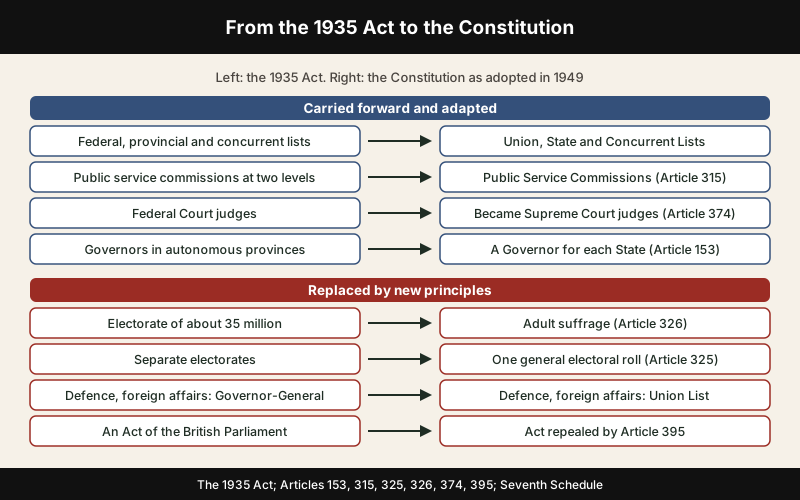
The debt to 1935 should not be overstated, because the Constitution rejected the Act's core political choices. The table sets out the main departures, each of which rests on a specific provision of the Constitution.
| Subject | Government of India Act, 1935 | Constitution as adopted |
|---|---|---|
| Franchise | Electorate of about 35 million, with property and land qualifications | Adult suffrage for elections to the House of the People and State Assemblies (Article 326) |
| Electorates | Separate electorates for Muslims, Sikhs and Europeans, with further reservations | One general electoral roll; no exclusion on grounds of religion, race, caste or sex (Article 325) |
| Defence and foreign affairs | Controlled by the British government through the Governor-General | Union subjects in List I of the Seventh Schedule |
| Federal Court | Created by the Act | Its judges became judges of the Supreme Court (Article 374) |
| Source of authority | An Act of the British Parliament | Adopted by the people through the Constituent Assembly; the 1935 Act repealed (Article 395) |
Borrowing was not slavish imitation. Each provision had to be defended as suited to Indian problems and aspirations, and the framers presented their variations as corrections of faults found elsewhere and adjustments to the needs of the country. The figure summarises what was carried forward and what was replaced.
Criticism of the Constituent Assembly and the Replies
Criticisms: Indirect Election, Congress Dominance and Delay
The Assembly has faced four main criticisms, some raised by its own members during the debates and others by later writers:
- Not a popular body: Its members were elected by the provincial assemblies rather than by universal adult suffrage, and Rajeev Dhavan has argued that the people had little say in the Constitution.
- One-party dominance: The Congress held about 82 per cent of the seats after Partition, and the Muslim League had boycotted the Assembly from its first sitting.
- Delay and cost: Some charged that it worked leisurely and wasted public money, likening it to Nero fiddling while Rome was burning.
- Quality of drafting: Naziruddin Ahmed condemned the Drafting Committee’s work as below par.
These objections matter because they question the legitimacy of the text itself. The debates of 25 November 1949 record the replies given at the time, and later accounts of the Assembly's composition supply the rest of the defence.
Replies: Representative Composition and Public Reason
The reply on representation is that the Assembly, though indirectly elected, was deliberately made representative: all religions were represented, 28 members came from the Scheduled Castes, and the Congress itself accommodated almost all shades of opinion. Members argued through public reason, giving principled reasons rather than advancing narrow interests.
On delay, Ambedkar compared other assemblies. The American Convention took four months and the South African about a year, but Canada's took two years and five months and Australia's nine years, while those constitutions were far shorter and had been passed as moved, not through 2,473 amendments.
On quality, Ambedkar turned Naziruddin Ahmed's jibe into a defence: the Drafting Committee had withdrawn amendments it thought faulty and substituted better ones, which he called drift with mastery. The charge of dilatoriness, he concluded, was quite unfounded.
Ambedkar's Warnings to the Assembly on 25 November 1949
Ambedkar ended with warnings that are still quoted. He cautioned against hero-worship in politics, calling it a sure road to degradation and to eventual dictatorship, and urged that political democracy be made a social democracy as well.
He also foresaw a life of contradictions from 26 January 1950: equality in politics, with one man one vote and one vote one value, alongside inequality in social and economic life, which he warned would put political democracy in peril if it continued for long.
Constitution Day and the Assembly's Legacy Today
Constitution Day on 26 November: The 2015 Decision
In November 2015 the Government decided to observe 26 November as Constitution Day, the day the Assembly adopted the Constitution in 1949. The day was made part of the year-long celebrations of the 125th birth anniversary of Dr B. R. Ambedkar, Chairman of the Drafting Committee, and schools were asked to read out the Preamble in their assemblies.
Published accounts also call the day National Law Day. A common error is to place the setting up of the Drafting Committee on 26 November 1949; the committee was appointed on 29 August 1947, and 26 November 1949 is the date of adoption.
Observable Outcomes of the Assembly's Work
The Assembly's method has produced three observable outcomes:
- An enduring text: The Constitution has survived and become a living reality where many others perished, and it became an exemplar for other constitutions, most notably South Africa’s.
- Continuity of institutions: The Assembly’s members became the Provisional Parliament, and G. V. Mavalankar, who had chaired its committee on functions, became the first Speaker of the Lok Sabha.
- A record for interpretation: In 2024 the Supreme Court noted that the Assembly had not agreed to include the words socialist and secular in the Preamble, before holding that the Constitution is a living document.
The last outcome links the Assembly to current debates. The choices made between 1946 and 1949, and the reasons recorded for them, are still weighed when the meaning of the Constitution is contested, as the 2024 ruling on the Preamble showed.
UPSC Relevance and Previous-Year Questions
Where the Constituent Assembly Fits in the UPSC-CSE Syllabus
This topic belongs to General Studies Paper II, under the historical underpinnings and evolution of the Constitution, and to post-independence history in General Studies Paper I. The linked questions from the preliminary examination test precise points:
- The temporary Chairman before Rajendra Prasad: Sachchidananda Sinha.
- The method of election: Indirect election by the Provincial Legislative Assemblies.
- Committee chairs, such as Nehru for the Union Constitution Committee.
- Dates: The Drafting Committee on 29 August 1947 and adoption on 26 November 1949.
- The features of the Government of India Act, 1935.
The linked question from the main examination asks whether experience of the 1935 Act enabled the Assembly to finish in about three years. The sections on the 1935 Act and on the criticisms of the Assembly supply the evidence on both sides.
Previous Year UPSC-CSE Questions
Previous Year UPSC-CSE Questions By the end you will be able to draft model answers for the following UPSC questions. Each question carries a collapsible framework showing how to approach it in the exam.
- UPSC Prelims 2024 GS-IWho was the Provisional President of the Constituent Assembly before Dr. Rajendra Prasad took over?
How to approach this Prelims question
Approach: Separate the temporary office of 9 to 11 December 1946 from the permanent presidency that began on 11 December 1946.
Trap to watch: Ambedkar chaired the Drafting Committee and T. T. Krishnamachari was a member of it; neither presided over the Assembly.
Key facts to recall:
- Temporary Chairman: Sachchidananda Sinha, the oldest member.
- President from 11 December 1946: Rajendra Prasad.
- Chairman of the Drafting Committee: B. R. Ambedkar.
Answer signal: Sinha presided before Prasad was elected, so option (d) is the answer.
- UPSC Prelims 2013 GS-IWith reference to Indian History, the Members of the Constituent Assembly from the Provinces were
How to approach this Prelims question
Approach: Recall that the Cabinet Mission Plan used the existing provincial legislatures as electoral colleges.
Trap to watch: The Assembly was representative, which can suggest direct election; no provincial member faced a popular vote for an Assembly seat.
Key facts to recall:
- Indirect election by the Provincial Legislative Assemblies.
- Seats divided among Muslims, Sikhs and general.
- Proportional representation with single transferable vote.
Answer signal: The provincial assemblies elected the members, so option (c) is the answer.
- UPSC Prelims 2005 GSWho among the following was the Chairman of the Union Constitution Committee of the Constituent Assembly?
How to approach this Prelims question
Approach: Use the pattern: Nehru for the Union bodies, Patel for the provinces and rights, Prasad for procedure, Ambedkar for drafting.
Trap to watch: Alladi Krishnaswami Ayyar was a member of the Drafting Committee, and Kripalani chaired a sub-committee, not a Union committee.
Key facts to recall:
- Union Constitution Committee: Nehru.
- Union Powers Committee: Nehru.
- Provincial Constitution Committee: Patel.
Answer signal: Nehru chaired the Union Constitution Committee, so option (c) is the answer.
- UPSC Prelims 2023 GS-IConsider the following statements in respect of the Constitution Day :
- Statement-I : The Constitution Day is celebrated on 26th November every year to promote constitutional values among citizens.
- Statement-II : On 26th November, 1949, the Constituent Assembly of India set up a Drafting Committee under the Chairmanship of Dr. B. R. Ambedkar to prepare a Draft Constitution of India.
Which one of the following is correct in respect of the above statements?
How to approach this Prelims question
Approach: Check each statement against its date before judging whether one explains the other.
Trap to watch: 26 November 1949 is the date of adoption, not the date the Drafting Committee was set up.
Key facts to recall:
- Drafting Committee: 29 August 1947.
- Adoption: 26 November 1949.
- Constitution Day: decided in 2015 for 26 November.
Answer signal: Statement-I is correct and Statement-II misdates the Drafting Committee, so option (c) is the answer.
- UPSC Prelims 2005 GSConsider the following statements : The Government of India Act, 1935 provided for
- The provincial autonomy
- The establishment of Federal Court
- All India Federation at the centre
Which of the statements given above is/are correct?
How to approach this Prelims question
Approach: Ask what the Act provided for, not what actually came into operation.
Trap to watch: The federation never came into operation, but the Act did provide for it, so statement 3 is still correct.
Key facts to recall:
- Provincial autonomy from 1937.
- Federal Court established by the Act.
- All India Federation provided for but never formed.
Answer signal: All three were provided for, so option (d) is the answer.
- UPSC Prelims 2024 GS-IWith reference to the Government of India Act, 1935, consider the following statements:
- It provided for the establishment of an All India Federation based on the union of the British Indian Provinces and Princely States.
- Defence and Foreign Affairs were kept under the control of the federal legislature.
Which of the statements given above is/are correct?
How to approach this Prelims question
Approach: Test statement 2 against dyarchy at the centre: some subjects were reserved to the Governor-General.
Trap to watch: A federal legislature existed on paper, but defence and foreign affairs were not under its control.
Key facts to recall:
- All India Federation of provinces and princely states.
- Dyarchy at the centre.
- Defence and foreign affairs controlled through the Governor-General.
Answer signal: Only statement 1 is correct, so option (a) is the answer.
- UPSC Mains 2015 GS-IIt would have been difficult for the Constituent Assembly to complete its historic task of drafting the Constitution for Independent India in just three years but for the experience gained with the Government of India Act, 1935. Discuss.
How to structure the answer in the exam
Introduction: The Constituent Assembly first met on 9 December 1946 and adopted the Constitution on 26 November 1949, a period Ambedkar put at two years, eleven months and seventeen days.
Body (sub-themes to develop):
- Electoral base: members were elected by provincial assemblies created under the 1935 Act.
- Federal blueprint: the three lists of the Act reappear in the Seventh Schedule; the Federal Court's judges became Supreme Court judges under Article 374.
- Experience: provincial autonomy from 1937 gave leaders experience of responsible government; B. N. Rau's draft of 243 articles drew on his constitutional work.
- Other factors: committees, a Drafting Committee that sat 141 days, and the background consensus of the national movement expressed in the Objectives Resolution.
- Departures: adult suffrage (Article 326), a single electoral roll (Article 325), Union control of defence and foreign affairs, and repeal of the Act by Article 395.
Conclusion: The 1935 Act gave the framers a working framework, but the speed of the Assembly also came from its method and its shared ideals, and the Constitution rejected the Act's colonial core.
Sources and Further Reading
- Legislative Department, Ministry of Law and Justice: The Constitution of India
- Lok Sabha Secretariat: Constituent Assembly Debates, Official Report, Volume I (9 December 1946)
- Lok Sabha Secretariat: Constituent Assembly Debates, Official Report, Volume XI (25 November 1949)
- NCERT: Indian Constitution at Work, Class 11, Chapter 1, Constitution: Why and How?
- Press Information Bureau: 26th November to be observed as Constitution Day (23 November 2015)
- Supreme Court of India: Dr Balram Singh v Union of India, order of 25 November 2024 (2024 INSC 893)
- Wikipedia: Constituent Assembly of India
- Wikipedia: Constitution of India
- Wikipedia: Government of India Act 1935
- Wikipedia: Indian Independence Act 1947
- Wikipedia: 1946 Cabinet Mission to India
- Wikipedia: Cripps Mission
- Wikipedia: Sachchidananda Sinha
- Wikipedia: B. N. Rau
Editorial Disclaimer
This article is for UPSC preparation and explains how the Constitution was made. Figures from the debates are given as the speakers reported them, and the official text of the Constitution governs any question of law.


