


Overview
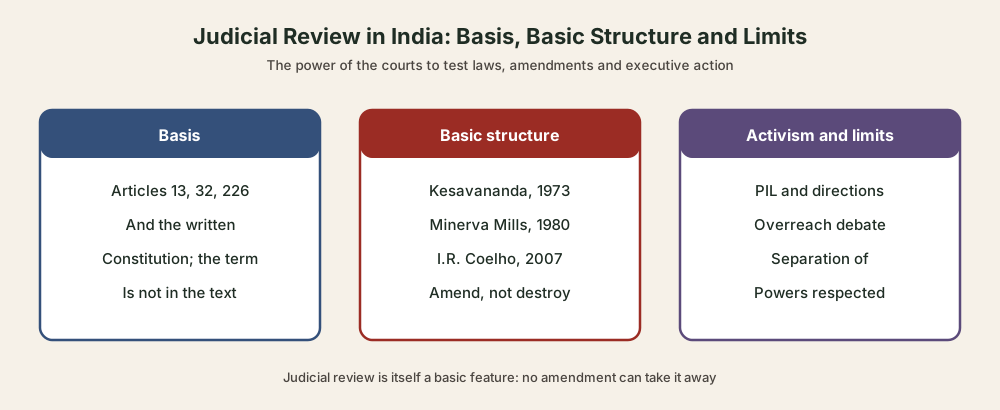
Judicial review is the power of the Supreme Court and the High Courts to test laws, executive action and constitutional amendments against the Constitution and to strike down what violates it. The phrase is not in the Constitution; the power rests on Articles 13, 32 and 226, and since Kesavananda Bharati (1973) it includes testing amendments against the Doctrine of Basic Structure.
Judicial Review in India: Meaning and Constitutional Basis
What Is Judicial Review
In India, judicial review is the power of the Supreme Court and the High Courts to examine whether a law, an executive order or a constitutional amendment is consistent with the Constitution, and to declare it unconstitutional and void if it is not. Such a law then cannot be enforced by the government. The power reaches laws of Parliament and of the State legislatures alike.
- Supremacy of the Constitution: No organ of government can act beyond the limits the Constitution sets.
- Federal balance: A State can challenge a Central law that strays into the State List, and the reverse.
- Fundamental Rights: A law that takes away a right in Part III can be struck down.
Constitutional Provisions Behind Judicial Review
The phrase "judicial review" appears nowhere in the Constitution. The power follows from the fact that India has a written Constitution and that several articles let the courts strike down what conflicts with it.
- Article 13: Any law inconsistent with the Fundamental Rights is void to the extent of the inconsistency.
- Articles 32 and 226: The Supreme Court and the High Courts enforce the Fundamental Rights through writs. Moving Article 32 in the Constituent Assembly on 9 December 1948, Dr B.R. Ambedkar called it the very soul of the Constitution and the very heart of it.
- Articles 131 to 136 and 143: The Court decides federal disputes, hears appeals and advises the President on questions of law.
- Article 246: The division of legislative powers between the Union and the States, which the courts police.
A constitutional challenge to a law or executive order can rest on three grounds: it infringes a Fundamental Right, it is outside the competence of the authority that made it, or it is repugnant to another provision of the Constitution. The Court's full jurisdiction is explained in the article on Supreme Court jurisdiction.
Judicial Review in India, the USA and the UK Compared
India's judicial review is narrower than the American version. The US Constitution protects rights through "due process of law", which lets its Supreme Court strike down laws not only as beyond power but also as unreasonable, and critics have called that court a third chamber of the legislature. India's Article 21 speaks instead of procedure established by law.
| Point | India | USA and UK |
|---|---|---|
| Standard | Procedure established by law, read since 1978 to require a just, fair and reasonable procedure | USA: due process of law, which tests reasonableness itself |
| Scope | Whether a law is within power and consistent with the Constitution | USA: wide review of laws and policy |
| Sovereignty | A synthesis: judicial review within a parliamentary system | UK: parliamentary supremacy |
The gap narrowed in Maneka Gandhi v. Union of India (1978), which held that the procedure under Article 21 must be just, fair and reasonable and that Articles 14, 19 and 21 work together. India thus combines the American idea of judicial supremacy and the British idea of parliamentary supremacy without adopting either in full, a synthesis of the two.
Scope of Judicial Review: Amendments, Laws and Executive Action
Review of Amendments and of Central and State Laws
Parliament may amend any part of the Constitution under Article 368, including the Fundamental Rights, but it may not alter the basic structure. An amendment is therefore reviewed on one question: does it damage a basic feature? The test applies to amendments made after 24 April 1973, the date of the Kesavananda Bharati judgment.
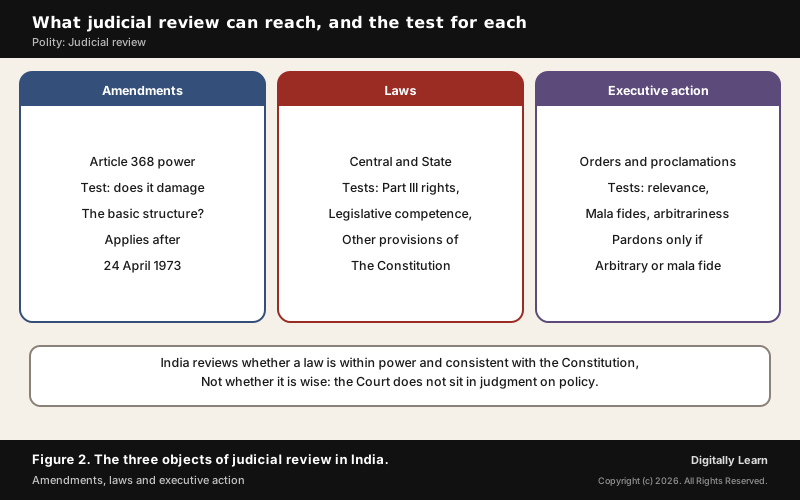
Ordinary laws are reviewed on the three grounds of Fundamental Rights, legislative competence and conflict with the Constitution. The federal ground is common: if the Centre makes a law on a subject that, in some States' view, belongs to the State List, those States can go to the Supreme Court, which may declare the law unconstitutional. The review power extends to State laws too.
The Court asks whether a law is within power, not whether it is wise. It examines only the substantive question of competence and consistency, and does not sit in judgment on the reasonableness, suitability or policy of a law the way a legislature would.
President's Rule, Pardons and Assent to Bills Before the Courts
Executive action is also reviewable, including actions once thought to be beyond the courts. The 38th Amendment of 1975 made the President's satisfaction in imposing President's Rule final and unchallengeable; the 44th Amendment of 1978 deleted that provision.
- President’s Rule (S.R. Bommai, 1994): A proclamation under Article 356 is subject to judicial review; the President’s satisfaction must rest on relevant material, and the Centre must show that it exists. The Court does not test the adequacy of the material, only its relevance.
- Pardons: The President’s pardoning power, exercised on the advice of the Union Cabinet, is not subject to judicial review except where the decision is arbitrary, irrational, mala fide or discriminatory.
- Assent to Bills: In its 2025 opinion the Court held that the decisions of the Governor and the President on assent are not justiciable before a law comes into force, though prolonged, unexplained inaction can be met with a limited direction to act.
Judicial Review of Amendments: Shankari Prasad to Kesavananda Bharati
Shankari Prasad, Sajjan Singh and Golak Nath Cases
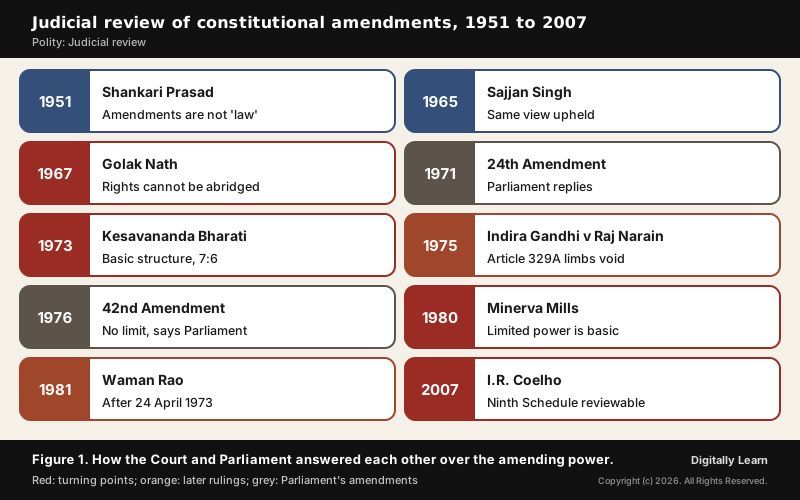
The contest began within a year of the Constitution. The First Amendment, moved by Prime Minister Jawaharlal Nehru and enacted on 18 June 1951, curtailed the right to property and added Article 31B and the Ninth Schedule, which shielded listed laws from challenge on the ground of Fundamental Rights.
- Shankari Prasad (1951): The Court upheld the First Amendment and held that “law” in Article 13 means ordinary law, not a constitutional amendment, so Parliament could amend Fundamental Rights.
- Sajjan Singh (1965): The Court took the same view.
- Golak Nath (1967): An eleven-judge bench reversed course while examining the Seventeenth Amendment, which had put certain State Acts in the Ninth Schedule. Fundamental Rights, it said, had a “transcendental and immutable” position, and an amendment was a law under Article 13 that could not abridge them.
24th Amendment and the Kesavananda Bharati Case (1973)
Parliament answered Golak Nath with the 24th Amendment of 1971, which amended Articles 13 and 368 to declare that Parliament may abridge or take away any Fundamental Right and that such an amendment is not a law under Article 13. The 25th and 29th Amendments followed on property and land laws.
In Kesavananda Bharati v. State of Kerala, decided on 24 April 1973 by the largest bench ever formed, 13 judges, the Court overruled Golak Nath and upheld the 24th Amendment. But by a margin of 7 to 6 it held that the power to amend does not include the power to alter the basic structure of the Constitution. It struck down the part of the 25th Amendment that barred courts from asking whether a law truly gave effect to the Directive Principles.
Elements of the Basic Structure Named by the Court
The Court has never given a complete definition of the basic structure. It has instead named features case by case, and has reserved to itself the right to decide whether a matter is part of it. In Kesavananda, Chief Justice S.M. Sikri listed the supremacy of the Constitution, the republican and democratic system, the secular character, the separation of powers and the federal character.
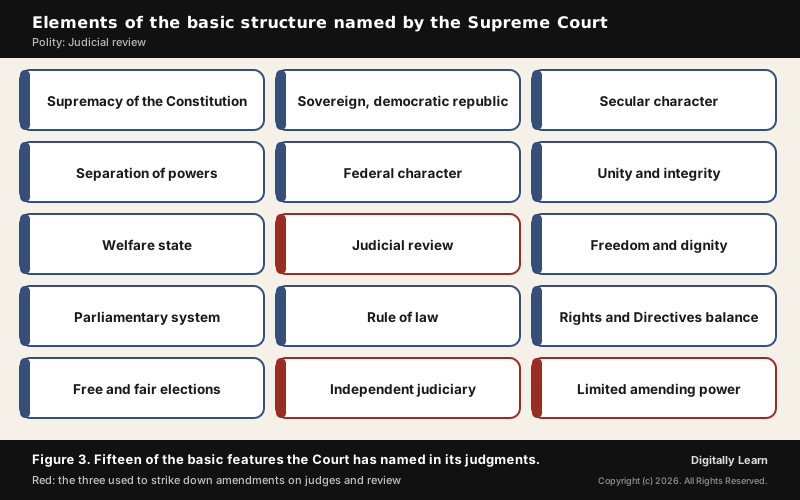
Later judgments added the rule of law, free and fair elections, the independence of the judiciary, a limited power to amend, and the balance between Fundamental Rights and Directive Principles, among others. The powers of the Supreme Court under Articles 32, 136, 141 and 142 are counted as well, and the basic structure is now counted among the salient features of the Constitution.
Doctrine of Basic Structure After Kesavananda
Indira Gandhi v Raj Narain and the 39th Amendment
The 39th Amendment of 1975 inserted Article 329A, which placed disputes over the election of the President, the Vice-President, the Prime Minister and the Speaker beyond the courts. In Indira Nehru Gandhi v. Raj Narain (1975) the Court applied the new test and struck down clauses (4) and (5) of Article 329A, which had made the existing election law inapplicable to the Prime Minister's and Speaker's elections and declared pending proceedings void.
The case added the rule of law, which depends on effective judicial review, to the basic features. Article 329A itself was later omitted by the 44th Amendment of 1978.
42nd Amendment and the Minerva Mills Case (1980)
Parliament's next reply was the 42nd Amendment of 1976, which declared that there was no limit on Parliament's constituent power and that no amendment could be questioned in any court. In Minerva Mills v. Union of India (1980) the Court struck this down because it excluded judicial review, itself a basic feature.
The Court's reasoning is the key to Mains questions on Article 368: since the Constitution gave Parliament a limited amending power, Parliament cannot use that power to enlarge it into an absolute one. "The donee of a limited power cannot by the exercise of that power convert the limited power into an unlimited one." A limited amending power is therefore itself a basic feature.
Ninth Schedule and the I.R. Coelho Case (2007)
Article 31B protects the Acts in the Ninth Schedule from challenge on the ground of any Fundamental Right. The Schedule held 13 Acts in 1951 and 282 by 2013, most of them State land reform laws. In Waman Rao (1981) the Court held that the basic structure test applies to amendments made after 24 April 1973.
In I.R. Coelho v. State of Tamil Nadu, decided in January 2007 by a nine-judge bench, the Court held that there can be no blanket immunity. Laws placed in the Ninth Schedule after 24 April 1973 can be challenged if they violate the rights in Articles 14, 15, 19 and 21 or the basic structure, because judicial review is a basic feature that cannot be removed by listing a law in a Schedule.
Bommai and NJAC: Secularism and Judicial Independence as Basic Features
Later benches kept adding to the list of basic features. In S.R. Bommai v. Union of India (1994) the Court held that secularism is one of the basic features of the Constitution, a positive concept of equal treatment of all religions. A State government that pursues non-secular policies acts contrary to the constitutional mandate and renders itself amenable to action under Article 356, and the same case brought President's Rule itself under judicial review.
The independence of the judiciary is a basic feature, and it decided the fate of the 99th Amendment. On 16 October 2015 a five-judge bench struck down the Amendment and the National Judicial Appointments Commission Act by a 4:1 majority, holding that an executive role in appointing judges would undermine that independence.
The judgment shows the same logic as Kesavananda and Minerva Mills: an amendment is valid only if it leaves the Constitution's identity intact. The collegium it restored, and its working, are explained in the article on the collegium system.
Judicial Activism, Judicial Overreach and Their Limits
Public Interest Litigation and Judicial Activism
In India, judicial activism describes courts taking an active role in protecting rights and correcting the other organs of government, and its chief instrument is public interest litigation. PIL let the courts hear the blinding of jail inmates by the police, inhuman working conditions in stone quarries and the sexual exploitation of children, making rights meaningful for the poor.
- Executive accountability: The Court directed the CBI to investigate politicians and bureaucrats in the hawala case, the Narasimha Rao case and the illegal allotment of petrol pumps.
- Electoral reform: Candidates must file affidavits on assets, income and education so that voters can choose on accurate knowledge.
- Governance: Powers once thought beyond review, such as those of the President and Governors, were brought within it.
Judicial Overreach, Separation of Powers and Judicial Restraint
The same activism draws criticism. It has overburdened the courts, and it has blurred the line between the judiciary and the other two organs: reducing air or sound pollution, investigating corruption or reforming elections are matters for the administration under the legislature's supervision. Critics call this judicial overreach.
The Constitution rests on a limited separation of powers with checks and balances: Parliament is supreme in making laws and amending the Constitution, the executive in implementing them, and the judiciary in settling disputes and testing laws against the Constitution. Alladi Krishnaswami Ayyar warned the Constituent Assembly on 23 November 1949 that judicial independence should not let the judiciary act as a super-legislature or super-executive.
Judicial review has limits the courts themselves observe. The Court does not review the wisdom or policy of a law, only its constitutionality; in President's Rule cases it looks at the relevance of the material, not its adequacy; and in 2025 it declined to set timelines for assent to Bills, holding that courts cannot create a "deemed assent" by relying on Article 142.
Restraint also runs the other way: because judicial review and the separation of powers are both basic features, neither Parliament nor the courts can remove the other's role. The result is the balance the Constitution intends, in which each organ respects the powers and jurisdiction of the others.
Previous Year UPSC-CSE Questions
Previous Year UPSC-CSE Questions By the end you will be able to draft model answers for the following UPSC questions. Each question carries a collapsible framework showing how to approach it in the exam.
- UPSC Mains 2016 GS-IIWhat was held in the Coelho case? In this context, can you say that judicial review is of key importance amongst the basic features of the Constitution?
Answer outline: how to structure the answer
What the question asks, the main arguments, relevant examples and the direction of the conclusion. This is not a full model answer.
Introduction: In I.R. Coelho (2007) a nine-judge bench held that laws placed in the Ninth Schedule after 24 April 1973 are open to judicial review.
Body (sub-themes to develop):
- Holding: no blanket immunity; test against Articles 14, 15, 19, 21 and the basic structure.
- Why judicial review is key: Minerva Mills struck down the 42nd Amendment's exclusion of review; without review no other basic feature can be enforced.
- Continuity: Kesavananda 1973, Raj Narain 1975, Waman Rao 1981, NJAC 2015.
Conclusion: Conclude that judicial review is the basic feature through which the others are secured.
- UPSC Mains 2019 GS-II“Parliament’s power to amend the Constitution is a limited power and it cannot be enlarged into absolute power.” In the light of this statement explain whether Parliament under Article 368 of the Constitution can destroy the Basic Structure of the Constitution by expanding its amending power?
Answer outline: how to structure the answer
What the question asks, the main arguments, relevant examples and the direction of the conclusion. This is not a full model answer.
Introduction: Article 368 lets Parliament amend any provision, but Kesavananda Bharati (1973) held that it cannot alter the basic structure.
Body (sub-themes to develop):
- Golak Nath and the 24th Amendment; Kesavananda 7:6.
- 42nd Amendment's claim of unlimited power; Minerva Mills 1980: the donee of a limited power cannot make it unlimited.
- Limited amending power as a basic feature; Waman Rao and Coelho on the cut-off date.
Conclusion: Conclude that Parliament can amend but not destroy, and cannot expand its power to do so.
- UPSC Mains 2014 GS-IIStarting from inventing the ‘basic structure’ doctrine, the judiciary has played a highly proactive role in ensuring that India develops into a thriving democracy. In light of the statement, evaluate the role played by judicial activism in achieving the ideals of democracy.
Answer outline: how to structure the answer
What the question asks, the main arguments, relevant examples and the direction of the conclusion. This is not a full model answer.
Introduction: From Kesavananda Bharati (1973), the judiciary set limits on majorities and then widened access to justice through PIL.
Body (sub-themes to develop):
- Protection of the constitutional identity: basic structure cases.
- Rights for the poor through PIL; accountability through court-monitored investigations; candidates' affidavits.
- Costs: overburdened courts, blurred separation of powers.
Conclusion: Conclude that activism strengthened democracy where it protected rights and should yield where it governs.
- UPSC Mains 2019 GS-IIDo you think that Constitution of India does not accept principle of strict separation of powers rather it is based on the principle of ‘checks and balance’? Explain.
Answer outline: how to structure the answer
What the question asks, the main arguments, relevant examples and the direction of the conclusion. This is not a full model answer.
Introduction: India follows a limited separation of powers in which each organ checks the others.
Body (sub-themes to develop):
- Overlaps: ministers sit in Parliament; the President's ordinances; courts' review of laws.
- Checks: judicial review; Parliament's removal of judges; executive appointment of judges on the collegium's recommendation.
- Separation of powers as a basic feature.
Conclusion: Conclude that India's model rests on checks and balances, not strict separation.
- UPSC Mains 2020 GS-IIJudicial Legislation is antithetical to the doctrine of separation of powers as envisaged in the Indian Constitution. In this context justify the filing of large number of public interest petitions praying for issuing guidelines to executive authorities.
Answer outline: how to structure the answer
What the question asks, the main arguments, relevant examples and the direction of the conclusion. This is not a full model answer.
Introduction: Judicial guidelines fill gaps the legislature has left, which sits uneasily with separation of powers.
Body (sub-themes to develop):
- Why petitions seek guidelines: executive inaction on rights, pollution, custody, elections.
- The concern: judiciary as super-legislature or super-executive.
- Justification: guidelines as temporary measures until the legislature acts; limits of restraint.
Conclusion: Conclude that guidelines are justified as stop-gaps that invite, not replace, legislation.
- UPSC Prelims 2017 Prelims-GSIn India, Judicial Review implies
How to approach this Prelims question
Approach: Ask what judicial review tests. It tests whether a law or an executive order is within the Constitution; it does not judge whether a law is wise, it does not vet Bills before assent, and reviewing its own past judgments is a different power. Only the first option describes it.
Trap to watch: "Wisdom of laws" describes American-style review.
Key facts to recall:
- (a) Pronouncing on the constitutionality of laws and executive orders: right. This is judicial review.
- (b) Questioning the wisdom of laws: wrong. Courts test validity, not the policy behind a law.
- (c) Reviewing all enactments before assent: wrong. Indian courts do not vet Bills before they become law.
- (d) Reviewing its own earlier judgments: wrong. That is the review jurisdiction over judgments, not judicial review of laws.
Answer signal: Option (a): judicial review tests the constitutionality of laws and executive orders.
- UPSC Prelims 2020 Prelims-GSConsider the following statements :
- The Constitution of India defines its 'basic structure' in terms of federalism, secularism, fundamental rights and democracy.
- The Constitution of India provides for 'judicial review' to safeguard the citizens' liberties and to preserve the ideals on which the Constitution is based.
Which of the statements given above is/are correct ?
How to approach this Prelims question
Approach: Check whether the text of the Constitution itself says each thing. The phrase basic structure appears nowhere in it; the doctrine was laid down in Kesavananda Bharati (1973). Judicial review is not named either; it is implied by several articles. Neither statement holds.
Trap to watch: Both statements describe real ideas, so they sound true.
Key facts to recall:
- (a) 1 only: wrong. The Constitution does not define a basic structure.
- (b) 2 only: wrong. The Constitution does not name judicial review; the power is implied by several articles.
- (c) Both 1 and 2: wrong. Neither statement describes the text of the Constitution.
- (d) Neither 1 nor 2: right. The basic structure is judge-made and judicial review is implied.
Answer signal: Option (d): neither statement describes the Constitution's own text.
- UPSC Prelims 2023 Prelims-GSIn essence, what does 'Due Process of Law' mean?
How to approach this Prelims question
Approach: Separate due process from India's original standard, procedure established by law. Due process asks whether the law itself is fair and just, which is the principle of natural justice; the other options describe procedure, application or equality, not due process.
Trap to watch: Option (b) is India's own phrase, not due process.
Key facts to recall:
- (a) Principle of natural justice: right. Due process tests the fairness of the law itself.
- (b) Procedure established by law: wrong. That is the narrower standard of Article 21 as first read.
- (c) Fair application of law: wrong. It concerns how a law is applied, not whether the law is fair.
- (d) Equality before law: wrong. That is Article 14, a different guarantee.
Answer signal: Option (a): in essence due process of law is the principle of natural justice.
- UPSC Prelims 2025 Prelims-GSConsider the following statements with regard to pardoning power of the President of India:
- I. The exercise of this power by the President can be subjected to limited judicial review.
- II. The President can exercise this power without the advice of the Central Government.
Which of the statements given above is/are correct?
How to approach this Prelims question
Approach: Recall the review exception and the advice rule. The pardoning power can be reviewed where the decision is arbitrary, irrational, mala fide or discriminatory, so statement I is correct. The President exercises it on the advice of the Union Cabinet, so statement II is wrong.
Trap to watch: "Without the advice" sounds like an independent power.
Key facts to recall:
- (a) I only: right. Review is limited to arbitrary, irrational, mala fide or discriminatory decisions.
- (b) II only: wrong. The President acts on the Cabinet's advice.
- (c) Both I and II: wrong. Statement II is wrong.
- (d) Neither I nor II: wrong. Statement I is correct.
Answer signal: Option (a): only statement I is correct.
- UPSC Prelims 2019 Prelims-GSConsider the following statements :
- The 44th Amendment to the Constitution of India introduced an Article placing the election of the Prime Minister beyond judicial review.
- The Supreme Court of India struck down the 99th Amendment to the Constitution of India as being violative of the independence of judiciary.
Which of the statements given above is/are correct?
How to approach this Prelims question
Approach: Match each amendment to what it did. The 39th Amendment, not the 44th, put the Prime Minister's election beyond judicial review through Article 329A; the 44th removed it. The 99th Amendment, which set up the National Judicial Appointments Commission, was struck down in 2015.
Trap to watch: The 44th Amendment is famous for undoing Emergency changes, which invites confusion.
Key facts to recall:
- (a) 1 only: wrong. Statement 1 names the wrong amendment.
- (b) 2 only: right. The 99th Amendment was struck down as violating judicial independence.
- (c) Both 1 and 2: wrong. Statement 1 is wrong.
- (d) Neither 1 nor 2: wrong. Statement 2 is correct.
Answer signal: Option (b): only statement 2 is correct.
- UPSC Prelims 2018 Prelims-GSConsider the following statements :
- The Parliament of India can place a particular law in the Ninth Schedule of the Constitution of India.
- The validity of a law placed in the Ninth Schedule cannot be examined by any court and no judgement can be made on it.
Which of the statements given above is/are correct ?
How to approach this Prelims question
Approach: Apply I.R. Coelho (2007). Parliament can place a law in the Ninth Schedule under Article 31B, so statement 1 is correct. A law placed there after 24 April 1973 can still be examined against the basic structure, so statement 2 is wrong.
Trap to watch: Statement 2 was true before 2007 thinking.
Key facts to recall:
- (a) 1 only: right. Parliament can add laws to the Ninth Schedule, but they remain open to review.
- (b) 2 only: wrong. Coelho opened Ninth Schedule laws to judicial review.
- (c) Both 1 and 2: wrong. Statement 2 is wrong after Coelho.
- (d) Neither 1 nor 2: wrong. Statement 1 is correct.
Answer signal: Option (a): only statement 1 is correct.
- UPSC Prelims 2019 Prelims-GSThe Ninth Schedule was introduced in the Constitution of India during the prime ministership of
How to approach this Prelims question
Approach: Link the Ninth Schedule to its date. It was added by the First Amendment in 1951, which Jawaharlal Nehru's government moved; the question turns on that date.
Trap to watch: Indira Gandhi is linked to later Ninth Schedule additions.
Key facts to recall:
- (a) Jawaharlal Nehru: right. The First Amendment of 1951 added the Ninth Schedule.
- (b) Lal Bahadur Shastri: wrong. The Schedule dates from the First Amendment of 1951, under Nehru.
- (c) Indira Gandhi: wrong. The Schedule dates from the First Amendment of 1951, under Nehru.
- (d) Morarji Desai: wrong. The Schedule dates from the First Amendment of 1951, under Nehru.
Answer signal: Option (a): the Ninth Schedule came in 1951, under Nehru.
- UPSC Prelims 2003 Prelims-GSThe Ninth Schedule to the Indian Constitution was added by
How to approach this Prelims question
Approach: Recall which amendment created the Schedule. The First Amendment of 1951 added the Ninth Schedule and Article 31B to protect land reform laws.
Trap to watch: The 42nd Amendment is a common distractor.
Key facts to recall:
- (a) First Amendment: right. It added the Ninth Schedule in 1951.
- (b) Eighth Amendment: wrong. The Ninth Schedule came with the First Amendment, not a later one.
- (c) Ninth Amendment: wrong. It facilitated the cession of the Berubari Union to Pakistan.
- (d) Forty-second Amendment: wrong. It came in 1976, long after the Schedule existed.
Answer signal: Option (a): the First Amendment added the Ninth Schedule.
Sources and Further Reading
- Legislative Department, Ministry of Law and Justice: The Constitution of India
- NCERT: Indian Constitution at Work, Class 11, Chapter 6, Judiciary
- Supreme Court of India: Constitution
- Supreme Court of India: Opinion in Special Reference No. 1 of 2025 (20 November 2025)
- Lok Sabha Secretariat: Constituent Assembly Debates, Volume VII, 9 December 1948 (Article 32)
- Wikipedia: Judicial review in India
- Wikipedia: Basic structure doctrine
- Wikipedia: Kesavananda Bharati v. State of Kerala
- Wikipedia: Golaknath v. State of Punjab
- Wikipedia: Maneka Gandhi v. Union of India
- Wikipedia: Public interest litigation in India
- Wikipedia: S. R. Bommai v. Union of India
- Wikipedia: First Amendment of the Constitution of India
Editorial Disclaimer
This article explains judicial review from the text of the Constitution, the Supreme Court's judgments as reported in the sources listed, and NCERT. It is not legal advice.


