


Overview
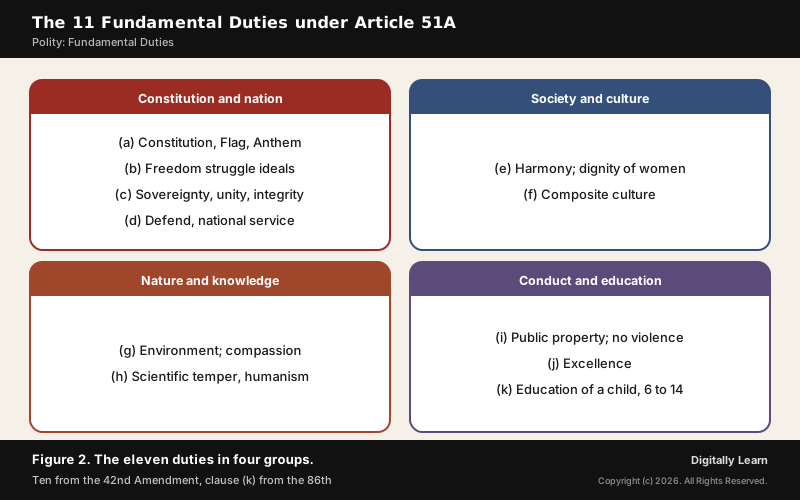
Fundamental Duties are the eleven duties that Article 51A, the only Article in Part IVA of the Constitution, places on every citizen of India. Ten were added by the 42nd Amendment of 1976, on the Swaran Singh Committee's recommendation, and came into force on 3 January 1977; the eleventh, on a child's education, was added by the 86th Amendment of 2002. No court can enforce them directly, but judges use them to interpret laws, and several are backed by separate Acts.
Fundamental Duties Meaning: Article 51A and Part IVA
What Fundamental Duties Are and Where They Sit in the Constitution
The Constitution first gave citizens rights; the duties came later. Article 51A, the only Article in Part IVA, opens with the words "It shall be the duty of every citizen of India" and lists eleven duties in clauses (a) to (k), from respect for the Constitution to a parent's duty to see a child educated. The duties fall on citizens: the Article does not expressly cast any duty on the State.
Several features set Part IVA apart. There is no legal sanction for not performing a duty, and the Constitution has neither a provision for enforcing the duties nor one forbidding it. The Supreme Court has held that the duties are nevertheless a valuable guide and aid to interpretation of constitutional and legal issues. And Parliament has written several of them into ordinary laws.
- Moral and civic duties: Some are moral precepts, such as cherishing the ideals of the freedom struggle; others are civic duties, such as respecting the Constitution, the Flag and the Anthem.
- Citizens only: Unlike some Fundamental Rights, which extend to foreigners too, the duties apply only to citizens.
- Rooted in tradition: They codify values long part of Indian tradition, religions and practices.
List of 11 Fundamental Duties Under Article 51A
The text of Article 51A, clause by clause. It shall be the duty of every citizen of India:
- (a) To abide by the Constitution and respect its ideals and institutions, the National Flag and the National Anthem;
- (b) To cherish and follow the noble ideals which inspired our national struggle for freedom;
- (c) To uphold and protect the sovereignty, unity and integrity of India;
- (d) To defend the country and render national service when called upon to do so;
- (e) To promote harmony and the spirit of common brotherhood amongst all the people of India transcending religious, linguistic and regional or sectional diversities; to renounce practices derogatory to the dignity of women;
- (f) To value and preserve the rich heritage of our composite culture;
- (g) To protect and improve the natural environment including forests, lakes, rivers and wild life, and to have compassion for living creatures;
- (h) To develop the scientific temper, humanism and the spirit of inquiry and reform;
- (i) To safeguard public property and to abjure violence;
- (j) To strive towards excellence in all spheres of individual and collective activity so that the nation constantly rises to higher levels of endeavour and achievement;
- (k) Who is a parent or guardian to provide opportunities for education to his child or, as the case may be, ward between the age of six and fourteen years.
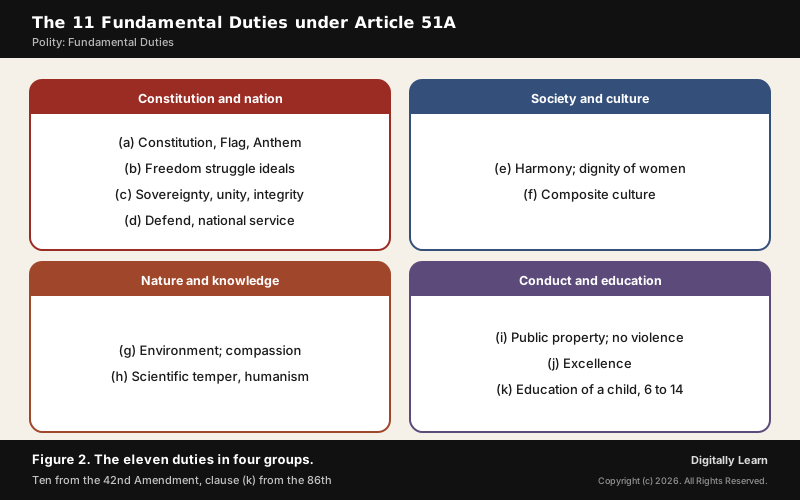
How Fundamental Duties Were Added: Swaran Singh Committee, 42nd and 86th Amendments
Swaran Singh Committee and the 42nd Amendment, 1976
The duties were not in the Constitution adopted in 1950. The Swaran Singh Committee of 1976, set up to review the Constitution, recommended that certain Fundamental Duties and obligations which every citizen owed the nation be included. The Constitution (Forty-second Amendment) Act, 1976 acted on this: its section 11 inserted Part IVA with ten duties, clauses (a) to (j), from 3 January 1977, and its section 10 inserted Article 48A, the Directive Principle on the environment, from the same date.
The Committee had suggested eight duties; the Amendment included ten. Three of its recommendations were not accepted: that Parliament could impose penalties for not observing the duties, that such a law could not be challenged for violating Fundamental Rights, and that paying taxes should be a duty.
Article 51A was one of many changes made during the Emergency. When the next Parliament undid most of them, the duties survived, because all parties considered the Article an unexceptionable charter of principles; the 44th Amendment of 1978 left it untouched. The duties also bring India into line with Article 29(1) of the Universal Declaration of Human Rights, under which everyone has duties to the community in which alone the free and full development of the personality is possible.
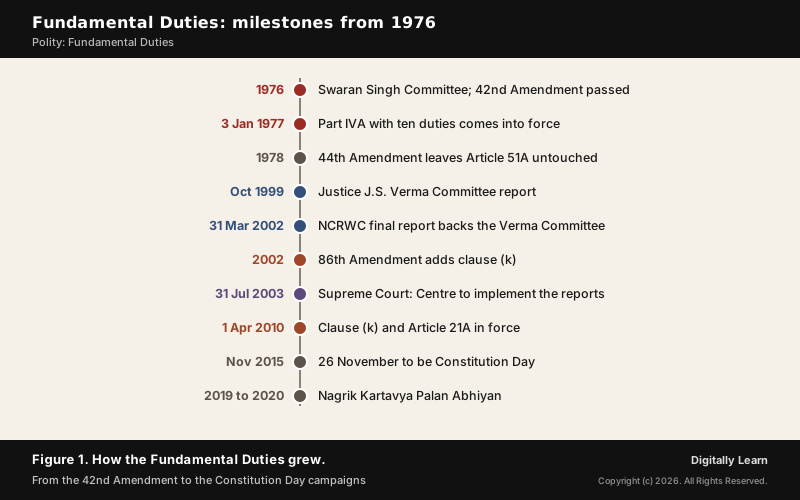
The Eleventh Duty: Clause (k) and the 86th Amendment, 2002
The eleventh duty makes it the duty of every parent or guardian to provide opportunities for education to a child or ward between six and fourteen. Section 4 of the Constitution (Eighty-sixth Amendment) Act, 2002 inserted it, with effect from 1 April 2010. The same Amendment made two matching changes from that date:
- Article 21A: The State shall provide free and compulsory education to all children of six to fourteen, in the manner the State may by law determine.
- Article 45: Substituted so that the State shall endeavour to provide early childhood care and education for all children until they complete six years.
So the same age band, six to fourteen, is a right against the State under Article 21A and a duty of the parent under Article 51A(k): the State must provide the school, and the parent must send the child.
Article 51A Clauses Explained: From the Constitution to a Child's Education
Respect for the Constitution and Freedom Struggle Ideals: Clauses (a) and (b)
Clause (a) asks citizens to abide by the Constitution and respect its ideals and institutions, the National Flag and the National Anthem. The ideals are those summed up in the Preamble, and the principal institutions are the Executive, the Legislature and the Judiciary. Clause (b) asks citizens to cherish the ideals of the freedom struggle, which may be read to include:
- Putting an end to foreign rule.
- Ushering in a Government of the people, by the people and for the people.
- Securing to all citizens justice, liberty and equality, and promoting fraternity and unity among them.
Clause (b) binds the citizen, not the State. In West Bengal Head Masters' Association v. Union of India (1983), the Calcutta High Court held that a student could not claim to be taught Indian history in a particular class in order to perform this duty. The ideals themselves are set out in the Preamble.
Sovereignty, National Service, Harmony and Composite Culture: Clauses (c) to (f)
- Clause (c): Uphold and protect the sovereignty, unity and integrity of India. The same value appears in the Preamble’s “unity and integrity of the Nation” (words substituted by the 42nd Amendment) and in Article 19(2), which allows reasonable restrictions on speech in the interests of the sovereignty and integrity of India.
- Clause (d): Defend the country and render national service when called upon. It is a duty that arises only when citizens are called upon; Article 23(2) separately lets the State impose compulsory service for public purposes.
- Clause (e): Promote harmony and common brotherhood across religious, linguistic and regional divides, and renounce practices derogatory to the dignity of women. The Commission of Sati (Prevention) Act, 1987 and the Vishaka guidelines of 1997 against sexual harassment at work are examples of this duty in law.
- Clause (f): Value and preserve the rich heritage of our composite culture, culture drawn from many strands. It means, for instance, not breaking each other’s places of worship or setting fire to religious texts. Article 49 gives the State the matching duty to protect monuments of national importance.
Environment, Scientific Temper, Public Property and Excellence: Clauses (g) to (j)
- Clause (g): Protect and improve the natural environment, including forests, lakes, rivers and wild life, and have compassion for living creatures. It mirrors Article 48A, the State’s duty on the environment.
- Clause (h): Develop the scientific temper, humanism and the spirit of inquiry and reform: an outlook founded on organised knowledge and experience, based on reason rather than superstition or blind faith.
- Clause (i): Safeguard public property and abjure violence.
- Clause (j): Strive towards excellence in all spheres of activity, so that the nation rises to higher levels of endeavour and achievement.
The ten original duties can also be sorted by the action they demand. Five are positive duties that ask citizens to act: clauses (b), (d), (f), (h) and (j). The other five are negative duties that ask citizens to refrain from harm, and these are the ones best suited to backing by law.
Verma Committee on Fundamental Duties (1999) and the NCRWC
Justice J.S. Verma Committee: Appointment, Terms of Reference and Report
The Justice J.S. Verma Committee was set up by the Government of India by an order of 21 July 1998, chaired by Justice J.S. Verma, a former Chief Justice of India. Its task was to work out how to teach Fundamental Duties in every educational institution across the country. It reported in October 1999, on the principle that the onus of discharging the duties is on every citizen, and noted that duties are observed because of the social system, the influence of role models or punitive laws. Its terms of reference were:
- A package for teaching the duties at primary, secondary, senior secondary and university levels.
- The activities to form part of curricular and co-curricular work.
- A review of the programme run by the NCERT under the National Curricular Framework.
- Packages for training citizens through non-formal education, adult education and the media.
Verma Committee Recommendations for Schools, Public Life and the Media
- Awareness: Display of the Preamble and Article 51A on government publications, calendars and public places; spots on All India Radio and Doordarshan; 3 January as Fundamental Duties Day; an autonomous body acting like an ombudsman on citizenship values; simple booklets for adult education.
- Schools and teachers: The Preamble and Article 51A printed in all textbooks; talks at morning assemblies; removing gender bias from textbooks; a module on the duties in all teacher education; compulsory NCC in teacher training institutions; the UGC’s human rights initiative renamed to include Fundamental Duties.
- Public life: Orientation of new legislators, a training module for civil servants, a Judicial Academy for judges on constitutional values, ethical codes for business, and a media that avoids glorifying violence.
The Committee held that rights and duties go together and that the discussion of duties cannot be divorced from Fundamental Rights. On enforcement it favoured a mix: suitable laws where needed to require obedience, with any gaps in the law filled, and social sanctions and role models alongside legal ones.
NCRWC Proposals and the Supreme Court's 2003 Direction
The National Commission to Review the Working of the Constitution (NCRWC), chaired by former Chief Justice M. N. Venkatachaliah, agreed fully with the Verma Committee in its final report of 31 March 2002. It went further on the content of the duties:
- Create awareness of the duties on the lines the Verma Committee recommended.
- Reform education and free it from governmental or political control.
- Add to Article 51A a duty to vote at elections, take part in democratic governance and pay taxes.
- Add duties to foster family values and responsible parenthood, and a duty on industry to educate employees’ children.
The Supreme Court then acted. In Ranganath Mishra v. Union of India, decided on 31 July 2003, a letter from the former Chief Justice seeking directions to teach citizens their duties was treated as a writ petition. The Court directed the Centre to consider the recommendations of the Commission and the Verma Committee in right earnestness and to implement them as expeditiously as possible. None of the proposed new duties, such as voting or paying tax, has been added.
Laws That Give Effect to Fundamental Duties
Prevention of Insults to National Honour Act, 1971 and Election Law
Disrespect to the National Flag and the National Anthem is punishable. The Prevention of Insults to National Honour Act, 1971, as amended in 2003 and 2005, gives effect to clause (a):
- Section 2: Burning, mutilating, defacing, defiling, destroying, trampling upon or otherwise showing disrespect to the National Flag or the Constitution in public view is punishable with up to three years’ imprisonment, a fine or both. Criticising the Constitution or the Flag with a view to changing it by lawful means is not an offence.
- Section 3: Intentionally preventing the singing of the National Anthem, or disturbing an assembly singing it, is an offence.
- Section 3A: A second or later conviction brings imprisonment of not less than one year.
A conviction carries an electoral cost. Under section 8(1) of the Representation of the People Act, 1951, a person convicted under section 2 or 3 of the 1971 Act is disqualified for six years. The same Act treats an appeal to vote on the ground of religion, race, caste, community or language, and the use of the national flag or emblem for a candidate's benefit, as a corrupt practice under section 123(3), with disqualification for up to six years under section 8A.
Criminal Law and Other Statutes Backing the Duties
Offences against harmony and religion, tied to clauses (c) and (e), were in the Indian Penal Code. The Bharatiya Nyaya Sanhita, 2023, in force from 1 July 2024, now carries them:
| Offence | IPC | BNS |
|---|---|---|
| Promoting enmity between groups | 153A | 196 |
| Imputations prejudicial to national integration | 153B | 197 |
| Defiling a place of worship | 295 | 298 |
| Outraging religious feelings | 295A | 299 |
| Disturbing a religious assembly | 296 | 300 |
| Trespassing on burial places | 297 | 301 |
| Words wounding religious feelings | 298 | 302 |
| Statements conducing to public mischief | 505 | 353 |
- National symbols: The Emblems and Names (Prevention of Improper Use) Act, 1950 and the Flag Code of India govern the correct use of the Flag and national symbols.
- Unlawful Activities (Prevention) Act, 1967: A communal organisation can be declared an unlawful association.
- Protection of Civil Rights Act, 1955: Earlier the Untouchability (Offences) Act.
- Environment (Protection) Act, 1986: Spells out the duty to protect the environment in clause (g) in detail.
Are Fundamental Duties Enforceable? Supreme Court Rulings
Fundamental Duties as an Aid to Interpretation
Courts cannot order a citizen to perform a duty, but they read laws in the light of the duties. In AIIMS Students' Union v. AIIMS, decided on 24 August 2001, the Supreme Court held that the duties, though not enforceable by a writ, are a valuable guide and aid to interpretation. It noted that they carry the same prefix, fundamental, that the founders gave the rights in Part III.
- Moulding relief: In case of doubt, the people’s wish expressed through Article 51A can guide both how a court resolves an issue and the relief it grants.
- Duty of the State: The State is, in a sense, all the citizens together, so the duty of every citizen is, collectively, the duty of the State, though Article 51A does not say so expressly.
National Anthem Cases: Bijoe Emmanuel and Shyam Narayan Chouksey
Can a citizen be made to sing the National Anthem? In Bijoe Emmanuel v. State of Kerala, decided on 11 August 1986, three children of a Jehovah's Witness family had been expelled from school for not singing it, though they stood up when it was sung. The Court, relying on Articles 19(1)(a) and 25(1), held that no law obliges anyone to sing the Anthem, that standing up shows proper respect, and that standing in silence is not an offence under section 3 of the 1971 Act.
The question returned in Shyam Narayan Chouksey v. Union of India, where the petitioner relied on clause (a). On 30 November 2016 the Court directed, as an interim measure, that cinema halls play the Anthem before the film and that all present stand. On 9 January 2018 it made playing the Anthem in cinemas optional, not mandatory, left the rules to an Inter-Ministerial Committee set up on 5 December 2017, and held that people must show respect whenever the Anthem is played on the occasions the executive specifies.
Environment and Excellence Cases: Clauses (g) and (j) in Court
| Case | Clause | What the court held |
|---|---|---|
| Rural Litigation and Entitlement Kendra (1986) | (g) | Closing mining in the Mussoorie hills was sustained; protecting the environment is every citizen's task |
| M.C. Mehta (12 January 1988) | (g) | The Centre must have schools teach environment lessons for an hour a week in the first ten classes |
| M.C. Mehta (14 March 1991) | (g) | Environment is both a State obligation and a citizen's duty |
| Mohan Kumar Singhania (1992) | (j) | Stress on IAS training upheld as serving excellence |
| Mirzapur Moti Kureshi (26 October 2005) | (g) | Compassion for living creatures covers the cattle of Article 48; ban on slaughter of bulls and bullocks upheld |
The 2005 case was decided by seven judges, with Chief Justice R. C. Lahoti writing for six and Justice A. K. Mathur dissenting. The majority said one object of Article 51A was to make the spirit of Articles 48 and 48A a duty of every citizen. Clause (j) has been used similarly to support higher standards in public service, including the writing of confidential reports on officials.
Fundamental Duties and Fundamental Rights and Directive Principles Compared
Rights, Directive Principles and Duties Compared: Enforceability and Addressees
The three Parts differ most in enforceability. Article 32 guarantees the right to move the Supreme Court to enforce the rights in Part III. Article 37 says the Directive Principles shall not be enforceable by any court but are fundamental in the governance of the country. Part IVA has neither a provision for enforcement nor a bar on it.
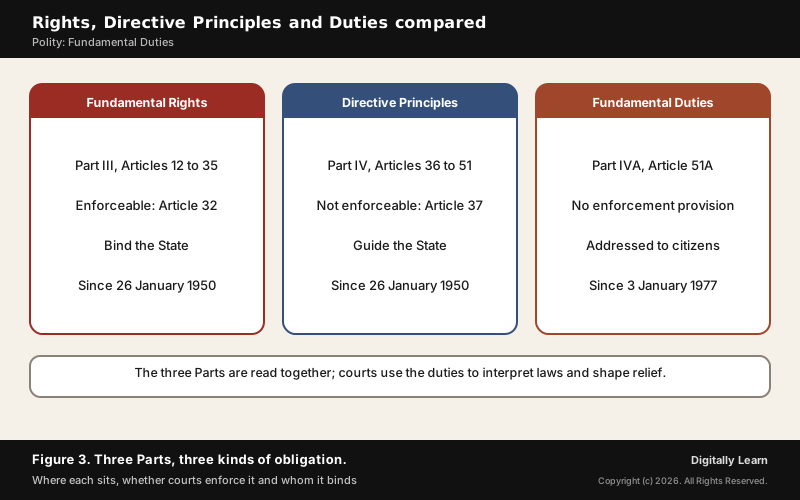
The Parts are still read together, as one compendium. Several duties even pair with a Directive Principle that gives the State the matching task:
- Environment: Article 48A for the State; Article 51A(g) for the citizen.
- Heritage: Article 49 for the State; Article 51A(f) for the citizen.
- Education: Articles 21A and 45 for the State; Article 51A(k) for the parent.
How Rights and Duties Correlate: Court Judgments and Commission Reports
Courts linked rights and duties even before 1977. In Chandra Bhavan Boarding and Lodging v. State of Mysore (1969), the Supreme Court said it is a fallacy to think that under our Constitution there are only rights and no duties. The NCRWC put the relationship precisely: every right implies a corresponding duty, but every duty does not imply a corresponding right. Yet the Constitution does not make the enjoyment of rights conditional on performing duties, so adding the duties did not change the status of the Fundamental Rights.
Why were duties left out in 1950? The values were practised as a way of life, the Preamble already spelt them out, and the rights in Part III carried built-in obligations. With the decline of values in public life over time, the nation felt the need to write them down. Some ideals remain duties of the State alone: protecting the weaker sections (Article 46) and promoting international peace (Article 51) are not in Article 51A.
Significance and Criticism of Fundamental Duties
Significance of Fundamental Duties and the Enforcement Debate
The duties matter because no democracy can succeed unless citizens take part in governance by accepting responsibilities. They remind citizens that rights come with obligations, guide courts, and give Parliament a constitutional basis for laws on the flag, harmony and the environment. They also warn against anti-national acts such as burning the flag or destroying public property. In 1992 the Supreme Court ruled that if a law seeks to give effect to a duty, a court may treat it as reasonable under Article 14 or Article 19. Whether the duties should be enforced is debated:
| Question | By law | By awareness |
|---|---|---|
| Can they be enforced? | They carry an element of compulsion | Not meant to be enforced by one citizen against another |
| What should the State do? | Enact laws with sanctions where needed | Spread awareness rather than give the duties teeth |
| Which clauses? | (a), (c), (e), (g) and (i) through laws | (b), (d), (f), (h) and (j) through education |
The practical limits are real. Around 2001 more than 99 per cent of citizens did not even know that Article 51A existed, and much more than the Article is needed to make citizens respect each religion and treat all human beings equally. For the Constitution's other features see the salient features.
- Not exhaustive: Duties such as voting, paying taxes and family planning are missing, though the Swaran Singh Committee had recommended a duty to pay taxes.
- Vague: Phrases like ‘noble ideals’, ‘composite culture’ and ‘scientific temper’ can be read in different ways.
- Only moral precepts: Being non-justiciable, they are called a code of moral precepts; the Committee had wanted penalties.
- Superfluous or misplaced: Some said people would perform them anyway; others that placing them after Part IV, not Part III, lowered their standing beside the rights.
Constitution Day, Nagrik Kartavya Palan Abhiyan and NEP 2020
- Constitution Day: In November 2015 the Government decided to observe 26 November, the day the Constitution was adopted in 1949, as Constitution Day.
- Nagrik Kartavya Palan Abhiyan: From 26 November 2019 to 26 November 2020, for the 70th year of the Constitution, a campaign spread awareness of the duties, with the kartavya.ugc.ac.in portal, essay competitions on each duty and talks in schools and colleges, the Department of Justice leading.
- National Education Policy 2020: Curriculum and teaching are to build a deep respect for the Fundamental Duties and constitutional values, and all B.Ed. programmes are to stress the practice of the duties in Article 51A.
Previous Year UPSC-CSE Questions
Previous Year UPSC-CSE Questions By the end you will be able to draft model answers for the following UPSC questions. Each question carries a collapsible framework showing how to approach it in the exam.
- UPSC Prelims 2017 GS-IWhich of the following statements is/are true of the Fundamental Duties of an Indian citizen?
- A legislative process has been provided to enforce these duties.
- They are correlative to legal duties.
Select the correct answer using the code given below:
How to approach this Prelims question
Approach: Ask whether the Constitution itself provides a mechanism to enforce Article 51A, and whether every duty corresponds to a legal duty.
Trap to watch: Laws such as the Prevention of Insults to National Honour Act give effect to some duties, which tempts the candidate to treat all duties as legally enforced.
Key facts to recall:
- No legal sanction is provided for violation or non-performance of Fundamental Duties.
- Only some duties have been incorporated in separate laws.
- Courts use the duties as a guide to interpretation, not as writ-enforceable rights.
Answer signal: Neither statement is correct, so option (d) is the answer.
- UPSC Prelims 2012 GS-IWhich of the following is/are among the Fundamental Duties of citizens laid down in the Indian Constitution?
- To preserve the rich heritage of our composite culture
- To protect the weaker sections from social injustice
- To develop the scientific temper and spirit of inquiry
- To strive towards excellence in all spheres of individual and collective activity
Select the correct answer using the codes given below:
How to approach this Prelims question
Approach: Match each item against the text of Article 51A clauses (a) to (k).
Trap to watch: Protecting the weaker sections from social injustice is the language of Article 46, a Directive Principle addressed to the State.
Key facts to recall:
- Clause (f): value and preserve the rich heritage of our composite culture.
- Clause (h): develop the scientific temper, humanism and the spirit of inquiry and reform.
- Clause (j): strive towards excellence in all spheres of individual and collective activity.
Answer signal: Items 1, 3 and 4 are duties, so option (c) is the answer.
- UPSC Prelims 2011 GS-IUnder the Constitution of India, which one of the following is not a fundamental duty?
How to approach this Prelims question
Approach: Check each option against the clauses of Article 51A.
Trap to watch: The Commission recommended adding a duty to vote, which makes the option sound familiar, but it was never inserted.
Key facts to recall:
- Clause (a): abide by the Constitution and respect its ideals and institutions.
- Clause (h): develop the scientific temper.
- Clause (i): safeguard public property and abjure violence.
- The NCRWC recommended including the duty to vote at elections and to pay taxes.
Answer signal: Voting in public elections is not a Fundamental Duty, so option (a) is the answer.
- UPSC Prelims 2015 GS-I“To uphold and protect the Sovereignty, Unity and Integrity of India” is a provision made in the
How to approach this Prelims question
Approach: Recall the exact wording of clause (c) and compare it with the Preamble and Article 19(2).
Trap to watch: The Preamble also mentions unity and integrity, but not the duty to uphold and protect them.
Key facts to recall:
- Article 51A(c): to uphold and protect the sovereignty, unity and integrity of India.
- The Preamble speaks of fraternity assuring the unity and integrity of the Nation.
- Article 19(2) permits restrictions in the interests of the sovereignty and integrity of India.
Answer signal: The phrase is a Fundamental Duty, so option (d) is the answer.
- UPSC Prelims 2017 GS-IIn the context of India, which one of the following is the correct relationship between Rights and Duties?
How to approach this Prelims question
Approach: Eliminate options that separate rights from duties or rank one above the other.
Trap to watch: Options that set rights against duties sound plausible but contradict the Commission's view that every right implies a corresponding duty.
Key facts to recall:
- Every right implies a corresponding duty (NCRWC final report).
- It is a fallacy to think that under the Constitution there are only rights and no duties (Chandra Bhavan, 1969).
- The Verma Committee called citizenship values a combination of rights and duties.
Answer signal: Rights are correlative with duties, so option (a) is the answer.
- UPSC Prelims 1996 GS-IConsider the following statements: No one can be compelled to sing the National Anthem since
- It will be violative of the Right to freedom of speech and expression.
- It will be violative of the Right to freedom of conscience and practise and propagation of religion.
- There is no legal provision obliging any one to sing the National Anthem.
Of these statements
How to approach this Prelims question
Approach: Recall the Articles the judgment dealt with and the Court's observation on the absence of any law.
Trap to watch: Clause (a) of Article 51A asks citizens to respect the National Anthem, but respect is shown by standing up, not by being compelled to sing.
Key facts to recall:
- Bijoe Emmanuel (1986) dealt with Articles 19(1)(a) and 25(1).
- No provision of law obliges anyone to sing the National Anthem.
- Standing up respectfully is proper respect and is not an offence under section 3 of the 1971 Act.
Answer signal: All three statements are correct, so option (c) is the answer.
Sources and Further Reading
- Legislative Department, Ministry of Law and Justice: The Constitution of India
- NCERT: Indian Constitution at Work (Class XI), Chapter 2, Rights in the Indian Constitution
- Department of Legal Affairs: NCRWC consultation paper on Effectuation of Fundamental Duties of Citizens (6 July 2001)
- Ministry of Law and Justice: NCRWC Report, Volume I, Chapter 3 (Fundamental Rights, Directive Principles and Fundamental Duties)
- Supreme Court of India: Ranganath Mishra v. Union of India, order of 31 July 2003
- Supreme Court of India: M.C. Mehta v. Union of India, judgment of 12 January 1988
- Supreme Court of India: M.C. Mehta v. Union of India, judgment of 14 March 1991
- Supreme Court of India: Shyam Narayan Chouksey v. Union of India, judgment of 9 January 2018
- Digital Supreme Court Reports: AIIMS Students' Union v. AIIMS, [2001] Supp. 2 SCR 79
- Digital Supreme Court Reports: State of Gujarat v. Mirzapur Moti Kureshi Kassab Jamat, [2005] Supp. 4 SCR 582
- Digital Supreme Court Reports: Bijoe Emmanuel v. State of Kerala (1986 INSC 167)
- Ministry of Home Affairs: The Prevention of Insults to National Honour Act, 1971
- India Code: The Representation of the People Act, 1951
- India Code: The Bharatiya Nyaya Sanhita, 2023
- National Crime Records Bureau: Corresponding section table of the Bharatiya Nyaya Sanhita, 2023
- Press Information Bureau: 26th November to be observed as Constitution Day (23 November 2015)
- Press Information Bureau: Nagrik Kartavya Palan Abhiyan and Constitution Day (26 November 2019)
- Press Information Bureau: Yearlong activities on Constitution Day and Citizens' Duties (6 December 2019)
- Press Information Bureau: Round-up of activities on Constitution Day and Fundamental Duties (29 January 2020)
- Ministry of Education: National Education Policy 2020
- Wikipedia: Fundamental Rights, Directive Principles and Fundamental Duties of India
- Wikipedia: Jana Gana Mana
- Wikipedia: List of Supreme Court cases involving Jehovah's Witnesses
- Wikipedia: National Commission to review the working of the Constitution
Editorial Disclaimer
This article is for UPSC preparation and explains the constitutional and statutory position on Fundamental Duties. Laws and official orders change from time to time, so the current official text governs any individual case.


