


Overview
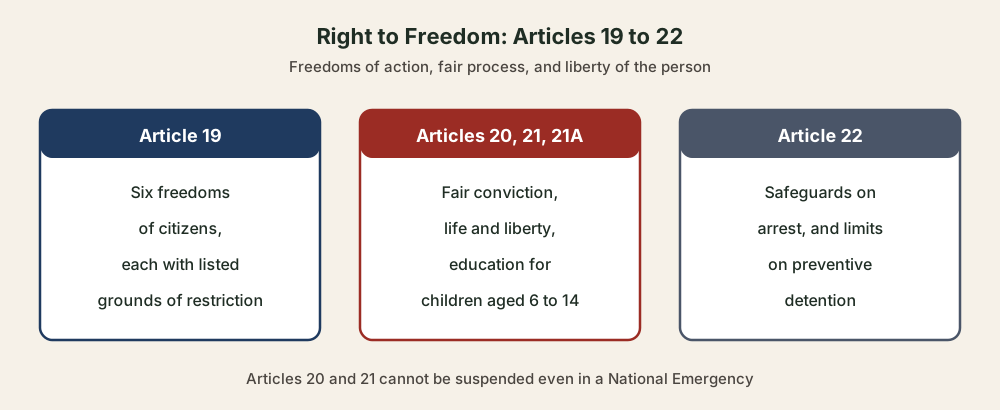
The right to freedom is the second Fundamental Right in Part III, set out in Articles 19 to 22. Article 19 gives citizens six freedoms that the State may limit only on listed grounds; Article 20 protects a person accused of a crime; Article 21 protects life and personal liberty; Article 21A gives children the right to education; and Article 22 guards against arbitrary arrest and detention.
Right to Freedom: Articles 19 to 22 at a Glance
What Is the Right to Freedom? Five Guarantees in Four Articles
Among the six Fundamental Rights of the Indian Constitution, the right to freedom follows the right to equality. Its five guarantees differ most in who can claim them: the six freedoms of Article 19 belong to citizens alone, while Articles 20, 21 and 22 protect any person, foreigners included. The table sets the five side by side.
| Article | What it guarantees | Who can claim it |
|---|---|---|
| 19 | Six freedoms: speech and expression, assembly, association, movement, residence, profession | Citizens only |
| 20 | No ex post facto criminal law, no double jeopardy, no compulsion to be a witness against oneself | Any person, including companies |
| 21 | No deprivation of life or personal liberty except according to procedure established by law | Any person |
| 21A | Free and compulsory education for children aged six to fourteen | Children |
| 22 | Safeguards on arrest, and limits on preventive detention | Any person; part of it excludes enemy aliens |
Article 21 has grown into the widest right in the Constitution. The courts have read into it privacy, dignity, livelihood, a clean environment and many other rights, so that today it is the foundation on which most new rights rest. The other articles stay close to their text, but each has a body of case law that the examination draws on.
Article 19: Six Freedoms of Citizens
Article 19 Freedoms and Reasonable Restrictions Under Article 19(2) to 19(6)
Article 19 guarantees six rights to every citizen. It originally had seven: the right to acquire, hold and dispose of property was deleted by the 44th Amendment of 1978. These freedoms belong only to citizens, not to foreigners or to legal persons such as companies, though shareholders as citizens can claim them.
None of the freedoms is absolute. The State may impose reasonable restrictions, but only on the grounds that Article 19 itself lists for each freedom, and the courts decide whether a restriction is reasonable. The grounds differ from freedom to freedom, as the table shows.
| Freedom | Clause | Grounds for restriction |
|---|---|---|
| Speech and expression | 19(1)(a), 19(2) | Sovereignty and integrity of India, security of the State, friendly relations with foreign States, public order, decency or morality, contempt of court, defamation, incitement to an offence |
| Assembly, peaceably and without arms | 19(1)(b), 19(3) | Sovereignty and integrity of India, public order |
| Association, unions, co-operative societies | 19(1)(c), 19(4) | Sovereignty and integrity of India, public order, morality |
| Movement throughout India | 19(1)(d), 19(5) | Interests of the general public, protection of Scheduled Tribes |
| Residence and settlement anywhere in India | 19(1)(e), 19(5) | Interests of the general public, protection of Scheduled Tribes |
| Any profession, occupation, trade or business | 19(1)(g), 19(6) | Interests of the general public; the State may prescribe qualifications and may itself carry on any trade |
Freedom of Speech and Expression Under Article 19(1)(a)
The freedom of speech and expression lets every citizen express views and opinions by word of mouth, writing, printing, pictures or any other medium. The Constitution does not mention the press, but the Supreme Court has read the freedom of the press into Article 19(1)(a), along with several other rights.
- The right to propagate one’s own views and the views of others.
- Freedom of the press, and freedom from pre-censorship of a newspaper.
- Freedom of commercial advertisements, and the right to telecast without a government monopoly on electronic media.
- The right to know about government activities (see also the Right to Information Act).
- Freedom of silence, and the right to demonstrate or picket, though not to strike.
The grounds of restriction were not all in the original text. The First Amendment of 1951 added public order, to meet the situation created by the Supreme Court's decision in Romesh Thapar's case of 1950, along with friendly relations with foreign States and incitement to an offence. The Sixteenth Amendment of 1963 added the sovereignty and integrity of India.
The right to know has kept growing. On 15 February 2024 a five-judge bench of the Supreme Court struck down the electoral bonds scheme, holding that it violated the voters' right to information about political funding under Article 19(1)(a).
Limits on Speech: Sedition, Section 66A and Internet Shutdowns
Three disputes show how courts test a restriction on speech: a restriction must fall within a ground in Article 19(2) and must be reasonable, with a close link between the speech and the harm it is said to cause.
- Sedition: Section 124A of the Indian Penal Code punished bringing or attempting to bring the Government into hatred or contempt. In Kedar Nath v. State of Bihar (1962) the Supreme Court upheld it, while the law itself said that comments expressing disapproval of government action, without exciting hatred or disaffection, are not an offence. The Supreme Court put the law on hold on 11 May 2022, and the Bharatiya Nyaya Sanhita, 2023 removes sedition as an offence, creating instead an offence of endangering India’s sovereignty, unity and integrity.
- Section 66A of the IT Act: It punished sending grossly offensive or menacing information online. In Shreya Singhal v. Union of India (2015) the Supreme Court struck it down as violating Article 19(1)(a) and not saved by Article 19(2), and held that online intermediaries need take down content only on a court or government order.
- Internet shutdowns: In Anuradha Bhasin v. Union of India the Supreme Court held that an indefinite suspension of internet services is illegal, that shutdowns must satisfy necessity and proportionality, and that such orders must be made public and are open to judicial review.
Public order is narrower than it sounds. It means public peace, safety and tranquillity, and mere criticism of the government does not necessarily disturb it. A restriction fails if there is no reasonable nexus between the speech it targets and the maintenance of public order.
Freedoms of Assembly, Association, Movement, Residence and Profession
The other five freedoms of Article 19 protect action rather than speech. Each has its own limits, set by its own clause.
- Assembly: The right to hold public meetings, demonstrations and processions, peaceably and without arms. It does not protect violent or riotous assemblies.
- Association: The right to form associations, unions and co-operative societies, to continue with them, and not to join one. Recognition of an association is not a Fundamental Right.
- Movement: The right to move freely throughout India, which treats the country as one unit for its citizens. Going abroad and returning is covered by Article 21, not Article 19.
- Residence: The right to reside temporarily and to settle permanently anywhere in India. Entry and settlement in tribal areas can be restricted to protect the culture and property of Scheduled Tribes.
- Profession: The right to any profession, occupation, trade or business. It does not cover immoral or dangerous trades, and the State may run a trade itself, even as a monopoly, without justifying it.
Article 20: Protection in Respect of Conviction for Offences
Ex Post Facto Laws, Double Jeopardy and Self-Incrimination Under Article 20
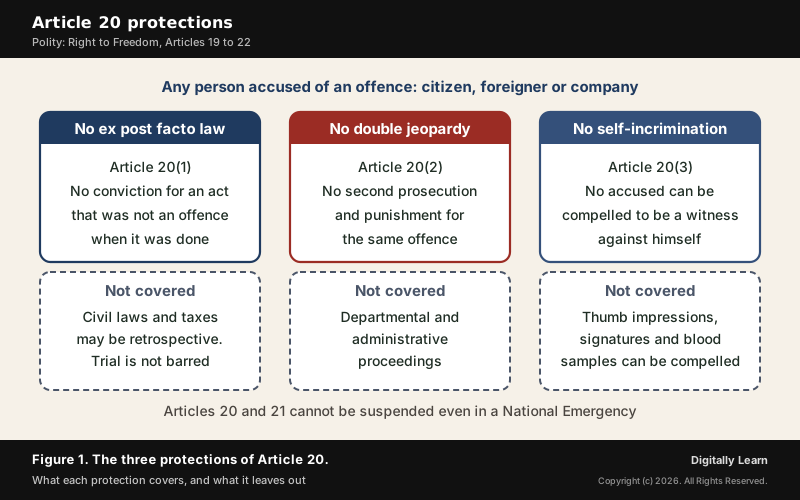
Article 20 protects anyone accused of a crime, whether a citizen, a foreigner or a legal person such as a company, against arbitrary and excessive punishment. It contains three protections, and it is one of the two articles, with Article 21, that cannot be suspended even during a National Emergency.
- No ex post facto law, Article 20(1): No one can be convicted except for breaking a law in force when the act was done, nor given a penalty greater than the law then prescribed. The bar applies only to criminal laws, not to civil liabilities or taxes, which can be imposed retrospectively, and only to conviction and sentence, not to trial.
- No double jeopardy, Article 20(2): No one can be prosecuted and punished for the same offence more than once. The protection applies to proceedings before a court or judicial tribunal, not to departmental or administrative proceedings.
- No self-incrimination, Article 20(3): No accused person can be compelled to be a witness against himself. It covers oral and documentary evidence, but not the compulsory production of material objects, thumb impressions, specimen signatures, blood samples or exhibition of the body.
Article 21: Protection of Life and Personal Liberty
From Gopalan to Maneka Gandhi: Procedure Established by Law and Due Process
Article 21 says that no person shall be deprived of life or personal liberty except according to procedure established by law. It protects citizens and foreigners alike. How much it protects depended on how the courts read the words "procedure established by law".
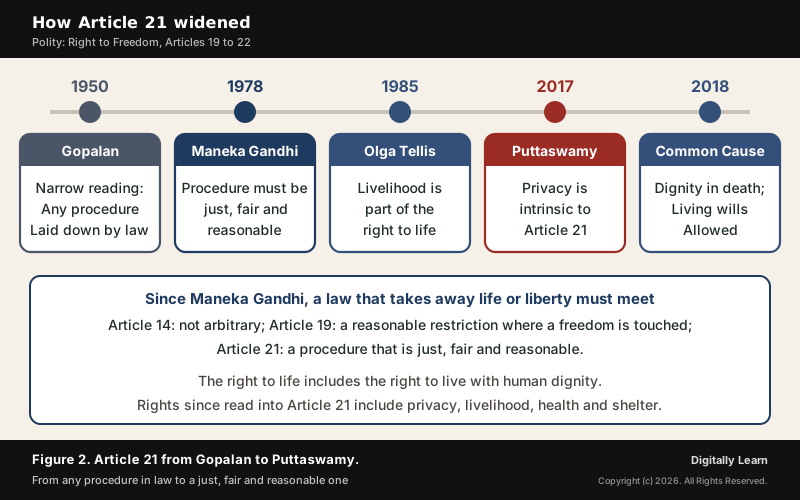
In A. K. Gopalan v. State of Madras (1950) the Supreme Court read Article 21 narrowly. It protected only against arbitrary executive action, not arbitrary laws: if a law laid down a procedure, the procedure could not be questioned as unfair. The Court held that Article 21 did not require the American standard of due process of law, which lets courts test a law's fairness, and upheld the Preventive Detention Act, 1950, except one section.
Maneka Gandhi v. Union of India (1978) overruled Gopalan. The Court held that the procedure must be just, fair and reasonable, which in effect brought in due process, and that Articles 14, 19 and 21 are linked, so a law depriving a person of liberty must satisfy all three. It also held that the right to life is not mere animal existence but includes the right to live with human dignity.
Rights Read Into Article 21: Dignity, Livelihood, Health and More
Building on Maneka Gandhi, the Supreme Court has declared a long list of rights to be part of Article 21. They fall into four broad groups.
| Group | Rights the Supreme Court has read into Article 21 |
|---|---|
| Dignity and the person | Right to live with human dignity; privacy; reputation; against solitary confinement, handcuffing, inhuman treatment and custodial harassment |
| Living conditions | Decent environment with pollution-free air and water; livelihood; shelter; health; emergency medical aid |
| Fair process | Speedy trial; fair trial; free legal aid; hearing; against delayed execution and public hanging |
| Freedom of the person | Travel abroad; against bonded labour; not to be driven out of a State; information |
Two cases show how the reading works. In Olga Tellis (1985) pavement and slum dwellers in Bombay challenged their eviction during the monsoon, and the Court accepted that taking away a person's livelihood takes away a part of the right to life. In Common Cause (2018) a five-judge bench read the right to die with dignity into Article 21 and allowed living wills, under which a terminally ill or vegetative patient can be passively euthanised; the procedure was eased in January 2023.
Right to Privacy: The Puttaswamy Judgment of 2017
Earlier benches in M. P. Sharma and Kharak Singh had held that there is no Fundamental Right to privacy. The question came up again in the challenge to the Aadhaar scheme. On 11 August 2015 a three-judge bench sent it to a bench of appropriate strength, because those earlier rulings had been given by eight and six judges.
In Justice K. S. Puttaswamy v. Union of India (2017) the nine judges held unanimously that the right to privacy is protected as an intrinsic part of the right to life and personal liberty under Article 21 and as part of the freedoms in Part III. The judgment overruled M. P. Sharma and Kharak Singh. Like other rights, privacy can be limited, but only where there is a compelling State interest.
Article 21A and the Right to Education Act, 2009
Article 21A requires the State to provide free and compulsory education to all children aged six to fourteen, in the manner the State determines by law. It makes only elementary education a Fundamental Right, not higher or professional education. The 86th Amendment Act of 2002 added it.
The right had a judicial history before the amendment. In 1993 the Supreme Court had already recognised a Fundamental Right to primary education within Article 21, free until a child completes the age of fourteen, while holding that education beyond that depends on the economic capacity of the State. The 86th Amendment also changed Article 45 to cover early childhood care up to the age of six, and added a Fundamental Duty on parents to provide their children opportunities for education.
Parliament gave effect to Article 21A through the Right of Children to Free and Compulsory Education Act, 2009, enacted on 4 August 2009. Section 3 gives every child of six to fourteen the right to free and compulsory education in a neighbourhood school until elementary education is complete, and private schools must reserve 25 per cent of seats for children from disadvantaged backgrounds. A notification of 16 February 2010 brought the 86th Amendment into force on 1 April 2010, the day the Act also took effect. The parent's duty sits with the other Fundamental Duties.
Article 22: Protection Against Arrest and Detention
Rights of an Arrested Person Under Article 22(1) and 22(2)
Article 22 deals with two kinds of detention. Punitive detention follows a trial and conviction; preventive detention is detention without trial, to stop a person from committing an offence in the near future. The first part of the article protects a person arrested under ordinary law.
- The right to be told the grounds of arrest.
- The right to consult and be defended by a lawyer of one’s choice.
- The right to be produced before a magistrate within 24 hours, excluding the journey.
- The right to be released after 24 hours unless the magistrate authorises further detention.
These safeguards do not apply to an enemy alien or to a person held under a preventive detention law. The courts have added to them. The guidelines laid down in D. K. Basu v. State of West Bengal (1997) require the arresting officer's identity to be shown by a name plate and rank, a memo of arrest to be prepared, and the arrested person to be allowed to inform a relative or friend. In Arnesh Kumar v. State of Bihar (2014) the Supreme Court held that for offences punishable with less than seven years, arrest should be the exception, and police must first decide whether an arrest is necessary under the law's conditions.
Preventive Detention Under Article 22: Safeguards and Laws
The second part of Article 22 protects persons held under a preventive detention law, citizens and aliens alike. The safeguards are limited, because the purpose of such detention is precaution based on suspicion.
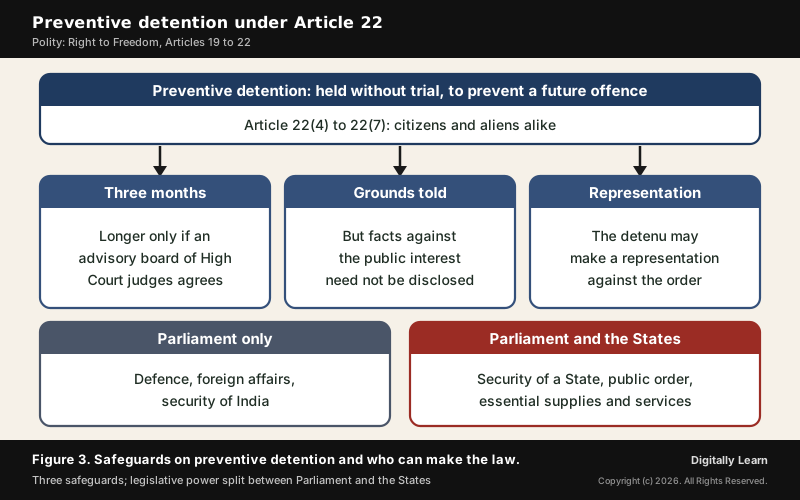
- Detention cannot exceed three months unless an advisory board of High Court judges reports sufficient cause.
- The grounds of detention must be communicated, though facts against the public interest need not be disclosed.
- The detenu must be given an opportunity to make a representation against the order.
- Parliament may prescribe cases of detention beyond three months without an advisory board, the maximum period, and the board’s procedure.
The 44th Amendment of 1978 reduced the period without an advisory board's opinion from three months to two, but that provision has not been brought into force. Parliament alone can make preventive detention laws on defence, foreign affairs and the security of India; Parliament and the States both can for the security of a State, public order and essential supplies. The National Security Act, 1980 is the main law today, with a maximum detention of 12 months.
Previous Year UPSC-CSE Questions
Previous Year UPSC-CSE Questions By the end you will be able to draft model answers for the following UPSC questions. Each question carries a collapsible framework showing how to approach it in the exam.
- UPSC Mains 2023 GS-II“The Constitution of India is a living instrument with capabilities of enormous dynamism. It is a constitution made for a progressive society.” Illustrate with special reference to the expanding horizons of the right to life and personal liberty.
Answer outline: how to structure the answer
What the question asks, the main arguments, relevant examples and the direction of the conclusion. This is not a full model answer.
Introduction: Article 21 says only that life and liberty may be taken by procedure established by law; the courts have made it the widest right in the Constitution.
Body (sub-themes to develop):
- The turn: Gopalan (1950) read it narrowly; Maneka Gandhi (1978) required a just, fair and reasonable procedure and linked Articles 14, 19 and 21.
- Dignity: the right to life is more than animal existence; it includes living with human dignity.
- New rights: livelihood (Olga Tellis, 1985), privacy (Puttaswamy, 2017), dignity in death and living wills (Common Cause, 2018), health, shelter, speedy trial, legal aid.
- Text responding to courts: the right to education read into Article 21 in 1993 became Article 21A in 2002.
Conclusion: Conclude that Article 21 shows a living Constitution: unchanged words, steadily wider protection.
- UPSC Mains 2017 GS-IIExamine the scope of Fundamental Rights in the light of the latest judgement of the Supreme Court on Right to Privacy.
Answer outline: how to structure the answer
What the question asks, the main arguments, relevant examples and the direction of the conclusion. This is not a full model answer.
Introduction: In Puttaswamy (2017) a nine-judge bench unanimously held privacy to be a Fundamental Right.
Body (sub-themes to develop):
- Holding: privacy is intrinsic to life and personal liberty under Article 21 and part of the freedoms in Part III; M. P. Sharma and Kharak Singh overruled.
- Scope: rights are not watertight compartments; Articles 14, 19 and 21 operate together, as Maneka Gandhi held.
- Limits: privacy can be restricted only for a compelling State interest.
- Consequences: decisional autonomy, data and the later rulings that build on it.
Conclusion: Conclude that the judgment widened Part III by reading unenumerated rights into its text.
- UPSC Mains 2013 GS-IIDiscuss Section 66A of IT Act, with reference to its alleged violation of Article 19 of the Constitution.
Answer outline: how to structure the answer
What the question asks, the main arguments, relevant examples and the direction of the conclusion. This is not a full model answer.
Introduction: Section 66A of the IT Act punished sending grossly offensive or menacing information online.
Body (sub-themes to develop):
- Conflict: vague terms like offensive or annoyance are not among the grounds in Article 19(2).
- Test: a restriction must fall within a listed ground and bear a close nexus to it, such as public order.
- Outcome: Shreya Singhal (2015) struck Section 66A down; intermediaries need act only on a court or government order.
Conclusion: Conclude that online speech carries the same protection as other speech, limited only on the grounds in Article 19(2).
- UPSC Prelims 2024 Prelims-GSUnder which of the following Articles of the Constitution of India, has the Supreme Court of India placed the Right to Privacy ?
How to approach this Prelims question
Approach: The 2017 nine-judge bench held privacy to be an intrinsic part of the right to life and personal liberty under Article 21, and part of the freedoms in Part III. The question asks where the Court placed it: Article 21.
Trap to watch: Article 19 is tempting because privacy touches several freedoms, but the Court rooted it in life and personal liberty.
Key facts to recall:
- (a) Article 15: wrong. It deals with discrimination on grounds of religion, race, caste, sex or place of birth.
- (b) Article 16: wrong. It deals with equality of opportunity in public employment.
- (c) Article 19: wrong. Privacy is linked to the freedoms, but the Court placed it in life and personal liberty.
- (d) Article 21: right. Puttaswamy held privacy intrinsic to the right to life and personal liberty.
Answer signal: Option (d): Article 21, Puttaswamy (2017).
- UPSC Prelims 2021 Prelims-GS'Right to Privacy' is protected under which Article of the Constitution of India?
How to approach this Prelims question
Approach: Privacy was held in 2017 to be part of the right to life and personal liberty, Article 21. The other options are equality, a freedom and a minority right.
Trap to watch: Article 19 again looks plausible because it lists freedoms.
Key facts to recall:
- (a) Article 15: wrong. It prohibits discrimination.
- (b) Article 19: wrong. It holds the six freedoms of citizens; privacy was placed in Article 21.
- (c) Article 21: right. Privacy is intrinsic to life and personal liberty.
- (d) Article 29: wrong. It protects the language, script and culture of minorities.
Answer signal: Option (c): Article 21.
- UPSC Prelims 2018 Prelims-GSRight to Privacy is protected as an intrinsic part of Right to Life and Personal Liberty. Which of the following in the Constitution of India correctly and appropriately imply the above statement?
How to approach this Prelims question
Approach: Match the option to the holding: privacy is protected as an intrinsic part of the right to life and personal liberty under Article 21 and as part of the freedoms guaranteed by Part III. Only one option pairs Article 21 with the freedoms in Part III.
Trap to watch: Options that pair an unrelated article with an amendment are distractors; anchor on Article 21.
Key facts to recall:
- (a) Article 14 and the 42nd Amendment: wrong. Privacy was not placed in Article 14 or traced to the 42nd Amendment.
- (b) Article 17 and the Directive Principles: wrong. Article 17 abolishes untouchability, and Directive Principles are not enforceable rights.
- (c) Article 21 and the freedoms in Part III: right. These are the words of the 2017 holding.
- (d) Article 24 and the 44th Amendment: wrong. Article 24 concerns child labour.
Answer signal: Option (c): Article 21 with the freedoms in Part III.
Sources and Further Reading
- Legislative Department, Ministry of Law and Justice: The Constitution of India
- NCERT: Indian Constitution at Work, Class 11, Chapter 2, Rights in the Indian Constitution
- NCERT: Social and Political Life III, Class 8, Understanding Our Criminal Justice System
- Wikipedia: Maneka Gandhi v. Union of India
- Wikipedia: A. K. Gopalan v. State of Madras
- Wikipedia: Puttaswamy v. Union of India
- Wikipedia: Shreya Singhal v. Union of India
- Wikipedia: Olga Tellis v. Bombay Municipal Corporation
- Wikipedia: Euthanasia in India
- Wikipedia: Freedom of expression in India
- Wikipedia: Internet censorship in India
- Wikipedia: Electoral bonds
- Wikipedia: Right of Children to Free and Compulsory Education Act, 2009
- Wikipedia: National Security Act, 1980
- Wikipedia: Arnesh Kumar Guidelines
- Supreme Court of India: Justice K. S. Puttaswamy (Retd.) v. Union of India, W.P. (C) 494 of 2012, reference order of 11 August 2015
- India Code: The Right of Children to Free and Compulsory Education Act, 2009, with notification S.O. 427(E)
- National Human Rights Commission: Guidelines for Police Personnel on Various Human Rights Issues
- Wikipedia: Section 124A of the Indian Penal Code
- Wikipedia: Bharatiya Nyaya Sanhita, 2023
- Wikipedia: Article 12 of the Constitution of India
Editorial Disclaimer
This article explains the right to freedom from the text of the Constitution, Supreme Court judgments, NCERT and the other sources listed. It is study material, not legal advice.


