


Overview
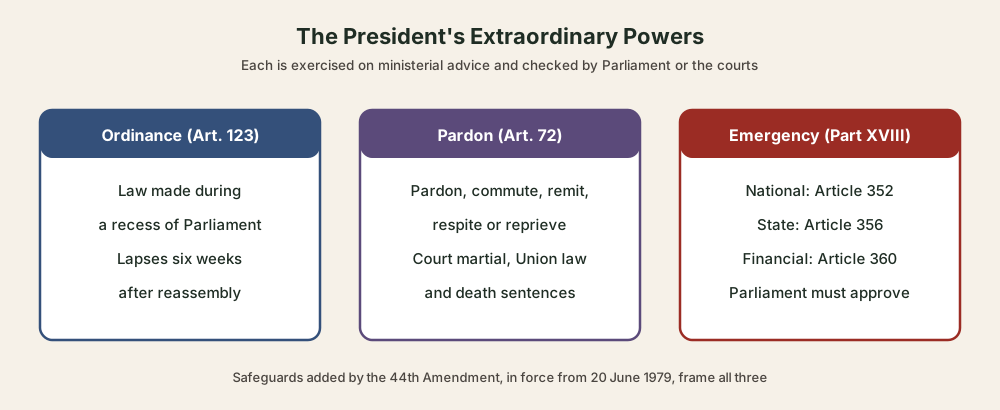
The ordinance, pardoning and emergency powers of the President let the Union act when ordinary processes cannot: ordinances under Article 123 during a recess of Parliament, clemency under Article 72, and national, State and financial emergencies under Articles 352, 356 and 360, each on ministerial advice and subject to Parliament and the courts.
Ordinance, Pardoning and Emergency Powers of the President: An Overview
Three Extraordinary Powers and What They Share
The ordinance, pardoning and emergency powers of the President are the three powers that let the Union act when ordinary processes cannot: Parliament is not in session, the judicial process has ended, or the security, constitutional order or finances of the country are threatened. Each is exercised on ministerial advice under Article 74.
These powers matter because they suspend ordinary rules. An ordinance makes law without Parliament, a pardon sets aside a court's sentence, and an emergency can shift power from the States to the Union and restrict rights, so each has been heavily litigated and amended.
The significance of these powers lies in the balance the Constitution strikes between speed and control:
- Speed: Each power can be used at once, without waiting for a session, a trial or a legislative debate.
- Parliamentary control: Ordinances and all three emergencies must be approved by Parliament within fixed periods, or they lapse.
- Judicial control: The Supreme Court reviews the satisfaction behind ordinances and President’s rule, and the manner of exercising clemency.
| Power | Article | When it can be used | Main check |
|---|---|---|---|
| Ordinance | 123 | Either House not in session; immediate action needed | Lapses six weeks after Parliament reassembles |
| Pardon and related powers | 72 | A person convicted of an offence | Advice of Ministers; limited judicial review |
| National emergency | 352 | War, external aggression or armed rebellion | Approval by both Houses within one month |
| President's rule | 356 | State government cannot be carried on as the Constitution requires | Approval within two months; three-year limit |
| Financial emergency | 360 | Financial stability or credit threatened | Approval by both Houses within two months |
The election and tenure of the office are explained in President of India: Election, Qualifications, Term and Impeachment, and the executive and legislative powers, including assent and veto, in Powers of the President of India. This article covers the three extraordinary powers in turn, with the safeguards that limit each.
Ordinance-Making Power of the President Under Article 123
Conditions for Promulgating an Ordinance
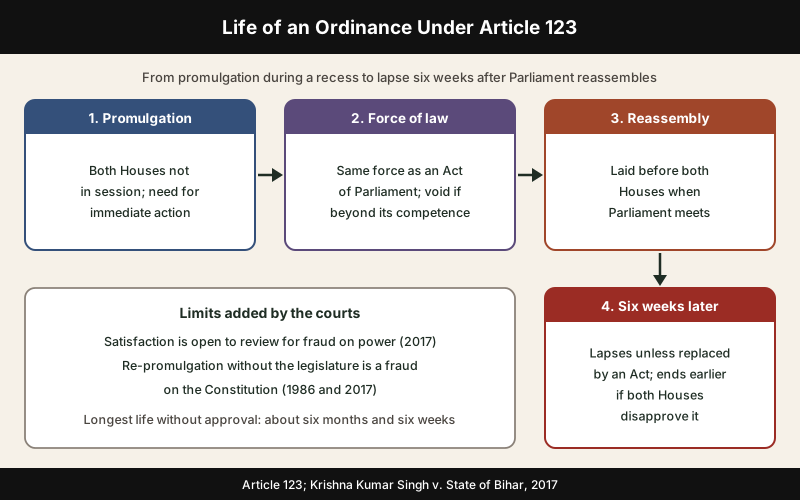
Under Article 123(1), the President may promulgate an ordinance at any time except when both Houses of Parliament are in session, if satisfied that circumstances exist which render immediate action necessary. An ordinance can therefore be made when either House is not sitting.
Under clause (2), an ordinance has the same force and effect as an Act of Parliament. Clause (3) sets the limit: an ordinance is void to the extent that it makes a provision that Parliament itself could not enact under the Constitution. Like other powers, the decision rests with the Council of Ministers, which may be asked to reconsider its advice once.
Life of an Ordinance: Six Weeks After Parliament Reassembles
An ordinance must be laid before both Houses. It ceases to operate six weeks after Parliament reassembles, or earlier if both Houses pass resolutions disapproving it, and the President may withdraw it at any time. When the Houses reassemble on different dates, the six weeks run from the later date.
Because Article 85(1) allows at most six months between sessions, an ordinance that is never approved can survive for about six months and six weeks. To last longer, its provisions must be enacted by Parliament through a replacing Act.
Judicial Review of the President's Satisfaction
In R. C. Cooper v. Union of India, a bench of eleven judges described the power as exercisable in extraordinary situations demanding immediate law, and noted that the President's determination was not declared final. The Thirty-eighth Amendment of 1975 then inserted a clause making the satisfaction immune from scrutiny by any court.
The Forty-fourth Amendment deleted that clause. In A. K. Roy v. Union of India, a Constitution Bench held that whether the preconditions of Article 123 are met cannot be regarded as a purely political question, and that after the deletion judicial review of the satisfaction is not totally excluded.
In 2017 the Court settled the point: the satisfaction of the President under Article 123 is not immune from judicial review. The test is whether it rests on some relevant material; courts do not weigh the sufficiency of that material, but they will intervene if the satisfaction is a fraud on power or rests on an oblique motive.
Re-promulgation: D. C. Wadhwa and Krishna Kumar Singh
The abuse the courts confronted was re-promulgation. Research into Bihar found that the Governor had promulgated and re-promulgated 256 ordinances between 1967 and 1981, some kept alive for fourteen years. In D. C. Wadhwa v. State of Bihar, decided on 20 December 1986, a Constitution Bench held the practice to be a colourable exercise of power.
In Krishna Kumar Singh v. State of Bihar, a seven-judge bench decided on 2 January 2017 that repeated re-promulgation without placing ordinances before the legislature is a fraud on the Constitution. The leading judgment, written by Justice D. Y. Chandrachud for the majority, also rejected the theory that rights created by an ordinance endure automatically after it lapses.
The reasoning explains the separation of powers concern. Re-promulgation, the leading judgment said, is an effort to overreach the legislature, the primary source of law-making, and poses a threat to the sovereignty of Parliament; open legislative debate is what distinguishes accountable law-making from the secrecy of ordinance-making.
Pardoning Power of the President Under Article 72
Five Forms of Clemency Under Article 72
Article 72(1) empowers the President to grant pardons, reprieves, respites or remissions of punishment, or to suspend, remit or commute the sentence of any person convicted of an offence. Each term describes a different degree of relief:
| Form | Meaning | Example |
|---|---|---|
| Pardon | Completely absolves the person of the crime | The convict goes free |
| Commutation | Substitutes a lighter form of punishment | Death sentence commuted to life imprisonment |
| Remission | Reduces the quantum of punishment without changing its nature | Twenty years of rigorous imprisonment reduced to ten |
| Respite | Awards a lesser sentence because of special circumstances | Pregnancy or mental condition of the convict |
| Reprieve | Delays the execution of a sentence, usually of death | Time to seek a pardon or another legal remedy |
The distinctions are frequently tested. A commutation changes the kind of punishment, a remission changes only its quantity, and a reprieve changes only its timing.
Scope of the Power: Court Martial, Union Laws and Death Sentences
The President's power extends to three classes of case: every punishment or sentence by a court martial, every sentence for an offence against a law on a matter within the executive power of the Union, and every sentence of death. Officers of the armed forces keep their statutory powers to suspend, remit or commute court-martial sentences.
The Governor's parallel power under Article 161 extends only to offences against laws on matters within the executive power of the State. A Governor cannot pardon a death sentence, but Article 72(3) preserves the Governor's power to suspend, remit or commute it.
| Case | President (Article 72) | Governor (Article 161) |
|---|---|---|
| Sentence by a court martial | Yes | No |
| Offence against a Union law | Yes | No |
| Offence against a State law | No | Yes |
| Pardon of a death sentence | Yes | No; may suspend, remit or commute |
Exercised on Advice and Subject to Limited Judicial Review
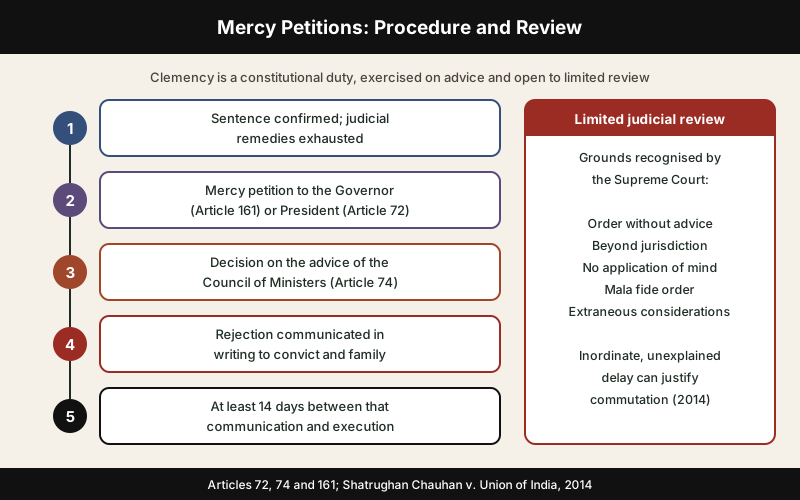
In Shatrughan Chauhan v. Union of India (2014), the Supreme Court described the power under Articles 72 and 161 as a constitutional duty, neither a matter of grace nor of privilege, exercised in aid of justice and on the aid and advice of the Council of Ministers. The President does not act on personal discretion in mercy cases.
The Court has declined to frame guidelines for the power itself. Maru Ram recommended guidelines, but Kehar Singh held them unnecessary, and the Court presumes that a constitutional authority applies its mind. It has also held that the power is above review, while the manner of its exercise is open to limited judicial review.
The recognised grounds, set out in Narayan Dutt v. State of Punjab for a Governor, are that the order was passed without the government's advice, beyond jurisdiction, without application of mind, mala fide, or on extraneous considerations. The same logic governs the President, who acts on the advice of the Union Council of Ministers.
Delay in Mercy Petitions: The Shatrughan Chauhan Guidelines
Decided on 21 January 2014 by a bench of Chief Justice P. Sathasivam and Justices Ranjan Gogoi and Shiva Kirti Singh, Shatrughan Chauhan held that undue, unexplained and inordinate delay in deciding mercy petitions is a supervening circumstance under Article 21 that can justify commutation. The Court commuted the death sentences of fifteen convicts.
It also treated insanity and solitary confinement as supervening circumstances to be weighed, and laid down procedural safeguards:
- A convict whose mercy petition is rejected must be informed in writing, and the family too.
- Death convicts are entitled as a right to a copy of the rejection order.
- A minimum of fourteen days must separate the communication of rejection and the scheduled execution.
The debate over a fixed time limit for the President continues. The Court chose not to set one, relying instead on delay as a ground for relief; in 2022 it ordered the release of A. G. Perarivalan after criticising the Tamil Nadu Governor for sitting on the State's remission recommendation for about two and a half years.
National Emergency Under Article 352
Grounds and Proclamation: War, External Aggression, Armed Rebellion
Under Article 352(1), the President may proclaim an emergency if satisfied that a grave emergency exists whereby the security of the country or any part of it is threatened by war, external aggression or armed rebellion. A proclamation may be made before the actual occurrence if there is imminent danger, and may cover the whole country or a part.
The Forty-fourth Amendment replaced the words internal disturbance with armed rebellion, with effect from 20 June 1979. Under clause (3), the President cannot issue or vary a proclamation unless the decision of the Union Cabinet, meaning the Prime Minister and the Cabinet Ministers, has been communicated in writing.
Approval, Duration and Revocation of a National Emergency
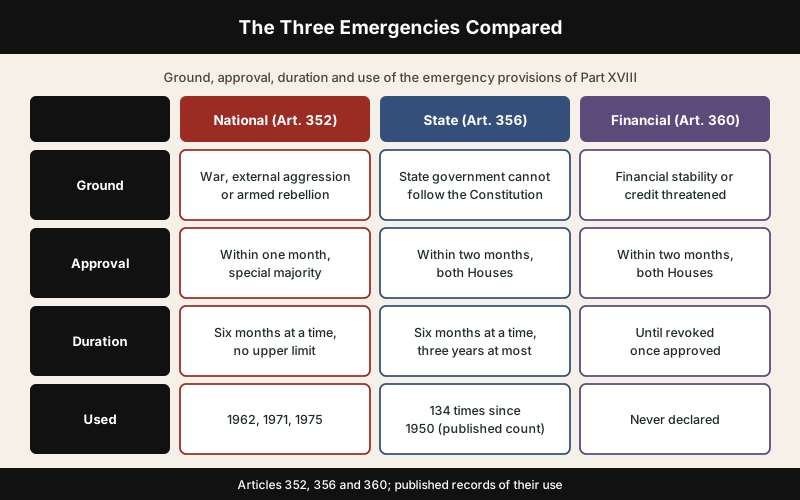
Every proclamation must be approved by both Houses within one month, each by a majority of its total membership and two-thirds of those present and voting. An approved proclamation lasts six months and may be continued for further six-month periods by fresh resolutions, with no upper limit on the number of extensions.
If the Lok Sabha is dissolved and only the Rajya Sabha has approved, the proclamation survives until thirty days after the new Lok Sabha first sits. The President must revoke a proclamation if the Lok Sabha passes a resolution disapproving it, and one-tenth of its members can require a special sitting within fourteen days to consider such a resolution.
Approval is thus a joint function of both Houses, while revocation lies with the Lok Sabha alone. It differs from a motion of no-confidence, which only the Lok Sabha can pass because the Council of Ministers is collectively responsible to it under Article 75(3), and from impeachment, in which both Houses act.
Effects on Centre-State Relations and Fundamental Rights
Emergency provisions can turn the federal polity into a highly centralised system. During a national emergency the Union may give directions to any State on the exercise of its executive power, and Parliament's laws may confer powers on the Union even on matters outside the Union List. The President may also modify the distribution of revenues under Articles 268 to 279, until the end of the financial year in which the emergency ends.
Under Article 250, Parliament may legislate on any State List matter while an emergency is in operation; such laws lapse six months after it ends. In ordinary times Parliament can do so only under Article 249, when the Rajya Sabha resolves by two-thirds of members present and voting that it is necessary in the national interest.
The life of the Lok Sabha may be extended by law one year at a time while a proclamation is in operation, but not beyond six months after it ends. Two provisions affect fundamental rights, and the Forty-fourth Amendment narrowed both:
| Feature | Article 358 | Article 359 |
|---|---|---|
| What it does | Article 19 cannot restrict laws and executive action | President may suspend enforcement of rights named in the order |
| When it applies | Only in an emergency declared for war or external aggression | In any national emergency |
| Limits added in 1979 | Applies only to laws that recite the emergency | Articles 20 and 21 cannot be suspended; only laws that recite the emergency are protected |
National Emergencies Proclaimed Since 1950
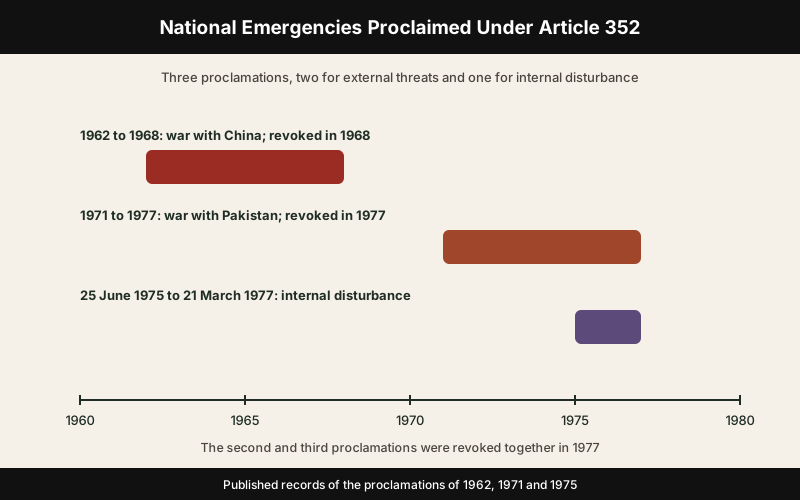
A national emergency has been proclaimed three times. President Sarvepalli Radhakrishnan proclaimed the first in 1962 during the war with China; it lasted through the war of 1965 and was revoked in 1968. President V. V. Giri proclaimed the second in 1971, on the eve of the war with Pakistan.
While the second was in force, President Fakhruddin Ali Ahmed proclaimed an emergency on grounds of internal disturbance on 25 June 1975, on the advice of Prime Minister Indira Gandhi; it ended on 21 March 1977, and the second and third proclamations were revoked together in 1977. Its political history is told in The Emergency 1975-77, and its lessons shaped the Forty-fourth Amendment.
President's Rule in the States Under Article 356
Failure of Constitutional Machinery: Grounds and Effects
Under Article 356(1), if the President, on a report from the Governor or otherwise, is satisfied that the government of a State cannot be carried on in accordance with the Constitution, the President may assume the functions of the State government and declare that the powers of the State Legislature shall be exercisable by or under the authority of Parliament.
The President cannot assume the powers of a High Court or suspend the provisions relating to it. Under Article 357, Parliament may confer the State's law-making power on the President, and laws so made continue after the proclamation ends until altered or repealed. The Council of Ministers goes, but dissolution of the Assembly is not automatic: it may be kept in suspended animation.
Article 355 frames the provision: it is the duty of the Union to protect every State against external aggression and internal disturbance and to ensure that its government is carried on in accordance with the Constitution. Nothing in Article 356 dissolves elected local bodies; the proclamation concerns the State government and legislature.
Approval and Duration: Two Months, Six Months, Three Years
A proclamation must be approved by both Houses within two months. Once approved, it lasts six months from the date of issue and can be continued six months at a time, but never beyond three years, subject to a special provision for Punjab after 1987.
Since the Forty-fourth Amendment, a resolution continuing President's rule beyond one year can be passed only if two conditions are met:
- A national emergency is in operation in the whole country or in the whole or any part of the State.
- The Election Commission certifies that continuance is necessary because of difficulties in holding elections to the State Assembly.
S. R. Bommai and the Limits on President's Rule
Ambedkar told the Constituent Assembly on 4 August 1949 that such articles would, he hoped, never be called into operation and would remain a dead letter. Practice differed: President's rule has been imposed 134 times since 1950, first in Punjab on 20 June 1951, then in PEPSU in 1953 and Kerala in 1959.
Article 356 was used sparingly until 1967, but more often once many States had non-Congress governments. By the time of the Sarkaria Commission, it had been invoked not less than 75 times in 37 years, and the Commission recommended using it very sparingly, in extreme cases, as a measure of last resort.
In S. R. Bommai v. Union of India, decided by nine judges on 11 March 1994, the Court held that a proclamation is not immune from judicial review. Courts can examine whether there was any material, whether it was relevant, and whether the power was used mala fide, though not the advice itself.
The judgment is summarised in a set of principles:
- Majority test: The support of a ministry is to be tested on the floor of the House.
- Conditioned power: The President’s satisfaction must rest on relevant material; Article 356 is not an absolute power.
- Dissolution: An Assembly should be dissolved only when necessary for the purposes of the proclamation, which is subject to the approval of both Houses.
- Secularism: It is part of the basic structure of the Constitution, and a State government that pursues non-secular policies acts contrary to the constitutional mandate.
The practice of dismissing opposition governments was limited only after these strict guidelines. The Governor's role in recommending President's rule is examined further in the articles on the Governor and on Centre-State relations.
Financial Emergency Under Article 360
Grounds, Approval and Duration of a Financial Emergency
Under Article 360(1), the President may proclaim a financial emergency if satisfied that the financial stability or credit of the country or any part of it is threatened. The proclamation must be laid before each House and approved by both within two months, with the same thirty-day rule if the Lok Sabha has been dissolved.
Once approved, a financial emergency continues until it is revoked; unlike the other two emergencies, it needs no periodic renewal. A financial emergency has never been declared, and a clause (5) inserted by the Thirty-eighth Amendment in 1975 was omitted by the Forty-fourth Amendment.
Consequences of a Financial Emergency
While a financial emergency is in operation, the Union's executive authority extends to giving directions to any State to observe canons of financial propriety, and to other directions the President considers necessary. These directions may include:
- Reduction of salaries and allowances of all or any class of persons serving the State.
- Reservation of Money Bills and other financial Bills passed by the State Legislature for the President’s consideration.
- Reduction of salaries and allowances of persons serving the Union, including the judges of the Supreme Court and the High Courts.
The last point matters because it reaches even the judges of the Supreme Court and the High Courts. Financial emergency thus makes the Union the guardian of fiscal discipline in the States, a power the Constitution provides but governments have never used.
Safeguards and Assessment of the Extraordinary Powers
Safeguards Added by the Forty-fourth Amendment
After the emergency of 1975 to 1977, the Forty-fourth Amendment, in force from 20 June 1979, rebuilt the safeguards around these powers:
- National emergency: Armed rebellion instead of internal disturbance, a written Cabinet decision, approval by special majority within one month, and renewal every six months.
- Lok Sabha control: A proclamation must be revoked if the Lok Sabha disapproves it, and one-tenth of its members can force a special sitting.
- Rights: Articles 20 and 21 cannot be suspended, and Article 358 applies only to war or external aggression.
- Review: The clause inserted in 1975 to make the satisfaction under Article 123 final was removed, as was clause (5) of Article 360.
These changes show a clear design choice: the powers remain, but each use must now pass through Parliament and remain open to the courts, so that an extraordinary power cannot become an ordinary way of governing.
Distinguishing Features, Outcomes and Current Debates
Three features distinguish these powers from the President's routine functions:
- Temporary by design: Ordinances lapse, emergencies need renewal, and President’s rule has a three-year ceiling.
- Double control: Parliament approves within fixed periods, and courts review the material behind the satisfaction.
- Advice, not discretion: The Council of Ministers decides, which places political responsibility on the government.
Three observable outcomes follow:
- After 1994, the use of President’s rule to dismiss opposition governments declined under the Bommai guidelines.
- After 2017, re-promulgation of ordinances without placing them before the legislature became constitutionally impermissible.
- After 2014, delay in deciding mercy petitions became a recognised ground for commuting death sentences.
The current debates continue these themes and turn on three questions of institutional balance:
- Timelines: Whether mercy petitions and reserved Bills need fixed deadlines.
- Review: How far courts should examine a Governor’s report recommending President’s rule.
- Ordinances: How often they should substitute for parliamentary debate.
Each question asks the same thing in a different setting: how to keep an extraordinary power available for genuine need while ensuring that Parliament and the courts can still call its use to account.
UPSC Relevance and Previous-Year Questions on These Powers
Where These Powers Fit in the UPSC-CSE Syllabus
These powers belong to General Studies Paper II, under the Executive, Parliament, federalism and emergency provisions. The linked questions from the preliminary examination test exact textual points:
- Ordinances: Made when either House is not in session, under Article 123.
- Pardon: Exercised on advice and subject to limited judicial review.
- Emergency: Approval by both Houses, the Lok Sabha’s term in an emergency, and Article 355.
- Financial emergency: Two months for approval, and judges’ salaries can be reduced.
- President’s rule: What necessarily follows, and what does not.
The linked questions from the main examination ask whether ordinances violate the separation of powers, whether the President should face a time limit on mercy petitions, and what a financial emergency involves. The sections on ordinances, clemency and Article 360 supply the material for each answer.
Previous Year UPSC-CSE Questions
Previous Year UPSC-CSE Questions By the end you will be able to draft model answers for the following UPSC questions. Each question carries a collapsible framework showing how to approach it in the exam.
- UPSC Prelims 2025 GS-IConsider the following statements with regard to pardoning power of the President of India:
- I. The exercise of this power by the President can be subjected to limited judicial review.
- II. The President can exercise this power without the advice of the Central Government.
Which of the statements given above is/are correct?
How to approach this Prelims question
Approach: Apply Article 74 to Article 72, then recall the review grounds from Shatrughan Chauhan.
Trap to watch: Statement II sounds plausible because clemency looks like a personal prerogative.
Key facts to recall:
- Exercised on advice of the Council of Ministers.
- Limited judicial review of the manner of exercise.
- Constitutional duty, not grace.
Answer signal: Only statement I is correct, so option (a) is the answer.
- UPSC Prelims 2003 GSUnder which Article of the Indian Constitution did the President give his assent to the ordinance on electoral reforms when it was sent back to him by the Union Cabinet without making any changes (in the year 2002)?
How to approach this Prelims question
Approach: Identify the power being exercised: promulgation of an ordinance, which lies in Article 123.
Trap to watch: Articles 121 and 122 concern Parliament's discussions and courts, and Article 124 the Supreme Court.
Key facts to recall:
- Article 123: ordinances by the President.
- Advice may be returned once under Article 74.
Answer signal: The power used was Article 123, so option (c) is the answer.
- UPSC Prelims 2002 GSWith reference to Indian Polity, which one of the following statements is correct?
How to approach this Prelims question
Approach: Read Article 123(1) literally: the bar applies only when both Houses sit together in session.
Trap to watch: It is easy to assume both Houses must be in recess; one House in recess is enough.
Key facts to recall:
- Except when both Houses are in session.
- Satisfaction that immediate action is needed.
Answer signal: Option (b) restates Article 123(1), so it is the answer.
- UPSC Prelims 2007 GSConsider the following statements in respect of Financial Emergency under Article 360 of the Constitution of India:
- A proclamation of Financial Emergency issued shall cease to operate at the expiration of two months unless before the expiration of that period it has been approved by resolutions of both Houses of Parliament.
- If any proclamation of Financial Emergency is in operation, it is competent for the President of India to issue directions for the reduction of salaries and allowances of all or any class of persons serving in connection with the affairs of the Union, but excluding the judges of the Supreme Court and the High Courts.
Which of the statements given above is/are correct?
How to approach this Prelims question
Approach: Check each detail against the text of clauses (2) and (4).
Trap to watch: Statement 2 reverses the text: judges are included, not excluded.
Key facts to recall:
- Approval within two months.
- Continues until revoked.
- Judges' salaries may be reduced.
Answer signal: Only statement 1 is correct, so option (a) is the answer.
- UPSC Prelims 2006 GSConsider the following statements:
- The Rajya Sabha alone has the power to declare that it would be in the national interest for Parliament to legislate with respect to a matter in the State List.
- Resolutions approving the Proclamation of Emergency are passed only by the Lok Sabha.
Which of the statements given above is/are correct?
How to approach this Prelims question
Approach: Recall that approval of every emergency needs both Houses; the Lok Sabha alone can only disapprove.
Trap to watch: The Lok Sabha's special role in revocation can make statement 2 look right.
Key facts to recall:
- Approval: both Houses, special majority for Article 352.
- Revocation: Lok Sabha resolution disapproving.
- Article 249: Rajya Sabha resolution.
Answer signal: Only statement 1 is correct, so option (a) is the answer.
- UPSC Prelims 2022 GS-IWhich of the following is/are the exclusive power(s) of Lok Sabha?
- To ratify the declaration of Emergency
- To pass a motion of no-confidence against the Council of Ministers
- To impeach the President of India
Select the correct answer using the code given below:
How to approach this Prelims question
Approach: For each item, ask whether the Rajya Sabha has any role.
Trap to watch: The Lok Sabha's power to disapprove an emergency is often confused with ratification.
Key facts to recall:
- Emergency approval: both Houses.
- No-confidence: Lok Sabha only, since Article 75(3).
- Impeachment: both Houses.
Answer signal: Only item 2 is exclusive to the Lok Sabha, so option (b) is the answer.
- UPSC Prelims 2017 GS-IWhich of the following are not necessarily the consequences of the proclamation of the President’s rule in a State?
- Dissolution of the State Legislative Assembly
- Removal of the Council of Ministers in the State
- Dissolution of the local bodies
Select the correct answer using the code given below:
How to approach this Prelims question
Approach: Separate what Article 356(1) requires from what the President may choose to do.
Trap to watch: Dissolution of the Assembly often happens, which makes it look necessary.
Key facts to recall:
- Council of Ministers removed.
- Assembly may be suspended, not dissolved.
- Local bodies unaffected by the proclamation.
Answer signal: Items 1 and 3 are not necessary consequences, so option (b) is the answer.
- UPSC Prelims 2018 GS-IIf the President of India exercises his power as provided under Article 356 of the Constitution in respect of a particular State, then
How to approach this Prelims question
Approach: Match each option against the text of Article 356(1) and Article 357.
Trap to watch: Option (d) looks right because President's Acts exist, but that power comes only from a law of Parliament under Article 357(1)(a).
Key facts to recall:
- Assembly: may be kept in suspended animation, not automatically dissolved.
- Article 19: suspended only under Article 358, in a war or external aggression emergency.
- Legislature's powers: exercisable by or under Parliament's authority.
Answer signal: Option (b) restates clause (1)(b) of Article 356, so it is the answer, as in the official UPSC answer key.
- UPSC Prelims 2002 GSThe term of the Lok Sabha
How to approach this Prelims question
Approach: Recall the proviso to Article 83(2): one year at a time, only during an emergency.
Trap to watch: Six months appears in the proviso, but as the limit after the emergency ends.
Key facts to recall:
- One year at a time.
- Only while a proclamation is in operation.
- Not beyond six months after it ends.
Answer signal: Option (c) states the proviso, so it is the answer.
- UPSC Prelims 2003 GSWhich one of the following Articles of the Indian Constitution provides that ‘It shall be the duty of the Union to protect every State against external aggression and internal disturbance’?
How to approach this Prelims question
Approach: Place the duty in Part XVIII, next to Article 356 which it frames.
Trap to watch: Article 325 concerns electoral rolls; Article 275 grants-in-aid.
Key facts to recall:
- Article 355: duty of the Union.
- Article 356: President's rule.
Answer signal: The duty is in Article 355, so option (d) is the answer.
- UPSC Mains 2015 GS-IIResorting to ordinances has always raised concern on violation of the spirit of separation of powers doctrine. While noting the rationales justifying the power to promulgate ordinances, analyze whether the decisions of the Supreme Court on the issue have further facilitated resorting to this power. Should the power to promulgate ordinances be repealed?
How to structure the answer in the exam
Introduction: Article 123 lets the President make law when either House is not in session and immediate action is necessary, but an ordinance lapses six weeks after Parliament reassembles.
Body (sub-themes to develop):
- Rationale: Parliament cannot always sit; urgent situations need immediate law; the ordinance is temporary and must face Parliament.
- Concern: executive law-making bypasses debate; re-promulgation in Bihar kept 256 ordinances alive between 1967 and 1981.
- Case law: Cooper and A. K. Roy opened review; D. C. Wadhwa (1986) and Krishna Kumar Singh (2017) held re-promulgation a fraud on the Constitution and the satisfaction reviewable.
- Did the Court facilitate resort? Review is limited to relevant material and fraud on power, so routine ordinances survive; but re-promulgation is now closed.
- Repeal or reform: retain the power for genuine emergencies, with laying, time limits and judicial review as the checks.
Conclusion: The Court has narrowed, not widened, the ordinance power; repeal would remove a needed tool, while stricter parliamentary scrutiny would answer the separation of powers concern.
- UPSC Mains 2014 GS-IIInstances of President’s delay in commuting death sentences has come under public debate as denial of justice. Should there be a time limit specified for the President to accept/reject such petitions? Analyse.
How to structure the answer in the exam
Introduction: Under Article 72 the President, on the advice of the Council of Ministers, may pardon, commute, remit, respite or reprieve a sentence, including a sentence of death.
Body (sub-themes to develop):
- Harm of delay: prolonged uncertainty on death row; Shatrughan Chauhan (2014) treated inordinate delay as a violation of Article 21 and commuted fifteen sentences.
- Case for a time limit: certainty for convicts and victims, accountability of the executive.
- Case against: clemency is a constitutional duty needing full consideration; the Court declined to frame guidelines for the power (Kehar Singh).
- Existing safeguards: written communication, copy of rejection, fourteen days before execution, limited judicial review.
- Middle path: administrative time frames with reasons, and delay as a ground for relief, as the Court applied again in 2022 for a Governor's delay.
Conclusion: A rigid constitutional deadline sits uneasily with a power of mercy, but executive time frames and judicial relief for unexplained delay protect the right to life.
- UPSC Mains 2018 GS-IIUnder what circumstances can the Financial Emergency be proclaimed by the President of India? What consequences follow when such a declaration remains in force?
How to structure the answer in the exam
Introduction: Article 360 allows the President to proclaim a financial emergency when the financial stability or credit of the country or any part of it is threatened.
Body (sub-themes to develop):
- Circumstances: satisfaction of a threat to financial stability or credit; decision on ministerial advice.
- Procedure: laid before both Houses; approval within two months; continues until revoked.
- Consequences for States: directions on canons of financial propriety; reduction of State salaries; Money Bills reserved for the President.
- Consequences for the Union: reduction of salaries of Union servants, including Supreme Court and High Court judges.
- Practice: never declared; the 1975 bar on judicial review was removed in 1978.
Conclusion: Article 360 gives the Union strong fiscal control in a crisis, balanced by parliamentary approval and judicial review.
Sources and Further Reading
- Legislative Department, Ministry of Law and Justice: The Constitution of India
- Supreme Court of India: Krishna Kumar Singh v. State of Bihar, judgment of 2 January 2017
- Supreme Court of India: Shatrughan Chauhan v. Union of India, judgment of 21 January 2014
- Supreme Court of India: S. R. Bommai v. Union of India, judgment of 11 March 1994 (Supreme Court Reports text)
- NCERT: Indian Constitution at Work, Class 11, Chapter 7, Federalism
- Inter-State Council Secretariat: Report of the Sarkaria Commission, Chapter VI, Emergency Provisions
- Lok Sabha Secretariat: Constituent Assembly Debates, Volume IX (4 August 1949)
- Wikipedia: President of India
- Wikipedia: President's rule
- Wikipedia: S. R. Bommai v. Union of India
- Wikipedia: The Emergency (India)
- Wikipedia: Pardon
- Wikipedia: Capital punishment in India
- Wikipedia: A. G. Perarivalan
- Wikipedia: D. Y. Chandrachud
Editorial Disclaimer
This article is for UPSC preparation and explains the President's ordinance, pardoning and emergency powers. Summaries of judgments follow their published text, and the official text of the Constitution governs any question of law.


