


Overview
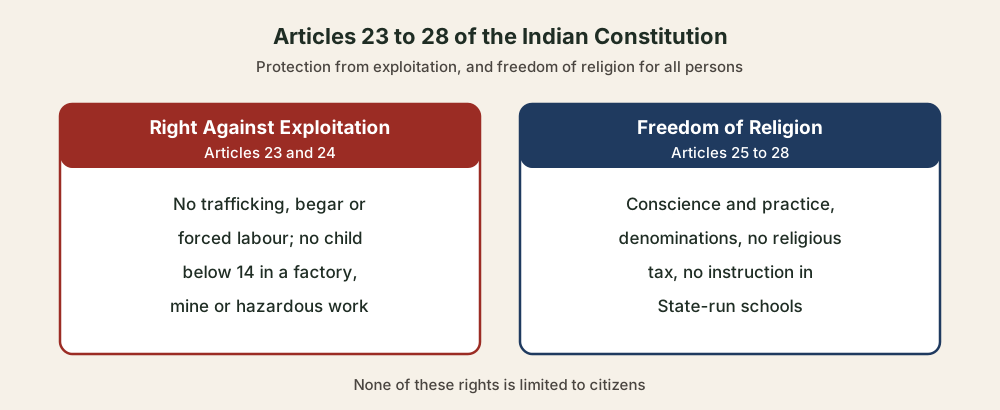
The right against exploitation (Articles 23 and 24) forbids trafficking in human beings, begar, forced labour and the employment of children below fourteen in factories, mines and hazardous work. The right to freedom of religion (Articles 25 to 28) protects freedom of conscience and of religious practice, the affairs of religious denominations, freedom from religious taxes, and freedom from compelled religious instruction.
Articles 23 to 28 at a Glance
Who Can Claim Articles 23 to 28, and Against Whom
Articles 23 to 28 hold two of the six Fundamental Rights, placed after the right to equality and the right to freedom. Unlike the six freedoms of Article 19, which belong to citizens alone, none of the rights in this group is limited to citizens. Article 23 goes further and binds private persons as well as the State: no one may traffic in another person or force labour from another.
| Article | What it guarantees | Who can claim it |
|---|---|---|
| 23 | No traffic in human beings, begar or other forced labour | Any person; binds private persons too |
| 24 | No child below fourteen in a factory, mine or hazardous employment | Children |
| 25 | Freedom of conscience and to profess, practise and propagate religion | Any person |
| 26 | Freedom of a religious denomination to manage its affairs | Religious denominations and their sections |
| 27 | No tax whose proceeds promote a particular religion | Any person |
| 28 | No religious instruction in institutions wholly maintained by the State | Any person attending such institutions |
The two halves serve different ends. Articles 23 and 24 protect the weakest against exploitation by others, whether a landlord, an employer or a trafficker. Articles 25 to 28 protect religious life, of the individual and of the community, while keeping the State from favouring any one faith.
Articles 23 and 24: Right Against Exploitation
Article 23: Traffic in Human Beings, Begar and Forced Labour
Article 23 prohibits traffic in human beings, begar and other similar forms of forced labour, and makes any breach an offence punishable by law. It protects citizens and non-citizens, and it protects them against private persons as well as the State.
- Traffic in human beings: Selling and buying people like goods, immoral traffic in women and children including prostitution, devadasis, and slavery.
- Begar: Compulsory work without payment, a system under which local zamindars sometimes forced their tenants to work for nothing.
- Forced labour: Compelling a person to work against his will. Force includes the compulsion of economic circumstances, so working for less than the minimum wage counts as forced labour.
Article 23 allows one exception. The State may impose compulsory service for public purposes, such as military or social service, without paying for it, but it may not discriminate on grounds only of religion, race, caste or class. Parliament has given the article teeth through the Immoral Traffic (Prevention) Act, 1956 and the Bonded Labour System (Abolition) Act, 1976. The 1976 Act, enacted on 9 February 1976 and deemed in force from 25 October 1975, freed all bonded labourers, erased their debts and made bondage a cognizable offence.
Article 24: Child Labour, the 2016 Amendment and ILO Conventions
Article 24 says that no child below the age of fourteen shall be employed in any factory or mine or engaged in any other hazardous employment. The article itself does not bar work that is harmless, which is why the law built on it matters as much as the text.
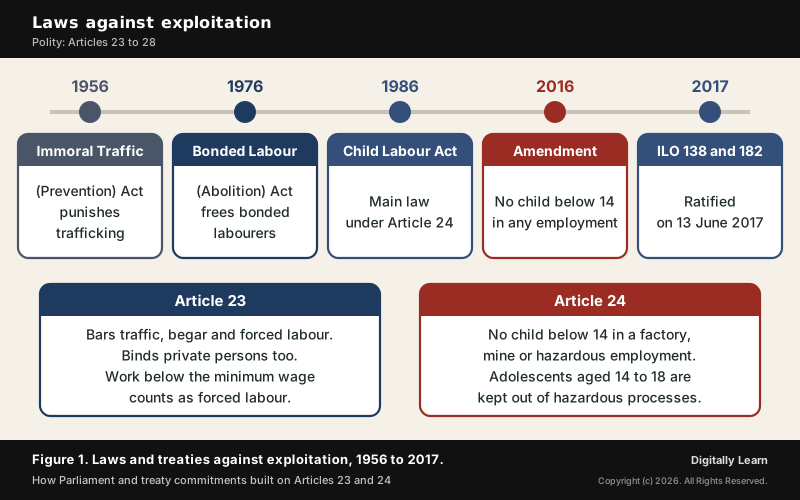
The Child Labour (Prohibition and Regulation) Act, 1986 is the main law. Amended in 2016, it now forbids employing a child below fourteen in any employment, including as a domestic help, and allows adolescents aged fourteen to eighteen to work except in mining, work with flammable substances or explosives, and other hazardous processes. Earlier, in 1996, the Supreme Court had ordered a Child Labour Rehabilitation Welfare Fund, into which an offending employer pays 20,000 rupees for each child employed.
India also accepted the two international standards on child labour. On 13 June 2017 it deposited its ratification of the Minimum Age Convention, 1973 (No. 138) and the Worst Forms of Child Labour Convention, 1999 (No. 182) with the International Labour Office. Convention 138 sets a general minimum age of 15 for work, with 14 allowed for a period; Convention 182 commits a country to eliminate the worst forms, such as slavery and child prostitution.
Articles 25 to 28: Right to Freedom of Religion
Article 25: Conscience, Profession, Practice and Propagation of Religion
Article 25 gives all persons, citizens and foreigners alike, freedom of conscience and the right freely to profess, practise and propagate religion. It covers both beliefs and the practices that express them, and it has four parts.
- Conscience: The inner freedom to shape one’s relation with God or with others in any way one chooses.
- Profession: Declaring one’s religious beliefs openly.
- Practice: Worship, rituals, ceremonies and the display of beliefs.
- Propagation: Spreading one’s beliefs to others or explaining the tenets of one’s faith.
These rights are subject to public order, morality and health and to the other Fundamental Rights. The State may also regulate any economic, financial, political or other secular activity linked to religious practice, and may provide for social welfare and reform or throw open Hindu religious institutions of a public character to all classes and sections of Hindus. Two explanations follow: wearing and carrying kirpans is part of the profession of Sikhism, and Hindus here include Sikhs, Jains and Buddhists.
Propagation does not include conversion. In Stanislaus v. State of Madhya Pradesh (1977) the Supreme Court held that the right to propagate does not include a right to convert, and upheld the Madhya Pradesh and Odisha laws that prohibit conversion by force, fraud or allurement. Forcible conversion, the Court reasoned, impinges on the freedom of conscience that every person holds alike.
Essential Religious Practices: Anthem, Triple Talaq and Sabarimala
Because Article 25 lets the State regulate the secular activity linked to religion, courts must often decide what counts as religion. Since the Shirur Mutt case of 1954 the Supreme Court has asked whether a practice is essential to the faith; the essential religious practices doctrine has made the Court the judge of what qualifies as religion. Three disputes show how the test works.
- National Anthem: Students of the Jehovah’s Witnesses in Kerala were expelled for not singing the anthem, though they stood up when it was sung. On 11 August 1986, in Bijoe Emmanuel, the Supreme Court reversed the High Court that had upheld the expulsion: the question is whether a belief is genuinely and conscientiously held as part of the profession or practice of religion, and no provision of law obliges anyone to sing the anthem. The freedom of speech also includes the freedom of silence, as the right to freedom page explains. On 9 January 2018 the Court also held that playing the anthem before films in cinema halls is optional, not mandatory.
- Triple talaq: On 22 August 2017 the Court held instant triple talaq unconstitutional by a 3 to 2 majority, after asking whether it was an essential feature of Islamic belief and practice. The Muslim Women (Protection of Rights on Marriage) Act, 2019 made it a crime from 1 August 2019.
- Sabarimala: On 28 September 2018 the Court ruled that women of all ages could enter the temple, holding the exclusion a violation of Article 25(1). On 14 November 2019 the review petitions were sent to a larger bench of at least seven judges, and on 10 February 2020 a nine-judge bench framed seven questions on the scope of religious freedom under Articles 25 and 26.
Article 26: Religious Denominations and Their Affairs
Article 25 protects the individual; Article 26 protects the community. Subject to public order, morality and health, every religious denomination or any section of it has four rights.
- To establish and maintain institutions for religious and charitable purposes.
- To manage its own affairs in matters of religion.
- To own and acquire movable and immovable property.
- To administer such property in accordance with law.
Unlike Article 25, these rights are not made subject to the other Fundamental Rights. The Supreme Court has set three conditions for a group to be a religious denomination: a collection of individuals with a system of beliefs they regard as conducive to their spiritual well-being, a common organisation, and a distinctive name. On that test the Court held the Ramakrishna Mission and Ananda Marga to be denominations within the Hindu religion, and the Aurobindo Society not to be one.
Article 27 and Article 28: Religious Taxes and Religious Instruction
Article 27 says no person shall be compelled to pay any tax whose proceeds are specifically used to promote or maintain a particular religion or denomination. The State may not favour one religion over another with public money, though taxes can be used for all religions alike. The bar covers a tax, not a fee: a fee can be charged to pilgrims for a special service or safety measures, or to religious endowments to meet the cost of regulating them.
Article 28 deals with religious instruction in schools and colleges. Its rule depends on who runs and funds the institution, so four kinds of institution are treated differently.
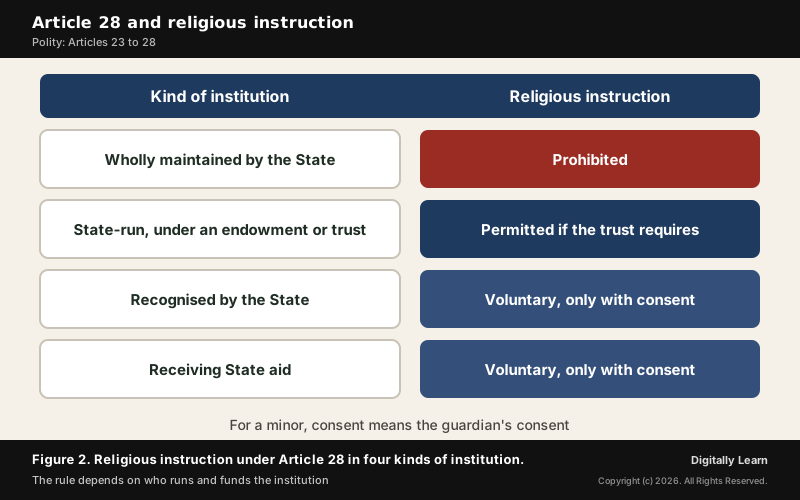
- Wholly maintained by the State: Religious instruction is completely prohibited.
- Administered by the State but set up under an endowment or trust: Religious instruction is permitted where the endowment or trust requires it.
- Recognised by the State, or receiving State aid: Religious instruction may be given, but no one can be made to attend it without consent, which for a minor is the guardian’s.
Secularism in India: The Constitutional Model
Indian Secularism and the Western Model: Principled Distance
The word secular entered the Preamble through the 42nd Amendment of 1976, but in S. R. Bommai (1994) the Supreme Court held that India had been secular since the Republic was formed. Articles 25 to 28 are where that secularism is written into rights, and the Indian version differs from the Western one.
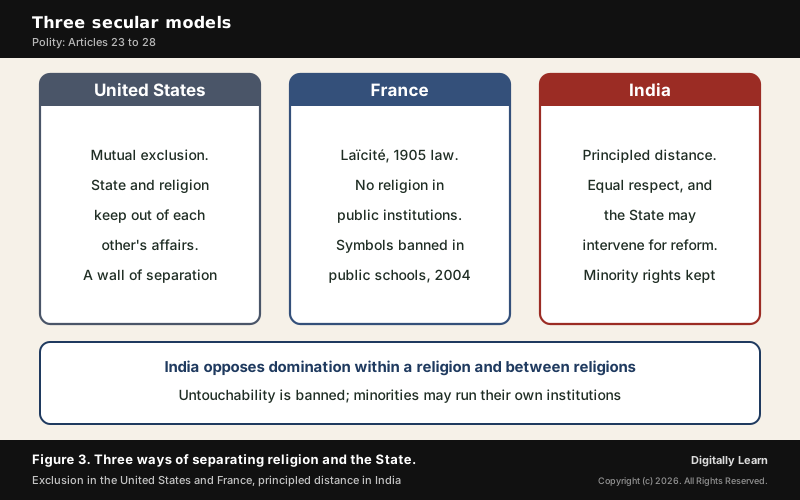
In the American model, separation means mutual exclusion: the State does not intervene in religion and religion does not interfere in the State. The First Amendment says Congress shall make no law respecting an establishment of religion, which Jefferson read as a wall of separation between church and State. France's laïcité, based on its 1905 law, goes further, keeping religion out of public institutions; a ban on religious symbols in public schools came into effect in 2004.
Indian secularism differs in three ways. It opposes domination within a religion as much as between religions; it protects the religious freedom of minority communities as well as of individuals; and it allows State-supported religious reform, which is why the Constitution bans untouchability. The State keeps a principled distance from all religions, so that it can intervene or abstain, depending on which better promotes liberty, equality and social justice. In India there is no prohibition on wearing religious markers in public institutions, unlike France.
Previous Year UPSC-CSE Questions
Previous Year UPSC-CSE Questions By the end you will be able to draft model answers for the following UPSC questions. Each question carries a collapsible framework showing how to approach it in the exam.
- UPSC Mains 2024 GS-IIDiscuss India as a secular state and compare with the secular principles of the US constitution.
Answer outline: how to structure the answer
What the question asks, the main arguments, relevant examples and the direction of the conclusion. This is not a full model answer.
Introduction: India has no State religion; the 42nd Amendment of 1976 added secular to the Preamble, and Bommai (1994) held India secular from the start.
Body (sub-themes to develop):
- Indian text: Articles 25 to 28 (conscience, denominations, no religious tax, no instruction in State schools), with the State free to regulate secular activity and reform.
- United States: the First Amendment bars any law respecting an establishment of religion; separation as mutual exclusion, a wall of separation.
- Differences: India opposes intra-religious as well as inter-religious domination, protects minority communities, and allows State-supported reform (untouchability banned).
- Common ground: no State religion, freedom of individual belief.
Conclusion: Conclude that both are secular, but India's principled distance fits a society of deep religious diversity.
- UPSC Mains 2019 GS-IIWhat can France learn from the Indian Constitution’s approach to secularism?
Answer outline: how to structure the answer
What the question asks, the main arguments, relevant examples and the direction of the conclusion. This is not a full model answer.
Introduction: France's laicite keeps religion out of public institutions; India keeps a principled distance from all religions.
Body (sub-themes to develop):
- France: separation under the 1905 law; religious symbols banned in public schools from 2004.
- India: no prohibition on religious markers in public institutions; equal respect; minority institutions protected (Articles 26 and 28).
- Lessons: accommodation of visible faith, community rights, reform without hostility to religion.
Conclusion: Conclude that India shows secularism can protect equality without banning religion from public life.
- UPSC Mains 2018 GS-IHow the Indian concept of secularism is different from the western model of secularism? Discuss.
Answer outline: how to structure the answer
What the question asks, the main arguments, relevant examples and the direction of the conclusion. This is not a full model answer.
Introduction: In the Western model, inspired by the American one, separation means mutual exclusion of State and religion.
Body (sub-themes to develop):
- Difference one: India opposes domination within a religion as well as between religions.
- Difference two: it protects the religious freedom of minority communities, not only individuals (Articles 26, 29, 30).
- Difference three: it allows State-supported reform, as with the ban on untouchability (Article 17) and Article 25(2).
- Principled distance: the State may intervene or abstain, whichever better promotes liberty, equality and social justice.
Conclusion: Conclude that Indian secularism is a distinct model, not an imitation of the Western one.
- UPSC Prelims 2017 Prelims-GSWhich of the following are envisaged by the Right against Exploitation in the Constitution of India?
- Prohibition of traffic in human beings and forced labour
- Abolition of untouchability
- Protection of the interests of minorities
- Prohibition of employment of children in factories and mines
Select the correct answer using the code given below:
How to approach this Prelims question
Approach: The right against exploitation is Articles 23 and 24 only. Article 23 prohibits traffic in human beings and forced labour (item 1); Article 24 prohibits employment of children in factories and mines (item 4). Abolition of untouchability is Article 17, part of the right to equality, and protection of minorities is Articles 29 and 30, the cultural and educational rights. So only items 1 and 4 qualify.
Trap to watch: Untouchability looks like exploitation in plain English, but in Part III it sits under the right to equality.
Key facts to recall:
- (a) 1, 2 and 4 only: wrong. Item 2, untouchability, is Article 17 under the right to equality.
- (b) 2, 3 and 4 only: wrong. Items 2 and 3 belong to equality and to cultural and educational rights, and item 1 is left out.
- (c) 1 and 4 only: right. These are Articles 23 and 24.
- (d) 1, 2, 3 and 4: wrong. Items 2 and 3 are outside Articles 23 and 24.
Answer signal: Option (c): items 1 and 4, Articles 23 and 24.
- UPSC Prelims 2004 Prelims-GSWhich Article of the Constitution of India says, “No child below the age of fourteen years shall be employed to work in any factory or mine or engaged in any other hazardous employment”?
How to approach this Prelims question
Approach: The quoted words are the text of Article 24, the second article of the right against exploitation. The other options deal with early childhood care, reserved seats and amendment.
Trap to watch: Article 45 also concerns children, but as a Directive Principle on early childhood care, not employment.
Key facts to recall:
- (a) Article 24: right. It prohibits employment of children below fourteen in factories, mines and hazardous employment.
- (b) Article 45: wrong. It is a Directive Principle on early childhood care and education up to six.
- (c) Article 330: wrong. It reserves seats for Scheduled Castes and Scheduled Tribes in the House of the People.
- (d) Article 368: wrong. It gives Parliament the power to amend the Constitution.
Answer signal: Option (a): Article 24.
- UPSC Prelims 2018 Prelims-GSInternational Labour Organization’s Conventions 138 and 182 are related to
How to approach this Prelims question
Approach: Convention 138 is the Minimum Age Convention, 1973, and Convention 182 the Worst Forms of Child Labour Convention, 1999. Both concern child labour; India ratified both on 13 June 2017.
Trap to watch: Gender parity at work is another ILO subject, but neither 138 nor 182 deals with it.
Key facts to recall:
- (a) Child labour: right. Convention 138 sets a minimum age for work; Convention 182 targets the worst forms of child labour.
- (b) Adaptation of agricultural practices to climate change: wrong. Neither convention deals with agriculture or climate.
- (c) Regulation of food prices and food security: wrong. Neither convention deals with food prices or food security.
- (d) Gender parity at the workplace: wrong. Neither convention concerns gender parity.
Answer signal: Option (a): child labour.
- UPSC Prelims 1996 Prelims-GSConsider the following statements: No one can be compelled to sing the National Anthem since
- I. It will be violative of the Right to freedom of speech and expression.
- II. It will be violative of the Right to freedom of conscience and practise and propagation of religion.
- III. There is no legal provision obliging any one to sing the National Anthem.
Of these statements
How to approach this Prelims question
Approach: Test each reason. I: the freedom of speech and expression under Article 19(1)(a) includes the freedom of silence, so compelling someone to sing would breach it. II: in Bijoe Emmanuel (1986) the Court protected students whose refusal was a belief genuinely and conscientiously held as part of the profession or practice of religion, an Article 25 right. III: the Court found that there is no provision of law which obliges anyone to sing the National Anthem. All three reasons hold, which matches the official answer.
Trap to watch: A reader may think standing silently is disrespect; the Court held that standing up respectfully shows proper respect.
Key facts to recall:
- (a) I and II are correct: wrong. Statement III is also correct: no provision of law obliges anyone to sing the anthem.
- (b) II and III are correct: wrong. Statement I is also correct: the freedom of speech and expression includes the freedom of silence.
- (c) I, II and III are correct: right. Silence is protected speech, the belief was protected religious practice, and no law compels singing.
- (d) None is correct: wrong. All three are correct.
Answer signal: Option (c): all three statements.
- UPSC Prelims 2008 Prelims-GSWhich of the following is/are included in the Directive Principles of State Policy?
- Prohibition of traffic in human beings and forced labour
- Prohibition of consumption except for medicinal purposes of intoxicating drinks and of other drugs which are injurious to health
Which of the statements given above is/are correct?
How to approach this Prelims question
Approach: Prohibition of traffic in human beings and forced labour is Article 23, a Fundamental Right, not a Directive Principle, so statement 1 is wrong. Article 47 asks the State to bring about prohibition of intoxicating drinks and harmful drugs except for medicinal purposes, so statement 2 is right.
Trap to watch: Both statements sound like social-welfare goals; the test is which Part of the Constitution each sits in.
Key facts to recall:
- (a) 1 only: wrong. Statement 1 is Article 23 in Part III, a Fundamental Right.
- (b) 2 only: right. Statement 2 is Article 47, a Directive Principle.
- (c) Both 1 and 2: wrong. Statement 1 is not a Directive Principle.
- (d) Neither 1 nor 2: wrong. Statement 2 is a Directive Principle.
Answer signal: Option (b): only statement 2, Article 47.
Sources and Further Reading
- Legislative Department, Ministry of Law and Justice: The Constitution of India
- NCERT: Political Theory, Class 11, Chapter 8, Secularism
- NCERT: Indian Constitution at Work, Class 11, Chapter 10, The Philosophy of the Constitution
- International Labour Organization: India ratifies both fundamental ILO Conventions on child labour, 13 June 2017
- Department of Legal Affairs: Effectuation of Fundamental Duties of Citizens
- Supreme Court of India: Shyam Narayan Chouksey v. Union of India, order of 9 January 2018
- Wikipedia: Bonded Labour System (Abolition) Act, 1976
- Wikipedia: Child labour in India
- Wikipedia: Minimum Age Convention, 1973
- Wikipedia: Worst Forms of Child Labour Convention
- Wikipedia: Stanislaus v. State of Madhya Pradesh
- Wikipedia: Jana Gana Mana
- Wikipedia: Triple talaq in India
- Wikipedia: Muslim Women (Protection of Rights on Marriage) Act, 2019
- Wikipedia: Entry of women to Sabarimala
- Wikipedia: Secularism in India
- Wikipedia: Establishment Clause
- Wikipedia: Laïcité
Editorial Disclaimer
This article explains Articles 23 to 28 from the text of the Constitution, Supreme Court judgments, NCERT and the other sources listed. It is study material, not legal advice.


