


Overview
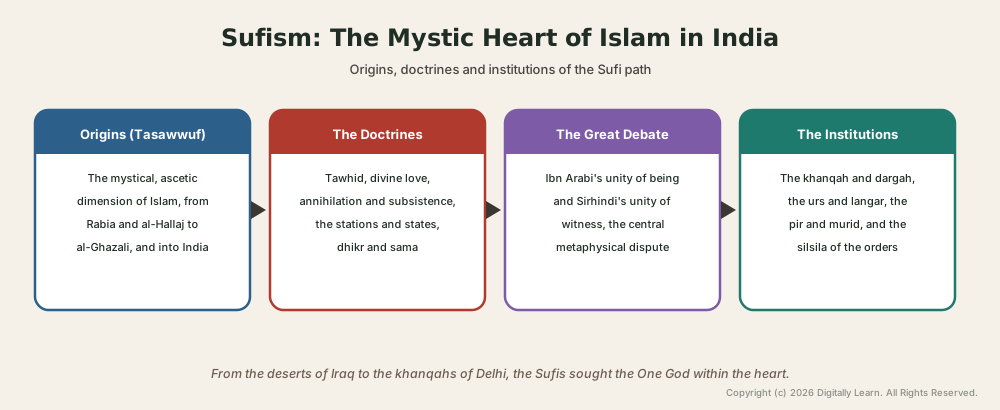
Sufism, in Arabic tasawwuf, is the mystical and ascetic dimension of Islam, the inward path that seeks not merely to obey God but to know and love him directly, until nothing seems truly to exist but the one God. Arising among the early ascetics of Iraq and carried into India from Persia and Central Asia, it taught a religion of the heart: the love of God, the remembrance of his Name, and the annihilation of the self in him. Its seekers gathered around a master, the pir, in the hospice called the khanqah, venerated their saints at tomb-shrines, and traced their authority through a chain of teachers, the silsila. This part sets out the origins, the doctrines and the institutions of the Sufi path.
Tasawwuf: The Origins of Sufism in the Mystical Dimension of Islam
Defining Sufism (Tasawwuf): The Inner Path of Islamic Mysticism
Sufism is the mystical and ascetic stream within Islam, the religion of the heart that seeks God not in the law alone but in direct experience of him.
The Arabic name for it is tasawwuf, and those who follow it are the Sufis, also called dervishes or faqirs, words that carry the sense of the poor man who has emptied himself for God. Where the scholar of the law, the ulama, attends to the outward duties of religion, the Sufi turns inward, to the purification of the soul and the love of God. Sufism is thus best understood not as a sect set apart from Islam but as its inner dimension, the deepening and intensifying of the same faith, concerned above all with ihsan, the call to worship God as though one could see him.
The goal of the Sufi is a direct and felt knowledge of the one God, reached by long discipline of the self. The seeker aims at the purification of the inner self, the polishing of the heart until it reflects the divine, and at last a state in which the veil between the soul and God grows thin. This inward quest, pursued through love, remembrance and the guidance of a master, is the common thread that binds the whole of the Sufi tradition across its many forms and orders.
The Early Ascetics and the Rise of Sufism in Eighth-Century Iraq
Sufism arose early in the history of Islam, among ascetics who recoiled from the wealth and worldliness of the new empire.
By the standard account it emerged in the first centuries of Islam, partly as a reaction against the worldliness of the early Umayyad Caliphate, whose conquests had brought sudden riches and power. Pious men and women turned away from this splendour toward a life of poverty, prayer and the fear and love of God. The figure most often named as a founder of this current is Hasan al-Basri of Basra, a great early preacher remembered as a founding figure in the science of purifying the heart, who set the pattern of inward devotion that the later Sufis would follow.
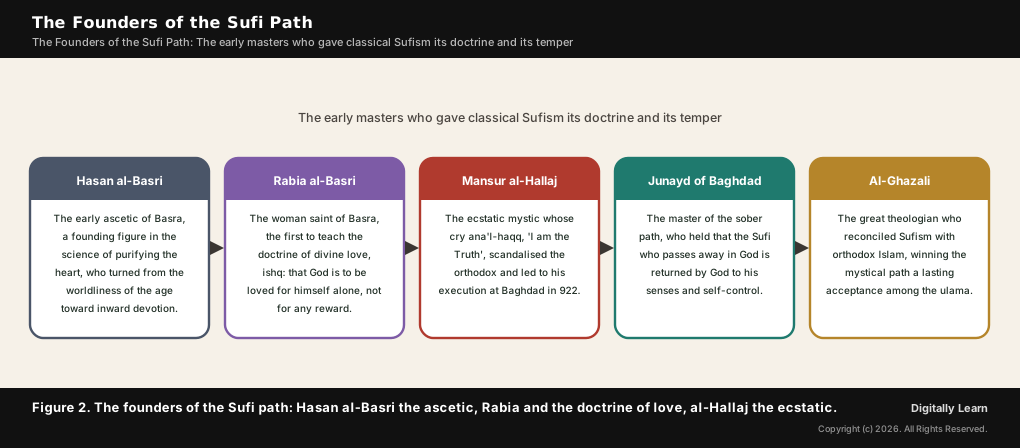
These early figures were ascetics before they were mystics, renouncers who fasted, kept vigil and withdrew from the world. Out of their renunciation, in the eighth and ninth centuries, grew the richer mysticism of love and union that is properly called Sufism. The movement took its first and deepest root in Iraq, at Basra and Baghdad, before spreading across the whole Islamic world, and it is to the great masters of that classical age that the next sections turn.
Rabia al-Basri and the Doctrine of Selfless Divine Love
Rabia of Basra gave Sufism its doctrine of pure, selfless love of God, and stands among the very first of the Sufi mystics.
Rabia al-Basri, a woman saint of Basra who lived in the eighth century, is widely remembered as the first to set forth the doctrine of divine love, the love called ishq. She taught that God is to be loved wholly for his own sake, and not from any hope of paradise or fear of hell. In a famous saying attributed to her she wished to burn paradise and quench the fires of hell, so that men might love God for himself alone and not for his rewards or punishments. With Rabia the temper of Sufism shifts from mere fear and renunciation toward a burning, selfless love that would become the heart of the whole tradition.
Little of her life can be known for certain, for the firm record is thin and most of the stories about her took shape long after her death; her sayings should therefore be received as the memory of a tradition rather than as exact history. What is not in doubt is her place in the tradition. That one of the earliest and most honoured of the Sufi mystics was a woman, and a freed slave by tradition, says much about the inward and equalising spirit of the movement, which valued the state of the heart above the rank, the learning or the sex of the seeker.
The Classical Masters: Ecstasy, Sobriety and Reconciliation
Mansur al-Hallaj and the Ecstatic Cry 'Ana'l-Haqq'
Al-Hallaj is the great martyr of ecstatic Sufism, whose cry that he was the Truth itself cost him his life.
Mansur al-Hallaj, a Persian mystic of the ninth and early tenth centuries, is remembered above all for the utterance ana'l-haqq, 'I am the Truth'. Since al-Haqq, the Truth or the Real, is one of the names of God, many of the orthodox heard in these words a man claiming to be God, and an unforgivable blasphemy. His defenders understood them quite otherwise: in the height of mystical union the self of al-Hallaj had so passed away that it was God, and not the man, who spoke through his lips. The saying became the most famous example of the ecstatic, transgressive utterance, the kind of speech a Sufi lets fall when he is overwhelmed by the divine presence.
Whatever the truth of his meaning, al-Hallaj was condemned and executed at Baghdad in 922, and his death made him the archetype of the Sufi martyr. Modern study suggests the reasons for his killing were more tangled than the simple charge of blasphemy, and that politics played its part, so the bald story of a saint slain for a single sentence should be told with care. Yet for the later tradition the meaning was plain: al-Hallaj stood for the intoxicated way of mysticism, the path of those who lose themselves so wholly in God that they will dare any word and any danger for the sake of union.
Junayd of Baghdad and the Sufism of Sobriety
Junayd of Baghdad set against the ecstatic way a path of sobriety, and his temper became the model of careful, lawful Sufism.
Junayd of Baghdad, a Persian master of the ninth century who was honoured as the leader of the Sufi group, taught what later writers called the way of sobriety, or sahw, against the way of intoxication, or sukr. The Sufi of the sober path, he held, may indeed pass away in God, but he does not remain lost in that absorption; he is returned by God to his senses and his self-possession, the better to live and serve in the world. Where the intoxicated saint is overwhelmed, the sober saint is given back to himself, master of his states rather than their captive. The figure below sets the two tempers side by side.
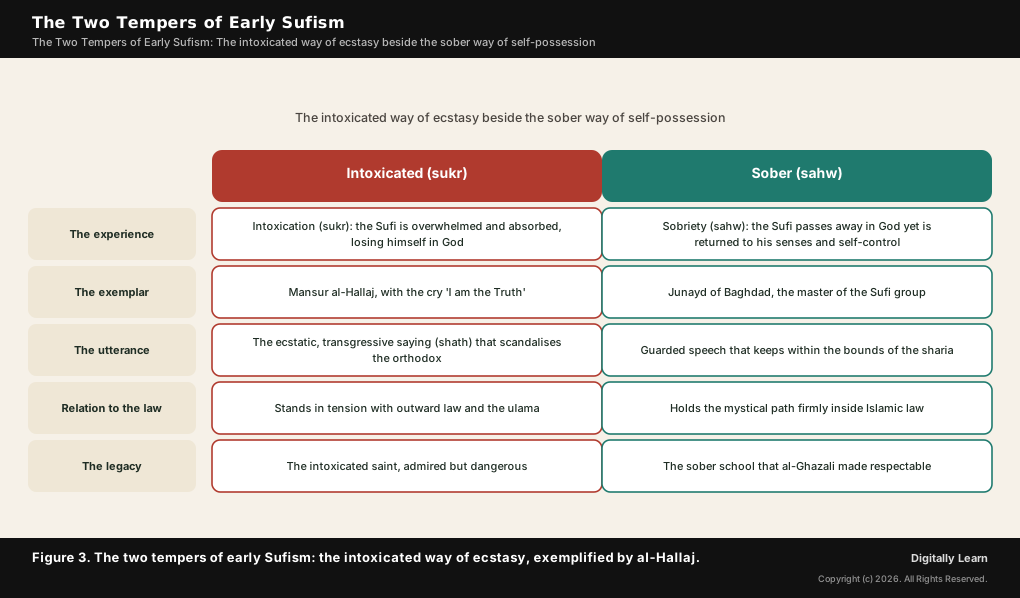
This sober temper kept the mystical path firmly within the bounds of the sharia, the law of Islam, and guarded its speech so as not to scandalise the orthodox. For this reason it was the sober tradition of Junayd, far more than the dangerous example of al-Hallaj, that the later orders took as their model, and through which Sufism could grow into a respectable and widely accepted form of Muslim piety. The distinction between intoxication and sobriety runs through the whole later history of the movement, and is worth holding firmly.
Al-Ghazali and the Reconciliation of Sufism with the Orthodox Ulama
Al-Ghazali reconciled Sufism with orthodox Islam, and so won the mystical path lasting acceptance among the learned.
Al-Ghazali, who lived from about 1058 to 1111 and is among the greatest of all Muslim theologians, contributed more than any other to the integration of Sufism into mainstream Islam. A master of law and theology who passed through a crisis of doubt and found peace in the mystical life, he argued that the inward way of the Sufis was not the enemy of orthodox religion but its living core. His great work, the Revival of the Religious Sciences, the Ihya ulum al-din, brought orthodox Sunni theology and Sufi mysticism together in a single comprehensive guide to the religious life, and remains one of the most influential books in the history of Islam.
The effect of his work was profound and lasting. After al-Ghazali, Sufism could no longer be dismissed by the orthodox as a suspect innovation; it had been shown to be compatible with, and even to fulfil, the law and the creed. This reconciliation gave the mystical path the respectability it needed to spread freely, and it was a Sufism so domesticated, lawful and broadly accepted that crossed into India in the centuries that followed. The arrival of that Sufism on Indian soil is the subject of the next section.
The Coming of Sufism to India
The Transmission of Sufism from Persia and Central Asia
Sufism came to India from the lands to its north-west, carried by saints and scholars who travelled the old roads from Persia and Central Asia.
The mystical tradition that had grown up in Iraq, Persia and Central Asia began to reach India in strength from about the eleventh and twelfth centuries, in the wake of the Turkish conquests that opened the north-western passes. Sufi teachers travelled from Khorasan and Transoxiana, by way of Ghazni and the passes, into the Punjab and the plains beyond, settling at Lahore, Multan and Delhi as the new political order took shape. They did not come as conquerors but as men of religion, and their hospices became centres of devotion that often outlasted the dynasties around them. The map below traces this movement.
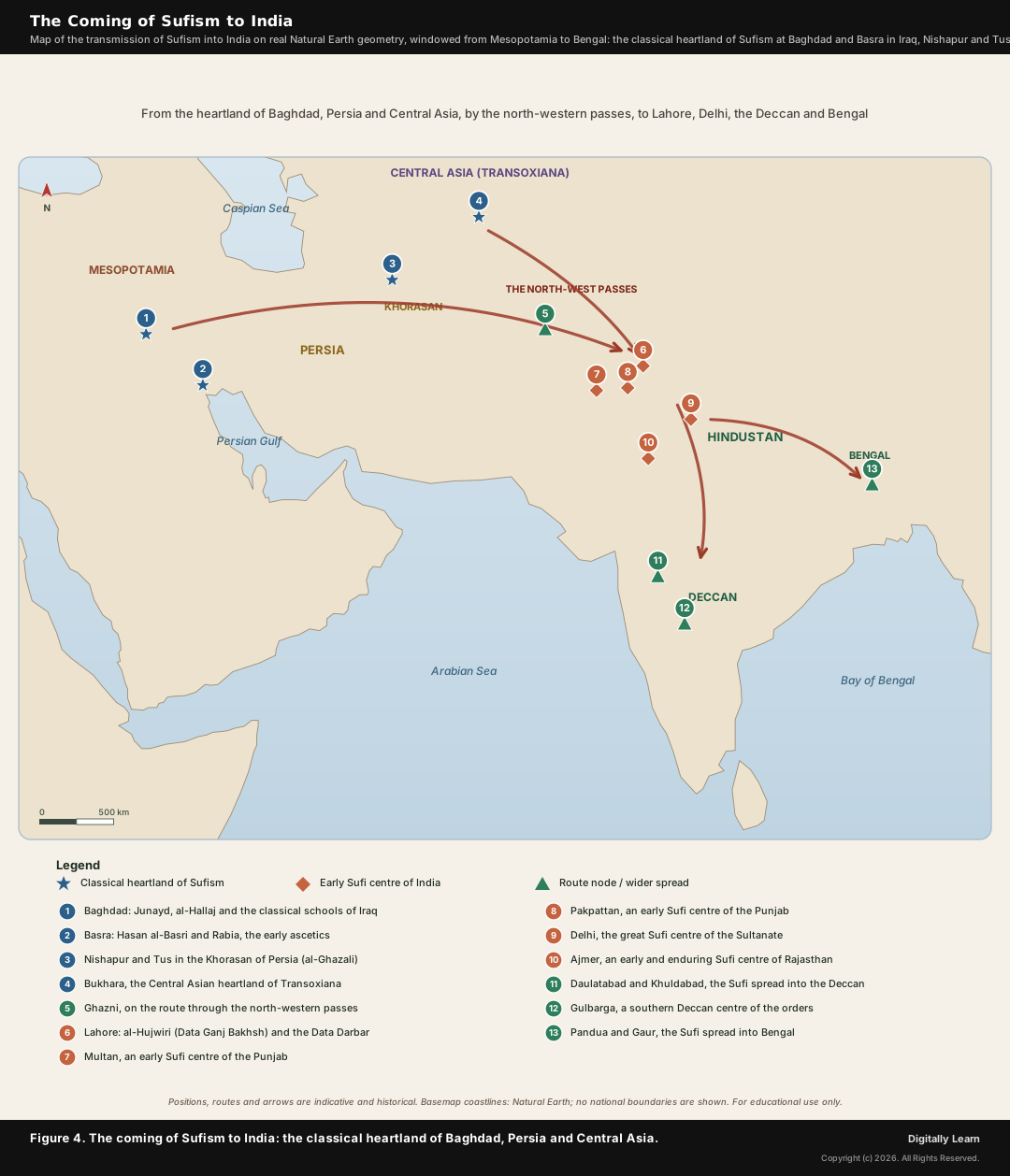
Indian Sufism was therefore from the first a Persianate tradition, speaking and writing in Persian, the language of culture across the whole region, and drawing its forms and ideas from the masters of the heartland. Yet it took root in Indian soil and grew its own character, shaped by the land and the people among whom it settled. Over the following centuries the orders spread south into the Deccan and east into Bengal, until the Sufi shrine had become a familiar landmark across the whole of the subcontinent.
Ali al-Hujwiri (Data Ganj Bakhsh) and the Kashf al-Mahjub of Lahore
Ali al-Hujwiri of Lahore was the first great Sufi of India, and wrote the earliest treatise on Sufism in the Persian tongue.
Ali al-Hujwiri, honoured to this day as Data Ganj Bakhsh, the bestower of treasure, was an eleventh-century mystic and scholar who came from Khorasan and settled at Lahore, where he died about 1072. His dates are not certain and should be given with caution, but his importance is not in doubt. He composed the Kashf al-Mahjub, the 'Unveiling of the Veiled', which is reckoned the earliest formal treatise on Sufism written in Persian, a work that explains the doctrines and the discipline of the path and records the lives of the early saints. Through it the teaching of the heartland was set down for the Muslims of India in their language of learning.
His tomb at Lahore, the Data Darbar, became one of the most frequented shrines of the whole subcontinent, and remains so. In al-Hujwiri the several themes of this part already meet: a Persian Sufi who carried the tradition eastward, an author whose book shaped Indian Sufism, and a saint whose shrine drew the devotion of centuries. He stands at the head of the Indian Sufi tradition, before the great orders that the next part of this series will describe, and his life shows how doctrine, literature and the cult of the shrine were bound together from the very beginning.
The Core Doctrines of Sufism: The Journey to the One
Tawhid: The Unity of God and the Goal of the Path
At the centre of all Sufi doctrine stands tawhid, the oneness of God, which the Sufi seeks not only to confess but to experience.
Tawhid, the affirmation that God is one, is the first article of Islam, shared by every Muslim. What sets the Sufi apart is that he seeks to make this truth not a creed held in the mind but a reality lived in the whole of the self. For the Sufi the goal is to pass beyond mere belief in the One toward a state in which he knows, with his entire being, that nothing truly exists but God, and that all things are wholly dependent on him. The whole discipline of the path, its loves and labours and stations, is bent toward this single end: the realisation, in experience, of the unity that the creed proclaims.
From this quest for a lived tawhid flows much of what is distinctive in Sufism, and much that is most contested. The boldest of the Sufis, pressing toward the experience of the One, spoke as though the boundary between the soul and God had dissolved altogether, and it is here that the great later debate over the unity of being would arise. The doctrines that follow, of love, of annihilation, of the stations and states, are all so many ways of describing the soul's journey toward this experienced oneness with the one God.
Ishq and Mahabba: The Way of Divine Love
The engine of the Sufi path is love, the longing of the soul for God and the answering love of God for the soul.
Where the jurist serves God from duty and the fear of judgement, the Sufi serves him from love, and this love is the moving force of the whole mystical life. The tradition speaks of it in two words: mahabba, the steady, tender love of the devoted heart, and ishq, the burning, passionate love that consumes the lover and leaves no room for any other object. It was Rabia of Basra, as we have seen, who first set this love at the heart of Sufism, teaching that God is to be loved for himself alone. The figure below gathers the core doctrines of the path.
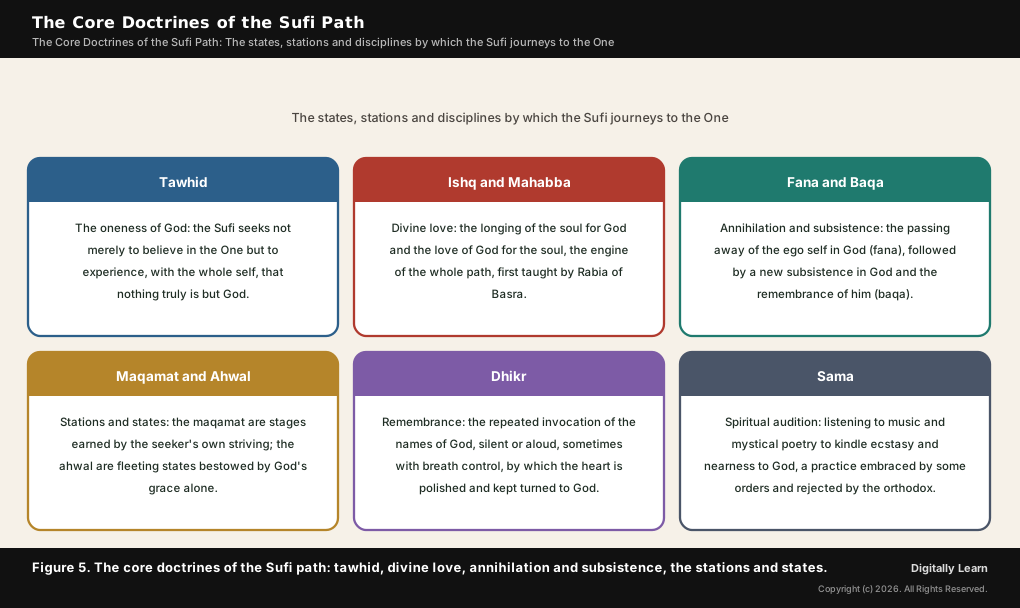
The Sufi poets developed this love into a whole language of longing, in which the soul is the lover and God the Beloved, and the pains of separation and the joys of union are sung in the imagery of human love and wine. This was no mere figure of speech but the description of a real and felt experience, the ache of the heart for its source and its rest. From the seeking of the Beloved the Sufi is led, by stages, toward the loss of the self and the finding of God, which is the matter of the next doctrine.
Fana and Baqa: Annihilation of the Self and Subsistence in God
The summit of the Sufi path is fana and baqa, the passing away of the self in God and the new life that is found in him.
Fana means the annihilation, or the passing away, of the self. It is the dissolving of the ego, the lower self that the Sufi calls the nafs, until the seeker dies, as the saying goes, before he dies, and his separate selfhood is extinguished in the presence of God. This is not the death of the body but the death of all that is selfish and self-regarding in the soul, so that nothing of the petty self is left to stand between the lover and the Beloved. Fana is the goal toward which the love and the discipline of the path have all along been tending, the moment in which the drop is lost in the ocean.
But annihilation is not the end. Beyond fana lies baqa, subsistence, the abiding of the self in God after the self has passed away. The Sufi who has been annihilated is given a new and higher subsistence, no longer living from his own ego but from God, and abiding in the constant remembrance of him; al-Hujwiri described baqa as the subsistence of the remembrance of God. In the pairing of fana and baqa the whole movement of the mystical life is caught: the self must be lost before the true self, hidden in God, can be found.
The Maqamat (Stations) and the Ahwal (States) of the Path
The Sufi path is mapped as a ladder of stations and states, and the two must be carefully told apart.
The maqamat, the stations, are the stages of the path that the seeker attains and holds by his own striving and discipline, with the help of God. Each is a settled spiritual condition, lasting and earned, which the traveller reaches and then keeps as he climbs to the next; the classic stations include repentance, abstinence, renunciation, poverty, patience, trust in God and contentment. The ahwal, the states, are different in kind: they are passing conditions of the heart, such as nearness, love, fear, hope and longing, that descend on the Sufi as gifts of God's grace and pass away again, and that he can neither earn nor hold by his own effort.
The distinction is precise and much tested: a station is acquired and abiding, the fruit of labour; a state is bestowed and fleeting, the gift of grace. Together the maqamat and the ahwal describe the long ascent of the soul toward God, a journey that is partly the work of disciplined effort and partly the free gift of the divine. This ordered map of the inward life, worked out by the early masters, gave the Sufi a clear sense of where he stood on the road and what lay ahead of him.
Dhikr and Sama: The Twin Disciplines of Sufi Devotion
Dhikr: The Invocation of the Divine Name
The central discipline of the Sufi is dhikr, the remembrance of God, by which the heart is kept turned toward him.
Dhikr means remembrance, and in practice it is the repeated invocation of the name or the names of God, until the thought of him fills the heart and crowds out every other thing. It may be done silently, in the secret of the heart, or aloud, alone or in the assembly of the order, and in some methods it is joined to the control of the breath and to bodily movements that help to fix the mind. By this constant repetition the Sufi seeks to polish the rust from the mirror of the heart, so that it may reflect the light of God, and to make the remembrance of God as natural and ceaseless as breathing itself.
Dhikr is the daily bread of the Sufi life, the practice that carries the seeker through the stations of the path and prepares him for the descent of the higher states. It is at once the simplest and the most central of the disciplines, open to the unlettered and the learned alike, and it is one of the practices by which the Sufi mystics of medieval India were widely known. Closely bound to it, and far more contested, is the practice of sama, to which the next section turns.
Sama: Spiritual Music and the Controversy It Aroused
Sama, the spiritual audition of music and poetry, was the most disputed of all Sufi practices, loved by some orders and condemned by others.
Sama means listening, and in the Sufi sense it is the practice of listening to music, chanting and mystical poetry, sometimes with movement or dance, in order to kindle the love of God and to rouse the soul to a state of ecstasy and nearness. Its defenders held that the beauty of sound and verse could lift the heart toward God as nothing else could, melting the worshipper into longing and union. The recitation of holy songs to arouse ecstasy in an assembly, the mahfil-i-sama, became one of the most characteristic and best-loved of Sufi practices, above all among the orders most at home in India.
But sama was deeply controversial, and Muslims held sharply divided views about it. The orthodox ulama, and some of the Sufi orders themselves, condemned the use of music in worship as a forbidden innovation, a bidah, that led to mere bodily excitement rather than true devotion; others, among them the theologian al-Ghazali, defended it as a help to the pure of heart. In India the practice divided the orders: some, such as the Chishtis, embraced sama and made it central to their devotion, while others, such as the Suhrawardis, held back from it in deference to the law. The full story of the orders belongs to the next part; here it is enough to mark sama as a central Sufi practice and a lasting controversy.
Wahdat al-Wujud and Wahdat al-Shuhud: The Great Sufi Debate
Ibn Arabi and Wahdat al-Wujud (the Unity of Being)
The boldest of all Sufi doctrines is Ibn Arabi's wahdat al-wujud, the unity of being, which holds that all that exists is one.
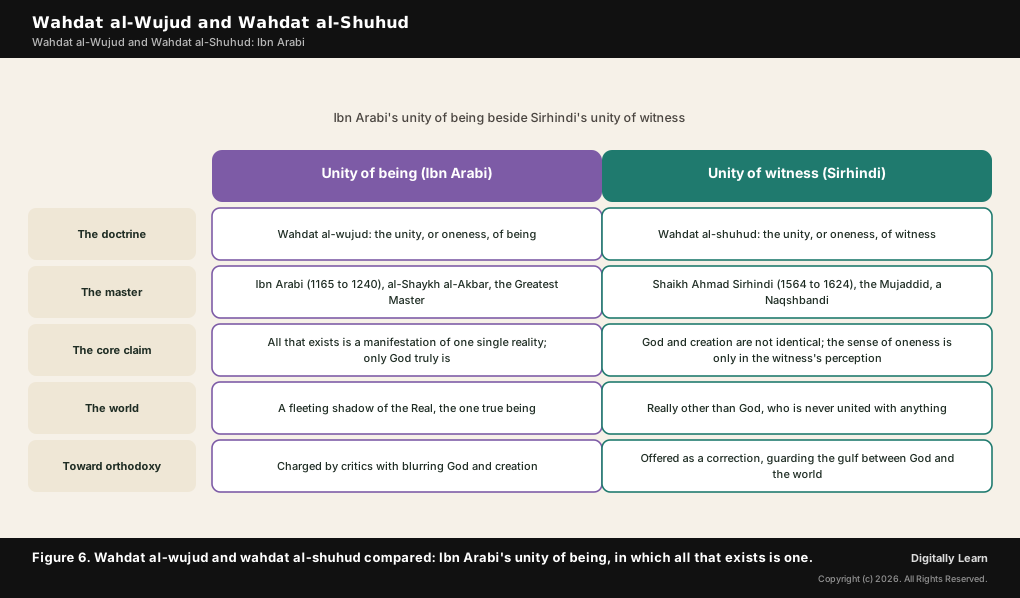
Ibn Arabi, the great mystic of Muslim Spain who lived from 1165 to 1240 and is honoured as al-Shaykh al-Akbar, the Greatest Master, gave classical expression to the doctrine of wahdat al-wujud, the unity, or oneness, of being. By this teaching all the things of the universe are so many manifestations of a single reality, and only God truly possesses being; the world has no independent existence of its own but is, as it were, a fleeting shadow of the Real, the one true being that is God. To press the experience of tawhid to its furthest point, Ibn Arabi taught that in the last analysis there is nothing in existence but God, and that the creature subsists only as a reflection of the divine.
This was a doctrine of overwhelming power, and it shaped Sufi thought across the whole Muslim world for centuries. But it was also charged by its critics with blurring the line between the Creator and the creation, and so with a kind of monism that seemed to make the world itself divine. To the cautious it edged dangerously close to denying the gulf that the orthodox creed sets between God and all that he has made. It was in answer to just this danger that, in India, a rival doctrine was advanced, to which the next section turns.
Shaikh Ahmad Sirhindi and Wahdat al-Shuhud (the Unity of Witness)
Against the unity of being, Shaikh Ahmad Sirhindi set the unity of witness, which guards the distance between God and the world.
Shaikh Ahmad Sirhindi, who lived from 1564 to 1624 and is honoured as the Mujaddid, the renewer of the second millennium of Islam, advanced the doctrine of wahdat al-shuhud, the unity, or oneness, of witness. He held that the oneness the Sufi experiences is not a oneness in being but a oneness in perception: in the height of his absorption the mystic sees only God and is aware of nothing else, but this unity is subjective, a condition of the witness's consciousness, and it does not mean that God and the creation are in truth one and the same. God, he insisted, is never united with anything, and nothing can be united with God; the creation is really other than its Creator.
By this teaching Sirhindi meant to correct, not to destroy, the path of Ibn Arabi, treating the unity of being as a true but lower stage that the seeker must pass beyond toward the sounder vision of the unity of witness. The contrast is among the most important in all Sufi thought, and the two doctrines must never be confused: wahdat al-wujud, the unity of being, is the teaching of Ibn Arabi, and wahdat al-shuhud, the unity of witness, the correction of Sirhindi. The figure above sets them out side by side; the wider history of Sirhindi's Naqshbandi order belongs to the next part of this series.
The Institutions and Practices of Indian Sufism
The Pir, the Murid and the Wali: Master, Disciple and Friend of God
The Sufi path is walked under a master, and at its summit stands the wali, the friend of God.
No one, the Sufis held, can travel the path alone, for its dangers are too great and its way too hidden; the seeker must place himself wholly in the hands of a guide. This guide is the pir, or murshid, the spiritual master, and the seeker who submits to him is the murid, the disciple, the one who desires the knowledge of God. The bond between them is the central relationship of Sufi life: the murid offers complete obedience and trust, and the pir leads him through the stations of the path, transmits to him the spiritual discipline, and in time may authorise him to guide others in his turn. So close is this bond that the disciple is said to be in the master's hands as a corpse in the hands of the washer.
The goal and the crown of the path is to become a wali, plural auliya, a friend of God or saint, one brought so near to God by love and discipline that he stands under the special protection of God. Such a friend of God was believed to be granted karamat, marvels or graces, the power to work wonders that were taken as signs of his nearness to the divine. It was around such saints, living and dead, that the devotion of Indian Sufism gathered, and it is to the institutions that grew up around them that we now turn.
The Khanqah and the Jamaat-Khana: The Sufi Hospice
The home of the Sufi life was the khanqah, the hospice of the order, where the master lived among his disciples.
The khanqah was a building set apart for the gatherings of a Sufi brotherhood, at once a residence, a school and a centre of devotion. Here the pir lived with his family and his close disciples; here the murids were trained in the discipline of the path; and here the assembly of remembrance was held. In the Indian setting the same institution was called by several names used almost interchangeably, among them the jamaat-khana, the gathering-house, and the takya. Around the master and his hospice there formed a community of seekers and servants, and a wider circle of devotees who came for blessing and instruction.
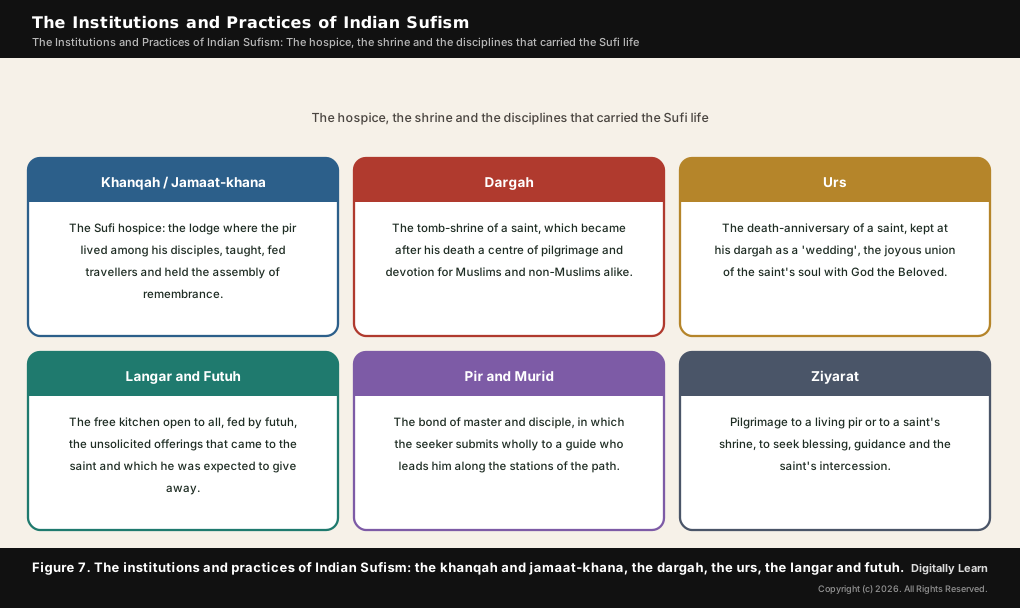
The khanqah was also a house of open hospitality. Its doors stood open to travellers and to the poor, who were lodged and fed without question, and its kitchen was a centre of charity for the whole neighbourhood. In an age without inns or relief for the destitute, the Sufi hospice was a refuge, and this practical service did as much as any doctrine to win the Sufis the love of the common people. The khanqah was thus the beating heart of Indian Sufism, the place where its doctrine, its discipline and its charity all met.
The Dargah, the Urs and Ziyarat: The Cult of the Shrine
Around the tombs of the saints grew the most popular face of Sufism, the cult of the shrine, the death-anniversary and the pilgrimage.
When a great saint died, his tomb became a dargah, a shrine, and a place of pilgrimage often more frequented than in his lifetime. The faithful came to the dargah to seek the blessing of the saint, to lay their petitions before him and to ask his intercession with God, in the belief that the friend of God could aid them still from beyond the grave. The annual high point of the shrine's life was the urs, the death-anniversary of the saint, kept not as a day of mourning but as a festival of joy; for the word urs means a wedding, and the saint's death was understood as the union of his soul with God, the Beloved for whom he had longed all his life.
The act of visiting the shrine or the living master to seek blessing was called ziyarat, pilgrimage, and it drew not only Muslims but Hindus and people of every community to the great dargahs, which became meeting-grounds of the whole society. This open and inclusive devotion, centred on the saint rather than on the mosque and the law, is one of the reasons that Sufism struck such deep roots in India, and that its shrines remain to this day among the most visited holy places of the subcontinent. The cult of the shrine gave the high doctrine of the masters a popular and living form.
Langar, Futuh and the Chishti Attitude to Wealth and the State
The Sufi ideal of poverty took shape in the free kitchen and the unsolicited gift, and in a wariness of the wealth and power of the state.
Central to the life of the hospice was the langar, the free community kitchen, in which food was cooked and shared with all who came, disciples and travellers, rich and poor, without distinction of rank or creed. The kitchen was fed by futuh, the unsolicited offerings that came to the saint unasked, gifts that the Sufi ideal required him not to hoard but to give away, often before the day was out, trusting God to provide for the morrow. To live from futuh and to keep nothing back was held to be the mark of true reliance on God, and the open kitchen the proof of it.
From this ideal of poverty flowed a particular attitude to wealth and to the state. The saints most admired in India, above all those of the order most at home here, held that the man of God should keep his distance from kings and from the wealth and offices they offered, lest the purity of his devotion be corrupted by the world. The greatest of them refused royal grants and would not attend at court, holding that the dervish and the sultan must keep apart. This studied independence from the state gave the Sufis a moral authority in the eyes of the people that the rulers themselves could not command, and is among the most distinctive marks of the Sufism of medieval India.
The Silsila and the Four Orders: Be-shara and Ba-shara
Every Sufi order was a silsila, a chain of spiritual succession, traced from master to master back to the Prophet.
The word silsila means a chain, and it is the name for the line of spiritual descent that runs through an order, from the living pir back through his master, and his master's master, in an unbroken succession to the Prophet himself. To belong to an order was to be a link in such a chain, and to receive through it the spiritual authority and blessing that flowed down the generations from its source. A Sufi order, or tariqa, was thus not merely a school of thought but a living genealogy of the spirit, and the legitimacy of a master depended on the soundness of the chain by which he was connected to those before him. The figure below shows the form of such a chain.
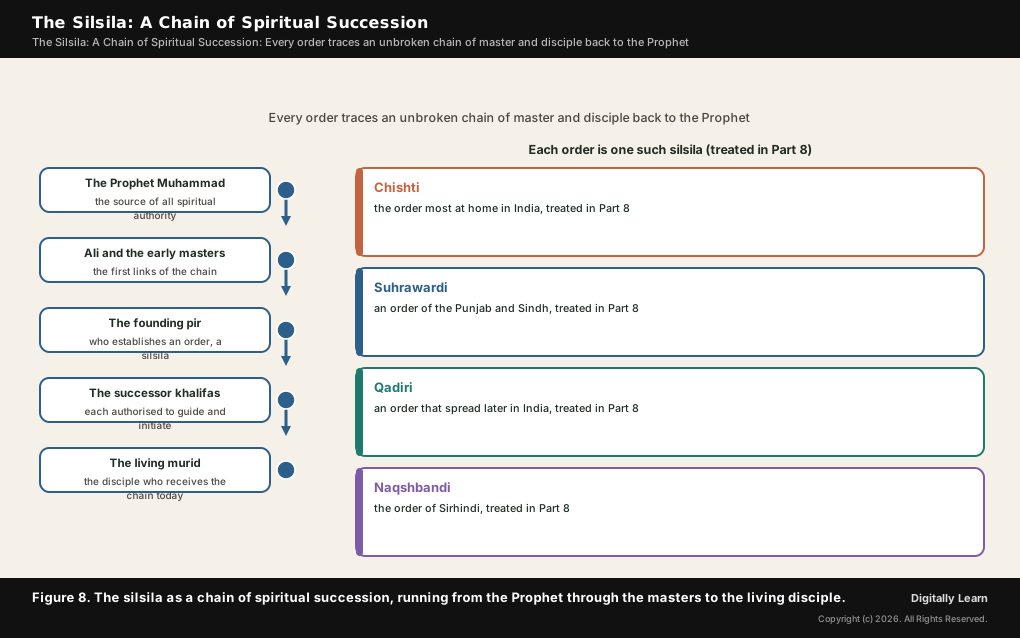
The Sufis of India were also divided, by a different measure, into two broad kinds. The ba-shara Sufis were those who kept faithfully within the bounds of the sharia, the law of Islam, observing its prayers and fasts as the frame of their mystical life; the be-shara Sufis were the wandering, antinomian dervishes who set the law aside in their pursuit of direct experience, men such as the roving qalandars. It was the law-abiding, ba-shara tradition that gave rise to the great organised orders. Of these, four became pre-eminent in India: the Chishti, the Suhrawardi, the Qadiri and the Naqshbandi. The histories of these four orders and of their saints are the subject of the next part of this series; here they are named only to complete the framework of the institutions.
| Term | Meaning | Kind |
|---|---|---|
| Tasawwuf | Sufism, the mystical and ascetic dimension of Islam | The path |
| Tawhid | The oneness of God, sought as a lived experience | Doctrine |
| Ishq and mahabba | Passionate and tender divine love | Doctrine |
| Fana and baqa | Annihilation of the self and subsistence in God | Doctrine |
| Maqamat | Stations of the path, earned by the seeker's effort | Doctrine |
| Ahwal | States of the heart, bestowed by God's grace | Doctrine |
| Dhikr | Remembrance of God by repeated invocation of his Name | Practice |
| Sama | Spiritual audition of music and poetry (contested) | Practice |
| Wahdat al-wujud | The unity of being (Ibn Arabi) | Doctrine |
| Wahdat al-shuhud | The unity of witness (Shaikh Ahmad Sirhindi) | Doctrine |
| Pir and murid | The master and the disciple | Institution |
| Wali (auliya) | A friend of God, a saint; granted karamat (marvels) | Institution |
| Khanqah | The Sufi hospice; also the jamaat-khana | Institution |
| Dargah | The tomb-shrine of a saint | Institution |
| Urs | The death-anniversary, kept as the saint's wedding with God | Practice |
| Langar and futuh | The free kitchen and unsolicited charity | Practice |
| Ziyarat | Pilgrimage to a shrine or a living master | Practice |
| Silsila | The chain of spiritual succession of an order | Institution |
| Ba-shara and be-shara | Sufis within and outside the sharia | Classification |
The Social Role of Sufism and Its Place in Medieval India
Sufism, the Orthodox Ulama and the Relation to the State
Sufism stood in a creative tension with the orthodox ulama and with the state, and from that tension drew much of its moral authority.
The relation of the Sufis to the ulama, the scholars of the law, was never simple. The two were not always opposed, for many a Sufi was himself a learned man, and after al-Ghazali the mystical path was broadly accepted within orthodox Islam; yet a real tension remained between the religion of the heart and the religion of the law, between the saint who sought God within and the jurist who guarded the outward observance. The bolder Sufi doctrines, of intoxication, of the unity of being, of music in worship, were always liable to the charge of innovation and excess, and the history of Sufism is in part the history of this long argument within Islam.
Toward the state the most admired of the Indian Sufis kept a studied distance, refusing the grants and the offices of kings and holding that the man of God should owe nothing to worldly power. This independence won them a moral standing in the eyes of the people that no court could buy, and made the great khanqahs centres of an authority that ran parallel to, and sometimes above, that of the sultans. The Sufi saint, poor, independent and open-handed, became in the popular mind a figure of holiness set over against the pomp of the court, and this contrast is essential to understanding the place of Sufism in medieval society.
Sufism and Indian Society: The Parallel with the Bhakti Movement
Sufism and the Bhakti movement ran as parallel currents of devotion, and together gave medieval India a shared and tolerant religious life.
The Sufi movement met an Indian society already astir with the devotional fervour of the Bhakti movement, and the kinship between the two was plain to contemporaries and to later historians alike. Both turned from outward ritual and priestly authority toward an inward religion of love; both sang of the soul's longing for God in the language of human love; both gathered around saints rather than institutions, and both reached across the lines of caste and creed. The shared, formless devotion of the nirguna Sants, treated in the nirguna Sants such as Kabir and Guru Nanak, stood especially close to the Sufi way of the One God within.
This kinship made the great Sufi shrines meeting-grounds of Hindu and Muslim, where people of every community came to seek blessing, and it fed the slow growth of a shared or composite culture in medieval India. The interaction must not be overstated into a simple merging of faiths, for real differences remained; but the Sufis, with their tolerance, their use of the local languages and their open shrines, did much to soften the line between the communities. This wider story of the meeting of Sufism and Bhakti, and of the composite culture it nourished, including the Sufis and the Bhakti movement under the Delhi Sultanate, is the subject of the closing part of this series; the individual orders and their saints are the subject of the next.
UPSC Relevance and Previous-Year Questions
Where Sufism Fits in the UPSC-CSE Syllabus
This topic belongs to General Studies Paper I: medieval Indian history and culture, and Sufism is a recurring theme, tested in Prelims as fine factual pairings on the doctrines and practices and in Mains as a subject of religion, culture and society.
The questions most often test the practices and doctrines of the Sufis, the meaning of the key terms, the easily-confused pairs, and the role of Sufism in medieval society. The following points are worth holding in working memory:
- Tasawwuf: Sufism is the mystical and ascetic dimension of Islam, seeking the direct experience of the one God through love and remembrance.
- The doctrinal pairs: fana is annihilation of the self and baqa subsistence in God; maqamat are earned stations and ahwal are bestowed states; do not confuse them.
- The practices: dhikr is the remembrance of God, sometimes with breath control; sama is the contested practice of spiritual music; the ascetic retreat in a lonely place is a Sufi discipline.
- Wahdat al-wujud and wahdat al-shuhud: the unity of being is Ibn Arabi’s, the unity of witness Shaikh Ahmad Sirhindi’s; never swap them.
- The institutions: the khanqah is the hospice, the dargah the tomb-shrine, the urs the death-anniversary kept as a wedding, and the silsila the chain of succession.
A 2012 Prelims question asked which practices the Sufi mystics of medieval India were known to pursue: meditation and the control of breath, severe ascetic exercises in a lonely place, and the recitation of holy songs to arouse a state of ecstasy. This part teaches that all three were indeed Sufi practices: the control of breath belongs to the discipline of dhikr, set out in the section on remembrance; the severe ascetic exercises in a lonely place are the renunciation and retreat that run from the early ascetics through the whole tradition; and the recitation of holy songs to arouse ecstasy is sama, the spiritual audition described in its own section. A reader who has followed the doctrines and practices can see that all three statements are correct.
A 1996 Prelims question asked which Sufi saint maintained that devotional music was one way of coming close to God. This part teaches the doctrine behind the answer in the section on sama: that some Sufis, and above all the order most at home in India, held the audition of music and mystical poetry to be a means of kindling the love of God and reaching nearness to him, while the orthodox and other orders rejected it. Honest scope note: the specific saint who is the answer to this question, the founder of the Chishti order, and the histories of the individual orders, are treated in the next part of this series; this part supplies the doctrine of sama and the division it caused, which is what the question rests upon.
A Mains question of 2020 held that the Persian literary sources of medieval India reflect the spirit of the age, and asked for comment. This part supplies an important part of the answer in its account of Sufi literature: the Kashf al-Mahjub of al-Hujwiri, the earliest Persian treatise on Sufism, and the wider tradition of recorded conversations and lives of the saints were among the great Persian literary sources of medieval India, and they reflect its devotional and mystical spirit as fully as any court chronicle. Honest scope note: the question embraces all Persian literary sources, including the court histories and secular poetry treated elsewhere; this part contributes the Sufi strand of that literature and the spirit it reflects.
Previous Year UPSC-CSE Questions
Previous Year UPSC-CSE Questions By the end you will be able to draft model answers for the following UPSC questions. Each question carries a collapsible framework showing how to approach it in the exam.
- UPSC Prelims 2012 GS-IWith reference to the religious history of medieval India, the Sufi mystics were known to pursue which of the following practices?
- Meditation and control of breath
- Severe ascetic exercises in a lonely place
- Recitation of holy songs to arouse a state of ecstasy in their audience
Select the correct answer using the codes given below:
How to approach this Prelims question
Approach: Test each listed practice against the known disciplines of Sufism: dhikr and its breath control, ascetic retreat, and sama. A statement is correct if it names a genuine Sufi practice.
Trap to watch: All three are framed plausibly; the temptation is to reject sama (music) as un-Islamic and choose a partial option, but sama was a real and central, if contested, Sufi practice, so all three are correct.
Key facts to recall:
- Dhikr, the remembrance of God, was sometimes joined to the control of the breath.
- Ascetic exercises and solitary retreat (the chilla) were practised from the early ascetics onward.
- Sama, the recitation of holy songs and music to arouse ecstasy, was a characteristic Sufi practice.
Answer signal: All three practices were pursued by the Sufi mystics, so the answer is 1, 2 and 3.
- UPSC Prelims 1996 GS-IThe sufi saint who maintained that devotional music was one way of coming close to God was
How to approach this Prelims question
Approach: Recall which Sufi tradition held devotional music to be a path to God; the order that championed sama, and its founder, is the answer.
Trap to watch: All four names are Sufi figures; the key is to connect the embrace of devotional music (sama) with the order that made it central, rather than with an order that rejected it.
Key facts to recall:
- Sama, the audition of devotional music, was held by some Sufis to be a means of coming close to God.
- The Chishti order embraced sama and made it central, while the Suhrawardi order held back from it.
- The founder of the Chishti order is the saint associated with this position (treated in detail in Part 8).
Answer signal: The saint who championed devotional music as a way to God is the founder of the Chishti order.
- UPSC Mains 2020 GS-IPersian literary sources of medieval India reflect the spirit of the age. Comment.
How to structure the answer in the exam
Introduction: The Persian literature of medieval India, from court chronicles to the writings of the Sufis, is not a neutral record but a mirror of the religious devotion, the courtly culture and the political concerns of its age.
Body (sub-themes to develop):
- The Sufi literary tradition: the Kashf al-Mahjub of al-Hujwiri, the earliest Persian treatise on Sufism, and the malfuzat (recorded conversations) and tazkiras (lives of the saints) that reflect the devotional spirit of the age.
- Court chronicles and histories that reflect the political ideals, conquests and anxieties of the Sultanate and Mughal states (treated more fully in the political-history clusters).
- Persian poetry, both courtly and mystical, that gives voice to the cultural refinement and the religious longing of the period.
- The use of Persian itself as the language of culture and administration, which reflects the Persianate character of the medieval Indian state and elite.
- A balanced judgement: the sources reflect the spirit of the age vividly but partially, written largely by and for a literate Muslim elite, so they must be read with care.
Conclusion: Read together and critically, the Persian literary sources, the Sufi writings prominent among them, do reflect the devotional, courtly and political spirit of medieval India, while remaining the testimony of a particular class and outlook.
Sources and Further Reading
- NCERT, Themes in Indian History Part II (the Bhakti-Sufi traditions, the be-shari'a and ba-shari'a Sufis)
- Wikipedia: Sufism
- Wikipedia: Sufism in India
- Wikipedia: Rabia of Basra (the doctrine of divine love)
- Wikipedia: Mansur Al-Hallaj (Ana'l-Haqq)
- Wikipedia: Junayd of Baghdad (the sober path)
- Wikipedia: Al-Ghazali (the reconciliation with orthodoxy)
- Wikipedia: Ali Hujwiri (Data Ganj Bakhsh, Kashf al-Mahjub)
- Wikipedia: Fana (Sufism) (fana and baqa)
- Wikipedia: Maqam (Sufism) (stations and states)
- Wikipedia: Sama (Sufism) (spiritual music and its controversy)
- Wikipedia: Sufi metaphysics (wahdat al-wujud and wahdat al-shuhud)
- Wikipedia: Ibn Arabi (wahdat al-wujud)
- Wikipedia: Ahmad Sirhindi (wahdat al-shuhud)
- Wikipedia: Khanqah (the Sufi hospice and jamaat-khana)
- Wikipedia: Urs (the death-anniversary)
- Ministry of Culture, Indian Culture portal: the Sufi tradition of India
Editorial Disclaimer
This article is for UPSC preparation. The account of Sufism follows the standard scholarship on Islamic mysticism and medieval Indian religion. The dates and biographies of several early Sufis, such as Rabia of Basra and al-Hujwiri, are uncertain or contested, and these are flagged in the text.