

Overview
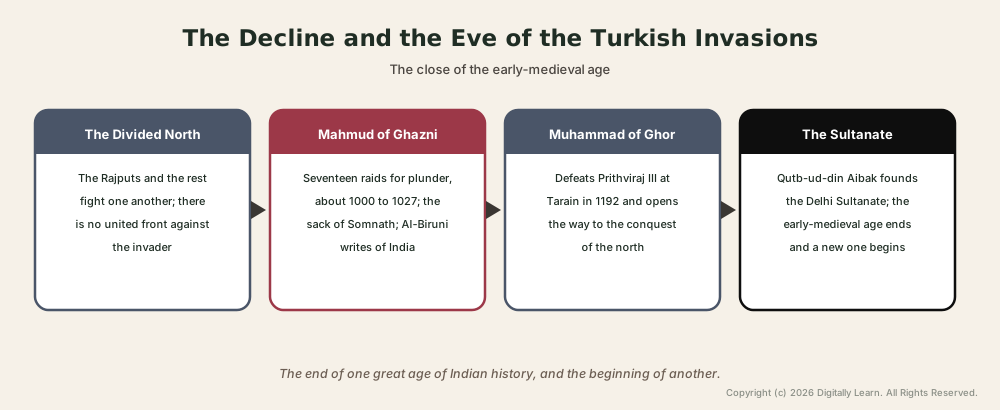
By the close of the early-medieval age, the kingdoms of India lay divided and open to invasion from the north-west. From Ghazni, Mahmud of Ghazni led some seventeen raids for plunder, sacking the great temple of Somnath, and the scholar Al-Biruni came with him to write his study of India. A century later Muhammad of Ghor came not to raid but to conquer; his victory at the second battle of Tarain in 1192 founded the Delhi Sultanate and brought the early-medieval age to its end. This part covers the disunity, the raids of Mahmud, the Ghurid conquest and the exam focus.
The Disunity of the North on the Eve of Conquest
A House Divided and the Sena Succession
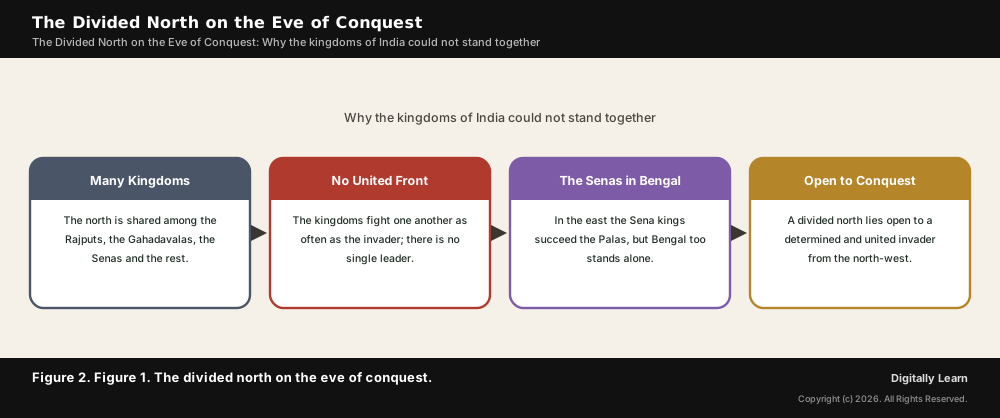
What is the significance of the disunity: the weakness that opened India to the Turks was not a want of valour but a want of unity, for the kingdoms of the north could not stand together.
The north was many kingdoms, the Rajput houses, the Gahadavalas of Kannauj, and in the east the Senas, who had succeeded the Palas in Bengal. Each was proud and jealous of the rest, and they spent their strength against one another as often as against any outside foe.
There was no single power to lead the north, no emperor to gather the kingdoms against a common danger. The Sena kings of Bengal, the Rajputs of the west, and the rest each faced the invader alone, and a divided India lay open to a united enemy from beyond the passes.
The Frontier: The Hindu Shahis and the First Invaders
Distinguishing the frontier: the first shock of the invasions fell on the north-west, where the Hindu Shahis held the gate of India against the rising power of Ghazni.
The Hindu Shahis, ruling from Kabul and the Punjab, were the first line of defence. Their kings, Jayapala and Anandapala, fought the early campaigns of Ghazni and were broken by them, so that the Punjab passed to the invader and the plains of India lay exposed.
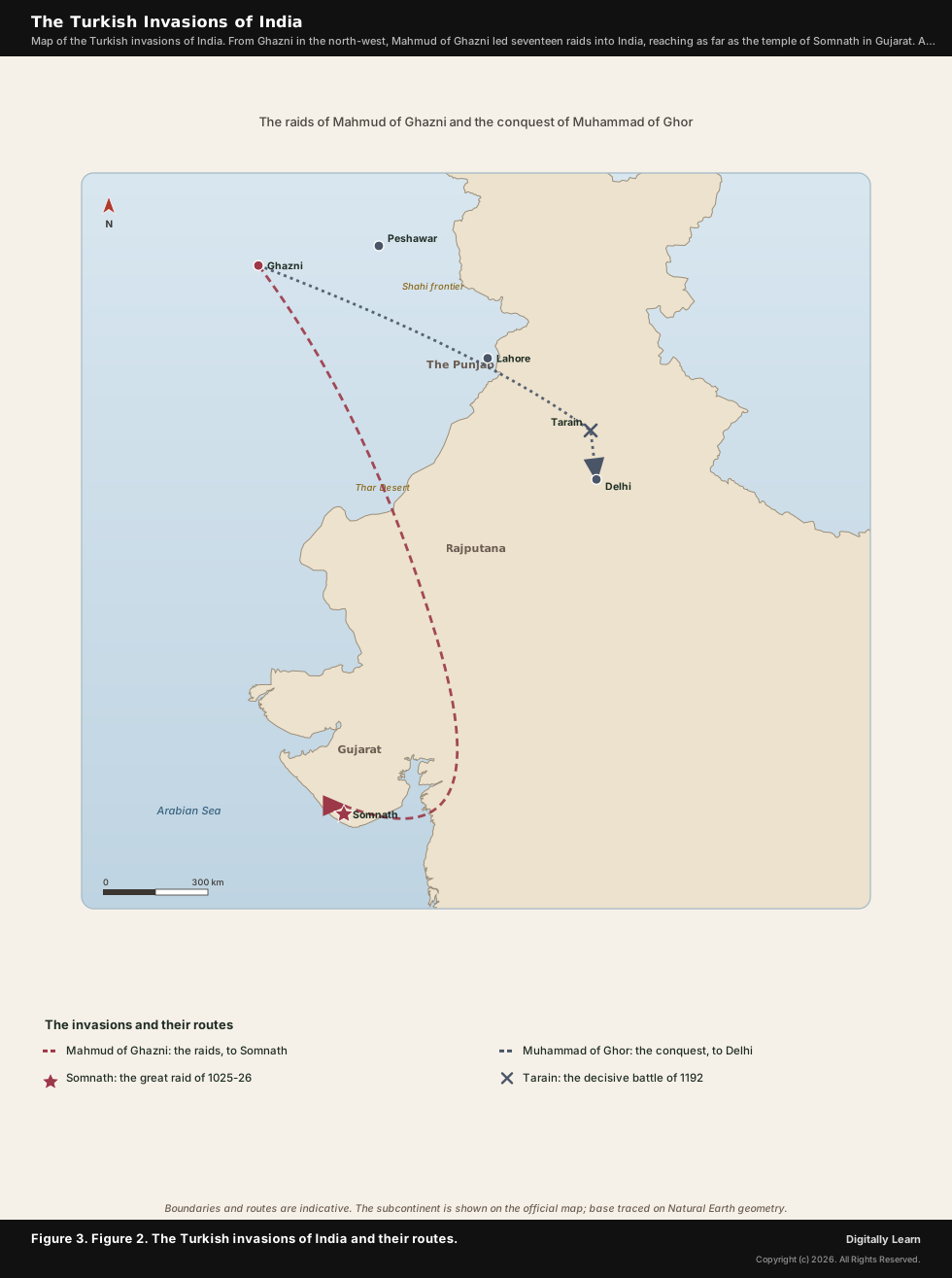
The map sets out the routes of the invasions: the raids of Mahmud from Ghazni deep into Gujarat, and the later march of Muhammad of Ghor through the Punjab to Tarain and Delhi. From the north-west, by these roads, came the power that would end the early-medieval age.
Mahmud of Ghazni and the Plunder of the North
The Seventeen Raids and the Sack of Somnath
What is the significance of Mahmud: he was the first great Turkish invader of India, but a raider for plunder, not a builder of empire, and his raids revealed the wealth and the weakness of the land.
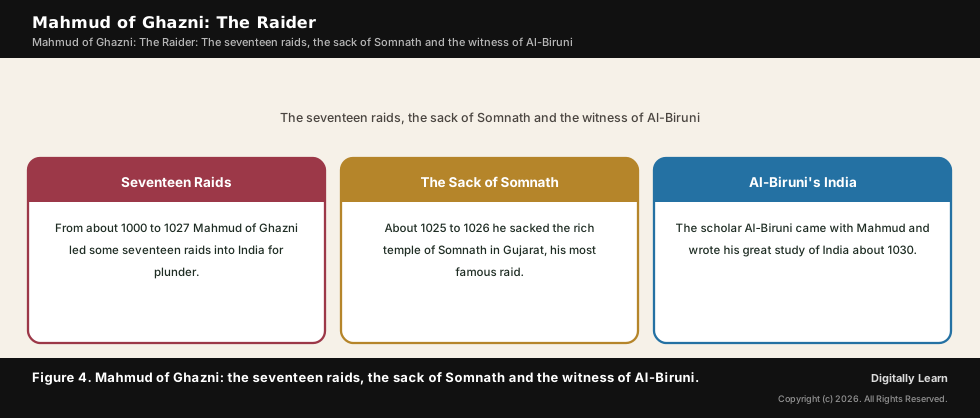
Mahmud of Ghazni, the Turkish ruler of Ghazni, led some seventeen raids into India between about 1000 and 1027. He came not to rule but to plunder, above all the rich temples of the north, and he carried their treasure back to Ghazni; he did not seek to found a kingdom in India beyond the Punjab.
His most famous raid was the sack of the great temple of Somnath in Gujarat, about 1025 to 1026, a Jyotirlinga shrine of Shiva whose wealth was renowned. With Mahmud came the scholar Al-Biruni, who learned the languages and sciences of India and wrote, about 1030, his great study of the land, the Kitab-ul-Hind.
The Ghurid Conquest and the End of the Age
Muhammad of Ghor and the Birth of the Sultanate
What is the significance of Muhammad of Ghor: where Mahmud had only raided, Muhammad of Ghor came to conquer, and his victory turned the north of India into a settled Turkish kingdom.
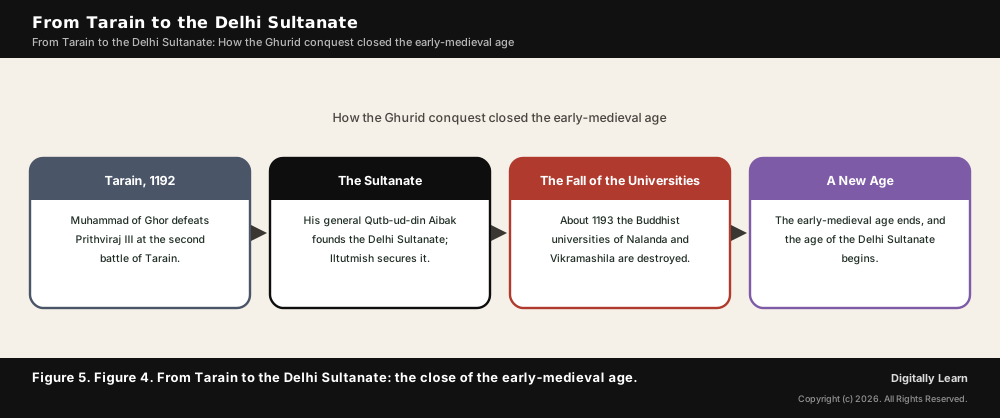
Muhammad of Ghor, the ruler of Ghor in Afghanistan, advanced into India in the later twelfth century with the aim of conquest, not mere plunder. He was checked at first by the Chauhan Prithviraj III, who defeated him at the first battle of Tarain in 1191, but he returned the next year and won the decisive second battle of Tarain in 1192.
This victory founded a new power. Muhammad of Ghor's general Qutb-ud-din Aibak took Delhi and, on his master's death, founded the Delhi Sultanate, which Iltutmish would secure. The distinction is worth holding: Mahmud was the raider, Muhammad of Ghor the conqueror whose lieutenants stayed to rule.
| Aspect | Mahmud of Ghazni | Muhammad of Ghor |
|---|---|---|
| Aim | Plunder, by raids. | Conquest, to rule. |
| Period | About 1000 to 1027. | The later twelfth century. |
| Chief act | The sack of Somnath. | The victory at Tarain, 1192. |
| Result | No lasting empire in India. | The founding of the Delhi Sultanate. |
The Fall of the Universities and the New Order
Distinguishing the close of the age: with the Ghurid conquest the early-medieval order of Hindu kingdoms gave way, and a new age of the Delhi Sultanate began.
The conquest swept away the old order. About 1193 the Buddhist universities of Nalanda and Vikramashila, the last great seats of the faith in India, were destroyed in the eastern campaigns, and with them passed the last age of Buddhism in the land of its birth. The kingdoms of the tripartite age and the Rajputs were absorbed or pushed aside.
With the Ghurid victory the early-medieval age came to its end. The story that began with the fall of the Guptas and the rise of the regional kingdoms closes here, on the field of Tarain, and the next great age, that of the Delhi Sultanate, opens. That age is the subject of the chapters that follow this series.
UPSC Relevance and Exam Focus
Where the Turkish Invasions Fit in the UPSC-CSE Syllabus
This topic belongs to General Studies Paper I: early-medieval and medieval Indian history, and it is the bridge from the ancient and early-medieval syllabus to the Delhi Sultanate.
The questions most often test the two invaders and their deeds: Mahmud of Ghazni and the sack of Somnath, the witness of Al-Biruni, and Muhammad of Ghor and the second battle of Tarain.
Several linked points recur and are worth holding in working memory:
- Mahmud of Ghazni: The raider of the seventeen raids and the sack of Somnath.
- Al-Biruni: Came with Mahmud and wrote the Kitab-ul-Hind about India.
- Muhammad of Ghor: The conqueror who won the second battle of Tarain.
- Tarain, 1192: The battle that opened the way to the Delhi Sultanate.
- Qutb-ud-din Aibak: The general who founded the Delhi Sultanate.
A 2022 question on the Somnath temple asked which statements were correct: that it is a Jyotirlinga shrine, and that Al-Biruni described it, are both true; but the modern reinstallation of the temple was done by Rajendra Prasad, the first President, not by S. Radhakrishnan, so only the first two statements are correct.
A common trap treats Mahmud of Ghazni as the founder of Turkish rule in India; in truth he was a raider who founded no lasting empire here, and it was Muhammad of Ghor, through his general Qutb-ud-din Aibak, who founded the Delhi Sultanate.
Previous Year UPSC-CSE Questions By the end you will be able to draft model answers for the following UPSC questions. Each question carries a collapsible framework showing how to approach it in the exam.
- UPSC Prelims 2022 GS-IWhich of the following statements are correct regarding the Somnath Temple?
- Somnath Temple is one of the Jyotirlinga shrines.
- A description of Somnath Temple was given by Al-Biruni.
- Pran Pratishtha of the present-day Somnath Temple was done by President S. Radhakrishnan.
Select the correct answer using the code given below.
How to approach this Prelims question
Approach: Test each statement: Somnath is a Jyotirlinga (correct); Al-Biruni described it (correct); the modern Pran Pratishtha was by Rajendra Prasad, not Radhakrishnan (so statement 3 is wrong).
Trap to watch: Statement 3 swaps the President: the 1951 reinstallation was done by Rajendra Prasad, the first President, not S. Radhakrishnan.
Key facts to recall:
- Somnath is one of the twelve Jyotirlinga shrines of Shiva.
- Al-Biruni, who came with Mahmud, described Somnath.
- The 1951 Pran Pratishtha of the present temple was done by Rajendra Prasad.
Answer signal: 1 and 2 only.
Prelims MCQ practice
Each question below tests one specific concept on the topic. Click to reveal the answer and a full option-wise explanation.
Q1. Mahmud of Ghazni, who led about seventeen raids into India between roughly 1000 and 1027, is best described as which one of the following?
- The founder of the Delhi Sultanate
- A raider who came chiefly for plunder
- A Hindu Shahi king of the Punjab
- A general of Muhammad of Ghor
Show answer and explanation
Answer: A raider who came chiefly for plunder
Explanation.
Option (b) is correct. Mahmud of Ghazni was a raider who came chiefly for plunder and founded no lasting empire in India; the Sultanate was founded later by the Ghurids. Hence option (b).
Q2. The temple sacked by Mahmud of Ghazni about 1025, a famous Jyotirlinga shrine in Gujarat, was which one of the following?
- The Lingaraja temple
- The Somnath temple
- The Sun temple of Modhera
- The Dilwara temples
Show answer and explanation
Answer: The Somnath temple
Explanation.
Option (b) is correct. Mahmud sacked the Somnath temple, a Jyotirlinga shrine of Shiva in Gujarat, about 1025 to 1026. Hence option (b).
Q3. With reference to Al-Biruni, consider the following statements:
- He came to India in the company of Mahmud of Ghazni.
- He wrote an account of India known as the Kitab-ul-Hind.
Which of the statements given above is/are correct?
- 1 only
- 2 only
- Both 1 and 2
- Neither 1 nor 2
Show answer and explanation
Answer: Both 1 and 2
Explanation.
Both statements are correct. Al-Biruni came to India with Mahmud of Ghazni and wrote his study of the land, the Kitab-ul-Hind (Tahqiq-ma-li'l-Hind), about 1030. Hence option (c).
Q4. The decisive battle, won in 1192, that opened the way to the founding of the Delhi Sultanate was which one of the following?
- The first battle of Tarain
- The second battle of Tarain
- The battle of Chandwar
- The battle of Waihind
Show answer and explanation
Answer: The second battle of Tarain
Explanation.
Option (b) is correct. Muhammad of Ghor won the second battle of Tarain in 1192, opening the way to the Delhi Sultanate; Prithviraj had won the first battle in 1191. Hence option (b).
Q5. The Delhi Sultanate was founded by which one of the following, a general of Muhammad of Ghor?
- Iltutmish
- Qutb-ud-din Aibak
- Balban
- Bakhtiyar Khalji
Show answer and explanation
Answer: Qutb-ud-din Aibak
Explanation.
Option (b) is correct. Qutb-ud-din Aibak, a general of Muhammad of Ghor, founded the Delhi Sultanate; Iltutmish later secured it. Hence option (b).
Q6. The Hindu Shahi kings who first faced the campaigns of Ghazni on the north-west frontier included which one of the following?
- Prithviraj III
- Jayapala and Anandapala
- Jayachandra
- Bhima I
Show answer and explanation
Answer: Jayapala and Anandapala
Explanation.
Option (b) is correct. The Hindu Shahis Jayapala and Anandapala first faced the Ghaznavid campaigns on the north-west frontier. Hence option (b).
Sources and Further Reading
Editorial Disclaimer
This article is for UPSC preparation. The dates of the Turkish invasions are approximate, and the account follows the standard scholarship on the close of the early-medieval age.


