


Overview
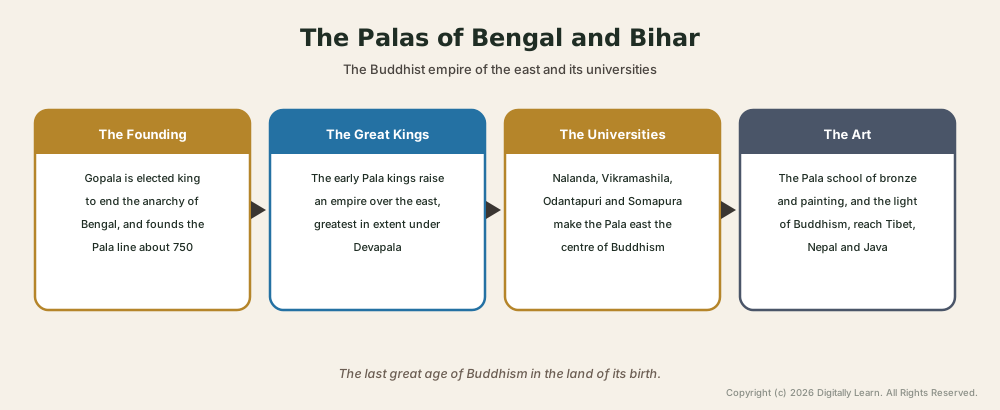
The Palas were the great Buddhist power of the early-medieval east, ruling Bengal and Bihar for some four centuries. Their founder Gopala was elected king to end the anarchy of Bengal, and under his successors, above all Devapala, the Pala empire reached its height. The Pala kings were the last great patrons of Buddhism in the land of its birth: their monastic universities at Nalanda and Vikramashila, and their distinct school of bronze and painting, carried Indian Buddhism and art to Tibet, Nepal and the lands across the sea. This part covers the founding, the great kings, the universities, the Pala art and the exam focus.
The Rise of the Palas
Gopala, the Elected Founder
What is the significance of the Palas: they were the great Buddhist power of the east, and their story begins with one of the rare elections of a king in Indian history.
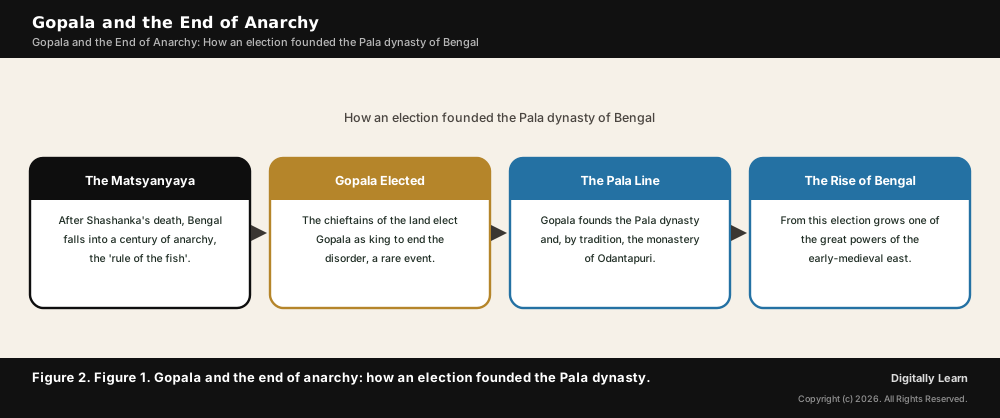
After the death of Shashanka of Gauda, Bengal fell into a century of disorder that the sources call the matsyanyaya, the rule of the fish, where the strong devoured the weak. To end this anarchy, a body of the land's chieftains chose one of their own, Gopala, and made him king, an election rather than a conquest.
Gopala thus founded the Pala dynasty about the middle of the eighth century. He is remembered as a devout Buddhist and, by tradition, the builder of the monastery of Odantapuri, and from his election grew one of the longest-lived powers of the early-medieval east.
The Pala Realm and the Buddhist Universities
Distinguishing the Pala country: the dynasty ruled the rich east, Bengal and Bihar, and made it the centre of the Buddhist world through its great monasteries.
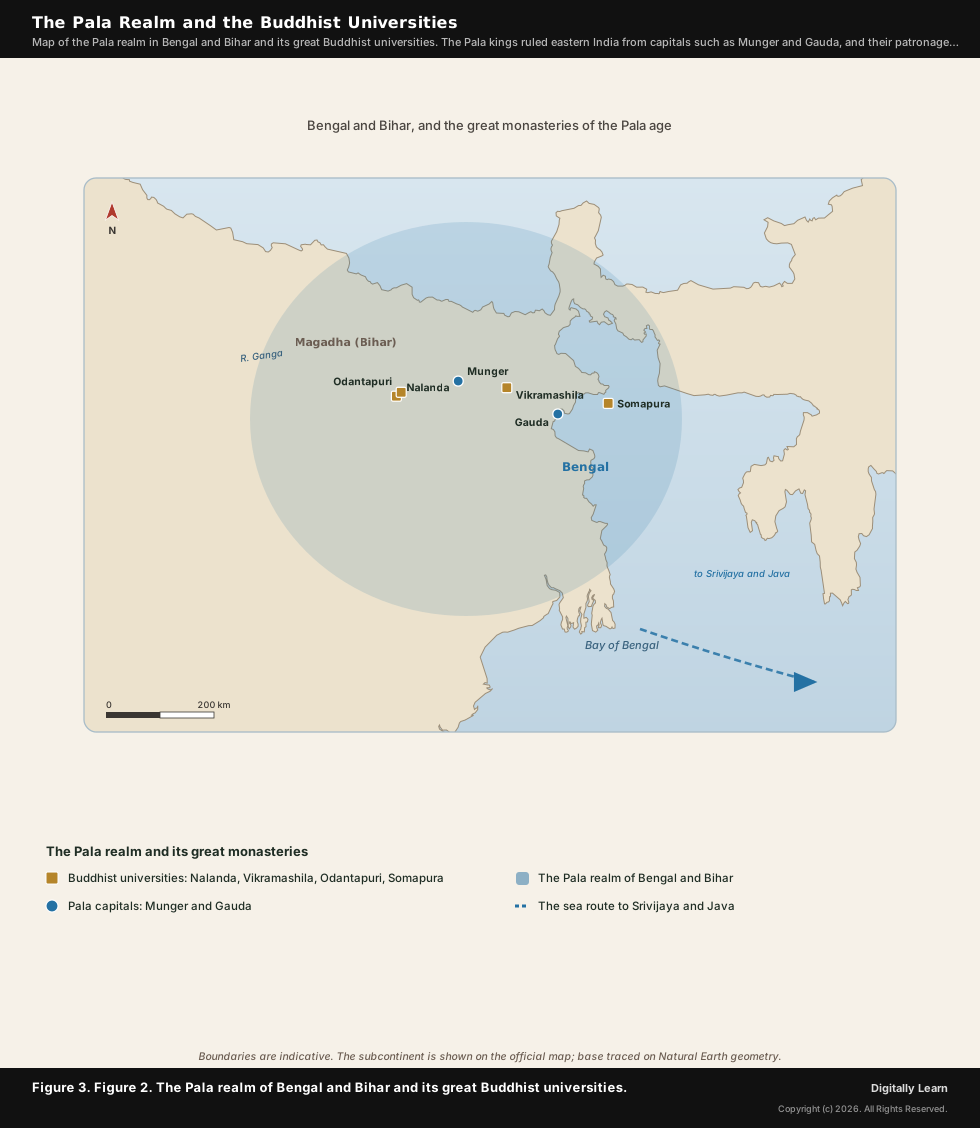
The Pala realm lay in Bengal and Magadha, the modern Bihar, ruled from capitals such as Munger and Gauda. It was here, on the Ganga, that the Pala kings raised or sustained the monastic universities, Nalanda, Vikramashila, Odantapuri and Somapura, whose fame drew scholars from across Asia.
The map sets out the realm and its universities, and the sea road that carried Pala learning across the Bay of Bengal. From this eastern land the light of Buddhism would pass north to Tibet and east to the islands, even as it faded elsewhere in India.
The Great Pala Kings
Dharmapala and Devapala
What is the significance of these two kings: under Dharmapala and his son Devapala the Pala empire rose to its greatest power and its widest fame.
Dharmapala, the son of Gopala, raised the Palas into a great power; he held Kannauj for a time in the tripartite struggle, and as a patron of the faith he founded the university of Vikramashila and the great monastery of Somapura at Paharpur, with the philosopher Haribhadra as his preceptor.
Devapala, his son, carried the empire to its greatest extent and prosperity. His fame reached across the sea: a copper-plate from Nalanda records that Balaputradeva, the Sailendra king of Java, sought from Devapala a grant of villages to endow a monastery at Nalanda, which the Pala king gladly gave.
| Ruler | Note |
|---|---|
| Gopala | The elected founder; ended the anarchy; built Odantapuri by tradition. |
| Dharmapala | Founded Vikramashila and Somapura; held Kannauj for a time. |
| Devapala | The greatest extent; the Nalanda grant to Balaputradeva of Java. |
| Mahipala I | Revived Pala power in the eleventh century, a second founder. |
| Ramapala | The last strong king; the subject of the Ramacharita. |
The Later Palas and the Ramacharita
Distinguishing the later age: after a period of decline the Palas were revived, and their last age gave us one of the most remarkable works of Sanskrit history.
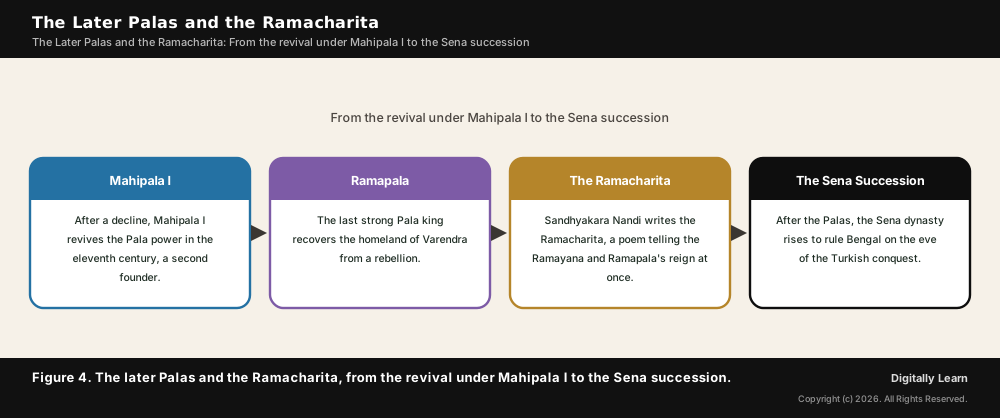
Mahipala I, in the eleventh century, revived the Pala power after a time of weakness and is remembered almost as a second founder of the line. Later still, Ramapala recovered the Pala homeland of Varendra from a rebellion, the last great effort of the dynasty.
His reign is known from a singular source. The poet Sandhyakara Nandi wrote the Ramacharita, a work of double meaning in which every verse tells at once the story of the Ramayana and the reign of Ramapala, a feat of art that is also the chief source for the late Pala age.
The Pala Achievement in Buddhism and Art
The Buddhist Universities and the Light to Tibet
What is the significance of the Pala universities: they made the Pala east the last great centre of Buddhism in India, from which the faith and its learning passed out to the wider world.
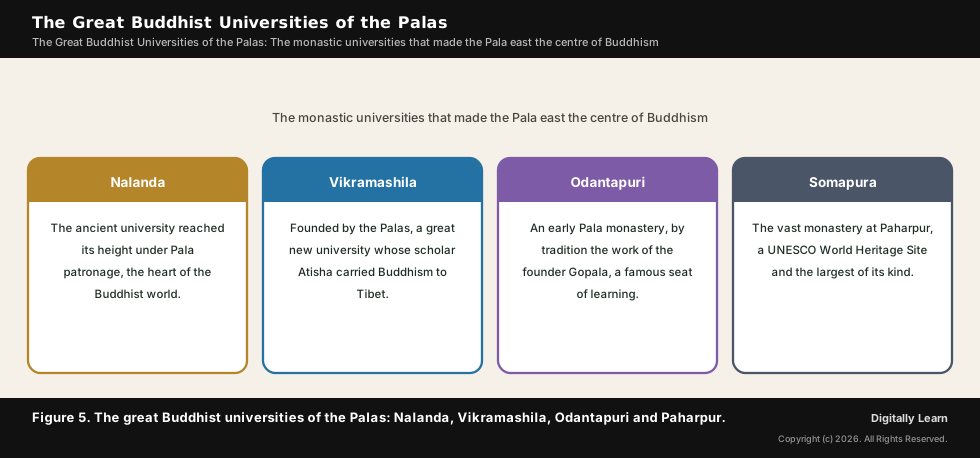
Under the Palas the ancient university of Nalanda reached its height, and the kings raised new universities beside it, Vikramashila, Odantapuri and the vast Somapura at Paharpur, today a World Heritage Site. Together they formed a network of learning that drew monks and scholars from Tibet, China and the lands beyond the sea.
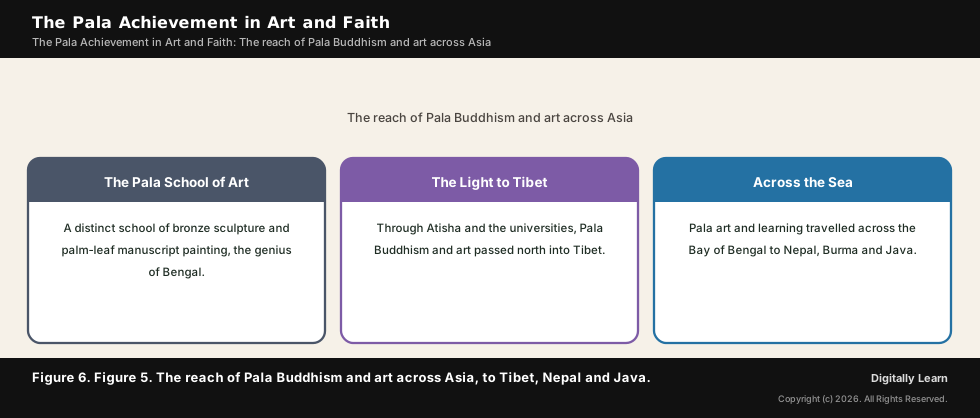
From these halls the light of Buddhism passed north. The great scholar Atisha, of Vikramashila, travelled to Tibet in the eleventh century and there renewed Mahayana Buddhism, so that the Pala universities shaped the faith of the Himalaya long after it had waned in the plains.
The Pala School of Art
Distinguishing the Pala art: the age produced a school of sculpture and painting so distinct that it became a model for the Buddhist art of half of Asia.
The Pala school is known above all for its bronze sculpture and its palm-leaf manuscript painting, the work of the master craftsmen of Bengal and Bihar. Its images of the Buddha and the Bodhisattvas, cast in metal or painted in miniature, are among the finest of early-medieval India.
This art did not stay at home. Carried by monks and pilgrims, the Pala style passed across the Himalaya into Nepal and Tibet, and across the Bay of Bengal to Burma and the islands of Java, shaping the Buddhist art of those lands for centuries.
UPSC Relevance and Exam Focus
Where the Palas Fit in the UPSC-CSE Syllabus
This topic belongs to General Studies Paper I: early-medieval Indian history and Indian art and culture, and the Palas are important for both Prelims and Mains.
The questions most often test the dynasty's role in Buddhism: Gopala the elected founder, the universities of Nalanda and Vikramashila, and the Palas as the last great patrons of the faith.
Several linked points recur and are worth holding in working memory:
- Gopala: The elected founder, who ended the matsyanyaya of Bengal.
- Dharmapala: Founded Vikramashila and the Somapura monastery.
- Devapala: The greatest king; the Nalanda grant to Balaputradeva.
- The universities: Nalanda, Vikramashila, Odantapuri and Somapura.
- The Ramacharita: Sandhyakara Nandi’s double-meaning poem on Ramapala.
A 2020 Mains question called the Pala period the most significant phase in the history of Buddhism in India, which the patronage of the universities, the school of art, and the carrying of the faith to Tibet and beyond together bear out.
A common Prelims point is that the Palas were patrons of Buddhism, which is correct, while the Ikshvakus of the south were not antagonistic to it but were in fact its patrons; so a statement calling the Ikshvakus antagonistic is wrong.
Previous Year UPSC-CSE Questions
Previous Year UPSC-CSE Questions By the end you will be able to draft model answers for the following UPSC questions. Each question carries a collapsible framework showing how to approach it in the exam.
- UPSC Mains 2020 GS-IPala period is the most significant phase in the history of Buddhism in India. Enumerate.
How to structure the answer in the exam
Introduction: The Pala dynasty of Bengal and Bihar (c. 750 to 1150) was the last great royal patron of Buddhism in India, sustaining its institutions and art when the faith was declining elsewhere.
Body (sub-themes to develop):
- Royal patronage: Gopala, Dharmapala and Devapala as devout Buddhist kings.
- The universities: Nalanda at its height, and the new foundations of Vikramashila, Odantapuri and Somapura (Paharpur).
- Scholarship and transmission: Atisha of Vikramashila renewing Buddhism in Tibet; links to China and Southeast Asia.
- The Pala school of art: bronze sculpture and palm-leaf manuscript painting, a model for Buddhist art across Asia.
- International reach: the Nalanda grant to Balaputradeva of Java, and the spread of the style to Nepal, Burma and Java.
Conclusion: Through its universities, its art and its transmission of the faith abroad, the Pala period was indeed the last and one of the most significant phases of Buddhism in the land of its birth.
- UPSC Prelims 2006 GS-IConsider the following statements:
- The Ikshvaku rulers of southern India were antagonistic towards Buddhism.
- The Pala rulers of Eastern India were patrons of Buddhism.
Which of the statements given above is/are correct?
How to approach this Prelims question
Approach: Judge each statement: the Palas were patrons of Buddhism (correct); the Ikshvakus were patrons, not opponents, of Buddhism (so 'antagonistic' is wrong).
Trap to watch: Statement 1 inverts the truth: the Ikshvakus of Nagarjunakonda were notable patrons of Buddhism, not its enemies.
Key facts to recall:
- The Palas were the last great royal patrons of Buddhism in India.
- The Ikshvakus of the lower Krishna valley patronised Buddhism at Nagarjunakonda.
- Only statement 2 is correct.
Answer signal: 2 only.
Sources and Further Reading
Editorial Disclaimer
This article is for UPSC preparation. The dates of the Pala kings are approximate, and the account follows the standard scholarship on early-medieval eastern India.