


Overview
The Rashtrakuta dynasty was the leading power of the Deccan from 753 to 982. From the reign of Amoghavarsha I its capital was Manyakheta, modern Malkheda in the Kalaburagi district of Karnataka. The Rashtrakutas began as subordinate rulers (samantas) of the Chalukyas of Badami. Their founder Dantidurga overthrew that overlordship, and within a few decades the Rashtrakuta empire was one of the three powers that fought over Kannauj, together with the Gurjara-Pratiharas and the Palas. Krishna I had the Kailasa temple carved out of a hillside at Ellora, the court of Amoghavarsha I produced the earliest surviving book on poetics in Kannada, and the Rashtrakuta kings supported Jain, Hindu and Buddhist institutions alike.
Rise of the Rashtrakutas: How the Dynasty Became Powerful
Dantidurga, Founder of the Rashtrakuta Dynasty
Dantidurga founded the imperial line of the Rashtrakutas, the Rashtrakutas of Manyakheta, and ruled from 753 to 756. His family had served the Chalukyas of Badami as a feudatory house, probably ruling from Achalapura in Berar (present-day Achalpur, also called Elichpur, in Maharashtra). Before he broke away, Dantidurga fought for his Chalukya overlords and took part in their victory over an invading Arab army at Navsari in Gujarat, which a grant of about 739 records.
The break came about 753. The Samangadh copper plate grant of that year states that Dantidurga defeated the great Karnatic army of Kirtivarman II of Badami, that is, the army of the Chalukyas, and took control of the northern part of their empire. His Ellora record says that he took the imperial titles Rajadhiraja and Parameshvara. He also fought the rulers of Lata (Gujarat), Malwa, Kalinga and Kosala, and he helped his son-in-law, the Pallava king Nandivarman II, to recover Kanchi from the Chalukyas.
The conquest was not complete at his death. A Vakkaleri inscription of 757 shows that Kirtivarman II still held his southern provinces up to that year.
Krishna I and the Conquest of the Chalukya Kingdom
Krishna I, Dantidurga's uncle, succeeded him in 756 and ruled until 773. He completed what Dantidurga had begun. He defeated Kirtivarman II, the last Chalukya emperor of Badami, in 757, and brought most of present-day Karnataka and the Konkan under Rashtrakuta rule. From this point the Chalukyas of Badami ceased to be a power, and the Rashtrakutas held the western Deccan as its masters.
Krishna I is remembered above all as the king who had the Kailasa temple at Ellora carved out of the rock. His coins carry the Shaiva legend Parama Maheshwara, while an early copper plate grant of Dantidurga shows an image of Shiva. These records show that the first Rashtrakuta kings openly honoured Shiva, even though Jain teachers were later prominent at their court.
Rashtrakuta Empire at Its Height
Dhruva and Govinda III in the Struggle for Kannauj
Dhruva Dharavarsha, who ruled from 780 to 793, turned the Rashtrakuta kingdom into an empire that stretched from the Kaveri to central India. He replaced his elder brother Govinda II on the throne. In the south he humbled the Eastern Chalukya king Vishnuvardhana IV, imprisoned the Western Ganga ruler Shivamara II and forced the Pallava Nandivarman II to accept his overlordship. In the north he defeated the Gurjara-Pratihara king Vatsaraja and then the Pala king Dharmapala in a battle in the Ganga-Yamuna doab. These victories brought him fame and great wealth, and with this northern campaign the Rashtrakutas entered the tripartite struggle for Kannauj, which went on through the eighth and ninth centuries with changing fortunes and no lasting victor.
Govinda III, Dhruva's third son, ruled from 793 to 814 and was the most successful Rashtrakuta king in war. He was chosen over his elder brother Stambha and put down a rising of 12 kings headed by Stambha. About 800 he led his northern campaign from his capital at Mayurakhandi in present-day Bidar district and obtained the submission of the Pratihara king Nagabhata II, the Pala king Dharmapala and Chakrayudha, the ruler whom Dharmapala had placed on the throne of Kannauj. The Sanjan plates claim that his horses drank the icy water of Himalayan streams and his war elephants tasted the waters of the Ganga.
Govinda III then turned south. He made his brother Indra the ruler of Lata (southern and central Gujarat), and that line became the Gujarat branch of the dynasty. The Cholas, the Pandyas and the Keralas are recorded as paying him tribute, and the king of Sri Lanka (Ceylon) is said to have sent two statues, one of himself and one of his minister, as a sign of submission.
Amoghavarsha I and the Capital at Manyakheta
Amoghavarsha I, the son of Govinda III, ruled from 814 to 878, a reign of 64 years, and is the best-known king of the dynasty. He was born in 800 at Sribhavan on the Narmada while his father was returning from the northern campaign, and he came to the throne at the age of 14. A revolt of relatives and feudatories unseated him for a time, and only by 821 had he restored his authority. He took the title Nripatunga, "peak of kings".
His reign was less warlike than his father's. He defeated the Eastern Chalukyas at Vingavalli and took the title Veeranarayana, but he made peace with the Western Gangas by giving two of his daughters in marriage into the Ganga royal family, and he kept friendly relations with the Pallavas and the Eastern Chalukyas. He moved the capital from Mayurakhandi to Manyakheta in present-day Kalaburagi district, which remained the capital of the Rashtrakutas until the end of the empire. The new city is said to have been built to rival the capital of the god Indra.
Amoghavarsha I was strongly drawn to Jainism and was a disciple of the Jain teacher Jinasena, yet he also supported Hindu temples. He was himself a poet in Sanskrit and Kannada. Because of his religious temperament, his interest in learning and his love of peace, he has been compared to Ashoka and called the "Ashoka of the South".
Krishna II, Indra III and Krishna III
Krishna II, who ruled from 878 to 914, faced a revolt of the Eastern Chalukyas, and the empire shrank to the western Deccan and Gujarat. He ended the separate status of the Gujarat branch and brought it under direct rule from Manyakheta. Indra III, his grandson, ruled from 914 to 929 and recovered the dynasty's position in the north. He defeated a Paramara ruler near Nasik, invaded the Ganga-Yamuna doab while the Pratiharas were divided by family quarrels, and sacked Kannauj, though the Rashtrakutas held the city only until about 916. The Kannada poet Pampa records that Indra III's feudatory, the Chalukya king Narasimha II of Vemulavada, pursued the fleeing Pratihara ruler Mahipala I.
Three short reigns followed, until Krishna III, who ruled from 939 to 967 and was the last great Rashtrakuta ruler. He placed his brother-in-law Butuga II on the Western Ganga throne, defeated the Cholas, claimed the capture of Kanchi and Tanjore in his Siddalingamadam plates of 944, and called himself "Conqueror of Kacci and Tanjai".
In the Battle of Takkolam (948‑949), in present-day Ranipet district of Tamil Nadu, his forces defeated a Chola army and killed the Chola crown prince Rajaditya, the son of Parantaka I, after which Krishna III took tribute from the Pandyas and the Chera ruler of Kerala and set up a pillar of victory at Rameswaram. His own inscriptions, however, are found only in Tondaimandalam (northern Tamil Nadu), so his firm control did not extend further south.
Indra III's sack of Kannauj weakened the Pratiharas, and in the tenth century several of the houses that had served them became independent. Among them were the Chandelas of Bundelkhand, with their centre at Khajuraho, who had begun as Pratihara feudatories. Their inscriptions name Nannuka as the first king of the line, and their territory was called Jejakabhukti after Jayashakti (Jeja), who consolidated Chandela power.
Rashtrakuta Rulers and Their Reigns
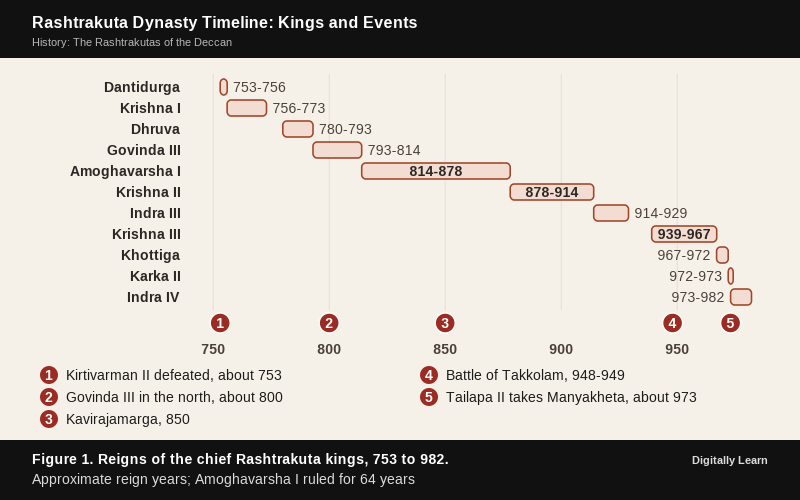
The main line of the Rashtrakuta dynasty ran from Dantidurga in 753 to Indra IV in 982. Six of its kings ruled for six years or less: Govinda II (774‑780), Amoghavarsha II (929‑930), Govinda IV (930‑936), Amoghavarsha III (936‑939), Khottiga (967‑972) and Karka II (972‑973). Several kings took the throne over an elder brother or a closer heir, so the crown went by ability and force as much as by birth. The reign years of the chief kings are approximate.
| Ruler | Reign | What he is known for |
|---|---|---|
| Dantidurga | 753‑756 | Founder; defeated Kirtivarman II of Badami |
| Krishna I | 756‑773 | Ended Chalukya rule of Badami; Kailasa temple at Ellora |
| Dhruva Dharavarsha | 780‑793 | Defeated Vatsaraja and Dharmapala in the doab |
| Govinda III | 793‑814 | Northern campaign of about 800; widest conquests |
| Amoghavarsha I | 814‑878 | Capital at Manyakheta; Kavirajamarga; reign of 64 years |
| Krishna II | 878‑914 | Gujarat branch brought under direct rule |
| Indra III | 914‑929 | Sack of Kannauj; the city held until about 916 |
| Krishna III | 939‑967 | Battle of Takkolam; victory over the Cholas |
| Khottiga | 967‑972 | Manyakheta plundered by Siyaka of Malwa in 972 |
| Karka II | 972‑973 | Dethroned when Tailapa II took Manyakheta |
| Indra IV | 973‑982 | Last claimant; died at Shravanabelagola in 982 |
Administration, Economy and Religion of the Rashtrakutas
Rashtrakuta Administration: Rashtras, Vishayas and Samantas
The Rashtrakuta state was a hereditary monarchy. The king governed the core of the empire through his own officers and the outer regions through samantas. The most important officer under the king was the chief minister, the mahasandhivigrahi (literally the minister of peace and war), and below him served the commander (dandanayaka) and other ministers, all trained in statecraft and war.
The directly ruled territory was divided in descending order:
- Rashtra: The province, under a rashtrapati; Amoghavarsha I's empire had 16 rashtras.
- Vishaya: The district, under a vishayapati.
- Nadu: A group of villages, under the nadugavunda.
- Grama: The village, under a gramapati or prabhu gavunda, the lowest unit of administration.
Villages remained largely self-governing. Feudatory kings kept large armies of their own and were expected to bring them in war, while a standing army stayed ready in the cantonment at the capital. The arrangement carried the weakness that had once helped the Rashtrakutas themselves. When Manyakheta was plundered in 972, a feudatory, Tailapa II, took the empire in turn.
Trade, Revenue and the Arab Accounts of the Balhara
The Rashtrakuta economy rested on farming, crafts, mining and trade. Cotton was the chief crop of southern Gujarat, Khandesh and Berar, and cotton yarn and cloth were shipped from Bharuch, one of the great ports of the time. The Deccan's copper and diamond mines added to royal income, and Manyakheta was a centre of the diamond and jewellery trade. The empire controlled most of the western seaboard, and horses, an important import, were brought in largely by Arab merchants.
Craftsmen worked through guilds, some of which received royal charters, and guilds lent money like banks. Land tax varied with the type of land and ranged from 8 to 16 per cent of the produce; it may have risen to 20 per cent to pay for frequent wars.
Arab writers who knew this coast left the most striking outside view of the dynasty. They called the Rashtrakuta king the Balhara. The merchant Sulaiman, writing in 851, counted the Rashtrakutas among the four great empires of the world, and he, Ibn Khurdadba and Al-Masudi all described their empire as the largest in the India of their day. Al-Masudi, a tenth-century traveller from Baghdad, praised a Rashtrakuta ruler for his innumerable troops and elephants and for honouring the Muslims in his kingdom, where mosques had been built for daily prayer.
Sulaiman, by contrast, described the Pratihara king Mihira Bhoja as a bitter enemy of the Muslims. No king of the Rashtrakuta main line was called Bhoja; the name belongs to Mihira Bhoja and to the later Paramara king Bhoja of Malwa.
Religious Patronage: Jainism, Shaivism, Vaishnavism and Islam
The Rashtrakuta kings patronised Hindu, Buddhist and Jain schools of thought at the same time, so no single religion describes the dynasty. Jainism flourished most visibly. Jain teachers such as Virasena, Jinasena and Gunabhadra worked at the court, Amoghavarsha I was a disciple of Jinasena, and the last claimant of the line, Indra IV, ended his life by sallekhana, the Jain fast unto death, at Shravanabelagola on 20 March 982.
Shiva and Vishnu were honoured as openly. Almost all Rashtrakuta inscriptions begin with an invocation to Vishnu or Shiva, Dantidurga performed the Hiranyagarbha ritual, and the Kailasa temple at Ellora was built for Shiva. Buddhism still had centres such as Dambal and Balligavi, though it had declined by this time. On the western coast Muslim traders settled under royal protection, and congregational mosques existed in the empire by the tenth century.
Rashtrakuta Literature in Kannada and Sanskrit
Kavirajamarga and the Court of Amoghavarsha I
Kannada became a major literary language under the Rashtrakutas. Their inscriptions use both Kannada and Sanskrit, government records of land grants were kept in Kannada, and the earliest Kannada literary writings that survive come from their court poets and kings.
The Kavirajamarga (850), inspired by or written in part by Amoghavarsha I, is the earliest available work on rhetoric, poetics and grammar in Kannada. Its name means "Royal Path for Poets", and it was meant as a guide for poets and scholars. It refers to earlier Kannada writers, which shows that Kannada poetry and prose existed before it, and it calls the whole region between the Kaveri and the Godavari the "Kannada country". The Prashnottara Ratnamalika, a religious work in Sanskrit that was later translated into Tibetan, is also attributed to him.
The same court supported scholars in other fields. The Jain mathematician Mahaviracharya, patronised by Amoghavarsha I, wrote the Ganita-sara-sangraha in 850, the earliest Indian text devoted entirely to mathematics and separate from astronomy. Jinasena wrote an Adipurana that his disciple Gunabhadra completed, and the Jain teachers of the court completed the Dhavala and Jayadhavala commentaries.
Pampa, Ponna and Sanskrit Learning
Two of the "three gems" (Ratnatraya) of classical Kannada literature, Pampa and Ponna, wrote under the Rashtrakutas; the third is Ranna. Pampa was the court poet of the Vemulavada Chalukya king Arikesari II, a feudatory of Krishna III. He wrote a Kannada Adipurana, the life of the first Jain tirthankara Rishabhadeva, and the Vikramarjuna Vijaya, also called the Pampa Bharata, his version of the Mahabharata with Arjuna as its hero. Both are in champu, a mixed form of prose and verse that became the model for later Kannada poets.
Ponna was a poet at the court of Krishna III himself, who gave him the title Ubhaya Kavichakravarti for his command of both Kannada and Sanskrit; his best-known work is the Shantipurana, the life of the sixteenth tirthankara Shantinatha. Sanskrit writing also continued: Trivikrama, at the court of Indra III, wrote the Nalachampu (915), and Somadeva wrote the Yashastilaka Champu at the court of Arikesari II.
Pampa's version was one of many regional retellings of the Mahabharata. In later centuries Tikkana carried the epic into Telugu (thirteenth century), Sarala Dasa into Odia and Kashiram Das into Bengali.
Rashtrakuta Art and Architecture
Kailasa Temple at Ellora
The Kailasa temple at Ellora is Cave 16 of the Ellora Caves in Chhatrapati Sambhajinagar district of Maharashtra and the largest rock-cut temple in India. It is generally attributed to the Rashtrakuta king Krishna I, who ruled from 756 to 773. The temple carries no dedicatory inscription, but a later copper plate grant credits a king named Krishnaraja with a wondrous Shiva temple at Elapura (Ellora), and scholars identify him with Krishna I. Some parts of the complex were finished under his successors, and the date of the great relief of Ravana shaking Mount Kailasa is debated, from a few decades after Krishna I to the reign of Krishna III in the tenth century.
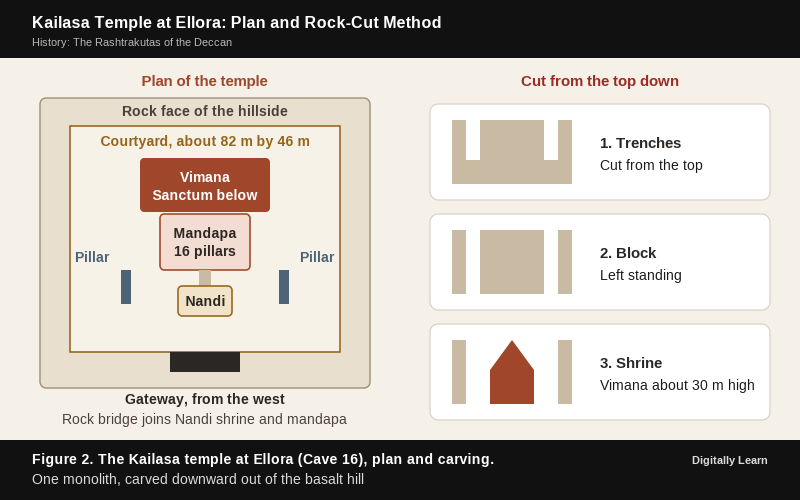
The temple is not built of stones laid together but carved out of the living rock, which makes it monolithic. The carvers started at the top of the original rock and worked downward, shaping the shrine, its tower and its halls from one mass of the basalt hillside, so that the finished temple is less a building than a gigantic sculpture. A copper plate inscription records the amazement of the chief sculptor when he finished it: "Oh how did I make it!"
The plan is that of a complete Dravida temple dedicated to Shiva:
- Gateway: A low gopuram-like entrance opens into a U‑shaped courtyard about 82 m by 46 m at its base, edged by a cloister three storeys high.
- Nandi mandapa: A shrine for Nandi, Shiva's bull, stands in front of the main temple and is joined to it by a rock bridge.
- Main shrine: The sanctum holds a lingam; before it stands a flat-roofed mandapa on 16 pillars, and above it rises a Dravida vimana about 30 m high.
- Base and walls: Carved elephants appear to hold up the temple, and the walls carry panels from the Ramayana and the Mahabharata.
- Courtyard features: Two flag pillars (dhvajastambhas) and five detached shrines stand in the courtyard, three of the shrines dedicated to the river goddesses Ganga, Yamuna and Saraswati.
The style follows the Virupaksha temple at Pattadakal, built by the Chalukyas, and through it the Kailasanatha temple of the Pallavas at Kanchi. A likely explanation is that Krishna I brought Chalukya and Pallava artists to Ellora after conquering the Chalukya kingdom. The sculpture of the Rashtrakuta phase is dynamic, with figures often larger than life, and the relief of Ravana shaking Mount Kailasa on the temple's left wall is counted among the masterpieces of Indian sculpture.
Ellora Caves and the Rock-Cut Tradition
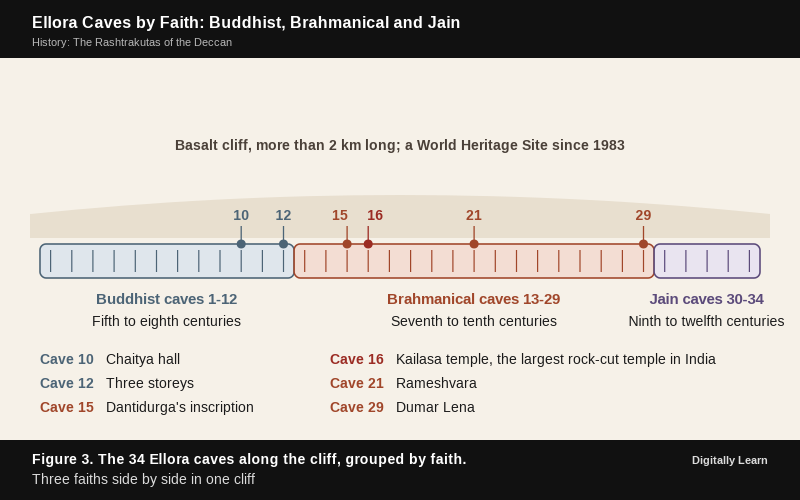
The Ellora Caves are a group of 34 Buddhist, Brahmanical and Jain monasteries and temples cut side by side into a basalt cliff for more than 2 km, and they were inscribed as a UNESCO World Heritage Site in 1983. They were excavated in three groups:
- Buddhist caves (1-12): Excavated between the fifth and eighth centuries, with images of Vajrayana Buddhism such as Tara and Avalokiteshwara; Cave 10 is a great chaitya hall, and Cave 12 is a three-storeyed monastery.
- Brahmanical caves (13‑29): Excavated between the seventh and tenth centuries, including Cave 15 (the Dashavatara cave), which bears an inscription of Dantidurga, Cave 16 (Kailasa), Cave 21 (Rameshvara) and Cave 29 (Dumar Lena).
- Jain caves (30‑34): Excavated between the ninth and twelfth centuries, with fine carving and paintings of the Digambara sect.
Ellora stands at the end of a long tradition of rock-cut architecture in India. The oldest surviving rock-cut caves are the Barabar caves near Gaya in Bihar, cut in the third century BCE under Ashoka for ascetics of the Ajivika sect; the Lomas Rishi cave there has the earliest carved chaitya arch. The tradition continued in the Buddhist caves of Ajanta, Bhaja, Karla and Kanheri. The Chalukyas, who ruled from Badami from 543, cut caves there and at Aihole; the Pallavas carved the monuments of Mahabalipuram; and the Elephanta caves were cut near Mumbai. The Kailasa temple was the culmination of at least a thousand years of rock-cut building.
Rock-cut monuments are among the most important sources for early Indian art and history because they survive where timber and brick buildings did not:
- Religion: Ellora places Buddhist, Hindu and Jain sanctuaries in one place, and its images show the rise of Vajrayana Buddhism and of Puranic Shaiva and Vaishnava themes.
- Patronage and politics: Dantidurga's inscription in Cave 15 and the Kailasa temple link the site to Rashtrakuta kings; after the sixth century such work depended more on royal patronage than on the collective patronage of earlier times.
- Craft and technology: The downward excavation of the Kailasa temple and the triple-storeyed caves show engineering skill, and guilds from Vidarbha, Karnataka and Tamil Nadu worked on the sculptures at Ellora.
- Society and daily life: The carved and painted surfaces show dress, ornament, music and the narratives people knew.
These sources also have limits. Many caves carry no inscription, so their dates and patrons are argued from style; the paintings that once covered Ellora have largely vanished; and the evidence speaks mainly of kings, monks and guilds rather than of ordinary people.
Rashtrakuta Temples in Karnataka and the Elephanta Question
The Rashtrakutas also built structural temples in Karnataka, in a southern style known as Karnata Dravida. Their most famous temples are the Kashivishvanatha temple and the Jain Narayana temple, both at Pattadakal, the latter possibly built in the ninth century under Krishna II. Pattadakal is a UNESCO World Heritage Site, inscribed in 1987. Other Rashtrakuta temples stand at Aihole, Konnur, Savadi, Lokapura and Kuknur, home of the Navalinga temples.
The Elephanta Caves on an island near Mumbai were once credited to the Rashtrakutas because they resemble Ellora, and some books still list them among Rashtrakuta works. The cave temples date to the fifth and sixth centuries, before the Rashtrakuta empire began, and most scholars now place their completion in the sixth century. The arrangement of the main cave at Elephanta is repeated in Cave 29 (Dumar Lena) at Ellora.
Decline of the Rashtrakutas and the Western Chalukyas of Kalyani
Sack of Manyakheta and the Rise of Tailapa II
The decline of the Rashtrakutas came quickly after Krishna III. In 972, during the reign of Khottiga, who had succeeded Krishna III, the Paramara king Siyaka of Malwa attacked the empire and plundered Manyakheta. The blow to the dynasty's prestige gave an ambitious feudatory his chance. Khottiga died soon after the raid and was succeeded by his nephew Karka II. Tailapa II, who ruled the Tardavadi province in present-day Vijayapura district, declared himself independent, dethroned Karka II in a battle about 973 and occupied the capital. By one account Karka II was killed in that battle; by another he escaped and ruled a small principality.
Tailapa II founded the Western Chalukyas of Kalyani, who built a new empire in the Rashtrakuta heartland and later ruled from Kalyani (modern Basavakalyan in northern Karnataka). Indra IV, a grandson of Krishna III, disputed Tailapa II's accession and was defeated. He was the last Rashtrakuta claimant; he renounced royal life and died at Shravanabelagola on 20 March 982, and the main line of the dynasty ended with him. The Paramaras of Malwa, once feudatories of the Pratiharas and the Rashtrakutas, became an independent power in the second half of the tenth century.
The dynasty that had once served the Chalukyas of Badami as samantas thus fell to a Chalukya feudatory of its own, 220 years after Dantidurga's break with Badami. Its legacy outlived it in the Kailasa temple, in the first classics of Kannada literature and in the memory of two centuries in which a Deccan kingdom decided events on the Ganga.
Previous Year UPSC‑CSE Questions
Each Prelims question is explained option by option, and each Mains question comes with an answer outline.
- UPSC Prelims 2022Consider the following pairs (King and Dynasty):
- Nannuka - Chandela
- Jayashakti - Paramara
- Nagabhata II - Gurjara-Pratihara
- Bhoja - Rashtrakuta
How many pairs given above are correctly matched?
How to approach this Prelims question
Approach: Check each pair separately and then count the correct ones.
- Pair 1: Nannuka was the first king of the Chandelas; pair 1 is correct.
- Pair 2: Jayashakti (Jeja) consolidated Chandela power and gave the Chandela territory its name Jejakabhukti, so he was a Chandela, not a Paramara; pair 2 is wrong.
- Pair 3: Nagabhata II was the Gurjara-Pratihara king who submitted to Govinda III about 800; pair 3 is correct.
- Pair 4: Bhoja was the name of the Pratihara king Mihira Bhoja and of a Paramara king of Malwa, and no king of the Rashtrakuta main line bore it; pair 4 is wrong.
Only pairs 1 and 3 are correct, so two pairs are correctly matched.
Trap to watch: Bhoja is a famous name in two dynasties of the period, so a student who remembers a great king called Bhoja accepts the Rashtrakuta pair without checking which dynasty he belonged to.
Why each option is right or wrong:
- (a) Only one pair: Wrong. Pairs 1 and 3 are both correct.
- (b) Only two pairs: Correct. Nannuka with the Chandelas and Nagabhata II with the Gurjara-Pratiharas are correct; the other two are wrong.
- (c) Only three pairs: Wrong. Jayashakti was a Chandela and Bhoja was not a Rashtrakuta.
- (d) All four pairs: Wrong. Pairs 2 and 4 are wrong.
Answer: (b) Only two pairs. Only Nannuka with the Chandelas and Nagabhata II with the Gurjara-Pratiharas are correctly matched.
- UPSC Prelims 2013With reference to the history of Indian rock-cut architecture, consider the following statements:
- The caves at Badami are the oldest surviving rock-cut caves in India.
- The Barabar rock-cut caves were originally made for Ajivikas by Emperor Chandragupta Maurya.
- At Ellora, caves were made for different faiths.
Which of the statements given above is/are correct?
How to approach this Prelims question
Approach: Test each statement against the dates and patrons of the three sites.
- Statement 1: The Badami caves were cut under the Chalukyas, whose rule there began in 543, while the Barabar caves of the Maurya period are the oldest surviving rock-cut caves in India; statement 1 is wrong.
- Statement 2: The Barabar caves were made for the Ajivikas under Ashoka, not Chandragupta Maurya; statement 2 is wrong.
- Statement 3: Ellora has 34 Buddhist, Brahmanical and Jain caves; statement 3 is correct.
Only statement 3 survives, so the answer is the option that contains statement 3 alone.
Trap to watch: Statement 2 gets the sect right (Ajivikas) and the dynasty right (Maurya) but the emperor wrong, so a student who checks only the sect accepts it.
Why each option is right or wrong:
- (a) 1 only: Wrong. The Barabar caves of the Maurya period are older than the Chalukya caves at Badami.
- (b) 2 and 3 only: Wrong. Statement 3 is right, but the Barabar caves were made under Ashoka, not Chandragupta Maurya.
- (c) 3 only: Correct. Ellora has caves of the Buddhist, Brahmanical and Jain faiths, and statements 1 and 2 are both wrong.
- (d) 1, 2 and 3: Wrong. Statements 1 and 2 are both wrong.
Answer: (c) 3 only. Ellora's caves belong to three faiths, while the oldest caves are at Barabar and were made under Ashoka.
- UPSC Prelims 2006Who among the following laid the foundation of Rashtrakuta Empire?
How to approach this Prelims question
Approach: The question asks for the founder, so the test is which of the four kings came first and broke away from the Chalukyas of Badami. Dantidurga ruled from 753 to 756 and defeated Kirtivarman II of Badami about 753, which began the dynasty. Krishna I, his uncle, succeeded him in 756; Dhruva ruled from 780 to 793; Amoghavarsha I ruled from 814 to 878. Each of the other three therefore ruled after the empire had been founded.
Trap to watch: Krishna I and Amoghavarsha I are better known because of the Kailasa temple and the Kavirajamarga, so students pick a famous name instead of the founder.
Why each option is right or wrong:
- (a) Amoghavarsha I: Wrong. He ruled from 814 to 878 and moved the capital to Manyakheta, long after the empire was founded.
- (b) Dantidurga: Correct. He defeated Kirtivarman II of Badami about 753 and founded the Rashtrakuta empire.
- (c) Dhruva: Wrong. He ruled from 780 to 793 and led a northern campaign, but he was a later king.
- (d) Krishna I: Wrong. He succeeded Dantidurga in 756 and completed the conquest of the Chalukya kingdom.
Answer: (b) Dantidurga. Dantidurga defeated Kirtivarman II of Badami about 753 and founded the Rashtrakuta empire.
- UPSC Prelims 1997Which one of the following pairs of composers in different languages and their works on the Mahabharata theme is correctly matched?
How to approach this Prelims question
Approach: Each pair names a poet who retold the Mahabharata, so the test is the language each poet wrote in. Sarala Dasa wrote the Sarala Mahabharata in Odia in the fifteenth century. Kashiram Das retold the Mahabharata in Bengali. Tikkana wrote in Telugu in the thirteenth century. Pampa wrote the Vikramarjuna Vijaya in Kannada in the tenth century. Only the last pair matches.
Trap to watch: The Bengali and Odia poets are swapped in options (a) and (b), so a student who knows that one of them wrote in Bengali can still pick the wrong pair.
Why each option is right or wrong:
- (a) Sarladasa - Bengali: Wrong. Sarala Dasa wrote his Mahabharata in Odia.
- (b) Kasirama - Oriya: Wrong. Kashiram Das wrote his Mahabharata in Bengali.
- (c) Tikkana - Marathi: Wrong. Tikkana carried the Mahabharata into Telugu.
- (d) Pampa - Kannada: Correct. Pampa wrote the Vikramarjuna Vijaya, the Pampa Bharata, in Kannada.
Answer: (d) Pampa - Kannada. Pampa's Vikramarjuna Vijaya retells the Mahabharata in Kannada and was written under a feudatory of Krishna III.
- UPSC Mains 2020 GS‑IThe rock-cut architecture represents one of the most important sources of our knowledge of early Indian art and history. Discuss.
Answer outline
The outline sets out what the question asks, the main arguments, relevant examples and the direction of the conclusion; it is not a full model answer.
Introduction: Rock-cut architecture, caves and temples carved out of living rock, runs in India from the Mauryan caves at Barabar in the third century BCE to the monolithic Kailasa temple at Ellora in the eighth century, and it survives where timber and brick buildings have not.
Body (sub-themes to develop):
- Continuity of a tradition: Barabar (Ashoka, for the Ajivikas), the Buddhist caves of Ajanta, Bhaja, Karla and Kanheri, the Chalukya caves of Badami and Aihole, Mahabalipuram and Elephanta, and Ellora show how styles grew over a thousand years.
- Religion: Ellora's 34 caves of three faiths show Buddhist, Brahmanical and Jain worship side by side, the rise of Vajrayana images and of Puranic Shaiva and Vaishnava themes.
- Polity and patronage: Dantidurga's inscription in Cave 15 and Krishna I's Kailasa temple tie monuments to Rashtrakuta kings; after the sixth century such work depended more on royal than on collective patronage.
- Craft and technology: The Kailasa temple was carved from the top downward out of one mass of rock, and guilds from Vidarbha, Karnataka and Tamil Nadu worked at Ellora.
- Society and art: Sculpture and painting record dress, ornament, music and the epic and Puranic stories people knew, as in the relief of Ravana shaking Mount Kailasa.
- Limits: Many caves have no inscription, so dates and patrons are argued from style, as with the Elephanta caves that some books still credit to the Rashtrakutas; paintings have largely vanished, and the record speaks mainly of kings, monks and guilds.
Conclusion: Rock-cut monuments are among the richest sources for early Indian art and history, and Ellora, with its three faiths and the Kailasa temple, shows their value most fully, though they must be read with inscriptions and texts to fill their silences.
Sources
- NCERT: Exploring Society: India and Beyond, Grade 7, second book, Chapter 3, Empires and Kingdoms: 6th to 10th Centuries
- NCERT: Exploring Society: India and Beyond, Grade 7, second book, Chapter 4, Turning Tides: 11th and 12th Centuries
- NCERT: Understanding Society: India and Beyond, Grade 9, Chapter 5, State and Society up to 1000 CE
- NCERT: An Introduction to Indian Art Part I, Class XI, Chapter 4, Post-Mauryan Trends in Indian Art and Architecture
- NCERT: An Introduction to Indian Art Part I, Class XI, Chapter 6, Temple Architecture and Sculpture
- NCERT: Themes in Indian History Part I, Class XII, Chapter 4, Thinkers, Beliefs and Buildings
- UNESCO World Heritage Centre: Ellora Caves
- UNESCO World Heritage Centre: Elephanta Caves
- PIB: India's World Heritage Sites, backgrounder of July 2024
- District Administration Kalaburagi: History of the District
- Wikipedia: Rashtrakuta dynasty
- Wikipedia: Dantidurga
- Wikipedia: Krishna I
- Wikipedia: Dhruva Dharavarsha
- Wikipedia: Govinda III
- Wikipedia: Amoghavarsha
- Wikipedia: Indra III
- Wikipedia: Krishna III
- Wikipedia: Battle of Takkolam
- Wikipedia: Karka II
- Wikipedia: Tailapa II
- Wikipedia: Malkheda
- Wikipedia: Kailasa Temple, Ellora
- Wikipedia: Elephanta Caves
- Wikipedia: Ellora Caves
- Wikipedia: Pattadakal
- Wikipedia: Barabar Caves
- Wikipedia: Chalukya dynasty
- Wikipedia: Kavirajamarga
- Wikipedia: Adikavi Pampa
- Wikipedia: Ponna (poet)
- Wikipedia: Sulaiman al‑Tajir
- Wikipedia: Kannada literature
- Wikipedia: Chandelas of Jejakabhukti
- Wikipedia: Sarala Das
- Wikipedia: Kashiram Das
- Wikipedia: Tikkana
- Wikipedia: Mahavira (mathematician)
- UPSC: Civil Services Examination question papers
Editorial Disclaimer
This article draws on the current NCERT textbooks, UNESCO and the other sources listed above.
See more of our UPSC articles in Google Search
Add to Preferred Sources