


Overview
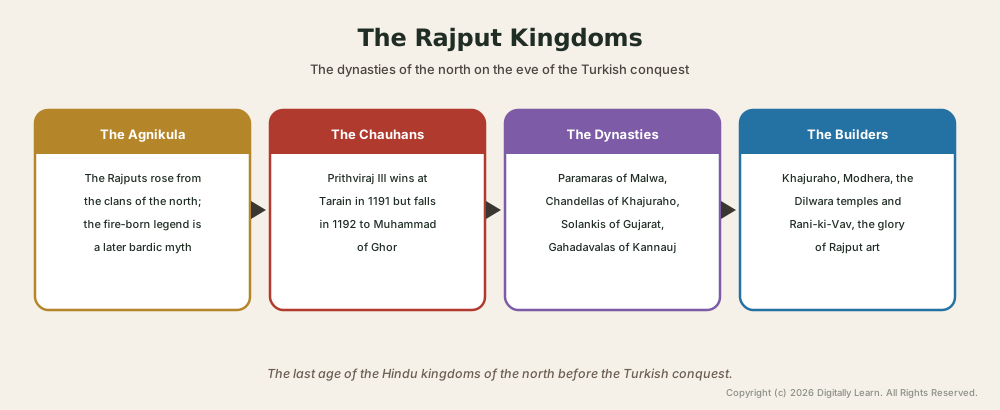
The Rajput kingdoms were the proud clan-states that divided northern India after the fall of the Pratiharas, from about the tenth century to the Turkish conquest. The Chauhans of Ajmer, whose king Prithviraj III fought at Tarain; the Paramaras of Malwa, with the scholar-king Raja Bhoja; the Chandellas of Khajuraho; and the Solankis of Gujarat were the greatest among them. They built the most splendid temples of the age, and they met the invasions of Muhammad of Ghor. This part covers the agnikula legend, the kingdoms, the great dynasties, the temple-builders and the exam focus.
The Rise of the Rajputs
Who the Rajputs Were and the Agnikula Legend
What is the significance of the Rajputs: they were the warrior clans who ruled the north between the fall of the Pratiharas and the coming of the Turks, and their origin is wrapped in a famous legend.
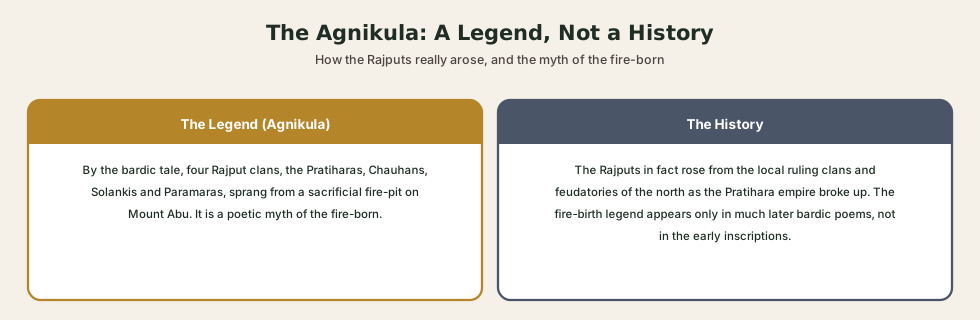
As the Pratihara empire broke up, the north passed to a number of proud clan-kingdoms whose rulers came to be called the Rajputs, the sons of kings. They rose, in truth, from the local ruling families and feudatories of the old order, gathering the lands the Pratiharas had let fall.
A famous legend gives them a grander birth. The agnikula tale tells that four clans, the Pratiharas, Chauhans, Solankis and Paramaras, sprang from a sacrificial fire-pit on Mount Abu. This is a poetic myth of much later bards, found in the Prithviraj Raso and like works, not in the early inscriptions, and it should be told as legend, not history.
The Rajput Kingdoms of North India
Distinguishing the kingdoms: several Rajput dynasties divided the north between them, each with its own country and capital, and an aspirant should be able to place each.
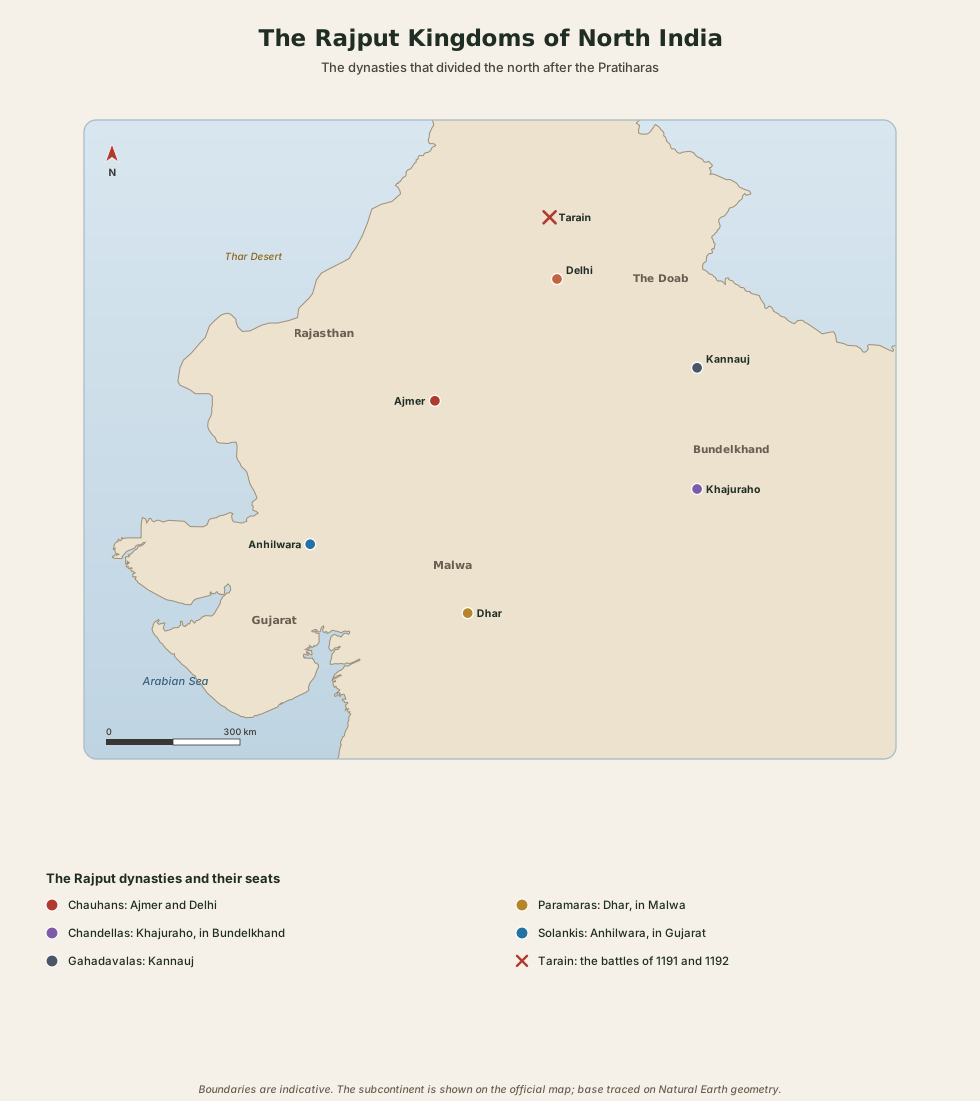
The chief Rajput houses were the Chauhans of Ajmer and Delhi, the Paramaras of Dhar in Malwa, the Chandellas of Khajuraho in Bundelkhand, the Solankis of Anhilwara in Gujarat, the Gahadavalas of Kannauj, and the Tomaras of Delhi, from whom the Chauhans took that city.
The map sets out these kingdoms across the north, and the field of Tarain near Thanesar where the decisive battles would be fought. Their very number, and their rivalries, would prove the weakness of the Rajput north before a united invader.
The Great Rajput Dynasties
The Chauhans and Prithviraj III
What is the significance of the Chauhans: theirs is the most famous of the Rajput houses, for their king Prithviraj III met the Turkish invader at the battles that decided the fate of the north.
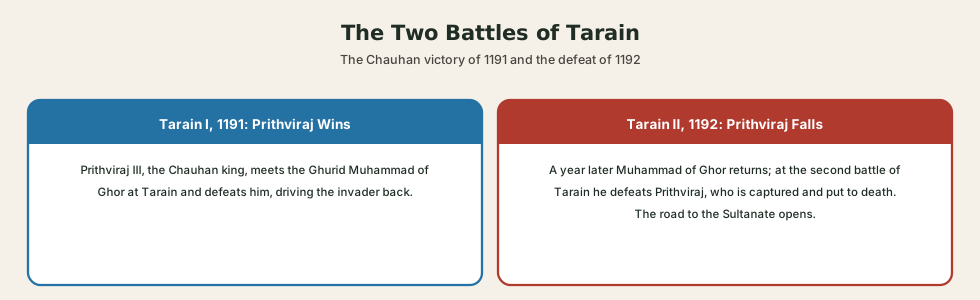
The Chauhans, or Chahamanas, ruled from Ajmer and held Delhi, which they had taken from the Tomaras. Their greatest king was Prithviraj III, the hero of bardic song, who faced the Ghurid invader Muhammad of Ghor in the two battles of Tarain.
At the first battle of Tarain, in 1191, Prithviraj defeated Muhammad of Ghor and drove him back. But the next year, at the second battle of Tarain, in 1192, the Ghurid returned and defeated him; Prithviraj was captured and put to death, and the way lay open for the Turkish conquest of the north.
The Paramaras, Chandellas and Solankis
Distinguishing the three great houses: besides the Chauhans, three Rajput dynasties stand out for their kings and their monuments, in Malwa, Bundelkhand and Gujarat.
The Paramaras of Malwa, ruling from Dhar, gave the age its great scholar-king, Raja Bhoja, who founded the Bhojshala and the city of Bhojpur. He must not be confused with the earlier Mihira Bhoja the Pratihara: this Bhoja was a Paramara of the eleventh century, famed for learning rather than conquest.
The Chandellas of Bundelkhand, ruling from Khajuraho, Mahoba and the fort of Kalinjar, built the famous temples of Khajuraho. The Solankis, or Chaulukyas, of Gujarat, ruling from Anhilwara, raised the Sun Temple at Modhera, the Dilwara Jain temples and the Rani-ki-Vav stepwell.
| Dynasty | Capital | Famed for |
|---|---|---|
| Chauhans (Chahamanas) | Ajmer and Delhi | Prithviraj III and the battles of Tarain. |
| Paramaras | Dhar (Malwa) | Raja Bhoja the scholar-king and the Bhojshala. |
| Chandellas | Khajuraho (Bundelkhand) | The temples of Khajuraho and the fort of Kalinjar. |
| Solankis (Chaulukyas) | Anhilwara (Gujarat) | Modhera, the Dilwara temples and Rani-ki-Vav. |
| Gahadavalas | Kannauj | Jayachandra, who fell at the battle of Chandwar. |
The Rajput Achievement and the Eve of Conquest
The Temple-Builders and the Bardic Tradition
What is the significance of the Rajput achievement: for all their political weakness, the Rajput kingdoms gave India some of its most splendid temples and a rich tradition of heroic song.
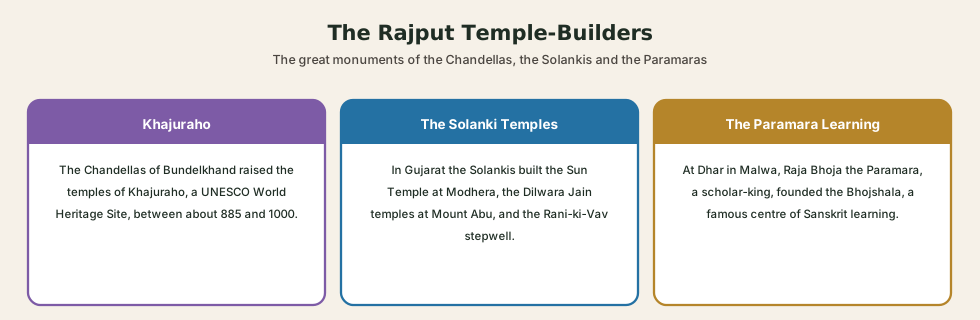
In stone, the Rajput age is the age of the great temples: Khajuraho of the Chandellas, a World Heritage Site built between about 885 and 1000; the Sun Temple of Modhera, the Dilwara Jain temples and the Rani-ki-Vav stepwell of the Solankis; and the learning of Raja Bhoja at Dhar. These are studied more fully in the next part, on the architecture of the age.
In song, the Rajputs are remembered through the bards: the Prithviraj Raso of Chand Bardai sings of Prithviraj III and his rival Jayachandra of Kannauj. Such tales are stirring but unreliable, and the famous feud of Prithviraj and Jaichand is not confirmed by the inscriptions; it belongs to legend more than to history.
The Disunity of the Rajputs
Distinguishing the fatal weakness: the Rajput north, for all its valour, was a house divided, and its disunity laid it open to a determined invader.
The Rajput kingdoms were many and proud, and they spent their strength as often against one another as against the common foe. There was no single power to lead the north, and the rivalry of houses such as the Chauhans and the Gahadavalas meant that when Muhammad of Ghor came, the Rajputs met him not as one people but as separate kings.
It was this disunity, as much as any weakness in arms, that opened the north to the Turks after the second battle of Tarain. The story of that conquest, and of the close of the early-medieval age, is the subject of the final part of this series.
UPSC Relevance and Exam Focus
Where the Rajput Kingdoms Fit in the UPSC-CSE Syllabus
This topic belongs to General Studies Paper I: early-medieval Indian history and Indian art and culture, and the Rajput kingdoms are important for their kings, their battles and their monuments.
The questions most often test the dynasties and their temples: the Chandellas with Khajuraho, the Solankis with the temples of Gujarat, and the Chauhans with Prithviraj III and the battles of Tarain.
Several linked points recur and are worth holding in working memory:
- The agnikula: A bardic legend of the fire-born Rajputs, not history.
- Prithviraj III: The Chauhan who won Tarain in 1191 and lost in 1192.
- Raja Bhoja: The Paramara scholar-king of Dhar, not Mihira Bhoja.
- The Chandellas: The builders of Khajuraho in Bundelkhand.
- The Solankis: The builders of Modhera, Dilwara and Rani-ki-Vav.
A 1997 question matched dynasties to their monuments, among them the Chandellas with Khajuraho, which is correct; the others were the Guptas with Deogarh, the Chalukyas with Badami and the Pallavas with Panamalai.
A common trap swaps the two battles of Tarain; Prithviraj III won the first, in 1191, and lost the second, in 1192. Another confuses the two Bhojas; the Bhoja of this Rajput age is Raja Bhoja the Paramara of Dhar, not Mihira Bhoja the Pratihara of Kannauj.
Previous Year UPSC-CSE Questions
Previous Year UPSC-CSE Questions By the end you will be able to draft model answers for the following UPSC questions. Each question carries a collapsible framework showing how to approach it in the exam.
- UPSC Prelims 1997 GS-IMatch List I (dynasty) with List II (site): I. Gupta, II. Chandella, III. Chalukya, IV. Pallava; with the sites A) Badami, B) Panamalai, C) Khajuraho, D) Deogarh.
- Gupta
- Chandella
- Chalukya
- Pallava
Select the correct answer using the code given below the lists.
How to approach this Prelims question
Approach: Anchor on the certain pair, Chandella-Khajuraho (II-C); then fit Gupta-Deogarh (I-D), Chalukya-Badami (III-A) and Pallava-Panamalai (IV-B).
Trap to watch: Do not pair the Chandellas with Badami (that is the Chalukyas) or the Guptas with Khajuraho (that is the Chandellas).
Key facts to recall:
- The Chandellas built the temples of Khajuraho.
- The Guptas built the Dashavatara temple at Deogarh; the Chalukyas the cave temples at Badami.
- The Pallavas built the temple at Panamalai.
Answer signal: I-D, II-C, III-A, IV-B.
Sources and Further Reading
Editorial Disclaimer
This article is for UPSC preparation. The dates of the Rajput kings are approximate, and the account follows the standard scholarship on early-medieval north India.