


Overview
Cold weather, hot weather, south-west monsoon and retreating monsoon
When each season comes, what its winds and rains are like, and what weather events belong to it.
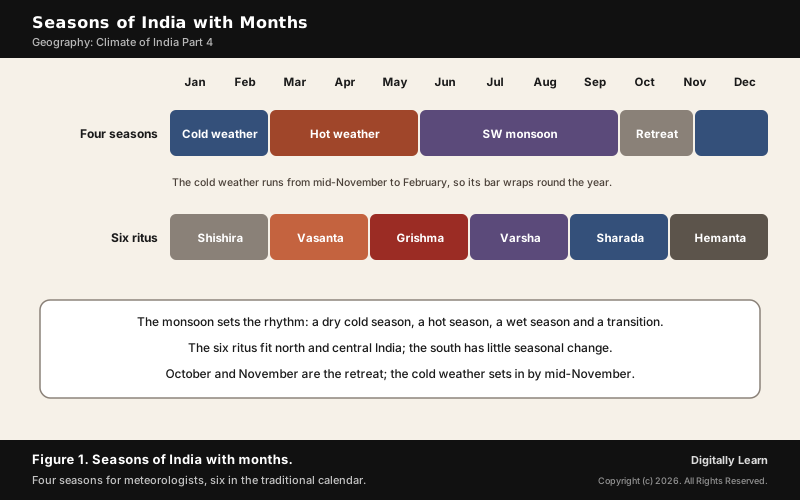
The seasons of India are four: the cold weather season from mid-November to February, the hot weather season from March to May, the south-west monsoon season from June to September, and the retreating monsoon season in October and November. The traditional Indian calendar divides the same year into six seasons of two months each, the ritus.
Seasons of India: How Many Seasons and Their Months
How Many Seasons Are There in India?
India has four seasons as meteorologists count them: the cold weather season, the hot weather season, the south-west monsoon season and the retreating monsoon season. The whole country has a monsoon type of climate, and it is the monsoon's seasonal reversal of winds that gives the year this rhythm.
| Season | Months | Main feature |
|---|---|---|
| Cold weather (winter) | Mid-November to February | Cold dry north, western disturbances bring winter rain |
| Hot weather (summer) | March to May | Heat moves north; loo, dust storms, pre-monsoon showers |
| South-west monsoon (rainy) | June to September | Moist winds from the sea bring three-quarters of the rain |
| Retreating monsoon | October and November | Withdrawal, October heat, rain and cyclones on the east coast |
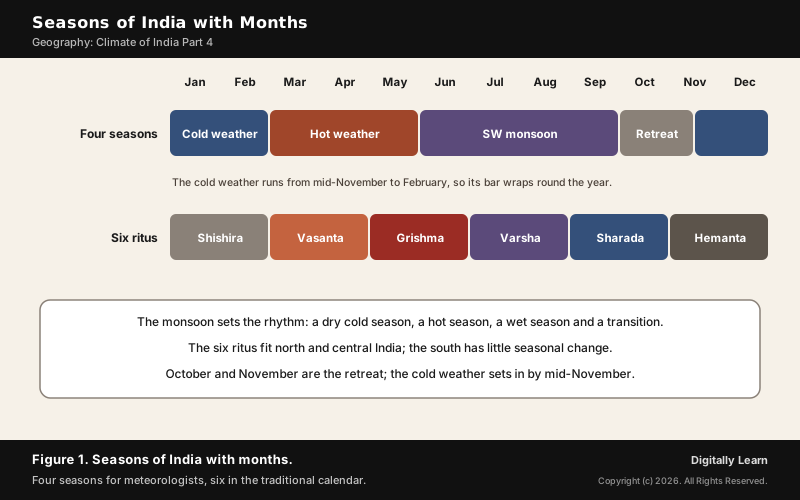
The seasons in India are sharpest in the interior. Coastal areas feel little change in temperature, though their rainfall still changes with the season, and the Peninsula has no well-defined cold season at all.
Traditional Indian Seasons: The Six Ritus
In the Indian tradition the year is divided into six seasons of two months each, the ritus. The word comes from the Vedic Sanskrit rtu, a fixed or appointed time. This cycle, followed by people in north and central India, grew out of practical experience of the weather over centuries.
| Ritu | Indian months | Months |
|---|---|---|
| Vasanta (spring) | Chaitra-Vaisakha | March-April |
| Grishma (summer) | Jyaistha-Asadha | May-June |
| Varsha (rains) | Sravana-Bhadra | July-August |
| Sharada (autumn) | Asvina-Kartika | September-October |
| Hemanta (pre-winter) | Margashirsa-Pausa | November-December |
| Shishira (winter) | Magha-Phalguna | January-February |
Cold Weather Season in India: Winter from Mid-November to February
Winter Temperature in India: Why the North Is Cold
Winter in India starts in the north. The cold weather season sets in by mid-November in northern India and lasts till February; December and January are the coldest months. The mean daily temperature stays below 21 degrees C over most of north India, and nights can fall below freezing in Punjab and Rajasthan.
- Continentality: Punjab, Haryana and Rajasthan lie far from the moderating sea.
- Himalayan snow: Snowfall on the nearby ranges creates cold waves.
- Cold winds from the north-west: Around February, winds from the Caspian Sea and Turkmenistan bring cold waves, frost and fog to north-western India.
Temperature falls from south to north. Chennai averages 24 to 25 degrees C in winter, while the northern plains average 10 to 15 degrees C; days are warm and nights cold. The Peninsula has no true winter at all: Thiruvananthapuram's mean maximum is 31 degrees C in January and 29.5 degrees C in June.
Winter Pressure and Winds: The North-East Monsoon
By 22 December the sun is overhead at the Tropic of Capricorn. A feeble high pressure forms over the northern plain, with slightly lower pressure to the south; the 1019 mb and 1013 mb isobars pass through north-west India and the far south. Light winds of 3 to 5 km per hour therefore blow outward, from land to sea.
- Direction: Westerly or north-westerly down the Ganga valley, northerly in the Ganga-Brahmaputra delta, and north-easterly over the Bay of Bengal, where relief no longer steers them.
- Mostly dry: These winter monsoon winds carry little moisture and blow from land to sea under anticyclonic conditions, so most of India gets no winter rain.
- Exception, Tamil Nadu: Crossing the Bay of Bengal in October and November, the north-east monsoon picks up moisture and brings heavy rain to the Tamil Nadu coast, southern Andhra Pradesh, south-east Karnataka and south-east Kerala.
Western Disturbances and Winter Rainfall in North-West India
The pleasant winter weather of the north is broken by western disturbances, shallow cyclonic depressions that start over the east Mediterranean Sea and travel east across West Asia, Iran, Afghanistan and Pakistan, picking up moisture from the Caspian Sea and the Persian Gulf on the way, before reaching north-western India. The westerly jet stream steers them in.
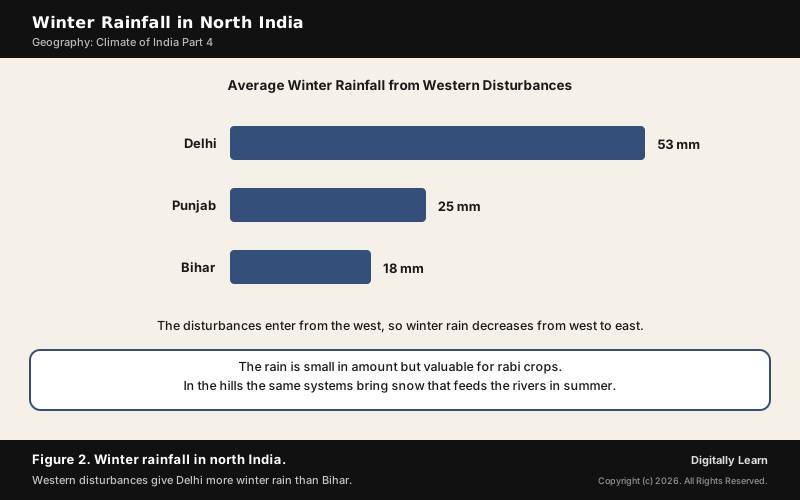
- Winter rain for rabi: Punjab, Haryana, Delhi and western Uttar Pradesh get light rain, locally called mahawat, which is small in amount but highly valuable for rabi crops.
- Snow in the hills: In the lower Himalaya the precipitation falls as snow, which sustains the flow of the Himalayan rivers in summer.
- Declining eastward: Winter rain decreases from west to east in the plains and from north to south in the mountains: about 53 mm in Delhi, 25 mm in Punjab and 18 mm in Bihar.
- Elsewhere: Arunachal Pradesh and Assam get 25 to 50 mm, and central India and the northern Peninsula get occasional winter rain.
Hot Weather Season in India: Summer from March to May
Summer Season in India: The Northward March of the Heat Belt
Summer in India starts in March, when the sun's apparent movement towards the Tropic of Cancer moves the heat belt north. The hot weather season runs from March to May, and in north India April, May and June are the summer months. Most of India records 30 to 32 degrees C, but the heat peaks in a sequence.
- March: About 38 degrees C on the Deccan Plateau, the highest in the country.
- April: 38 to 43 degrees C in Gujarat and Madhya Pradesh.
- May: The heat belt moves further north, and around 48 degrees C is not uncommon in north-western India.
The south stays milder. The Peninsula, moderated by the sea, stays between 26 and 32 degrees C, and the hills of the Western Ghats below 25 degrees C. Along the coasts, isotherms run parallel to the shore, showing that temperature rises from the coast inland rather than falling from north to south.
Summer Pressure, Winds, the Loo and Dust Storms
The summer months bring excessive heat and falling air pressure over the northern half of the country. As the land heats, the ITCZ moves north, and a long low-pressure trough stretches from the Thar desert to Patna and the Chotanagpur plateau. This trough sets the winds of the next season in motion.
- Loo: Hot, dry, oppressive winds blowing over the northern plains from Punjab to Bihar, strongest between Delhi and Patna. They blow in the afternoon and often continue well into midnight; direct exposure can be fatal.
- Dust storms: Common in the evening in May over Punjab, Haryana, eastern Rajasthan and Uttar Pradesh. They bring welcome relief, with light rain and a cool breeze.
- Violent local storms: When dry and moist air masses meet suddenly, storms with violent winds, torrential rain and even hail follow.
- Heatwaves: On 25 April 2026 the IMD reported 40 to 44 degrees C across north-west, central and peninsular India, 44.5 degrees C at Sri Ganganagar, and temperatures 5 degrees C or more above normal in several regions, and issued heatwave guidance: avoid the afternoon sun, drink enough water and protect children and the elderly.
Pre-Monsoon Showers: Mango Showers, Blossom Showers, Nor'westers
Towards the end of summer, moist winds drawn towards the edge of the trough bring the first pre-monsoon rains. Several have local names, and most of them matter to a crop.
| Local storm | Where | Effect |
|---|---|---|
| Mango showers | Kerala and coastal Karnataka | Help the early ripening of mangoes |
| Blossom showers | Kerala and nearby areas | Coffee flowers blossom |
| Nor'westers (Kalbaisakhi) | Bengal and Assam | Dreaded evening thunderstorms, useful for tea, jute and rice |
| Bardoli Chheerha | Assam | The Assamese name for the nor'westers |
| Loo | Northern plains, Punjab to Bihar | Hot, dry, oppressive winds |

The nor'westers are named Kalbaisakhi, a calamity of the month of Baisakh, because of the damage they do. They build in the afternoon or just before sunset, with thick dark clouds, gale-force winds, torrential rain and often hail, but last only a short time.
Indian Monsoon Season: South-West Monsoon from June to September
Onset and Burst of the South-West Monsoon
The Indian monsoon season begins when the heat low over the north-west becomes strong enough, by early June, to draw in the south-east trade winds of the southern hemisphere. They cross the equator, turn south-west, and arrive loaded with moisture from the warm seas: the south-west monsoon.
- The burst: The rain begins abruptly, with violent thunder and lightning, and brings the temperature down sharply; this sudden onset is called the burst of the monsoon.
- Normal dates: The monsoon sets in over Kerala around 1 June and covers the whole country by 8 July, a week earlier than the old normal of 15 July.
- Coast first: The monsoon may burst in the first week of June on the coasts of Kerala, Karnataka, Goa and Maharashtra, but reach the interior only in the first week of July.
- Cooling: Day temperatures fall by 5 to 8 degrees C between mid-June and mid-July.
The detailed mechanism, from the ITCZ to the jet streams, is explained in Indian Monsoon Part 1.
Arabian Sea and Bay of Bengal Branches of the Monsoon
The monsoon reaches India in two branches, and their paths explain the map of rainfall. Relief and the thermal low over the north-west bend each branch as it comes ashore.
- Arabian Sea branch: One stream rises over the Western Ghats and gives the windward side 250 to 400 cm, leaving a rain-shadow east of the hills; another moves up the Narmada and Tapi valleys into central India; a third crosses Saurashtra and Kachchh and follows the Aravallis, giving only scanty rain.
- Bay of Bengal branch: Turned by the Arakan Hills, it enters West Bengal and Bangladesh from the south and south-east; one arm moves west up the Ganga plains to Punjab, another up the Brahmaputra valley, and a sub-branch strikes the Garo and Khasi hills, where Mawsynram gets the highest average rainfall.
- Tamil Nadu stays dry: Its coast lies parallel to the Bay branch and in the rain shadow of the Arabian Sea branch.
Characteristics of Monsoon Rainfall: Breaks and Variability
The rain of this season is seasonal, uneven and uncertain, and each of these traits shapes Indian farming. Over three-fourths of India's rain falls in this one season, and its spread ranges from 12 cm to more than 250 cm.
- Governed by relief: The windward Western Ghats get over 250 cm; the hills of the North-east are among the wettest places.
- Declining inland: Kolkata gets 119 cm in the season, Patna 105 cm, Allahabad 76 cm and Delhi 56 cm.
- Wet spells and breaks: Rain comes in spells separated by rainless breaks, linked to depressions from the head of the Bay of Bengal and to shifts of the monsoon trough.
- Heavy downpours: Much of the rain runs off and causes soil erosion.
- Uncertain timing: The rains can start late or end early, damaging standing crops and making winter sowing difficult.
Retreating Monsoon Season: October and November
Withdrawal of the Monsoon and the October Heat
The retreating monsoon in India is the season of October and November, the transition from the rains to the dry winter. By the end of September the south-west monsoon weakens as the low-pressure trough of the Ganga plain moves south with the sun.
- Withdrawal begins in the north-west: Under the new normal dates, the monsoon starts withdrawing from north-west India around 17 September, more than two weeks later than the old date of 1 September.
- Most of India by mid-October: It leaves most of the country, except the south Peninsula and parts of central India, by 15 October.
- The low moves south: By early November the low pressure lies over Karnataka and Tamil Nadu, and by the middle of December it has left the Peninsula.
The retreat brings clear skies and rising temperature while the land is still moist. The heat and humidity make the weather oppressive, which is known as the October heat. In the second half of October the temperature falls quickly, especially in northern India.
North-East Monsoon Rain and Cyclones of the Retreating Monsoon
The rain of the retreating season falls mainly on the Coromandel coast. Much of it comes from cyclonic depressions that form over the Andaman Sea and cross the east coast of the southern Peninsula; the bulk of the coast's rainfall is derived from these depressions and cyclones.
- Targets: The thickly populated deltas of the Godavari, Krishna and Kaveri are struck most often; some storms reach West Bengal, Bangladesh and Myanmar.
- Arabian Sea: Cyclonic storms are less frequent there.
- Tamil Nadu: The state receives most of its annual rain in the north-east monsoon season.
| System | Wind speed |
|---|---|
| Depression | 31 to 49 km per hour |
| Deep depression | 50 to 61 km per hour |
| Cyclonic storm | 62 to 88 km per hour |
| Severe cyclonic storm | 89 to 117 km per hour |
| Very severe cyclonic storm | 118 to 166 km per hour |
| Extremely severe cyclonic storm | 167 to 221 km per hour |
| Super cyclonic storm | 222 km per hour or more |
The IMD issues colour-coded warnings with its impact-based forecasts: green means no warning and no action, yellow means be watchful, orange means be alert and prepared to act, and red means take action. The guidelines were framed with the National Disaster Management Authority and are used for cyclones, heatwaves, thunderstorms and heavy rain. More on the storms themselves is in tropical cyclones.
Seasons and Agriculture in India: Kharif, Rabi and Zaid
Cropping Seasons of India: Kharif, Rabi and Zaid
India's farm calendar follows its seasons. In the north and the interior there are three distinct crop seasons, kharif, rabi and zaid, each timed to the heat and water that a season brings.
| Crop season | Months and weather | Main crops in the north |
|---|---|---|
| Kharif | June to September, the south-west monsoon | Rice, cotton, bajra, maize, jowar, tur |
| Rabi | October to March, the cold weather | Wheat, gram, rapeseed and mustard, barley |
| Zaid | April to June, the hot weather | Vegetables, fruits, fodder |
- Kharif: Largely coincides with the south-west monsoon, which makes tropical crops such as rice, cotton, jute, jowar, bajra and tur possible.
- Rabi: Begins with the onset of winter in October-November and ends in March-April; low temperatures suit temperate and subtropical crops such as wheat, gram and mustard, and the winter rain of the western disturbances helps them.
- Zaid: A short summer season after the rabi harvest, for watermelons, cucumbers, vegetables and fodder on irrigated land.
The south does not follow this pattern. There the temperature is high enough to grow tropical crops at any time of the year, so the same crop can be grown three times in a year if there is enough soil moisture. That is the farming face of the same fact: the south has little seasonal change in temperature.
Previous Year UPSC-CSE Questions
Previous Year UPSC-CSE Questions By the end you will be able to draft model answers for the following UPSC questions. Each question carries a collapsible framework showing how to approach it in the exam.
- UPSC Mains 2022 GS-IDiscuss the meaning of colour-coded weather warnings for cyclone prone areas given by India Meteorological Department.
How to structure the answer in the exam
Introduction: Open with the east coast's exposure: October-November cyclones strike the Godavari, Krishna and Kaveri deltas.
Body (sub-themes to develop):
- Impact-based forecasting: what the weather will do, not only what it will be.
- Green: no warning, no action; yellow: be watchful; orange: be alert and prepared; red: take action.
- Guidelines framed with NDMA; used for cyclones, heatwaves, thunderstorms and heavy rain.
- Cyclone classes from depression to super cyclonic storm set the level of warning.
Conclusion: Conclude that colours turn a forecast into instructions that district authorities and people can act on.
- UPSC Prelims 2015 Prelims-GSConsider the following statements:
- The winds which blow between 30° N and 60° S latitudes throughout the year are known as westerlies.
- The moist air masses that cause winter rains in North-Western region of India are part of westerlies.
Which of the statements given above is/are correct?
How to approach this Prelims question
Approach: Check the latitudes in statement 1 and the source of winter rain in statement 2.
Trap to watch: 30 degrees N to 60 degrees S spans the tropics; the westerlies lie between 30 and 60 degrees in each hemisphere.
Key facts to recall:
- Western disturbances travel east with the westerly flow
Answer signal: 2 only, option (b).
- UPSC Prelims 2001 Prelims-GSConsider the following:
- Assertion (A): Anti-cyclonic conditions are formed in winter season when atmospheric pressure is high and air temperatures are low.
- Reason (R): Winter rainfall in Northern India causes development of anticyclonic conditions with low temperatures.
Select the correct answer using the codes given below.
How to approach this Prelims question
Approach: Accept the winter anticyclone; test whether rain can cause it.
Trap to watch: Rain comes from cyclonic disturbances, not anticyclones.
Key facts to recall:
- Feeble high pressure over the northern plain in winter
Answer signal: A true, R false, option (c).
- UPSC Prelims 2004 Prelims-GSConsider the following:
- Assertion (A): Bangalore receives much higher average annual rainfall than Mangalore.
- Reason (R): Bangalore has the benefit of receiving rainfall both from south-west and north-east monsoons.
Select the correct answer using the codes given below.
How to approach this Prelims question
Approach: Place both cities: Mangalore on the windward coast, Bangalore beyond the Ghats.
Trap to watch: Bangalore does get some rain from both monsoons, so R is true; A is false.
Key facts to recall:
- Windward Western Ghats 250 to 400 cm
- Rain shadow east of the Ghats
Answer signal: A false, R true, option (d).
- UPSC Prelims 1996 Prelims-GSHigh temperature and low pressure over the Indian sub-continent during the summer season, draws air from the Indian Ocean leading to the in-blowing of the
How to approach this Prelims question
Approach: Name the wind that the summer low pressure draws in from the Indian Ocean.
Trap to watch: The south-east trades are the source, but they arrive as the south-west monsoon.
Key facts to recall:
- Heat low over the north-west by early June
Answer signal: Southwest monsoon, option (b).
- UPSC Prelims 2014 Prelims-GSThe seasonal reversal of winds is the typical characteristic of
How to approach this Prelims question
Approach: Recall the defining feature of a monsoon.
Trap to watch: Equatorial and Mediterranean climates do not reverse their winds with the seasons.
Key facts to recall:
- Monsoon means seasonal reversal of winds
Answer signal: Monsoon climate, option (c).
Sources
- NCERT: India Physical Environment (Class XI), Climate: The Rhythm of Seasons
- NCERT: Contemporary India I (Class IX), Climate
- NCERT: India People and Economy (Class XII), Land Resources and Agriculture
- IMD: New Normal Dates of Onset and Withdrawal of the Southwest Monsoon (2020)
- IMD RSMC New Delhi: Frequently Asked Questions on Tropical Cyclones
- IMD: Monsoon 2025, A Report
- PIB (MoES): Updated Long Range Forecast for the 2026 Southwest Monsoon
- PIB (MoES): IMD heatwave guidance, 25 April 2026
- PIB (MoES): Early warning and colour-coded warnings, 26 July 2023
- Wikipedia: Climate of India
- Wikipedia: Western disturbance
- Wikipedia: Westerlies
- Wikipedia: Ritu (Indian season)
- Wikipedia: Nor%27westers
- Wikipedia: Mango showers
- UPSC: Civil Services Examination question papers
Disclaimer
This article draws on the NCERT geography textbooks, the India Meteorological Department, the Press Information Bureau and the other sources listed on this page. Season dates are long-term normals; any single year may be earlier or later.