


Overview
The Indus Valley Civilisation, also called the Harappan civilisation, was the earliest civilisation of the Indian subcontinent and its first age of cities, sometimes called the First Urbanisation of India. It was a Bronze Age civilisation: Its people worked copper and bronze but did not use iron. Its planned cities flourished in the Mature Harappan phase, from about 2600 to 1900 BCE, across the north-west of the subcontinent, from Afghanistan and Balochistan to Gujarat, Maharashtra and western Uttar Pradesh, and more than 2,000 of its sites have been found. Until the excavations of the 1920s, no one knew that its ruins belonged to an ancient civilisation.
Names and Sources of the Harappan Civilisation
Indus, Harappan and Indus-Sarasvati: Three Names for One Civilisation
The civilisation has more than one name, and each name records a stage in what archaeologists learnt about it. It was first called the Indus Valley civilisation because its first cities, Harappa and Mohenjo-daro, and the sites found soon after them lay in the plains of the Indus and its tributaries. Later discoveries showed that it reached far beyond the Indus region, so the word "Valley" is now often dropped from the name.
The name Harappan civilisation follows the usual rule of archaeology, which names a culture after its type site, the place where it was first identified. Harappa, on the old course of the Ravi in Pakistani Punjab, was the first site of the civilisation to be excavated, and its people are called Harappans for that reason.
A third name, Indus-Sarasvati or Sindhu-Sarasvati civilisation, draws attention to the many sites along the Ghaggar-Hakra, a river that some scholars identify with the Sarasvati of the Rig Veda. The three names refer to the same civilisation.
Archaeological Sources: How the Harappans Are Known Without a Deciphered Script
The Harappans left writing, but nobody can yet read it. Their seals usually carry a short line of signs, the longest inscription has about 26 signs, and the script remains undeciphered. What is known of them therefore comes from material evidence: The houses, drains, pottery, tools, ornaments, seals, weights, beads, grains and bones that archaeologists recover from the mounds.
This evidence has limits. Cloth, leather, wood and reeds decay, especially in a hot climate, while stone, terracotta and metal survive. People threw away broken or useless objects and recycled the rest, so a valuable object found intact was usually lost or hidden and never retrieved. Archaeologists classify each find by its material and by its likely use, and they judge its use from the place where it was found, whether a house, a drain, a grave or a kiln. Much of what is said about Harappan government and belief is reasoned from such evidence and is open to more than one reading.
Discovery of Harappa and Mohenjo-daro
Early Notices of Harappa: Masson, Burnes and Cunningham
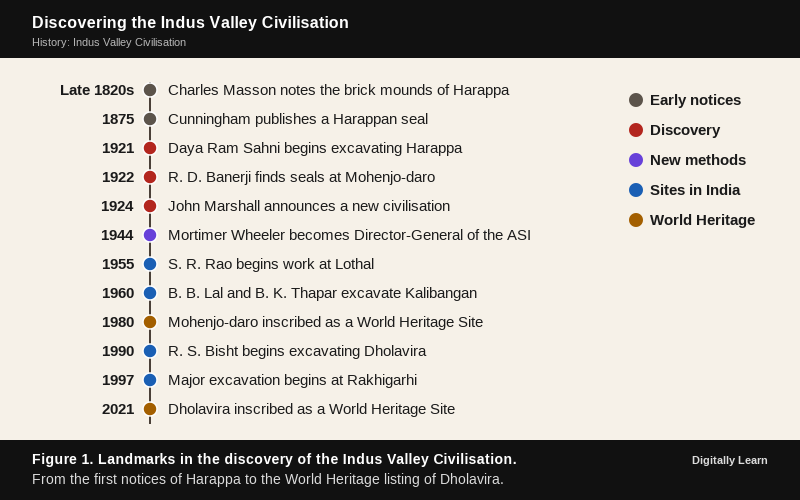
The ruins of Harappa were seen and described almost a century before anyone knew what they were. Charles Masson, a deserter from the East India Company's army, travelled through Punjab in the late 1820s and noted the great brick mounds of Harappa; he published his observations in 1842 and took the ruins to be a city of Alexander's time. Alexander Burnes, sent by the Company to survey the Indus, also stopped at Harappa and noted both its baked bricks and their removal by local people.
Harappa suffered badly before it was understood. After the British annexed Punjab in 1848‑49, its bricks were carted away as ballast for the railway line between Lahore and Multan. Alexander Cunningham, the first Director-General of the ASI, noted in 1875 that the brick taken from the site was enough for "about 100 miles" (about 160 km) of that line.
Cunningham visited Harappa in 1853 and 1856, and in 1875 he published a Harappan seal that an Englishman had given him. He could not place it in time, because, like most scholars of his day, he believed that Indian history began with the first cities of the Ganga valley. He used the accounts of Chinese Buddhist pilgrims to look for early historic cities, and Harappa did not fit that search.
Excavations of 1921‑22 and John Marshall's Announcement of 1924
The Indus Valley Civilisation was discovered through the work of three officers of the ASI: Daya Ram Sahni, who excavated Harappa from 1921; R. D. Banerji, who excavated Mohenjo-daro from 1922; and John Marshall, the Director-General, who recognised the two sites as one civilisation and announced it in 1924.
The discovery of Harappa as an ancient city came with excavation. Marshall, Director-General of the ASI from 1902 to 1928, brought the site under the ASI's control under the Ancient Monuments Preservation Act, 1904, and directed Daya Ram Sahni to excavate its two mounds. Sahni found seals in layers much older than the Early Historic levels.
Far to the south-west, in Sindh, R. D. Banerji, an ASI officer, surveyed Mohenjo-daro in 1919 and returned to dig there in the 1922‑23 season, when he found seals like those of Harappa. In a letter to Marshall in 1923 he argued that the site was of remote antiquity, and M. S. Vats noted the same likeness in the seals and the script of the two sites. Marshall brought the material of both sites together and concluded that they belonged to one archaeological culture.
In September 1924 Marshall announced the discovery of a new civilisation in the Indus valley in the Illustrated London News. A week later the Assyriologist Archibald Sayce pointed to very similar seals found in Bronze Age levels in Mesopotamia and Iran, which gave the first strong indication of the civilisation's date: It was as old as Mesopotamia. It was said of Marshall that he "left India three thousand years older than he had found her".
Later Excavators: Vats, Mackay and Wheeler
Systematic excavation followed the announcement. At Mohenjo-daro K. N. Dikshit, H. Hargreaves and Ernest Mackay dug in turn from 1924 to 1931, and at Harappa M. S. Vats supervised the excavations until 1934‑35 and published their results. Marshall's report, Mohenjo-daro and the Indus Civilisation, appeared in 1931.
The methods of these years lost much information. Marshall excavated in uniform horizontal units across a mound and ignored its stratigraphy, the order of the layers in which people had built and lived. Objects found in the same unit were grouped together even when they came from different layers, so the context of many finds was lost.
Mortimer Wheeler, who became Director-General of the ASI in 1944, corrected this. He followed the layers of the mound instead of digging in level strips, and in 1946 he excavated at Harappa, where he exposed its fortifications. In 1947 he read the skeletons found at Mohenjo-daro as victims of an Aryan invasion, a view that the archaeologist George Dales questioned in the 1960s.
Harappan Discoveries in India After 1947
Partition and the Search for Harappan Sites in India
The Partition of 1947 left Harappa, Mohenjo-daro and most of the known sites in Pakistan. The frontiers of the civilisation had little to do with modern borders, but the loss spurred Indian archaeologists to look for Harappan sites within India. An extensive survey in Kutch and Saurashtra revealed many Harappan settlements, and explorations in Punjab and Haryana added many more. Kalibangan, Lothal, Rakhigarhi and Dholavira were explored and excavated as part of this work, and fresh explorations continue. Ropar, now Rupnagar, in Punjab was the first Harappan site excavated after independence.
| Major excavation began | Site | State | Excavator |
|---|---|---|---|
| 1955 | Lothal | Gujarat | S. R. Rao |
| 1958‑59 | Daimabad | Maharashtra | M. N. Deshpande |
| 1960 | Kalibangan | Rajasthan | B. B. Lal and B. K. Thapar |
| 1976‑77 | Manda | Jammu and Kashmir | J. P. Joshi |
| 1990 | Dholavira | Gujarat | R. S. Bisht |
| 1997 | Rakhigarhi | Haryana | Amrendra Nath |
Dholavira shows how slowly a site moves from notice to excavation. A villager, Shambhudan Gadhvi, drew official attention to it in the early 1960s; J. P. Joshi of the ASI recorded it in 1967 or 1968; and R. S. Bisht began its excavation in 1990.
World Heritage Listing: Mohenjo-daro in 1980 and Dholavira in 2021
Two Harappan cities are on UNESCO's World Heritage List. Mohenjo-daro was inscribed in 1980 as the "Archaeological Ruins at Moenjodaro" in Pakistan. Dholavira, on the island of Khadir in the Rann of Kutch, Gujarat, was inscribed as "Dholavira: A Harappan City" on 27 July 2021 and became India's 40th World Heritage Site. Occupied for over 1,500 years, from the 3rd to the mid-2nd millennium BCE, it shows the whole course of the civilisation's rise and fall at one place.
Geographical Extent of the Indus Valley Civilisation
Farthest Harappan Sites: Shortughai, Manda, Daimabad, Alamgirpur and Sutkagan Dor
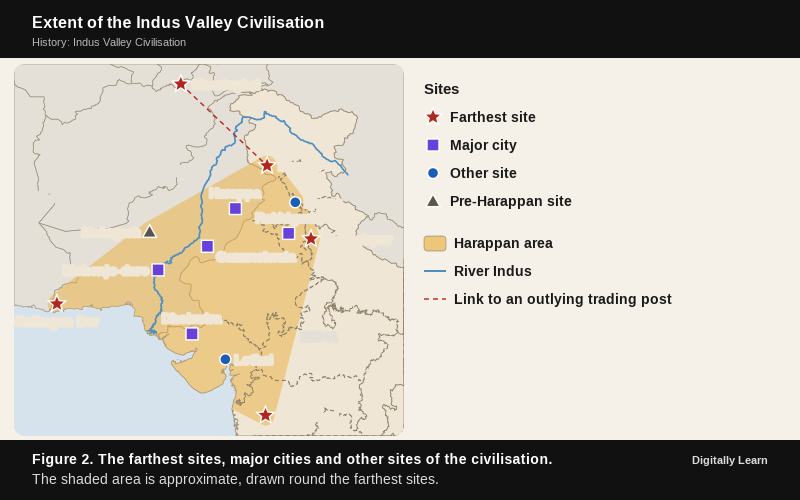
The extent of the civilisation is fixed by its farthest known sites. Of the three early civilisations of Egypt, Mesopotamia and the Indus, it was the most widespread, covering much of present-day Pakistan, north-western India and north-eastern Afghanistan. Its pottery, bricks, seals, weights, beads and copper and bronze objects have been found in Afghanistan, in the Balochistan, Sindh and Punjab provinces of Pakistan, and in the Indian States and Union Territories of Jammu and Kashmir, Punjab, Haryana, Rajasthan, Uttar Pradesh, Gujarat and Maharashtra.
- North: Shortughai, on the Amu Darya (Oxus) in northern Afghanistan, is the northernmost Harappan settlement, a trading post near the lapis lazuli mines that was set up around 2000 BCE. Within India the northernmost site is Manda, on the right bank of the Chenab in Jammu district.
- South: Daimabad, on the left bank of the Pravara, a tributary of the Godavari, in Maharashtra, is the southernmost site; its finds show that the Late Harappan culture reached the Deccan Plateau.
- East: Alamgirpur, on the Hindon in Meerut district of Uttar Pradesh, about 28 km from Delhi, is the easternmost site, in the Ganga-Yamuna Doab.
- West: Sutkagan Dor, on the Makran coast near Gwadar in Pakistan's Balochistan, close to the Iranian border, is the westernmost site, a small settlement with stone walls and gateways.
Number of Harappan Sites, Major Cities and Settlement Types
More than 2,000 Harappan sites have been found in the subcontinent. Most lie in the basins of the Indus and of the Ghaggar-Hakra, and nearly two-thirds of the settlements lie in the Ghaggar-Hakra (Sarasvati) basin. Sites were built most often on rivers, but also on the old sea coast, as at Balakot, and on islands, as at Dholavira.
Five major cities have been identified: Mohenjo-daro in Sindh, Harappa in Punjab and Ganweriwala in the Cholistan desert, all in Pakistan, and Rakhigarhi in Haryana and Dholavira in Gujarat, in India. The rest were regional centres, farming villages, ports and craft centres. Chanhudaro, a craft town of less than 7 hectares in Sindh, and Kot Diji, also in Sindh, whose name is given to an Early Harappan phase, are among the many smaller sites. Desalpur (Desalpar) in Kutch, a fortified settlement with a massive stone wall and Harappan pottery, was excavated by the ASI in 1963.
The Harappan world also reached beyond its farming core for raw materials. Its people founded settlements such as Nageshwar and Balakot near sources of shell, Shortughai near the best source of lapis lazuli and Lothal near carnelian from Bharuch.
Ghaggar-Hakra: The River of the Eastern Sites
The Ghaggar-Hakra is a seasonal river that rises in the Shivalik Hills and flows through Punjab, Haryana and Rajasthan into Pakistan's Cholistan, where its old bed is dry; it is called the Ghaggar in India and the Hakra in Pakistan. Kalibangan in Rajasthan, and Banawali, Bhirrana and Rakhigarhi in Haryana, stand on its channels or its plain. A river called the Sarasvati is first mentioned in the Rig Veda, which praises it both as a goddess and as a river flowing "from the mountain to the sea", and later texts describe it drying up and disappearing.
Since the nineteenth century, scholars have proposed that the Ghaggar-Hakra is the Sarasvati, and this identification lies behind the name Indus-Sarasvati civilisation. Others hold that it is not proven, and the question remains debated.
Chronology of the Harappan Civilisation: Early, Mature and Late Phases
Mehrgarh and the Farming Roots of the Harappan Civilisation
The Harappan cities grew out of a long village past. The best-known witness to that past is Mehrgarh, on the Kacchi plain of Balochistan near the Bolan Pass, whose earliest levels are Neolithic; a French mission led by Jean-François Jarrige and Catherine Jarrige discovered it in 1974. Its earliest farming village is dated to about 7000 BCE, though some scholars place it later, and it is one of the earliest sites with evidence of farming and herding in South Asia.
Harappan culture emerged from such early farming communities. Before the cities there were several regional cultures, each with its own pottery, farming, herding and some crafts, in small settlements with virtually no large buildings. The urban phase grew out of the gradual change and internal development of these cultures, and the Mature Harappan cities rose in many of the areas the earlier cultures had occupied.
Formative, Urban and Declining Phases of the Harappans
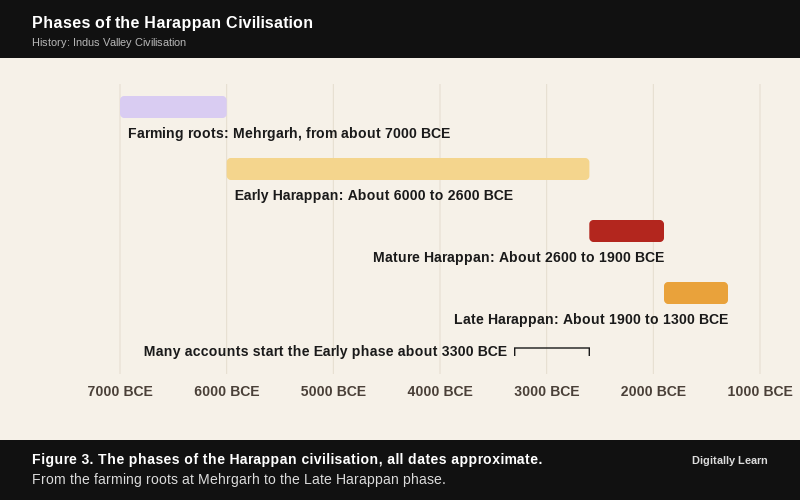
The chronology of the Harappan civilisation is divided into three phases, which together span from about 6000 BCE to 1300 BCE. All the dates are approximate, and developments differed from one region to another.
- Early Harappan (about 6000 to 2600 BCE): The formative phase. Villages and small towns grew, with distinctive pottery, farming, herding and some crafts. From about 3500 BCE villages grew into towns, and with growing trade the towns grew into cities.
- Mature Harappan (about 2600 to 1900 BCE): The urban phase and the most prosperous. Planned cities with standard bricks, drains, seals, weights and long-distance trade flourished across the whole area.
- Late Harappan (about 1900 to 1300 BCE): The phase of decline. The cities were abandoned one by one, and those who remained took up a rural way of life from about 1900 BCE in regional cultures such as the Cemetery H culture of Punjab, Haryana and western Uttar Pradesh, the Jhukar culture of Sindh and the Rangpur culture of Gujarat.
The dates of the first phase differ between accounts. Many archaeologists begin the Early Harappan about 3300 BCE, with the Ravi phase (about 3300 to 2800 BCE) and the Kot Diji phase (about 2800 to 2600 BCE) of the Harappa sequence, and treat the farming villages before it, such as Mehrgarh, as pre-Harappan; on that reckoning the civilisation spans about 3300 to 1300 BCE. Both reckonings give the Mature phase as about 2600 to 1900 BCE.
| Phase | Approximate dates | Character | Sites that show it |
|---|---|---|---|
| Pre-Harappan farming roots | From about 7000 BCE | Neolithic farming and herding villages | Mehrgarh |
| Early Harappan | About 6000 to 2600 BCE | Formative: Villages, small towns, regional pottery | Kot Diji, Amri, early Kalibangan |
| Mature Harappan | About 2600 to 1900 BCE | Urban: Planned cities, seals, weights, trade | Mohenjo-daro, Harappa, Dholavira, Rakhigarhi, Lothal |
| Late Harappan | About 1900 to 1300 BCE | Decline: Cities abandoned, rural regional cultures | Cemetery H, Jhukar, Rangpur, Daimabad |
Dating the Harappan Civilisation: Mesopotamian Links and Radiocarbon
The Indus-type seals that Sayce pointed to in 1924, found in Bronze Age levels in Mesopotamia, gave only a relative date: The Indus cities were as old as the Bronze Age cities of Mesopotamia. Mesopotamian texts also mention contact with a land called Meluhha, possibly the Harappan region, and name carnelian, lapis lazuli, copper, gold and varieties of wood among its products.
Radiocarbon dating, developed in the late 1940s by Willard Libby at the University of Chicago, later gave absolute dates. Radiocarbon (carbon‑14) forms in the atmosphere and enters every living plant and animal; after death it decays, with a half-life of about 5,730 years, so the share left in charcoal, grain or bone shows how long ago the organism died. In 2014 six radiocarbon dates from the excavations of 1997 to 2000 at Rakhigarhi were published, covering its pre-formative, Early Harappan and Mature Harappan phases, and recent carbon‑14 dates from Dholavira, with the style of its finds, are used to date the stages of that city.
Some radiocarbon dates are disputed. Two charcoal samples from the lowest layers at Bhirrana in Haryana were dated to the 8th and 7th millennia BCE, but they came from the same levels as Hakra Ware pottery dated elsewhere to the 4th millennium BCE, and the archaeologist Gregory Possehl expressed reservations about claims based on them. Such disputes explain why the start of the Early Harappan phase is given differently in different accounts.
Within a site, the order of events comes from stratigraphy. Generally the lowest layers are the oldest and the highest the most recent, and layers left empty during a desertion, called sterile layers, show breaks in occupation. At Kalibangan, for example, a ploughed field belongs to the Early Harappan levels, older than the Mature city. Absolute dates and the order of layers together give the chronology.
Bronze Age or Chalcolithic: Which Age the Civilisation Belongs To
The Indus Valley Civilisation belongs to the Bronze Age. Its people worked copper, a soft metal, and added tin to it to make bronze, which is harder; they made tools, vessels and figurines of bronze. They did not use iron.
The Harappan cities grew out of a Chalcolithic, or Copper Age, background. The Chalcolithic stage, marked by the first use of copper, began about 4000 BCE, more than a thousand years before the cities. Daimabad in Maharashtra is described both as a Late Harappan and as a Chalcolithic site.
Previous Year UPSC‑CSE Questions
Each question is explained option by option.
- UPSC Prelims 2019Which one of the following is not a Harappan site?
How to approach this Prelims question
Approach: Test each name against the settlements of the Harappan civilisation in Sindh and Kutch, and look for the one that belongs to a later period. Chanhudaro and Kot Diji are in Sindh and Desalpur is in Kutch, all inside the Harappan area, while Sohgaura in eastern Uttar Pradesh is known for a copper-plate inscription of the Mauryan period, and so does not belong to the Harappan civilisation.
Trap to watch: Students who know the eastern limit only as "Uttar Pradesh" may take Sohgaura for a Harappan site because it lies in that State; the easternmost Harappan site is Alamgirpur on the Hindon, and Sohgaura, known for an inscription of the Mauryan period, lies far to its east.
Why each option is right or wrong:
- (a) Chanhudaro: Wrong. Chanhudaro in Sindh was a small Harappan craft town of less than 7 hectares, devoted to bead-making, shell-cutting and metal-working.
- (b) Kot Diji: Wrong. Kot Diji in Sindh, on the east bank of the Indus opposite Mohenjo-daro, is a Harappan site, and it gives its name to the Kot Diji phase of the Early Harappan period.
- (c) Sohgaura: Correct. Sohgaura, a village on the Rapti in Gorakhpur district of Uttar Pradesh, is known for a copper-plate inscription in Prakrit in the Mauryan Brahmi script, far later than the Harappan civilisation and far east of its easternmost site, Alamgirpur.
- (d) Desalpur: Wrong. Desalpur (Desalpar) in Kutch, Gujarat, is a fortified Harappan settlement with Harappan pottery, excavated by the ASI in 1963.
Answer: (c) Sohgaura. Sohgaura is known for a Mauryan copper-plate inscription, while Chanhudaro, Kot Diji and Desalpur are Harappan sites.
Sources
- NCERT: Themes in Indian History Part I, Class XII, Theme 1, Bricks, Beads and Bones: The Harappan Civilisation
- NCERT: Exploring Society: India and Beyond, Class VI, Chapter 6, The Beginnings of Indian Civilisation
- NCERT: An Introduction to Indian Art Part I, Class XI, Chapter 2, Arts of the Indus Valley
- PIB: India gets its 40th World Heritage Site, Dholavira inscribed on UNESCO's World Heritage List
- UNESCO World Heritage Centre: Dholavira, a Harappan City
- District Kachchh, Government of Gujarat: Dholavira
- Wikipedia: Indus Valley Civilisation
- Wikipedia: Harappa
- Wikipedia: Charles Masson
- Wikipedia: Daya Ram Sahni
- Wikipedia: R. D. Banerji
- Wikipedia: John Marshall (archaeologist)
- Wikipedia: Madho Sarup Vats
- Wikipedia: Mortimer Wheeler
- Wikipedia: Lothal
- Wikipedia: Rupnagar
- Wikipedia: Dholavira
- Wikipedia: Rakhigarhi
- Wikipedia: Shortugai
- Wikipedia: Manda, Jammu
- Wikipedia: Daimabad
- Wikipedia: Alamgirpur
- Wikipedia: Sutkagan Dor
- Wikipedia: Ghaggar-Hakra River
- Wikipedia: Kalibangan
- Wikipedia: Banawali
- Wikipedia: Bhirrana
- Wikipedia: Mehrgarh
- Wikipedia: Kot Diji
- Wikipedia: Desalpar Gunthli
- Wikipedia: Sohgaura copper plate inscription
- Wikipedia: Radiocarbon dating
- UPSC: Civil Services Examination question papers
Editorial Disclaimer
This article uses the current NCERT textbooks and the other sources listed under Sources. Where NCERT and other accounts differ on a date, NCERT's date is given and the other is stated once.
See more of our UPSC articles in Google Search
Add to Preferred Sources