


Overview
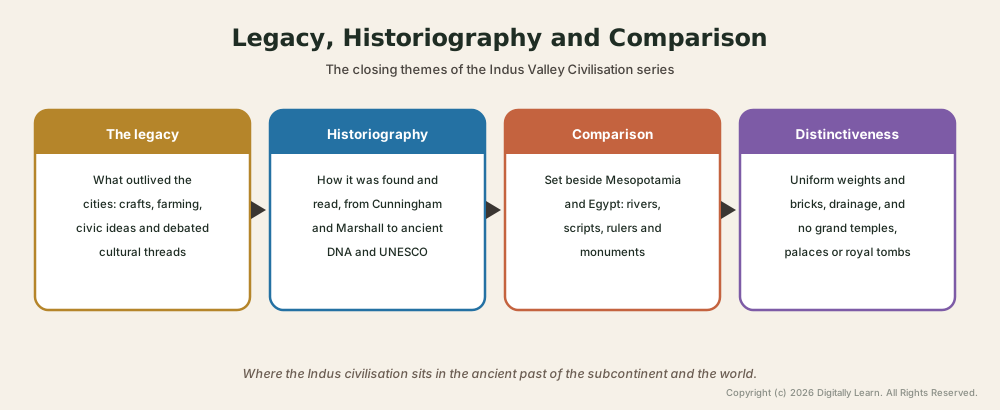
The Harappan legacy, the historiography of the civilisation, and its place among the great civilisations of the ancient world are the closing themes of this series. When the cities broke up after about 1900 BCE, much was lost, yet crafts, farming, civic ideas and some cultural threads passed into later India. The historiography, the story of how the civilisation was discovered and interpreted, runs from Alexander Cunningham and the formal announcement by John Marshall in 1924 to the recent evidence of ancient DNA. Set beside Mesopotamia and Egypt, the Indus civilisation stands out for its uniformity and civic order and for the absence of the grand temples, palaces and royal tombs that mark the others, while its script alone remains unread.
The Harappan Legacy: What Survived the Cities
What the Harappans Left to Later India
What is the significance of the legacy: although the great cities were abandoned, the Harappan achievement did not vanish without trace, and weighing what survived against what was lost is a favourite theme of the examiner.
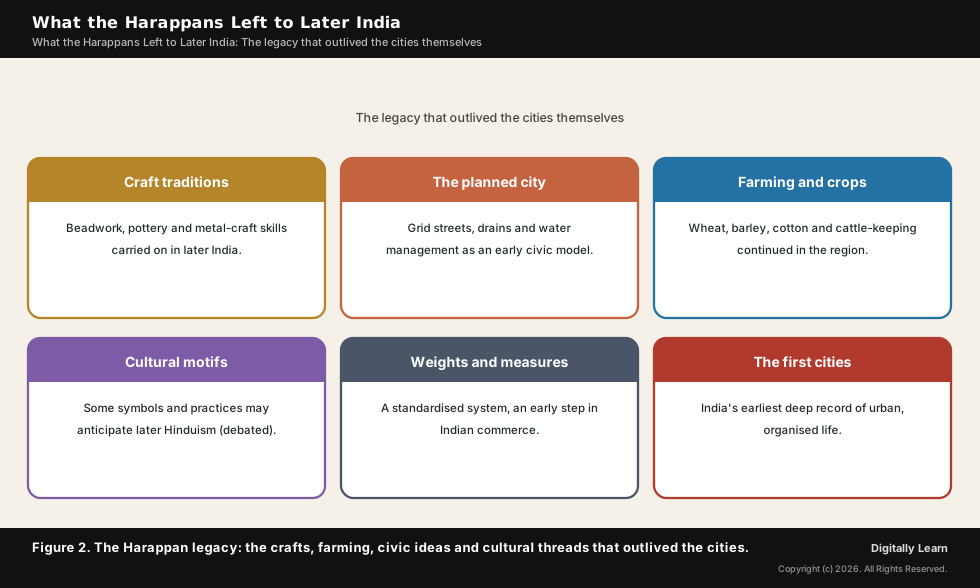
The clearest break was the end of the cities themselves. The grid streets, the drains, the script and the standardised weights of the urban age passed out of use, so the city-based, or urban, tradition was broken. What continued ran instead through the countryside and the crafts.
Distinguishing what endured: the craft skills of the bead-makers, potters and metal-workers carried on; the staple crops and the cattle-keeping of the Harappan farmer remained the basis of village life; and the very idea of the planned settlement, with its care for drainage and water, left a model for later town builders. Certain cultural and religious motifs may also echo into later India, though these links are debated.
Debated Continuities into Later Indian Religion and Culture
Harappan Roots of Later Hindu Practice: The Scholarly Debate
What is the significance of the continuity debate: it is tempting to trace parts of later Hinduism directly back to the Harappans, but scholars now treat most such links with caution, and a careful answer grades them rather than asserting them.
Distinguishing the proposals: the famous reading of the Pashupati seal as an early Shiva, first proposed by John Marshall, is now largely rejected by scholars, and the same caution applies to the idea that the terracotta figurines prove a Mother Goddess cult.
The reverence for the pipal tree, the veneration of animals, and the link between ritual bathing and the Great Bath are genuinely debated, neither proven nor dismissed, while the claim that the Harappan swastika carries a religious continuity is treated as a fringe view.
| Proposed continuity | What it claims | Standing in scholarship |
|---|---|---|
| The Pashupati seal | An early form of Shiva | An old proposal, now largely rejected |
| Mother Goddess figurines | An organised goddess cult | Increasingly doubted |
| The pipal (sacred fig) tree | A root of later tree veneration | Genuinely debated |
| Veneration of animals | A source of later animal worship | Suggested, not widely accepted |
| Ritual bathing and water | The Great Bath as ritual purity | The Great Bath, widely thought ritual; wider claims debated |
| The swastika motif | A religious continuity into Hinduism | Treated as a fringe view |
The Historiography of the Indus Civilisation
From Cunningham to Rakhigarhi: How the Civilisation Was Found and Read
What is the significance of the historiography: how the Indus civilisation was discovered, and how each generation read the evidence, is itself an examinable story, and it shows how archaeology, language and science have together reshaped the picture.
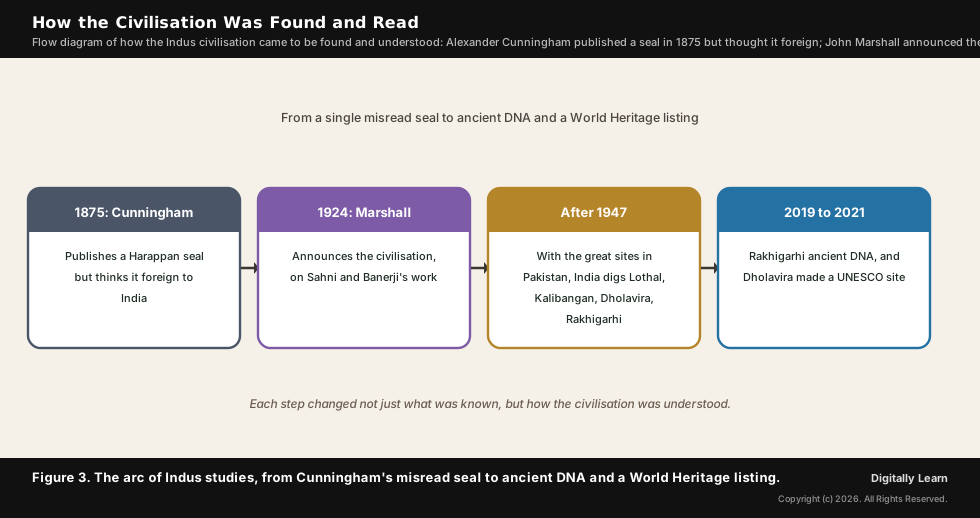
Distinguishing the discovery: Alexander Cunningham, the first head of the Archaeological Survey of India, visited Harappa and published a seal in 1875, but he thought it foreign to India and missed its true age. The civilisation was formally announced only in 1924, when John Marshall made it known to the world on the strength of the excavations of Daya Ram Sahni at Harappa and Rakhal Das Banerji at Mohenjo-daro.
Distinguishing the later turns: the early reading that an Aryan invasion had destroyed the cities gave way, as we saw, to the migration model. After the Partition of 1947 left Harappa and Mohenjo-daro in Pakistan, Indian archaeologists opened a series of sites of their own, among them Lothal, Kalibangan, Dholavira and Rakhigarhi. The most recent chapter is scientific: the Rakhigarhi ancient DNA study of 2019, and the listing of Dholavira as a UNESCO World Heritage Site in 2021.
The Naming Debate: Indus, Harappan or Indus-Saraswati
Distinguishing the names: the civilisation goes by more than one name, and the choice carries meaning. Indus Valley Civilisation names it after the river along which it was first found, while Harappan Civilisation follows the usual rule of archaeology, naming a culture after the first site dug, which was Harappa.
A third label, Indus-Saraswati or Sindhu-Saraswati, stresses the many sites along the dry Ghaggar-Hakra, which some identify with the Saraswati. This name is associated with the indigenous-Aryanist school rather than being a neutral choice, so it is best used with that context made clear. The plain term Harappan remains the safest in an answer.
Comparing the Indus, Mesopotamia and Egypt
Three Bronze Age River-Valley Civilisations Compared
What is the significance of the comparison: the Indus civilisation was one of three great river-valley civilisations of the Bronze Age, and setting it beside Mesopotamia and Egypt brings out both what they shared and what made the Indus world unusual.
All three grew on the floodplains of great rivers, fed cities from irrigated farming, kept written records and traded over long distances. Mesopotamia, between the Tigris and the Euphrates, gave the world its first cities and the cuneiform script; Egypt, along the Nile, raised the pyramids under its pharaohs. The Indus, on the Indus and the Ghaggar-Hakra, matched them in scale but went its own way in form.
| Feature | Indus (Harappan) | Mesopotamia | Egypt |
|---|---|---|---|
| River | Indus and Ghaggar-Hakra | Tigris and Euphrates | The Nile |
| Peak period | c. 2600 to 1900 BCE | From the 4th millennium BCE | From c. 3100 BCE |
| Writing | Indus script (undeciphered) | Cuneiform (deciphered) | Hieroglyphs (deciphered) |
| Rulers | No clearly identified kings | City-states under kings | A kingdom under pharaohs |
| Great monuments | None of temple, palace or tomb | Ziggurats (temple-towers) | Pyramids (royal tombs) |
| Hallmark | Town planning and uniformity | The first cities and writing | Monumental royal tombs |
What Made the Harappan Civilisation Distinctive
What is the significance of the distinctiveness: the contrast in the table points to a deeper difference, and naming it is what lifts a comparison answer from a list into an argument.
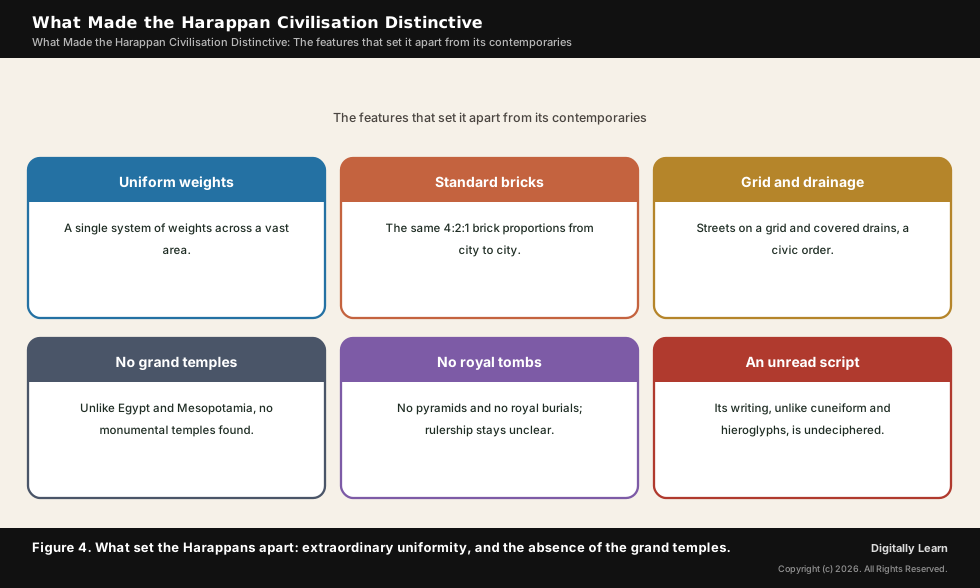
Distinguishing the Harappan stamp: the hallmark of the Indus world was uniformity. The same system of weights, the same 4:2:1 brick proportions, the same grid planning and covered drainage appear from city to distant city. Just as striking is what is missing: there are no grand temples, no palaces and no royal tombs, and no clear sign of kings or of large-scale war, which has led many to read the Harappan order as comparatively egalitarian, though this remains debated.
Culture Without Breakdown? The Continuity Question
Why India's Ancient Heritage Is Said to Have Endured
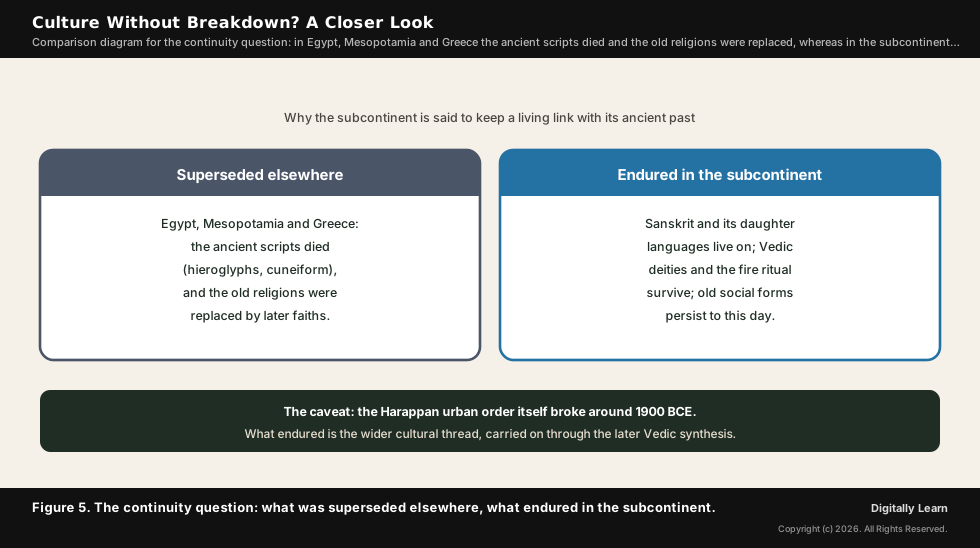
What is the significance of the continuity question: a famous claim holds that, unlike Egypt, Mesopotamia and Greece, the civilisation of the subcontinent has kept its culture and traditions alive to the present day, and weighing this claim is a classic examination task.
There is real truth in it. In Egypt and Mesopotamia the ancient scripts died and the old religions were replaced, and the Greek world too saw its old faith give way. In the subcontinent, by contrast, Sanskrit and its daughter languages live on, the Vedic deities and the fire ritual survive in Hindu practice, and many old social forms persist. The thread from the ancient past to the present is unusually unbroken.
The qualification, which the question invites: the claim must be handled with care. The Harappan urban order itself broke around 1900 BCE, when the cities, the script and the weights were lost, so there was no simple, unbroken descent from the Indus cities.
What endured is better seen as the wider cultural thread, carried not directly from the Harappans but through the later Vedic synthesis and the long growth of Hinduism. The honest comment is that the continuity is real in culture and language, but not a seamless survival of the Indus civilisation itself.
UPSC Relevance and Exam Focus
Where This Fits in the UPSC-CSE Syllabus
This topic belongs to General Studies Paper I: ancient Indian history and culture, and its comparison and continuity themes also feed the broader questions on Indian heritage.
For Prelims, hold the firm facts: the civilisation was announced in 1924 by John Marshall; the Indus script alone, unlike cuneiform and hieroglyphs, is undeciphered; Dholavira became a UNESCO World Heritage Site in 2021; and the Harappans built no grand temples, palaces or royal tombs.
For Mains, the strongest answers compare the Indus civilisation with Egypt and Mesopotamia feature by feature, name its distinctiveness (uniformity and the absence of monumental power), and treat the claim of unbroken continuity critically, granting the cultural thread while noting that the urban order itself broke.
Recurring linked concepts an aspirant should keep in working memory:
- The announcement: 1924, John Marshall, on Sahni and Banerji’s work.
- The naming: Indus, Harappan, or the contested Indus-Saraswati label.
- The comparison: undeciphered script and no monuments, unlike Egypt and Mesopotamia.
- The distinctiveness: uniform weights and 4:2:1 bricks, drainage, no royal tombs.
- The continuity: real for culture and language, but the urban order itself broke.
A common Prelims trap is to credit the decipherment of the Indus script. It is not deciphered; only the Mesopotamian and Egyptian scripts have been read.
A common Mains trap is to accept the continuity claim without qualification. The disciplined answer grants the cultural and linguistic thread but notes that the Harappan urban civilisation itself did not survive unbroken.
Previous Year UPSC-CSE Questions
Previous Year UPSC-CSE Questions By the end you will be able to draft model answers for the following UPSC questions. Each question carries a collapsible framework showing how to approach it in the exam.
- UPSC Mains 2015 GS-IThe ancient civilization in Indian sub-continent differed from those of Egypt, Mesopotamia and Greece in that its culture and traditions have been preserved without a breakdown to the present day. Comment.
How to structure the answer in the exam
Introduction: Open with the claim of unbroken cultural continuity and the comparison it draws with the other ancient civilisations.
Body (sub-themes to develop):
- The case for continuity: Sanskrit and its daughter languages, Vedic deities and the fire ritual, and old social forms survive, whereas Egyptian and Mesopotamian scripts and religions were superseded.
- The qualification: the Harappan urban order (cities, script, weights) itself broke around 1900 BCE, so there was no seamless descent from the Indus cities.
- The resolution: what endured is the wider cultural thread, carried through the later Vedic synthesis and the long growth of Hinduism, rather than the Indus civilisation itself.
Conclusion: Conclude that the continuity is real at the level of culture and language but should not be read as the unbroken survival of the Indus civilisation.
Sources and Further Reading
Editorial Disclaimer
This article is for UPSC preparation. The cultural continuities and the naming of the civilisation are matters of scholarly debate, and the views given here represent the current mainstream balance. Verify specific details before relying on them.