


Overview
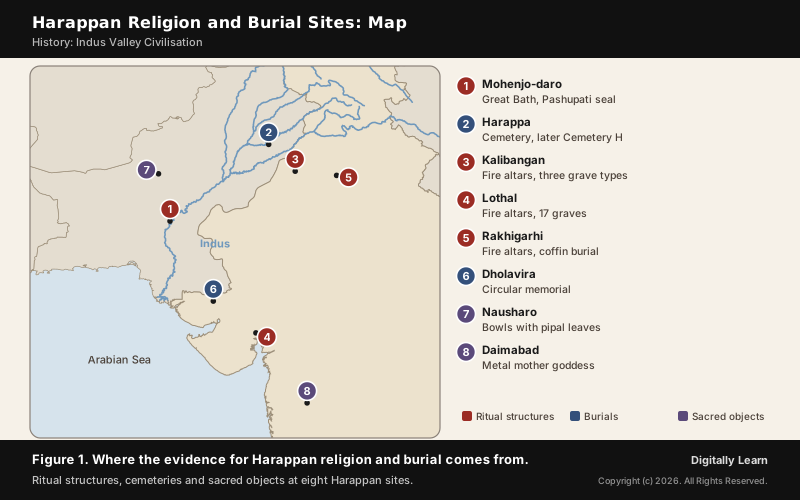
Harappan religion is known only from objects, because the Indus script is still undeciphered: female figurines read as a mother goddess, a seated horned figure on a seal read as proto-Shiva, fire altars, the Great Bath, and animals and trees shown on seals and pots. Harappan society had rulers, scribes, craftspeople and farmers, with luxuries gathered in the big cities, and who ruled it, one state or many cities, is still debated.
Indus Valley Civilization Society: Social Structure and Social Differences
Who Lived in Harappan Cities: Rulers, Scribes, Craftspeople and Farmers
A Harappan city was a busy place. Some people planned the construction of special buildings, and these were probably the rulers. They may have sent people to distant lands for metal, precious stones and other goods, and kept the most valuable objects, ornaments of gold and silver or beautiful beads, for themselves. Scribes, people who knew how to write, helped prepare the seals and perhaps wrote on materials that have not survived.
- Craftspeople: Men and women made all kinds of things, in their own homes or in special workshops. Chanhudaro, a settlement of less than 7 hectares, was almost wholly given to crafts such as bead-making, shell-cutting, metal-working, seal-making and weight-making.
- Farmers and herders: People in the countryside grew crops and reared animals, and supplied food to craftspersons, scribes and rulers in the cities; they grew wheat, barley, pulses, peas, rice, sesame, linseed and mustard.
- Travellers: People went to distant lands and came back with raw materials and, perhaps, stories.
Dholavira in Gujarat points to a graded society. Its walled city had a fortified Castle and Bailey, a Ceremonial Ground, a Middle Town and a Lower Town, and its residential areas seem to have been separated by occupation, which points to a stratified society.
Social Differences in Harappan Civilization: Burials, Luxuries and Hoards
Archaeologists look for social differences first in burials. Some of the pyramids of Egypt, royal burials with enormous wealth, were built at the same time as the Harappan cities. Harappan graves were very different: the dead were generally laid in pits, some lined with bricks, and some graves held pottery and ornaments, perhaps for use in the afterlife. Jewellery was buried with both men and women, but on the whole the Harappans did not bury precious things with the dead.
The second test is to sort objects into everyday things and luxuries. Querns, pottery, needles and body scrubbers turn up all over a settlement. Rare objects of costly or non-local materials, or made with complicated techniques, cluster in large settlements: little faience pots, perhaps perfume bottles, are found mostly at Mohenjodaro and Harappa and none at small settlements like Kalibangan. Gold was rare, and all the gold jewellery found at Harappan sites came from hoards, objects stored carefully, often in pots.
Citadel and Lower Town: Was Harappan Society Equal?
The layout of the cities adds a third clue. Mohenjodaro had two sections: a smaller, higher Citadel, raised on mud-brick platforms and walled off, and a much larger, lower Lower Town, also walled. Most settlements had a small high western part and a larger lower eastern section, while at Dholavira and Lothal the whole settlement was fortified and sections within the town were separated by walls.
Special buildings stood on the citadel, such as the Great Bath and a warehouse at Mohenjodaro, set apart from the houses of the Lower Town. Building them took labour on a vast scale: if one labourer moved about a cubic metre of earth a day, the platforms of Mohenjodaro alone would have needed four million person-days. Someone had to command that labour.
Harappan Dress, Ornaments and Daily Life: Cotton, Jewellery and Toys
Cloth has mostly decayed, so dress is known from traces and sculpture. There are traces of cotton at some Harappan sites, and pieces of cloth were found attached to the lid of a silver vase and to some copper objects at Mohenjodaro. Many spindles and spindle whorls in houses show that spinning of cotton and wool was very common, and whorls of costly faience as well as cheap pottery and shell show that rich and poor alike spun.
- Dress: Men and women wore two separate pieces like the dhoti and shawl, the shawl covering the left shoulder and passing below the right; the steatite bust called the priest-king wears such a shawl decorated with trefoil patterns.
- Ornaments: Necklaces, fillets, armlets and finger-rings were worn by both sexes, while women also wore girdles, earrings and anklets.
- Fashion: Different hairstyles were in vogue, a beard was popular, and cinnabar was used as a cosmetic, with face-paint, lipstick and collyrium also known.
- The Dancing Girl: A bronze figure from Mohenjodaro, cast by the lost-wax process, shows a young woman with a bent right arm resting on her hip and her forearm ringed with bangles.
- Toys: Many terracotta toys have been found, among them carts with wheels, whistles, rattles, birds and animals.
Harappan Polity: Did the Indus Valley Civilization Have Kings?
Evidence of Authority: Uniform Bricks, Weights, Seals and Planned Settlements
Harappan society took complex decisions and put them into effect. Pottery, seals, weights and bricks are remarkably uniform, and bricks, though not made at any single centre, kept the same ratio from Jammu to Gujarat: the length four times and the breadth twice the height. Settlements were placed at chosen locations, and labour was mobilised to make bricks and build massive walls and platforms.
- Weights: The lower denominations were binary, 1, 2, 4, 8, 16, 32 and so on up to 12,800, and the higher ones followed the decimal system.
- Streets first: Streets with drains were laid out first on an approximate grid, and houses were built along them.
- Planned before built: Once the platforms were in place, all building was restricted to them, so the settlement was planned first and then carried out.
The planning itself is the subject of Harappan town planning and architecture; here it matters as evidence that someone was in charge.
Theories of Harappan Polity: No Rulers, City-States or a Single State
Looking for a centre of power gives no direct answer. A large building at Mohenjodaro was labelled a palace, but nothing spectacular was found in it. A stone statue is still called the priest-king, a name borrowed from the priest-kings of Mesopotamia, but it is not known whether those who performed Harappan rituals also held political power.
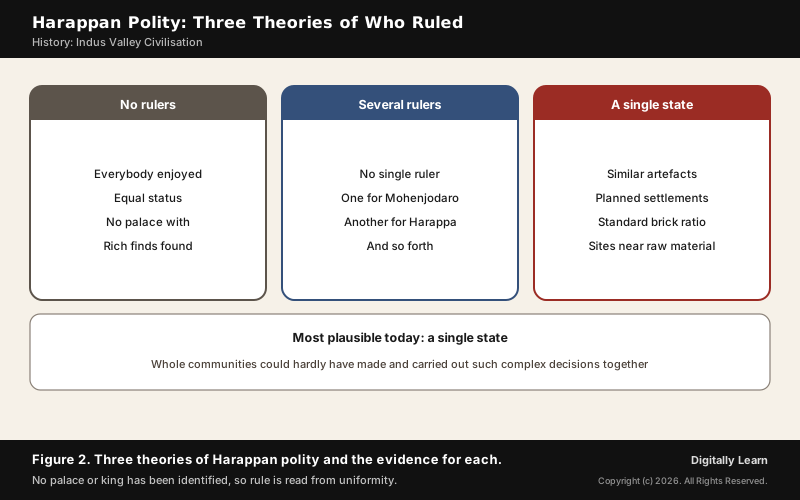
| Theory | What it holds |
|---|---|
| No rulers | Harappan society had no rulers, and everybody enjoyed equal status |
| Several rulers | No single ruler: Mohenjodaro had one, Harappa another; each city a self-governing city-state |
| A single state | Similar artefacts, planned settlements, a standard brick ratio, sites near raw materials |
The single-state theory seems the most plausible at present, as it is unlikely that entire communities could have made and carried out such complex decisions together. It also explains how the civilisation ended: when seals, the script, distinctive beads and pottery disappeared and standard weights gave way to local ones, a strong unifying element, perhaps the Harappan state, seems to have come to an end.
Indus Valley Civilization Religion: Gods, Goddesses and Sacred Symbols
Religious Beliefs of Harappan Civilization: Evidence Without a Deciphered Script
Religion is where reading the past is hardest. Early archaeologists gave a religious meaning to objects that seemed unusual: heavily jewelled female figurines, stone statues of men seated with one hand on the knee, the Great Bath, fire altars, seals with ritual scenes, plant motifs and composite animals. In 1931 John Marshall listed the features of the Indus religion: a Great Male God and a Mother Goddess, the veneration of animals and plants, symbols of the linga and yoni, and the use of baths and water in ritual.
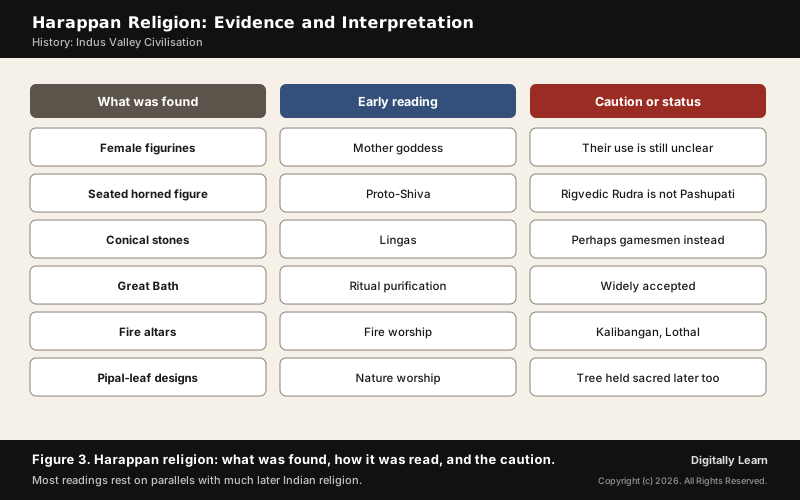
- Later parallels: Many readings assume that later traditions provide parallels with earlier ones; moving from the present to the past works for querns and pots, but becomes speculative for religious symbols.
- Lingas and ring stones: Conical stones were classified as lingas, but some may have been pestles or game counters, and ring stones once read as yoni were architectural bases for pillars.
- No monumental palaces: Unlike Egypt and Mesopotamia, the Indus cities have no monumental palaces, which suggests that ceremonies may have been held in homes, small temples or the open air.
Mother Goddess Figurines and Other Harappan Deities
The commonest candidates for Harappan deities are terracotta female figures, found in large numbers at many sites. They are usually crude standing figures wearing necklaces, a loin cloth and a girdle, many with a fan-shaped head-dress with a cup-like projection on each side. They are generally believed to represent a mother goddess and to show a fertility cult, and Marshall saw in them a forerunner of the later Shakta tradition.
- Doubts: The function of the female figurines is still unclear, and one leading specialist does not find the evidence for a mother-goddess cult terribly robust.
- Variation: Excavators found no evidence of mother-goddess worship at Kalibangan or at Lothal, a sign that religious practice differed from place to place.
- Late survival: The late Harappan site of Daimabad in Maharashtra has yielded metal-cast mother goddess figures.
- Male figures: A few terracotta figurines of bearded men with coiled hair stand rigidly upright, and the repetition of the same pose suggests a deity; a terracotta mask of a horned deity has also been found.
Pashupati Seal: Proto-Shiva, Horned Deity or Tirthankara
The most debated object is a small seal from Mohenjo-daro, found in 1928 or 1929. A human figure wearing a headdress with buffalo horns sits cross-legged in a yogic posture. An elephant and a tiger are shown to its right, a rhinoceros and a buffalo to its left, and two antelopes below the seat. It is unusual because a human figure, not an animal, is its main subject.
Marshall read the figure as an early form of Shiva as Pashupati, the lord of animals, and the seal is named after that reading. The objection is strong. The Rigveda, compiled around 1500 to 1000 BCE, mentions a god named Rudra, a name later used for Shiva, but its Rudra is neither a Pashupati nor a yogi, so the seal does not match him. Some scholars suggest the figure is a shaman.
- Other readings: Some identify the figure as a female deity, one scholar linked it to Mahisha, the buffalo god, and some see an early form of a Jain Tirthankara.
- Where it is: The seal is in the National Museum, New Delhi, allocated to India at Partition in 1947.
Indus Valley Civilization Gods of Nature: Animals, the Pipal Tree and the Swastika
Seals and pottery point to a religion close to nature. Some seals carry plant motifs, thought to show nature worship, and some animals, such as the one-horned creature often called the unicorn, seem to be mythical composite beings. Some seals show animals carried in processions, and one from Mohenjo-daro shows a half-human, half-buffalo monster attacking a tiger.
- The pipal tree: The earliest record of the pipal in human culture is its leaf on seals and pottery of the third millennium BCE; large bowls painted inside with stylised pipal leaves are numerous at Nausharo, and the civilisation venerated the tree in its religious art.
- Later sacred tree: As the ashvattha, the pipal is sacred in Hindu scripture, and the Buddha attained enlightenment under one.
- The swastika: In South Asia the symbol first appears around 3000 BCE in the Indus Valley civilisation; the word itself implies something fortunate or auspicious.
- Amulets: Seals seem also to have been carried as amulets, and copper tablets with animals and signs appear to have been amulets too.
The seals themselves, their animals, signs and making, are covered in Harappan art, seals and the Indus script.
Harappan Ritual Places and Burial Practices
Great Bath and Fire Altars: Places of Harappan Ritual
Only one building is widely accepted as religious. The Great Bath on the Citadel at Mohenjo-daro is a brick tank about 12 metres by 7 metres and 2.4 metres deep, entered by two wide staircases from the north and the south. Its bricks were set in gypsum plaster and sealed with a thick layer of bitumen, and rooms stood on all sides. Water was probably brought from a well and drained after use, and important people may have bathed there on special occasions; it is widely thought to have served ritual purification.
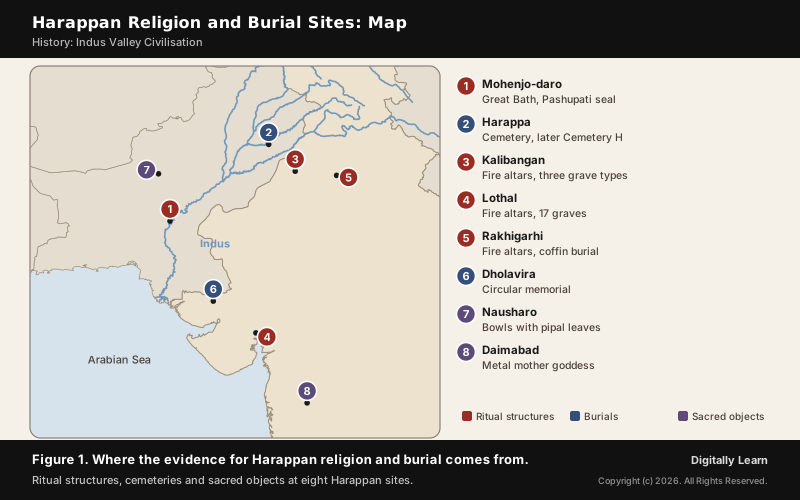
Fire altars point to a second kind of ritual. Kalibangan and Lothal had fire altars, where sacrifices may have been performed. At Kalibangan the southern half of the walled citadel held five or six raised mud-brick platforms carrying oval fire-pits of burnt brick, each with a sacrificial post in the middle. Fire altars have also been found at Rakhigarhi, and Lothal had both private and public altars.
Harappan Burial Practices: Extended Burials, Symbolic Graves and Cremation
Burials are the best evidence of Harappan ideas about death. Most of the dead were laid in pits, sometimes brick-lined, often with pots and ornaments and sometimes with copper mirrors. In the cemetery at Harappa, excavations in the mid-1980s found an ornament of three shell rings, a jasper bead and hundreds of micro beads near the skull of a man.
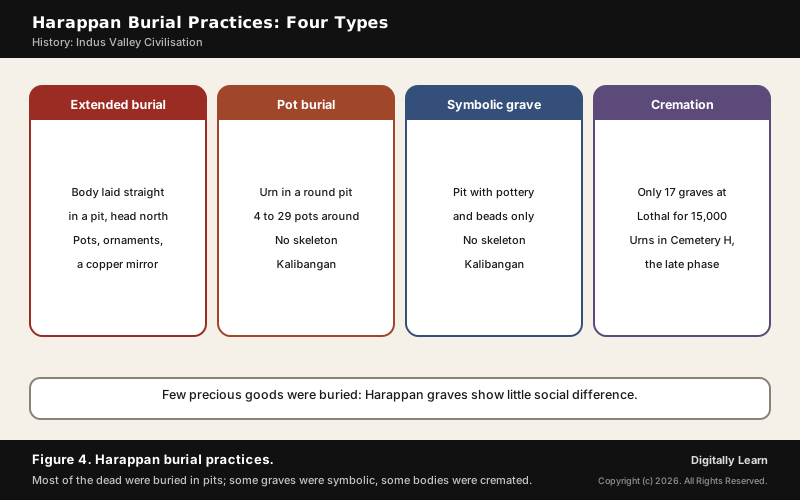
- Kalibangan: In a burial ground of about 34 graves, bodies were laid straight in pits with the head to the north amid pottery; other graves held an urn in a circular pit with 4 to 29 pots around it and no body; a third kind held only pottery and objects such as beads and shells. The last two may be symbolic burials.
- Lothal: Only 17 graves for an estimated population of 15,000 suggest that the dead were also cremated; burials after cremation have been noted at Harappa and other sites.
- Rakhigarhi: A cemetery of the mature phase has brick-covered grave pits, one with a wooden coffin, and 53 burials with 46 skeletons have been found.
- Dholavira: The great majority of burials in its cemetery are memorial in nature, and a huge circular structure of ten radial walls, like a spoked wheel, held no human remains.
- Late phase: The Cemetery H culture that followed stored cremated bones in painted pottery urns.
Harappan Religion and Later Indian Traditions
Did the Harappans Practise Hinduism? Continuity and Caution
No one can say whether the Harappans practised anything like later Hinduism. Several of their symbols have been read as early forms of later Indian ones: the sacred pipal, the swastika, the mother goddess, the seated horned figure, and rituals of water and fire. But conclusions about the Indus religion are partly speculative and largely based on a view from a much later Hindu perspective, and the one text that can be tested against the seal, the Rigveda's account of Rudra, does not fit it.
- Undeciphered script: If a bilingual inscription is ever found, questions about the languages the Harappans spoke might be settled.
- New after the Harappans: The cultural changes that followed the Harappan phase include the introduction of the horse, iron tools and new religious practices.
- Carts of the Harappans: Toy models of two-wheeled carts show that cattle were used for transport.
The continuity also had a break. In the Harappan sites still occupied after 1900 BCE, weights, seals and special beads disappeared, and so did writing, long-distance trade and craft specialisation. The subcontinent waited over a millennium for new cities, in a completely different region. What carried on was not the city but some of its symbols and practices.
- Egypt: Its religion, which lasted about 3,500 years, was suppressed in the Christian period and is considered to have died out fully in the 530s CE.
- Mesopotamia: Its religion declined with the spread of Christianity between the first and fifth centuries CE and had almost completely died out by about 400 to 500 CE.
- Greece: Official persecution of the old religion began under the Roman emperor Theodosius I in 381 CE, with priesthoods disbanded and temples destroyed.
How the cities declined, and the debate over the Aryans, is taken up in the decline of the Indus Valley civilisation and the Aryan question.
Previous Year UPSC-CSE Questions
Previous Year UPSC-CSE Questions By the end you will be able to draft model answers for the following UPSC questions. Each question carries a collapsible framework showing how to approach it in the exam.
- UPSC Mains 2015 GS-IThe ancient civilization in Indian sub-continent differed from those of Egypt, Mesopotamia and Greece in that its culture and traditions have been preserved without a breakdown to the present day. Comment.
Answer outline: how to structure the answer
What the question asks, the main arguments, relevant examples and the direction of the conclusion. This is not a full model answer.
Introduction: State that Indian civilisation shows continuity from Harappan times, unlike Egypt, Mesopotamia and Greece, but that the continuity is of symbols and practices, not of cities.
Body (sub-themes to develop):
- Continuity: pipal, swastika, mother goddess, a seated horned figure, fire altars, ritual bathing.
- Caution: these readings rest on later parallels; Rudra in the Rigveda does not fit the seal.
- Break: seals, script, weights and cities vanished after 1900 BCE; new cities came a millennium later.
- Contrast: Egyptian religion ended by the 530s CE, Mesopotamian by about 400 to 500 CE, Greek persecuted from 381 CE.
Conclusion: Conclude that India's continuity is real in beliefs and symbols but not unbroken, while the religions of the other three ancient civilisations did not survive.
- UPSC Prelims 2013 Prelims-GSWhich of the following characterizes/characterize the people of Indus Civilization?
- They possessed great palaces and temples.
- They worshipped both male and female deities.
- They employed horse-drawn chariots in warfare.
Select the correct statement/statements using the codes given below.
How to approach this Prelims question
Approach: Step 1: statement 1: no palace or great temple has been found; only the Great Bath is widely accepted as a religious building; wrong. Step 2: statement 2: the female figurines and the seated horned figure point to the worship of both female and male deities; correct. Step 3: statement 3: the Harappans had cattle-drawn carts, not horse-drawn chariots; wrong.
Trap to watch: No monumental palace is known, and the horse arrives after the Harappan phase.
Key facts to recall:
- (a) 1 and 2 only: wrong. No great palaces or temples have been found, so statement 1 is wrong.
- (b) 2 only: correct. Only the worship of both male and female deities describes the Indus people.
- (c) 1, 2 and 3: wrong. Statements 1 and 3 are wrong: no palaces, and carts drawn by cattle, not horse chariots.
- (d) None of the statements is correct: wrong. Statement 2 is correct.
Answer signal: 2 only, option (b).
- UPSC Prelims 2011 Prelims-GSRegarding the Indus Valley Civilization, consider the following statements :
- It was predominantly a secular civilization and the religious element, though present, did not dominate the scene.
- During this period, cotton was used for manufacturing textiles in India.
Which of the statements given above is/are correct?
How to approach this Prelims question
Approach: Step 1: statement 1: religion is present in the figurines, seals and fire altars, but only the Great Bath is widely accepted as a religious building and no temple dominates the cities; correct. Step 2: statement 2: cloth was found on a silver vase lid at Mohenjodaro, and the spinning of cotton and wool was common; correct.
Trap to watch: Plenty of religious objects does not mean religion dominated the cities.
Key facts to recall:
- (a) 1 only: wrong. Statement 2 is also correct: cotton was spun and woven.
- (b) 2 only: wrong. Statement 1 is also correct: religion was present but did not dominate the cities.
- (c) Both 1 and 2: correct. Both statements describe the civilization.
- (d) Neither 1 nor 2: wrong. Both statements are correct.
Answer signal: Both 1 and 2, option (c).
- UPSC Prelims 2025 Prelims-GSThe famous female figurine known as 'Dancing Girl', found at Mohenjo-daro, is made of
How to approach this Prelims question
Approach: Step 1: the Dancing Girl is a bronze figure from Mohenjodaro, cast by the lost-wax process. Step 2: clay was used for the many terracotta figurines and toys, and gold for ornaments, which is why those options are tempting.
Trap to watch: Terracotta was used for figurines, but the Dancing Girl is cast metal.
Key facts to recall:
- (a) Carnelian: wrong. The Dancing Girl is a metal casting made by the lost-wax process, not a stone object.
- (b) Clay: wrong. Clay was used for the terracotta figurines and toys, not for this figure.
- (c) Bronze: correct. The figure was cast in bronze by the lost-wax process.
- (d) Gold: wrong. Gold went into ornaments for the elite; the Dancing Girl is bronze.
Answer signal: Bronze, option (c).
Sources
- NCERT: Themes in Indian History Part I (Class XII), Bricks, Beads and Bones
- NCERT: Our Pasts I (Class VI), In the Earliest Cities
- NCERT: An Introduction to Indian Art Part I (Class XI), Arts of the Indus Valley
- PIB: India gets its 40th World Heritage Site, Dholavira (2021)
- National Museum, New Delhi: Harappan Civilization gallery
- National Museum, New Delhi: Life in Harappan Civilization (activity booklet)
- Ministry of Culture: Treasures of the National Museum, New Delhi
- Wikipedia: Indus Valley Civilisation
- Wikipedia: Pashupati seal
- Wikipedia: Priest-King (sculpture)
- Wikipedia: Dancing Girl (prehistoric sculpture)
- Wikipedia: Great Bath, Mohenjo-daro
- Wikipedia: Kalibangan
- Wikipedia: Lothal
- Wikipedia: Rakhigarhi
- Wikipedia: Dholavira
- Wikipedia: Cemetery H culture
- Wikipedia: Ficus religiosa
- Wikipedia: Swastika
- Wikipedia: Ancient Egyptian religion
- Wikipedia: Ancient Mesopotamian religion
- Wikipedia: Ancient Greek religion
- UPSC: Civil Services Examination question papers
Editorial Disclaimer
This article draws on the NCERT history and art textbooks and the other sources listed on this page. Every reading of Harappan religion is an interpretation of objects, since the script is undeciphered.