


Overview
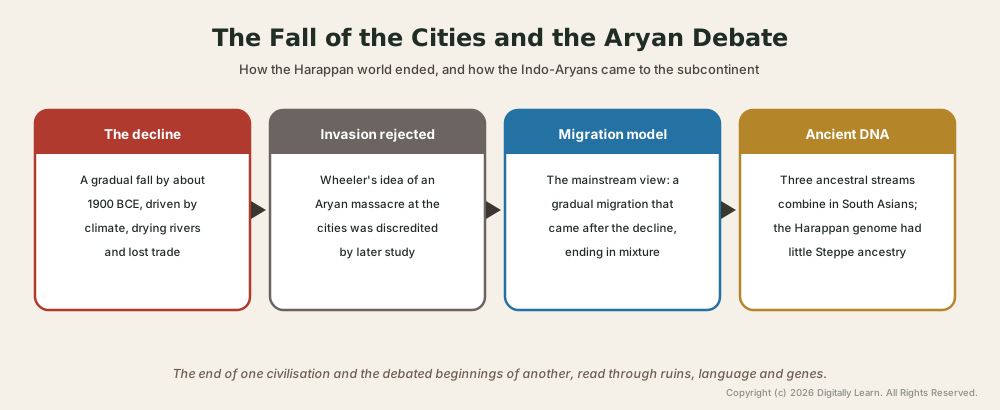
The decline of the Indus Valley Civilisation and the Aryan question are two of the most debated problems in early Indian history. By about 1900 BCE the great Harappan cities had been largely abandoned, though village life carried on in the countryside for centuries more. Historians now explain this fall not by one cause but by many causes acting together, above all a drier climate and the drying of the Ghaggar-Hakra river. A second, separate question is when and how the Indo-Aryan-speaking peoples, whose language became Sanskrit, reached the subcontinent. The old idea of a violent Aryan invasion that destroyed the cities has been set aside; the mainstream view today is of a gradual migration that came after the decline, with recent ancient DNA evidence reshaping the whole discussion.
De-urbanisation by 1900 BCE: What the Decline Actually Was
A Gradual Fall, Not a Sudden Collapse
What is the significance of the decline: the end of the Harappan cities marks the close of the first urban age of the subcontinent, and how we explain it shapes how we read every later chapter of ancient Indian history.
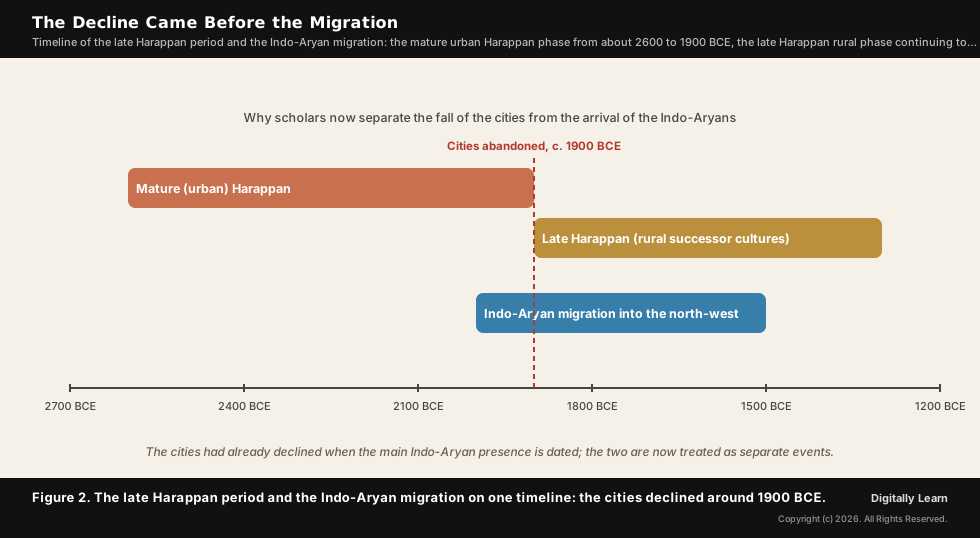
The decline was a de-urbanisation rather than a sudden death. From about 1900 BCE the cities lost their order: the great drains fell into disuse, long-distance trade shrank, the script and the standard weights passed out of use, and the population dispersed into smaller villages. The collapse was of the urban system, not of the people.
Distinguishing the Late Harappan phase: city life gave way to humbler rural cultures that carried on to about 1300 BCE. Archaeologists name them by region, the Cemetery H culture in the Punjab, the Jhukar culture in Sindh, and the Rangpur culture in Gujarat. These successor cultures show continuity in pottery and farming alongside the loss of the cities.
The Multi-Causal Decline: Climate, Rivers, Trade and Ecology
Why the Cities Were Abandoned: The Competing Explanations
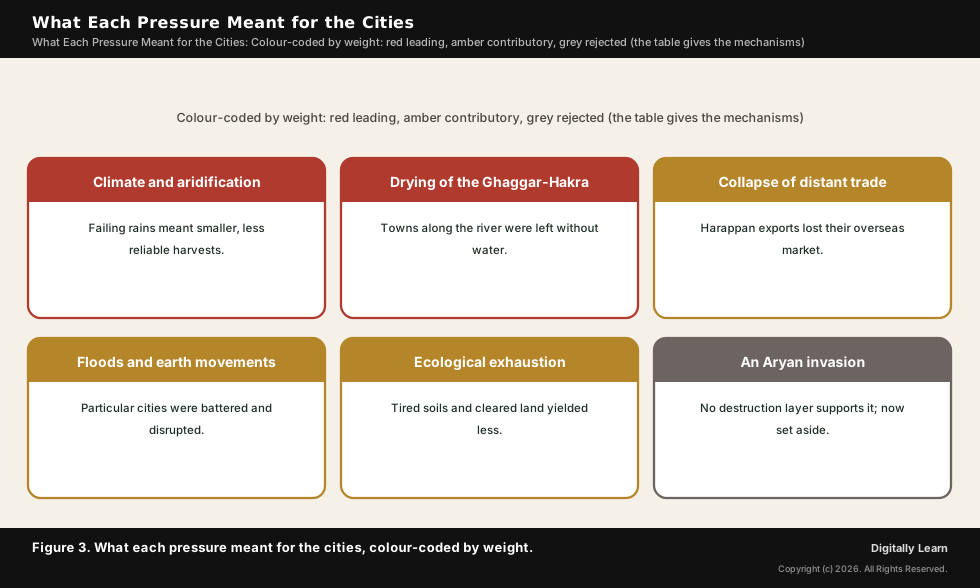
Why it matters: the modern answer is that no single cause brought the cities down. Several pressures acted together over generations, and the examiner rewards the student who can weigh them rather than name just one.
The leading explanation is environmental. A long-term weakening of the monsoon, part of the wider drying known as the 4.2 kiloyear event around 2200 to 1900 BCE, reduced the water and the harvests on which the cities depended. Closely tied to this was the drying and shifting of the Ghaggar-Hakra river system, which had watered many Harappan settlements.
Other causes were contributory. The collapse of Mesopotamian trade, after the fall of the Akkadian and Ur states around 2000 BCE, removed an important market for Harappan goods. Floods and earth movements, especially the repeated flooding of Mohenjo-daro, strained particular cities. Ecological exhaustion, through deforestation and the salting of over-worked soils, weakened the agricultural base.
| Explanation | Mechanism | Standing today |
|---|---|---|
| Climate and aridification | Weakening monsoon, the 4.2 kiloyear drying | Leading driver |
| Drying of the Ghaggar-Hakra | Loss and shifting of a major river | Leading driver |
| Collapse of distant trade | Fall of Mesopotamian cities, c. 2000 BCE | Contributory |
| Floods and earth movements | Repeated flooding at Mohenjo-daro | Contributory |
| Ecological exhaustion | Deforestation, soil salinity | Contributory |
| Aryan invasion | Destruction by incomers | Rejected |
The Saraswati and the Ghaggar-Hakra River Question
Distinguishing the river question: many Harappan sites cluster along the dry bed of the Ghaggar-Hakra, which some scholars identify with the Saraswati river praised in later Sanskrit texts. The river's fate is therefore central both to the decline and to the Aryan debate.
A study by Singh and colleagues in 2017 found that the great Himalayan channel that once flowed through this valley, fed by the Sutlej, had been abandoned long before the urban Harappan phase. During the time of the cities the Ghaggar-Hakra carried only a seasonal, monsoon-fed flow, not a mighty perennial river. As the monsoon weakened, even that flow failed, and the settlements along it were left without water.
The Aryan Invasion Theory and Why Scholars Rejected It
Wheeler's Invasion Thesis and the Massacre at Mohenjo-daro
What is the significance of the invasion theory: for much of the twentieth century the fall of the Harappan cities and the coming of the Indo-Aryans were treated as one event, a violent conquest, and that idea shaped a great deal of writing on early India.
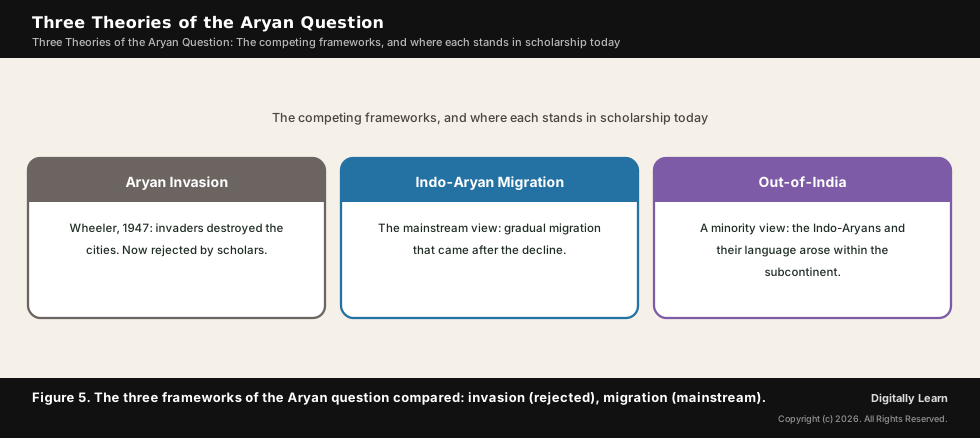
In 1947 the archaeologist Sir Mortimer Wheeler argued that invading Indo-Aryans had destroyed the cities. He pointed to scattered skeletons at Mohenjo-daro, which he read as the victims of a massacre, and to verses in the Rig Veda in which the god Indra shatters the walled strongholds, the pur, of his enemies. In a famous phrase he wrote that, on the circumstantial evidence, Indra stood accused.
How Later Archaeology Discredited the Massacre
Distinguishing the rebuttal: later study took the invasion theory apart on the evidence. In 1964 the archaeologist George Dales, in an essay titled The Mythical Massacre at Mohenjo-daro, showed that the skeletons came from different levels and different periods, not from a single moment of slaughter, and that the city showed no signs of battle, burning or sacked defences.
Two further points settled the matter. The Rig Vedic destruction of the pur is now read as ritual or pastoral language rather than the storming of Harappan cities. And the chronology does not fit: the cities had already declined by about 1900 BCE, while the Indo-Aryan presence is dated some centuries later. For these reasons the Aryan invasion theory is no longer held by mainstream scholarship.
The Indo-Aryan Migration Model and the Out-of-India Debate
Migration, Not Invasion: The Mainstream View
What is the significance of the migration model: with invasion set aside, the question becomes how an Indo-Aryan language and culture came to north-western India at all. The mainstream answer is migration, a slow movement of people and speech rather than a conquest.
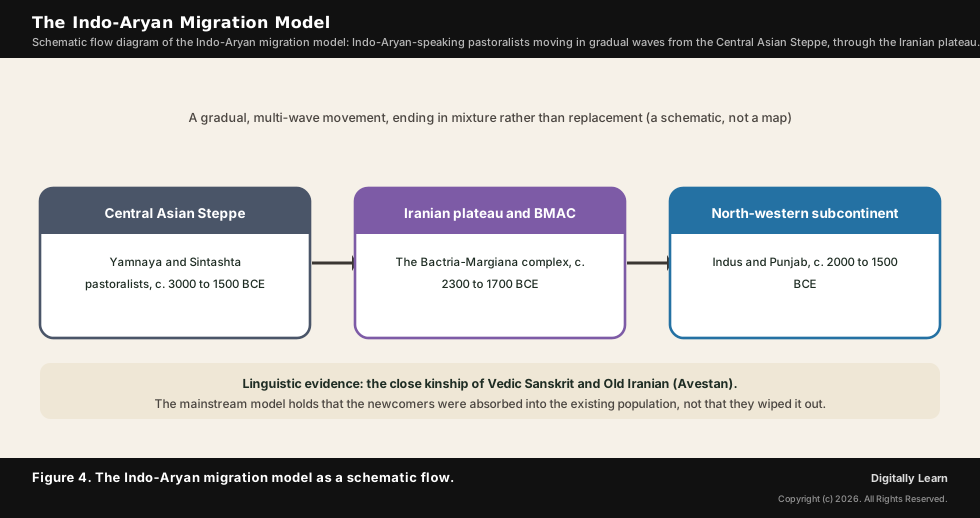
On this view, Indo-Aryan-speaking pastoralists moved in gradual, multiple waves out of the Central Asian Steppe, through the Iranian plateau and the Bactria-Margiana region, and into the Indus and Punjab plains between about 2000 and 1500 BCE. The strongest evidence is linguistic: Vedic Sanskrit is closely akin to Old Iranian, the language of the Avesta, which points to a shared origin not long before.
Distinguishing migration from invasion: the model describes absorption, not replacement. The newcomers were relatively few, and they mixed with the far larger existing population, so that the later Vedic culture grew out of a blending of peoples rather than the wiping out of one by another.
The Out-of-India Theory and the Indigenist Position
Distinguishing the Out-of-India theory: a minority of scholars reject any migration into the subcontinent. The Out-of-India theory holds that the Indo-Aryan languages, and the wider Indo-European family, arose within the subcontinent and spread outward to Iran and Europe. Its advocates include Shrikant Talageri, Subhash Kak and Michel Danino.
Their case rests on a claimed continuity between the Harappan and the Vedic worlds, and on identifying the Vedic Saraswati with the Ghaggar-Hakra. The mainstream response is that the linguistic, archaeological and genetic evidence all point the other way, placing the Indo-European homeland in the Steppe. The Out-of-India theory remains a minority position in academic study, though it carries weight in wider cultural and political debate.
A note on neutrality: this is a genuinely contested field, and a sensitive one, because it touches questions of who is native to the land. The responsible course, and the one the examiner expects, is to set out the rival theories and the state of the evidence fairly, without treating any one of them as a settled article of faith.
Ancient DNA and the Genetics of the Aryan Question
What the Rakhigarhi Genome and Steppe Ancestry Show
What is the significance of the genetic evidence: since 2018 the study of ancient DNA has given the debate a new and largely independent line of evidence, and it has done much to clarify, though not entirely to close, the question.
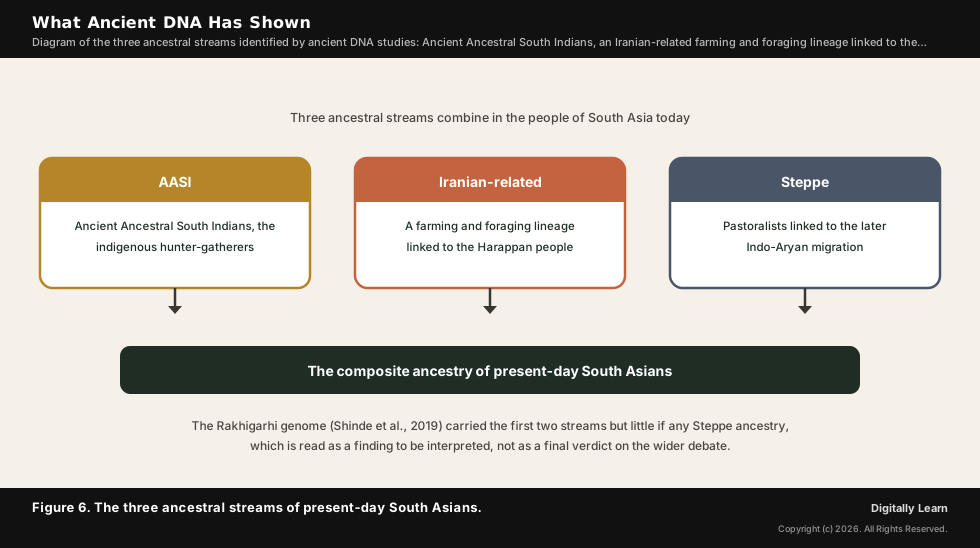
A large study by Narasimhan and colleagues in 2019 found that the ancestry of present-day South Asians is built from three streams: the Ancient Ancestral South Indians, the indigenous hunter-gatherers; an Iranian-related lineage linked to the Harappan farming population; and the Steppe pastoralists, whose ancestry entered the subcontinent in the second millennium BCE, in keeping with the migration model.
Distinguishing the Rakhigarhi finding: a genome from the Harappan site of Rakhigarhi, published by Shinde and colleagues in 2019, carried the indigenous and the Iranian-related ancestry but little if any Steppe ancestry. The Iranian-related component, moreover, had split off before farming began, which makes it deeper and more local than once thought. The careful reading is that this is a finding to be interpreted, not a verdict that ends the debate.
| Ancestral stream | Associated with | When it is dated |
|---|---|---|
| Ancient Ancestral South Indians | Indigenous hunter-gatherers | Deepest, pre-farming |
| Iranian-related lineage | The Harappan farming population | Split before farming began |
| Steppe pastoralists | The Indo-Aryan migration | Second millennium BCE |
The Current Consensus and the Making of Vedic India
How the Decline and the Migration Fit Together
What is the significance of the present consensus: the strands now join into a single, careful picture, and holding them apart is the key skill the topic demands.
The settled points are these. The decline of the Indus cities, around 1900 BCE, was multi-causal and chiefly environmental, and it was not caused by any invasion. The Indo-Aryan migration was a separate and later process, gradual rather than violent. The two were once fused into a single story of conquest; they are now firmly separated in time and in cause.
Contemporary linkages: out of the meeting of the migrant Indo-Aryans, the Harappan farming people and the older hunter-gatherers grew the composite ancestry of modern South Asians and, in time, the Vedic culture. The debate stays alive in current research, through fresh excavation at sites such as Rakhigarhi and continued work on ancient DNA, and it remains charged in public discussion, which is exactly why a calm and evidence-led treatment matters.
The Vedic Society and Religion that Emerged
What is the significance of the Vedic outcome: the meeting of peoples in the centuries after the decline produced the early Vedic culture, whose society and religion became the foundation of much that is recognisably Indian, so the Aryan question matters far beyond archaeology.
Distinguishing Vedic society: the early, Rig Vedic people were a pastoral and tribal folk of the Punjab, organised into tribes, the jana, under a chief whose power was checked by the tribal assemblies, the sabha and the samiti. In the later Vedic age they moved east into the Ganga plain, settled to agriculture, and the fourfold varna order, set out in the late Purusha Sukta hymn of the Rig Veda, hardened into a fixed social hierarchy.
Distinguishing Vedic religion: worship centred on the nature deities, chief among them Indra, Agni the fire, and Varuna, praised in the hymns of the Rig Veda. The central act was the yajna, the fire sacrifice, which grew more elaborate and priest-led in the later Vedic age, until the Upanishads, at the close of the period, turned from ritual towards the philosophy of the self and the absolute.
What still prevails: much of this endures in present-day India. Sanskrit and its daughter languages remain living tongues; the fire ritual survives in the Hindu havan; deities such as Agni and the Sun are still invoked, and the Gayatri verse of the Rig Veda is still recited; and the varna idea casts a long shadow over the later caste order. The continuity the examiner asks about is therefore real and deep.
UPSC Relevance and Exam Focus
Where This Fits in the UPSC-CSE Syllabus
This topic belongs to General Studies Paper I: ancient Indian history and culture, and it also feeds the wider debates on Indian society and identity that surface in essay and interview.
For Prelims, hold the firm facts: the cities declined by about 1900 BCE from many causes, chiefly climate and the drying of the Ghaggar-Hakra; the Aryan invasion theory is rejected; the mainstream model is gradual migration; and ancient DNA finds three ancestral streams, with the Harappan genome carrying little Steppe ancestry.
For Mains, the strongest answers separate the decline from the migration, weigh the competing causes of the decline, and present the invasion, migration and Out-of-India theories as a live debate that language and genetics have reshaped, without taking sides.
Recurring linked concepts an aspirant should keep in working memory:
- The decline: Gradual de-urbanisation by about 1900 BCE, multi-causal.
- Leading causes: A drier climate and the drying of the Ghaggar-Hakra.
- The invasion theory: Wheeler 1947, discredited by Dales 1964.
- The mainstream model: Gradual Indo-Aryan migration, not invasion.
- Ancient DNA: Three streams; the Rakhigarhi genome had little Steppe ancestry.
A common Prelims trap is to credit the Aryan invasion with the fall of the cities. The mainstream view rejects this; the decline was chiefly environmental and came before the Indo-Aryan presence.
A common Mains trap is to treat the Aryan question as settled in any one direction. The disciplined answer presents migration as the mainstream view, notes the Out-of-India theory as a minority position, and lets the evidence speak.
Previous Year UPSC-CSE Questions
Previous Year UPSC-CSE Questions By the end you will be able to draft model answers for the following UPSC questions. Each question carries a collapsible framework showing how to approach it in the exam.
- UPSC Mains 2023 GS-IWhat are the main features of Vedic society and religion? Do you think some of the features are still prevailing in Indian society?
How to structure the answer in the exam
Introduction: Open with the Vedic culture as the synthesis that emerged after the Indus decline and the Indo-Aryan migration.
Body (sub-themes to develop):
- Vedic society: a pastoral, tribal early Vedic people (the jana, the sabha and samiti) moving to settled agriculture and a hardening fourfold varna order in the later Vedic age.
- Vedic religion: worship of nature deities (Indra, Agni, Varuna), the central fire sacrifice (yajna), the Rig Veda, and the Upanishadic turn to the self and the absolute.
- Continuity: Sanskrit and its daughter languages, the surviving fire ritual (havan) and Vedic deities, the Gayatri verse, and the long shadow of varna on the caste order.
Conclusion: Conclude that many Vedic features, in language, ritual and social order, still prevail, so the Vedic age remains a living foundation of Indian society.
Sources and Further Reading
- Wikipedia: Indus Valley Civilisation
- Wikipedia: Indo-Aryan migrations
- Wikipedia: 4.2-kiloyear event
- Wikipedia: Rakhigarhi
- Wikipedia: Genetics and archaeogenetics of South Asia
- Wikipedia: Mortimer Wheeler
- Wikipedia: Ghaggar-Hakra River
- Wikipedia: Mohenjo-daro
- Wikipedia: Vedic period
- Wikipedia: Historical Vedic religion
Editorial Disclaimer
This article is for UPSC preparation. The Aryan question is an area of active scholarly debate, and the dates and interpretations given here represent the current mainstream view, not a final settlement. Verify specific details before relying on them.