


Overview
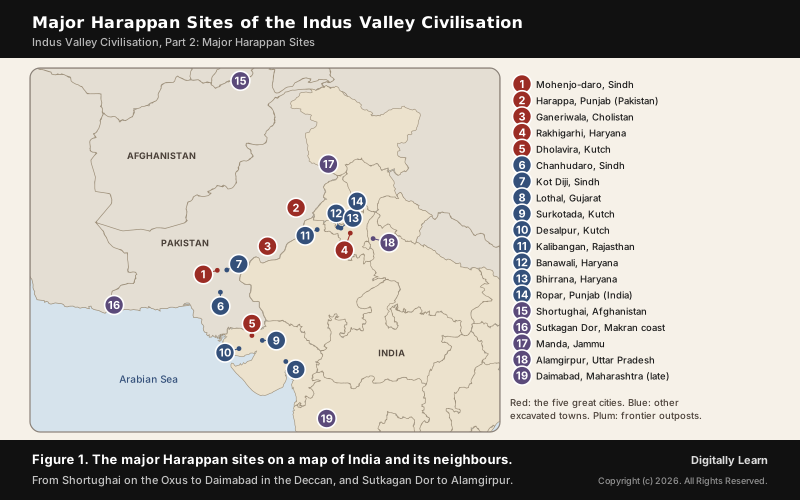
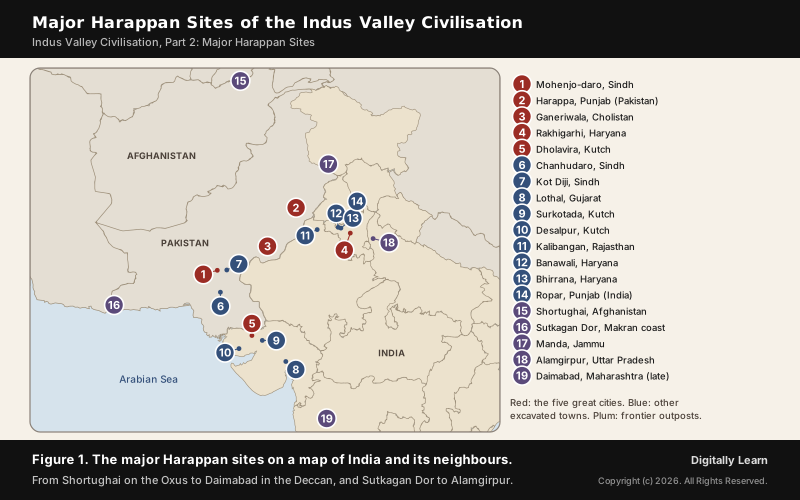
Harappan sites are the settlements of the Indus Valley or Harappan civilisation (c. 2600 to 1900 BCE), found from Afghanistan and Baluchistan to Jammu, Haryana and Gujarat. More than a thousand have been reported, but five were great cities: Mohenjo-daro, Harappa and Ganeriwala in Pakistan, and Rakhigarhi and Dholavira in India. Each major site is remembered for a signature find, such as the Great Bath at Mohenjo-daro, the dockyard at Lothal and the ploughed field at Kalibangan.
Harappan Sites at a Glance
Major Harappan Sites and Their Findings: The Master List
The civilisation is named after Harappa, the first site where it was discovered, and it is dated between about 2600 and 1900 BCE. The major sites, where they are today and what each is best known for are set out below; the sections that follow explain each one.
| Site | Where it is today | Best known for |
|---|---|---|
| Mohenjo-daro | Sindh, Pakistan | Great Bath, citadel, drains, Dancing Girl |
| Harappa | Punjab, Pakistan | First site found; store houses |
| Chanhudaro | Sindh, Pakistan | Bead-making and craft town |
| Dholavira | Kutch, Gujarat | Stone reservoirs, three-part city, signboard |
| Lothal | Ahmedabad, Gujarat | Dockyard, bead workshop, warehouse |
| Surkotada | Kutch, Gujarat | Bones described as horse, disputed |
| Kalibangan | Hanumangarh, Rajasthan | Earliest ploughed field, fire altars |
| Rakhigarhi | Hisar, Haryana | One of the largest sites; human DNA |
| Banawali | Fatehabad, Haryana | Terracotta plough model, planned fort town |
| Ropar | Rupnagar, Punjab | First site dug in independent India |
| Site | Found or excavated by |
|---|---|
| Mohenjo-daro | R. D. Banerji found the first seals |
| Harappa | Daya Ram Sahni |
| Chanhudaro | N. G. Majumdar, 1931 |
| Dholavira | J. P. Joshi found it; R. S. Bisht excavated it |
| Lothal | Archaeological Survey of India, 1955 to 1960 |
| Surkotada | J. P. Joshi, 1964 |
| Kalibangan | B. B. Lal, 1960s |
| Rakhigarhi | Amarendra Nath |
| Banawali | R. S. Bisht, 1974 |
| Manda | J. P. Joshi, 1976 to 1977 |
How Many Harappan Sites Are There and Which Is the Largest
More than a thousand Mature Harappan sites have been reported and nearly a hundred excavated, but only five were major urban centres: Mohenjo-daro in the lower Indus valley, Harappa in western Punjab, Ganeriwala in the Cholistan desert, Dholavira in Gujarat and Rakhigarhi in Haryana. Sizes varied enormously: Chanhudaro covered less than 7 hectares, Mohenjo-daro about 125.
Which is the largest is disputed. After two more mounds were found in 2014, the Archaeological Survey of India claimed that Rakhigarhi, with remains spread over 300 to 350 hectares, was the largest known Harappan site, but that figure includes outlying remains that were probably not one town at one time. The safe answer for an examination is that Rakhigarhi is one of the largest Harappan sites and the largest in India.
Harappan Sites in Pakistan: Mohenjo-daro, Harappa and Chanhudaro
Mohenjo-daro: The Great Bath, the Citadel and the Lower Town
Mohenjo-daro, "Mound of the Dead" in Sindhi, lies near the west bank of the lower Indus in Larkana district of Sindh. Built about 2500 BCE and home to at least 40,000 people, it is the best-known Harappan site, and in 1980 it became the first UNESCO World Heritage Site in South Asia. R. D. Banerji found seals there like those from Harappa, which first suggested a single culture.
- Citadel and Lower Town: A smaller, higher Citadel built on mud-brick platforms and a larger Lower Town, each walled.
- Streets and drains: Streets on a rough grid; every house connected to covered street drains.
- Houses and wells: Courtyard houses with bathrooms, and about 700 wells across the city.
- Great Bath: A tank about 12 by 7 metres and 2.4 metres deep, made watertight with bricks set on edge in gypsum mortar, probably for a special ritual bath.
- Warehouse: A massive structure on the Citadel; its use as a granary is debated.
The planning began below ground. Most buildings stood on platforms, and it has been calculated that laying the foundations alone needed about four million person-days of labour; building was then confined to the platforms, so the city was planned first and built afterwards. Its bricks, sun-dried or baked, followed a standard ratio: length four times and breadth twice the height, the same at every Harappan settlement. The city prospered for centuries and was abandoned by about 1700 BCE.
Several famous objects come from Mohenjo-daro. When the finds were divided after 1947, Pakistan kept the stone Priest-King, and India kept the bronze Dancing Girl and the Pashupati seal; most of India's share is in the National Museum, New Delhi.
Harappa: The First Site Discovered and the Brick Robbers
Harappa, near the former course of the Ravi about 24 km west of Sahiwal in Pakistani Punjab, was the first Harappan site to be discovered, which is why the whole civilisation is named after it. It covered about 150 hectares at its height. Its fate shows how much was lost: in 1875 Alexander Cunningham, the first Director-General of the Archaeological Survey, noted that its bricks had been carried off to lay about 100 miles of the Lahore-Multan railway.
Daya Ram Sahni found seals at Harappa in the early twentieth century in layers far older than the early historic cities, and in 1924 John Marshall, the Director-General, announced the discovery of a new civilisation in the Indus valley. Harappa had elaborate store houses, and burials excavated in its cemetery in the mid-1980s included an ornament of shell rings, a jasper bead and hundreds of micro beads.
Chanhudaro, Kot Diji and Ganeriwala: Craft Town, Early Site and Lost City
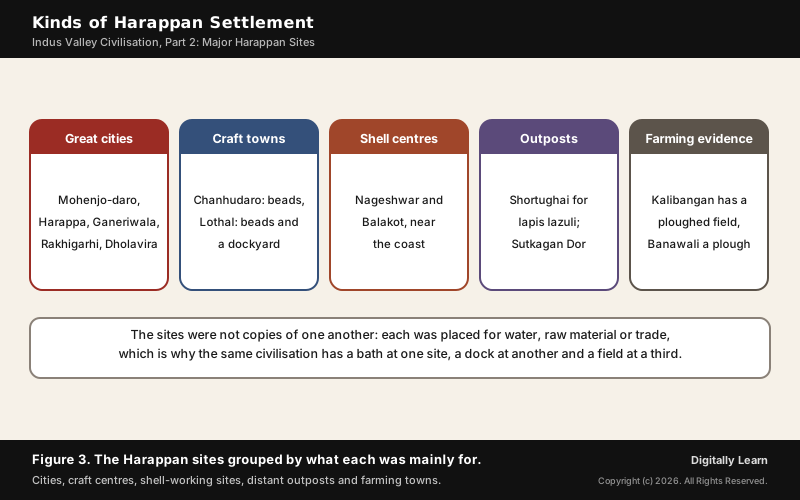
Chanhudaro, about 130 km south of Mohenjo-daro, was a tiny settlement of under 7 hectares given almost entirely to craft production: bead-making, shell-cutting, metal-working, seal-making and weight-making. It is known above all for carnelian beads, and specialised drills for boring beads have been found there, at Lothal and at Dholavira. N. G. Majumdar first excavated it in 1931.
Kot Diji, on the east bank of the Indus opposite Mohenjo-daro, shows the early, formative stage of the civilisation: its earliest layers, with fortifications of unbaked mud-brick, are older than the Mature Harappan cities. Ganeriwala, in the Cholistan desert, was one of the five great cities, but it was rediscovered only in the 1970s and has not been properly excavated.
Harappan Sites in Gujarat: Dholavira, Lothal, Surkotada and Desalpur
Dholavira: Water Reservoirs, a Three-Part City and the Signboard
Dholavira stands on the island of Khadir in the Great Rann of Kutch, on the Tropic of Cancer. A villager, Shambhudan Gadhvi, drew attention to it in the early 1960s; J. P. Joshi of the Archaeological Survey recorded it in 1967 or 1968, and the Survey excavated it under R. S. Bisht between 1990 and 2005. It was occupied for more than 1,500 years, and it was inscribed as India's 40th World Heritage Site on 27 July 2021.
- Three-part plan: Most Harappan cities had two parts; Dholavira had three, a castle with its bailey, a middle town and a lower town, each fortified.
- Water management: Stone-built reservoirs and channels stored rainwater and water diverted from two seasonal streams, the Mansar and the Manhar.
- The signboard: Ten large signs of the Indus script, carved from white stone and probably inlaid in wood, about 3 metres long; writing is usually found only on small objects.
- Trade: Its position gave access to copper, shell, agate-carnelian and steatite, and to trade with Magan (Oman) and Mesopotamia.
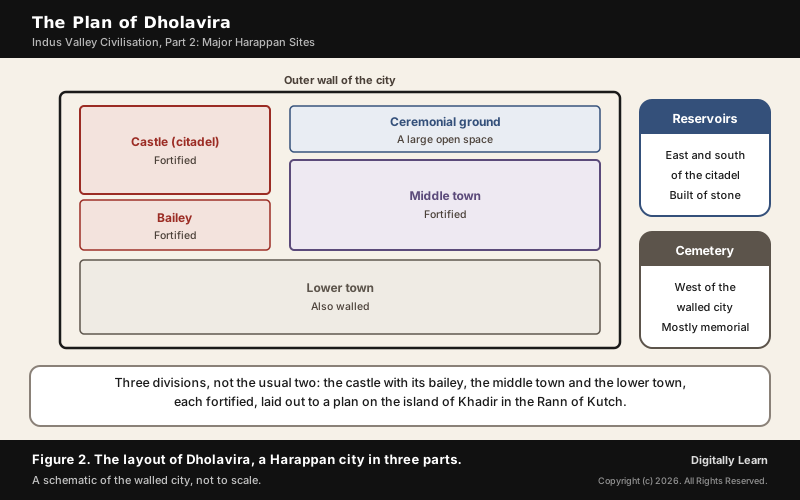
Dholavira covered about 47 hectares, and the Press Information Bureau describes it as the sixth largest of more than 1,000 Harappan sites. Excavation in 2014 began on a rectangular stepwell 73.4 metres long, 29.3 metres wide and 10 metres deep, about three times the size of the Great Bath. The city was repeatedly shaken by earthquakes, and most burials in its cemetery west of the city were memorials, not graves.
Lothal, Surkotada and Desalpur: Dockyard, Bead Workshop and Kutch Forts
Lothal lies in the Bhal region of Ahmedabad district, beside a tributary of the Sabarmati near the Gulf of Khambhat. The Archaeological Survey found it in 1954 and dug it from 1955 to 1960. It was built around 2300 BCE and is one of the southernmost Harappan sites. Unlike most cities, its Citadel was not walled off but simply built at a height.
- The dockyard: A large brick basin linked by channels to the river; the archaeologist S. R. Rao read it as a dock, and marine microfossils found inside support that reading, though some archaeologists call it an irrigation tank.
- Bead workshop: A building with stone pieces, half-made beads, tools and finished beads.
- Warehouse: A store house where many seals and sealings were found.
- Raw materials: It lay near sources of carnelian, steatite and metal, which explains its crafts.
- Fire altars: Like Kalibangan, Lothal had fire altars, where sacrifices may have been performed.
Lothal shows that planning reached small towns too: its houses were of mud brick but its drains were of burnt brick. Its sheltered harbour, its cotton and rice-growing surroundings and its bead industry drew the Harappans there, and its beads and gems were in demand as far as West Asia.
Surkotada, in Rapar taluka of Kutch, is a small fortified site of about 1.4 hectares, found by J. P. Joshi in 1964. It is famous for a debate: its excavators described bones from all its levels as those of the horse, an animal otherwise hard to trace in the Harappan world. Some experts accepted that a few samples were true horse, while others argue that horse bones cannot easily be told apart from those of the ass or the onager.
Desalpur (Desalpar Gunthli), about 25 km from Bhuj in Nakhatrana taluka, is another modest Kutch site, about 130 by 100 metres, on the bank of a seasonal stream. Many such Kutch sites are known because, after 1947, Indian archaeologists surveyed it closely to find sites on the Indian side of the border.
Harappan Sites in Rajasthan, Haryana and Punjab
Kalibangan: The Earliest Ploughed Field and the Fire Altars
Kalibangan lies on the left bank of the Ghaggar in Hanumangarh district of Rajasthan. The Italian scholar Luigi Tessitori first recognised its ruins as very ancient, and B. B. Lal excavated it through the 1960s. By about 2900 BCE the settlement had become a planned town, and the excavation report calls it a major provincial capital of the civilisation.
Kalibangan has given the world's earliest attested ploughed field, dated to about 2800 BCE and belonging to Early Harappan levels. It has two sets of furrows at right angles, which suggests that two crops were grown together in the same field. The site is also known for its fire altars, where sacrifices may have been performed, a feature it shares with Lothal.
Rakhigarhi, Banawali and Bhirrana on the Ghaggar Plain
Rakhigarhi, in Hisar district about 150 km north-west of Delhi, is made up of the villages of Rakhi-Khas and Rakhi-Shahpur, with seven mounds on the right bank of a dried palaeo-channel of the Drishadvati. It shows every stage from pre-Harappan to Mature Harappan, and the 2020 Union Budget named it one of five iconic archaeological sites to be developed. A granary of seven chambers has been found, and DNA from a single skeleton, published in 2019, showed no steppe ancestry.
Banawali, in Fatehabad district on the dry bed of the ancient Sarasvati, was excavated by R. S. Bisht in 1974. It shows three stages, pre-Harappan, Harappan and post-Harappan; a planned, fortified Harappan town on a chessboard pattern; a terracotta model of a plough; and a touchstone streaked with gold. Nearby Bhirrana has yielded some very early dates, whose interpretation is still debated.
Frontier Harappan Sites: Ropar, Shortughai, Sutkagan Dor and Beyond
Ropar and the Outposts at the Edges of the Harappan World
Ropar (Rupnagar) on the Sutlej in Punjab was the first Harappan site excavated after India's independence, and it shows occupation from Harappan to medieval times. The frontier sites below mark the edges of the civilisation, from the Oxus to the Deccan, and are asked about as the northernmost, westernmost and easternmost sites:
| Site | Where | Why it matters |
|---|---|---|
| Shortughai | Northern Afghanistan, on the Oxus | Northernmost; a trading post near the lapis lazuli mines |
| Sutkagan Dor | Makran coast near Gwadar, Pakistan | Westernmost; stone walls, near the Iranian border |
| Manda | Jammu district, Jammu and Kashmir | A northern Harappan site, dug by J. P. Joshi in 1976 to 1977 |
| Alamgirpur | Meerut district, Uttar Pradesh | Easternmost, in the Ganga-Yamuna doab |
| Daimabad | Ahmednagar district, Maharashtra | Late Harappan culture in the Deccan; bronzes |
Sites near raw materials explain these frontiers. The Harappans set up Nageshwar and Balakot near the coast for shell, and Shortughai near the best source of lapis lazuli. Lothal sat near carnelian from Bharuch, and copper probably came from the Khetri region of Rajasthan and from Oman.
Harappan Sites in UPSC Previous Year Questions
What UPSC Has Asked About Harappan Sites
UPSC's objective questions on the sites test two things: matching a site to its signature find, and recognising which places are Harappan at all. The Mains question on Harappan architecture expects site evidence: Mohenjo-daro's citadel, drains and Great Bath, Dholavira's reservoirs and three-part plan, and Lothal's dockyard.
| Year | What the question asked | The point being tested |
|---|---|---|
| 2021 | The town known for bunds, check-dams and connected reservoirs | Dholavira |
| 2019 | Which of Chanhudaro, Kot Diji, Sohgaura and Desalpur is not Harappan | Sohgaura, a Mauryan site |
| 2025 | The material of the Dancing Girl of Mohenjo-daro | Bronze |
| 2025 Mains | The salient features of Harappan architecture | Site evidence for planning and engineering |
Previous Year UPSC-CSE Questions
Previous Year UPSC-CSE Questions By the end you will be able to draft model answers for the following UPSC questions. Each question carries a collapsible framework showing how to approach it in the exam.
- UPSC Mains 2025 GS-IDiscuss the salient features of the Harappan architecture.
How to structure the answer in the exam
Introduction: Open with the Harappan city as a planned settlement, first laid out and then built.
Body (sub-themes to develop):
- Planning: a raised, walled citadel and a larger lower town; streets on a rough grid.
- Materials: baked and sun-dried bricks of a standard ratio, laid on massive platforms.
- Sanitation: covered street drains, house bathrooms and about 700 wells at Mohenjo-daro.
- Public structures: the Great Bath and the warehouse; Dholavira's reservoirs; Lothal's dockyard.
- Variation: Dholavira's three parts, Lothal's unwalled raised citadel.
Conclusion: Conclude that the architecture reflects organised authority and civic engineering.
- UPSC Prelims 2021 Prelims-GSWhich one of the following ancient towns is well-known for its elaborate system of water harvesting and management by building a series of dams and channelizing water into connected reservoirs?
How to approach this Prelims question
Approach: Link the description of reservoirs and channels to the site famous for water management.
Trap to watch: Kalibangan and Rakhigarhi are major sites too, but they are known for other finds.
Key facts to recall:
- Dholavira: stone reservoirs fed by rainwater and two seasonal streams
Answer signal: Dholavira, option (a).
- UPSC Prelims 2019 Prelims-GSWhich one of the following is not a Harappan site?
How to approach this Prelims question
Approach: Check each place against the Harappan map.
Trap to watch: Desalpur is a small Kutch site, easily mistaken for a later one.
Key facts to recall:
- Chanhudaro and Kot Diji are in Sindh; Desalpur is in Kutch
- Sohgaura is known for a Mauryan copper-plate inscription
Answer signal: Sohgaura, option (c).
- UPSC Prelims 2025 Prelims-GSThe famous female figurine known as 'Dancing Girl', found at Mohenjo-daro, is made of
How to approach this Prelims question
Approach: Recall the material of the most famous Harappan figurine.
Trap to watch: Carnelian is famous at Chanhudaro and Lothal for beads, not for figurines.
Key facts to recall:
- The Dancing Girl of Mohenjo-daro is a bronze figure
- India kept it when the finds were divided
Answer signal: Bronze, option (c).
Sources
- NCERT: Themes in Indian History Part I (Class XII), Bricks, Beads and Bones
- NCERT: Our Pasts I (Class VI), In the Earliest Cities
- Press Information Bureau: India gets its 40th World Heritage Site, Dholavira
- Press Information Bureau: Rakhi Garhi Is Being Developed as One of the Five Identified Iconic Archaeological Sites
- Haryana Tourism: Ancient Site of Rakhigarhi
- Haryana Tourism: Ancient Site of Banawali
- Incredible India (Ministry of Tourism): Dholavira
- Wikipedia: Indus Valley Civilisation
- Wikipedia: Mohenjo-daro
- Wikipedia: Harappa
- Wikipedia: Chanhudaro
- Wikipedia: Kot Diji
- Wikipedia: Dholavira
- Wikipedia: Lothal
- Wikipedia: Surkotada
- Wikipedia: Kalibangan
- Wikipedia: Rakhigarhi
- Wikipedia: Banawali
- Wikipedia: Rupar
- Wikipedia: Shortugai
- Wikipedia: Sutkagan Dor
- Wikipedia: Alamgirpur
- Wikipedia: Daimabad
- Wikipedia: Sohgaura copper plate inscription
- UPSC: Civil Services Examination question papers
Editorial Disclaimer
This article is for UPSC preparation. Site attributions follow the Archaeological Survey of India and standard histories; a few finds, such as the Surkotada horse, remain debated, and positions on the map are indicative. Verify specific details before relying on them.