


Overview
The Chola dynasty was a Tamil dynasty of the Kaveri valley. It was one of the three crowned royal houses of Tamilakam, along with the Cheras and the Pandyas, and under the medieval Cholas it ruled a maritime empire whose arms reached beyond the peninsula to Sri Lanka, the Maldives and parts of South-East Asia. The Cholas governed varying territories until the thirteenth century CE, and for about three centuries, between 907 and 1215 CE, they held peninsular India south of the Tungabhadra as one state.
Chola Dynasty Periods: Sangam Cholas to the Later Cholas
Four Phases of Chola History
The imperial Chola period runs from about 850 to 1279. The history of the dynasty falls into four periods:
- The Early Cholas of Sangam literature, known from poems, Ashokan inscriptions and foreign notices.
- An interregnum of roughly three centuries in which the family lost its power.
- The imperial Cholas, the line of Vijayalaya, from about the middle of the ninth century.
- The Later Cholas, from Kulottunga I in 1070, who ruled a Chola-Chalukya kingdom until the Pandyas ended it.
Early Cholas of the Sangam Age and the Long Eclipse
The Cholas appear in the Major Rock Edicts of the Mauryan emperor Ashoka (273 to 232 BCE) as one of his southern neighbours, not subject to him but on friendly terms. Edict II lists the Chola, Pandya, Satiyaputra and Keralaputra kingdoms among the places where Ashoka arranged care for people and animals, and Edict XIII records the victory of Dhamma among the Cholas and Pandyas as far as Sri Lanka. The earliest datable references to the Cholas are these inscriptions of the third century BCE. Foreign notices add the Chola country, its towns, ports and commerce to the picture.
Sangam literature, composed between about 300 BCE and 300 CE, names two Chola kings above the rest, Karikala and Kocengannan. Their oldest capital was Uraiyur, now part of Tiruchirappalli, and Kaveripattinam on the coast also served as a capital. The royal emblem of the Cholas was the tiger, while the bow stood for the Cheras and the fish for the Pandyas.
After the Sangam age the family went into a long eclipse. The Kalabhras invaded the Tamil country and displaced the older kingdoms, and the Pandyas and the Pallavas replaced the Kalabhras in the sixth century. The Cholas almost disappeared from the Tamil land, though branches of the family survived among the Telugu Cholas, and the family had to wait about three centuries for Vijayalaya to revive it.
Rise of the Imperial Cholas from Vijayalaya to Parantaka I
Vijayalaya, Founder of the Imperial Cholas, and the Capture of Thanjavur
The founder of the imperial Chola line was Vijayalaya. In the middle of the ninth century the Pallavas and the Pandyas were fighting for supremacy in the south, and Vijayalaya used that struggle to defeat Elango Mutharaiyar, the last ruler of the Mutharaiyar family, and capture Thanjavur. Thanjavur became the capital of the imperial Cholas. Vijayalaya is placed at about 850, and his reign is given as 850 to 871.
NCERT places the revival of the Cholas under Vijayalaya in the ninth century; other accounts give 848 for the founding of the empire and 850 for the start of his reign, so the revival is best dated to about the middle of the ninth century.
Aditya I and Parantaka I and the Growth of Chola Power
Aditya I, the son of Vijayalaya, expanded the kingdom by defeating the Pallavas, bringing most of present-day Tamil Nadu under Chola control. He invaded Tondai Nadu in 897, killed the Pallava king Aparajita in battle, and annexed the Pallava lands. The Western Ganga king acknowledged his overlordship, and he took Kongu Nadu, which had been under the Pandyas. He died in 907 and was succeeded by his son Parantaka I.
Parantaka I (907 to 955) turned south and captured Madurai, the Pandya capital, early in his reign, and he took the title Maduraikonda, the capturer of Madurai. The decisive battle against the Pandyas and their Sri Lankan allies was fought at Vellur, around 915. Around 946 to 947 he sent an army to Sri Lanka to recover the Pandya royal insignia, which the Pandya king had left there. The Chola army sacked Anuradhapura, but the insignia had been moved to Rohana, in the south of the island, and Parantaka never recovered them. They were recovered in the reign of his grandson Rajendra I.
Parantaka also held the north against the Rashtrakutas for a time. He defeated the Rashtrakuta king Krishna II at Vallala. By the end of his reign the Cholas ruled the Tamil country from Kanyakumari north towards Nellore.
Takkolam, the Rashtrakuta Setback and Chola Recovery
The northern frontier broke in 949. At Takkolam in North Arcot the Rashtrakuta emperor Krishna III defeated the Chola army, which was led by Parantaka's eldest son and crown prince, Rajaditya. Rajaditya was killed in the battle, and the Chola records remember him as the prince who died on the back of an elephant.
The Rashtrakutas conquered the eastern and northern parts of the Chola territory and Krishna III took the title Tanjaiyunkonda, the conqueror of Thanjavur. The defeat undid much of the gain of Parantaka's earlier reign and opened a period in which the succession was disputed.
The Cholas recovered under Parantaka II, also called Sundara Chola. His son Aditha Karikalan, the crown prince, commanded an army that defeated the Pandyas and expanded the kingdom to Tondaimandalam, but he was assassinated in a political plot. Parantaka II was followed by Uttama Chola, who ruled from 971 to 985. In 985 Arulmozhi Varman took the throne with the regnal name Rajaraja, and the empire of the next fifty years began.
Chola Rulers and Conquests from Rajaraja I to Kulottunga I
Rajaraja I and the Making of the Empire
Rajaraja I ruled from 985 to 1014 and is regarded, with his son, as the greatest of the Chola rulers. He was the first Chola king to conquer northern Sri Lanka. He inherited a small kingdom centred on the Thanjavur and Tiruchirappalli region and turned it into an empire with a strong army and navy.
- South and west: About 988 he destroyed ships at Kandalur Salai on the Kerala coast. He conquered the Pandyas and took the title Pandya Kulashani, and the Pandya territory became Rajaraja Mandalam. Once his authority in the south was secure he took the title Mummudi Chola, the three-crowned, for his power over the Cholas, Pandyas and Cheras.
- Sri Lanka: In 993 he took Anuradhapura and annexed the northern part of Sri Lanka, called Ila-mandalam in Chola records; the province was renamed Mummudicholamandalam after his title Mummudi Chola. Polonnaruwa became the provincial capital, renamed Jananathamangalam.
- North and Deccan: His armies fought the Western Chalukyas and the Western Gangas up to the Tungabhadra, brought Vengi under a viceroy placed by the Cholas, and reached Kalinga, which marked the northern boundary of the empire at that time.
- Islands: A naval campaign took the Maldive Islands, which mattered for control of trade with South-East Asia.
His administrative work is as important as his wars. He began a land survey in 1000 that regrouped the Tamil country into units called valanadus, and the Brihadisvara temple at Thanjavur was inaugurated in 1009 to 1010. NCERT gives 1014 as the last year of his reign, while other accounts give 1012. His son Rajendra served as co-regent from 1012.
Rajendra I and the Reach Beyond the Peninsula
Rajendra I ruled from 1014 to 1044, and under him the empire reached its zenith. He completed the conquest of Sri Lanka by invading Rohana, and by his fifth year he claimed to have conquered the whole island. He recovered the Pandya royal insignia that had been kept there since Parantaka's time. Lakshadweep and the Maldives, the latter first taken by his father, were also under his rule.
The Ganga expedition began in 1019. A Chola army marched through Kalinga, defeated the Somavamsi ruler Indraratha, reached Bengal and defeated the Pala king Mahipala. The army returned with pots of Ganga water, and Rajendra took the title Gangaikonda Chola, the Chola who brought the Ganga. His inscriptions list the conquered lands, and he celebrated the campaign by founding a new capital, Gangaikondacholapuram.
The sea expedition came in 1025. Srivijaya, which ruled the Malay Peninsula and Sumatra, held the Strait of Malacca on the trade route to China, and its hold on the strait stood in the way of Chola trade with China. Rajendra's fleet sacked Kadaram (Kedah) and Pannai in Sumatra, took Malaiyur on the Malay Peninsula, and captured the Srivijaya king. The raid was short and aimed at plunder, so it did not install direct Chola rule. It did weaken the Srivijaya hegemony and let Tamil trade guilds extend their influence in the Malay Peninsula and northern Sumatra. The Chola kings also sent diplomatic missions to China in 1016, 1033 and 1077.
Chola Dynasty Rulers at a Glance
Nine rulers mark the course of the imperial and Later Cholas, from the capture of Thanjavur about 850 to the last emperor in 1279.
| Ruler | Reign | Main achievement |
|---|---|---|
| Vijayalaya | About 850 to 871 | Captured Thanjavur and founded the imperial line |
| Aditya I | 871 to 907 | Defeated the Pallavas and took Kongu Nadu |
| Parantaka I | 907 to 955 | Took Madurai; lost the north at Takkolam in 949 |
| Rajaraja I | 985 to 1014 | Annexed northern Sri Lanka; land survey of 1000; Brihadisvara temple |
| Rajendra I | 1014 to 1044 | Completed the conquest of Sri Lanka; Ganga expedition; Srivijaya expedition |
| Rajadhiraja I | 1044 to 1052 | Killed at Koppam while leading the army against the Western Chalukyas |
| Kulottunga I | 1070 to 1122 | Began the Later Chola line; Chola and Eastern Chalukya crowns united |
| Kulottunga III | 1178 to 1218 | Last great Chola king; defeated by the Pandyas, 1215‑16 |
| Rajendra III | 1246 to 1279 | Last Chola emperor |
The empire grew in two waves, first under Parantaka I and then under Rajaraja I and Rajendra I, separated by the setback at Takkolam in 949. After Rajendra I the kings mostly defended what had been won, until the Pandya victory of 1215 to 1216 began the final decline.
Successors of Rajendra I and the Later Chola Line
After Rajendra I the empire held but the wars with the Western Chalukyas over Vengi never ended. His son Rajadhiraja I was killed leading his army at Koppam, the only Chola emperor to die in battle. Virarajendra later defeated the Chalukya king Someshvara I on at least five occasions. In 1070 Athirajendra, the son of Virarajendra, was assassinated in a civil disturbance, and Kulottunga I took the throne.
Kulottunga I (1070 to 1122) was the son of Ammangadevi, a daughter of Rajendra I, and of the Eastern Chalukya king Rajaraja Narendra. He united the Chola and Vengi crowns, and with him the Later Chola dynasty began. He kept the empire intact up to the Tungabhadra, but Sri Lanka was lost. Around the time he took the throne, the Sinhalese king Vijayabahu I drove the Cholas out. His reign also saw a Chola mission to China in 1077.

Later Cholas, Decline and End of the Empire
Later Chola Kings and the Causes of Decline
The Later Cholas included Vikrama Chola (1118 to 1135), Kulottunga II, Rajaraja II, Rajadhiraja II and Kulottunga III (1178 to 1218). They lost Vengi to the Western Chalukyas and the southern Mysore districts, Gangavadi, to the Hoysalas around 1118, then recovered both under Vikrama. The empire remained largely intact under Rajaraja II.
Kulottunga III was the last great Chola monarch. He defeated the Hoysala generals at Karuvur, quelled revolts in Madurai and Sri Lanka, and joined the Hoysalas in destroying Chalukya power between 1185 and 1190. In 1215 to 1216 the Pandya king Maravarman Sundara Pandya II defeated him, and that defeat began the final decline.
The decline had three causes.
- Costly wars: Frequent and extensive conflicts with neighbours, especially the Western Chalukyas, the Pandyas and the rulers of Sri Lanka, drained the treasury.
- Rival powers: The Pandyas revived from about 1150 and became the staunchest opponents of the Cholas, while the Western Chalukyas faded away and the Kakatiyas and Hoysalas grew stronger and replaced them.
- Weak succession: Disputes and intrigue clouded the succession in the reigns of Rajadhiraja II and Kulottunga III, and Rajaraja III (1216 to 1246) came to a much-reduced kingdom.
Rajendra III (1246 to 1279) was the last Chola emperor. By then the empire had shrunk considerably, and the Pandyas finally absorbed it.
Extent of the Chola Empire and Its Capitals
Territory of the Chola Empire at Its Height
At its widest, between about 980 and 1150, the empire covered the whole peninsula from sea to sea, bounded in the north by an irregular line along the Tungabhadra and the Vengi frontier. Vengi had a separate political existence but was so closely tied to the Cholas that their power in practice reached the Godavari. At its peak the empire stretched from northern Sri Lanka to the Godavari-Krishna basin, up to Bhatkal on the Konkan coast, and included the Malabar Coast, Lakshadweep and the Maldives.

Expeditions took Chola arms well beyond these limits, but conquest did not always mean administration. The 1025 raid on Srivijaya was short and did not install direct Chola rule.
Chola Capitals: Uraiyur, Thanjavur and Gangaikondacholapuram
The capital moved as the empire grew. The Early Cholas ruled from Uraiyur and Puhar (Kaveripattinam). Vijayalaya took Thanjavur from the Mutharaiyar, and the city remained the chief city through the reign of Rajendra I, with the Brihadisvara temple adding to the grandeur of the monarchy. Rajendra I founded Gangaikondacholapuram, "the city of the Chola who took the Ganga", after his northern campaign, and it served as the capital for over 250 years. Kulottunga I ruled from it.
Kanchipuram, next in importance, and Madurai served as regional capitals where courts were sometimes held. Gangaikondacholapuram was extensively sacked by the Pandyas in the dying days of the empire, and the great Shiva temple built by Rajendra I is what survives of it.
Central Administration of the Chola Empire
The Chola King and His Titles
The Chola administration was strong because the king stood at its centre and a ranked bureaucracy carried out his orders. Chola monarchs used the titles Chakravartigal, meaning emperor, and Tribhuvana-Chakravartin, meaning emperor of the three worlds. The king was the supreme commander of the army and the source of every order.
Before Rajaraja I, portions of the Chola territory were ruled by hereditary lords and princes in loose alliance with the Cholas. From his reign until that of Vikrama Chola (1118 to 1135), these hereditary lords were either replaced or turned into dependent officials, so the king exercised closer control over the empire.
From the time of Rajaraja I the crown prince took part in active administration, and minor princes were appointed regional governors. Rajaraja I made Rajendra co-regent late in his reign and placed him in command of the northern and north-western territories.
Royal Orders and the Bureaucracy
The king gave his orders orally to responsible officers when petitions came to him. A special official, the Tirumandira Olai Nayagam, recorded each oral order on palm leaf, and the orders were recorded in detail in inscriptions, usually on the walls of temples. That is why Chola inscriptions are a rich source of administrative history.

There was a definite hierarchy of officials, and each held office at the crown's pleasure. They bore titles such as Marayan and Adigarigal, and a qualifying title such as Perundanam or Sirutanam showed seniority within the same cadre. Rajaraja I added to the number of offices, and records of his reign name officials such as Villavan Muvendavelan, the general Senapathi Krishnan Raman and Kuruvan Ulagalandan, who organised the country-wide land survey.
Inscriptions name individual ministers but give no definite evidence of a formal council of ministers, and the king's will rested on a powerful bureaucracy that carried out his orders. The balance between central control and local independence was careful, and non-interference in local government was a settled rule.
Audit, Inspection and Revenue Officials
The work of officials was under constant audit. An inscription of the reign of Uttama Chola records how some officials delayed recording a grant, a dispute followed over who should benefit, and the officials were punished. The king also toured the country himself and carried out inquests into local administration. Rajaraja I extended the audit and control by which village assemblies and other public bodies were held to account while keeping their autonomy.
Revenue officials held the most important posts under the king. They were responsible for tax collection and for the receipts and expenditure of the government. They also regulated the receipts and expenditure of temples, purchased land on behalf of village assemblies, attested documents drawn up by local bodies, and sometimes acted as magistrates. The Rajaraja survey of 1000 and a later resurvey by Kulottunga I, dated around 1089, recorded the extent of lands and their assessment. Part of the revenue was kept for the king, and the rest was spent on roads, tanks, the army and the building of temples.
The Army and the Navy under the King
The Chola army had four elements: Cavalry, an elephant corps, divisions of infantry, and a navy, with the emperor as supreme commander. Troops were stationed in garrisons and military camps called kodagams, and the army was mostly made up of royal troops who received regular payments from the treasury. The navy was the high point of early medieval Indian sea power. It carried the conquest of Sri Lanka and the raids on Srivijaya, and its commanders were sometimes also used as diplomats. From about 900 to 1100 the navy grew from a small force into an instrument of power and diplomacy in Asia, and it lost importance when the Cholas turned to land wars against the Chalukyas.
Provinces and Their Link to the Centre
The imperial territory was divided into several provinces called mandalams, and each mandalam into valanadus, subdivided into units called kottams or kurrams, also known as nadus. A number of villages made up a nadu, and every village was a self-governing unit. At the height of the empire there were eight or nine provinces, including Sri Lanka. These divisions and their names changed throughout the Chola period.
| Unit | What it was | Detail |
|---|---|---|
| Mandalam | A province of the empire | Examples: Rajaraja Mandalam (the Pandya country), Ila-mandalam (northern Sri Lanka), Tondaimandalam |
| Valanadu | A district-level division, regrouped after the land survey of 1000 | Example: Madurantaka Valanadu, later called Rajaraja Valanadu |
| Nadu, kurram or kottam | A group of villages | Several of them made up one valanadu |
| Village (ur) | The smallest unit, a self-governing body | Governed itself |
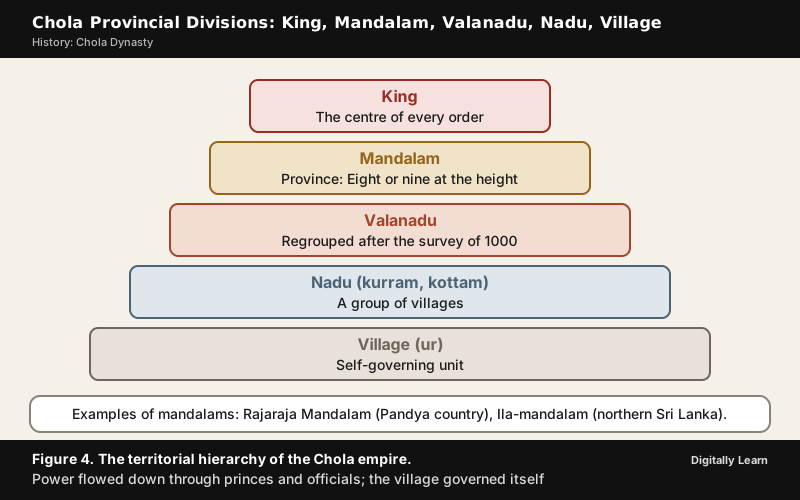
Territories won by the kings were named for them: The Pandya country became Rajaraja Mandalam, and the Sri Lankan province was renamed Mummudicholamandalam after Rajaraja's title Mummudi Chola.
Chola Dynasty Timeline: Key Dates
Key Chola Dates for Prelims
A few dates anchor the history of the Cholas, and each is tied to one ruler.
- Vijayalaya: About 850, capture of Thanjavur.
- Parantaka I: 907 to 955; Madurai; Takkolam in 949.
- Rajaraja I: 985 to 1014; Anuradhapura in 993; survey of 1000; Brihadisvara inaugurated 1009 to 1010.
- Rajendra I: 1014 to 1044; Ganga march from 1019; Srivijaya expedition in 1025.
- Kulottunga I: From 1070; the Later Chola line.
- Decline: Defeat by the Pandyas in 1215 to 1216; last emperor Rajendra III, 1246 to 1279.
Previous Year UPSC‑CSE Questions
Each question is explained option by option.
- UPSC Prelims 2026Which of the following pairs of the king and his dynasty in early historical Tamilakam is/are not correctly matched?
- Senguttuvan : Chera
- Udiyanjeral : Chola
- Nedunjeliyan : Pandya
Select the answer using the code given below:
How to approach this Prelims question
Approach: Each king is matched with the line he belongs to. Senguttuvan is the best-known Chera king, Udiyanjeral (Uthiyan Cheralathan) is the earliest known Chera ruler, and Nedunjeliyan is a Pandya king. Only pair 2, which calls Udiyanjeral a Chola, is wrongly matched.
Trap to watch: Udiyanjeral fought at the time of the Chola wars, but he was a Chera king.
Why each option is right or wrong:
- (a) 1 and 2: Wrong. Pair 1 is correctly matched, since Senguttuvan is a Chera king.
- (b) 2 only: Correct. Udiyanjeral was a Chera, not a Chola.
- (c) 1 and 3: Wrong. Both pairs are correctly matched.
- (d) 3 only: Wrong. Nedunjeliyan is a Pandya king, so pair 3 is correct.
Answer: (b) 2 only. Udiyanjeral was a Chera, so pair 2 alone is wrong.
- UPSC Prelims 2025Who among the following led a successful military campaign against the kingdom of Srivijaya, the powerful maritime State, which ruled the Malay Peninsula, Sumatra, Java and the neighbouring islands?
How to approach this Prelims question
Approach: Only one of the four rulers sent a fleet across the Bay of Bengal. Rajendra I's navy sacked Kadaram, Pannai and Malaiyur in 1025 and captured the Srivijaya king.
Trap to watch: All four are powerful medieval kings; only the Chola had a navy that crossed the sea.
Why each option is right or wrong:
- (a) Amoghavarsha (Rashtrakuta): Wrong. He ruled from 814 to 878, long before the Chola voyage of 1025.
- (b) Prataparudra (Kakatiya): Wrong. He ruled at Warangal from about 1289 to 1323, long after the raid on Srivijaya.
- (c) Rajendra I (Chola): Correct. His fleet struck Srivijaya in 1025.
- (d) Vishnuvardhana (Hoysala): Wrong. He ruled from 1108 to 1152 and fought the Cholas on land, not Srivijaya.
Answer: (c) Rajendra I (Chola). Rajendra I led the 1025 naval expedition against Srivijaya.
- UPSC Prelims 2020Consider the following events in the history of India:
- Rise of Pratiharas under King Bhoja
- Establishment of Pallava power under Mahendravarman I
- Establishment of Chola power by Parantaka I
- Pala dynasty founded by Gopala
What is the correct chronological order of the above events, starting from the earliest time?
How to approach this Prelims question
Approach: Give each event an anchor date. Mahendravarman I reigned from 590 to 630, Gopala founded the Pala dynasty in 750, Bhoja ruled from 836 to 885, and Parantaka I became king in 907. The order is 2, 4, 1, 3.
Trap to watch: The Pratihara and Pala events are both early medieval and easily swapped; the Pala founding comes first.
Why each option is right or wrong:
- (a) 2 – 1 – 4 – 3: Wrong. It puts Bhoja (836 to 885) before Gopala's founding of the Pala dynasty (750).
- (b) 3 – 1 – 4 – 2: Wrong. It puts Parantaka I (907) before Mahendravarman I (590 to 630).
- (c) 2 – 4 – 1 – 3: Correct. Mahendravarman I, then Gopala, then Bhoja, then Parantaka I.
- (d) 3 – 4 – 1 – 2: Wrong. It again puts Parantaka I first.
Answer: (c) 2 – 4 – 1 – 3. Mahendravarman I ruled from 590 to 630, Gopala founded the Pala dynasty in 750, Bhoja ruled from 836 to 885, and Parantaka I became king in 907.
- UPSC Prelims 2003Consider the following statements:
- The Cholas defeated Pandya and Chera rulers and established their domination over peninsular India in early medieval times.
- The Cholas sent an expedition against the Sailendra empire of South-East Asia and conquered some of the areas.
Which of these statements is/are correct?
How to approach this Prelims question
Approach: Each statement is checked against the reigns of Rajaraja I and Rajendra I.
- Statement 1 is correct, because Rajaraja I conquered the Pandyas and took the title Mummudi Chola for his power over the Cholas, Pandyas and Cheras, and the Cholas held the peninsula south of the Tungabhadra as one state.
- Statement 2 is correct, because Srivijaya was then ruled by the Sailendra dynasty: Rajendra I's fleet sacked Kadaram, Pannai and Malaiyur in 1025 and captured its king, Sangrama Vijayatunggavarman.
Trap to watch: The Srivijaya raid installed no lasting rule, but the question says only that some areas were conquered, which is true.
Why each option is right or wrong:
- (a) Only 1: Wrong. Statement 2 is also correct, since Rajendra I's fleet struck Srivijaya in 1025.
- (b) Only 2: Wrong. Statement 1 is also correct, since the Cholas dominated the Pandya and Chera lands.
- (c) Both 1 and 2: Correct. Both the peninsular dominance and the overseas expedition are recorded.
- (d) Neither 1 nor 2: Wrong. Both statements are correct.
Answer: (c) Both 1 and 2. The Cholas dominated the Pandya and Chera lands under Rajaraja I, and Rajendra I's fleet struck the Sailendra rulers of Srivijaya in 1025.
- UPSC Prelims 2001Which one of the Chola kings conquered Ceylon?
How to approach this Prelims question
Approach: The Chola campaigns in Sri Lanka (Ceylon) ran in three stages, so the stage decides the king. A raid came under Parantaka I, the capture of Anuradhapura and annexation of the north under Rajaraja I in 993, and the completion of the conquest under Rajendra I. The conquest of Ceylon as Chola territory begins with Rajaraja I.
Trap to watch: Rajendra I completed the conquest, which makes option (c) tempting, but the first conquest and annexation was his father's.
Why each option is right or wrong:
- (a) Aditya I: Wrong. He conquered the Pallava lands and Kongu Nadu and died in 907, long before any Chola rule in Sri Lanka.
- (b) Rajaraja I: Correct. He took Anuradhapura in 993 and annexed northern Sri Lanka as Ila-mandalam.
- (c) Rajendra: Wrong. Rajendra I completed the conquest by invading Rohana, but the conquest began with Rajaraja I's annexation of 993.
- (d) Vijayalaya: Wrong. He captured Thanjavur in the middle of the ninth century and founded the imperial line.
Answer: (b) Rajaraja I. Rajaraja I took Anuradhapura in 993 and annexed northern Sri Lanka.
- UPSC Prelims 1998The Asokan major rock edicts which tell us about the Sangam Kingdom include rock edicts
How to approach this Prelims question
Approach: The question turns on which Major Rock Edicts name the southern kingdoms. Major Rock Edict II lists the Chola, Pandya, Satiyaputra and Keralaputra kingdoms, and Major Rock Edict XIII records the victory of Dhamma among the Cholas and Pandyas.
Trap to watch: Option (d) has Edict II right but pairs it with Edict XIV, which does not name the southern kingdoms.
Why each option is right or wrong:
- (a) I and X: Wrong. Edict I prohibits animal slaughter and Edict X condemns the desire for fame; neither names the southern kingdoms.
- (b) I and XI: Wrong. Edict I deals with animal slaughter and Edict XI explains Dhamma; neither names the southern kingdoms.
- (c) II and XIII: Correct. Both edicts name the Cholas and their southern neighbours.
- (d) II and XIV: Wrong. Edict XIV is about the engraving of the inscriptions, not the southern kingdoms.
Answer: (c) II and XIII. Edicts II and XIII name the Cholas and their neighbours.
Sources
- NCERT: Exploring Society, India and Beyond, Class VII, Empires and Kingdoms, 6th to 10th Centuries
- NCERT: Exploring Society, India and Beyond, Class VII, Turning Tides, 11th and 12th Centuries
- NCERT: Understanding Society, India and Beyond, Class IX
- Archaeological Survey of India: Great Living Chola Temples
- Press Information Bureau: Aadi Thiruvathirai Festival, Rajendra Chola I
- Press Information Bureau: Birth anniversary of Rajendra Chola I
- Tamil Nadu Tourism: Gangaikonda Cholapuram
- Tamil Nadu Urban Local Bodies: Tiruvannamalai
- Tamil Nadu Urban Local Bodies: Jayankondam
- Wikipedia: Chola dynasty
- Wikipedia: Chola Empire
- Wikipedia: Chola government
- Wikipedia: Vijayalaya Chola
- Wikipedia: Aditya I
- Wikipedia: Parantaka I
- Wikipedia: Battle of Takkolam
- Wikipedia: Krishna III
- Wikipedia: Uttama Chola
- Wikipedia: Rajaraja I
- Wikipedia: Rajendra I
- Wikipedia: Rajadhiraja I
- Wikipedia: Kulottunga I
- Wikipedia: Kulottunga III
- Wikipedia: Rajaraja III
- Wikipedia: Rajendra III
- Wikipedia: Gangaikonda Cholapuram
- Wikipedia: Major Rock Edicts
- Wikipedia: Karikala Chola
- Wikipedia: Kalabhra dynasty
- Wikipedia: Cheran Senguttuvan
- Wikipedia: Uthiyan Cheralathan
- Wikipedia: Nedunjeliyan II
- Wikipedia: Mahendravarman I
- Wikipedia: Gopala I
- Wikipedia: Mihira Bhoja
- Wikipedia: Amoghavarsha
- Wikipedia: Prataparudra
- Wikipedia: Vishnuvardhana
- UPSC: Civil Services Examination question papers
Editorial Disclaimer
This article draws on the current NCERT textbooks, the Archaeological Survey of India, the Press Information Bureau, Tamil Nadu government pages and the other sources listed.
See more of our UPSC articles in Google Search
Add to Preferred Sources