

Overview
Saline and alkaline soils are soils in which salts or sodium have built up to a level that harms the growth of most crops. They are intra-zonal soils, because they owe their character to a local problem such as poor drainage or waterlogging rather than to the climate of a whole zone. In India they occur in the drier parts of the country, in the coastal and delta lands, and in patches of canal-irrigated land. They are of three types: Saline soils hold an excess of neutral soluble salts, sodic or alkali soils an excess of exchangeable sodium, and saline-sodic soils both.
Types of Salt-Affected Soils: Saline, Sodic and Saline-Sodic
Saline Soils: Soluble Salts and the White Crust
A saline soil contains enough neutral soluble salts to harm most crops. By the standard definition, its electrical conductivity of the saturation extract (ECe), the conductivity of water drawn from a soil paste, is more than 4 dS/m (decisiemens per metre) at 25 °C. This limit is used the world over, although the Soil Science Society of America has lowered the boundary between saline and non-saline soils to 2 dS/m.
The salts are mostly chlorides and sulphates of sodium, calcium and magnesium; sodium and chloride are by far the most common ions in highly saline soils. Soluble carbonates are always absent, and the pH of the saturated soil paste stays below 8.2, more often near neutral.
Saline soils keep a good physical condition. The excess salts hold the clay in a flocculated state, that is, in small crumbs, so structure, tillage and permeability are good. In the field a saline soil shows itself by:
- Salt crust: A white crust of salts forms on the surface as the soil dries.
- Patchy crop: Crops grow in spots, with barren patches between them.
- Crop colour: Under mild salinity, plants often take a blue-green tinge.
- Poor germination: Cereal seeds germinate and emerge poorly.
Sodic (Alkaline) Soils: Exchangeable Sodium and High pH
A sodic soil is one whose exchangeable sodium percentage (ESP), the share of the clay's exchangeable cations held by sodium, is 15 or more. The limit is useful because many soils show a sharp fall in their physical properties around or above this ESP. Sodic soils have few neutral salts but contain salts that make the soil alkaline, mainly sodium carbonate, so their ECe is often below 4 dS/m.
Sodium harms the soil in a way soluble salts do not. When the clay holds much sodium and the soil water is not salty, the clay and organic matter disperse, the pores are blocked and water hardly enters the soil. The pH of the saturated paste is 8.2 or more and may rise above 10.5.
The surface signs follow from this dispersion:
- Dark crust: Dispersed organic matter is carried up and left on the surface, giving a brownish-black crust; this is why such soils were also called black sodic soils.
- Wetness: The soil stays wet for a long time after rain or irrigation, because water drains through it so slowly.
- Hard surface: A few centimetres below the surface the soil may be saturated while the surface itself is dry and hard; on drying it cracks in the same places each time.
A third measure, the sodium adsorption ratio (SAR), compares sodium with calcium and magnesium in water. It is used to judge irrigation water and the soil solution; when a soil is irrigated for some time with water of a given SAR, its ESP tends to become about equal to that SAR.
Difference Between Saline and Alkaline Soils: EC, ESP and pH
Saline and alkaline soils differ in chemistry, in structure and in the treatment they need.
| Property | Saline soil | Sodic (alkaline) soil |
|---|---|---|
| What has built up | Neutral soluble salts | Exchangeable sodium on the clay |
| Main salts | Chlorides and sulphates of sodium, calcium and magnesium | Sodium carbonate |
| ECe (dS/m) | More than 4 | Often less than 4 |
| pH of saturated paste | Below 8.2, often near neutral | 8.2 or more; may exceed 10.5 |
| Soil structure | Good; clay flocculated | Poor; clay dispersed |
| Surface sign | White crust | Brownish-black crust |
| Main remedy | Leaching and drainage | Gypsum or another amendment, then leaching |
A saline-sodic soil has a high content of soluble salts, like a saline soil, but its salts are mostly of sodium. Its properties lie between those of the other two, and if it is not managed properly it can easily become sodic.
The pH limit for an alkali soil is given in two ways. Researchers of the United States Salinity Laboratory proposed in 1954 a saturated paste pH of 8.5 or more, and many descriptions of alkali soils still give a pH above 8.5. A later survey of published data found that an ESP of 15 to 20 most often goes with a pH of 8.2, and 8.2 was suggested as the more realistic limit.
Causes of Soil Salinity in India: Natural and Human
Natural Salinity: Arid Climate, Capillary Rise and Inland Basins
Natural, or primary, salinity begins with the weathering of rocks. Weathering releases salts, which surface water and groundwater carry away from their source; as the water moves from humid to drier areas, the salts in it become more concentrated. Salt-affected soils therefore form mostly in regions that receive salts from other areas.
Two conditions let the salts build up in the soil:
- Dry climate: Little rain falls and evaporation is fast, so little water passes down through the soil to wash the salts out.
- High water table: When the water table lies within 1 to 2 m of the surface, groundwater rises through the soil by capillary action and adds to evaporation from the surface.
Evaporation at the surface then leaves the dissolved salts behind in the topsoil as a crust.
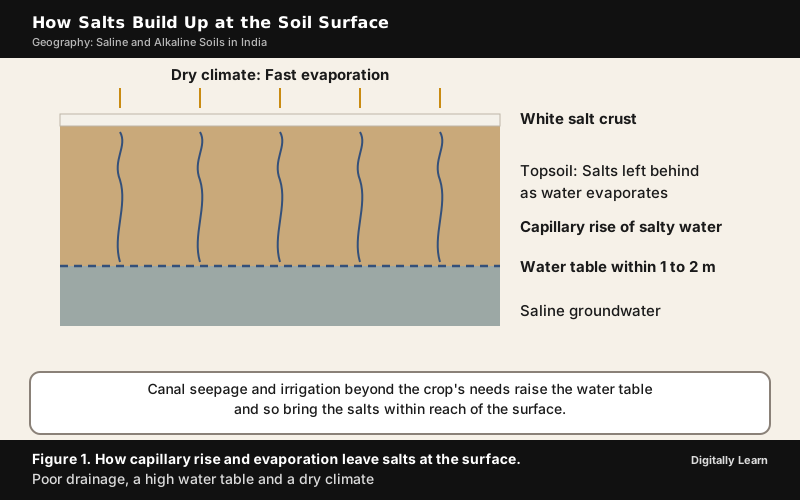
Arid soils, such as those of western Rajasthan, are generally saline, and in some areas the salt content is so high that common salt is obtained by evaporating the water. The Rann of Kachchh, a salt marsh of over 26,000 km² lying mostly in Gujarat, formed when tectonic uplift cut it off from the sea; when the water recedes in the dry season, a crust of salt is left behind.
Secondary Salinity: Canal Irrigation, Waterlogging and Poor Drainage
Secondary salinity is salinity caused by human use of land and water, and irrigation is its main cause. All irrigation water, from rivers or wells, carries some salt, and the salt stays in the soil when the water evaporates. Where natural drainage is poor and no drainage is built, the salt accumulates year after year.
Canal irrigation adds a second effect. Seepage from irrigation channels, water applied beyond the crop's needs and obstructions to natural drainage all raise the water table; once it comes within 1 to 2 m of the surface, capillary rise brings salt into the root zone. The salinity is worse where the groundwater itself is saline, as is usual in arid regions.
Both effects are seen in India:
- North-western plains: In Punjab, Haryana and western Uttar Pradesh, over-irrigation has caused waterlogging and a rise in salinity and alkalinity of the soil.
- Indira Gandhi Canal command: Intensive irrigation and excessive use of water brought the twin problems of waterlogging and soil salinity to this command area in western Rajasthan, and the plan for its sustainable development includes reclaiming the land they affected.
How Sodic Soils Form in the Indo-Gangetic Plains
The sodic soils of the Indo-Gangetic plains formed under alternate wet and dry seasons on land with poor drainage. In the wet season, water carrying the products of rock weathering collects in low-lying areas. In the dry season evaporation concentrates this water, calcium and magnesium separate out as solid minerals, and sodium becomes the main cation in the soil solution. Sodium carbonate forms, the clay takes up sodium, and the pH rises.
Most of the salt-affected soils of Uttar Pradesh have a pH above 10 and an ESP above 15. The alkali soils of the central and eastern Gangetic plains also suffer from surface drainage congestion and a high water table, are relatively heavy in texture and carry calcium carbonate concretions at shallow depth.
Coastal Salinity: Seawater Ingress, Tides and Storm Surges
Coastal salinity is caused by the sea. Seawater enters the land with high tides, through underground aquifers and as wind-blown salt spray. Pumping fresh groundwater near the coast lowers its pressure and lets the denser seawater push inland beneath it; canals and drainage channels also carry seawater inland, and storm surges flood the land with it.
The coastal soils of the Ganga delta in West Bengal show the usual pattern. They are near neutral in reaction but rich in soluble salts of chloride, sodium, calcium, magnesium and potassium, and their salinity changes greatly from season to season and from place to place. A brackish aquifer lies close to the surface and drainage is poor.
The Sundarbans also suffer from rising salinity caused by sea-level rise and a reduced supply of fresh water. When Cyclone Aila struck in May 2009, its storm surge flooded the forest's freshwater sources with salt water. On the west coast, the sea keeps salinity high in the coastal tracts of Gujarat.
Some waterlogged coastal soils of the deltas, rich in the iron sulphide mineral pyrite, become strongly acid when they are drained and the pyrite oxidises to sulphuric acid. These acid sulphate or acid saline soils face acidity as well as salinity, and are managed with lime and higher doses of phosphate fertiliser.
Saline and Alkaline Soils in India: Extent and Distribution
Area of Salt-Affected Soils by State
India has 67,44,968 hectares, about 6.74 million hectares, of salt-affected soils. Of this, 17,10,673 ha is saline, 37,88,159 ha is alkali (sodic) and 12,46,136 ha is coastal saline. The extent has stayed almost the same since 1970, because the land reclaimed in these years has been matched by new land turning saline or sodic.
| State or Union Territory | Saline soils | Alkali soils | Coastal saline soils | Total |
|---|---|---|---|---|
| Gujarat | 12,18,255 | 5,41,430 | 4,62,315 | 22,22,000 |
| Uttar Pradesh | 21,989 | 13,46,971 | 0 | 13,68,960 |
| Maharashtra | 1,77,093 | 4,22,670 | 6,996 | 6,06,759 |
| West Bengal | 0 | 0 | 4,41,272 | 4,41,272 |
| Rajasthan | 1,95,571 | 1,79,371 | 0 | 3,74,942 |
| Tamil Nadu | 0 | 3,54,784 | 13,231 | 3,68,015 |
| Andhra Pradesh | 0 | 1,96,609 | 77,598 | 2,74,207 |
| Haryana | 49,157 | 1,83,399 | 0 | 2,32,556 |
| Bihar | 47,301 | 1,05,852 | 0 | 1,53,153 |
| Punjab | 0 | 1,51,717 | 0 | 1,51,717 |
| Karnataka | 1,307 | 1,48,136 | 586 | 1,50,029 |
| Odisha | 0 | 0 | 1,47,138 | 1,47,138 |
| Madhya Pradesh | 0 | 1,39,720 | 0 | 1,39,720 |
| Andaman and Nicobar Islands | 0 | 0 | 77,000 | 77,000 |
| Kerala | 0 | 0 | 20,000 | 20,000 |
| Jammu and Kashmir | 0 | 17,500 | 0 | 17,500 |
| India | 17,10,673 | 37,88,159 | 12,46,136 | 67,44,968 |
Three patterns stand out. Gujarat has the largest area, with large areas of all three kinds. Uttar Pradesh holds more than a third of India's alkali soils. West Bengal, Odisha, Kerala and the Andaman and Nicobar Islands have only coastal saline soils, while Punjab, Madhya Pradesh and Jammu and Kashmir have only alkali soils.
Regional Belts: Gujarat, the Gangetic Plains and Coastal Deltas
Saline and alkaline soils occur in the arid and semi-arid regions, in coastal and delta regions, and wherever drainage is poor for long periods. Five regional belts can be traced across the country:
- Gujarat: The Kachchh region and the coastal tracts carry natural and sea-borne salinity, and salinity is also rising in the irrigation command areas; about 2.22 million ha in the State is out of cultivation because of waterlogging and salinity or sodicity. Salt-affected black soils (Vertisols) of the Bara tract are hard to reclaim because of their high clay content and slow drainage.
- Indo-Gangetic plains: Sodic soils cover large areas of Uttar Pradesh, Haryana, Punjab and Bihar. In Uttar Pradesh the salt-affected area is about 1.37 million ha, and the waterlogged sodic land lies mostly in the Sharda Sahayak canal command, with Prayagraj (Allahabad), Raebareli, Pratapgarh, Unnao and Hardoi the hardest hit.
- Arid north-west: Western Rajasthan and the Indira Gandhi Canal command combine natural salinity with salinity from irrigation.
- East coast and the Sundarbans: The Sundarbans of West Bengal, the coastal tracts of Odisha and the deltas of Andhra Pradesh and Tamil Nadu carry coastal salinity.
- West coast of Kerala: Waterlogged coastal fields of brackish water carry saline soils on which salt-tolerant rice is grown in rotation with prawn farming.
Effects of Salinity and Sodicity on Crops and Land
How Salts and Sodium Harm Crops and Soil Structure
Salts and sodium harm crops in two different ways. Soluble salts affect the plant's uptake of nutrients and the microbial life of the soil, and yields fall as ECe rises. Sodium spoils the soil itself: The dispersed clay seals the surface so that water hardly enters, and the high pH, poor drainage and toxic effects of sodium make cultivation difficult.
Soil salinity classes grade salinity by its effect on crops, so they begin below the 4 dS/m that defines a saline soil: Even a slightly saline soil can restrict sensitive crops.
| Soil salinity class | Salinity (ECe) | Effect on crop plants |
|---|---|---|
| Non-saline | 0 to 2 dS/m | Salinity effects negligible |
| Slightly saline | 2 to 4 dS/m | Yields of sensitive crops may be restricted |
| Moderately saline | 4 to 8 dS/m | Yields of many crops are restricted |
| Strongly saline | 8 to 16 dS/m | Only tolerant crops yield satisfactorily |
| Very strongly saline | Above 16 dS/m | Only a few very tolerant crops yield satisfactorily |
Crops tolerate salinity and sodicity differently, and the two must not be confused. Barley tolerates saline soils but not sodic soils; cotton tolerates salinity but is only moderately tolerant of sodicity, and sensitive to it at some growth stages. Rice is only moderately sensitive to salinity but tolerates sodicity well: At an ESP of about 50, rice yield was virtually unaffected while the wheat crop almost failed. Rice and dhaincha (Sesbania aculeata) are tolerant of sodic conditions, wheat and bajra moderately tolerant, and pulses such as black gram (mash) and lentil sensitive.
The damage reaches beyond the crop:
- Farm costs: More seed, water and fertiliser are needed for a lower yield, and the choice of crops narrows to the salt-tolerant ones.
- Land loss: Severely saline or sodic land goes out of cultivation, and the loss of land pushes some farmers to migrate to cities.
- Wider degradation: Salt-affected soils are fragile and erode easily by wind and water; drainage water from them can raise the salt content of groundwater and streams.
- Sodic soils and carbon: Loss of organic matter weakens soil aggregates, increases nutrient loss in run-off and adds carbon dioxide to the air.
Reclamation of Saline and Alkaline Soils
Reclaiming Saline Soils: Leaching and Subsurface Drainage
Saline soils are reclaimed by washing the salts out of the root zone and carrying them away. Leaching is done by ponding fresh water on the surface and letting it pass down through the soil. To keep salts from building up again, irrigation water must, over the years, be applied in excess of the crop's needs; this extra share is the leaching requirement, and a leaching requirement of 10 or 20 per cent can be used, depending on how saline the soil already is.
Leaching works only where the salty water can leave the field. If it cannot drain, it raises the water table and the salts return. The work proceeds in four steps:
- Lower the water table: A drainage system keeps the groundwater at a safe depth.
- Level the land: Levelling spreads water evenly so that the whole field is leached.
- Pond and leach: Good-quality water is ponded on the field, preferably when the soil is dry and the water table deep; leaching in summer is less effective because much water is lost to evaporation.
- Carry the salts away: The salty drainage water is led to a safe outlet so that it does not spoil land and water downstream.
Drainage can be built in several ways:
- Surface drains: Open ditches remove excess water before it enters the soil.
- Subsurface drains: Buried pipes, or deep open ditches, hold the water table at a set depth below the root zone.
- Mole drains: Shallow channels drawn through the soil by a bullet-shaped tool feed the main drains.
- Vertical drains: Tubewells pump out groundwater where the deeper layers conduct water well.
India's subsurface drainage technology for waterlogged saline land was first developed in Haryana, at Sampla. It is a network of concrete or PVC pipes covered with gravel or a synthetic filter, laid at a set depth and spacing below the surface to control the water table and help leaching. The technology has spread to Rajasthan, Gujarat, Punjab, Andhra Pradesh, Madhya Pradesh, Maharashtra and Karnataka, and has reclaimed around 50,000 ha of waterlogged saline land.
The method of irrigation also matters. Light and frequent irrigations suit salt-affected soils, and drip irrigation can grow vegetables with relatively poor saline water. Because drip wets only the root zone, the dry ground between the plants grows few weeds and loses less soil to erosion. Most drip systems, however, are designed to apply little or no water for leaching, so salts brought in with the water can build up at the edge of the wetted zone.
Reclamation of Alkaline Soil: Gypsum and Other Amendments
Leaching alone reclaims a sodic soil only very slowly, because the sodium is held on the clay and water passes poorly through the dispersed soil. For quicker results a soil amendment is first applied to supply calcium, which takes the place of sodium on the clay; the sodium then forms a soluble salt that is leached out. Organic matter and plant roots also free calcium from the soil, but that is a slow process.
Amendments fall into three groups:
- Soluble calcium salts: Gypsum and calcium chloride supply calcium directly.
- Acids and acid-forming materials: Sulphuric acid, iron sulphate, sulphur and pyrite make acid in the soil, which dissolves the soil's own calcium carbonate and so releases calcium indirectly.
- Calcium salts of low solubility: Ground limestone works only in soils with a pH below about 7.0, so it is of little use on most sodic soils.
Gypsum, calcium sulphate (CaSO4·2H2O), is the amendment on which India's reclamation of alkali land is based. It is a white mineral that must be ground before it is applied; it dissolves in water to about 0.25 per cent and so is a direct source of soluble calcium. Gypsum reacts with the sodium carbonate in the soil and turns it into sodium sulphate, a neutral salt that does not raise the pH and is leached away. Calcium chloride reacts in the same way. The two reactions are:
- Gypsum: Na2CO3 + CaSO4 → CaCO3 + Na2SO4
- Calcium chloride: Na2CO3 + CaCl2 → CaCO3 + 2NaCl
Sulphur acts more slowly. Microbes in the soil oxidise it to sulphuric acid, which reacts with the calcium carbonate already present to form calcium sulphate, the same calcium source that gypsum supplies.

The quantity of amendment is set by the soil's gypsum requirement, the amount needed to replace the excess sodium. Estimating it avoids applying too much or too little, and a field kit now lets farmers estimate the gypsum requirement without a laboratory or electricity. Several other sources of calcium have also been tested:
- Marine gypsum: A by-product of common-salt making, about 92 per cent pure against about 70 per cent for mineral gypsum, so about 23.8 per cent less is needed per hectare.
- Phosphogypsum and distillery spent wash: Industrial by-products advised for alkali land.
- Pressmud and compost: Farmyard manure, pressmud and municipal solid waste compost, the last of which can replace half the gypsum.
- Fly ash: Coal fly ash, rich in calcium, helps the clay to flocculate when used with gypsum.
The gypsum technology was handed over to the State Land Reclamation Corporations for implementation. About 45,000 ha of alkali land has been reclaimed each year, for a total of about 1.8 million ha, and the reclaimed land yields 12 to 15 million tonnes of paddy and wheat a year. Gypsum reclamation is not effective where the water table is shallow, less than 2 m below the surface, and a shallow water table is also the main reason why reclaimed alkali land turns sodic again.
Biological Methods: Green Manure, Bio-Drainage and Salt-Tolerant Trees
Biological methods use plants and organic matter to improve salt-affected soils. They work more slowly than chemical amendments, and they also add organic matter and nutrients to the soil.
- Organic manure: Farm manure worked into the soil improves its permeability and releases carbon dioxide and organic acids as it decomposes, which helps dissolve calcium; it also adds nutrients. Soil organic matter improves soil structure and water retention.
- Green manure: Dhaincha, which tolerates sodic conditions, is grown and ploughed in; two dhaincha genotypes that give high leaf biomass at 45 to 50 days after sowing have been registered.
- Mulch and crop residue: A mulch cuts evaporation and so slows salinization, and crop residue left in the field improves the entry of water into the soil and its retention there.
- Bio-reclamation: Growing salt-tolerant rice and wheat varieties lets about half the usual dose of gypsum reclaim the alkali soils of the central and eastern Gangetic plains.
- Bio-drainage: Rows of Eucalyptus planted along field boundaries in waterlogged saline canal-command land lowered the water table by 85 cm in five years, each tree transpiring about 50 litres of water a day.
- Trees on barren land: Salt-tolerant trees such as Prosopis juliflora and Casuarina equisetifolia, and fruit trees such as aonla and karonda, are grown on alkali community lands; about 60,000 ha has been reclaimed through tree plantation.
After reclamation, resource conservation practices keep the soil productive. Zero tillage, in which a crop is sown without ploughing, leaves the soil and the crop residue on it undisturbed; it lets more water infiltrate, and the residue reduces evaporation. In the rice-wheat system on reclaimed land, wheat gave its highest yield when sown by zero tillage after rice grown together with dhaincha as a manure crop, and direct-seeded rice, sown straight into the field without transplanting, used water most productively.
Coastal Saline Lands: Land Shaping, Pokkali and Halophytes
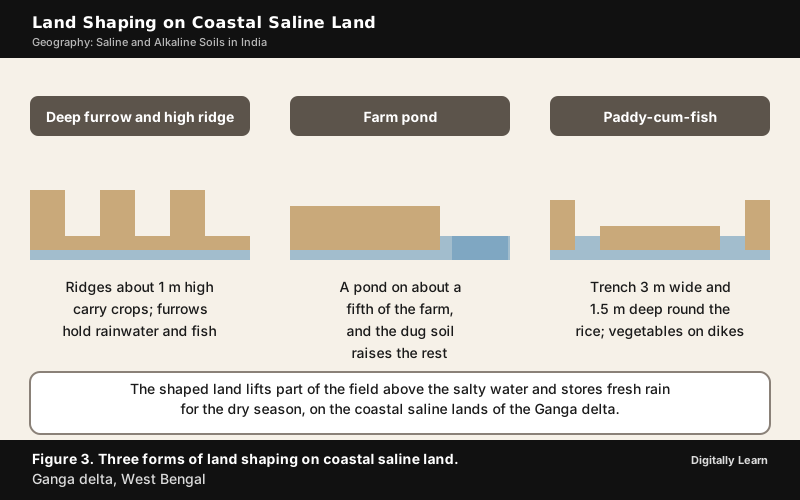
Coastal saline land is managed largely by controlling water, because waterlogging and the inflow of salt water are its main problems. Land shaping reshapes a low-lying field so that part of it stays above the salty water and part stores fresh rainwater.
Three of the forms of land shaping developed for the coastal saline lands of the Ganga delta are:
- Deep furrow and high ridge: Half the field is shaped into alternate furrows about 1 m deep and ridges about 1 m high; the ridges stay free of drainage congestion and low in salinity and carry several crops, while the furrows store rainwater and raise fish with rice.
- Farm pond: About a fifth of a farm is dug into a pond that stores excess rain for irrigation in the dry season, and the dug-out soil raises the rest of the land.
- Paddy-cum-fish: Trenches about 3 m wide and 1.5 m deep around the field hold fish with the rice in the wet season, and vegetables grow on the dikes.
Kerala's coast shows traditional farming adapted to saline land. Pokkali is a salt-tolerant rice grown organically on about 5,000 hectares of waterlogged coastal land in the Alappuzha, Kottayam, Thrissur and Ernakulam districts. Rice is grown from June to early November, when the salinity of the water in the fields is low, and prawns are raised from mid-November to mid-April, when the salinity is high; the prawns feed on the crop residue and the rice draws nutrients from their waste. Kaipad fields of northern Kerala follow a similar integrated system of rice and aquaculture in brackish marshes. Both carry a Geographical Indication.
On the highly saline black soils of Gujarat, halophytes, plants that grow in soil or water of high salinity, are cultivated. Salvadora persica grows on soils with an ECe above 40 dS/m, and dill, castor and sunflower are grown with saline water.
Salt-Tolerant Crop Varieties and Biosaline Agriculture
CSSRI Salt-Tolerant Varieties of Rice, Wheat and Mustard
Salt-tolerant varieties let farmers grow crops on moderately saline or sodic land, and they reduce the amount of amendment needed. The breeding programme of the Central Soil Salinity Research Institute (CSSRI) has released a series of salt-tolerant rice varieties, the CSR series, the latest in 2024, along with five wheat varieties, five Indian mustard varieties and one gram variety (Karnal Chana 1) for salt-affected areas. Between 2014 and 2019 these varieties of rice, wheat and mustard covered a combined area of more than 7.5 million ha, about 1.5 million ha a year.
| Crop | Variety | Stress tolerated | Note |
|---|---|---|---|
| Rice | CSR 30 | Sodicity up to pH 9.5; salinity up to 7.0 dS/m | First salt-tolerant basmati variety; for sodic areas of Uttar Pradesh, Haryana and Punjab |
| CSR 10 | Sodicity up to pH 10.0; salinity up to 11.0 dS/m | For highly deteriorated sodic and inland saline soils | |
| CSR 36 | Sodicity up to pH 9.9; salinity up to 11.0 dS/m | For sodic soils of Uttar Pradesh, Haryana and Puducherry | |
| CSR 101 | Sodicity of pH 9.8 to 10.0; salinity of 8.0 dS/m | Salt-tolerant and resistant to bacterial leaf blight; released in 2024 | |
| Wheat | KRL 1-4 | Salinity up to 7.0 dS/m | First wheat variety for saline and sodic soils of the north-western plains |
| KRL 210 | Sodicity up to pH 9.3; salinity up to 6.0 dS/m | For salt-affected soils of the north-western and north-eastern plains | |
| Mustard | CS 52 | Salinity up to 9.0 dS/m; sodicity up to pH 9.3 | Seeds give 38 per cent oil even with saline irrigation |
The pH limits for the varieties are measured in a 1:2 soil-water suspension, which reads about one unit higher than the saturated paste used to define a sodic soil.
Biosaline Agriculture and Saline Water Use
Biosaline agriculture is the growing of plants with saline groundwater or on saline soil, using salt-tolerant plants and halophytes to make unproductive land useful.
Saline groundwater can be used to grow crops chosen for their tolerance:
- Fruit trees: Several fruit trees, among them aonla and karonda, can be irrigated with saline water of EC up to 10 dS/m, with cluster bean and barley grown between the rows.
- Grasses and aromatic crops: Some grasses grow with saline water of EC 10 dS/m, and vetiver, lemon grass and palmarosa with water of EC 8.5 dS/m.
- Medicinal crops: Psyllium can be grown with saline water of EC 8.5 dS/m.
Using saline groundwater this way also has a drainage benefit: Pumping it for irrigation keeps the water table from rising and so helps prevent waterlogging and salinization.
Institutions and Schemes for Salt-Affected Soils
ICAR-Central Soil Salinity Research Institute, Karnal
The ICAR-Central Soil Salinity Research Institute (CSSRI) at Karnal in Haryana is the national institute for research on salinity and alkalinity and on the use of poor-quality irrigation water. It works under the Indian Council of Agricultural Research (ICAR), and it began on the recommendation of an Indo-American team that helped ICAR plan a national water management programme.
The institute's network grew in stages:
- 1969: The institute began at Hisar on 1 March 1969 and moved to Karnal in October 1969.
- 1970: The Central Rice Research Station at Canning Town in West Bengal was transferred to it in February 1970 for research on coastal salinity.
- 1989: A regional station for inland salinity in the black soils of western India began at Anand in Gujarat in February 1989; it moved to Bharuch in April 2003.
- 1999: A regional station at Lucknow was set up in October 1999 for the alkali soils of the central and eastern Gangetic plains, with their high water table and heavy soils.
The institute also hosts the coordinating unit of the All India Coordinated Research Project (AICRP) on Management of Salt Affected Soils and Use of Saline Water in Agriculture. Its eight centres are at Agra, Bapatla, Bikaner, Gangawati, Hisar, Indore, Kanpur and Tiruchirappalli. The institute's main contributions are the gypsum technology for alkali soils, subsurface drainage for saline soils, salt-tolerant varieties of rice, wheat and mustard, and the reclamation of salt-affected land with salt-tolerant trees.
Government Schemes: Reclamation of Problem Soils and State Projects
The Union Government supports reclamation through the agricultural schemes it funds in the States. Reclamation of Problem Soils, a sub-scheme of the Rashtriya Krishi Vikas Yojana run since 2016‑17, develops land affected by alkalinity, salinity and acidity on a pilot basis in 15 States; ₹24.60 crore was released to the States for its pilot projects in the three years to 2021, the latest figure published.
States run their own reclamation programmes, mostly through land reclamation corporations, and some with external funding:
- Uttar Pradesh Sodic Land Reclamation III Project: It was designed to reclaim 1,30,000 ha of sodic land in 28 sodic-affected districts of Uttar Pradesh, with drainage improvement, on-farm land treatment and support for farmers.
- Gujarat: Halophyte and saline-water technologies for saline black soils have been adopted on a large scale by farmers, voluntary groups and State institutions.
Previous Year UPSC‑CSE Questions
Each question is explained option by option.
- UPSC Prelims 2018With reference to agricultural soils, consider the following statements :
- A high content of organic matter in soil drastically reduces its water holding capacity.
- Soil does not play any role in the sulphur cycle.
- Irrigation over a period of time can contribute to the salinization of some agricultural lands.
Which of the statements given above is/are correct ?
How to approach this Prelims question
Approach: Test each statement against what organic matter, soil microbes and irrigation do.
- Statement 1: Organic matter improves soil structure and water retention, so it does not reduce water holding capacity; wrong.
- Statement 2: Microbes in the soil oxidise sulphur to sulphuric acid and sulphate, which is a step of the sulphur cycle, so the soil does play a role; wrong.
- Statement 3: Irrigation water always carries some salt, which stays in the soil when the water evaporates, and over-irrigation raises the water table; correct.
Trap to watch: Students include statement 1 because organic soils can stay wet and poorly drained, but organic matter raises the soil's capacity to hold water; the word "reduces" makes the statement wrong.
Why each option is right or wrong:
- (a) 1 and 2 only: Wrong. Organic matter raises water retention, and soil microbes oxidise sulphur.
- (b) 3 only: Correct. Only statement 3 holds, since irrigation leaves salts behind in poorly drained land.
- (c) 1 and 3 only: Wrong. Statement 1 is wrong, because organic matter improves water retention.
- (d) 1, 2 and 3: Wrong. Statements 1 and 2 are both wrong.
Answer: (b) 3 only. Irrigation can salinize farmland over time, while organic matter improves water retention and the soil takes part in the sulphur cycle.
- UPSC Prelims 2017Which of the following practices can help in water conservation in agriculture?
- Reduced or zero tillage of the land
- Applying gypsum before irrigating the field
- Allowing crop residue to remain in the field
Select the correct answer using the code given below:
How to approach this Prelims question
Approach: Ask what each practice does to the soil's water.
- Item 1: Zero tillage leaves the soil and its residue cover undisturbed, lets more water infiltrate and reduces evaporation, so it helps conserve water; correct.
- Item 2: Gypsum supplies calcium to replace sodium on the clay of a sodic soil. It improves water entry only in such a soil, as part of reclamation, and is not a water-saving practice; wrong.
- Item 3: Crop residue left in the field acts as a mulch, cuts evaporation and improves the entry of water into the soil; correct.
Trap to watch: Students include item 2 because gypsum is applied with irrigation water during reclamation, but the water there is used to leach the freed sodium, not saved.
Why each option is right or wrong:
- (a) 1 and 2 only: Wrong. Gypsum is an amendment for sodic soil, not a water-saving practice.
- (b) 3 only: Wrong. Zero tillage also helps conserve water.
- (c) 1 and 3 only: Correct. Zero tillage and crop residue both keep water in the soil.
- (d) 1, 2 and 3: Wrong. Item 2 does not conserve water.
Answer: (c) 1 and 3 only. Zero tillage and crop residue conserve soil water, while gypsum only replaces sodium in sodic soils.
- UPSC Prelims 2016Which of the following is/are the advantage/advantages of practising drip irrigation?
- Reduction in weed
- Reduction in soil salinity
- Reduction in soil erosion
Select the correct answer using the code given below:
How to approach this Prelims question
Approach: Check each item against how a drip system wets the soil.
- Item 1: Drip wets only the root zone, so the dry ground between the plants grows few weeds; correct.
- Item 2: Drip systems are designed for high efficiency and apply little or no water for leaching, so salts brought in with the water can build up at the edge of the wetted zone; a reduction in soil salinity is not an advantage of the method; wrong.
- Item 3: With only the root zone wetted, less soil is lost to erosion; correct.
Trap to watch: Students pick option (a) because drip irrigation can grow crops with saline water, but growing a crop with saline water is not the same as lowering the salt in the soil; without leaching, salts collect at the edge of the wetted zone.
Why each option is right or wrong:
- (a) 1 and 2 only: Wrong. Drip does not remove salts, and item 3 is an advantage.
- (b) 3 only: Wrong. Weed reduction is also an advantage.
- (c) 1 and 3 only: Correct. Drip lessens weed growth and soil erosion.
- (d) None of the above is an advantage of practising drip irrigation: Wrong. Two of the three items are advantages.
Answer: (c) 1 and 3 only. Drip irrigation lessens weeds and erosion, but with little leaching it can let salts gather at the edge of the wetted zone.
- UPSC Prelims 2011Salinization occurs when the irrigation water accumulated in the soil evaporates, leaving behind salts and minerals. What are the effects of salinization on the irrigated land?
How to approach this Prelims question
Approach: Separate the effect of salt left in the soil from the effects of excess water. Salt left behind by evaporating irrigation water lowers yields, so it does not raise crop production. When sodium dominates the salts, the clay disperses and blocks the soil pores, and water can hardly enter, so some soils become impermeable. A rising water table and water-filled air spaces describe waterlogging, which is a cause of salinization, not its effect.
Trap to watch: Students pick option (c) because a high water table and salinity go together in canal commands, but the rising water table comes first and brings the salts up; it is not caused by the salts.
Why each option is right or wrong:
- (a) It greatly increases the crop production: Wrong. Salts affect the plant's uptake of nutrients, and yields fall as salinity rises.
- (b) It makes some soils impermeable: Correct. Where sodium builds up, the clay disperses, blocks the pores and seals the soil.
- (c) It raises the water table: Wrong. Over-irrigation and seepage raise the water table; salinization follows from that rise.
- (d) It fills the air spaces in the soil with water: Wrong. That is waterlogging, the result of excess water, not of salt.
Answer: (b) It makes some soils impermeable. Salinization with sodium disperses the clay and blocks the pores, so some soils become impermeable to water.
Sources
- NCERT: Contemporary India II (Class X), Resources and Development (Reprint 2026‑27)
- NCERT: India People and Economy (Class XII), Land Resources and Agriculture (Reprint 2026‑27)
- NCERT: India People and Economy (Class XII), Planning and Sustainable Development in Indian Context (Reprint 2026‑27)
- NCERT: Fundamentals of Physical Geography (Class XI), Geomorphic Processes (Reprint 2026‑27)
- Wikipedia: 1938 USDA soil taxonomy
- ICAR‑CSSRI: Extent and Distribution of Salt Affected Soils in India
- ICAR‑CSSRI: About Institute
- ICAR‑CSSRI: Director's Message
- ICAR‑CSSRI: Highlights of Research
- ICAR‑CSSRI: Varieties Developed
- ICAR‑CSSRI: Regional Research Station, Canning Town
- ICAR‑CSSRI: Regional Research Station, Bharuch
- ICAR‑CSSRI: Regional Research Station, Lucknow
- ICAR‑CSSRI: Frequently Asked Questions on the AICRP
- PIB (Ministry of Agriculture and Farmers Welfare): Sustaining Agricultural Production and Development of Alkaline and Arid Land, 3 August 2021
- PIB: Saving Soil, Securing Farms, 24 July 2026
- FAO: Salt-Affected Soils and Their Management, Soils Bulletin 39, Origin, Classification and Distribution
- FAO: Salt-Affected Soils and Their Management, Soils Bulletin 39, Saline Soils and Their Management
- FAO: Salt-Affected Soils and Their Management, Soils Bulletin 39, Sodic Soils and Their Management
- FAO Soils Portal: More Information on Salt-Affected Soils
- FAO Soils Portal: Technical Issues of Salt-Affected Soils
- Wikipedia: Alkali soil
- Wikipedia: Soil salinity control
- Wikipedia: Sodium adsorption ratio
- Wikipedia: Saltwater intrusion
- Wikipedia: Rann of Kutch
- Wikipedia: Sundarbans
- Wikipedia: Cyclone Aila
- Wikipedia: Pokkali Rice
- Wikipedia: Kaipad rice
- Wikipedia: Halophyte
- Wikipedia: Biosaline agriculture
- Wikipedia: Soil organic matter
- Wikipedia: Drip irrigation
- Wikipedia: No-till farming
- Wikipedia: Uttar Pradesh Sodic Land Reclamation III Project
- UPSC: Civil Services Examination question papers
Editorial Disclaimer
This article draws on documents of the FAO and the Central Soil Salinity Research Institute, the current NCERT textbooks and the other sources listed above.
See more of our UPSC articles in Google Search
Add to Preferred Sources