


Overview
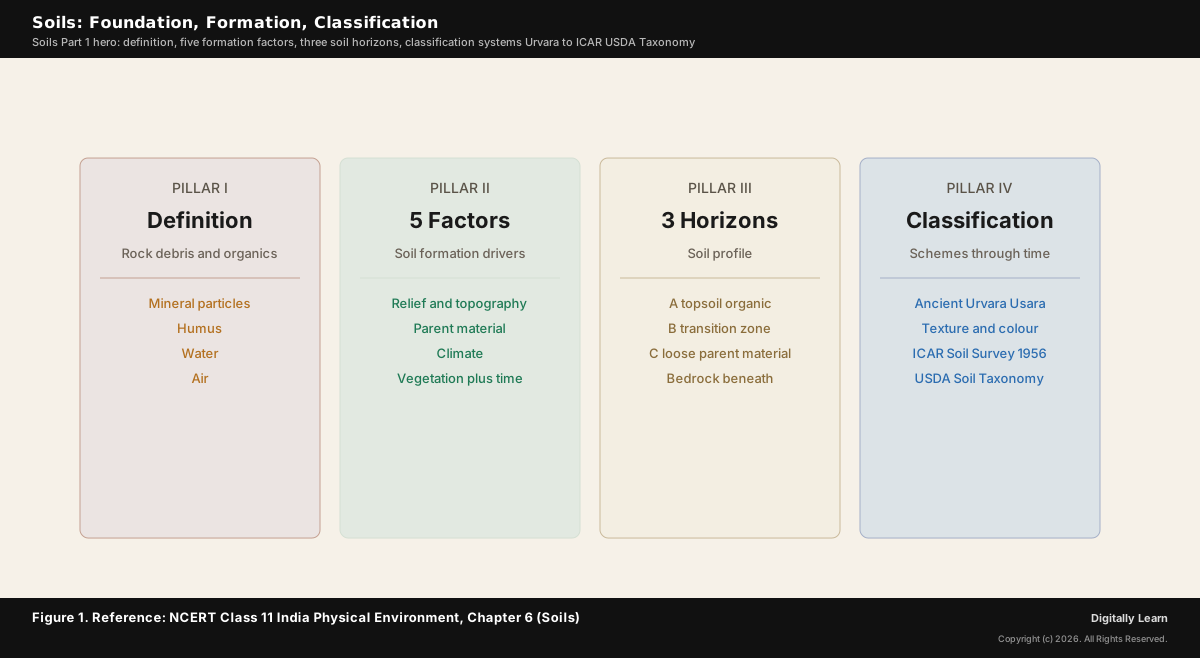
Soil is the mixture of rock debris and organic materials that develops on the Earth's surface where the lithosphere meets the atmosphere, hydrosphere, and biosphere. Every type of soil in India has four components: mineral particles, humus, water, and air. Its formation is governed by five factors: relief, parent material, climate, vegetation and other life-forms, and time. A vertical cross-section reveals three horizons (A topmost organic-rich, B transition, C loose parent material) above the bedrock. Modern Indian classification follows the ICAR-NBSS&LUP framework aligned to the USDA Soil Taxonomy, which recognises twelve orders worldwide and eight across India.
Background and Historical Context
Why it matters: The types of soil in India underpin national agriculture, food security for more than one and a half billion people, and the regional geographic differentiation that UPSC Prelims and Mains repeatedly test. The classification framework determines fertiliser recommendations, irrigation planning, erosion-control strategies, and the agro-climatic zoning that the Indian Council of Agricultural Research operates at district level. Inceptisols and Entisols together cover nearly two-thirds of the country, dominating the alluvial plain and the river floodplains.
What is the significance of the soil-formation framework? The five factors operate together to produce every regional soil type. Reading the factors in sequence reveals why basaltic Deccan trap produces clayey black soil, why crystalline gneiss produces sandy red soil, why the alluvial Indo-Gangetic plain produces loamy soil, and why arid western Rajasthan produces sandy aeolian Aridisols. The framework is the analytical bridge between geology and agriculture.
Contemporary linkages: The National Bureau of Soil Survey and Land Use Planning (NBSS&LUP) at Nagpur publishes the national soil atlas. The ICAR-Indian Institute of Soil Science at Bhopal coordinates the supporting research. The Soil Health Card scheme launched on 19 February 2015 distributes farm-level nutrient profiles to farmers, with over 220 million cards issued across its first two cycles. The All India Soil Survey organisation established in 1956 became the national soil-survey institute reorganised as NBSS&LUP in 1976.
Introduction: Soil as a Four-Sphere Interface
Defining soil and its four components
Soil is the mixture of rock debris and organic materials that develops on the Earth's surface where the lithosphere meets the atmosphere, the hydrosphere, and the biosphere. The bulk of human food and much of human clothing derives from land-based crops that grow in soil. The thin layer covering the continents is the product of thousands of years of weathering of parent rock by agents of gradation, modified by climate and life.
Soil has four components: mineral particles (the inorganic skeleton derived from weathered rock), humus (decomposed organic matter), water (held in pore spaces), and air (also in pore spaces). The actual proportion of each component varies sharply across soil types. The factors that produce this variation are the next analytical layer.
Five Factors of Soil Formation
Five factors plus human activity
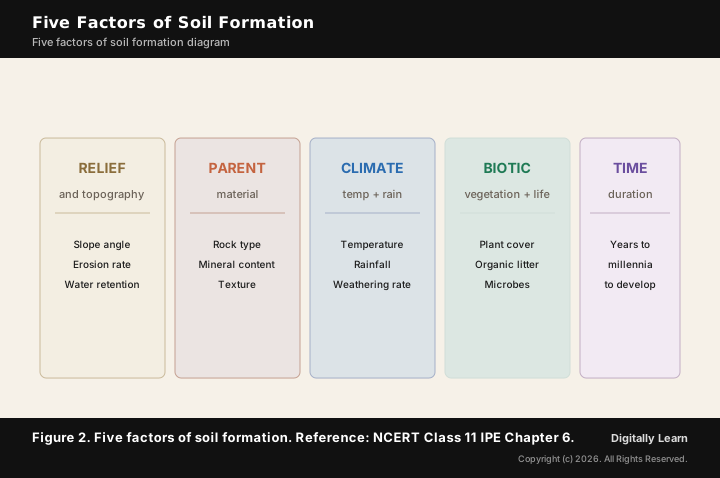
The spatial diversity of soil in India, spanning the alluvial Indo-Gangetic plain, the basaltic Deccan plateau, the lateritic peninsular slopes, and the arid Thar of western Rajasthan, is the joint product of five formation factors acting over geological time. Each region carries a different combination of factor values, which produces a different soil type. UPSC Prelims tests soil-formation linkages with biodiversity and regional geography; Mains GS-I treats soil distribution as the foundation for agricultural geography.
- Relief and topography: Slope angle controls erosion rate and water retention; flat lands accumulate fine alluvium, steep slopes shed material faster than soil can develop.
- Parent material: Rock type and mineral content set the inorganic skeleton of the soil; basaltic Deccan trap produces clayey black soil, crystalline gneiss produces sandy red soil, alluvial Indo-Gangetic plain produces loamy alluvial soil.
- Climate: Temperature and rainfall together govern weathering rate; tropical-monsoon climates produce thicker soils via faster chemical weathering than cold or arid climates.
- Vegetation and other life-forms: Plant cover supplies organic litter, microbes decompose it into humus, and root systems hold soil in place.
- Time: Soil development requires hundreds to thousands of years; geologically young surfaces carry thin immature profiles while old surfaces carry deep mature profiles.
Human activities additionally influence soil formation through agriculture, irrigation, mining, deforestation, and urbanisation. The anthropogenic factor is sometimes called the sixth factor; it accelerates erosion and salinization on the negative side and builds organic matter on the positive side through organic farming and bio-fertilisers.
Soil Profile and the Three Horizons
Horizons A, B, C and the bedrock
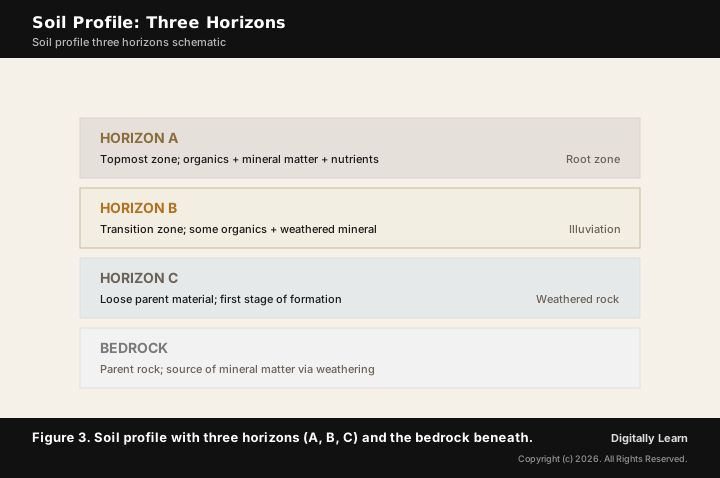
A vertical pit dug into a mature soil reveals a layered structure called the soil profile, and the layers, called horizons, record the formation history of the soil. The horizons differ in colour, texture, organic content, and mineral composition because each forms under different chemical and biological conditions at different depths. The profile is the single most useful field tool for reading how a soil has developed.
- (i) Horizon A: The topmost zone where organic materials have incorporated with mineral matter; rich in nutrients and water; the root zone for most agricultural plants.
- (ii) Horizon B: The transition zone between A and C, containing matter derived from both above and below; some organic matter present, but mineral matter is noticeably weathered.
- (iii) Horizon C: Composed of loose parent material; the first stage of soil formation; eventually develops into Horizons A and B over geological time.
Underneath these three horizons lies the bedrock (also called parent rock), the geological base from which the soil ultimately derives its mineral matter through weathering and gradation.
Classification of Soils: From Urvara-Usara to USDA Taxonomy
Evolution of Indian soil classification
Ancient Indian classification grouped soils into Urvara (fertile) and Usara (sterile). In the sixteenth century, soils were classified by inherent characteristics and external features such as texture (sandy, clayey, silty, loam), colour (red, yellow, black), slope, and moisture content. These descriptive schemes worked for local agriculture but did not allow international comparison.
After Independence the All India Soil Survey organisation was established in 1956 and conducted comprehensive studies of selected areas, including the Damodar Valley. The National Bureau of Soil Survey and Land Use Planning (NBSS&LUP) under the Indian Council of Agricultural Research, formed in 1976, now builds the modern Indian soil-classification framework. To enable international comparison, ICAR adopted the United States Department of Agriculture (USDA) Soil Taxonomy as the reference standard.
Two parallel systems remain in use for the types of soil in India. The older genetic eight-fold scheme groups soils by colour, texture, and origin (alluvial, black, red, laterite, and four more), and is still the standard frame for school and UPSC geography. The modern USDA-aligned scheme groups soils by measurable diagnostic horizons into orders such as Inceptisols and Entisols, and is the operational frame for survey and policy.
| Feature | Genetic eight-fold scheme | ICAR-USDA Soil Taxonomy |
|---|---|---|
| Basis of grouping | Colour, texture, and mode of origin | Measurable diagnostic horizons and properties |
| Main groups | Alluvial, black, red, laterite, arid, saline, peaty, forest | Eight orders in India (Inceptisols, Entisols, Alfisols, Vertisols, Aridisols, Mollisols, Ultisols, Histosols) |
| Worldwide scope | India-specific descriptive scheme | Twelve orders recognised worldwide |
| Primary use | School and UPSC geography teaching | Soil survey, mapping, and agro-climatic policy |
ICAR-USDA Soil Orders in India
The major soil orders of India per USDA Taxonomy
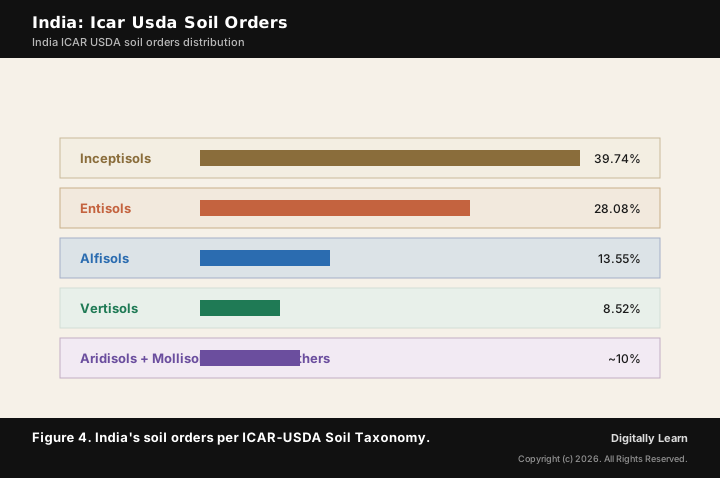
The ICAR-USDA classification guides India's agro-climatic zoning, fertiliser recommendations, irrigation planning, and erosion-control strategies. The NBSS&LUP soil atlas publishes district-level maps using these orders, while the ICAR-Indian Institute of Soil Science at Bhopal coordinates the research that supports the framework. The Indian distribution by USDA order is dominated by Inceptisols and Entisols, together covering nearly two-thirds of the country.
- Inceptisols: 130,372.90 thousand hectares, 39.74 per cent of India; young soils with weak horizon development; cover the Indo-Gangetic alluvial plain.
- Entisols: 92,131.71 thousand hectares, 28.08 per cent; recent soils without significant horizon development; cover floodplains, deltas, sand-dune tracts.
- Alfisols: 44,448.68 thousand hectares, 13.55 per cent; clay-enriched subsoil horizons; cover peninsular plateau red-soil tracts.
- Vertisols: 27,960.00 thousand hectares, 8.52 per cent; high clay content with deep summer cracks; cover Deccan black-cotton-soil tracts.
- Other orders: Aridisols (Rajasthan desert), Mollisols (sub-Himalayan tract), Ultisols, Histosols (peaty Kerala backwaters) – together cover the remaining ~10 per cent.
Previous Year UPSC-CSE Questions
Previous Year UPSC-CSE Questions By the end you will be able to draft model answers for the following UPSC questions. Each question carries a collapsible framework showing how to approach it in the exam.
- UPSC Prelims 2011Biodiversity forms the basis for human existence in the following ways:
- Soil formation
- Prevention of soil erosion
- Recycling of waste
- Pollination of crops Select the correct answer using the codes given below:
How to approach this Prelims question
Approach: All four statements are correct biodiversity-mediated ecosystem services. Statement 1: soil formation is driven jointly by parent material weathering AND biological activity (microbes, root systems, vegetation cover) – CORRECT. Statement 2: vegetation cover prevents erosion via root binding and canopy interception – CORRECT. Statement 3: bacterial and fungal decomposers recycle waste into nutrients – CORRECT. Statement 4: insect, bird, bat, and mammal pollinators are essential for crop reproduction – CORRECT.
Trap to watch: Each statement reads as plausibly correct in isolation; the test is whether the candidate accepts all four jointly.
Key facts to recall:
- Soil formation requires biological activity (vegetation and microbes) alongside weathering of parent material
- Biodiversity ecosystem services include provisioning, regulating, cultural, and supporting categories
- Pollination value globally is estimated at ~10 per cent of global crop production
Answer signal: Correct answer is (d) (1, 2, 3 and 4).
Sources
- NCERT Class 11 India Physical Environment, Chapter 6 (Soils)
- Indian Council of Agricultural Research (ICAR)
- National Bureau of Soil Survey and Land Use Planning (NBSS&LUP), Nagpur
- ICAR-Indian Institute of Soil Science, Bhopal
- USDA Natural Resources Conservation Service (NRCS) Soil Taxonomy
- Ministry of Agriculture and Farmers Welfare, Soil Health Card
- Wikipedia: Soil classification
- Wikipedia: USDA soil taxonomy
- Wikipedia: Soils of India
Disclaimer
This article is prepared for UPSC preparation by Digitally Learn's editorial team. Key concepts, figures, and named institutions are cross-verified with the authoritative sources listed in the Sources block below.