


Overview

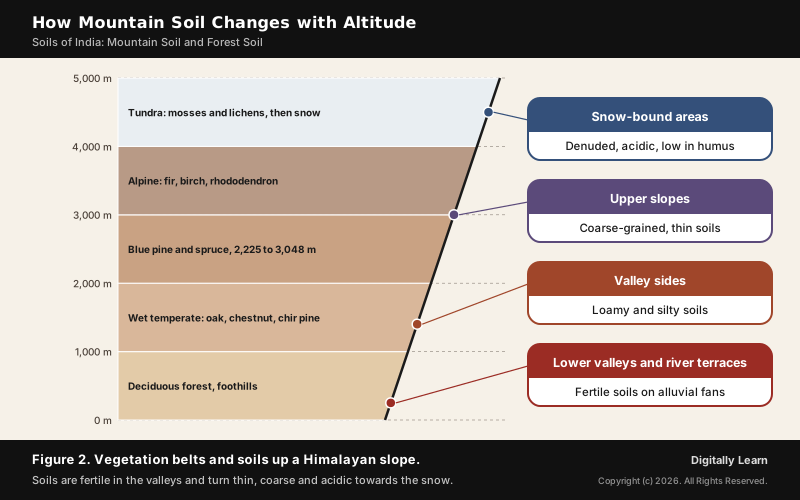
Mountain soil, also called forest soil, is the soil that forms on forested hills and mountains where rainfall is sufficient. Its character changes with the slope: it is loamy and silty on valley sides, coarse-grained on the upper slopes, and acidic and low in humus in the snow-bound Himalaya, while the soils of the lower valleys, on river terraces and alluvial fans, are fertile. In India mountain soil covers the Himalaya, the north-eastern hills and the forested ranges of the Peninsula, from the Western Ghats to the Satpura.
Mountain Soil in India: Meaning and Where It Is Found
What Is Mountain Soil and What Is Forest Soil?
NCERT groups the soils of India, by their origin, colour, composition and location, into eight classes: alluvial, black, red and yellow, laterite, arid, saline, peaty and forest soils. Forest soils form in forest areas where enough rain falls, and because those areas are mostly hills and mountains, the same group is widely called mountain soil or forest and mountain soil.
What sets mountain soil apart is that it is not one uniform soil. The mountain environment decides its structure and texture, so the soil changes within a few kilometres as the slope rises from a valley floor to a ridge. A student who remembers that one idea can answer most questions on the topic: fertile below, thin and acidic above.
Where Mountain Soil Is Found: States and Hill Ranges
Mountain soil follows India's forested hills. The largest belt runs along the Himalaya, from Jammu and Kashmir and Himachal Pradesh through Uttarakhand to Sikkim and Arunachal Pradesh, and continues into the higher hill ranges of the north-east and the hilly areas of West Bengal around Darjeeling. In the Peninsula it covers the Western Ghats, especially in Kerala, Tamil Nadu and Karnataka, where the Nilgiri, Anaimalai and Palani hills carry temperate shola forests, and the forested Vindhya, Satpura and Maikal ranges of central India.
NCERT divides these into northern and southern mountain forests. The northern belt, along the Himalaya, climbs through every climate from tropical to tundra, so its soils change the most with height. The southern forests of the Western Ghats, the Vindhyas and the Nilgiris lie closer to the tropics and only about 1,500 m above sea level, so their vegetation is temperate in the higher parts and subtropical lower down.

Characteristics of Mountain Soil and Forest Soil
Characteristics of Mountain Soil: Texture, Fertility and Acidity
The features of forest soil all follow from slope and climate. NCERT's description reduces to five points that answer most questions:
- Where it forms: In forest areas on hills and mountains with sufficient rainfall.
- Texture varies with the slope: Loamy and silty on valley sides, coarse-grained on the upper slopes.
- Acidic and poor near the snow: In the snow-bound areas of the Himalaya the soils suffer denudation and are acidic with low humus content.
- Fertile in the valleys: Soils in the lower parts of valleys, particularly on river terraces and alluvial fans, are fertile.
- Thin on steep ground: Soils are thin on steep slopes and thick over flat uplands; soil forms best on gentle slopes, where erosion is slow and water soaks in.
| Position on the slope | Soil | Best use |
|---|---|---|
| Lower valleys, river terraces, alluvial fans | Fertile soils | Farming, which NCERT would keep to valleys |
| Valley sides | Loamy and silty | Terraces on moderate slopes |
| Upper slopes | Coarse-grained, thin | Forest cover |
| Snow-bound heights | Denuded, acidic, low in humus | Alpine pasture below the snow |
Colour and chemistry follow the local rock. In Sikkim, where the rocks are mainly gneiss and schist, they weather into generally poor and shallow brown clay soils, coarse, rich in iron oxide, neutral to acidic and lacking in organic and mineral nutrients; they support evergreen and deciduous forests.
How Altitude and Slope Shape Mountain Soil
Altitude changes the forest, and the forest changes the soil. In the Himalaya NCERT traces a succession from deciduous forests in the foothills to wet temperate forests of oak and chestnut between 1,000 and 2,000 m, blue pine and spruce between 2,225 and 3,048 m, and alpine forests of fir, birch and rhododendron between 3,000 and 4,000 m, above which mosses and lichens form tundra vegetation.
- Temperature: Chemical activity in soil slows in cool conditions and stops when frozen, so high, cold slopes carry mostly mechanically broken rock rather than mature soil.
- Humus: Bacteria work slowly in cold climates, so organic matter accumulates; in humid tropical climates they work fast and leave little humus.
- Aspect: The southern slopes of the Himalaya carry thicker vegetation than the drier north-facing slopes because they receive more precipitation, and soils follow the vegetation.
- Pasture use: The alpine pastures above the tree line are grazed through transhumance by the Gujjars, Bakarwals, Bhotiyas and Gaddis, which is why grazing control matters for high-altitude soils.
Brown Forest Soil, Podzols and Rainforest Soils Compared
Two soil names from world geography help explain Indian mountain soils. Brown forest soil, or brown earth, is the soil of deciduous woodland in humid temperate climates: well drained, fertile, with a pH between 5.0 and 6.5 and a brown topsoil of well-decomposed mull humus. It is described mainly from Europe, but it shows what a fertile soil under broadleaf forest looks like.
Higher up, under conifers, decomposition is slow and a thick layer of litter builds up as acidic mor humus. Under such litter in cool, humid climates, soils can develop into podzols. FAO describes podzols as soils with an ash-grey subsurface layer, bleached by organic acids, over a dark layer where humus and iron have collected; they form in humid, mostly boreal and temperate, climates. The name means under-ash in Russian, and the USDA system calls them spodosols.
The rainforest case shows why forest cover and soil fertility are not the same thing. In humid tropical and equatorial climates bacterial action is intense, so dead vegetation is rapidly oxidised and leaves very low humus in the soil. Heavy rain then washes nutrients down through the profile. NCERT explains India's laterite soils the same way: intense leaching by tropical rains removes lime and silica and leaves soils rich in iron oxide and aluminium but poor in organic matter, nitrogen, phosphate and calcium.
Clearing such a forest removes the only steady supply of organic matter to the soil. That is why a jhum plot is farmed for only a few years before it is left to recover: its fertility and crop yield fall with use, and a short fallow cannot rebuild them.
Crops Grown in Mountain Soil: Tea, Coffee and Spices
Tea on Mountain Soil: Darjeeling, Nilgiri, Kangra and Sikkim
Tea is the crop most tied to mountain soils. NCERT describes it as grown on the undulating topography of hilly areas and on well-drained soils in humid and sub-humid tropics and sub-tropics. The hill tea regions all sit on hill slopes, while Assam's tea grows on the Brahmaputra valley floor, on clay soil rich in floodplain nutrients.
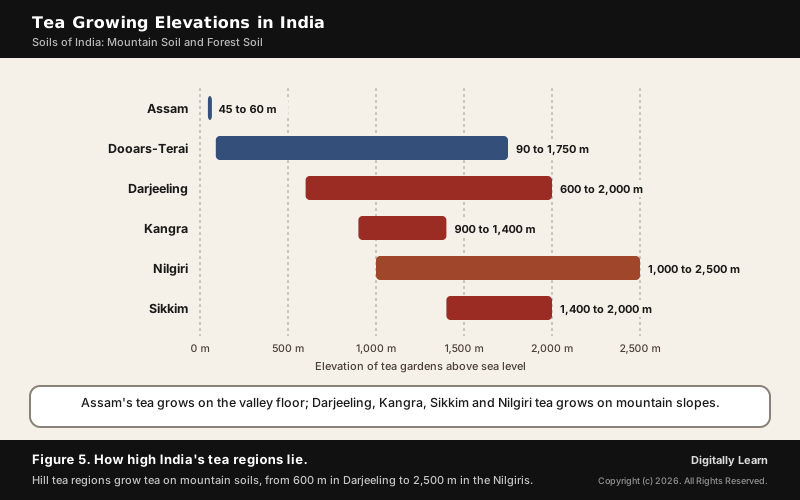
- Darjeeling: First planted in 1841 by Archibald Campbell. The Chinese variety, sinensis, flourished there because it had been bred for higher elevations, while the Assam variety preferred warmer and wetter conditions. In 2004 Darjeeling tea became India’s first product with legal geographical indication protection.
- Nilgiri: Grown at 1,000 to 2,500 m on well-drained hillsides of lateritic loam, under two monsoons with alternating fog and sunshine.
- Kangra: Planted after an 1848 survey found the valley suitable; grown at 900 to 1,400 m and given geographical indication status in 2005.
- Sikkim: Grown at 1,400 to 2,000 m; the Temi tea garden was established by 1968.
Why Hill Tea Did Not Spread Across the Himalaya
British planters tried tea along the Shivaliks and the Lesser Himalaya, but only Darjeeling became a lasting success. The sources point to a mix of plant, soil, terrain and history rather than one cause:
- Kangra’s lost lead: Kangra tea succeeded at Palampur and Dharamsala, failed elsewhere, and by the 1880s sold in Kabul and Central Asia; the 1905 Kangra earthquake destroyed its factories and the British sold the plantations.
- The right plant for the height: The sinensis variety suited Darjeeling’s elevation, while the Assam variety preferred warmer and wetter conditions, which the Brahmaputra valley supplied.
- Hard terrain: Darjeeling itself could not compete on quantity or price because of remoteness, slower plant growth and the impossibility of mechanising steep gardens, so it competed on quality instead.
- Fragile slopes: Clearing forest for tea and heavy use of fertilisers on rainy hillsides brought erosion, slope instability and soil depletion; organic practices later helped Darjeeling gardens cope with them.
Coffee, Cardamom and Other Crops of Hill Soils
Coffee is the Western Ghats' mountain crop. NCERT notes that it is grown in the highlands of the Western Ghats in Karnataka, Kerala and Tamil Nadu, with Karnataka alone producing more than two-thirds of India's coffee, and that India mostly grows the superior arabica. The Coffee Board records that Indian coffee grows under a canopy of thick natural shade in the ecologically sensitive Western and Eastern Ghats, and traces the crop to seven seeds planted by the saint Baba Budan on the Baba Budan Giris in Karnataka.
- Where coffee grows: Karnataka produces about 71 per cent, Kerala 21 per cent and Tamil Nadu 5 per cent; newer areas lie in Andhra Pradesh and Odisha and in the north-eastern states, and 98 per cent of India’s roughly 250,000 growers are small growers.
- Cardamom: Sikkim produces more cardamom than any other state and has the largest cultivated area of it.
- Terraced grain: Sikkim’s farming rests on terraced rice with maize, millet, wheat and barley.
- Tree crops on laterite: NCERT notes that red laterite soils of Tamil Nadu, Andhra Pradesh and Kerala suit tree crops such as cashew.
Soil Erosion in Mountain Areas and How Forests Prevent It
Stages of Soil Erosion and How Forests Prevent Soil Erosion
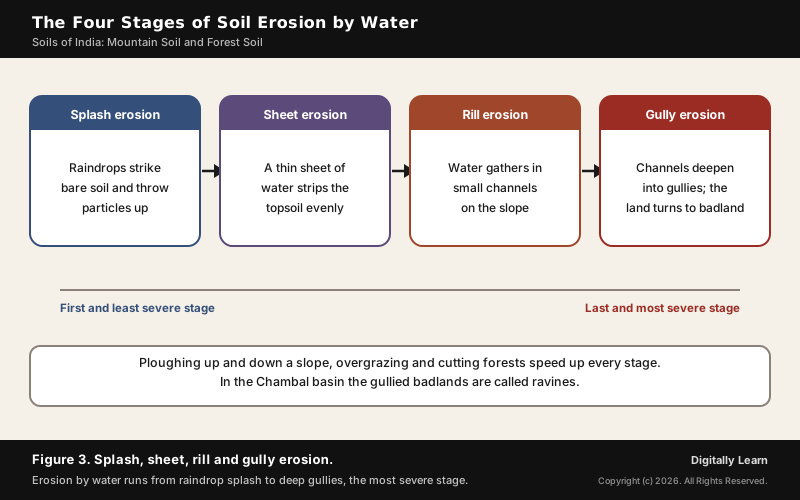
Soil erosion is the removal of the soil cover and its washing down the slope. Soil formation and erosion normally balance each other, but deforestation, overgrazing, construction and mining upset that balance, and on mountain slopes running water does the most damage. Erosion by water passes through four stages, from the least to the most severe:
- Splash erosion: Raindrops strike bare soil and throw particles into the air.
- Sheet erosion: Water flows as a sheet over a large area and washes away the topsoil.
- Rill erosion: The flow concentrates into small channels on the hillside.
- Gully erosion: Running water cuts deep channels called gullies, and the land becomes unfit for cultivation, known as badland; in the Chambal basin such land is called ravines.
Forests prevent soil erosion on mountain slopes in three ways. The litter of the forest floor covers the ground, prevents erosion, conserves moisture and returns nutrients to the soil. Tree roots and cover let water soak in instead of running off. And the steady supply of leaves keeps building humus.
Cutting the forest reverses all three. NCERT's Class VIII text explains that with fewer trees there is more soil erosion: the removal of the topsoil exposes lower, harder and rocky layers with less humus, the soil holds less water, less water soaks into the ground, and floods follow. Faulty farming adds to it: ploughing up and down a slope forms channels for the quick flow of water.
Soil Conservation in the Hills: Terraces, Contour Bunding and Check Dams
Conservation starts with land use. NCERT advises that land with a slope of 15 to 25 per cent should not be cultivated, and that where such land must be farmed, terraces should be made with care. The western and central Himalaya already have well-developed terrace farming.
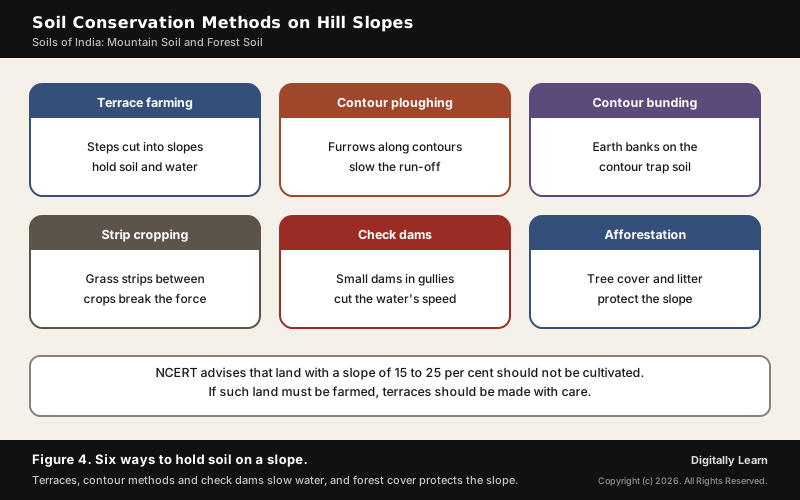
- Contour ploughing and bunding: Ploughing and building earth banks along the contour lines slows the flow of water down the slope.
- Strip cropping: Strips of grass left between crops break the force of the wind.
- Gully control: Finger gullies can be removed by terracing; in bigger gullies a series of check dams reduces the water’s speed, and gully heads are plugged or planted.
- Land-use planning: Regulated forestry, controlled grazing, cover cropping, mixed farming and crop rotation, with land classified by its capability; the Central Soil Conservation Board has prepared plans for different regions.
- Grazing and shifting cultivation: Over-grazing and shifting cultivation have stripped the natural cover and caused extensive erosion; NCERT says both should be regulated by educating villagers, and land unfit for crops should be turned into pasture.
Jhum Cultivation, Sea Buckthorn and Soil Care in the Hills
Jhum is the slash-and-burn shifting cultivation of north-east India: forest is cleared and burnt, the plot is farmed for a few years, and then it is left to recover. Tree fallows protect the soil against erosion, but when the fallow period is cut short the soil loses nutrients with each cycle and can be exhausted in less than a decade. NCERT therefore recommends encouraging terrace farming in the north-eastern hill states where jhumming is still practised.
- Sea buckthorn: A shrub found through most of the Himalayan region, including India, with about 12,000 hectares here. Its deep roots and nitrogen-fixing Frankia bacteria make it useful against soil erosion and for land reclamation, and its fruit is rich in vitamins.
- Organic hill farming: Sikkim converted its agriculture to fully organic between 2003 and 2016, the first Indian state to do so.
Landslides and Mountain Soils in the Himalaya and Western Ghats
Causes of Landslides in the Himalaya and the Western Ghats
Thin soil on a steep, wet slope is only as stable as the rock and roots beneath it. NCERT places both mountain regions in the very high vulnerability zone for landslides, but for different reasons. ISRO's Landslide Atlas of India, published in 2023, maps about 80,000 landslides from 1998 to 2022 across 17 states and two union territories in the Himalaya and the Western Ghats.
| Factor | Himalaya | Western Ghats and Nilgiris |
|---|---|---|
| Rock and relief | Young, highly unstable mountains | Steep slopes |
| Trigger | Frequent ground-shaking from earthquakes | Very high monsoon rainfall |
| Human pressure | Roads, dams and construction | The same pressures on steep, rain-soaked slopes |
- High vulnerability zone: All the Himalayan states and the north-eastern states except the plains of Assam.
- Moderate to low zone: Drier areas such as the trans-Himalayan Ladakh and Spiti, the Aravali, and the rain-shadow sides of the Western and Eastern Ghats.
- Consequences: Blocked roads and railway lines, and rivers dammed or diverted by rock-falls, which can cause floods and make hill regions costly to develop.
NCERT's remedies follow directly from mountain soil: restrict roads, dams and large settlements in the high-risk zones, limit farming to valleys and moderate slopes, promote large-scale afforestation, build bunds to slow water, and encourage terrace farming where jhumming continues.
Previous Year UPSC-CSE Questions
Previous Year UPSC-CSE Questions By the end you will be able to draft model answers for the following UPSC questions. Each question carries a collapsible framework showing how to approach it in the exam.
- UPSC Mains 2021 GS-IDifferentiate the causes of landslides in the Himalayan region and Western Ghats.
Answer outline: how to structure the answer
What the question asks, the main arguments, relevant examples and the direction of the conclusion. This is not a full model answer.
Introduction: Open with NCERT's zoning: both the Himalaya and the Western Ghats lie in the very high landslide vulnerability zone.
Body (sub-themes to develop):
- Himalaya: young, unstable mountains, frequent earthquakes, roads, dams and construction.
- Western Ghats and Nilgiris: steep slopes under very high monsoon rainfall, thin soils over rock.
- Common factors: deforestation, thin soils on steep slopes, human activity on slopes.
- Evidence: ISRO's Landslide Atlas maps about 80,000 landslides from 1998 to 2022 in both regions.
Conclusion: Conclude with area-specific mitigation: restrict construction, afforest, build bunds and encourage terracing.
- UPSC Mains 2014 GS-IWhereas the British planters had developed tea gardens all along the Shivaliks and Lesser Himalayas from Assam to Himachal Pradesh, in effect they did not succeed beyond the Darjeeling area. Explain.
Answer outline: how to structure the answer
What the question asks, the main arguments, relevant examples and the direction of the conclusion. This is not a full model answer.
Introduction: Open with the spread of British tea along the Himalaya and note that Kangra did succeed until 1905.
Body (sub-themes to develop):
- Plant and altitude: sinensis suited Darjeeling's elevation; the Assam variety needs warmer, wetter conditions.
- Soil and slope: tea needs well-drained, stable slopes; clearing and fertilisers brought erosion and instability.
- Terrain: remoteness, slow growth and no mechanisation made hill tea costly; Darjeeling chose quality.
- History: the 1905 Kangra earthquake destroyed factories and the British sold the plantations.
Conclusion: Conclude that Darjeeling lasted because its altitude, soil and quality niche fitted, which other hill tracts lacked.
- UPSC Prelims 2001 Prelims-GSIdentify the correct order of the processes of soil erosion from the following:
How to approach this Prelims question
Approach: Water erosion runs from the least to the most severe stage. Raindrops first splash particles off bare soil; water then flows as a sheet and strips the topsoil; the flow gathers into small rills; finally the rills deepen into gullies and the land becomes badland.
Trap to watch: Sheet erosion comes before rills; gullies are always last and most severe.
Key facts to recall:
- (a) Splash, sheet, rill, gully: right. This is the order from the first and least severe stage to the most severe.
- (b) Sheet, splash, gully, rill: wrong. Splash comes first, and rills form before gullies.
- (c) Rill, gully, sheet, splash: wrong. It starts in the middle and ends with the first stage.
- (d) Gully, rill, sheet, splash: wrong. It is the sequence in reverse.
Answer signal: Answer (a): erosion begins with raindrop splash and ends in gullies.
- UPSC Prelims 2014 Prelims-GSIn India, the problem of soil erosion is associated with which of the following?
- Terrace cultivation
- Deforestation
- Tropical climate
Select the correct answer using the code given below.
How to approach this Prelims question
Approach: Judge each item. Terrace cultivation checks erosion on slopes rather than causing it, so item 1 is out. Deforestation removes the litter, roots and canopy that hold soil, so it causes erosion. The key keeps deforestation alone.
Trap to watch: Terrace cultivation is a conservation method, not a cause.
Key facts to recall:
- (a) 1 and 2 only: wrong. Terrace cultivation checks soil erosion; it does not cause it.
- (b) 2 only: right. Deforestation strips the cover that holds the soil on slopes.
- (c) 1 and 3 only: wrong. It includes terracing and leaves out deforestation, the main cause.
- (d) 1, 2 and 3: wrong. Terrace cultivation is a remedy, not a cause.
Answer signal: Answer (b), 2 only: terracing is a conservation method, so only deforestation remains.
- UPSC Prelims 2012 Prelims-GSGovernment of India encourages the cultivation of ‘sea buckthorn’. What is the importance of this plant?
- It helps in controlling soil erosion and in preventing desertification.
- It is a rich source of biodiesel.
- It has nutritional value and is well-adapted to live in cold areas of high altitudes.
- Its timber is of great commercial value.
Which of the statements given above is/are correct?
How to approach this Prelims question
Approach: Recall what sea buckthorn is valued for. Its deep roots and nitrogen-fixing bacteria make it useful against soil erosion and for land reclamation (statement 1). It grows through the cold Himalayan region and its fruit is rich in vitamins (statement 3). It is a shrub, so it gives no commercial timber, and it is not valued as a fuel crop (statements 2 and 4).
Trap to watch: It is a shrub, so its timber has no great commercial value, and it is not a biodiesel crop.
Key facts to recall:
- (a) 1 only: wrong. Statement 3 is also true: the shrub grows in the cold high Himalaya and its fruit is rich in vitamins.
- (b) 2, 3 and 4 only: wrong. It leaves out erosion control and includes biodiesel and timber, which are not its uses.
- (c) 1 and 3 only: right. Erosion control and nutritional value in cold, high areas are its two strengths.
- (d) 1, 2, 3 and 4: wrong. A shrub gives no commercial timber, and it is not a biodiesel source.
Answer signal: Answer (c), 1 and 3 only: a soil-binding Himalayan shrub with nutritious fruit, not a timber or fuel crop.
- UPSC Prelims 2023 Prelims-GSConsider the following statements : Statement-I : The soil in tropical rain forests is rich in nutrients. Statement-II : The high temperature and moisture of tropical rain forests cause dead organic matter in the soil to decompose quickly. Which one of the following is correct in respect of the above statements?
How to approach this Prelims question
Approach: In humid tropical forests bacterial action is intense, so dead vegetation decomposes quickly and leaves very little humus; heavy rain then washes nutrients out. Statement II is therefore correct, and it is exactly why Statement I, that rainforest soil is rich in nutrients, is wrong.
Trap to watch: Dense forest suggests rich soil, but the nutrients are in the plants, not the soil.
Key facts to recall:
- (a) Both correct, II explains I: wrong. Statement I is false; rainforest soil is poor.
- (b) Both correct, II does not explain I: wrong. Statement I is false.
- (c) I correct, II incorrect: wrong. It reverses the truth of the two statements.
- (d) I incorrect, II correct: right. Fast decomposition and leaching leave the soil poor in nutrients.
Answer signal: Answer (d): quick decomposition leaves little humus, so the soil is poor despite the thick forest.
Sources
- Wikipedia: Brown earth
- Wikipedia: Podzol
- Wikipedia: Humus
- Wikipedia: Forest floor
- Wikipedia: Sikkim
- Wikipedia: Darjeeling tea
- Wikipedia: Kangra tea
- Wikipedia: Nilgiri tea
- Wikipedia: Assam tea
- Wikipedia: Coffee production in India
- Wikipedia: Jhum
- Wikipedia: Shifting cultivation
- Wikipedia: Hippophae rhamnoides
- Wikipedia: Soil erosion
- NCERT: India Physical Environment (Class XI), Soils; Natural Vegetation; Natural Hazards and Disasters
- NCERT: Fundamentals of Physical Geography (Class XI), Soil-forming factors
- NCERT: Contemporary India II (Class X), Resources and Development
- NCERT: India People and Economy (Class XII), Tea and Coffee
- FAO: Lecture Notes on the Major Soils of the World, Podzols
- ISRO: Landslide Atlas of India
- Tea Board of India: Tea regions and elevations
- Coffee Board of India
- UPSC: Civil Services Examination question papers
Editorial Disclaimer
This article is compiled from the reference materials listed in the Sources section. It is an explainer for UPSC preparation and is not a substitute for primary documents (NCERTs, GoI ministry releases, IMD bulletins, RBI / CEA / MoEFCC publications, and Standing-Committee reports).