


Overview
The 2026 Foreign Ministers' Meeting
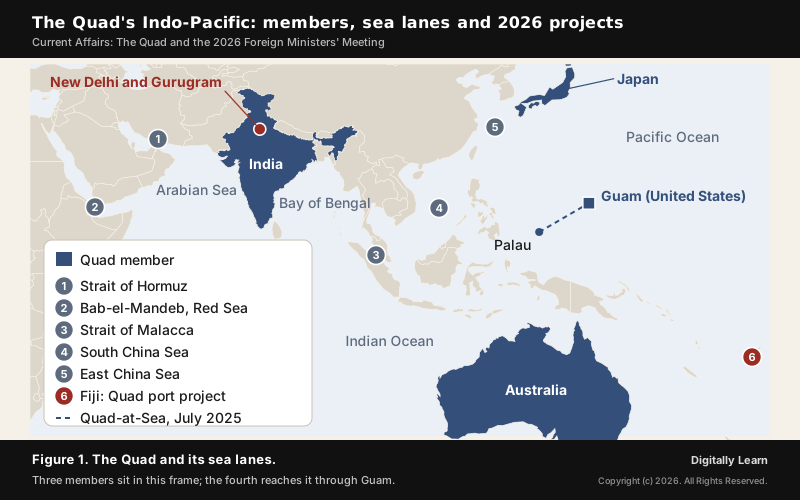
The Quad member countries are India, Australia, Japan and the United States, partners for a free and open Indo-Pacific. Their foreign ministers met in New Delhi on 26 May 2026 for the 11th Quad Foreign Ministers' Meeting, which launched new work on maritime surveillance, energy security and critical minerals but set no date for the leaders' summit India has waited to host since 2024.
Quad Foreign Ministers Meeting 2026 in New Delhi: Why It Is in the News
11th Quad Foreign Ministers' Meeting: Date, Venue and Ministers
External Affairs Minister S. Jaishankar hosted U.S. Secretary of State Marco Rubio, Australian Foreign Minister Penny Wong and Japanese Foreign Minister Toshimitsu Motegi. The meeting closed with a Joint Statement and a Factsheet. Two more texts came out the same day: a Quad Critical Minerals Initiative Framework and a Quad Statement on Indo-Pacific Energy Security.
The timing explains the agenda. The United States and Israel had gone to war with Iran on 28 February 2026, and Iran's grip on the Strait of Hormuz was squeezing oil and gas supplies across Asia. President Donald Trump had just visited China. Rubio's four-day trip, his first to India since taking office in January 2025, was also the first visit by a senior U.S. official since the war began, and it came after a year of strained India-U.S. ties.
Before the meeting, Motegi called the Quad a "vital framework" and named critical minerals as the top item. The ministers had last met on 1 July 2025 in Washington, D.C., when they simplified the Quad's work into four areas. Their meeting in New Delhi had to show that the grouping still mattered.
Outcomes of the 2026 Meeting: Maritime Surveillance, Energy, Minerals and Ports
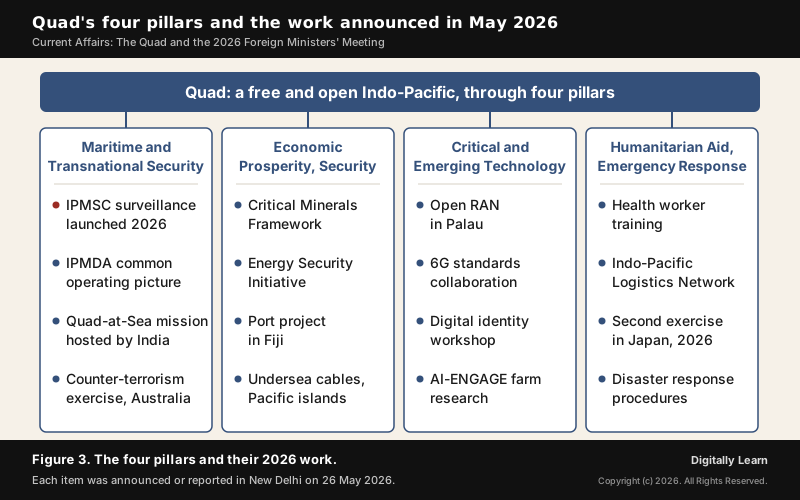
Most of what the ministers announced is practical work at sea and in supply chains. The list below follows the Factsheet issued after the meeting.
- Indo-Pacific Maritime Surveillance Collaboration (IPMSC): A new initiative that pools the four countries’ maritime surveillance to share real-time information on vessels, starting in the Indian Ocean Region.
- IPMDA expanded: The ministers welcomed India’s running of the Indian Ocean part of the Indo-Pacific Partnership for Maritime Domain Awareness through its Information Fusion Centre at Gurugram, and agreed to build a Common Operating Picture across the Indo-Pacific.
- Quad-at-Sea in India: India will host the next Quad-at-Sea Ship Observer Mission, which brings the four countries’ coast guards together on one ship. The first sailed from Palau to Guam in July 2025.
- Critical minerals: A framework under which the partners intend to mobilise up to US$20 billion in government and private support for mining, processing and recycling.
- Energy security: A Quad Initiative on Indo-Pacific Energy Security, covering technology, policy, market analysis and emergency response exercises, and a Quad Fuel Security Forum for high-level talks.
- Ports and cables: The Quad will work with Fiji’s government on port infrastructure, and it has backed the aim of connecting every Pacific Islands Forum country by undersea cable by 2026.
- Technology and health: Trusted suppliers selected for Open RAN networks in Palau, joint work on 6G standards, over US$6 million for six farm research projects under AI-ENGAGE, and health training across the region valued at over US$50 million.
Quad Joint Statement 2026: Hormuz, South China Sea and Terrorism
The Joint Statement opens with the Quad's standing positions: peace in the Indo-Pacific rests on international law, the peaceful settlement of disputes, and respect for sovereignty and territorial integrity. The four oppose any attempt to change the status quo by force or coercion.
- West Asia and the Strait of Hormuz: They backed diplomacy for lasting peace, called for the uninterrupted flow of commerce through the Strait of Hormuz and the Red Sea as reflected in the UN Convention on the Law of the Sea (UNCLOS), condemned attacks on commercial ships and opposed any toll on passing vessels.
- South and East China Seas: Serious concern at coercive actions, including the unsafe use of water cannons and the militarisation of disputed features. They called the 2016 arbitral award on the South China Sea a significant milestone and the basis for settling disputes peacefully.
- Terrorism: Condemnation of cross-border terrorism, naming the Pahalgam attack of 22 April 2025 and the Bondi Beach attack in Australia of 14 December 2025.
- North Korea and Myanmar: Complete denuclearisation of North Korea, and an end to the violence in Myanmar.
- Online scam centres: Deeper law-enforcement cooperation against the scam centres of Southeast Asia and the crimes linked to them, from trafficking in persons to illicit finance.
The statement also showed what four partners can no longer say together. It criticised Iran's actions in the war but did not mention that the United States and Israel started it, or that the U.S. Navy torpedoed the Iranian ship IRIS Dena in the Indian Ocean, near Sri Lankan waters, on 4 March. Washington's new engagement with China and Russia appeared to narrow the language.
What Is Quad: Quad Countries List, Full Form and Nature
Quad Member Countries and the Quad Full Form
The Quad is a partnership of four countries, India, Australia, Japan and the United States, committed to a free and open Indo-Pacific that is prosperous and resilient. Its work runs on four pillars: maritime and transnational security; economic prosperity and security; critical and emerging technologies; and humanitarian assistance and disaster response. It concentrates on three sub-regions, Southeast Asia, the Indian Ocean Region and the Pacific Islands.
On the full form, the External Affairs Ministry's brief is precise: the partnership is known formally as the "Quad", not the Quadrilateral Security Dialogue. The longer name is still widely used, and UPSC itself wrote "Quadrilateral Security Dialogue (Quad)" in a 2020 Mains question, so an aspirant should know both.
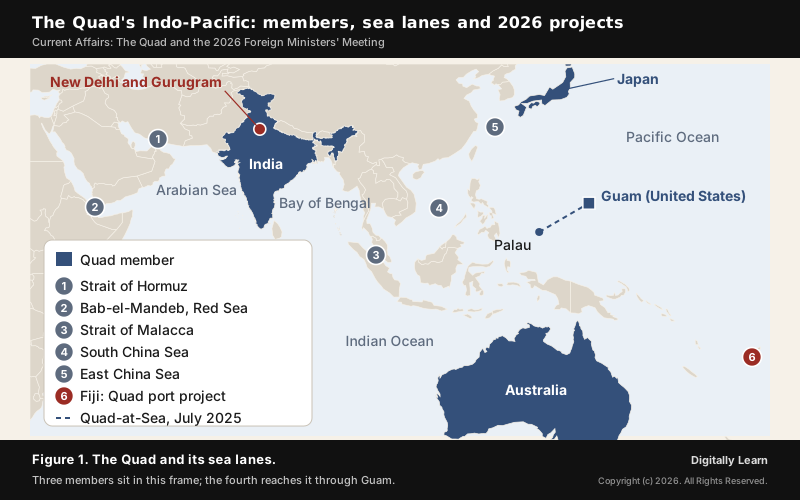
Each member brings its own regional work to the table. India runs the Information Fusion Centre for the Indian Ocean Region at Gurugram. Japan has proposed POWERR Asia, a partnership on energy and resources resilience. Australia funds energy security in Southeast Asia and the Pacific, including AUD30 million in budget support to Fiji. The United States supplies maritime surveillance technology, such as the SeaVision software India bought in 2025.
Is Quad a Military Alliance? The Quad and AUKUS Compared
The Quad is not a military alliance, because it does not rest on a principle of collective defence: no member is pledged to defend another. Its work runs through meetings of leaders, ministers and officials, and through dialogues, workshops and table-top exercises among experts. Even its critics note its hesitation to project itself as a security-centric grouping, and its habit of not naming China.
The four navies do train together, but outside the Quad's own structure. The Malabar exercise began in 1992 as a bilateral India-U.S. exercise off the Malabar Coast; Japan became a permanent partner in 2015 and Australia rejoined in 2020, so all four Quad navies now take part. In September 2026 a Japanese defence official said the next naval exercise of the Quad states would be held near the Sea of Japan before the year ended.
AUKUS is different in kind. Announced on 15 September 2021, it is a trilateral security partnership of Australia, the United Kingdom and the United States. Its first pillar helps Australia acquire nuclear-powered attack submarines; its second covers advanced military capabilities. India is not a member.
Staying out of a military alliance has a long history in India's foreign policy. During the Cold War India kept away from the military alliances led by the United States and the Soviet Union, NATO and the Warsaw Pact, and followed non-alignment: it took an independent stand on international issues and drew aid from members of both blocs. Working in the Quad without any defence pledge continues that independence, now called strategic autonomy.
| Feature | Quad | AUKUS |
|---|---|---|
| Members | India, Australia, Japan, United States | Australia, United Kingdom, United States |
| Began | 2004 tsunami relief; officials from 2007; leaders from 2021 | Announced 15 September 2021 |
| Nature | Partnership for a free and open Indo-Pacific; no collective defence | Trilateral security partnership |
| Core work | Four pillars: maritime security, economic security, technology, disaster relief | Pillar 1: nuclear-powered submarines for Australia; Pillar 2: advanced capabilities |
| India | Founding member | Not a member |
When the Quad Was Established: From the 2004 Tsunami to the Summits
Evolution of the Quad: Revival, Quad Plus Countries and Summits
The four countries first came together to coordinate relief after the Indian Ocean tsunami of 2004. The first meeting of Quad officials followed in May 2007, on the sidelines of the ASEAN Regional Forum in the Philippines. Then the grouping lapsed for a decade.
- November 2017: After a gap of ten years, officials met again in Manila on the margins of the East Asia Summit, to discuss connectivity, maritime security, counter-terrorism and a free and open Indo-Pacific.
- September 2019: The foreign ministers met for the first time, on the margins of the UN General Assembly in New York.
- 2020, Quad Plus: During the COVID-19 pandemic Brazil, Israel, New Zealand, South Korea and Vietnam were invited to “Quad Plus” meetings on the response to it.
- 12 March 2021: The Quad rose to the level of leaders with a virtual summit, followed by the first in-person summit in Washington, D.C., on 24 September 2021.
- 2022 to 2024: Summits at Tokyo (24 May 2022), Hiroshima (20 May 2023) and Wilmington (21 September 2024). The Indo-Pacific Partnership for Maritime Domain Awareness was launched in 2022, and the Quad Cancer Moonshot was agreed at Wilmington.
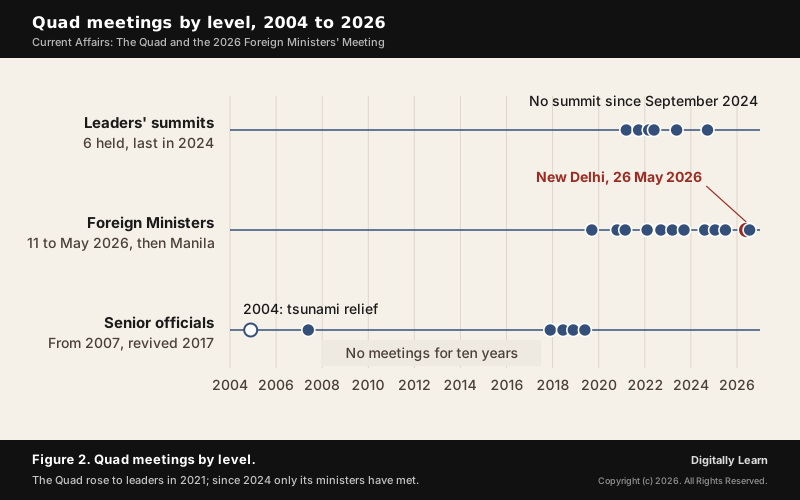
So the answer to "in which year was the Quad established" depends on what is counted: 2004 for the first coordination, 2007 for the first meeting, 2017 for the revival, and 2021 for the leaders' level. The chart shows why observers now speak of a slowdown: leaders have not met since September 2024, while the ministers keep meeting.
Quad Leaders' Summits and Foreign Ministers' Meetings: Full List
| Level | Meeting | Date and place |
|---|---|---|
| Leaders | 1st (virtual) | 12 March 2021 |
| Leaders | 2nd | 24 September 2021, Washington, D.C. |
| Leaders | 3rd (virtual) | 3 March 2022 |
| Leaders | 4th | 24 May 2022, Tokyo |
| Leaders | 5th | 20 May 2023, Hiroshima |
| Leaders | 6th | 21 September 2024, Wilmington |
| Foreign Ministers | 1st to 5th | New York 2019; Tokyo 2020; virtual 2021; Melbourne and New York 2022 |
| Foreign Ministers | 6th to 8th | New Delhi, 3 March 2023; New York 2023; Tokyo, 29 July 2024 |
| Foreign Ministers | 9th and 10th | Washington, D.C., 21 January and 1 July 2025 |
| Foreign Ministers | 11th | New Delhi, 26 May 2026 |
Two patterns stand out in the table. India hosted the ministers twice, in 2023 and 2026, but has never hosted the leaders. And the foreign ministers, who met roughly once a year before 2021, now carry the grouping: their three meetings between January 2025 and May 2026 were what the Ministry called a sign of growing momentum.
The ministers met once more in July 2026, on the sidelines of the 59th ASEAN Foreign Ministers' Meeting in Manila. As ASEAN Comprehensive Strategic Partners, they reaffirmed their support for a free and open Indo-Pacific and for ASEAN unity and centrality.
Quad Summit 2026: Why India Has Not Hosted the Leaders' Summit
India's Quad Chair and the Missing Leaders' Summit
India took over as Quad chair in 2024, but no summit has been held in India since. In 2024 tensions with the United States delayed the meeting and the summit was held in the United States instead, at Wilmington. In 2025 disputes over tariffs, sanctions, trade and U.S. claims about Operation Sindoor kept President Trump and the other leaders from travelling to Delhi.
New Delhi's meeting of May 2026 did not settle the question. The ministers only said they looked forward to the next summit, and a Ministry official said leaders' schedules were difficult to pin down. Sources said Australia would host the next ministers' meeting as India handed over the chair, and that a summit could be held on the sidelines of another gathering. Asked whether this meant a downgrade, Penny Wong said she would take offence to suggesting that anything held in Australia is a downgrade.
U.S. Policy, China and the Debate Over the Quad's Future
The doubts about the Quad come mostly from Washington. The U.S. National Security Strategy of November 2025 puts the Western Hemisphere ahead of the Indo-Pacific and mentions the Quad only in passing. Japan's updated Free and Open Indo-Pacific policy of May 2026 mentions it once, on critical minerals. Trump's visit to Beijing in May 2026 and Xi Jinping's planned visit to Washington point to a U.S. effort to get along with China.
China has always protested the Quad as an "exclusive clique" or, mockingly, as "ocean foam". A U.S. turn towards Beijing therefore raises a basic question for India: whether the platform built around the U.S.'s Indo-Pacific strategy keeps its value if Washington loses interest. Defenders reply that its regional work on climate, health, debt, infrastructure and maritime security remains a force for good.
- Lack of consultation: The partners were not consulted before or during the West Asia war, which raised questions about the Quad’s relevance.
- India-U.S. strains: The U.S. imposed a 50 per cent tariff on Indian goods, and differences over the India-Pakistan conflict, visas and immigration slowed ties through 2025 and 2026.
- India’s own balance: Jaishankar describes India as one of very few countries with strong relations with the United States, Israel, Iran and the Gulf countries at the same time. In Manila in July 2026 he told China’s Wang Yi that stable India-China ties would help foster a multipolar Asia.
Key Quad Initiatives: IPMDA, Critical Minerals and Regional Public Goods
IPMDA, the Information Fusion Centre and India's SAGAR Vision
The Indo-Pacific Partnership for Maritime Domain Awareness (IPMDA), launched under the Quad in 2022, shares near-real-time maritime data among partner countries so that they can detect, deter and respond to threats to shipping. Maritime domain awareness means knowing what is moving at sea, and it matters because hundreds of vessels switch off their Automatic Identification System transponders, "going dark" to evade sanctions, hide cargo or carry out ship-to-ship transfers.
India is the hub for the Indian Ocean part of this work. The Information Fusion Centre for the Indian Ocean Region (IFC-IOR) at Gurugram now runs IPMDA's Indian Ocean programme, and India bought SeaVision maritime software from the United States in 2025. The new IPMSC adds the members' own surveillance to IPMDA's commercial data.
This links the Quad to India's own maritime policy. Prime Minister Modi first spoke of SAGAR, Security and Growth for All in the Region, in Mauritius on 12 March 2015, as a vision of trust, transparency and respect for maritime rules in the Indian Ocean. The Indian Ocean is also at the centre of India's MAHASAGAR maritime policy. SAGAR is India's national vision; IPMDA gives it shared data and partners.
The Indian Ocean Rim Association (IORA) is the other regional body the Quad supports. Launched on 6 and 7 March 1997 with its headquarters at Ebene in Mauritius, it has 23 member states and six priority areas: maritime security, trade and investment, fisheries, disaster risk reduction, academic and scientific cooperation, and tourism and culture, with the blue economy as a focus area.
Quad Critical Minerals Framework, Pax Silica and India's Supply Chains
Critical minerals are the metals that green energy and advanced technology cannot do without, and supplies tightened after China imposed export controls on rare earth elements in 2025. The Quad framework of 26 May 2026 has three parts: investment in projects with a "Quad nexus", meaning projects located in Quad countries, run by companies headquartered there or supplying Quad markets; better rules on permits and on reviewing transactions that threaten national security; and recycling of critical minerals from e-waste and scrap.
India signed a separate framework with the United States on the same day, covering mining, processing, recycling and investment in critical minerals and rare earths. India had joined the U.S.-led Pax Silica, a 15-nation economic-security initiative covering minerals, semiconductors and computing, on 20 February 2026, and the Quad's statement welcomed Pax Silica as a pillar of the members' economic security.
At home, the government released a list of 30 critical minerals in July 2023, including lithium, cobalt, nickel and the rare earth elements. In 2023 Parliament amended the Mines and Minerals (Development and Regulation) Act, 1957, so that the Central Government alone auctions concessions for the critical minerals in Part D of its First Schedule, with the revenue going to the State. India also has to look abroad: its joint venture KABIL acquires overseas assets of lithium and cobalt.
For the full domestic picture, the page on India's critical minerals strategy covers the National Critical Mineral Mission.
Quad Technology, Health and Disaster Relief Initiatives
Beyond the sea and minerals, the Quad's work is regional public goods: services the four provide to smaller countries that cannot build them alone. This is the side of the Quad that Mains 2020 had in mind when it asked whether the grouping was turning from a security dialogue into something wider.
- Quad Cancer Moonshot: Agreed in 2024 and aimed at eliminating cervical cancer, alongside health worker training across the region valued at over US$50 million.
- Digital Public Infrastructure principles: Adopted in 2024, followed by Open RAN networks in Palau and joint work on 6G standards.
- Humanitarian Assistance and Disaster Relief (HADR): Coordinated responses to the Enga landslide in Papua New Guinea (2024) and the Myanmar earthquake (2025), backed by standard operating procedures.
- Indo-Pacific Logistics Network: Shared logistics for civilian disaster response, tested in a table-top exercise in April 2025 and a field exercise in December 2025, with a second table-top exercise due in Japan in 2026.
- AI-ENGAGE: Research projects that use artificial intelligence, robotics and sensing to help farmers with yields and pests.
Significance of the Quad for India and the Limits It Faces
Why the Quad Matters for India's Indo-Pacific Strategy
- Maritime security: India’s own Information Fusion Centre is the base of the Quad’s Indian Ocean surveillance, and India will host the next Quad-at-Sea mission.
- Energy and trade: The Hormuz crisis showed how exposed India is; Jaishankar said India must diversify its energy supplies, and the Quad’s energy initiative and its line against tolls serve that need.
- Supply chains: The minerals framework and Pax Silica tie India into supply chains that avoid reliance on any one country.
- Standing in the region: The Quad’s work for the Pacific Islands, ASEAN and the Indian Ocean raises India’s profile as a provider of security and development, alongside IORA.
The Quad's path also answers the Mains 2020 question. It began in disaster relief and maritime security, and its agenda has widened to minerals, energy, ports, cables and health. It has not become a trade bloc: it has no trade agreement or tariff preferences. Its economic work is about secure supply chains and investment, so it is better described as a grouping that has added economic security to maritime security.
Challenges: U.S. Unilateralism, China and India's Strategic Autonomy
The grouping's internal contradictions, above all the U.S.'s unilateral moves across the world, are a serious challenge. The New Delhi meeting produced worthy initiatives, yet the four could not speak with one voice on who started the West Asia war, and Rubio's visit produced only one bilateral agreement of note, on critical minerals.
- Divergent priorities: The United States wants the Strait of Hormuz reopened and talks with Iran through Pakistan; India wants secure energy supplies; Japan put critical minerals at the top of the agenda.
- Summit drift: Three years without a summit in India, and the risk that the Quad slips back to the ministers-only format it had before 2021.
- China: Beijing’s opposition and Washington’s outreach to it pull the Quad in two directions; the Quad avoids naming China, which keeps smaller countries comfortable but blurs its purpose.
India has also kept other doors open. It chaired the BRICS Summit in New Delhi in September 2026, as explained on the page on the BRICS Summit 2026 and the New Delhi Declaration. Membership of both groupings is how India practises multi-alignment.
Quad UPSC Relevance: Syllabus Links and Exam Angles
Quad in the UPSC Syllabus: GS Paper II and Prelims
- GS Paper II: Bilateral, regional and global groupings and agreements involving India; the effect of policies of developed countries on India’s interests (see the GS Paper II syllabus).
- GS Paper III: Security challenges in border and maritime areas, through IPMDA and the Information Fusion Centre; critical minerals and supply chains.
- Prelims: Members, dates and venues, the pillars, IPMDA, IORA, AUKUS and the critical minerals rules.
- Essay and interview: Multi-alignment, strategic autonomy and India’s role in the Indo-Pacific.
Previous Year UPSC-CSE Questions By the end you will be able to draft model answers for the following UPSC questions. Each question carries a collapsible framework showing how to approach it in the exam.
- UPSC Mains 2026 GS-II"IPMDA (Indo-Pacific Partnership for Maritime Domain Awareness) bridges the gap between India's SAGAR (Security and Growth for All in the Region) vision and the Quad's collective Indo-Pacific strategy." Make a critical assessment of the statement focusing on IPMDA.
Answer outline: how to structure the answer
What the question asks, the main arguments, relevant examples and the direction of the conclusion. This is not a full model answer.
Introduction: Introduce IPMDA as the Quad's maritime domain awareness partnership of 2022 that shares near-real-time data, and SAGAR as India's Indian Ocean vision announced in Mauritius in 2015.
Body (sub-themes to develop):
- Bridge, national side: SAGAR's aims of trust and respect for maritime rules need a picture of the sea; IPMDA's Indian Ocean programme runs through the IFC-IOR at Gurugram.
- Bridge, Quad side: a common operating picture across the Indo-Pacific; the IPMSC of May 2026 adds members' surveillance; Quad-at-Sea, hosted next by India, builds coast guard interoperability.
- Value: tracks vessels that go dark to evade sanctions or smuggle; serves Indian Ocean littoral states, matching SAGAR's 'growth for all'.
- Gaps: full operation rests on U.S.-India cooperation amid tariffs and visa strains; no Quad summit since 2024; data sharing is not response capacity; China's opposition.
Conclusion: Conclude that IPMDA is the most practical link between SAGAR and the Quad, but the bridge holds only as long as the partnership behind it keeps its momentum.
- UPSC Mains 2020 GS-II‘Quadrilateral Security Dialogue (Quad)’ is transforming itself into a trade bloc from a military alliance, in present times – Discuss.
Answer outline: how to structure the answer
What the question asks, the main arguments, relevant examples and the direction of the conclusion. This is not a full model answer.
Introduction: Introduce the Quad of India, Australia, Japan and the United States, born in 2004 tsunami relief, revived in 2017 and raised to leaders in 2021, for a free and open Indo-Pacific.
Body (sub-themes to develop):
- Not a military alliance at the start: no treaty pledge or command; navies train together in Malabar, outside the Quad's structure.
- Widening agenda: four pillars; critical minerals framework (up to US$20 billion), energy security, ports of the future, undersea cables, Open RAN, health.
- Not a trade bloc: no free trade agreement or tariff preferences; economic work is supply-chain security and investment.
- Security still central: IPMDA, IPMSC, Quad-at-Sea, positions on Hormuz and the South China Sea.
- Constraints: no summit since 2024; U.S. tariffs and outreach to China; differing priorities.
Conclusion: Conclude that the Quad has moved from a security dialogue to a provider of security and economic public goods, rather than from an alliance to a trade bloc.
- UPSC Mains 2021 GS-IIThe newly tri-nation partnership AUKUS is aimed at countering China’s ambitions in the Indo-Pacific region. Is it going to supersede the existing partnerships in the region? Discuss the strength and impact of AUKUS in the present scenario.
Answer outline: how to structure the answer
What the question asks, the main arguments, relevant examples and the direction of the conclusion. This is not a full model answer.
Introduction: Introduce AUKUS as the trilateral security partnership announced on 15 September 2021 to help Australia acquire nuclear-powered submarines.
Body (sub-themes to develop):
- Strength: hard military capability, technology sharing among close allies, a long-term submarine presence in the Indo-Pacific.
- Impact: shifts the regional military balance; China's objections; non-proliferation debate.
- Not superseding: the Quad works on public goods with India, which avoids alliances; ASEAN-led forums and IORA remain the regional architecture.
- Complementarity: the same aim of a free and open Indo-Pacific pursued by different means.
Conclusion: Conclude that AUKUS adds a military layer to the region's partnerships but does not replace the Quad or the ASEAN-centred architecture.
- UPSC Prelims 2015 Prelims-GSWith reference to 'Indian Ocean Rim Association for Regional Cooperation (IOR-ARC)', consider the following statements:
- It was established very recently in response to incidents of piracy and accidents of oil spills.
- It is an alliance meant for maritime security only.
How to approach this Prelims question
Approach: Step 1: statement 1, established very recently in response to piracy and oil spills: incorrect, it was launched in 1997 for regional economic cooperation. Step 2: statement 2, an alliance for maritime security only: incorrect, maritime security is one of six priority areas. So neither.
Trap to watch: Maritime security is one of IORA's priority areas, which makes "only" sound plausible.
Key facts to recall:
- (a) 1 only: wrong. IORA was launched in 1997, long before 2015, and not because of piracy.
- (b) 2 only: wrong. Its six priority areas include trade, fisheries and tourism, not only security.
- (c) Both 1 and 2: wrong. Both statements are incorrect.
- (d) Neither 1 nor 2: right. IORA is a 1997 body with a broad economic and maritime agenda.
Answer signal: Neither 1 nor 2: option (d), the official answer.
- UPSC Prelims 2025 Prelims-GSConsider the following statements:
- I. India has joined the Minerals Security Partnership as a member.
- II. India is a resource-rich country in all the 30 critical minerals that it has identified.
- III. The Parliament in 2023 has amended the Mines and Minerals (Development and Regulation) Act, 1957 empowering the Central Government to exclusively auction mining lease and composite license for certain critical minerals.
Which of the statements given above are correct?
How to approach this Prelims question
Approach: Step 1: statement I, India joined the Minerals Security Partnership: correct, in June 2023. Step 2: statement II, resource-rich in all 30 critical minerals: incorrect, India looks abroad for lithium and cobalt. Step 3: statement III, the 2023 amendment lets the Centre exclusively auction critical mineral concessions: correct. So I and III.
Trap to watch: "All 30" in statement II: India listed 30 critical minerals precisely because supply of many is insecure.
Key facts to recall:
- (a) I and II only: wrong. Statement II is incorrect.
- (b) II and III only: wrong. Statement II is incorrect and statement I is correct.
- (c) I and III only: right. India joined the MSP in 2023, and the 2023 amendment gave the Centre the auctions.
- (d) I, II and III: wrong. India is not rich in all 30 critical minerals.
Answer signal: I and III only: option (c), the official answer.
Sources
- Ministry of External Affairs: Quad Foreign Ministers' Meeting Joint Statement (26 May 2026)
- Ministry of External Affairs: Factsheet, Quad Foreign Ministers' Meeting in New Delhi (May 2026)
- Ministry of External Affairs: Quad Critical Minerals Initiative Framework (26 May 2026)
- Ministry of External Affairs: Quad Statement on Indo-Pacific Energy Security (26 May 2026)
- Ministry of External Affairs: Quad brief (updated July 2026)
- PIB: Thirty Critical Minerals List Released (24 July 2023)
- NCERT: Politics in India since Independence (Class XII), India's External Relations
- PIB: Parliament passes the Mines and Minerals (Development and Regulation) Amendment Bill, 2023
- PIB: Critical minerals initiatives of the Ministry of Mines (2025)
- The Hindu, Delhi, 4 and 11 May 2026: India's diplomatic calendar; India seeks to recharge the IORA
- The Hindu, Delhi, 23 to 26 May 2026: Jaishankar to host Quad Ministers' meet on May 26; Delhi plays a key role in Indo-Pacific policy of the U.S., says Rubio; Quad grouping is 'vital', says Japan's Foreign Minister; India-U.S. ties, Iran crisis in focus as Quad Foreign Ministers meet today
- The Hindu, Delhi, 27 May 2026: Quad announces maritime plans amid Hormuz crisis; India, U.S. draw up deal on rare earth elements; No clarity on Quad leaders' summit; editorial on the Rubio visit
- The Hindu, Delhi, 28 May 2026: Quad says ports for Fiji; Ditoka says no specific project yet
- The Hindu, Delhi, 30 May 2026: Different directions (editorial)
- The Hindu, Delhi, 6 and 25 June, 7, 8, 9 and 23 July 2026: the U.S., China and the Quad; India and Australia; Quad Foreign Ministers in Manila
- The Hindu, Delhi, 22 August 2026: maritime domain awareness and the IPMDA
- The Hindu, Delhi, 24 and 30 September 2026: Jaishankar takes up U.S. sanctions law with Rubio; Japan on the next Quad naval exercise
- Wikipedia: Quadrilateral Security Dialogue
- Wikipedia: AUKUS
- Wikipedia: Exercise Malabar
- Wikipedia: Indian Ocean Rim Association
- Wikipedia: Security and Growth for All in the Region
- Wikipedia: Minerals Security Partnership
- Wikipedia: Pax Silica
- UPSC: Civil Services Examination question papers
Editorial Disclaimer
This article draws on the Quad Joint Statement and Factsheet, official releases and the other sources listed on this page.


