


Overview
The India-Middle East-Europe Economic Corridor (IMEC) is a planned trade and infrastructure corridor that links India, the Gulf and Europe through a combined sea-and-rail network. It was launched on the sidelines of the G20 Summit in New Delhi in September 2023, when eight partners signed a Memorandum of Understanding to build it. The corridor has two arms: an Eastern Corridor connecting India to the Gulf and a Northern Corridor connecting the Gulf to Europe. Along this route it envisages a ship-to-rail transit network supplemented by road, together with an electricity cable, a clean-hydrogen pipeline and a high-speed data cable. The IMEC forms part of the Partnership for Global Infrastructure and Investment (PGII), the G7's infrastructure-financing initiative, and is widely read as a democratic-world alternative to China's Belt and Road Initiative.
India and Seven Partners Launch the IMEC at the G20 Summit
An eight-party Memorandum of Understanding at the 2023 G20 Summit
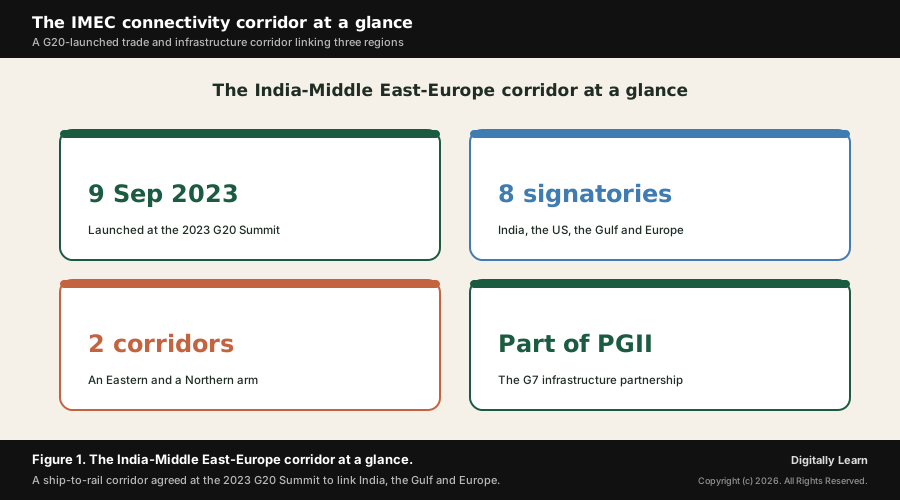
The India-Middle East-Europe Economic Corridor (IMEC) was launched on 9 September 2023, on the sidelines of the G20 Summit in New Delhi. At a special event on the Partnership for Global Infrastructure and Investment and the IMEC, co-chaired by India and the United States, the partners signed a Memorandum of Understanding committing to build a new trade and infrastructure corridor linking three regions. The corridor was unveiled as one of the most consequential outcomes of India's G20 presidency.
Eight partners signed the Memorandum of Understanding: India, the United States, Saudi Arabia, the United Arab Emirates, the European Union, Italy, France and Germany. The World Bank also took part in the launch event, signalling the multilateral support behind the corridor's financing. The breadth of the signatories, three continents and both governments and a major development institution, is itself a measure of the ambition behind the project.
Rather than a single new road or railway, the IMEC is conceived as a network. It joins existing ports, railways and roads across the partner countries into one corridor for the movement of goods, energy and data. The figure below sets out the headline facts of the launch.
Why the IMEC Is in the News: From Announcement to Implementation
Framework agreements, a stalled segment and renewed momentum
Why it matters now is that the IMEC has moved from a G20 announcement toward the slow work of implementation, even as events in West Asia have tested it. India and the United Arab Emirates have signed an inter-governmental framework agreement to advance the Eastern Corridor, the sea-and-rail leg that connects India to the Gulf, and Gulf partners have continued to build out their own ports, railways and clean-energy links.
At the same time, the Gaza conflict that began in October 2023 has strained relations along the corridor's Northern arm and stalled the rail segment that would cross the region, since Israel sits on that route. The corridor therefore stands at an early and uncertain stage: real progress on its eastern leg, set against a paused northern leg, which is exactly why it remains a live subject for analysts and for the exam.
Understanding the Significance of the IMEC for India and the World
A shorter trade route, deeper partnerships and a strategic stake
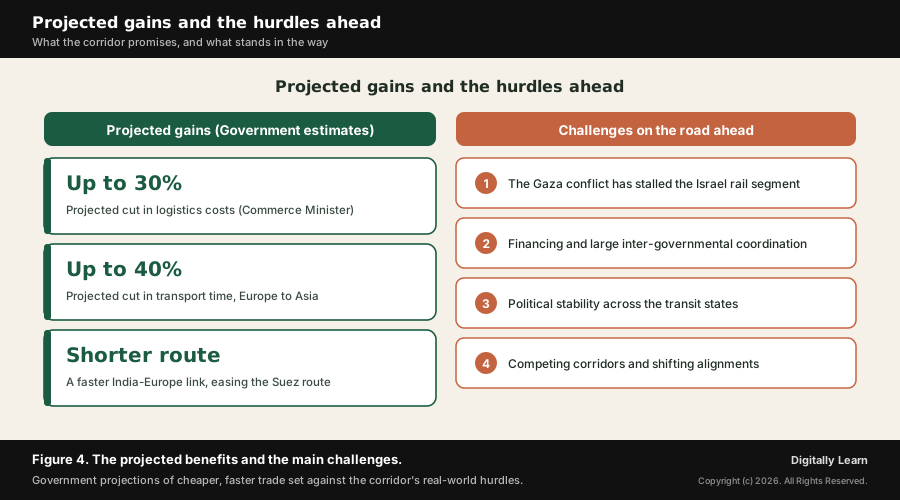
What is the significance of the IMEC lies first in the trade route it promises. By linking India to Europe through the Gulf with a combined sea-and-rail network, the corridor offers a shorter, potentially faster path than the long sea lane through the Suez Canal. The Commerce Minister has projected that it could cut logistics costs by up to 30 percent and transport time by up to 40 percent, figures the Government presents as estimates of potential, not achieved results.
Its second significance is the partnerships it deepens. The IMEC binds India more closely to the Gulf states and to Europe at once, building on a decade of warming ties with the United Arab Emirates and Saudi Arabia and on the I2U2 grouping of India, Israel, the UAE and the United States. For a country whose energy and diaspora interests are concentrated in West Asia, that web of connectivity is a substantial diplomatic gain.
Its third significance is strategic. The corridor gives India a stake in a major, democratic-world infrastructure initiative that is widely seen as an alternative to China's Belt and Road Initiative. It places India at the western end of a corridor that others must reckon with, turning connectivity into a form of geo-economic influence.
How the IMEC Works: The Two Corridors, Ship-to-Rail and the PGII
The Eastern Corridor, the Northern Corridor and the ship-to-rail network
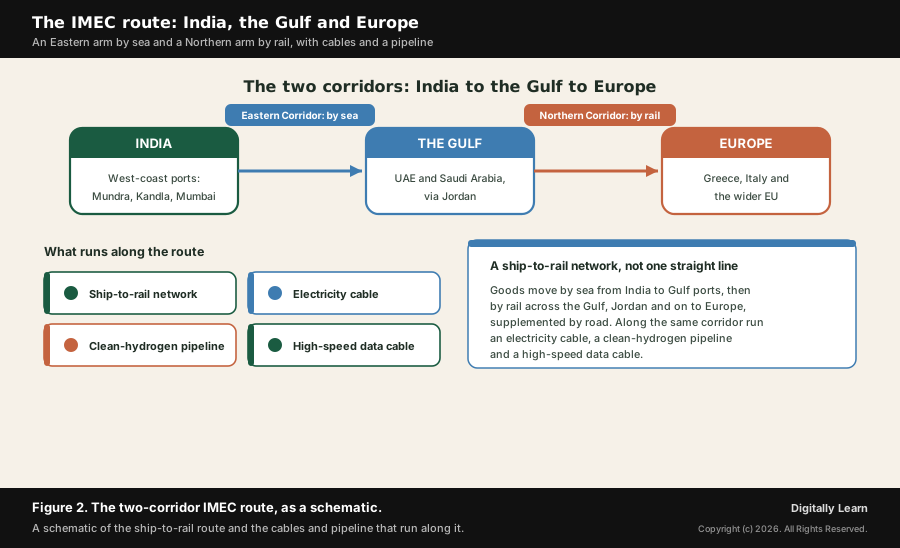
The IMEC is built from two corridors, and the design is easier to follow once they are clear. The Eastern Corridor connects India to the Gulf: goods leave India's western ports and travel by sea across the Arabian Sea to ports in the United Arab Emirates and Saudi Arabia. The Northern Corridor then connects the Gulf to Europe, carrying goods overland by rail across the Arabian Peninsula and on toward the Mediterranean and the European Union.
The heart of the scheme is a ship-to-rail transit network. Instead of relying on a single mode, the corridor stitches sea and rail together, supplemented by road, so that a container can move by ship to a Gulf port, transfer to rail across the peninsula, and continue to Europe. This multimodal design is what allows the route to bypass parts of the longer maritime journey through the Red Sea and the Suez Canal.
Alongside the goods route, the corridor envisages three further infrastructure links running along the same path: a cross-border electricity cable, a clean-hydrogen pipeline and a high-speed data cable. These turn the IMEC from a trade route alone into a combined corridor for trade, clean energy and digital connectivity. The schematic below traces the route and its components.
| Element | What it connects | What it carries |
|---|---|---|
| Eastern Corridor | India to the Gulf | Goods by sea, from India's ports to Gulf ports |
| Northern Corridor | The Gulf to Europe | Goods by rail and road across the peninsula |
| Ship-to-rail network | Sea and land legs | The multimodal transit of containers |
| Cable and pipeline | Along the route | Electricity, clean hydrogen and high-speed data |
Reading the rows together shows the logic: two geographic arms, one multimodal goods network joining them, and a set of energy and data links laid along the same corridor.
The IMEC within the Partnership for Global Infrastructure and Investment
The IMEC does not stand alone but sits within the Partnership for Global Infrastructure and Investment (PGII). The PGII is the G7 grouping's initiative to finance high-quality infrastructure in developing and partner countries, under which the G7 has set out to mobilise large sums of public and private money for projects of this kind over the present decade.
Placing the IMEC inside the PGII matters for two reasons. First, it gives the corridor an organised financing and standards framework rather than leaving each segment to be funded ad hoc. Second, it ties the corridor to a wider geopolitical purpose: the PGII is openly presented as the democratic world's answer to China's Belt and Road Initiative, and the IMEC is its most prominent flagship.
The World Bank and other multilateral institutions are associated with the PGII, which is why the Bank took part in the IMEC launch event. Their involvement is meant to bring the discipline of project appraisal and the weight of development finance to a corridor that will need both to move from a Memorandum of Understanding to laid track and built ports.
Strategic Importance for India: Suez, the Gulf, Energy and Maritime Security
A shorter India-Europe route that eases reliance on the Suez Canal
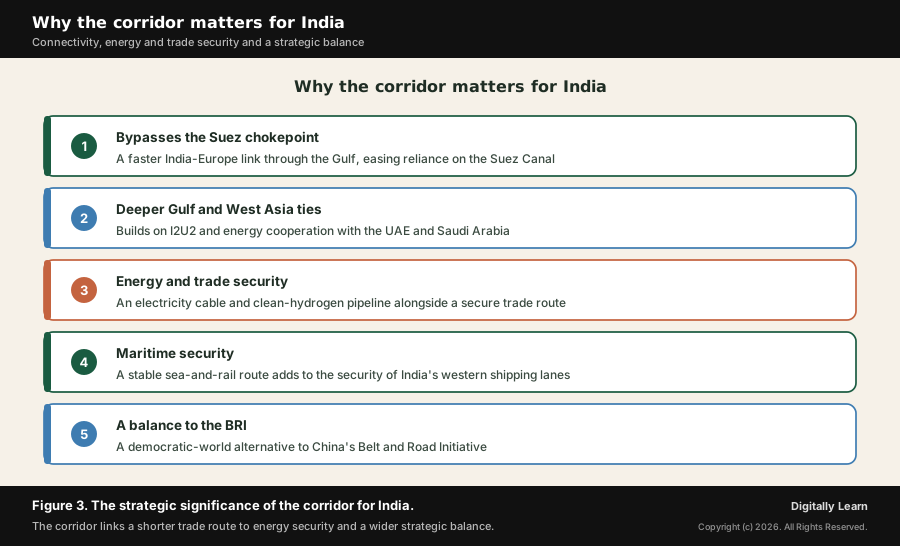
For India, the first strategic gain is a shorter trade route to Europe. Indian exports to Europe today travel the long sea lane up the Red Sea and through the Suez Canal, a single waterway whose disruption, by accident or by conflict, can hold up much of India-Europe trade. By moving goods by sea to the Gulf and then by rail toward Europe, the IMEC offers a path that does not depend wholly on that one chokepoint.
This matters for India's trade security. Recent disruptions to shipping in the Red Sea have shown how exposed a long single-route supply line can be, raising freight and insurance costs and lengthening delivery times. A corridor that diversifies the way Indian goods reach Europe reduces that exposure and gives exporters a more resilient option, which is the practical sense in which the Government's projected savings on cost and time are meant to be read.
Deeper ties with the Gulf and West Asia, building on I2U2
The corridor also advances India's West Asia policy. Over the past decade India has built unusually close ties with the United Arab Emirates and Saudi Arabia, anchored in trade, investment and a large Indian diaspora, and the IMEC turns that relationship into a shared infrastructure project. The Gulf states sit at the hinge of the corridor, so the project gives India and its Gulf partners a common, long-term stake in keeping the route open and secure.
The IMEC connects, too, to the I2U2 grouping of India, Israel, the United Arab Emirates and the United States, whose first leaders' summit was held in 2022. I2U2 set out to pool investment in energy, transport and food security across the same space the corridor now seeks to link. The two reinforce each other: I2U2 provides the diplomatic platform, while the IMEC provides the infrastructure through which such cooperation can flow.
Energy security and India's energy cooperation with West Asia
Energy sits at the centre of the corridor's value for India, because India's energy security is bound up with West Asia. The Gulf supplies a large share of India's imported crude oil and liquefied natural gas, so the sea lanes between India and the Gulf are also the arteries of its energy supply. A corridor that secures the India-Gulf link therefore strengthens India's energy lifeline, which is why energy cooperation with West Asia is a first-order economic interest.
India's energy-policy cooperation with the Gulf already runs deep and the IMEC extends it. India and the United Arab Emirates and India and Saudi Arabia have built partnerships spanning crude and gas supply, strategic petroleum reserves, refining and downstream investment, and increasingly clean energy. The corridor's planned clean-hydrogen pipeline and cross-border electricity cable carry this cooperation into the energy transition, opening a route for green hydrogen and renewable power to move between the Gulf, India and Europe.
Seen this way, the IMEC is as much an energy corridor as a trade route. It secures the conventional oil-and-gas relationship that underpins India's economy today and builds the rails for the clean-energy trade of tomorrow, tying India's long-running energy diplomacy with West Asian countries to a single, durable piece of infrastructure.
Maritime security and a strategic balance to the Belt and Road Initiative
The corridor adds to India's maritime security. The Government has presented the IMEC as a project that strengthens the security of the western Indian Ocean and the Arabian Sea, the waters through which both its trade and its energy flow. A stable, well-used sea-and-rail route, backed by partners with a shared interest in protecting it, makes those shipping lanes safer and more predictable for Indian commerce.
Finally, the IMEC gives India a strategic balance to China's Belt and Road Initiative. For a decade the BRI has been the dominant connectivity project across Asia, the Gulf and Europe, one India has declined to join on grounds of sovereignty and debt. The IMEC offers a transparent, partner-led alternative, and by placing India at its eastern end it lets India shape the region's connectivity. The figure below summarises these gains.
Challenges and the Road Ahead for the IMEC
The Gaza conflict, financing and inter-governmental coordination
A balanced reading must weigh the challenges the corridor faces, since its promise is still largely on paper. The most immediate is the Gaza conflict that began in October 2023. Because the Northern Corridor's rail segment is planned to run through the region where Israel sits, the war has strained relations among the very partners that segment depends on and has effectively stalled that leg of the route for the near term, slowing the corridor's momentum soon after its launch.
A second challenge is financing and coordination. Building ports, laying railways, stringing an electricity cable and a data cable and constructing a hydrogen pipeline across many sovereign states is enormously costly and demands sustained inter-governmental agreement on standards, customs, gauges and tariffs. Each partner has its own priorities and budget cycles, so turning a Memorandum of Understanding into built infrastructure requires a level of coordination that such multi-country projects often struggle to maintain.
Political stability, competing corridors and the path forward
A third challenge is political stability across the transit states. The corridor passes through a region of shifting alignments, and any project that runs across several West Asian countries is exposed to changes of government, to disputes between partners, and to the broader volatility of the region. The route is only as reliable as the stability of the weakest link along it.
A fourth is competition. The IMEC is not the only connectivity scheme in the field: China's Belt and Road Initiative is already established across much of the same space, and other corridors are being proposed. The IMEC must show that it can be built and used, not merely announced, if it is to hold its own. The figure below sets the projected gains against these hurdles.
The realistic assessment, and the one an answer should reach, is that the IMEC is a significant and promising initiative whose value will depend on whether its partners can sustain the financing, coordination and regional stability the project needs. Its eastern leg is advancing while its northern leg waits on peace; the corridor's future will be decided in the slow work of implementation rather than in the headlines of its launch.
The IMEC in Context: Connectivity, the Indian Ocean and India's Foreign Policy
How the corridor sits among India's other connectivity and partnership initiatives
Contemporary linkages place the IMEC within India's wider connectivity diplomacy. It belongs beside other corridors India has backed, such as the International North-South Transport Corridor that links India to Russia through Iran, and beside India's growing engagement with the European Union, with which it is negotiating a free-trade agreement. The IMEC is the western, Gulf-facing piece of a larger effort to plug India into the main trade routes of Eurasia.
It connects, too, to India's Indian Ocean strategy. India sees the security and the economic integration of the Indian Ocean region as central to its rise, and a corridor that runs from its western ports across the Arabian Sea to the Gulf reinforces that maritime focus. The corridor is therefore read alongside India's port-development, naval and Indian-Ocean-cooperation efforts as part of one connected vision.
Finally, the IMEC sits at the meeting point of trade, energy and geopolitics in India's foreign policy. It links India's economic interest in cheaper, faster trade, its energy interest in secure Gulf supplies and a clean-energy future, and its strategic interest in shaping the region's connectivity, into a single project.
- International North-South Transport Corridor: The India-Iran-Russia multimodal route, an earlier connectivity corridor that the IMEC complements on India’s western flank.
- I2U2 grouping: The India-Israel-UAE-United States partnership for investment in energy, transport and food security across the same space.
- Partnership for Global Infrastructure and Investment (PGII): The G7 financing framework of which the IMEC is the flagship corridor.
- Belt and Road Initiative: China’s connectivity project, which the IMEC is widely seen as balancing.
Taken together, these linkages show that the IMEC is not an isolated project but a node in India's evolving connectivity architecture, joining its West Asia policy, its Indian Ocean strategy and its partnerships with Europe and the United States.
UPSC Relevance and Exam Focus
Where the IMEC fits in the UPSC-CSE syllabus
This topic maps most directly to General Studies Paper II: India and its neighbourhood, bilateral and regional groupings and agreements involving India, and effect of policies of developed and developing countries on India's interests. It also reaches firmly into General Studies Paper III, where infrastructure, energy security and the economy sit, since the corridor is at once a foreign-policy and an economic project.
For Prelims, hold the high-yield facts: the IMEC was launched at the 2023 G20 Summit in New Delhi; its eight signatories are India, the United States, Saudi Arabia, the UAE, the European Union, Italy, France and Germany; it has an Eastern Corridor to the Gulf and a Northern Corridor to Europe; it is part of the PGII; and it carries a ship-to-rail network, an electricity cable, a clean-hydrogen pipeline and a data cable.
For Mains, the recurring framing is to assess the corridor's strategic and economic significance for India, its links to energy security and India-Gulf relations, and the challenges to its realisation. A strong answer treats the IMEC as connectivity diplomacy: a project that joins trade, energy and strategy and that must be judged on implementation, not just announcement.
Recurring linked concepts an aspirant should keep in working memory:
- PGII and the BRI: The G7 infrastructure partnership that funds the IMEC, and the Chinese initiative it is meant to balance.
- I2U2 and India-Gulf ties: The India-Israel-UAE-United States grouping and India’s deepening partnerships with the UAE and Saudi Arabia.
- Energy security and West Asia: India’s dependence on Gulf oil and gas and its growing clean-energy cooperation with the region.
- The Suez chokepoint: The single waterway whose vulnerability the corridor is meant to ease for India-Europe trade.
A common Prelims trap is to confuse the IMEC's signatories with the membership of the G20 or to add countries, such as China, that are not part of it. Hold the eight signatories and the World Bank's participation in the launch event precisely.
A common Mains trap is to praise the corridor without testing it. Its exam value lies in a balanced judgment: the genuine gains in trade, energy and strategic balance, set honestly against the Gaza-conflict stall, the financing and coordination burden, and the political volatility of the region it crosses.
Previous Year UPSC-CSE Questions By the end you will be able to draft model answers for the following UPSC questions. Each question carries a collapsible framework showing how to approach it in the exam.
- UPSC Mains 2017 GS-IIAnalyse India's energy security and its energy-policy cooperation with West Asian countries.
How to structure the answer in the exam
Body (sub-themes to develop):
- Why energy security is central: India's dependence on imported oil and gas makes the security of its supply lines, above all those to the Gulf, a first-order economic interest underpinning growth, industry and prices.
- Conventional cooperation with West Asia: crude and gas supply from the UAE and Saudi Arabia, strategic petroleum reserves, refining and downstream investment, and the role of the India-Gulf sea lanes as energy arteries.
- Clean-energy cooperation and the IMEC: the corridor's planned clean-hydrogen pipeline and cross-border electricity cable carry India-Gulf energy cooperation into the transition, linking green hydrogen and renewable power between the Gulf, India and Europe.
- Strategic and trade dimensions: the Suez-bypassing route, deeper Gulf and I2U2 partnerships and maritime security around the Arabian Sea reinforce the security of India's energy and trade flows.
- Challenges: regional instability, the Gaza-conflict stall on the northern leg, financing and coordination, and over-reliance on a single region all temper the gains.
Sources and Further Reading
- Ministry of External Affairs: Partnership for Global Infrastructure and Investment (PGII) and India-Middle East-Europe Economic Corridor (IMEC)
- Press Information Bureau: PGII and India-Middle East-Europe Economic Corridor (IMEC)
- Press Information Bureau: India poised to become a trusted bridge of global connectivity through IMEC (Shri Piyush Goyal)
- Press Information Bureau: IMEC initiative to add to India's maritime security (Shri Piyush Goyal)
- Press Information Bureau: IMEC is a strategic and economic game changer for India and others
- Press Information Bureau: Cabinet approves India-UAE Inter-Governmental Framework Agreement on the IMEC
- Department of Commerce, Ministry of Commerce and Industry: Press Releases on the IMEC
- World Bank: Partnership for Global Infrastructure and Investment (PGII)
- NITI Aayog: Infrastructure Connectivity and Indian Ocean Region economic integration
- Wikipedia: India-Middle East-Europe Economic Corridor
Editorial Disclaimer
This briefing is for UPSC preparation. Verify the figures and provisions against the official MEA and PIB sources before relying on them.


