


Overview
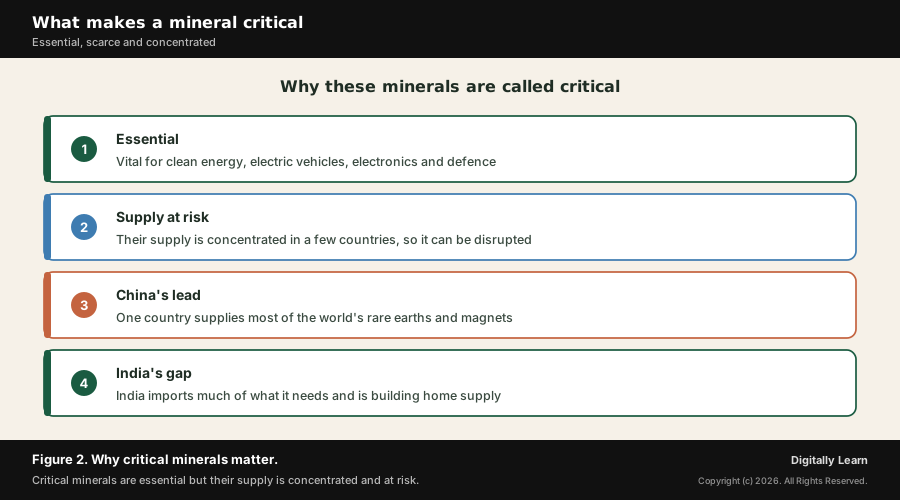
Critical minerals are metals and elements, such as lithium, cobalt and the rare earths, that are essential for clean energy, electric vehicles, electronics and defence, but whose supply is scarce and concentrated in a few countries. As China dominates the supply of many of them and has tightened exports, India has moved to secure its own access through a National Critical Mineral Mission, reforms to its mining law, overseas mineral assets and global partnerships. The aim is to reduce a strategic dependence on a single supplier.
India Moves to Secure Its Critical Minerals
A push to cut dependence on one supplier
As China has tightened its exports of rare earths and the magnets made from them, India has stepped up efforts to secure its own supply of critical minerals. These are the metals and elements on which clean energy, electric vehicles, electronics and modern defence depend.
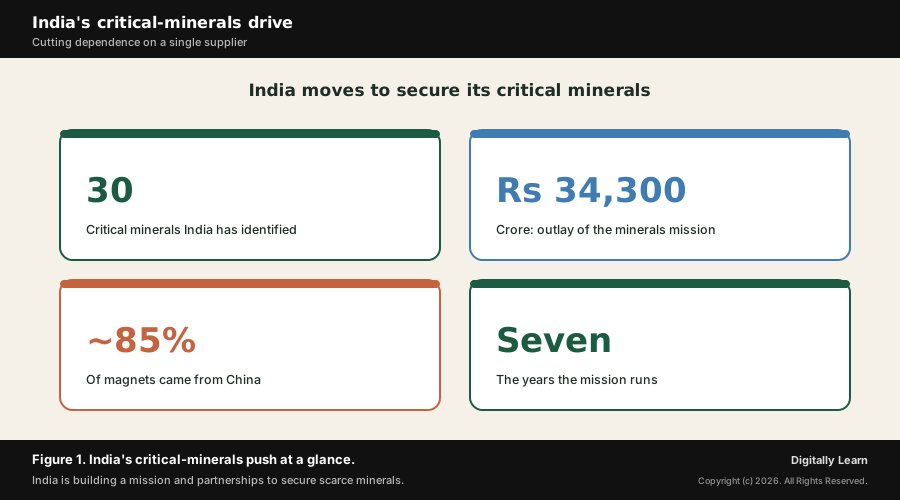
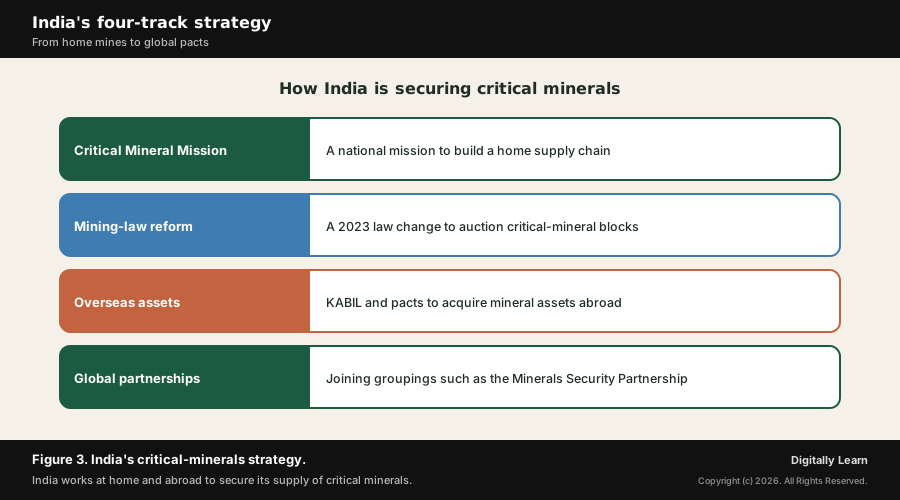
India has identified a list of around thirty critical minerals and built a strategy around them. It runs from a national mission and reformed mining laws at home to deals for mineral assets abroad and membership of global partnerships.
The urgency comes from a simple imbalance. India imports much of what it needs, while a single country supplies most of the world's rare earths and finished magnets, which makes any disruption a strategic risk for industry and defence.
Why Critical Minerals Matter
The raw materials of the clean-energy age
Why it matters is that critical minerals are the building blocks of new technology. Lithium and cobalt go into the batteries of electric vehicles and power grids, rare earths into the magnets of motors and wind turbines, and others into chips and weapons.
Because their supply is concentrated, control over these minerals has become a tool of geopolitics. A country that dominates mining or processing can use export curbs as leverage, which is why securing them is now a matter of both the economy and national security.
What India's Strategy Signifies
From import dependence to a secure supply
What is the significance of this strategy lies in the shift it represents. India has long imported most of its critical minerals and finished products; the new effort aims to build domestic capacity and to spread its sources so no single supplier holds decisive leverage.
It also ties India's resource policy to its foreign policy. By joining mineral-security groupings and signing pacts with resource-rich nations, India seeks both supply and a place in shaping the rules of a contested global market.
Critical Minerals, China's Dominance and India's Reserves
India's critical-minerals position at a glance
The table sets out the key elements of India's position and what each one means. Together they show a country that is resource-poor in some minerals but is acting on several fronts to secure supply.
| Feature | Detail |
|---|---|
| Critical minerals identified | Around thirty, including lithium, cobalt, nickel, graphite and rare earths |
| National Critical Mineral Mission | A seven-year mission with an outlay of about 34,300 crore rupees |
| Mining-law reform | The mining law was amended in 2023 to auction critical-mineral blocks |
| China's role | A single country supplies most of the world's rare earths and magnets |
| India's reserves | Large monazite sands that hold rare-earth oxides, though much capacity is undeveloped |
| Global partnerships | Membership of the Minerals Security Partnership and Quad cooperation |
Read together, the rows show the gap India is trying to close: rich in some reserves on paper, but dependent on imports for the processed minerals that industry actually uses.
Rare Earths, Monazite and India's Mineral Base
India does hold significant rare-earth resources, chiefly in the form of monazite, a mineral found in its coastal sands that contains rare-earth elements and also thorium. On paper, this gives India one of the larger rare-earth reserves in the world.
The difficulty is in turning reserves into usable supply. Mining and especially processing rare earths is technically hard and costly, and India has limited capacity, so it still imports most finished rare-earth products and the magnets made from them.
What to Watch in India's Mineral Security
Three things to track from here
The strategy points to three developments worth following, since securing minerals is a long effort rather than a single decision.
- (a) Domestic capacity. Whether India can build mining and processing of critical minerals at home, not just sign plans.
- (b) Overseas assets. Whether deals abroad, through bodies like KABIL, actually deliver minerals to India.
- (c) The partnerships. Whether groupings such as the Minerals Security Partnership and the Quad build real, diversified supply chains.
The real test is whether India turns plans and reserves into a secure, diversified supply of minerals that its industry and defence can actually rely on.
India's Critical-Minerals Architecture and Global Partnerships
The mission, the law and the partnerships
Contemporary linkages tie this strategy to a set of concrete steps. The centrepiece is the National Critical Mineral Mission, a seven-year programme to build exploration, mining, processing and recycling of critical minerals within India.
Domestic law has been reformed to match. India amended its mining law, the Mines and Minerals (Development and Regulation) Act, in 2023 to let the central government auction blocks of critical minerals and to open some, earlier reserved, minerals to private mining.
Abroad, India acquires assets through KABIL, a joint venture of public-sector firms set up to secure overseas mineral assets, and through bilateral pacts with resource-rich nations such as Australia and Argentina. These aim to lock in supply at the source.
Multilaterally, India has joined the Minerals Security Partnership, a grouping of major economies that works to diversify and secure critical-mineral supply chains, and pursues similar cooperation through the Quad and the Indo-Pacific Economic Framework.
UPSC Relevance and Exam Focus
Where this fits in the UPSC-CSE syllabus
This topic maps to General Studies Paper III: the mobilisation of resources, energy and the economy, and to General Studies Paper II through bilateral and multilateral groupings involving India.
For Prelims, hold the high-yield facts: what critical minerals are, the National Critical Mineral Mission, the 2023 mining-law amendment, monazite as a source of rare earths and thorium, and India's membership of the Minerals Security Partnership.
For Mains, two framings recur: how the West and India seek to reduce dependence on China's supply chains, and how India can secure the minerals behind its clean-energy and defence ambitions.
Recurring linked concepts an aspirant should keep in working memory:
- Critical minerals: essential minerals such as lithium, cobalt and rare earths with concentrated supply.
- National Critical Mineral Mission: India’s mission to build a home critical-mineral supply chain.
- KABIL: the public-sector venture that acquires mineral assets abroad.
- Minerals Security Partnership: a grouping to secure global critical-mineral supply chains, which India has joined.
A common Prelims trap is to assume India is self-sufficient in critical minerals because it has reserves; India is import-dependent for most processed critical minerals.
A common Mains trap is to treat this only as an economic issue. Control over critical minerals is also a question of geopolitics and national security.
Previous Year UPSC-CSE Questions By the end you will be able to draft model answers for the following UPSC questions. Each question carries a collapsible framework showing how to approach it in the exam.
- UPSC Mains 2024 GS-IIThe West is fostering India as an alternative to reduce dependence on China's supply chain and as a strategic ally to counter China's political and economic dominance. Explain this statement with examples.
How to structure the answer in the exam
Introduction: Open with the West's interest in a reliable alternative to China.
Body (sub-themes to develop):
- Manufacturing: incentives and friend-shoring towards India.
- Critical minerals: the Minerals Security Partnership and Quad cooperation.
- Strategy: the Quad and Indo-Pacific frameworks countering China.
- Limits: India's own capacity gaps and its strategic autonomy.
Conclusion: Conclude that India gains, but must build real capacity to be a true alternative.
- UPSC Prelims 2025 GS-IConsider the following statements:
- India has joined the Minerals Security Partnership as a member.
- India is a resource-rich country in all the 30 critical minerals that it has identified.
- The Parliament in 2023 has amended the Mines and Minerals (Development and Regulation) Act, 1957 empowering the Central Government to exclusively auction mining lease and composite license for certain critical minerals.
Which of the statements given above are correct?
How to approach this Prelims question
Approach: Test each statement against India's critical-mineral position.
Trap to watch: Statement II is wrong: India is import-dependent, not resource-rich in all 30 minerals.
Key facts to recall:
- India has joined the Minerals Security Partnership, so statement I is correct.
- The MMDR Act was amended in 2023 to auction critical-mineral blocks, so statement III is correct; statement II is false.
Answer signal: Reject statement II and the answer is I and III only.
- UPSC Prelims 2022 GS-IWith reference to India, consider the following statements:
- Monazite is a source of rare earths.
- Monazite contains thorium.
- Monazite occurs naturally in the entire Indian coastal sands in India.
- In India, Government bodies only can process or export monazite.
Which of the statements given above are correct?
How to approach this Prelims question
Approach: Check each statement about monazite against the facts.
Trap to watch: Statement 3 overstates the spread; monazite occurs in particular coastal stretches, not the entire coastline.
Key facts to recall:
- Monazite is a source of rare earths and contains thorium, and its processing and export are tightly controlled by the government, so statements 1, 2 and 4 are correct.
- It is not found along the entire coastline, so statement 3 is wrong.
Answer signal: Reject statement 3 and the answer is 1, 2 and 4 only.
Sources and Further Reading
Editorial Disclaimer
This briefing is for UPSC preparation. Verify the mission's provisions and figures against the official government sources before relying on them.


