


Overview
New Delhi Declaration
India chaired the 18th Summit at Bharat Mandapam on 12 and 13 September 2026.
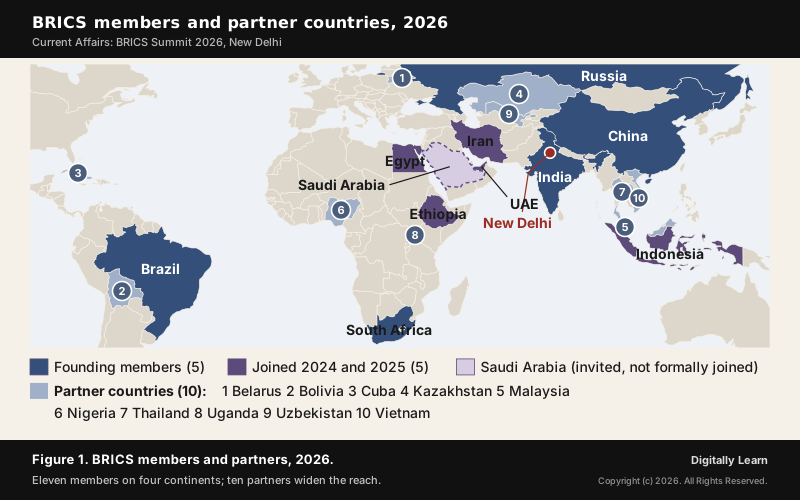
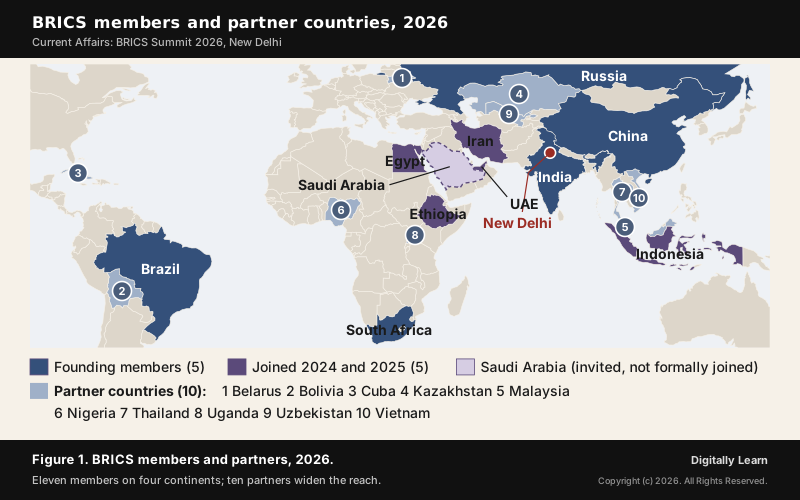
BRICS is a grouping of emerging economies named after its first five members, Brazil, Russia, India, China and South Africa, and now eleven strong with ten partner countries. India chaired it in 2026 and hosted the BRICS Summit 2026, the 18th, in New Delhi on 12 and 13 September, where the members adopted the New Delhi Declaration by consensus.
BRICS Summit 2026 in New Delhi: Why It Is in the News
18th BRICS Summit: Dates, Venue, Theme and Leaders
India chaired the summit under the theme "Building for Resilience, Innovation, Cooperation and Sustainability", which reads the letters of the acronym as India's four priorities for the year. The theme draws on Prime Minister Narendra Modi's call for a "Humanity First", people-centred BRICS. It was the first BRICS summit since the United States and Israel attacked Iran on 28 February 2026, a war in which Iran's Supreme Leader Ali Khamenei was killed and Iran struck back at its Gulf neighbours, the UAE among them.
- Leaders at the table: Eight members were represented at the top, India, Russia, China, Iran, Indonesia, Egypt, Ethiopia and South Africa. Vladimir Putin and Masoud Pezeshkian attended, and Xi Jinping made his first trip to India in seven years.
- Represented at a lower level: Brazil sent Foreign Minister Mauro Vieira as President Lula da Silva heads into elections, and the UAE sent the Crown Prince of Abu Dhabi, Sheikh Khaled bin Mohamed bin Zayed Al Nahyan. Saudi Arabia, offered membership in 2024 but yet to join formally, sent its Foreign Minister, who arrived after the declaration had been adopted.
- Partners and guests: Leaders of partner countries such as Malaysia, Vietnam and Kazakhstan came, as did the Vice-Presidents of Uganda and Nigeria, the President of the Philippines and Burundi’s President as chair of the African Union. Bangladesh, invited as chair of BIMSTEC, sent no one. UN Secretary-General Antonio Guterres also attended.
The summit was the peak of a year of meetings: the declaration records over four hundred meetings and engagements in thirty cities across India. A BRICS Business Forum opened the week on 11 September, where Commerce Minister Piyush Goyal urged members to link their payment systems and trade more in local currencies.
Forging the New Delhi Declaration: Iran, the UAE and West Asia
Iran and the UAE, both members since 2024, had blocked every joint statement at BRICS ministerial meetings in 2026. When the foreign ministers met in New Delhi in May, India as chair could issue only a Chair's Summary, as explained in the BRICS Foreign Ministers' Meeting of May 2026. Iran wanted the summit to condemn the United States and Israel, as the Shanghai Cooperation Organisation had at its Bishkek summit; the UAE wanted Iran's strikes on its neighbours condemned equally.
The deadlock broke on the summit's first day, when both accepted wording that names no country. Paragraph 28 expresses deep concern at the escalation in the Middle East and West Asia, asks all sides to exercise maximum restraint, and calls for protecting civilians and keeping trade, supply chains and energy flowing. Paragraph 29 adds serious concern over attacks on civilian infrastructure and on peaceful nuclear facilities under the safeguards of the International Atomic Energy Agency.
Iran's President and the Abu Dhabi Crown Prince then met on the sidelines, their highest-level meeting since the war began, and both spoke of de-escalation. India's Sherpa for the talks, Sudhakar Dalela, Secretary (Economic Relations) in the External Affairs Ministry, credited months of negotiation for the agreed text.
What Is BRICS: Origin of the BRICS Countries and How the Grouping Works
BRICS Full Form, Origin and Expansion Timeline
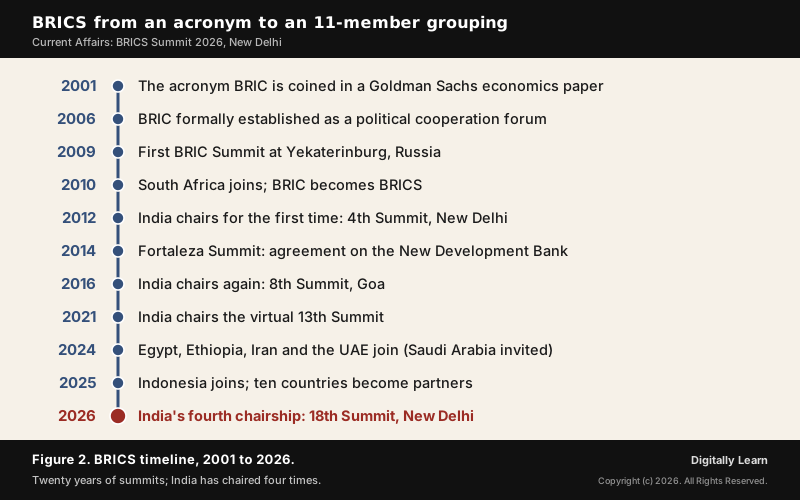
BRICS is formed from the initials of its first five members, Brazil, Russia, India, China and South Africa. The acronym BRIC was coined in 2001 by the investment bank Goldman Sachs, in a paper that projected the four as among the world's largest economies over the next five decades. BRIC was formally established in 2006 as a forum for political cooperation, and the 2008 global financial crisis gave it a common cause: a bigger voice for emerging economies in the International Monetary Fund and the World Bank.
The first BRIC summit was held at Yekaterinburg, Russia, in 2009. South Africa joined in September 2010 and attended the 2011 summit as a full member, turning BRIC into BRICS. The grouping stayed at five for over a decade, until Egypt, Ethiopia, Iran and the UAE joined in January 2024; Saudi Arabia was invited at the same time and is listed among the members by India, but it has not formally joined. Indonesia became the eleventh member in January 2025.
Recent summits followed one another as the grouping grew. Russia chaired the 16th Summit at Kazan in October 2024, whose declaration was titled "Strengthening Multilateralism for Just Global Development and Security". Brazil hosted the 17th at Rio de Janeiro in July 2025, and India took over the chair on 1 January 2026.
BRICS Members and Partner Countries 2026: Full List
Together the eleven members hold 49.5 per cent of the world's population, 40 per cent of global GDP and 26 per cent of global trade. Measured at purchasing power parity, their combined output is larger than that of the G7, and they include some of the world's largest energy producers as well as its biggest energy consumers.
| Country | Status in 2026 | Year joined |
|---|---|---|
| Brazil, Russia, India, China | Founding members | 2006 |
| South Africa | Member | 2010 |
| Egypt, Ethiopia, Iran, United Arab Emirates | Members | 2024 |
| Saudi Arabia | Invited; not formally joined | 2024 |
| Indonesia | Member | 2025 |
| Belarus, Bolivia, Cuba, Kazakhstan, Malaysia, Nigeria, Thailand, Uganda, Uzbekistan, Vietnam | Partner countries | 2025 |
How BRICS Works: Chairship, Consensus and Three Pillars
BRICS has no permanent seat and no secretariat. The chair rotates every year in the order of the acronym's letters, running from 1 January to 31 December; the chair sets the year's priorities, hosts the summit and steers the ministerial and working-group meetings. With eleven members, a new rotation formula is under discussion. Decisions are taken by consensus, so a single member can hold up a joint text, as Iran and the UAE did through 2026.
- Political and security cooperation: The summit’s positions on conflicts, terrorism, the UN and outer space.
- Economic and financial cooperation: Trade, the New Development Bank, payments, health, food, energy and technology.
- Cultural and people-to-people cooperation: Education, youth, sport, culture and tourism.
These are the three pillars the members name in the declaration's second paragraph. Two proposals at the summit addressed how the grouping works. Mr. Modi suggested a troika, as in the G20, so that the outgoing, current and incoming chairs carry work across years, and a BRICS Continuity and Implementation Mechanism: a secure digital record of every decision, its nodal point, its deadline and its status.
India has chaired BRICS four times, so the 2026 summit was the fourth held in India.
- 2012, 4th Summit, New Delhi: Theme “BRICS Partnership for Global Stability, Security and Prosperity”; it proposed exploring a new development bank and laid the groundwork for the Contingent Reserve Arrangement.
- 2016, 8th Summit, Goa: Theme “Building Responsive, Inclusive and Collective Solutions”; the first NDB loans were rolled out and an outreach summit was held with BIMSTEC countries.
- 2021, 13th Summit, virtual: Theme “BRICS@15: Intra-BRICS Cooperation for Continuity, Consolidation and Consensus”; it adopted the BRICS Counter-Terrorism Action Plan and launched a Vaccine Research and Development Centre.
- 2026, 18th Summit, New Delhi: Theme “Building for Resilience, Innovation, Cooperation and Sustainability”; the New Delhi Declaration of 140 paragraphs, adopted by consensus.
New Delhi Declaration 2026: Key Outcomes by Theme
Global Governance Reform: UN Security Council, IMF and WTO
The New Delhi Declaration is the summit's agreed text, and reform of global institutions is its opening theme. On the UN, the members back a comprehensive reform of the Security Council to give developing countries more seats. China and Russia, the two permanent members in BRICS, repeat their support for Brazil and India playing a greater role in the UN, including its Security Council. The text also notes that no woman has ever been elected UN Secretary-General.
The Security Council has five permanent members, the United States, Russia, the United Kingdom, France and China, chosen because they were the most powerful states and the victors at the end of the Second World War, and ten non-permanent members. India rests its claim to a permanent seat on its economic rise and on a record of regular financial contributions to the UN, which it has never failed to pay.
Mr. Modi asked the leaders to draw up ten proposals for global governance reform, to become a BRICS Reform Road map by the next summit, around three ideas: representation, responsiveness and rule-making. Negotiations on the Security Council, he said, need a definite timeline, and the Global South must move from being "rule-takers to rule-shapers". He also proposed a Seafarers' Emergency Support Network to help crews in distress.
On finance, the declaration wants a strong, quota-based and adequately resourced IMF. It urges the quota increases of the 16th General Review of Quotas to take effect without delay and a realignment under the 17th that raises the share of emerging economies. The stakes are plain: the United States holds 16.49 per cent of the IMF's votes, and major decisions need an 85 per cent supermajority, which gives Washington alone a veto.
On trade, the members voice serious concern at unilateral tariff and non-tariff measures that break WTO rules, ask for the WTO's two-tier dispute settlement to be restored with new Appellate Body members, and back Ethiopia's and Iran's bids to join the WTO. They condemn unilateral coercive measures, including secondary sanctions, and oppose carbon border adjustment mechanisms as protectionist.
Peace and Security: Gaza, Terrorism and Outer Space
Beyond West Asia, the declaration takes clear positions on several other conflicts and threats.
- Gaza and Palestine: Concern at continued violence despite the ceasefire of October 2025; a call to halt any forced displacement of Palestinians; support for a sovereign Palestine within the 1967 borders with East Jerusalem as its capital, and for its full UN membership. It notes the International Court of Justice’s provisional measures in South Africa’s case against Israel.
- Lebanon: Israel should withdraw its forces from Lebanese territory; attacks on the UN Interim Force in Lebanon (UNIFIL), in which four Indonesian peacekeepers died, are condemned.
- Terrorism: The members condemn the terrorist attack in Jammu and Kashmir on 22 April 2025 that killed 26 people, reject double standards, name cross-border movement of terrorists, terror financing and safe havens, and call for the Comprehensive Convention on International Terrorism to be adopted at the UN.
- Other conflicts: An immediate ceasefire in Sudan, an inclusive transition in Syria, and an end to the economic measures against Cuba.
- Outer space: Support for preventing an arms race in outer space and for the draft treaty against placing weapons in space submitted to the Conference on Disarmament in 2014.
The terrorism paragraph matters most to India. The attack at Pahalgam is condemned in a text that China and every other member accepted, together with a call for zero tolerance for terrorism and no double standards in countering it. The leaders also welcomed the work of the BRICS Counter-Terrorism Working Group and its five subgroups.
New BRICS Initiatives in Health, Farming, Technology and Trade
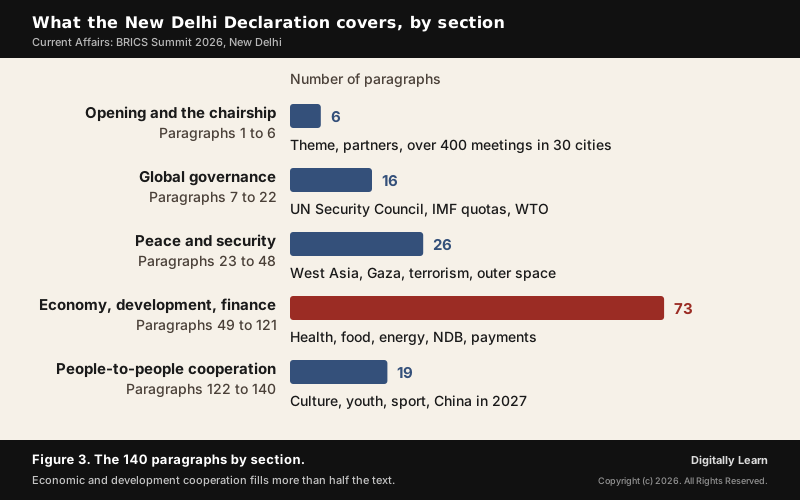
Most of the declaration, 73 of its 140 paragraphs, deals with economic and development cooperation, and this is where India's chairship placed its practical outcomes. The leaders adopted or welcomed the following.
- BRICS Integrated Early Warning System (health): A sub-working group to give early warning of mass infectious diseases.
- BRICS Mission for Healthy Lifestyle (health): A 2026-2029 roadmap against obesity and non-communicable diseases.
- Network of mental health centres (health): Centres of excellence coordinated by NIMHANS.
- BRICS Grain Exchange (agriculture): A grain trading platform among members, still under discussion.
- BRICS AGRIN (agriculture): A farmer-centric network on agro-inputs, genetic resources and information.
- BRICS Network on Digital Agriculture (agriculture): AI, geospatial tools and digital public infrastructure for farmers.
- BRICS Incubator Network (innovation): Links start-ups and incubators across members; a Startup Innovation Fund is under consideration.
- Logistics Supply-Chain Cooperation Framework (trade): Makes supply chains more reliable and resilient.
- Jaipur Consensus (trade): A study of an invoice discounting mechanism to free MSME working capital.
- BRICS CONNECT (labour): Capacity building, employability, new skills and social security.
- BRICS Urban Mobility Hub (urban): Sharing of good practice in city transport.
Technology ran through the summit. The leaders committed to implement their statement on the global governance of artificial intelligence and welcomed India's AI Impact Summit of February 2026. Mr. Modi warned against the "weaponisation" of technology and of access to critical minerals, while Mr. Xi offered a five-point plan that includes a BRICS AI open source community. Russia proposed an insurance mechanism and a grain market.
On climate, the members restate their commitment to the Paris Agreement, back Ethiopia's presidency of COP32 and take note of India's International Big Cats Alliance. They also welcome India's chairship of the Kimberley Process, the scheme that certifies rough diamonds, in 2026.
BRICS Finance: New Development Bank, CRA and BRICS Currency
New Development Bank (NDB): Headquarters, Capital and Lending
The New Development Bank is BRICS's own lender. The five founders signed its agreement at the 6th Summit in Fortaleza, Brazil, on 15 July 2014, and it is headquartered in Shanghai, China. It raises money for infrastructure and sustainable development in BRICS and in other emerging and developing countries, and its first loans, mostly for renewable energy, were rolled out in 2016.
- Capital: An initial authorised capital of US$100 billion; the initial subscribed capital of US$50 billion was split equally among the five founders.
- Voting: Each founder has an equal share, so no single country controls the bank. New members may join, but the founders’ collective share cannot fall below 55 per cent.
- Leadership: India’s K. V. Kamath was its first president; Dilma Rousseff of Brazil, elected in March 2023, leads it now.
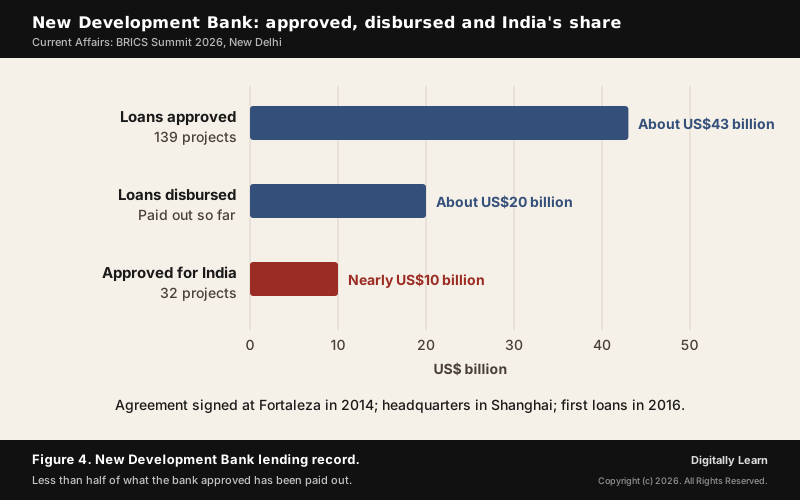
A decade on, the record is modest. The bank has approved 139 projects worth about US$43 billion, mostly in its founding members, and disbursed only about US$20 billion. India has secured nearly US$10 billion across 32 projects, among them metro lines and the Delhi-Ghaziabad-Meerut RRTS corridor.
Sanctions have hurt it. After Russia invaded Ukraine, the bank froze operations involving Russia in March 2022 and has extended no new credit to it since, to protect its credit rating of AA to AA-plus. Its 2022-26 strategy aims at 30 per cent of lending and borrowing in members' own currencies, yet that share stood at roughly 22 per cent in mid-2025, and a long-promised rupee bond has still not been issued.
The declaration backs the bank's growing role, wider membership and more local-currency financing, thanks Russia for hosting its 11th annual meeting in Moscow in May 2026, and welcomes a BRICS-NDB Knowledge Portal launched under India's chairship.
NDB and AIIB Compared: Two Banks Led by Emerging Economies
India is a founding member of both banks that emerging economies set up in the 2010s, and they are often confused. The Asian Infrastructure Investment Bank (AIIB) is a China-led lender that began work on 16 January 2016. The table sets the two side by side.
| Feature | NDB | AIIB |
|---|---|---|
| Set up by | The five BRICS countries (agreement of 2014) | China-led; began work on 16 January 2016 |
| Based in | Shanghai | Beijing |
| Members | Five founders, open to new members | 111 member states, including non-Asian ones such as Germany |
| Voting | Equal for the five founders | By capital subscribed: China largest, India second |
| Lending | 139 projects, about US$43 billion | 350 projects, about US$69 billion |
| Credit rating | AA to AA-plus | AAA |
Each bank serves India differently. In the NDB India has the same vote as China, and the bank has funded Indian transport projects. In the AIIB India subscribes the second-largest capital, US$8,367.3 million against China's US$29,780.4 million, which gives it a say in a bank with more members, more lending and the top credit rating. Both give India sources of infrastructure finance outside the Bretton Woods institutions; the AIIB also tells India how far China's weight can shape such a bank.
BRICS Currency and De-Dollarisation: What the Grouping Agreed
The work sits with the BRICS Payment Task Force, which studies how members' payment and messaging channels can work together. The declaration's paragraph on it acknowledges this work but sets no new target, which is why progress on local currency trade is described as incremental.
India's stand explains much of that caution. India supports trading in local currencies but opposes a common BRICS currency, because China supplies about two-thirds of all BRICS exports and a shared currency would in practice run on the yuan. US President Donald Trump has also threatened 100 per cent tariffs on countries that adopt a BRICS currency. India's rupee trade with BRICS partners is limited to the UAE and Russia, and it has paid for Russian oil in UAE dirhams.
The record matches the caution. The 126-point Rio declaration of July 2025 did not use the word "de-dollarisation" once, and Mr. Putin said in November 2024 that the bloc had not sought to abandon the dollar. Half of the NDB's own outstanding bonds are in US dollars.
The Contingent Reserve Arrangement (CRA), a US$100 billion pool of reserves set up in 2015 to help a member ride out a financial crisis without going to the IMF, has never been activated. A member that wants more than 30 per cent of its allotted share must first enter an IMF programme. The declaration welcomes amendments to the CRA treaty to make it more flexible, a ninth test run, and talks on bringing new members in.
India and BRICS: Strategic Autonomy, China and the West
Why BRICS Matters for India: Non-West, Not Anti-West
Members disagree on what BRICS is for. Russia, China and Iran want an anti-Western BRICS, while India, Brazil and South Africa see it as non-Western: a platform for emerging economies, not a bloc against anyone. Mr. Modi made the same point at the summit, describing BRICS as moving forward "not against anyone" but by taking everyone along.
For India the grouping serves strategic autonomy, the freedom to work with all major powers without joining any camp. BRICS lets India keep close ties with the United States without becoming a front line in the US-China rivalry, and gives it a forum to engage China even when bilateral visits stall.
- Diplomatic standing: A consensus text in wartime, as at the G20 summit India hosted in 2023, adds to its reputation as a bridge between divided camps.
- India-China ties: Mr. Modi and Mr. Xi welcomed steady progress since their meeting at Tianjin in August 2025, agreed that differences should not become disputes, and sought a fair, reasonable and mutually acceptable settlement of the boundary question. India’s trade deficit with China has grown from US$38 billion to US$113 billion since 2014.
- Security interests: Pahalgam condemned in a text China signed, and Russian and Chinese support for India’s larger UN role.
- Bilateral gains: The UAE’s International Holding Company announced an investment of US$11.5 billion in an aluminium project in Odisha, and Malaysia agreed to an Indian Consulate General at Kota Kinabalu. Mr. Putin invited Mr. Modi to the 24th India-Russia Annual Summit.
Challenges Before an Expanded BRICS and the Road to 2027
Expansion has made BRICS larger but harder to steer, and the New Delhi summit showed both sides of that.
- Rivalries among members: Iran and the UAE are in an undeclared conflict, and new members have brought their bilateral disputes into the grouping, the danger that left SAARC paralysed.
- Consensus under strain: A non-consensus chair’s statement was issued under Russia’s chairship in 2020 and again by India in May 2026; if this becomes common, BRICS loses its weight.
- China’s weight: China’s support for reform is selective, as on Security Council seats for India, Brazil and South Africa, and it builds parallel bodies such as the AIIB and the Belt and Road Initiative.
- Pressure from Washington: Mr. Trump has accused BRICS of plotting against the dollar and threatened its members with tariffs, and Brazil and India have already faced punitive US tariffs.
- Delivery: The NDB disburses slowly, the CRA has never been used, and Saudi Arabia’s place remains unclear.
The chair now passes to China, which will host the 19th Summit in 2027 with India's full support recorded in the declaration's last paragraph. The BRICS Reform Road map that Mr. Modi proposed is due by that summit, and the 12th BRICS Parliamentary Forum meets in October 2026.
BRICS for UPSC: Syllabus Links and Exam Angles of the 2026 Summit
BRICS in the UPSC Syllabus: GS Paper II and Prelims
BRICS sits in GS Paper II, International Relations, under groupings and agreements involving India or affecting its interests, and under important international institutions, their structure and mandate (see the GS Paper II syllabus). The New Development Bank, payments and trade in local currencies also touch GS Paper III, and state PCS papers ask the same facts.
- Prelims facts: Members and partners, the order of joining, summit venues and themes, and the NDB’s headquarters and founders.
- Mains analysis: BRICS as a voice of the Global South, India’s non-West stand, the limits of de-dollarisation, and the NDB set against the AIIB and the Bretton Woods institutions.
- Essay and interview: Reformed multilateralism, strategic autonomy and India’s role as a bridge in a divided world.
Previous Year UPSC-CSE Questions By the end you will be able to draft model answers for the following UPSC questions. Each question carries a collapsible framework showing how to approach it in the exam.
- UPSC Mains 2026 GS-II"BRICS acts as a powerful counterweight in global governance, actively amplifying the voice and influence of the Global South." Explain the role of BRICS in projecting itself as an alternative to other groupings.
Answer outline: how to structure the answer
What the question asks, the main arguments, relevant examples and the direction of the conclusion. This is not a full model answer.
Introduction: Introduce BRICS as an 11-member grouping holding 49.5 per cent of the world's population and 40 per cent of global GDP, whose 18th Summit in New Delhi in September 2026 adopted a 140-paragraph declaration by consensus.
Body (sub-themes to develop):
- Voice of the Global South: Security Council reform with support for Brazil and India; IMF quota realignment against a 16.49 per cent US vote and an 85 per cent threshold; WTO Appellate Body.
- Own institutions: the New Development Bank (equal votes for founders) and the US$100 billion Contingent Reserve Arrangement as alternatives to the Bretton Woods bodies.
- Alternative agenda: opposition to unilateral tariffs, secondary sanctions and carbon border taxes; cooperation on health, food, digital public infrastructure and AI.
- Not anti-West: India's non-West stand; consensus diplomacy; partner countries widen reach.
- Limits: Iran-UAE rivalry; no common currency; NDB approvals of about US$43 billion with about US$20 billion disbursed; CRA never used; China's weight.
Conclusion: Conclude that BRICS is a credible counterweight in voice and agenda, but its institutions still complement rather than replace the existing order.
- UPSC Mains 2014 GS-IIIndia has recently signed to become founding member of New Development Bank (NDB) and also the Asian Infrastructure Investment Bank (AIIB). How will the role of the two Banks be different? Discuss the strategic significance of these two Banks for India.
Answer outline: how to structure the answer
What the question asks, the main arguments, relevant examples and the direction of the conclusion. This is not a full model answer.
Introduction: Introduce the NDB (BRICS agreement at Fortaleza, 2014; Shanghai) and the AIIB (China-led; began work in January 2016; Beijing), with India a founding member of both.
Body (sub-themes to develop):
- Ownership and voting: NDB equal for the five founders, founders keep at least 55 per cent; AIIB by capital, China largest, India second.
- Membership and reach: NDB small and open to new members; AIIB 111 member states including non-Asian ones.
- Lending: NDB 139 projects, about US$43 billion; AIIB 350 projects, about US$69 billion; AIIB AAA against NDB AA to AA-plus.
- For India: infrastructure finance (nearly US$10 billion across 32 NDB projects, including the Delhi-Ghaziabad-Meerut RRTS); a larger say than in the Bretton Woods bodies; leverage in South-South cooperation.
- Caution: China's weight in the AIIB; sanctions on Russia slowing the NDB.
Conclusion: Conclude that the two banks complement each other and the World Bank, widening India's options for development finance and its voice in global economic governance.
- UPSC Prelims 2025 Prelims-GSConsider the following statements with regard to BRICS:
- 16th BRICS Summit was held under the Chairship of Russia in Kazan.
- Indonesia has become a full member of BRICS.
- The theme of the 16th BRICS Summit was Strengthening Multiculturalism for Just Global Development and Security.
Which of the statements given above is/are correct?
How to approach this Prelims question
Approach: Step 1: statement I, the 16th Summit was held at Kazan under Russia's chairship: correct. Step 2: statement II, Indonesia became a full member in January 2025: correct. Step 3: statement III swaps "Multilateralism" for "Multiculturalism": incorrect. So I and II.
Trap to watch: One word changed in the theme: Multiculturalism in place of Multilateralism.
Key facts to recall:
- (a) I and II: right. Kazan under Russia and Indonesia's membership are both correct.
- (b) II and III: wrong. Statement III misstates the theme.
- (c) I and III: wrong. Statement III misstates the theme.
- (d) I only: wrong. Statement II is also correct; Indonesia joined in January 2025.
Answer signal: I and II: option (a), the official answer.
- UPSC Prelims 2019 Prelims-GSWith reference to Asian Infrastructure Investment Bank (AIIB), consider the following statements:
- AIIB has more than 80 member nations.
- India is the largest shareholder in AIIB.
- AIIB does not have any members from outside Asia.
Which of the statements given above is/are correct?
How to approach this Prelims question
Approach: Step 1: statement 1, more than 80 members: correct, it has 111. Step 2: statement 2, India the largest shareholder: incorrect, China is; India is second. Step 3: statement 3, no members from outside Asia: incorrect, Germany is one. So 1 only.
Trap to watch: India is a large shareholder, which makes statement 2 tempting; it is second, not first.
Key facts to recall:
- (a) 1 only: right. Only the membership statement is correct.
- (b) 2 and 3 only: wrong. China, not India, is the largest shareholder, and the bank has non-Asian members.
- (c) 1 and 3 only: wrong. Statement 3 is incorrect; Germany and other non-Asian states are members.
- (d) 1, 2 and 3: wrong. Statements 2 and 3 are both incorrect.
Answer signal: 1 only: option (a), the official answer.
- UPSC Prelims 2016 Prelims-GSConsider the following statements:
- New Development Bank has been set up by APEC.
- The headquarters of New Development Bank is in Shanghai.
Which of the statements given above is/are correct?
How to approach this Prelims question
Approach: Step 1: statement 1, set up by APEC: incorrect, the NDB is the BRICS bank. Step 2: statement 2, headquarters in Shanghai: correct. So 2 only.
Trap to watch: APEC is an Asia-Pacific economic forum; it has no development bank of this name.
Key facts to recall:
- (a) 1 only: wrong. The NDB was set up by BRICS, not APEC.
- (b) 2 only: right. Shanghai is the NDB's headquarters, and BRICS set it up.
- (c) Both 1 and 2: wrong. Statement 1 is incorrect.
- (d) Neither 1 nor 2: wrong. Statement 2 is correct.
Answer signal: 2 only: option (b), the official answer.
- UPSC Prelims 2014 Prelims-GSWith reference to a grouping of countries known as BRICS, consider the following statements :
- The First Summit of BRICS was held in Rio de Janeiro in 2009.
- South Africa was the last to join the BRICS grouping.
Which of the statements given above is/are correct?
How to approach this Prelims question
Approach: Step 1: statement 1, first summit at Rio de Janeiro in 2009: incorrect, it was at Yekaterinburg. Step 2: statement 2, South Africa the last to join: correct in 2014, when it was the latest member. So 2 only.
Trap to watch: The year 2009 is right but the city is wrong. Statement 2 was true in 2014; Egypt, Ethiopia, Iran, the UAE and Indonesia have joined since.
Key facts to recall:
- (a) 1 only: wrong. The first summit was at Yekaterinburg, not Rio de Janeiro.
- (b) 2 only: right. In 2014 South Africa, which joined in 2010, was the last to join.
- (c) Both 1 and 2: wrong. Statement 1 is incorrect.
- (d) Neither 1 nor 2: wrong. Statement 2 was correct when the question was set.
Answer signal: 2 only: option (b), the official answer, correct as of 2014.
Sources
- BRICS India 2026: New Delhi Declaration, 12 September 2026
- PIB Backgrounder: BRICS Evolution, Cooperation and India's Leadership (10 September 2026)
- Ministry of External Affairs: Kazan Declaration (23 October 2024)
- NCERT: Contemporary World Politics (Class XII), International Organisations
- The Hindu, Delhi, 8 September 2026: India's opportunity to put BRICS back together
- The Hindu, Delhi, 10 September 2026: Turning economic cooperation into shared prosperity
- The Hindu, Delhi, 12 September 2026: More heft (editorial); The BRICS bank, an alternative that wasn't; A bigger BRICS, shaped by India's vision; BRICS negotiators work late into evening; Goyal calls for local-currency trade among BRICS nations
- The Hindu, Delhi, 13 September 2026: BRICS countries adopt New Delhi Declaration; PM urges BRICS leaders to draw up 10 global governance reform proposals; Iran President, Abu Dhabi Crown Prince discuss regional hostilities; Xi, Modi welcome 'steady progress' in India-China ties
- The Hindu, Delhi, 14 September 2026: Building consensus (editorial); Modi flags weaponisation of tech, critical minerals; At BRICS, India must bank on the NDB; Unilateral sanctions impacting food security: Pezeshkian
- The Hindu, Delhi, 16 September 2026: AI cooperation (editorial)
- The Hindu, Delhi, 17 September 2026: Currency conundrum (editorial)
- The Hindu, Delhi, 24 September 2026: India and the plausible multilateralism of BRICS
- Wikipedia: BRICS
- Wikipedia: New Development Bank
- Wikipedia: Asian Infrastructure Investment Bank
- Wikipedia: 16th BRICS summit
- UPSC: Civil Services Examination question papers
Editorial Disclaimer
This article draws on the New Delhi Declaration, official releases and the other sources listed on this page.


