


Overview
Three tracks, a long history and the hard issues bridged
The India-EU Free Trade Agreement, with a parallel Investment Protection Agreement and a Geographical Indications agreement, was re-launched in 2022 and concluded at the 16th India-EU Summit in 2026.
The India-EU Free Trade Agreement (FTA) is a comprehensive trade pact between India and the European Union, a bloc of twenty-seven member states that is among India's largest trading partners. It is negotiated alongside two companion agreements: a stand-alone Investment Protection Agreement (IPA) and a Geographical Indications (GI) agreement, the three pursued on separate tracks. The aim is to cut tariffs and open markets in goods and services, protect investment, and settle the modern rules of trade such as digital commerce and sustainability. Negotiations first began in 2007 as the Broad-based Bilateral Trade and Investment Agreement, stalled in 2013, were re-launched in 2022, and were concluded at the sixteenth India-EU Summit in 2026. The deal matters because it diversifies India's trade, supports its labour-intensive exporters and deepens a strategic partnership with Europe.
What the India-EU Free Trade Agreement Is: A Pact Across Three Tracks
A free trade agreement, an investment treaty and a GI agreement
The India-EU Free Trade Agreement (FTA) is a comprehensive trade pact between India and the European Union, the bloc of twenty-seven member states that together form one of India's largest trading partners. A free trade agreement of this kind seeks to remove or reduce tariffs and other barriers on goods and services, and to write the modern rules that govern that trade. For India, a deal with so large and wealthy a market is among its most consequential trade negotiations.
Crucially, the negotiation is not a single document but three separate tracks. The first is the FTA itself, covering trade in goods and services. The second is a stand-alone Investment Protection Agreement (IPA), a treaty to protect each side's investments in the other's territory. The third is a Geographical Indications (GI) agreement, which protects the names of regional products so that only goods from the true place of origin may use the name.
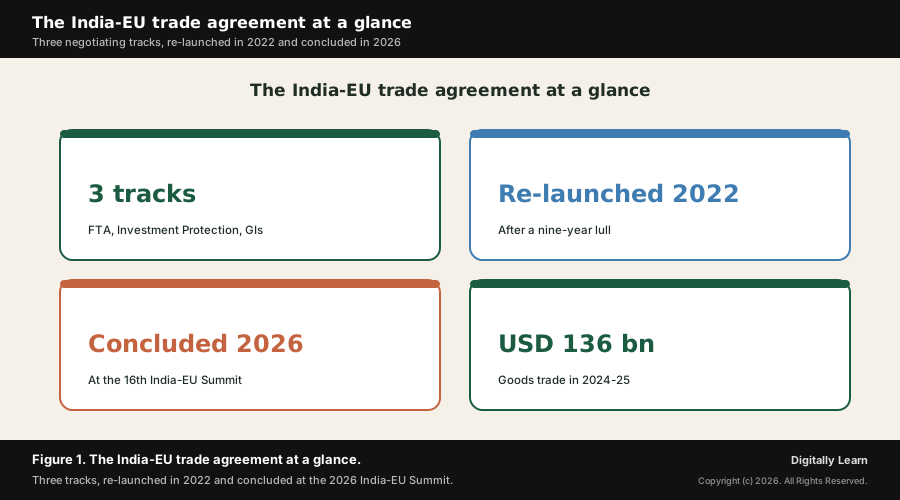
The deal is also tied to a wider strategic partnership. It sits beside the India-EU Trade and Technology Council, a high-level platform on trade, trusted technology and security, and beside a shared interest in resilient supply chains. The agreement should therefore be read not only as a tariff deal but as part of a broader economic and geopolitical relationship between India and Europe. The figure below sets out the headline facts.
Why the India-EU FTA Is in the News: The 2026 Conclusion
The conclusion of the agreement at the 16th India-EU Summit
Why it matters now is that the long-running negotiation has reached its decisive moment. The leaders of India and the European Union announced the conclusion of the India-EU Free Trade Agreement at the sixteenth India-EU Summit in 2026, after talks that had run since the re-launch in 2022. A conclusion of negotiations marks political agreement on the text; the agreement still moves through legal scrubbing, signature and ratification on both sides before it enters into force.
The announcement was treated as a landmark in India-EU economic relations. According to the official Indian materials, the agreement opens markets for the great bulk of India's exports while preserving policy space for sensitive sectors. The European Union committed to eliminating duties on a large share of tariff lines, with the rest phased in over time, so that almost all of India's export trade value to the EU would eventually face zero or reduced tariffs.
Understanding the Significance of the India-EU FTA for India
Market access, trade diversification and strategic depth
What is the significance of the India-EU Free Trade Agreement lies first in market access. The European Union is a vast, high-income market, and lower tariffs there are most valuable for India's labour-intensive exporters in textiles, apparel, leather, footwear, gems and jewellery and engineering goods, sectors that employ millions and that have faced higher duties than some competitors. Better access can lift exports, output and jobs in exactly the parts of the economy where India most needs them.
Its second significance is trade diversification and resilience. By deepening trade with Europe, India reduces its dependence on any single partner and spreads its risk across more markets, a goal that has gained urgency as global supply chains are being reorganised. A strong economic link to the EU complements India's other recent agreements and supports the wider effort to make its external sector more resilient.
Its third significance is strategic depth. A trade agreement with the European Union binds India more closely to a bloc that shares many of its interests in a stable, rules-based order, and it strengthens a partnership that already spans technology, connectivity and security. For India, the FTA is thus both an economic gain and a way to deepen a strategic relationship with one of the world's major powers.
The Long History: From the 2007 BTIA to the 2013 Stall and the 2022 Re-launch
The 2007 launch, the 2013 stall, the 2021 Porto meeting and the 2022 re-launch
The story begins in 2007. Following a commitment by leaders at the India-EU Summit, India and the EU launched negotiations on a Broad-based Bilateral Trade and Investment Agreement (BTIA) in Brussels in June 2007. The two sides aimed at a comprehensive agreement covering goods, services and investment, consistent with World Trade Organization rules, that would open markets and expand opportunity for businesses on both sides.
The talks proved difficult. Fifteen rounds of negotiation were held, alternating between Brussels and New Delhi, but they stalled in 2013 after the last meeting in New Delhi. The sticking points then were much the same as those that would recur later: the depth of tariff cuts, the level of market access, the treatment of intellectual property and the alignment of regulatory standards. For nearly a decade the negotiation lay dormant.
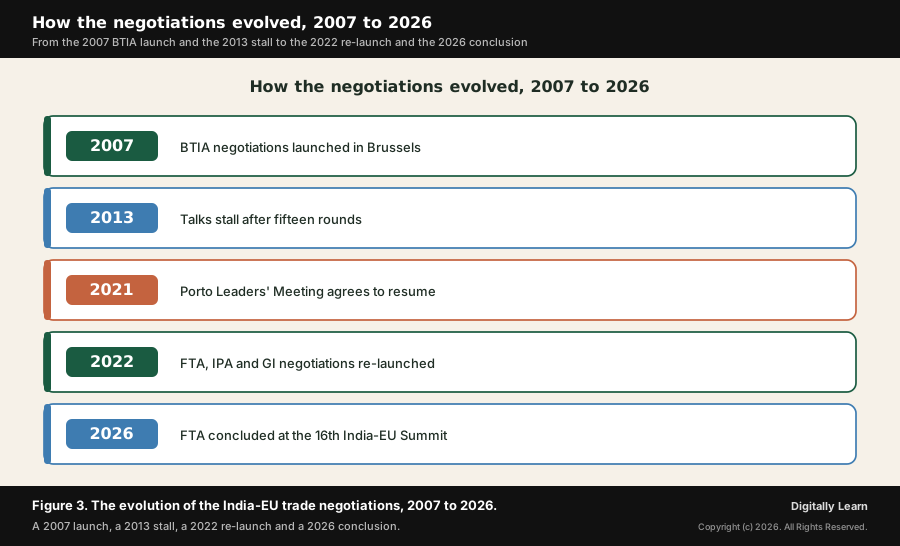
Momentum returned at the start of the 2020s. At the India-EU Leaders' Meeting in Porto in 2021, the two sides agreed to resume negotiations for a balanced and comprehensive trade agreement and to begin fresh talks on a separate investment agreement and a GI agreement. On this basis the negotiations were formally re-launched in 2022, after a nine-year lull, with the first round of all three tracks held in New Delhi. The timeline below traces this evolution.
| Stage | When | What happened |
|---|---|---|
| BTIA launched | 2007 | India and the EU begin Broad-based Trade and Investment Agreement talks in Brussels |
| Talks stall | 2013 | After fifteen rounds, negotiations lapse over tariffs, market access and standards |
| Porto meeting | 2021 | Leaders agree to resume the FTA and to start IPA and GI talks |
| Re-launch | 2022 | FTA, IPA and GI negotiations re-launched after a nine-year lull |
| Conclusion | 2026 | The FTA is concluded at the sixteenth India-EU Summit |
Reading the rows together shows the pattern: an ambitious launch, a long stall over familiar disagreements, a political decision to resume, and finally a concluded agreement once both sides judged the moment ripe and the balance of concessions acceptable.
The Three Negotiating Tracks and the Trade and Technology Council
The FTA, the Investment Protection Agreement and the GI agreement
The first track, the FTA itself, is the core. It covers trade in goods, where the central business is cutting tariffs and agreeing rules of origin, and trade in services, where the prize for India is access for its professionals and service firms. It also carries the modern chapters of a twenty-first-century trade deal: digital trade, intellectual property, government procurement, competition, and a chapter on trade and sustainable development.
The second track is the Investment Protection Agreement (IPA), kept deliberately separate from the FTA. An IPA is a treaty that gives investors of each side legal protections, against unfair or discriminatory treatment and against expropriation without compensation, in the territory of the other. Keeping investment protection in a stand-alone agreement reflects how the European Union now structures such treaties and lets the two sides manage the politically sensitive question of investor-state dispute settlement on its own track.
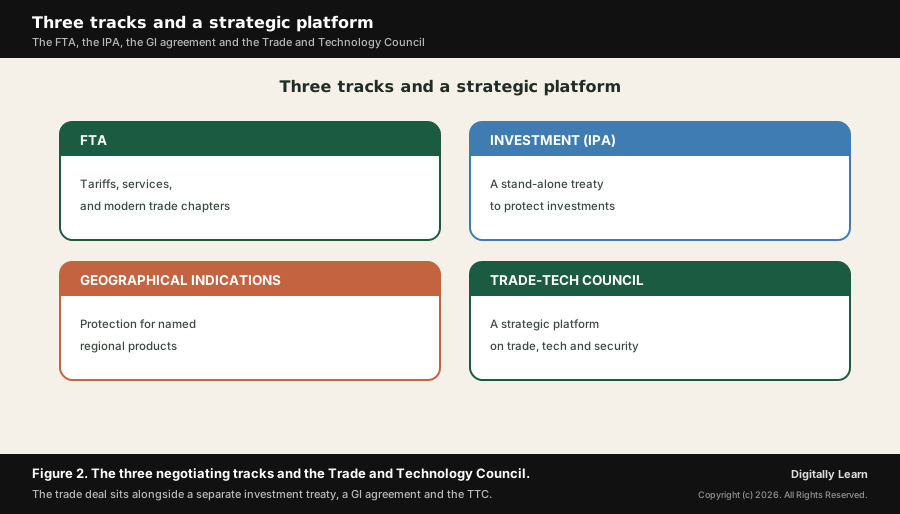
The third track is the Geographical Indications (GI) agreement. A geographical indication is a sign used on products whose qualities are due to a specific origin; protecting GIs means names such as Basmati or Darjeeling, and many European food and drink names, are reserved for genuine products from the named region. For India this protects its own prized regional products in the EU market. The figure below sets out the three tracks and the platform beside them.
A strategic platform on trade, trusted technology and security
Beyond the three trade tracks, India and the EU run a Trade and Technology Council (TTC), a high-level platform for the fast-moving issues where trade, trusted technology and security meet. It was announced by the leaders in 2022 and established in early 2023, and the first ministerial meeting was held in Brussels in 2023. The EU runs only one other such council, with the United States, which signals the strategic weight it attaches to India.
The Council works through dedicated working groups. These cover strategic technologies, digital governance and digital connectivity; green and clean energy technologies; and trade, investment and resilient value chains. The TTC is not a substitute for the FTA; rather it complements it, building cooperation on standards, semiconductors, clean technology and secure supply chains that a tariff agreement alone cannot deliver. Taken together, the trade tracks and the TTC give the relationship both an economic and a technological dimension.
The Hard Issues: CBAM, Autos, Agriculture, Services and Data
What the EU sought and what India sought
Each side came to the table with clear asks. The European Union wanted India to cut high tariffs on cars and car parts, on wine and spirits, and on a range of manufactured and farm goods; it sought access for its dairy and agricultural exporters, strong protection for intellectual property and geographical indications, and ambitious chapters on sustainability, labour and the environment. These were long-standing European priorities that had featured in the original BTIA talks.
India, for its part, sought deep tariff cuts for its labour-intensive exports, above all textiles, apparel, leather and footwear, along with better terms for pharmaceuticals and marine and engineering goods. In services it pressed for commitments on the movement of professionals, the so-called Mode-4 mobility of contractual service suppliers and independent professionals, and for recognition of its information-technology and business-services strengths. It also sought clarity on data flows and a fair outcome on the EU's new carbon levy.
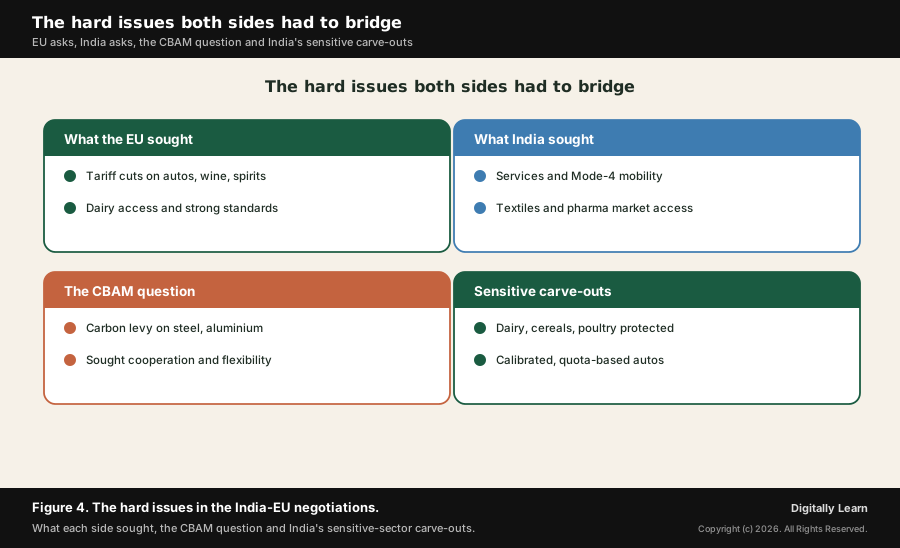
The asks were in tension because each side's offer was the other's sensitivity. European access to Indian dairy and autos ran into India's protection of its farmers and its automakers; India's demand for easier movement of professionals ran into Europe's caution on migration and on data. Bridging these gaps, sector by sector, is what made the negotiation so long and so hard. The figure below groups the main fault lines.
The EU Carbon Border Adjustment Mechanism (CBAM)
The single most contested issue was the EU's Carbon Border Adjustment Mechanism (CBAM). CBAM is a carbon levy the EU places on imports of certain carbon-intensive goods, including iron and steel, aluminium, cement, fertilisers, electricity and hydrogen, to match the carbon price its own producers pay and to prevent carbon leakage. A transitional reporting phase ran from October 2023, and the definitive phase, under which importers buy CBAM certificates priced to the EU carbon market, began in 2026.
For India the concern is real, because steel and aluminium are significant exports to the EU and a carbon levy raises their cost there. India and many developing countries argue that such a measure shifts the cost of Europe's climate policy onto their exporters. The issue must be put in measured terms: the EU presents CBAM as a climate and anti-leakage tool applied to all partners, while India views it as a barrier; both positions are stated without endorsing either.
In the concluded agreement, according to the official Indian materials, the two sides addressed CBAM through cooperation rather than removal of the measure. The reported outcome includes a forward-looking assurance that any flexibility the EU grants to third countries would extend to India, technical cooperation on recognising carbon prices and verifiers, and support to help Indian producers meet the new carbon requirements. The levy itself remains, so CBAM stays a live issue for India's exporters.
Autos, wine and spirits, and agriculture and dairy
On automobiles, the two sides bridged the gap with a calibrated, quota-based package rather than a sudden opening. Such a design lets European carmakers sell more models in India over time within agreed limits, while giving Indian industry a phased adjustment and the prospect of using India as a manufacturing and export base. On wine and spirits, long a European priority, the agreement provides for tariff reductions structured so as to phase in competition gradually.
On agriculture and dairy, India moved carefully to protect the livelihoods of its farmers. The official materials record that India safeguarded sensitive sectors, including dairy, cereals, poultry, soymeal and certain fruits and vegetables, keeping them outside the deepest tariff cuts. At the same time India secured improved access for its own farm and food exports, such as tea, coffee, spices, processed foods and several fruits and vegetables, so the agriculture chapter is a balance of offensive and defensive interests.
This balance connects directly to World Trade Organization disciplines. India's farm support, much of it through minimum support prices and input subsidies, is repeatedly questioned at the WTO, and any trade deal must leave room for India to run those programmes while honouring its international commitments. The careful carve-outs for dairy and cereals are designed precisely to defend domestic farm policy space within a WTO-consistent agreement, an issue examined in the next sub-section.
Agriculture, India's Farm Subsidies and the WTO Question
To see why India guards agriculture so closely, one must understand its farm-subsidy regime. India's support divides into two kinds. Direct subsidies are price and output support: above all, procurement at the Minimum Support Price (MSP), under which agencies such as the Food Corporation of India and NAFED buy crops like rice and wheat at an assured price and feed the public distribution system. This shores up farmers' incomes and underpins national food security.
Indirect subsidies are input subsidies that lower the cost of cultivation. The largest is the fertiliser subsidy, followed by subsidised power and irrigation for pumping groundwater, concessional agricultural credit and interest support, and crop-insurance premiums borne by the state. Together the direct, price-based support and the indirect, input-based support form a dense web of assistance to a farm population numbering in the hundreds of millions, which is why any opening of the sector is politically and economically sensitive.
These subsidies sit awkwardly with the WTO Agreement on Agriculture, which rests on three pillars: domestic support, market access and export subsidies. Its domestic-support rules sort subsidies into boxes. The Amber Box holds the most trade-distorting, production-linked support, measured by the Aggregate Measurement of Support and meant to be capped; the Green Box covers minimally distorting support that is permitted; and the Blue Box covers production-limiting payments. A de minimis rule lets developing countries keep trade-distorting support up to a ceiling of ten per cent of the value of production.
India's MSP-backed procurement for public stockholding is exactly what gets challenged, because buying at administered prices above the market is counted as Amber-box support and India's rice support has crossed the ten-per-cent de minimis limit. India invokes the Peace Clause agreed at Bali in 2013, which shields food-security stockholding from legal challenge, and presses for a permanent solution, pointing to the gulf between rich-country and developing-country entitlements. This unresolved policy-space fight is the deeper reason India carved dairy, cereals and other sensitive farm products out of the EU's market-access demands: conceding there would narrow the very room it defends at the WTO.
Services, Mode-4 mobility, digital trade and data
In services, where India is highly competitive, the agreement opens access for Indian providers across a wide range of sub-sectors, including information technology and business services, professional services and others. For India the most valued prize is Mode-4 mobility, the temporary movement of natural persons to supply services, and the agreement provides a framework for the entry and stay of business visitors, intra-corporate transferees, contractual service suppliers and independent professionals.
On digital trade and data, the agreement sets rules for a secure environment for electronic commerce, promoting paperless trade and electronic invoicing and contracts. Here India sought to balance the benefits of open data flows with its interest in regulating personal data at home. The question of EU data-adequacy recognition, which would ease data transfers for Indian firms, is part of the wider digital conversation, though it is a regulatory determination distinct from the tariff schedule.
The Strategic Context: China-Plus-One, Supply Chains and Diversification
China-plus-one, supply-chain resilience and market diversification
The agreement cannot be read apart from its strategic context. As firms and governments seek to reduce their concentration in a single manufacturing hub, a strategy often called China-plus-one, India has positioned itself as an alternative destination for production and a partner in more resilient supply chains. A trade agreement with the European Union strengthens that position by giving European buyers and investors easier access to India and to goods made in India.
For India the deal also advances market diversification. Spreading its trade across the EU, the United Kingdom, the Gulf and other partners reduces the risk that comes from over-reliance on any one market and cushions the economy against shocks in a single region. This is the external-sector logic of resilience: more partners, deeper agreements and a broader base of demand for Indian exports.
Finally, the agreement reflects a convergence of geopolitical interest. India and the European Union share an interest in a stable, rules-based global order and in trusted technology and secure supply chains, themes carried forward through the Trade and Technology Council. The FTA, the investment treaty and the GI agreement therefore serve not only commerce but a wider effort to build a durable partnership between India and Europe in a more contested world.
Challenges, Debates and the Road Ahead
Ratification, the CBAM unease, farm sensitivities and implementation
Several challenges remain even after conclusion. The first is the path to entry into force: the text must undergo legal scrubbing, translation, signature and ratification, including approval by the European Parliament and the member states on the EU side, a process that can take time and is not a formality. Until the agreement is ratified and enters into force, its tariff cuts are commitments on paper rather than realities for exporters.
A second debate is the CBAM unease, which the agreement manages but does not remove. Indian steel and aluminium exporters still face the carbon levy, and the adequacy of the cooperation and flexibility secured will be tested in practice. A third concern is the farm question: while sensitive sectors were carved out, farm and dairy groups will watch closely how the agreement interacts with domestic support and with future WTO discussions on agricultural subsidies.
A fourth challenge is implementation. The gains from a trade agreement are realised only if Indian firms can meet the EU's standards, quality requirements and sustainability rules, and if domestic reforms in logistics, regulation and skilling let exporters seize the new access. The agreement opens the door; turning that into higher exports and jobs depends on the follow-through, which is where the harder, less visible work now lies.
The India-EU FTA in Context: India's Wider Trade Strategy
How the deal sits among India's other recent trade agreements
Contemporary linkages place the India-EU FTA within a busy phase of India's trade diplomacy. It comes alongside a cluster of recent agreements, the comprehensive deal with the United Kingdom, the partnership with the four-country European Free Trade Association bloc, the agreement with Australia and the conclusion of talks with several other partners. The EU deal is the largest of these by the size of the market involved, and it caps a deliberate strategy of opening high-income markets for Indian exporters.
It also connects to India's posture at the World Trade Organization. As multilateral trade liberalisation has slowed, India, like many countries, has turned to bilateral and regional agreements to secure market access. At the same time India continues to defend its policy space at the WTO, especially on agriculture and on special treatment for developing countries, so its bilateral deals are crafted to be consistent with, and complementary to, its multilateral stance.
The deal further links to India's domestic economic goals, from raising the share of manufacturing and the export-to-output ratio to the ambition of much higher merchandise exports by the end of the decade. The following items are worth holding together in working memory:
- India-UK CETA and India-EFTA TEPA: Recent comprehensive agreements with the United Kingdom and the European Free Trade Association bloc, part of the same diversification push.
- The Trade and Technology Council: The strategic India-EU platform on trade, trusted technology and resilient value chains that complements the FTA.
- WTO disciplines: The multilateral rules, including on agricultural subsidies, within which India’s bilateral deals must sit.
- China-plus-one and supply-chain resilience: The strategic backdrop of diversification that gives the EU deal much of its weight.
Taken together, these linkages show that the India-EU FTA is not a stand-alone event but a centrepiece of India's broader effort to diversify trade, attract investment and integrate more deeply into global value chains while protecting its core domestic priorities.
UPSC Relevance and Exam Focus
Where the India-EU FTA fits in the UPSC-CSE syllabus
This topic maps to two parts of the syllabus at once. It falls under General Studies Paper II: bilateral, regional and global groupings and agreements involving India and affecting India's interests, and under General Studies Paper III: the Indian economy and the external sector, where trade policy, free trade agreements and the balance of trade are examined. The topic also touches sustainable development and the environment through the CBAM dimension.
For Prelims, hold the high-yield facts: the India-EU FTA is negotiated across three tracks, the FTA, the Investment Protection Agreement and the Geographical Indications agreement; the EU is among India's largest trading partners; negotiations began in 2007 as the BTIA, stalled in 2013, were re-launched in 2022 and concluded in 2026; the India-EU Trade and Technology Council is a separate strategic platform; and CBAM is the EU's carbon levy on imports such as steel and aluminium.
For Mains, the recurring framing is to assess the significance of the agreement for India's economy and strategy, to weigh the gains in market access against the sensitivities in agriculture and the unease over CBAM, and to place the deal within India's wider trade diversification and the China-plus-one context. A strong answer treats the FTA as both an economic instrument and a strategic choice, and it handles the contested CBAM and data questions in measured, balanced terms.
Recurring linked concepts an aspirant should keep in working memory:
- Free trade agreements and the external sector: Tariffs, rules of origin, market access and the balance of trade that an FTA reshapes.
- CBAM and trade-and-climate: The EU carbon levy and the wider debate on carbon border measures and developing-country exports.
- WTO and agricultural subsidies: The multilateral disciplines that frame India’s farm support and its trade negotiations.
- Supply-chain resilience and China-plus-one: The strategic logic of diversification that underpins the deal.
A common Prelims trap is to confuse the three tracks or to treat the deal as a single agreement; hold the FTA, the Investment Protection Agreement and the Geographical Indications agreement as separate, and remember the Trade and Technology Council is a distinct platform, not part of the FTA.
A common Mains trap is to present the agreement as an unqualified gain. Its exam value lies in a balanced judgment: the real benefits for India's labour-intensive exporters and for trade diversification, set against the agricultural sensitivities, the continuing CBAM burden and the work of ratification and implementation that still lies ahead.
Previous Year UPSC-CSE Questions By the end you will be able to draft model answers for the following UPSC questions. Each question carries a collapsible framework showing how to approach it in the exam.
- UPSC Mains 2023 GS-IIIExplain the direct and indirect subsidies to India's farm sector and discuss the issues the WTO raises about agricultural subsidies.
How to structure the answer in the exam
Body (sub-themes to develop):
- Direct subsidies: budgetary transfers such as fertiliser, power and irrigation support, and procurement at minimum support prices that underpins farmers' incomes and food security.
- Indirect subsidies: input subsidies, credit and insurance support, and price support that lowers the cost of cultivation, much of it counted as domestic support under WTO rules.
- WTO issues: the Agreement on Agriculture's disciplines on domestic support (the boxes and the de minimis limits), the dispute over public stockholding for food security, and the developed-developing country divide on agricultural subsidies.
- India's stance: defending policy space for food security and farmers' livelihoods, seeking a permanent solution on public stockholding, and crafting bilateral deals such as the India-EU FTA to carve out sensitive farm sectors while staying WTO-consistent.
- Balance: reconciling support for a large, vulnerable farm population with the need to keep subsidies within WTO limits and to avoid trade distortion.
Sources and Further Reading
- Press Information Bureau: After a 9-year lull, India and EU re-launch negotiations for India-EU Free Trade Agreement
- Press Information Bureau: India-EU Free Trade Agreement Concluded, A Strategic Breakthrough
- Press Information Bureau: First Ministerial meeting of the India-EU Trade and Technology Council
- Ministry of Commerce and Industry: India-EU Broad-based Trade and Investment Agreement (BTIA) negotiations
- Ministry of Commerce and Industry: India-EU Free Trade Agreement Concluded (27 January 2026)
- Ministry of External Affairs: India-EU Bilateral Relations brief (February 2025)
- Ministry of External Affairs: First India-EU Trade and Technology Council
- World Bank: A window of opportunity, Trade as a catalyst for India's development
- NITI Aayog: Exports, India's window of opportunity and integration into global value chains
- Wikipedia: India-European Union Free Trade Agreement
- Wikipedia: EU Carbon Border Adjustment Mechanism
Editorial Disclaimer
This briefing is for UPSC preparation. Verify the facts and provisions against the official PIB, Commerce Ministry and MEA sources before relying on them.


