


Overview
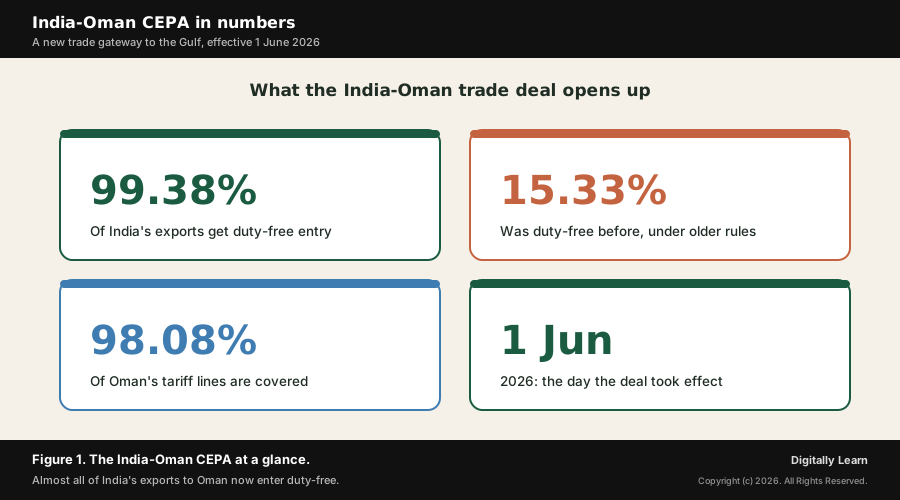
The India-Oman Comprehensive Economic Partnership Agreement, a trade pact covering goods and services, came into force on 1 June 2026. Signed at Muscat in December 2025, it gives almost all of India's exports, about 99.38 per cent by value, duty-free entry into Oman, up from a small share before. A CEPA is a deep trade agreement that lowers tariffs on goods and also opens services and investment.
The India-Oman CEPA Comes Into Force
A new trade gateway to the Gulf opens
On 1 June 2026, the India-Oman Comprehensive Economic Partnership Agreement came into force. The two countries had signed it at Muscat in December 2025, and its tariff cuts took effect immediately on that date.
Under the deal, about 99.38 per cent of India's exports by value now enter Oman free of customs duty, up from only 15.33 per cent under the earlier rules. On its side, the agreement covers more than ninety-eight per cent of Oman's tariff lines.
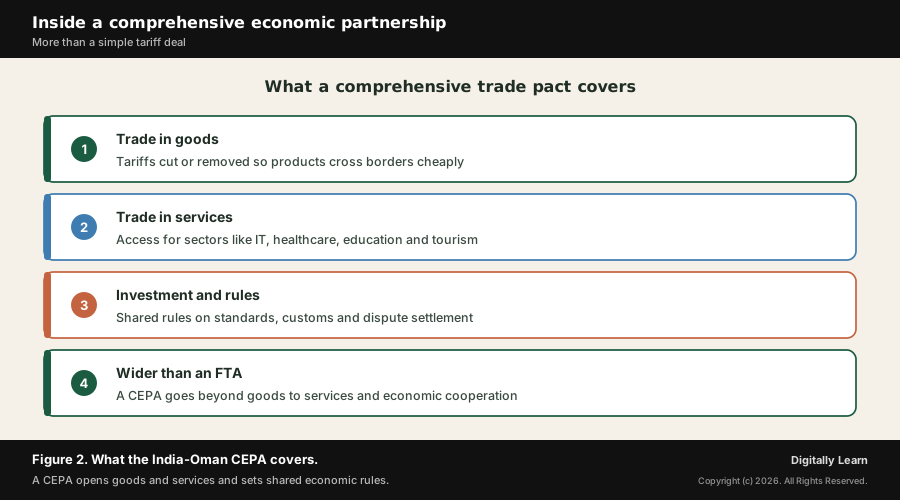
A Comprehensive Economic Partnership Agreement, or CEPA, is a deep trade pact. It does not only cut tariffs on goods; it also opens services and sets shared rules on investment, standards and customs.
Why a Trade Deal With Oman Matters
A partner at the mouth of the Gulf
Why it matters is that Oman sits at a strategic point, near the Strait of Hormuz through which much of the world's oil and a large part of India's energy imports pass. Closer economic ties there strengthen India's presence in a vital region.
Oman is also home to a large Indian community and a long-standing partner in defence and maritime security. A trade agreement adds an economic pillar to a relationship that already rests on energy, diaspora and strategic links.
What the Agreement Signifies for India's Trade
Wider access for goods and services
What is the significance of this agreement lies in the breadth of access it gives. Duty-free entry for almost all Indian exports lowers costs for sectors such as engineering goods, textiles, gems and jewellery, and chemicals competing in the Gulf market.
The deal also opens services, where India has a strong interest. Oman has made commitments in areas such as professional services, computer and information technology, education, healthcare and tourism, sectors in which Indian firms and workers can expand.
Goods, Services and What the CEPA Covers
The India-Oman CEPA at a glance
The table sets out the key features of the agreement and what each one means. Together they show a comprehensive pact that goes well beyond a simple tariff deal.
| Feature | Detail |
|---|---|
| Type | A Comprehensive Economic Partnership Agreement covering goods and services |
| In force | 1 June 2026, after signing at Muscat in December 2025 |
| Access for India | About 99.38 per cent of India's exports enter Oman duty-free |
| Earlier access | Only 15.33 per cent of India's exports were duty-free before |
| Coverage on Oman's side | More than ninety-eight per cent of Oman's tariff lines |
| Services | Commitments in IT, professional, education, healthcare and tourism services |
Read together, the rows show a deal designed to open both the goods and the services sides of trade, and to lock in access so Indian exporters can plan with certainty.
How a CEPA differs from a simple trade deal
A free-trade agreement mainly removes tariffs on goods. A CEPA goes further: it adds trade in services, rules on investment, and cooperation on standards, customs procedures and dispute settlement.
This depth is why India describes its newer pacts as comprehensive partnerships rather than simple trade deals. The same model underlies India's agreements with the United Arab Emirates and others, opening services trade where India is competitive, not only goods.
What to Watch in the India-Oman Partnership
Three things to track from here
The agreement points to three developments worth following, since signing a deal is the start of a partnership rather than its end.
- (a) The trade response. Whether Indian exports to Oman actually rise as the duty cuts take effect.
- (b) The services side. Whether Indian professionals and firms gain real access in the sectors Oman has opened.
- (c) The wider Gulf. Whether the deal supports India’s broader push for trade agreements across the Gulf region.
The real test is whether the pact deepens a balanced partnership, with gains for exporters and service providers on both sides, rather than a one-sided flow.
India's Trade-Agreement Strategy and the WTO Context
From global trade talks to bilateral deals
Contemporary linkages tie the Oman pact to India's wider trade strategy. The World Trade Organization sets the global rules of trade, but its broad Doha round of negotiations has long been stalled by differences between developed and developing countries.
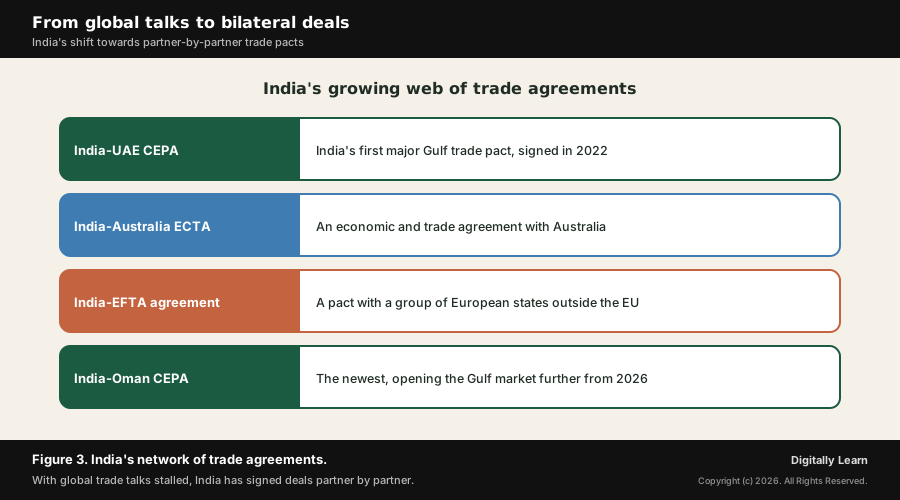
With multilateral talks blocked, and amid rising trade tensions between major economies, India has turned to bilateral and regional agreements signed partner by partner. The Oman CEPA joins recent deals with the United Arab Emirates, Australia and a group of European states.
India's interest in these talks is consistent: secure market access for its goods and services, protect sensitive sectors such as agriculture, and build resilient supply chains. Bilateral pacts let India pursue these aims where the wider WTO process cannot deliver.
These agreements also connect to India's external accounts. Trade in goods and in services, the invisibles that include software and professional work, both shape India's current account, and a services-rich deal like this one plays to India's strengths.
UPSC Relevance and Exam Focus
Where this fits in the UPSC-CSE syllabus
This topic maps to General Studies Paper II: bilateral and regional groupings and agreements involving India, and to the external-sector and trade portion of General Studies Paper III.
For Prelims, hold the high-yield facts: what a CEPA is and how it differs from a free-trade agreement, the India-Oman pact and its 2026 entry into force, India's other recent agreements, and the meaning of terms like most-favoured-nation and the current account.
For Mains, two framings recur: the state of the WTO and the Doha round from India's perspective, and why India increasingly relies on bilateral and regional trade agreements.
Recurring linked concepts an aspirant should keep in working memory:
- CEPA: a comprehensive pact covering goods, services and investment.
- Free-trade agreement: a narrower deal focused on removing tariffs on goods.
- Most-favoured-nation: the WTO principle of treating trading partners equally.
- Current account: the part of the balance of payments covering trade in goods and invisibles such as services.
A common Prelims trap is to treat a CEPA and a simple free-trade agreement as the same; a CEPA is broader, adding services and investment to tariff cuts.
A common Mains trap is to view bilateral deals as a rejection of the WTO. They are better read as a response to a stalled multilateral process, not a replacement for global rules.
Previous Year UPSC-CSE Questions By the end you will be able to draft model answers for the following UPSC questions. Each question carries a collapsible framework showing how to approach it in the exam.
- UPSC Mains 2016 GS-IIThe broader aims and objectives of WTO are to manage and promote international trade in the era of globalization. But the Doha round of negotiations seem doomed due to differences between the developed and the developing countries.” Discuss in the Indian perspective.
How to structure the answer in the exam
Introduction: Open with the WTO's role as the manager of global trade rules.
Body (sub-themes to develop):
- WTO aims: a rules-based, non-discriminatory multilateral trading system.
- Doha deadlock: farm subsidies, market access and developed-developing splits.
- India's stand: food security, special and differential treatment, the peace clause.
- India's response: bilateral and regional pacts such as the Oman and UAE CEPAs.
Conclusion: Conclude that India backs the WTO but pursues bilateral deals while the Doha round remains stalled.
- UPSC Prelims 2016 GS-IThe term ‘Regional Comprehensive Economic Partnership’ often appears in the news in the context of the affairs of a group of countries known as
How to approach this Prelims question
Approach: Recall which grouping anchors the Regional Comprehensive Economic Partnership.
Trap to watch: Do not confuse it with the SCO or SAARC; the RCEP is built around ASEAN.
Key facts to recall:
- The Regional Comprehensive Economic Partnership is a trade bloc built around ASEAN and its partners.
- A comprehensive economic partnership covers goods, services and investment.
Answer signal: The RCEP is centred on ASEAN.
- UPSC Prelims 2014 GS-IWith reference to Balance of Payments, which of the following constitutes/constitute the Current Account?
- Balance of trade
- Foreign assets
- Balance of invisibles
- Special Drawing Rights
Select the correct answer using the code given below.
How to approach this Prelims question
Approach: Recall that the current account covers the balance of trade and the balance of invisibles.
Trap to watch: Foreign assets and Special Drawing Rights belong to the capital account, not the current account.
Key facts to recall:
- Current account = balance of trade (goods) + balance of invisibles (services and transfers).
- Foreign assets and SDRs are capital-account items.
Answer signal: Only items 1 and 3 belong to the current account.
Sources and Further Reading
- Press Information Bureau: India and Oman energize a new Trade Gateway through a landmark CEPA
- Press Information Bureau: India-Oman CEPA Comes into Force on 1 June 2026
- Ministry of Commerce and Industry: India and Oman sign the Comprehensive Economic Partnership Agreement
- Ministry of External Affairs: India-Oman bilateral relations
Editorial Disclaimer
This briefing is for UPSC preparation. Verify the agreement's provisions against the official government sources before relying on them.


