


Overview
A Free Trade Agreement (FTA) is a treaty in which two or more economies cut or remove tariffs and ease rules on services, investment and the movement of people, so that goods and capital cross borders with fewer barriers. On 27 April 2026, India and New Zealand signed a comprehensive FTA, concluding talks that were launched on 16 March 2025 and wrapped up on 22 December 2025. Commerce Minister Piyush Goyal and New Zealand Trade Minister Todd McClay signed the agreement.
Why this is in the news in April 2026
The signing and the road to it
India and New Zealand signed a comprehensive Free Trade Agreement on 27 April 2026. The signatories were Indian Commerce and Industry Minister Piyush Goyal and New Zealand Minister for Trade and Investment Todd McClay.
A Free Trade Agreement removes or lowers customs duties between partner economies and writes shared rules for services, investment and mobility. The aim is to make each partner's exports cheaper and more competitive in the other's market, while protecting sectors each side treats as sensitive.
The road to signing was short by trade-deal standards. Negotiations were launched on 16 March 2025, and were concluded in a record nine months, on 22 December 2025. The signing on 27 April 2026 turned that concluded text into a signed treaty awaiting ratification.
The headline outcomes of the agreement fall into four groups:
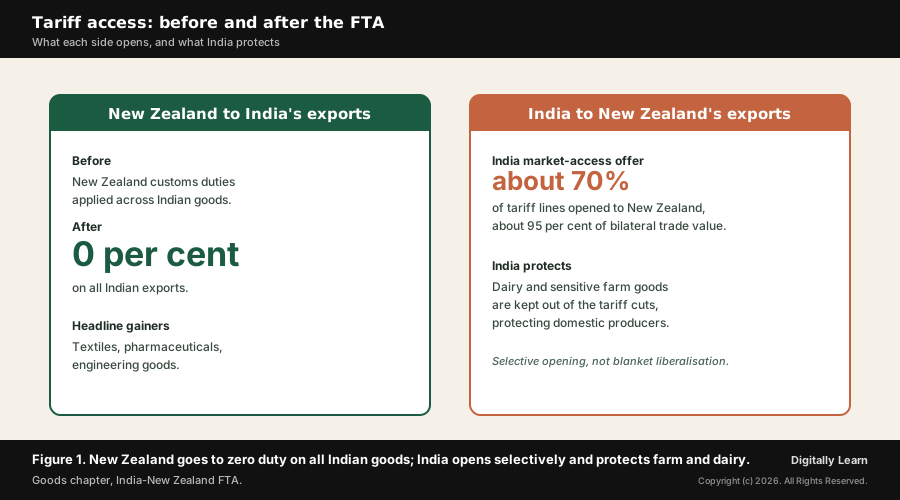
- Goods: all Indian exports get duty-free entry into New Zealand; India opens about 70 per cent of its tariff lines, about 95 per cent of bilateral trade value, while protecting dairy and farm goods.
- Services and mobility: visa pathways for Indian professionals and students, including temporary-work entry and post-study work rights.
- Investment: New Zealand commits to facilitate up to US$20 billion of investment into India over fifteen years.
- Trade facilitation: customs cooperation and streamlined procedures to speed legitimate clearances.
Why the agreement matters for Indian exporters and workers
Market access, mobility and a developed-economy partner
The agreement gives Indian goods a price edge in a developed market and opens structured routes for Indian workers and students. Both gains land with sectors that employ large numbers of people at home.
On the goods side, all Indian exports now enter New Zealand duty-free, covering the full range of tariff lines. Textiles, pharmaceuticals and engineering goods are the headline gainers, since these are labour-intensive sectors where the removal of New Zealand customs duties directly improves competitiveness.
On the people side, the agreement opens services access that matters for India's workforce. New Zealand made commitments across 118 services sectors, with most-favoured-nation treatment in 139 sectors, alongside professional and student pathways for Indians. These provisions widen the export of services and skills, not only goods.
The strategic value is the partner itself. New Zealand is a small but high-income, rules-based economy. Securing duty-free access there signals that India can negotiate deep market opening with developed economies while still protecting the sectors it chooses.
Significance for India's developed-economy trade strategy
What the deal signals beyond New Zealand
Its weight runs well past the size of the New Zealand market, which is modest. The deal matters as a template, a mobility precedent and a diplomatic signal.
It is a template for how India opens up to a rich economy without surrendering farm protection. India kept dairy and a set of sensitive farm goods out of the tariff cuts, yet still secured full duty-free entry for its own goods. That asymmetry, gain on exports without forced opening of sensitive sectors, is the shape India wants to repeat with larger partners.
It is a services precedent. For the first time in an Indian FTA, New Zealand facilitated trade in AYUSH, that is Ayurveda, Yoga, Naturopathy, Unani, Siddha and Homoeopathy, and other traditional-medicine services. This opens services trade in a field where India holds a distinctive advantage and supports medical-value travel.
It is a diplomatic signal within India's tilt toward developed economies. Coming alongside the EFTA, United Kingdom and Oman agreements, the New Zealand FTA shows India choosing rules-based, high-income partners and diversifying away from over-reliance on any single large market in a period of global trade friction.
Distinguishing features of the agreement
The four chapters in one view
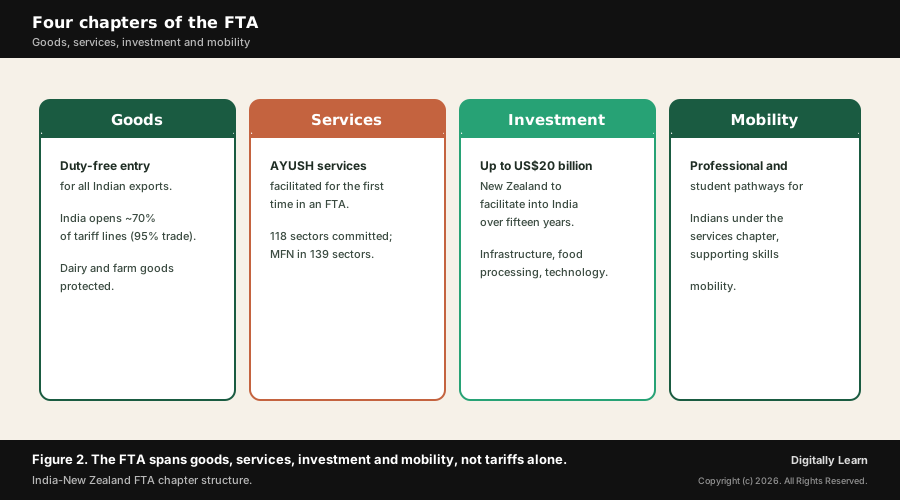
The FTA is more than a tariff schedule. The table below sets out its four working chapters, what each covers, and the principal Indian gain, so that the goods story is read alongside services, investment and mobility.
| Chapter | What it covers | Principal Indian gain |
|---|---|---|
| Goods | Tariff cuts and rules of origin | Duty-free entry for all Indian exports; textiles, pharma and engineering gain most |
| Services | Cross-border services and professional access | First FTA to facilitate AYUSH services; commitments across 118 sectors, MFN in 139 |
| Investment | Investment facilitation and protection | New Zealand to facilitate up to US$20 billion into India over fifteen years |
| Mobility | Movement of professionals and students | Professional and student pathways for Indians under the services chapter |
Three features that set this FTA apart
Three design choices separate this agreement from a routine tariff pact:
- (i) Full duty-free entry for Indian goods. New Zealand drops duties to zero on the entire range of Indian exports, rather than on a negotiated subset, which is rare in India’s recent deals.
- (ii) Selective Indian opening with protected sectors. India opens about 70 per cent of its tariff lines, covering roughly 95 per cent of bilateral trade value, while keeping about 30 per cent including dairy out of the cuts. Duty-free access for New Zealand’s exports phases in over several years.
- (iii) Traditional-medicine and services depth. It is the first Indian FTA to facilitate AYUSH services trade, paired with New Zealand commitments across 118 services sectors and most-favoured-nation treatment in 139, treating services and skills as part of the deal.
Observable outcomes the agreement is expected to produce
Three trackable outcomes over five to fifteen years
The agreement sets three measurable targets that aspirants can track as the treaty enters into force and is implemented.
- (a) A marked rise in bilateral trade from its 2024-25 level of about US$1.3 billion, driven mainly by Indian goods and services exports as duties fall.
- (b) Up to US$20 billion of New Zealand-facilitated investment flowing into India over fifteen years, with infrastructure, renewable energy, food processing and technology named as target sectors.
- (c) Wider services and skills exports through New Zealand’s commitments across 118 services sectors and the professional and student pathways, expanding India’s services trade.
The treaty enters into force only after both countries complete domestic ratification. The targets above are commitments on paper until that step is done, so the signing date and the entry-into-force date are separate milestones an aspirant should not conflate.
India's wave of trade agreements
Where the New Zealand FTA sits in India's FTA push
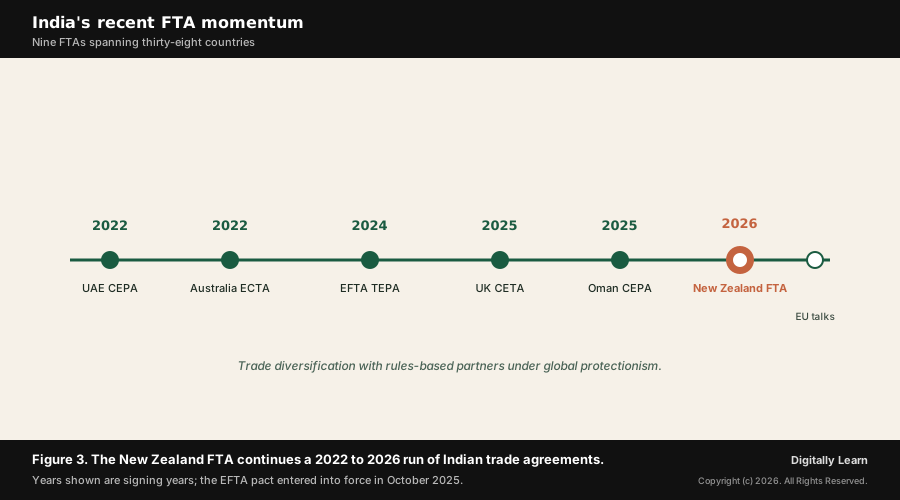
The New Zealand FTA is one step in a fast-moving sequence of Indian trade agreements. India has built a network of nine FTAs spanning thirty-eight countries, with several concluded in close succession.
The recent run includes the India-UAE CEPA (2022), the India-Australia ECTA (2022), the India-EFTA TEPA (signed 2024, in force October 2025), the India-UK CETA (2025) and the India-Oman CEPA (2025). The New Zealand FTA (2026) and the concluding India-European Union talks extend the same line of policy.
The common thread is trade diversification under global protectionism. As tariff tensions rise among major economies, India is widening market access through bilateral deals with rules-based partners, and is doing so while protecting its farm sector at home. The New Zealand pact also fits the Act East and Indo-Pacific frame, deepening ties with a Pacific economy.
UPSC relevance and exam focus
Where this fits in the UPSC-CSE syllabus
This topic maps to General Studies Paper II: bilateral, regional and global groupings and agreements involving India, and to General Studies Paper III: effects of liberalisation on the economy, and changes in industrial policy and their effects on industrial growth.
For Prelims, hold the high-yield facts: the signing date (27 April 2026), the signatories (Piyush Goyal and Todd McClay), duty-free entry for all Indian exports, India's offer on about 70 per cent of tariff lines (95 per cent of bilateral trade value), the protected sectors led by dairy, the US$20 billion investment commitment, the 118 services-sector commitments, and the first-ever AYUSH services facilitation in an FTA.
For Mains, two framings recur: how FTAs with developed economies serve India's trade diversification under global protectionism, and how India balances export gains against the protection of dairy and farm livelihoods in such agreements.
Recurring linked concepts an aspirant should keep in working memory:
- Acronyms: FTA (Free Trade Agreement), CEPA (Comprehensive Economic Partnership Agreement), CECA, ECTA (Economic Cooperation and Trade Agreement), TEPA (Trade and Economic Partnership Agreement), CETA (Comprehensive Economic and Trade Agreement).
- India’s recent FTAs: UAE CEPA, Australia ECTA, EFTA TEPA, UK CETA, Oman CEPA, New Zealand FTA, and the European Union talks.
- WTO concepts: most-favoured-nation treatment, national treatment, and the difference between an FTA and a customs union.
- Sensitive sectors India routinely protects: dairy, edible oils, and selected agricultural produce.
The agreement was signed on 27 April 2026 but enters into force only after ratification in both countries. A statement claiming it is already in force would be incorrect on the signing date.
Avoid presenting the FTA as blanket liberalisation. India opened selectively, opening about 70 per cent of its tariff lines while keeping roughly 30 per cent including dairy excluded, so the answer must capture both the export gain and the protective design.
Previous Year UPSC-CSE Questions By the end you will be able to draft model answers for the following UPSC questions. Each question carries a collapsible framework showing how to approach it in the exam.
- UPSC Prelims 2006Consider the following statements regarding the South Asian Free Trade Area (SAFTA):
- The agreement on SAFTA came into effect from 1st December 2005.
- As per SAFTA terms, India, Pakistan and Sri Lanka have to decrease their customs duties to the level of 0 per cent to 5 per cent by the year 2013.
Which of the statements given above is/are correct?
How to approach this Prelims question
Approach: Validate each statement separately. Distinguish the date a trade agreement was signed or came into effect from the longer schedule over which its tariff cuts are phased.
Trap to watch: Statement 1 swaps the dates. SAFTA was signed in 2004 and came into force on 1 January 2006, not 1 December 2005, so statement 1 is incorrect.
Key facts to recall:
- SAFTA was signed at the 12th SAARC Summit in Islamabad in January 2004.
- SAFTA entered into force on 1 January 2006.
- Tariff liberalisation under SAFTA was phased, with non-least-developed members cutting duties to the 0 to 5 per cent band over a multi-year schedule.
Answer signal: Statement 1 is incorrect on the in-force date; statement 2 reflects the phased tariff target. Correct answer: 2 only.
- UPSC Mains 2018 GS-IIWhat are the key areas of reform if the WTO has to survive in the present context of 'Trade War', especially keeping in mind the interest of India?
How to structure the answer in the exam
Introduction: Open with the WTO's central difficulty: a stalled dispute-settlement Appellate Body and a Doha Round that has not concluded, against rising unilateral tariffs.
Body (sub-themes to develop):
- Restoring the dispute-settlement Appellate Body, which protects smaller economies including India from unilateral tariff action.
- Reforming agricultural subsidy rules in a way that preserves India's public food-stockholding and minimum-support-price space.
- Updating rules for digital trade, e-commerce and services, where India has both offensive and defensive interests.
- Special and differential treatment for developing countries, which India defends as a core principle.
- Why a credible WTO still matters for India even as it signs bilateral FTAs such as the New Zealand pact.
Conclusion: Conclude that India gains from a reformed, rules-based WTO, and that bilateral FTAs complement rather than replace the multilateral order.
Sources and Further Reading
- Press Information Bureau: India-New Zealand Free Trade Agreement signed (27 April 2026 release)
- Department of Commerce, Government of India: India-New Zealand FTA Factsheet
- Department of Commerce, Government of India: trade agreements portal
- Ministry of External Affairs: India-New Zealand bilateral brief
- New Zealand Ministry of Foreign Affairs and Trade: New Zealand-India Free Trade Agreement
- Press Information Bureau: India's achievements in Free Trade Agreements 2025-26
- Wikipedia: New Zealand-India Free Trade Agreement
Editorial Disclaimer
This article is compiled from the reference materials listed in the Sources section. It is an explainer for UPSC preparation and is not a substitute for primary documents (NCERTs, GoI ministry releases, IMD bulletins, RBI / CEA / MoEFCC publications, and Standing-Committee reports).


