


Overview
Bishkek Declaration and India's agenda
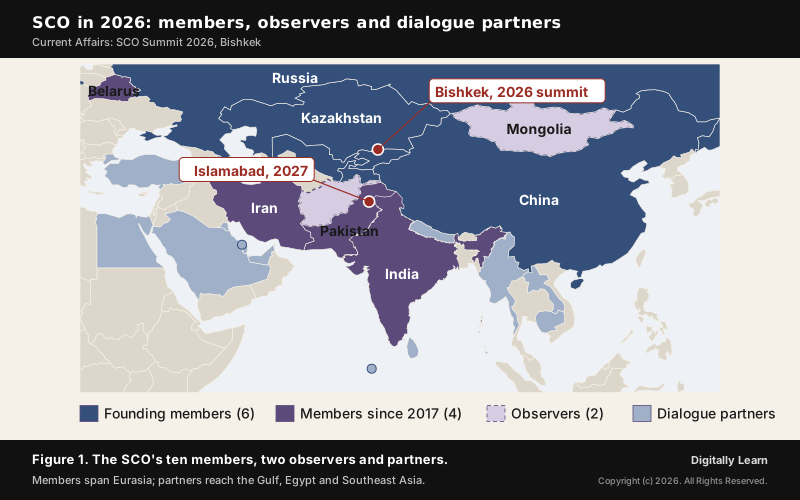
The SCO Summit 2026, the 26th meeting of the Council of Heads of State of the Shanghai Cooperation Organisation, was held at Bishkek, Kyrgyzstan, on 31 August and 1 September 2026, marking the organisation's 25th anniversary. The SCO is a ten-member Eurasian grouping founded on 15 June 2001; at Bishkek India pressed its agenda of security, connectivity and opportunity, and Pakistan took over the chair.
SCO Summit 2026 at Bishkek: Why It Is in the News
26th SCO Summit: Dates, Theme, Host and Leaders
Kyrgyz President Sadyr Japarov chaired the summit under the theme "25 Years of the SCO: Together for Sustainable Peace, Development and Prosperity". All ten members were represented at the top: Xi Jinping of China, Vladimir Putin of Russia, Masoud Pezeshkian of Iran, Shehbaz Sharif of Pakistan, Alexander Lukashenko of Belarus and the presidents of Kazakhstan, Tajikistan and Uzbekistan joined Mr. Modi and Mr. Japarov. Leaders of partner countries such as Azerbaijan, Armenia, Mongolia and Turkey attended an expanded "SCO Plus" session, and UN Secretary-General Antonio Guterres was also present.
Mr. Modi reached Bishkek after a state visit to Uzbekistan, his fourth visit there, and attended the opening of the sixth World Nomad Games on 31 August, Kyrgyzstan's Independence Day. It was the first summit of the grouping since the United States and Israel began their war on Iran on 28 February 2026, and that war, with US tariffs and sanctions on Russia, made this summit more sombre than the one at Tianjin in 2025.
Bishkek Declaration 2026: Iran, Afghanistan, Terrorism and Missile Defence
The Bishkek Declaration was adopted with 27 other documents, among them four memoranda of understanding and more than twenty decisions and statements on fields such as climate, nuclear safety, energy conservation and drug addiction. Its main positions were these.
- Iran: Deep concern at, and condemnation of, the military strikes on Iran; support for its sovereignty and territorial integrity; criticism of the United States and Israel for violating international law and the UN Charter; and support for the right of members to develop atomic energy for peaceful purposes.
- West Asia: A just settlement of the Palestine question as the only way to lasting stability in the region, and deep concern over the war in the Persian Gulf region.
- Afghanistan: A call on the Taliban administration to form an inclusive government with all ethno-political groups.
- Terrorism: Strong condemnation of terrorism in all its forms, including cross-border terrorism, and of the three evils of terrorism, separatism and extremism.
- Strategic security: The unilateral and unlimited build-up of global missile defence systems by groups of states harms international security, and unauthorised satellite internet services on members’ territory violate international law.
The declaration said nothing on Russia's role in the war in Ukraine. Members also backed aligning China's Belt and Road Initiative with the Eurasian Economic Union, a passage India stayed away from, as it does not endorse the BRI.
Modi's Bilateral Meetings at Bishkek: Iran, Russia and the BRICS Run-Up
The summit gave Mr. Modi his first meeting with Iran's President since the war began. In Bishkek on 31 August he urged Mr. Pezeshkian to help secure peace in West Asia and freedom of navigation in the Strait of Hormuz, and said civilians, commercial shipping and seafarers must not be harmed. Mr. Pezeshkian blamed Israel and the United States for the conflict and asked India to use its contacts to help the dialogue.
With Mr. Putin, Mr. Modi said the world must "move from endless war to end of war". They discussed the conflicts in West Asia and the Black Sea, where Indian seafarers have been attacked, and Mr. Putin noted that 40,000 Indians now study in Russia. Both meetings looked ahead to the BRICS Summit India hosted in New Delhi on 12 and 13 September, where an Iran-UAE deadlock threatened the joint declaration.
What Is the Shanghai Cooperation Organisation: Origin, Charter and Members
From the Shanghai Five to the SCO: Founding in 2001
The Shanghai Cooperation Organisation (SCO) grew out of a border-confidence group. The Shanghai Five, formed in April 1996 by China, Kazakhstan, Kyrgyzstan, Russia and Tajikistan, settled the frontiers left by the break-up of the Soviet Union. Uzbekistan joined in 2001, making it the Shanghai Six, and the six founded the SCO on 15 June 2001.
A body built to manage borders among states that distrusted one another works by consensus, and that origin still explains both its survival for 25 years and the limits on what any member can push through it. The SCO has no collective defence commitment, and its members include rivals such as India and Pakistan and, on the boundary, India and China.
SCO Charter: Shanghai Spirit, Three Evils and Official Languages
The SCO Charter sets the organisation's spirit, goals and rules. Its preamble speaks of mutual trust, mutual advantage, equality, mutual consultations, respect for cultural diversity and aspiration for joint development, a formula known as the Shanghai Spirit.
- Goals: Mutual trust and good-neighbourliness, regional peace and stability, a democratic, fair and rational international order, and cooperation in politics, trade, defence, energy, transport, environment, culture, education and science.
- The three evils: Joint combating of terrorism, separatism and extremism in all their manifestations, along with illicit narcotics and arms trafficking and other transnational crime.
- Principles: Mutual respect of sovereignty, independence and territorial integrity of states, inviolability of state borders, non-aggression and non-interference in internal affairs.
- Languages: Russian and Chinese are the official and working languages of the SCO.
Two of these matter directly for India. The principle of territorial integrity is the basis of India's objection to connectivity projects that cross its territory, and India's push for English as an official language, an initiative that found a place in the Bishkek Declaration, follows from the language clause.
SCO Members 2026: Member Countries, Observers and Dialogue Partners
The SCO has ten member states, two observers and fifteen dialogue partners. India and Pakistan joined together at Astana in June 2017, Iran at the summit India hosted virtually on 4 July 2023, and Belarus became the tenth member at Astana on 4 July 2024.
| Category | Countries |
|---|---|
| Founding members (2001) | China, Kazakhstan, Kyrgyzstan, Russia, Tajikistan, Uzbekistan |
| Members since 2017 | India, Pakistan (2017); Iran (2023); Belarus (2024) |
| Observers | Afghanistan, Mongolia |
| Dialogue partners | Azerbaijan, Armenia, Cambodia, Laos, Nepal, Turkey, Sri Lanka, United Arab Emirates, Kuwait, Maldives, Bahrain, Myanmar, Egypt, Saudi Arabia, Qatar |
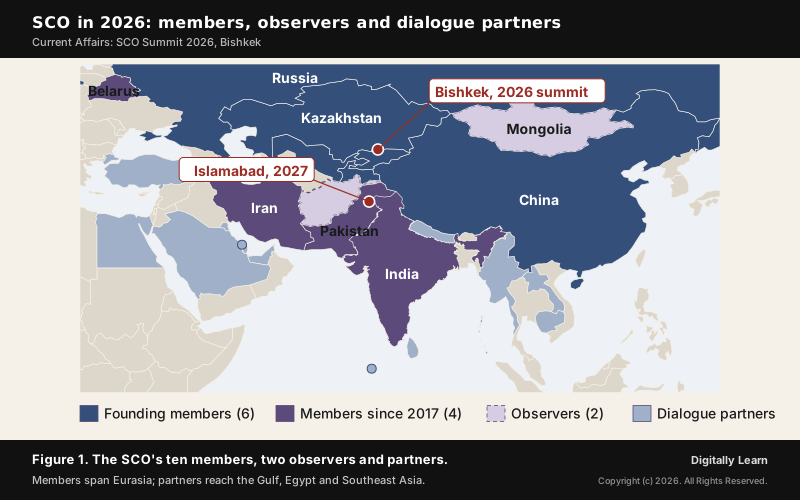
Together the members cover at least 24 per cent of the world's area, about 65 per cent of Eurasia, and hold 42 per cent of the world's population. Their share of world output is about 23 per cent at market prices (2024) and about 36 per cent at purchasing power parity, so the grouping is far more populous than it is rich.
SCO Structure: Councils, Secretariat and RATS
Council of Heads of State and the Other SCO Councils
The Council of Heads of State is the SCO's supreme body. It meets once a year in the country that holds the presidency, which rotates among members in Russian alphabetical order; India is represented by the Prime Minister.
- Council of Heads of Government: The second-highest body; it meets yearly on trade, economic cooperation and the budget. India is usually represented by the External Affairs Minister.
- Council of Foreign Ministers: Meets about a month before the summit to settle the draft outcome documents, so most of a declaration is negotiated before leaders arrive.
- Council of National Coordinators: Runs day-to-day work and prepares the other councils’ meetings; India’s coordinator is the Additional Secretary (SCO) in the External Affairs Ministry.
- Ministerial meetings: Defence, economy and trade, transport, culture, health, justice, emergency situations, and the secretaries of national security councils, among others.
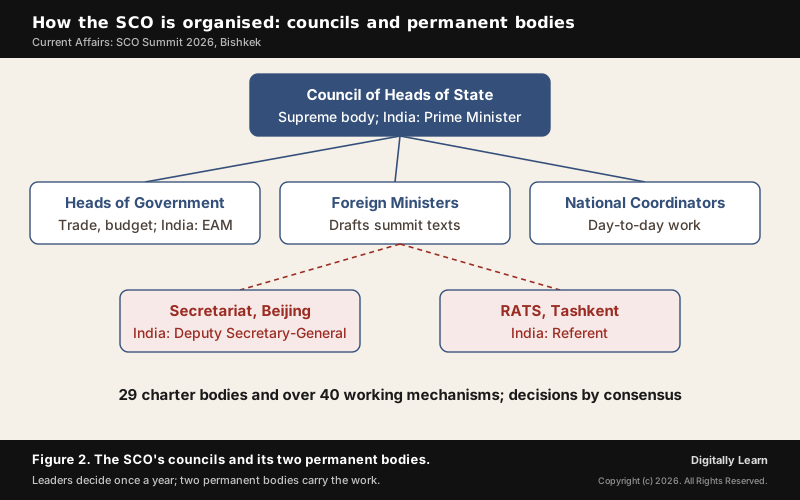
In all the SCO has 29 charter bodies and more than 40 working mechanisms that meet through the year. Even where members disagree, these regular channels keep them talking, which can matter in a sudden crisis between neighbours.
SCO Headquarters: Secretariat in Beijing and RATS in Tashkent
The SCO has two permanent bodies: the Secretariat in Beijing and the Executive Committee of the Regional Anti-Terrorist Structure (RATS) in Tashkent. They carry out the councils' decisions; the Secretary-General, Nurlan Yermekbaev of Kazakhstan, took office in January 2025 for a three-year term. The SCO has also been an observer in the UN General Assembly since 2005.
RATS works through information rather than force. It keeps a database of individuals and organisations that member states have designated as terrorist, separatist or extremist, and coordinates intelligence among members. India has served in the SCO's counter-terrorism exercises too: 200 Indian personnel joined the Peace Mission exercise at Chebarkul, Russia, from 22 to 29 August 2018, India's first after membership, and again in 2021.
New SCO Centres and the SCO Development Bank Proposal
The organisation is adding new machinery. At the Tianjin summit of 31 August and 1 September 2025, members agreed to set up an SCO Universal Center for Countering Security Challenges and Threats, against organised crime and cyber and information threats, and approved an SCO Anti-Drug Center for intelligence sharing and joint operations against narcotics trafficking.
On finance, the SCO Interbank Consortium has existed since October 2005 to fund joint projects, and the creation of an SCO Development Bank has now been announced. With leaders' calls for more trade in local currencies, it is one way the grouping pushes back against a US-led economic order.
India and the SCO: From Observer to Member
India's Path to SCO Membership: Astana 2005, Ufa 2015, Astana 2017
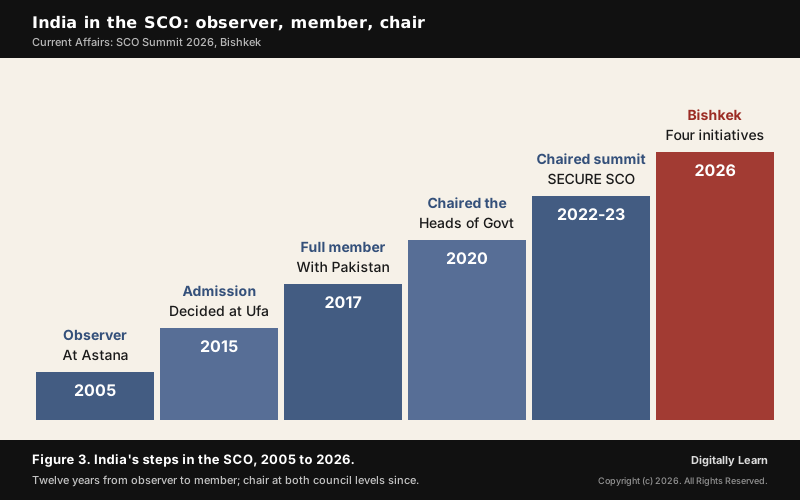
India's entry took twelve years. At the Astana summit of July 2005 India, Iran and Pakistan became observers; at Ufa in Russia in July 2015 the members decided to admit India; and India formally joined at Astana in June 2017, at the same summit as Pakistan. India came in with Russia's backing, as Pakistan did with China's, and since then it has sat inside a security grouping alongside both China and Pakistan.
India's interest is driven by geography, not ideology. Central Asia, rich in hydrocarbons and bordering Russia, China, Afghanistan and Pakistan, has become a zone of competition between outside powers, and India and Tajikistan are separated only by the narrow Wakhan corridor of Afghanistan. Mr. Modi visited all five Central Asian countries in 2015; India's trade in goods with the region has grown from $500 million in 2010 to more than $2 billion in 2025, while China-Central Asia trade reached $106 billion in 2025. India invited all five Central Asian leaders as chief guests for Republic Day in 2022, which led to the India-Central Asia Dialogue, but the India-Central Asia Summit has not met since 2022.
India's SCO Chairships and the SECURE SCO Framework
India has chaired both main councils. The Vice-President chaired the 19th Council of Heads of Government, hosted virtually on 30 November 2020, the first summit-level meeting under India's chair. India then held the presidency of the Council of Heads of State from Samarkand on 17 September 2022 and hosted the virtual summit of 4 July 2023 that admitted Iran.
As chair, India set out its priorities as a SECURE SCO: Security, Economic development, Connectivity, Unity, Respect for sovereignty and territorial integrity, and Environmental protection. More than 130 meetings and events were held under its chairship, 14 of them ministerial, and India opened five new areas of work: start-ups and innovation, traditional medicine, science and technology, youth empowerment and shared Buddhist heritage. Varanasi was the first SCO Cultural and Tourism Capital for 2022-23.
India's Stake: Budget Share, Posts and Central Asia Connectivity
India pays 5.9 per cent of the SCO's annual budget and holds two designated posts: a Deputy Secretary-General at the Secretariat in Beijing and a Referent at the RATS headquarters in Tashkent. These give India continuous sight of the organisation's work, not just a seat once a year.
Its real constraint is access. With no land route to Central Asia that avoids Pakistan, India relies on two projects through Iran.
- International North-South Transport Corridor: A 7,200 km network of sea, rail and road routes for freight between India, Iran, Azerbaijan, Russia, Central Asia and Europe, agreed by India, Iran and Russia on 16 May 2002 and estimated to be 30 per cent cheaper and 40 per cent shorter than the route through the Suez Canal.
- Chabahar: Under a 2016 agreement India is refurbishing a berth at the Shahid Beheshti port and building a 600 m container facility. The port, 800 km closer to the Afghan border than Pakistan’s Karachi, gives India a route for trade with Afghanistan that does not pass through Pakistan.
Both routes run through Iran, so the war on Iran and the blockade of the Strait of Hormuz bear directly on India's access to Central Asia; the blockade was among the concerns Mr. Modi raised with Iran's President at Bishkek.
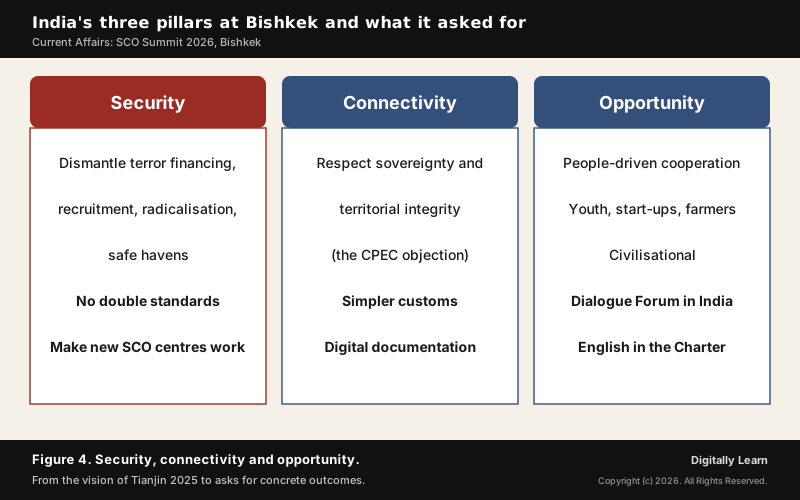
India's SCO Agenda at Bishkek: Security, Connectivity and Opportunity
Security Pillar: Dismantling the Terror Ecosystem
Mr. Modi first set out India's vision of security, connectivity and opportunity at Tianjin in 2025; at Bishkek he said the time had come to turn it into concrete outcomes. On terrorism he said the SCO cannot stay with an action-reaction approach and must dismantle the whole ecosystem of terrorist financing, recruitment, radicalisation and safe havens.
He asked members to speak with one voice, with no double standards, and to send a strong message to countries that use terrorism as an instrument of policy and give safe haven to terrorists: terrorism can never be a strategic asset for anyone. The line was a pointed reference to Pakistan, and it came as Pakistan took over the SCO chair.
- Peace in Afghanistan: A peaceful Eurasia is linked to peace in Afghanistan, where India gives development and humanitarian aid and will continue to do so.
- The war in West Asia: The war has hit energy security, maritime trade and supply chains, and the Global South bears the greatest brunt; conflicts must be settled by dialogue and diplomacy, not on the battlefield.
- Narcotics: Drug trafficking is not merely a crime but a threat to young people and to regional security, which is why the new SCO centres must work in practice.
Connectivity Pillar: Sovereignty, the CPEC Objection and Customs
India backs connectivity that links markets and opens trade, but insists that it respect the sovereignty and territorial integrity of all countries, which Mr. Modi called the fundamental spirit of the SCO Charter. The objection is to the China-Pakistan Economic Corridor (CPEC), a part of China's Belt and Road Initiative that runs through Gilgit-Baltistan, territory India claims as its own.
Grounding the objection in the Charter turns a bilateral dispute into a question about a text every member has signed. Mr. Modi also widened the idea of connectivity beyond roads, railways and air corridors to simpler customs, digital documentation and efficient logistics.
Opportunity Pillar: Youth, Start-ups and the Civilisational Dialogue Forum
The third pillar is about who benefits. Mr. Modi said SCO cooperation should be people-driven, not only government-driven, and measured by the opportunities it creates for young people, the markets it opens for entrepreneurs, the technology it brings to farmers and the lives it improves. He welcomed Kyrgyzstan's focus on youth and listed India's own platforms: the SCO Start-up Forum, the Young Authors' Conclave and the Young Scientists' Forum.
| Initiative led or supported by India | What it is |
|---|---|
| English as an official language in the SCO Charter | A structural change: the Charter now names only Russian and Chinese |
| SCO Civilisational Dialogue Forum | Proposed by India in 2025; its first session is to be held in India in 2026 |
| Young Scientists' Forum | A youth platform continuing work begun under India's 2020 chairship |
| Young Authors' Conclave | A youth and cultural platform |
Challenges for India in the SCO and the Road to Islamabad 2027
Consensus, the China-Pakistan Dyad and Pakistan's Chairship
Negotiating against a China-Pakistan pair inside the SCO is demanding but essential for India. Consensus lets India put its terrorism language into the record, but a declaration cannot name a member, and it does not by itself change any member's conduct. In the same way, every member accepts the Charter's sovereignty principle, yet China and Pakistan do not accept that the CPEC violates it.
- Pakistan’s chair: Pakistan sets the agenda for 2026-27 and hosts the next summit at Islamabad. India has not said at what level it will attend; the External Affairs Minister went to Islamabad for the heads of government meeting in 2024, but Pahalgam, Operation Sindoor and the Indus Waters Treaty decision have since hardened ties.
- A changed neighbourhood: Pakistan has gained diplomatic room through its mediation between Iran and the United States and a new security pact with Saudi Arabia and Turkey.
- China’s weight: Central Asia trade with China dwarfs India’s, and members backed the BRI-Eurasian Economic Union alignment that India rejects.
- Strain from outside: US tariffs, the war on Iran and sanctions on Russia have damaged economic and energy security and connectivity across the grouping.
Why the SCO Still Matters for India
The SCO remains one of the few forums where India can engage China, Russia, Iran and the Central Asian states at once. India and China began to re-engage after Galwan when Mr. Modi met Mr. Xi at the Kazan BRICS summit in 2024, and at Tianjin in 2025 they agreed on an "early harvest" proposal on boundary delimitation and on resuming border trade through three points, despite China's support for Pakistan during Operation Sindoor.
The forum also serves India's other goals. Its sidelines let Mr. Modi meet Iran and Russia before the BRICS summit, and Central Asian votes matter in India's contest with Tajikistan for the Asian non-permanent seat on the UN Security Council for 2028-29. For Kyrgyzstan and its neighbours, heavily dependent on China, India and the SCO offer a valuable counterweight.
SCO for UPSC: Syllabus Links and Exam Angles
SCO in the UPSC Syllabus: GS Paper II Regional Groupings
The SCO belongs to General Studies Paper II, under regional and global groupings and agreements involving India or affecting its interests, and important international institutions, their structure and mandate. Its security agenda, from terror financing to narcotics, also reaches GS Paper III, and state PCS papers ask the same facts.
- Prelims facts: Founding on 15 June 2001; the Shanghai Five of 1996; ten members, two observers and fifteen dialogue partners; Russian and Chinese as official languages; the Secretariat in Beijing and RATS in Tashkent; India’s observer status in 2005 and membership in 2017.
- Mains analysis: The SCO’s aims and India’s interests, managing rivalries inside a consensus body, the CPEC objection grounded in the Charter, Central Asia connectivity through Iran.
- Current facts: Bishkek, 31 August to 1 September 2026; Pakistan’s chair for 2026-27; India’s four initiatives in the Bishkek Declaration.
Previous Year UPSC-CSE Questions By the end you will be able to draft model answers for the following UPSC questions. Each question carries a collapsible framework showing how to approach it in the exam.
- UPSC Mains 2021 GS-IICritically examine the aims and objectives of SCO. What importance does it hold for India?
Answer outline: how to structure the answer
What the question asks, the main arguments, relevant examples and the direction of the conclusion. This is not a full model answer.
Introduction: Introduce the SCO, founded on 15 June 2001 from the Shanghai Five, now ten members with two observers and fifteen dialogue partners, holding 42 per cent of the world's population.
Body (sub-themes to develop):
- Aims from the Charter: mutual trust and good-neighbourliness, combating terrorism, separatism and extremism, respect for territorial integrity, cooperation in trade, energy, transport and culture.
- Delivery: RATS and its database, Peace Mission exercises, the 2025 security and anti-drug centres, the Interbank Consortium and the proposed SCO Development Bank.
- Critique: consensus means no member can be named; rivalries (India-Pakistan, India-China); no collective defence; Russian and Chinese as the only official languages.
- Importance for India: access to Central Asia, counter-terrorism cooperation, a channel to China and Russia (Kazan 2024, Tianjin 2025), and a platform for its positions, such as the 2026 Bishkek initiatives.
Conclusion: Conclude that the SCO's aims outrun its delivery, but for India the forum is worth more inside than outside.
- UPSC Mains 2023 GS-II‘Virus of Conflict is affecting the functioning of the SCO’. In the light of the above statement point out the role of India in mitigating the problems.
Answer outline: how to structure the answer
What the question asks, the main arguments, relevant examples and the direction of the conclusion. This is not a full model answer.
Introduction: Note that the SCO, built on mutual trust, now holds rival members (India and Pakistan, India and China) and members at war or under sanctions (Iran, Russia).
Body (sub-themes to develop):
- The virus: consensus blocks naming any member; Pakistan's chair for 2026-27; the CPEC dispute; the Iran war and the Hormuz blockade hurting energy and connectivity.
- India's role on security: no double standards, dismantling terror ecosystems, pressing the new SCO centres to work.
- India's role on conflict: dialogue and diplomacy, not the battlefield; meetings with Iran and Russia at Bishkek; re-engaging China at Kazan and Tianjin.
- India's role on cooperation: SECURE framework, start-up, youth and civilisational forums, English in the Charter.
Conclusion: Conclude that India cannot cure the SCO's conflicts but keeps it working by turning disputes into Charter principles and cooperation.
- UPSC Mains 2024 GS-IICritically analyse India’s evolving diplomatic, economic and strategic relations with the Central Asian Republics (CARs) highlighting their increasing significance in regional and global geopolitics.
Answer outline: how to structure the answer
What the question asks, the main arguments, relevant examples and the direction of the conclusion. This is not a full model answer.
Introduction: Describe Central Asia as India's extended neighbourhood, landlocked between Russia and China and separated from India only by the Wakhan corridor.
Body (sub-themes to develop):
- Diplomatic: Mr. Modi's 2015 visits to all five states; the India-Central Asia Dialogue; SCO membership; the state visit to Uzbekistan in 2026; votes for the UN Security Council seat.
- Economic: trade up from $500 million (2010) to over $2 billion (2025), far behind China's $106 billion; INSTC and Chabahar routes through Iran.
- Strategic: counter-terrorism with Uzbekistan and RATS; Afghanistan; balancing China's weight.
- Limits: no land route avoiding Pakistan; the Iran war and Hormuz blockade; the India-Central Asia summit not held since 2022.
Conclusion: Conclude that India's ties are growing in intent but trail in delivery, and that connectivity through Iran decides how far they can go.
- UPSC Prelims 2025 Prelims-GSIndia is one of the founding members of the International North-South Transport Corridor (INSTC), a multimodal transportation corridor, which will connect
How to approach this Prelims question
Approach: Step 1: the corridor is called North-South and runs from India through Iran. Step 2: it carries freight on to Central Asia, Russia and Europe. So India to Central Asia to Europe via Iran.
Trap to watch: China, Bangladesh and Myanmar belong to other corridors; the INSTC's gateway is Iran.
Key facts to recall:
- (a) India to Central Asia to Europe via Iran: right. Iran is the gateway, with routes on to Central Asia, Russia and Europe.
- (b) India to Central Asia via China: wrong. The INSTC does not pass through China.
- (c) India to South-East Asia through Bangladesh and Myanmar: wrong. That describes eastward corridors, not the INSTC.
- (d) India to Europe through Azerbaijan: wrong. Azerbaijan is a member of the network, but the route runs via Iran.
Answer signal: India to Central Asia to Europe via Iran: option (a), the official answer.
- UPSC Prelims 2017 Prelims-GSWhat is the importance of developing Chabahar Port by India?
How to approach this Prelims question
Approach: Step 1: Chabahar is in south-eastern Iran, facing the Arabian Sea. Step 2: its purpose for India is a route to Afghanistan and Central Asia that avoids Pakistan. So option (c).
Trap to watch: Trade with Africa and ties with Arab oil producers are not why India builds Chabahar.
Key facts to recall:
- (a) Trade with African countries will enormously increase: wrong. The port faces Afghanistan and Central Asia, not Africa.
- (b) Relations with oil-producing Arab countries will be strengthened: wrong. Chabahar is in Iran, and its aim is access, not Gulf diplomacy.
- (c) India will not depend on Pakistan for access to Afghanistan and Central Asia: right. That is the port's purpose.
- (d) Pakistan will protect a gas pipeline between Iraq and India: wrong. The port has nothing to do with such a pipeline, and its purpose is to bypass Pakistan.
Answer signal: Access to Afghanistan and Central Asia without Pakistan: option (c), the official answer.
- UPSC Prelims 2007 Prelims-GSWhich one of the following is NOT a member of the Shanghai Cooperation Organization?
How to approach this Prelims question
Approach: Step 1: Russia, Kazakhstan and Uzbekistan are founding members of 2001. Step 2: Ukraine has never belonged to the SCO. So Ukraine.
Trap to watch: All four are former Soviet republics; only membership of the SCO separates them.
Key facts to recall:
- (a) Russia: wrong. Russia is a founding member.
- (b) Kazakhstan: wrong. Kazakhstan is a founding member.
- (c) Ukraine: right. Ukraine is not a member, observer or dialogue partner of the SCO.
- (d) Uzbekistan: wrong. Uzbekistan joined in 2001, making the Shanghai Five the Shanghai Six.
Answer signal: Ukraine: option (c), the official answer.
Sources
- PIB: Prime Minister participates in the 26th SCO Summit in Bishkek, Kyrgyz Republic (1 September 2026)
- PIB: English translation of the Prime Minister's statement at the 26th SCO Summit (1 September 2026)
- Ministry of External Affairs: Brief on India-SCO Cooperation (3 July 2026)
- Ministry of External Affairs: Charter of the Shanghai Cooperation Organization
- PIB: Curtain raiser, Exercise SCO Peace Mission 2018
- PIB: Indian military contingent in the 6th edition of Exercise SCO Peaceful Mission 2021
- NCERT: Contemporary World Politics (Class XII), Chapter 2, The End of Bipolarity
- United Nations DPPA: Shanghai Cooperation Organization
- The Hindu, Delhi, 28 August 2026: India's return to its Central Asian neighbourhood (op-ed)
- The Hindu, Delhi, 30 August 2026: PM's Central Asia visit (news analysis); PM in Uzbekistan for 2-day visit ahead of SCO summit
- The Hindu, Delhi, 1 September 2026: Ensure peace, freedom of navigation, PM urges Iran; PM calls for 'end of war' at meeting with Putin
- The Hindu, Delhi, 2 September 2026: SCO must dismantle terror ecosystem: PM; Xi urges SCO member states to make security a key priority; Water must never be weaponised, says Sharif
- The Hindu, Delhi, 4 September 2026: Forging consensus (editorial)
- The Hindu, Delhi, 6 September 2026: Shanghai Cooperation Organisation, the house of multilaterals
- Wikipedia: Shanghai Cooperation Organisation
- Wikipedia: 2026 Bishkek SCO summit
- Wikipedia: Regional Anti-Terrorist Structure
- Wikipedia: SCO Interbank Consortium
- Wikipedia: International North–South Transport Corridor
- Wikipedia: Chabahar Port
- Wikipedia: China–Pakistan Economic Corridor
- UPSC: Civil Services Examination question papers
Editorial Disclaimer
This article draws on the PIB releases, the MEA brief, the SCO Charter and the other sources listed on this page.


