


Overview
Hosted in New Delhi
India hosted the Asian Productivity Organization Governing Body at Bharat Mandapam, then handed the chair to Indonesia.
The Asian Productivity Organization (APO) is a regional intergovernmental organisation established in 1961 and headquartered in Tokyo, with the mandate to enhance productivity in the Asia-Pacific region through technical assistance, training, research, and policy advisory. The Governing Body is the supreme organ of the APO, composed of the APO Directors appointed by member economies, and meets annually.
Why this is in the news on 21 May 2026
The Bharat Mandapam meeting and the chair transition
From 20 to 22 May 2026, India hosted the 68th Session of the Asian Productivity Organization (APO) Governing Body at Bharat Mandapam, New Delhi. The three-day session brought together over 60 senior delegates from 20 APO member economies.
Definition: The APO Governing Body is the supreme organ of the Asian Productivity Organization, composed of APO Directors appointed by member economies. It meets annually to review the work programme, approve the biennial budget, and elect the Chair and Vice Chairs.
Three outcomes define the New Delhi session:
- (i) Chair transition. The APO Director for Indonesia, Prof. Anwar Sanusi, assumed charge as APO Chair for 2026-27, succeeding Amardeep Singh Bhatia of India. The Acting APO Directors for Iran and Japan assumed the First and Second Vice Chair roles respectively.
- (ii) Policy and budget agenda. The session reviewed the APO Vision 2030 framework, deliberated the 2027-28 biennium budget, and finalised the review of the APO Secretary-General election procedures.
- (iii) Inaugural session. Union Commerce and Industry Minister Piyush Goyal addressed the inaugural session on 21 May 2026, framing the meeting around AI-driven productivity and Asia-Pacific cooperation.
Why hosting matters for India's productivity diplomacy
India in the APO architecture
Why it matters: India has been a founding member of the APO since its 1961 establishment. The National Productivity Council (NPC), set up in 1958 as an autonomous society under the Department for Promotion of Industry and Internal Trade (DPIIT), Ministry of Commerce and Industry, is India's APO Member Body.
Hosting the 68th Governing Body at Bharat Mandapam signals India's intent to lead the productivity-and-AI agenda for the Asia-Pacific. The 2025-26 chair tenure under Amardeep Singh Bhatia and the elevation of the Indian agenda within APO Vision 2030 are the practical levers.
Significance for India's productivity strategy
What the New Delhi session means for India's productivity diplomacy
What is the significance of this issue: The 68th Governing Body session carries three significances for India's productivity strategy:
- (i) Manufacturing-and-MSME signal. The Vision 2030 framework explicitly centres on manufacturing productivity, MSME competitiveness, and digital-economy integration. The Indian Make in India and Production-Linked Incentive (PLI) schemes sit naturally within this framework.
- (ii) AI-and-digital signal. The meeting framing on AI-driven productivity connects to the Indian IndiaAI Mission, the Digital India programme, and the Semiconductor Mission as productivity-frontier investments.
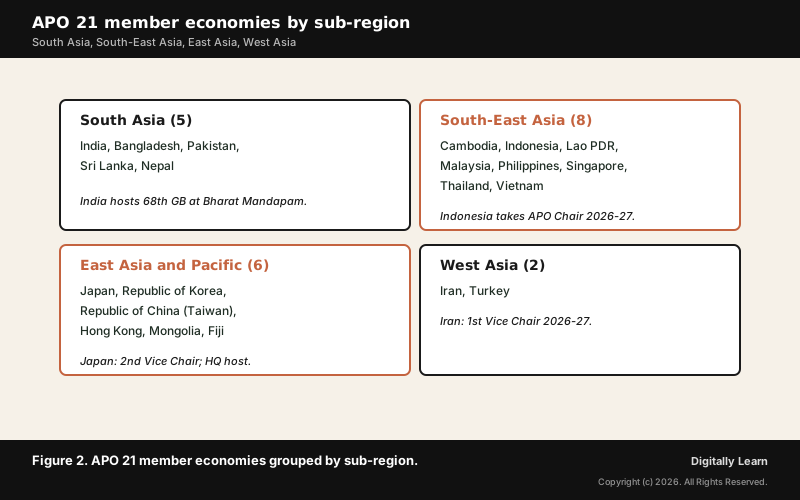
- (iii) South-Asia-and-South-East-Asia signal. The APO membership covers Bangladesh, Pakistan, Sri Lanka, Nepal from South Asia and Cambodia, Indonesia, Lao PDR, Malaysia, Philippines, Thailand, Vietnam, Singapore from South-East Asia, giving India a productivity-and-extension platform across the broader neighbourhood.
Structural reading: The 60-delegate-and-20-member-economy footprint of the APO is small relative to ASEAN or BIMSTEC, but its technical-assistance and training mandate gives it operational depth that the larger groupings lack on productivity-specific issues.
Distinguishing features of the APO architecture
How the APO Vision 2030 framework is run
Distinguishing features: Three institutional pillars give the APO its productivity-specific institutional weight:
- (i) Founding and mandate. The APO was established in 1961 on the initiative of Japan; its headquarters is in Tokyo. The mandate covers productivity enhancement through training, research, advisory, demonstration, and information services.
- (ii) Membership. Currently 21 member economies across Asia-Pacific: Bangladesh, Cambodia, Republic of China (Taiwan), Fiji, Hong Kong, India, Indonesia, Iran, Japan, Republic of Korea, Lao PDR, Malaysia, Mongolia, Nepal, Pakistan, Philippines, Singapore, Sri Lanka, Thailand, Turkey, and Vietnam.
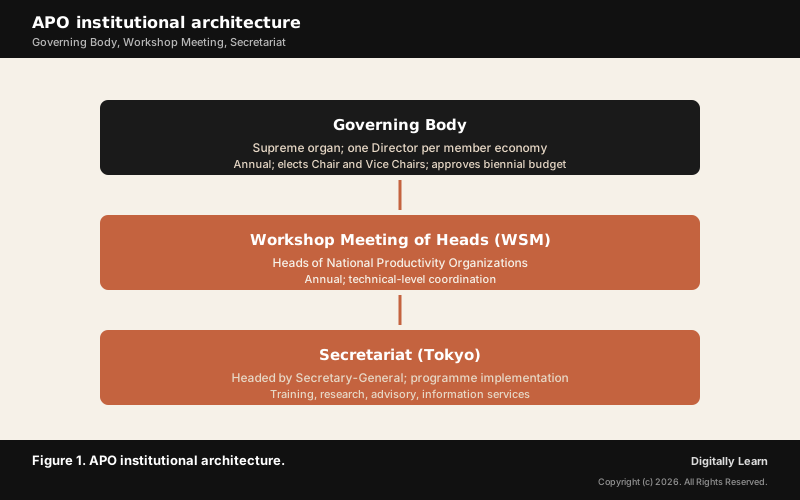
- (iii) Governance. The Governing Body is the supreme organ (one Director per member economy). The Secretariat is headed by the Secretary-General based in Tokyo. The Workshop Meeting of Heads of National Productivity Organizations (WSM) is the technical-level body convened annually.
The 68th APO Governing Body session in numbers
| Session parameter | Detail | Significance |
|---|---|---|
| Session | 68th Session of the APO Governing Body | Annual supreme-organ meeting |
| Dates and venue | 20-22 May 2026, Bharat Mandapam, New Delhi | First APO Governing Body hosted by India in current cycle |
| Delegates | over 60 senior delegates from 20 member economies | Director-level representation |
| Inaugural session | Union Minister Piyush Goyal, 21 May 2026 | Ministerial-level engagement |
| Outgoing Chair | Amardeep Singh Bhatia (India), 2025-26 | India hosted as outgoing Chair |
| Incoming Chair | Prof. Anwar Sanusi (Indonesia), 2026-27 | Vice Chairs: Iran and Japan |
| Founding | 1961, Tokyo, on Japan's initiative | 65 years of operation |
| Indian Member Body | National Productivity Council (NPC), established 1958 | Autonomous society under DPIIT, Ministry of Commerce and Industry |
| Vision framework | APO Vision 2030 | Manufacturing, MSME, AI-driven productivity priorities |
Observable outcomes to track after the Delhi session
What to watch on India's APO engagement through 2030
Observable outcomes: Five outcomes frame the APO engagement trajectory from 2026 to 2030:
- (a) Vision 2030 deliverables. Specific productivity-target deliverables in manufacturing, MSME, AI-readiness, and green-productivity dimensions.
- (b) 2027-28 biennium budget execution. Allocations to flagship workstreams including Centre of Excellence on Smart Manufacturing and Green Productivity programmes.
- (c) Indian-led workstreams. Continued visibility of Indian-led workstreams on AI, semiconductors, and digital-productivity tooling within APO Asia-Pacific programmes.
- (d) Secretary-General election cycle. Outcome of the SG election procedure review and the subsequent SG election cycle for the post-2027 Secretariat leadership.
- (e) NPC India operational footprint. Cross-member-economy training programmes hosted in India under the NPC umbrella; APO-NPC joint research outputs and policy advisory engagements.
Threads connecting APO to wider Indian productivity policy
How the APO meeting connects to Make in India and the IndiaAI Mission
Contemporary linkages: Three threads connect the APO 68th Governing Body session to wider Indian productivity policy.
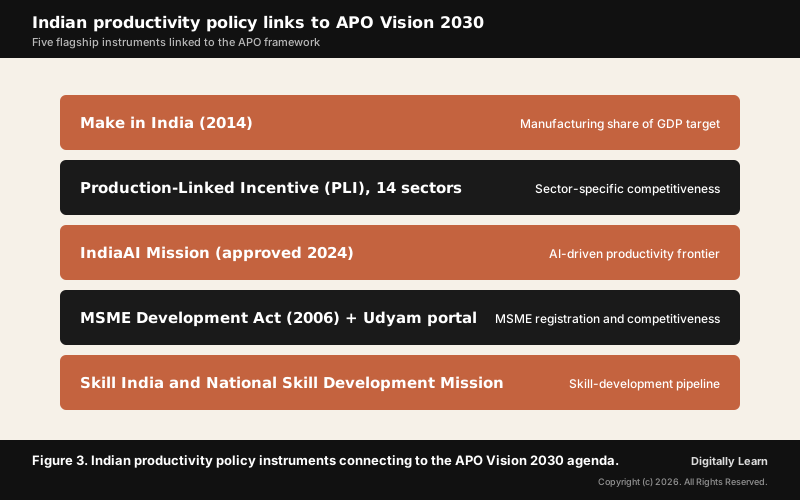
The first is the Make in India and PLI linkage. The Make in India programme launched in 2014 and the Production-Linked Incentive (PLI) schemes for 14 sectors drive India's manufacturing-productivity push. The APO Vision 2030 framework aligns directly with these instruments.
The second is the AI and digital-economy linkage. The IndiaAI Mission (approved 2024), the India Semiconductor Mission, and the Digital India programme together frame India's AI-and-digital productivity agenda. The APO meeting's AI framing operationalises this through Asia-Pacific knowledge sharing.
The third is the MSME and Skill India linkage. The APO's traditional strength is small-firm productivity tooling; the Indian MSME Development Act, 2006, Udyam registration portal, and the Skill India programme are the operational counterparts.
UPSC Relevance
Where the APO sits in the UPSC syllabus
UPSC context: The APO falls within General Studies Paper II under the head important International institutions, agencies and fora, their structure, mandate. The Vision 2030 manufacturing-and-MSME framing touches General Studies Paper III under development of new technology, indigenisation of technology and Indian economy and issues relating to planning, mobilisation of resources, growth, development and employment.
Prelims relevance: The Prelims surface includes the APO founding year 1961, headquarters Tokyo, current 21 member economies, the Governing Body as supreme organ, the National Productivity Council (NPC) as the Indian Member Body established in 1958, and Bharat Mandapam as the 68th-session venue.
Mains relevance: Two framings dominate the Mains-paper surface:
- (i) Manufacturing-MSME-share framing. How to increase the share of the manufacturing sector in GDP, particularly through MSMEs. The APO Vision 2030 framework on manufacturing productivity is the comparative-best-practice surface for any answer.
- (ii) Make-in-India-Skill-India framing. Whether Make in India’s success depends on Skill India and labour reforms. The APO membership of Bangladesh, Vietnam, and Thailand provides the productivity-comparator surface for any answer.
Mains practice question: A focused fifteen-mark question would read: India hosted the 68th Asian Productivity Organization Governing Body in May 2026. Examine the relevance of the APO Vision 2030 framework for India's manufacturing-and-MSME competitiveness, with reference to the Make in India, PLI, and IndiaAI initiatives.
- Past Mains linkage. 2023 GS-III Q1: Faster economic growth requires increased share of the manufacturing sector in GDP, particularly of MSMEs. Comment on the present policies of the Government in this regard. The APO Vision 2030 framework on manufacturing productivity is the comparative-best-practice surface for any answer.
- Past Mains linkage. 2015 GS-III Q8: “Success of ‘Make in India’ programme depends on the success of ‘Skill India’ programme and radical labour reforms.” Discuss with logical arguments. The APO membership of Bangladesh, Vietnam, and Thailand provides the productivity-comparator surface.
- Prelims linkage. Prelims questions on Make in India, PLI schemes, MSME architecture, and the IndiaAI Mission test the institutional surface that the APO 68th session sits within.
Previous Year UPSC-CSE Questions By the end you will be able to draft model answers for the following UPSC questions. Each question carries a collapsible framework showing how to approach it in the exam.
- UPSC Mains 2023 GS-IIIFaster economic growth requires increased share of the manufacturing sector in GDP, particularly of MSMEs. Comment on the present policies of the Government in this regard.
How to structure the answer in the exam
Introduction: Open with the manufacturing-share-of-GDP target of 25 per cent under the original Make in India framing, name the present-day 14-17 per cent band as the policy gap, and frame the comment through three policy buckets.
Body (sub-themes to develop):
- Sectoral-scheme policies: Make in India (2014), Production-Linked Incentive (PLI) schemes for 14 sectors, MSME Development Act (2006), Udyam registration portal (2020 onwards), MUDRA refinancing for micro-enterprises, Credit Guarantee Fund Trust for Micro and Small Enterprises (CGTMSE).
- Factor-market reforms: Skill India and the National Skill Development Mission; the four Labour Codes (Code on Wages 2019, Industrial Relations Code 2020, Occupational Safety Health and Working Conditions Code 2020, Code on Social Security 2020); GST input-credit and the formalisation push.
- Digital-and-AI productivity tooling: Digital India (2015), IndiaAI Mission (approved 2024), Open Network for Digital Commerce (ONDC), India Semiconductor Mission; the productivity-frontier investments that the APO Vision 2030 framework also names.
- Comparative perspective: APO Asia-Pacific productivity comparators including Bangladesh (textiles), Vietnam (electronics assembly), Thailand (auto-component), Indonesia (resource-processing); the 68th APO Governing Body of May 2026 as institutional reference point.
- Limitations: persistent 14-17 per cent manufacturing-share-of-GDP band; MSME credit penetration gap; ease-of-doing-business state-level variance; logistics-cost-to-GDP at 13-14 per cent.
Conclusion: Conclude that the present policy bouquet (PLI, MSME Act, IndiaAI, Skill India, Labour Codes) addresses the manufacturing-share gap through three policy buckets, that the 25 per cent target requires factor-market and digital-productivity complementarities, and that the APO Vision 2030 framework provides the institutional Asia-Pacific reference point.
The APO Vision 2030 framework on manufacturing productivity and MSME competitiveness is the comparative-best-practice surface the 2023 GS-III question's policy-commentary answer must include. The body sub-theme on Asia-Pacific comparators supplies the leading Mains evidence pillar.
- UPSC Mains 2015 GS-III“Success of ‘Make in India’ programme depends on the success of ‘Skill India’ programme and radical labour reforms.” Discuss with logical arguments.
How to structure the answer in the exam
Introduction: Open with Make in India 2014 launch and the 25 per cent manufacturing-share-of-GDP target, name Skill India 2015 and the four Labour Codes of 2019-2020 as the conditional dependencies, and frame the discussion through three logical-argument blocks.
Body (sub-themes to develop):
- Argument 1: Make in India's manufacturing-productivity needs match Skill India's pipeline supply. Auto-component, electronics-assembly, textile-and-apparel, and semiconductor sectors all require trained Industrial Training Institute and National Skills Qualifications Framework graduates; the National Skill Development Corporation pipeline is the supply-side.
- Argument 2: Labour-codes reform enables firm-scale economies. The four Labour Codes (Code on Wages 2019, Industrial Relations Code 2020, OSH Code 2020, Code on Social Security 2020) raise the threshold for retrenchment-approval requirement and expand fixed-term-employment options, enabling Make-in-India firms to scale workforce flexibly.
- Argument 3: Comparative APO experience confirms the joint-reform pattern. APO comparator economies including Vietnam (electronics), Bangladesh (apparel), Thailand (auto-component) all combined export-oriented manufacturing pushes with skill-pipeline and labour-market reforms; the 68th APO Governing Body of May 2026 reinforces the joint-reform institutional architecture.
- Limits: PLI scheme uptake variance across sectors; Labour Codes operationalisation pending in several states; women's labour-force participation rate persistently low; Industrial Training Institute curriculum lag relative to advanced-manufacturing skill demand.
- AI-productivity complement: IndiaAI Mission and Semiconductor Mission of 2024 are the post-2015 additions to the original three-leg framing; the conditional-dependence claim now extends to AI-skill-formation.
Conclusion: Conclude that Make in India's success-conditionality on Skill India and labour reforms is logically sound, that the APO Vision 2030 framework and the May 2026 68th Governing Body in New Delhi reinforce the joint-reform pattern, and that the AI-productivity layer extends the original 2015 framing.
The APO membership pool of Bangladesh, Vietnam, Thailand, and Indonesia provides the productivity-comparator surface the 2015 GS-III question's logical-argument answer must include. The body sub-theme on APO comparator experience supplies the leading comparative-policy evidence pillar.
Sources
- PIB release: India to Host 68th Session of Asian Productivity Organization Governing Body in New Delhi
- Asian Productivity Organization official site: 68th Governing Body Meeting
- National Productivity Council of India
- Ministry of Commerce and Industry: Make in India and PLI schemes
- Ministry of Labour and Employment: four Labour Codes 2019-2020
- Department for Promotion of Industry and Internal Trade: PLI implementation framework
- Wikipedia: Asian Productivity Organization
Editorial Disclaimer
This article is compiled from the reference materials listed in the Sources section. It is an explainer for UPSC preparation and is not a substitute for primary documents (NCERTs, GoI ministry releases, IMD bulletins, RBI / CEA / MoEFCC publications, and Standing-Committee reports).


