

Overview
Electrolysis, batteries, lithium-ion cells and fuel cells
How chemistry makes electricity, and electricity makes chemistry.
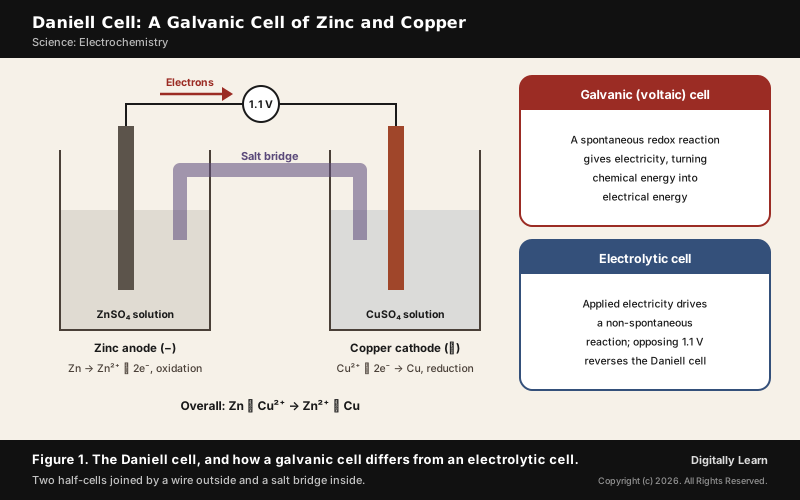
Electrochemistry is the study of how chemical energy and electrical energy turn into each other through redox reactions: galvanic cells and batteries turn chemical energy into electricity, while electrolysis uses electricity to drive reactions that would not happen on their own.
Electrochemistry: Turning Chemical Energy into Electricity
Electrochemical Cell: Galvanic Cell, Voltaic Cell and the Daniell Cell
Every battery, from a torch cell to the pack in an electric car, is an electrochemical cell. It works through a redox reaction, in which one substance loses electrons and another gains them, as explained under chemical reactions. A galvanic cell, also called a voltaic cell, is an electrochemical cell that converts the chemical energy of a spontaneous redox reaction into electrical energy; the energy released by the reaction becomes electrical work that can run a motor, a heater or a fan.
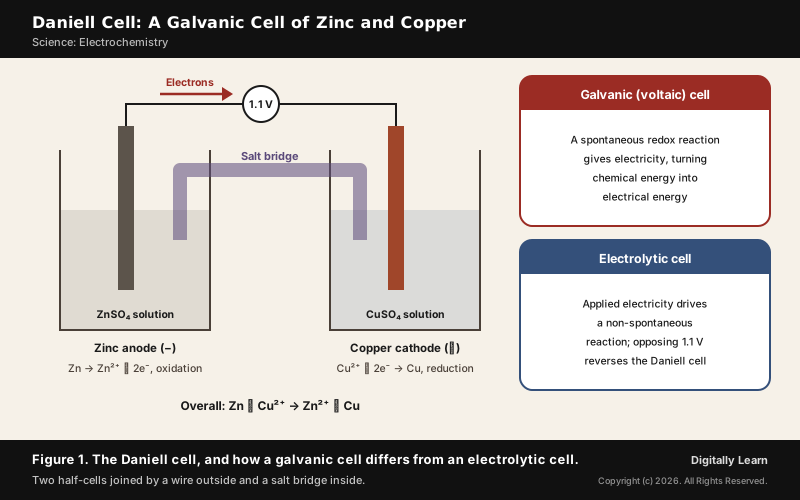
- The Daniell cell: A zinc rod dips in zinc sulphate solution and a copper rod in copper sulphate solution. Zinc is oxidised (Zn → Zn²⁺ + 2e⁻) and copper ions are reduced (Cu²⁺ + 2e⁻ → Cu); the cell gives 1.1 V when both ion concentrations are 1 mol per litre.
- Half-cells: Each metal electrode dipped in its electrolyte is a half-cell, or redox couple. The two are joined outside by a metal wire through a voltmeter and inside by a salt bridge between the two electrolytes.
- Anode and cathode: Oxidation takes place at the zinc electrode, the anode, and reduction at the copper electrode, the cathode; electrons flow through the wire from zinc to copper.
- Electrolytic cell: If an opposing external voltage is raised above 1.1 V, the reaction runs backwards. The device is now an electrolytic cell, which uses electrical energy to carry out a non-spontaneous reaction.
Electrode Potential and the Electrochemical Series
Each half-cell has an electrode potential, but only the difference between two can be measured. By convention the standard hydrogen electrode is given zero at all temperatures: a platinum electrode coated with platinum black, dipped in acid of 1 molar hydrogen ion concentration, with pure hydrogen gas at one bar bubbled through it. Every other half-cell is measured against it.
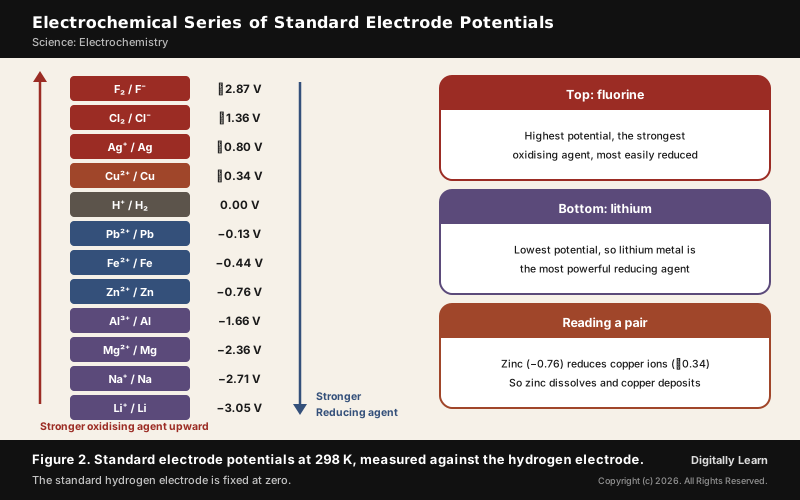
Arranging standard electrode potentials in order gives the electrochemical series. Copper measures +0.34 V against hydrogen and zinc −0.76 V, so the Daniell cell gives 0.34 − (−0.76) = 1.10 V. A positive value means the ion is reduced more easily than hydrogen ions, which is why copper does not dissolve in hydrochloric acid; a negative value means hydrogen ions can oxidise the metal, as they do zinc.
- Top of the series: Fluorine, at +2.87 V, has the greatest tendency to be reduced, so fluorine gas is the strongest oxidising agent.
- Bottom of the series: Lithium, at −3.05 V, has the lowest potential, so lithium metal is the most powerful reducing agent in water.
- Displacement: A metal lower in the series reduces the ions of a metal above it, so zinc placed in copper sulphate solution dissolves while copper is deposited; the same order underlies the reactivity series in metals and non-metals.
- Uses: Electrochemical cells are used to find the pH of solutions, solubility products and equilibrium constants, and in potentiometric titrations.
Electrolysis, Faraday's Laws and Electrolysis of Water
Electrolysis is the process of passing electricity through an electrolyte, a solution or a melt, to bring about a chemical reaction that would not happen on its own; it takes place in an electrolytic cell. When copper sulphate solution is electrolysed between copper electrodes, copper dissolves at the anode and is deposited at the cathode. This is the basis of electrolytic refining: impure copper is made the anode, and pure copper collects on the cathode.
- Metals won by electrolysis: Sodium and magnesium are produced by electrolysing their fused chlorides, and aluminium by electrolysing aluminium oxide with cryolite, because no suitable chemical reducing agent is available for them.
- Faraday’s first law: The amount of chemical reaction at an electrode is proportional to the quantity of electricity passed through the electrolyte.
- Faraday’s second law: The amounts of different substances liberated by the same quantity of electricity are proportional to their chemical equivalent weights. Michael Faraday published both laws in 1833-34.
- The faraday: The charge on one mole of electrons, 96,487 coulombs, is called one faraday. Charge equals current in amperes multiplied by time in seconds, and commercial metal production uses currents as high as 50,000 amperes.
- Brine: Electrolysing aqueous sodium chloride gives sodium hydroxide, chlorine and hydrogen, not sodium metal, because water is reduced at the cathode in preference to sodium ions.
Electrolysis of water uses electricity to split water into hydrogen and oxygen. In the school experiment a little dilute sulphuric acid is added to water between two carbon electrodes, and gas bubbles form at both. Ideally the amount of hydrogen produced is twice the amount of oxygen, matching 2H₂O → 2H₂ + O₂. Because water splitting itself releases no greenhouse gas, hydrogen made this way with renewable electricity is the green hydrogen discussed below.
Batteries: Primary, Secondary, Lithium-Ion and Sodium-Ion Cells
Primary Batteries: Dry Cell and Mercury Cell
A battery is one or more galvanic cells connected in series. To be of practical use it must be reasonably light and compact, and its voltage should not vary much while it is used. In primary batteries the reaction occurs only once: when the reactants are used up the battery is dead and cannot be reused. The dry cell is the most familiar example.
- Dry cell (Leclanché cell): A zinc container is the anode, and a carbon (graphite) rod surrounded by powdered manganese dioxide and carbon is the cathode. The space between them is filled with a moist paste of ammonium chloride and zinc chloride, the electrolyte. It gives nearly 1.5 V and runs clocks and transistor radios.
- Inside the dry cell: Zinc is oxidised to zinc ions at the anode, while at the cathode manganese is reduced from the +4 to the +3 oxidation state; the ammonia produced forms a complex with the zinc ions.
- Zinc-carbon battery: The common name for this disposable dry cell, one of the earliest batteries made for consumer devices and still a cheap option for low-power appliances.
- Mercury cell: Used in low-current devices such as hearing aids and watches. It has a zinc-mercury amalgam anode, a paste of mercury(II) oxide and carbon as the cathode, and a paste of potassium hydroxide and zinc oxide as the electrolyte. Its potential of about 1.35 V stays constant through its life, because no ion in solution changes in concentration.
Secondary Batteries: Lead-Acid and Nickel-Cadmium Cells
A secondary battery can be recharged after use by passing current through it in the opposite direction, and a good one survives a large number of discharge and charge cycles. The most important is the lead storage battery, used in automobiles and inverters and invented in 1859 by Gaston Planté as the first rechargeable battery.
- Construction: A lead anode and a grid of lead packed with lead dioxide (PbO₂) as the cathode, in a 38 per cent solution of sulphuric acid as the electrolyte.
- Discharge and charge: In use, both electrodes turn into lead sulphate: Pb + PbO₂ + 2H₂SO₄ → 2PbSO₄ + 2H₂O. Charging reverses the reaction, turning lead sulphate back into lead and lead dioxide.
- The car battery: Six lead-acid cells in series give a nominal 12-volt system in most passenger vehicles, while heavy trucks use twelve cells for 24 volts. Its main task is the starter motor, so it is called an SLI battery, for starting, lighting and ignition.
- Capacity: Battery capacity is stated in ampere-hours (Ah). One ampere-hour is the charge carried by a steady current of one ampere for one hour, or 3,600 coulombs.
- Recycling: The 12-volt car battery is the most recycled product in the world, and a used lead-acid battery is classed as hazardous waste under the Basel Convention.
- Nickel-cadmium cell: Uses nickel oxide hydroxide and metallic cadmium as electrodes and gives about 1.2 V. It lasts longer than the lead storage cell but costs more to make, and portable sealed types can replace ordinary dry cells in small devices.
Lithium-Ion Battery: How It Works and What It Is Made Of
A lithium-ion battery is a rechargeable battery that stores energy through the reversible movement of lithium ions into and out of electrically conducting solid electrodes, a process called intercalation. Compared with other rechargeable types it generally has higher energy density and efficiency and a longer life, which is why it powers phones, laptops and electric cars and is used for grid-scale storage.
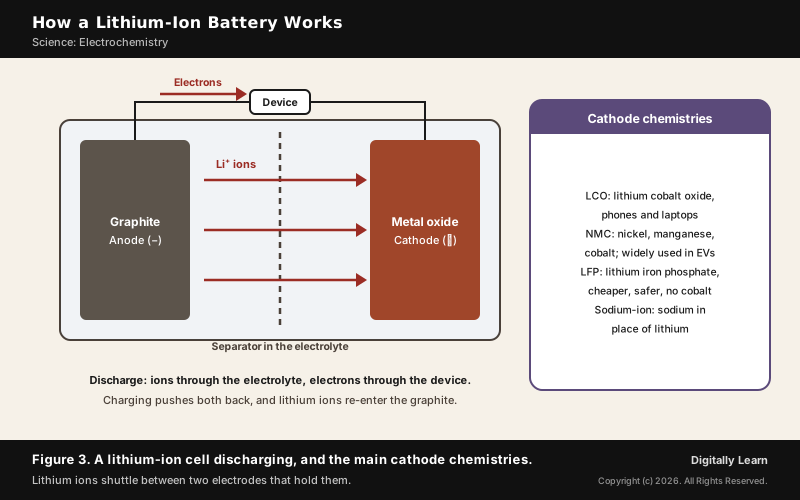
- How it works: On discharge, lithium ions move through the electrolyte while electrons move through the external circuit to the cathode; charging drives them back into the graphite. A cell has a nominal voltage of 3.6 or 3.7 V.
- Anode and electrolyte: The negative electrode is usually graphite, sometimes mixed with silicon to raise capacity; the electrolyte is usually lithium hexafluorophosphate dissolved in organic carbonates.
- Cathode: Varieties are named by their cathode: lithium cobalt oxide (LCO) in handheld electronics; lithium iron phosphate (LFP), lithium manganese oxide and lithium nickel manganese cobalt oxide (NMC) for longer life, with NMC widely used in electric vehicles.
- Invention: Stanley Whittingham built the first rechargeable lithium-ion battery in the 1970s, John Goodenough introduced the lithium cobalt oxide cathode in 1980 and Akira Yoshino built the first prototype with a carbon anode in 1985. The battery reached the market in 1991, and the three shared the 2019 Nobel Prize in Chemistry.
- Risks: The flammable electrolyte makes these cells a fire or explosion hazard. Charging too fast or in the cold can plate lithium metal on the anode, and the dendrites can pierce the separator and short the cell.
- Minerals: Lithium mining is water-intensive in often arid regions, and cobalt can be a conflict mineral; the Democratic Republic of the Congo accounts for about 75 per cent of global cobalt supply.
India's space programme builds its own cells. The Vikram Sarabhai Space Centre of ISRO has developed and qualified lithium-ion cells of 1.5 Ah to 100 Ah for satellites and launch vehicles, and in 2018 offered the technology to industry, drawing responses from 141 companies. Its silicon-graphite anode cells reach 190 Wh/kg, against 157 Wh/kg for its standard lithium-ion cells.
Sodium-Ion Battery and Other Alternatives to Lithium
Lithium's high cost, uneven geographic distribution and damaging extraction have driven the search for other chemistries. A sodium-ion battery works on the same principle but carries sodium ions (Na⁺); sodium sits in the same group of the periodic table as lithium, so the two behave alike, and sodium is abundant, particularly in salt water. Its larger ion, however, moves into the electrodes more slowly.
| Technology | How it differs | Where it stands |
|---|---|---|
| Sodium-ion | Sodium ions in place of lithium; many types need no cobalt, copper or nickel | Commercial interest since the 2010s |
| Lithium iron phosphate (LFP) | Iron phosphate cathode: low cost, high safety, long life, less energy per kg than NMC | 31 per cent of the EV battery market by September 2022 |
| Solid-state | A solid electrolyte in place of liquid or gel; could use a lithium metal anode | Not yet commercial at scale in 2026 |
| Redox flow | Two liquids pumped on either side of a membrane; refilled like a fuel cell or recharged | Stores energy in its liquids |
Fuel Cells and Hydrogen
Fuel Cell: How a Hydrogen Fuel Cell Works
A fuel cell is a galvanic cell that converts the chemical energy of a fuel, often hydrogen, and an oxidising agent, often oxygen, directly into electricity. Unlike a battery, which holds its reactants inside, a fuel cell needs a continuous supply of fuel and oxygen, and it runs as long as they are supplied. Sir William Grove built the first crude fuel cells in the 1830s.
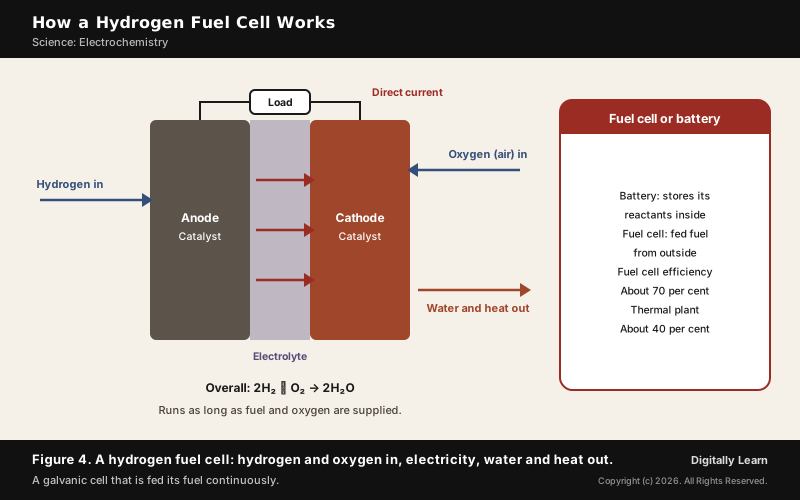
- The hydrogen-oxygen cell: Hydrogen and oxygen are bubbled through porous carbon electrodes into concentrated sodium hydroxide solution, with finely divided platinum or palladium in the electrodes as catalysts. The overall reaction is 2H₂ + O₂ → 2H₂O. The cell powered the Apollo space programme, and its water was added to the astronauts’ drinking supply.
- How the charge flows: At the anode a catalyst oxidises the fuel into ions and electrons; the ions cross the electrolyte, while the electrons flow through an external circuit as direct current.
- By-products: Besides electricity, a fuel cell produces water vapour and heat and, depending on the fuel, very small amounts of nitrogen dioxide and other emissions.
- Stacks: A single cell gives only about 0.7 V, so cells are stacked in series to reach a useful voltage.
- Types: Fuel cells are classified by their electrolyte; a proton-exchange membrane (PEM) cell starts in about 1 second and a solid oxide cell in about 10 minutes.
- Uses: Portable power systems for remote sites, primary and backup power for buildings, and vehicles from forklifts and cars to buses, trains, boats and submarines.
A fuel cell turns chemical energy into electricity directly, without first raising steam, so it wastes less energy. NCERT puts its efficiency at about 70 per cent against about 40 per cent for a thermal power plant; other accounts give 40 to 60 per cent for working cells, rising to about 85 per cent when the waste heat is used to warm a building.
Microbial Fuel Cells: Electricity from Bacteria
A microbial fuel cell uses bacteria in place of a metal catalyst. The bacteria oxidise a fuel at the anode, and the electrons travel through an external circuit to the cathode, where they reduce an oxidising agent such as oxygen. Most such cells use an organic electron donor, which is oxidised to carbon dioxide, protons and electrons, although sulphur compounds and hydrogen have also been used.
- History: Michael Cressé Potter generated electricity from yeast, Saccharomyces cerevisiae, in 1911; cells in which bacteria pass electrons directly to the anode, without a chemical mediator, emerged in the 1970s.
- Wastewater treatment: In the 21st century microbial fuel cells have begun to find commercial use in wastewater treatment, generating electricity while they clean the water.
- Bioremediation: Microbes on the anode break down organic pollutants.
Hydrogen Fuel Cell Vehicles, H-CNG and Green Hydrogen
Hydrogen fuel cell vehicles are electric vehicles whose motor runs on electricity from a fuel cell that combines compressed hydrogen with oxygen from the air, sometimes backed by a small battery. Most are classed as zero-emission vehicles, because the exhaust is water. The first, General Motors' Electrovan, appeared in 1966, and the first government-certified commercial fuel cell vehicles began leasing in 2002.
Hydrogen can also be burnt. India notified hydrogen as an automotive fuel for internal combustion engines in 2016, and in September 2020 allowed H-CNG, an 18 per cent blend of hydrogen with compressed natural gas, in CNG engines; 50 H-CNG buses were demonstrated in Delhi. The hydrogen in the blend lowers carbon dioxide emissions, and the blend can be refuelled with small changes to existing CNG stations, which makes it an interim step. The blend is still more than four-fifths natural gas, a carbon fuel, so it reduces carbon emissions rather than removing them.
- Green hydrogen: Hydrogen made by electrolysis of water with renewable electricity, or from biomass. Under India’s standard it counts as green only if the process emits no more than 2 kg of CO₂ equivalent per kg of hydrogen.
- National Green Hydrogen Mission: Approved on 4 January 2023 with ₹19,744 crore, including ₹17,490 crore for the SIGHT programme of incentives for making electrolysers and producing green hydrogen. It targets at least 5 million tonnes a year by 2030, with about 125 GW of new renewable capacity, under the Ministry of New and Renewable Energy.
- Industry: Green ammonia is to replace fossil feedstock in fertiliser plants, green hydrogen is to replace fossil-based hydrogen in refineries, and five steel pilots are testing it for reducing iron ore.
- Blending with natural gas: NTPC began India’s first blending of green hydrogen into a piped natural gas network, supplying households of its Kawas township in Surat, in January 2023, starting at 5 per cent by volume with a phased goal of 20 per cent. It is also studying hydrogen co-firing in the Kawas gas turbines to generate power.
- Road transport pilots: Five pilot projects cover 37 hydrogen buses and trucks on 10 routes, 15 with fuel cells and 22 with hydrogen internal combustion engines.
The mission's progress and the SIGHT awards are followed in the current affairs briefing on the National Green Hydrogen Mission.
Batteries in India's Energy Transition
Electric Vehicles and Battery Storage: Emissions and Benefits
Electric vehicles cut emissions where people live. A battery electric vehicle produces no tailpipe emissions, and its tank-to-wheels efficiency is about three times that of an internal combustion engine. It uses no energy while standing still, and regenerative braking recovers energy that friction brakes lose as heat.
The full benefit depends on how the electricity is made. Building an EV emits on average about 50 per cent more CO₂ than building a comparable conventional car, a gap more than offset over its life by the fuel it never burns. On India's carbon-intensive grid the life-cycle saving is about 20 per cent, against about 40 per cent in China, and it grows as the grid shifts to clean power.
- Cell manufacturing: The PLI scheme National Programme on Advanced Chemistry Cell Battery Storage, approved on 12 May 2021 with ₹18,100 crore, aims at 50 GWh of domestic capacity. Four firms have been awarded 40 GWh, but only 1 GWh was installed by December 2025; the ministry lists unavailable technology, a skills gap and imported equipment among the hurdles. The Cabinet expected faster EV adoption from these cells to save ₹2 lakh crore to ₹2.5 lakh crore on the oil import bill over the programme.
- Battery minerals: The National Critical Minerals Mission, approved on 29 January 2025 with ₹16,300 crore, and five lithium brine blocks acquired by Khanij Bidesh India Limited in Argentina aim to secure supply.
- Distributed energy resources: Small generation and storage units of 10 MW or less, connected close to the load: rooftop solar, biomass generators, fuel cells and grid-connected battery storage.
- Limits: Mining lithium, cobalt and nickel carries local environmental hazards, and electric cars do not reduce the road space or parking that cars take up.
How India plans to charge a growing EV fleet from its grid is followed in the current affairs briefing on India's EV and grid strategy.
Previous Year UPSC-CSE Questions
Previous Year UPSC-CSE Questions By the end you will be able to draft model answers for the following UPSC questions. Each question carries a collapsible framework showing how to approach it in the exam.
- UPSC Prelims 2009 Prelims-GSIn a dry cell (battery), which of the following are used as electrolytes?
How to approach this Prelims question
Approach: Recall how a dry cell is built. The zinc container is the anode; a carbon (graphite) rod surrounded by powdered manganese dioxide and carbon is the cathode; the space between them is filled with a moist paste of ammonium chloride (NH₄Cl) and zinc chloride (ZnCl₂). The question asks for the two electrolytes, so look for the option that names both of these salts and nothing else.
Trap to watch: Two options carry one correct salt each; only one carries both.
Key facts to recall:
- (a) Ammonium chloride and zinc chloride: right. These two salts make the moist paste between the zinc can and the carbon rod.
- (b) Sodium chloride and calcium chloride: wrong. Neither salt is in the dry cell's paste.
- (c) Magnesium chloride and zinc chloride: wrong. Zinc chloride is correct, but its partner is ammonium chloride, not magnesium chloride.
- (d) Ammonium chloride and calcium chloride: wrong. Ammonium chloride is correct, but its partner is zinc chloride, not calcium chloride.
Answer signal: Option (a): the paste is ammonium chloride and zinc chloride.
- UPSC Prelims 1999 Prelims-GSConsider the following statements regarding a motor car battery:
- I. The voltage is usually 12 V.
- II. Electrolyte used is hydrochloric acid.
- III. Electrodes are lead and copper.
- IV. Capacity is expressed in ampere-hour.
Which of the above statements are correct?
How to approach this Prelims question
Approach: Check each statement against the lead storage battery. I: a car battery uses six lead-acid cells of about 2 volts each in series, a nominal 12-volt system, so I is correct. II: the electrolyte is a 38 per cent solution of sulphuric acid, not hydrochloric acid, so II is incorrect. III: the electrodes are lead (anode) and a lead grid packed with lead dioxide (cathode); there is no copper, so III is incorrect. IV: battery capacity is stated in ampere-hours, the charge of one ampere flowing for one hour, so IV is correct. The correct pair is I and IV.
Trap to watch: Hydrochloric acid and copper sound plausible; the lead-acid battery uses sulphuric acid and lead dioxide.
Key facts to recall:
- (a) I and II: wrong. I is correct, but II is false because the electrolyte is sulphuric acid.
- (b) II and III: wrong. Both are false: the acid is sulphuric and the electrodes are lead and lead dioxide.
- (c) III and IV: wrong. IV is correct, but III is false because there is no copper electrode.
- (d) I and IV: right. Six cells give 12 V, and capacity is expressed in ampere-hours.
Answer signal: Option (d): 12 V and ampere-hours are true; hydrochloric acid and copper are not.
- UPSC Prelims 1995 Prelims-GS113. Which one of the following pairs of materials serves as electrodes in chargeable batteries commonly used in devices such as torchlights, electric shavers, etc.?
How to approach this Prelims question
Approach: The key word is chargeable, for small devices. Zinc and carbon make the dry cell, a primary cell that cannot be recharged, so it goes. Lead and lead dioxide (lead peroxide) make the rechargeable lead storage battery, but that is the heavy battery of automobiles and inverters. The small rechargeable cell whose portable sealed types can replace dry cells is the nickel-cadmium cell.
Trap to watch: Lead and lead peroxide is rechargeable too, but it is the car battery, not the torch or shaver cell.
Key facts to recall:
- (a) Nickel and cadmium: right. The Ni-Cd cell uses nickel oxide hydroxide and metallic cadmium, and its portable sealed types replace dry cells in small devices.
- (b) Zinc and carbon: wrong. That is the disposable dry cell, a primary battery that cannot be recharged.
- (c) Lead peroxide and lead: wrong. That is the lead storage battery, rechargeable but heavy, used in automobiles and inverters.
- (d) Iron and cadmium: wrong. The rechargeable cadmium cell pairs cadmium with nickel, not iron.
Answer signal: Option (a): nickel and cadmium, the small rechargeable cell.
- UPSC Prelims 2025 Prelims-GSIn the context of electric vehicle batteries, consider the following elements:
- I. Cobalt
- II. Graphite
- III. Lithium
- IV. Nickel
How many of the above usually make up battery cathodes?
How to approach this Prelims question
Approach: Sort each element into cathode or anode. Cobalt: in lithium cobalt oxide (LCO) and nickel manganese cobalt oxide (NMC) cathodes, so yes. Graphite: the negative electrode, the anode, so no. Lithium: every lithium-ion cathode is a lithium compound (LCO, LFP, NMC), so yes. Nickel: in NMC cathodes, widely used in electric vehicles, so yes. Three of the four.
Trap to watch: Graphite is in every lithium-ion cell, but as the anode.
Key facts to recall:
- (a) Only one: wrong. Cobalt, lithium and nickel all appear in common cathodes.
- (b) Only two: wrong. Three elements, not two, are cathode materials.
- (c) Only three: right. Cobalt, lithium and nickel make up cathodes; graphite forms the anode.
- (d) All the four: wrong. Graphite is the negative electrode, not part of the cathode.
Answer signal: Option (c): three, because graphite is the anode.
- UPSC Prelims 2023 Prelims-GSAbout three-fourths of world's cobalt, a metal required for the manufacture of batteries for electric motor vehicles, is produced by
How to approach this Prelims question
Approach: Cobalt is mostly a by-product of copper and nickel mining, and the Copperbelt in the Democratic Republic of the Congo and Zambia yields most of the world's cobalt; the Congo alone accounts for about 75 per cent of global supply. Three-fourths matches the Congo.
Trap to watch: Argentina is linked to battery minerals through lithium, not cobalt.
Key facts to recall:
- (a) Argentina: wrong. It appears in battery supply chains as the site of the lithium brine blocks acquired by Khanij Bidesh India Limited, not as a cobalt producer.
- (b) Botswana: wrong. It is not part of the Copperbelt that yields most of the world's cobalt.
- (c) The Democratic Republic of the Congo: right. It accounts for about 75 per cent of global cobalt supply.
- (d) Kazakhstan: wrong. It is not part of the Congo-Zambia Copperbelt that produces most cobalt.
Answer signal: Option (c): the Congo supplies about three-fourths of the world's cobalt.
- UPSC Prelims 2015 Prelims-GSWith reference to 'fuel cells' in which hydrogen-rich fuel and oxygen are used to generate electricity, consider the following statements:
- If pure hydrogen is used as a fuel, the fuel cell emits heat and water as by-products.
- Fuel cells can be used for powering buildings and not for small devices like laptop computers.
- Fuel cells produce electricity in the form of Alternating Current (AC).
Which of the statements given above is/are correct?
How to approach this Prelims question
Approach: Test each statement. 1: a fuel cell on pure hydrogen produces electricity together with water vapour and heat, so 1 is correct. 2: fuel cells power buildings, but they are also made as portable power systems, so the claim that they cannot serve small devices is false. 3: electrons flow from the anode through the external circuit to the cathode in one direction, which is direct current, so 3 is false. Only statement 1 is correct.
Trap to watch: Statement 2 sounds cautious but is false: fuel cells serve portable devices as well as buildings.
Key facts to recall:
- (a) 1 only: right. Water and heat are the by-products; statements 2 and 3 are false.
- (b) 2 and 3 only: wrong. Both are false: fuel cells serve portable power too, and they give direct current.
- (c) 1 and 3 only: wrong. Statement 3 is false because fuel cells produce direct current, not alternating current.
- (d) 1, 2 and 3: wrong. Statements 2 and 3 are false.
Answer signal: Option (a): only the water-and-heat statement is true.
- UPSC Prelims 2010 Prelims-GSHydrogen fuel-cell vehicles produce one of the following as “exhaust”.
How to approach this Prelims question
Approach: Write the overall cell reaction: 2H₂ + O₂ → 2H₂O. Only hydrogen and oxygen go in, so the exhaust can contain only hydrogen and oxygen atoms, and the equation gives water.
Trap to watch: Hydrogen peroxide also contains only H and O, but the cell's product is water.
Key facts to recall:
- (a) NH₃: wrong. Ammonia contains nitrogen, which is not a reactant in the cell reaction.
- (b) CH₄: wrong. Methane contains carbon; a pure hydrogen cell has no carbon to release.
- (c) H₂O: right. Hydrogen and oxygen combine to form water.
- (d) H₂O₂: wrong. The cell reaction forms water, 2H₂ + O₂ → 2H₂O, not hydrogen peroxide.
Answer signal: Option (c): water is the only product of hydrogen and oxygen in the cell.
- UPSC Prelims 2024 Prelims-GSWhich one of the following is the exhaust pipe emission from Fuel Cell Electric Vehicles, powered by hydrogen ?
How to approach this Prelims question
Approach: A hydrogen fuel cell vehicle combines compressed hydrogen with oxygen from the air; the product, released with heat, is water vapour. Eliminate anything that is not that product.
Trap to watch: Oxygen goes into the cell from the air; it is consumed, not emitted.
Key facts to recall:
- (a) Hydrogen peroxide: wrong. The cell reaction gives water, not hydrogen peroxide.
- (b) Hydronium: wrong. Hydronium, H₃O⁺, is an ion in water, not a gas leaving an exhaust pipe.
- (c) Oxygen: wrong. Oxygen is a reactant drawn from the air and consumed at the cathode.
- (d) Water vapour: right. Fuel cells produce water vapour and heat besides electricity.
Answer signal: Option (d): the exhaust is water vapour.
- UPSC Prelims 2011 Prelims-GSMicrobial fuel cells are considered a source of sustainable energy. Why?
- They use living organisms as catalysts to generate electricity from certain substrates.
- They use a variety of inorganic materials as substrates.
- They can be installed in waste water treatment plants to cleanse water and produce electricity.
Which of the statements given above is/are correct?
How to approach this Prelims question
Approach: Check each statement. 1: microbial fuel cells generate electricity from reactions catalysed by bacteria, so living organisms act as catalysts: correct. 2: most microbial fuel cells use an organic electron donor, oxidised to carbon dioxide, protons and electrons, so 'a variety of inorganic materials as substrates' is incorrect. 3: they have begun to find commercial use in wastewater treatment, generating electricity while cleaning the water: correct. Statements 1 and 3.
Trap to watch: The fuel is mainly organic matter, not inorganic material.
Key facts to recall:
- (a) 1 only: wrong. Statement 3 is also correct: the cells are used in wastewater treatment.
- (b) 2 and 3 only: wrong. Statement 2 is false because the substrates are mainly organic.
- (c) 1 and 3 only: right. Bacteria act as catalysts, and the cells can clean wastewater while producing electricity.
- (d) 1, 2 and 3: wrong. Statement 2 is false.
Answer signal: Option (c): bacterial catalysts and wastewater use are true; inorganic substrates are not.
- UPSC Prelims 2023 Prelims-GSWith reference to green hydrogen, consider the following statements :
- 1. It can be used directly as a fuel for internal combustion.
- 2. It can be blended with natural gas and used as fuel for heat or power generation.
- 3. It can be used in the hydrogen fuel cell to run vehicles.
How many of the above statements are correct?
How to approach this Prelims question
Approach: Check each use against India's own examples. 1: India notified hydrogen as an automotive fuel for internal combustion engines in 2016, and 22 of the 37 hydrogen vehicles in the road pilots use hydrogen internal combustion engines, so it can be burnt directly: correct. 2: NTPC blends green hydrogen into the piped natural gas supplied to households at its Kawas township (heat), and is studying hydrogen co-firing with natural gas in its Kawas gas turbines (power): correct. 3: 15 of the pilot vehicles run on hydrogen fuel cells: correct. All three.
Trap to watch: Blending with natural gas for heat and power is real, not hypothetical.
Key facts to recall:
- (a) Only one: wrong. All three uses are in operation or trial in India.
- (b) Only two: wrong. Engines, blending and fuel cells all use hydrogen.
- (c) All three: right. Hydrogen engines, blending into piped gas and gas turbines, and fuel cell vehicles.
- (d) None: wrong. Each statement has a working Indian example.
Answer signal: Option (c): hydrogen is burnt in engines, blended with natural gas, and used in fuel cells.
- UPSC Prelims 2023 Prelims-GSConsider the following heavy industries :
- 1. Fertilizer plants
- 2. Oil refineries
- 3. Steel plants
Green hydrogen is expected to play a significant role in decarbonizing how many of the above industries?
How to approach this Prelims question
Approach: Match each industry to its use of hydrogen under the National Green Hydrogen Mission. Fertiliser plants: green ammonia is to replace fossil-fuel-based feedstock. Oil refineries: green hydrogen is to replace fossil-based hydrogen. Steel plants: five pilot projects are testing green hydrogen for reducing iron ore. All three.
Trap to watch: Steel may look unrelated, but hydrogen can replace carbon in reducing iron ore.
Key facts to recall:
- (a) Only one: wrong. All three industries are named for decarbonisation with green hydrogen.
- (b) Only two: wrong. Steel joins fertilisers and refining through the iron-reduction pilots.
- (c) All three: right. Green ammonia for fertilisers, green hydrogen in refineries, and steel pilots.
- (d) None: wrong. Each industry has a named role in the mission.
Answer signal: Option (c): fertiliser, refining and steel all appear in the mission.
- UPSC Prelims 2019 Prelims-GSIn the context of proposals to the use of hydrogen-enriched CNG (H-CNG) as fuel for buses in public transport, consider the following statements:
- 1. The main advantage of the use of H-CNG is the elimination of carbon monoxide emissions.
- 2. H-CNG as fuel reduces carbon dioxide and hydrocarbon emissions.
- 3. Hydrogen up to one-fifth by volume can be blended with CNG as fuel for buses.
- 4. H-CNG makes the fuel less expensive than CNG.
Which of the statements given above is/are correct?
How to approach this Prelims question
Approach: Judge each statement. 1: H-CNG is still more than four-fifths natural gas, a carbon fuel, so it reduces carbon emissions rather than eliminating carbon monoxide: false. 3: India allows an 18 per cent hydrogen blend, and blends under 20 per cent hydrogen by volume are treated identically to CNG, so up to one-fifth by volume is right: true. 2: the hydrogen in the blend lowers carbon dioxide emissions, and the government calls H-CNG an interim technology for emissions reduction, which matches the statement. Now eliminate: (a) and (d) contain the false statement 1, and (c) leaves out the true statement 3, so only (b) survives.
Trap to watch: Reducing emissions is not eliminating them; the blend still burns natural gas.
Key facts to recall:
- (a) 1 only: wrong. Statement 1 is false: the blend is mostly natural gas and does not eliminate carbon monoxide.
- (b) 2 and 3 only: right. Lower carbon dioxide emissions, and hydrogen up to one-fifth by volume (18 per cent in India).
- (c) 4 only: wrong. It leaves out statement 3, which is true.
- (d) 1, 2, 3 and 4: wrong. It includes the false statement 1.
Answer signal: Option (b): statements 2 and 3.
- UPSC Prelims 2024 Prelims-GSConsider the following:
- 1. Battery storage
- 2. Biomass generators
- 3. Fuel cells
- 4. Rooftop solar photovoltaic units
How many of the above are considered "Distributed Energy Resources"?
How to approach this Prelims question
Approach: Distributed energy resources are small generation and storage units of 10 MW or less, connected to the grid or distribution system close to the load. Battery storage: a grid-connected storage device counts as a distributed energy resource. Biomass generators: biomass is one of the renewable sources such systems use. Fuel cells: residential fuel cell units serve as on-site generation. Rooftop solar photovoltaic units: solar power is a distributed source. All four.
Trap to watch: Battery storage generates nothing, yet grid-connected storage still counts.
Key facts to recall:
- (a) Only one: wrong. All four fit the definition of small, grid-connected generation or storage near the load.
- (b) Only two: wrong. Storage and fuel cells count as well as biomass and rooftop solar.
- (c) Only three: wrong. Battery storage is the one people leave out, and it counts.
- (d) All four: right. Storage, biomass generators, fuel cells and rooftop solar are all distributed energy resources.
Answer signal: Option (d): all four.
- UPSC Mains 2023 GS-IIIThe adoption of electric vehicles is rapidly growing worldwide. How do electric vehicles contribute to reducing carbon emissions and what are the key benefits they offer compared to traditional combustion engine vehicles?
How to structure the answer in the exam
Introduction: An electric vehicle runs on electricity stored in a battery, so it burns no fuel on the road and emits nothing from a tailpipe.
Body (sub-themes to develop):
- Emissions: no tailpipe emissions; tank-to-wheels efficiency about three times a combustion engine; no energy used while idling; regenerative braking.
- Life cycle: building an EV emits about 50 per cent more CO₂, repaid over its life; on India's grid the lifetime saving is about 20 per cent and rises as the grid decarbonises.
- Benefits: cleaner air in cities; a smaller oil import bill, put at ₹2 to 2.5 lakh crore over the ACC programme; batteries as grid storage and distributed energy resources.
- India: the ₹18,100 crore ACC PLI for 50 GWh of cells; critical minerals mission; hurdles in technology and minerals.
Conclusion: Conclude that EVs deliver their full climate benefit only alongside a cleaner grid and domestic battery manufacturing.
Sources
- NCERT: Chemistry Part I (Class XII), Electrochemistry
- NCERT: Science (Class X), Chemical Reactions and Equations
- PIB: Cabinet approves National Green Hydrogen Mission (4 January 2023)
- PIB: Unlocking India's Green Hydrogen Production Potential (press note, November 2025)
- Ministry of New and Renewable Energy: National Green Hydrogen Mission
- PIB: Cabinet approves PLI scheme National Programme on Advanced Chemistry Cell Battery Storage (12 May 2021)
- PIB: Advanced Chemistry Cell batteries and domestic capacity (12 December 2025)
- PIB: Notification allowing use of H-CNG issued (28 September 2020)
- PIB: Hydrogen fuel for public transport (15 December 2021)
- PIB: NTPC starts India's first green hydrogen blending operation in PNG network (3 January 2023)
- PIB: NTPC and GE Gas Power MoU on hydrogen co-firing (6 October 2022)
- ISRO: Transfer of VSSC developed lithium-ion cell technology to industries
- ISRO: Flight demonstration of Si-Gr anode based high energy density Li-ion cells
- Wikipedia: Lithium-ion battery
- Wikipedia: Sodium-ion battery
- Wikipedia: Fuel cell
- Wikipedia: Microbial fuel cell
- Wikipedia: Fuel cell vehicle
- Wikipedia: Automotive battery
- Wikipedia: Electric vehicle
- Wikipedia: Distributed generation
- UPSC: Civil Services Examination question papers
Editorial Disclaimer
This article draws on the NCERT chemistry and science textbooks, the Ministry of New and Renewable Energy, the Ministry of Heavy Industries and other ministries through the Press Information Bureau, ISRO, and the other sources listed on this page.


