


Overview
Reactivity series, metallurgy, alloys and corrosion
Metals and non-metals are the two broad classes of elements. Metals are lustrous, malleable, ductile and conduct heat and electricity, and form positive ions and basic oxides; non-metals are mostly dull, brittle and non-conducting, and form negative ions and acidic or neutral oxides. Their reactivity decides how metals are found, extracted, alloyed and corroded.
Physical and Chemical Properties of Metals and Non-Metals
Physical Properties of Metals and Their Exceptions
Elements are grouped as metals or non-metals by their properties, and metals are the large majority, as the modern periodic table shows. In their pure state metals have a shining surface, metallic lustre, and most are hard. They can be beaten into thin sheets, malleability, and drawn into wires, ductility; a wire about 2 km long can be drawn from one gram of gold.
- Conductors: Metals conduct heat and electricity; silver and copper are the best conductors of heat, while lead and mercury are comparatively poor.
- Sonorous: Metals ring when struck, which is why school bells are made of metal.
- Most malleable and ductile: Gold and silver are the most malleable metals, and gold is the most ductile.
- Non-metals: They are few, such as carbon, sulphur, iodine, oxygen and hydrogen; they are solids or gases except bromine, a liquid, and are neither malleable nor ductile.
| Rule of thumb | Exception |
|---|---|
| Metals are solid at room temperature | Mercury is a liquid |
| Metals have high melting points | Gallium and caesium melt on the palm |
| Metals are hard | Lithium, sodium and potassium can be cut with a knife |
| Non-metals are dull | Iodine is lustrous |
| Non-metals do not conduct | Graphite, a form of carbon, conducts electricity |
| Non-metals are soft | Diamond, also carbon, is the hardest natural substance |
Chemical Properties: Reactions with Oxygen, Water and Acids
Chemical behaviour separates metals from non-metals more clearly. Almost all metals combine with oxygen to form basic oxides, while most non-metals give acidic oxides, as explained under acids, bases and salts. Some metal oxides, such as aluminium oxide and zinc oxide, react with both acids and bases; these are amphoteric oxides.
- With oxygen: Potassium and sodium react so vigorously that they catch fire in the open, so they are kept under kerosene. Magnesium, aluminium, zinc and lead grow a thin oxide layer that stops further oxidation. Silver and gold do not react with oxygen even at high temperatures.
- With water: Metal and water give a metal oxide and hydrogen. Potassium and sodium react violently with cold water, calcium less so, magnesium with hot water, and aluminium, iron and zinc only with steam; lead, copper, silver and gold do not react at all.
- With dilute acids: Metals give a salt and hydrogen, with reactivity falling from magnesium to aluminium, zinc and iron; copper does not react. Nitric acid is an exception: it oxidises the hydrogen to water.
- Aqua regia: A fresh 3:1 mixture of concentrated hydrochloric and nitric acids, it dissolves gold and platinum, which neither acid can alone.
Metals react by losing electrons and non-metals by gaining them. Sodium (2, 8, 1) gives its outer electron to chlorine (2, 8, 7), and the oppositely charged ions form sodium chloride, an ionic compound explained under chemical bonding. Non-metals do not displace hydrogen from dilute acids.
Reactivity Series and the Difference Between Metals and Non-Metals
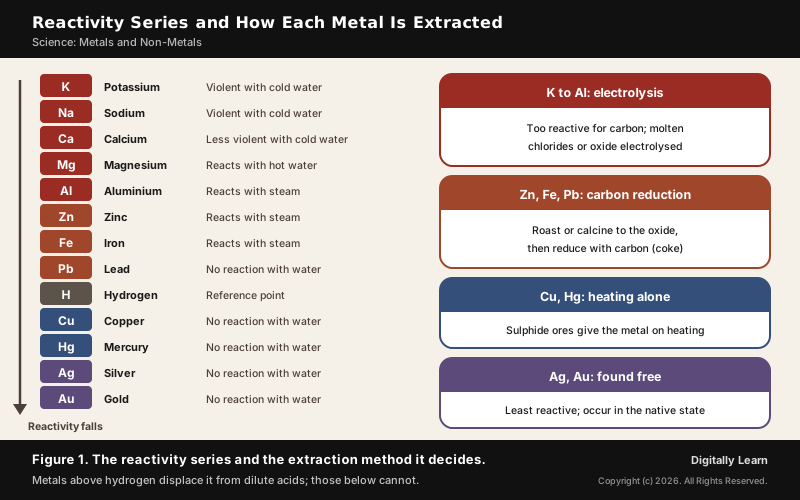
The reactivity series, or activity series, is a list of metals arranged in order of decreasing reactivity. It is built from displacement reactions: if metal A displaces metal B from a solution of its salt, A is more reactive. An iron nail in copper sulphate solution turns brown as iron displaces copper, but copper does nothing to iron sulphate.
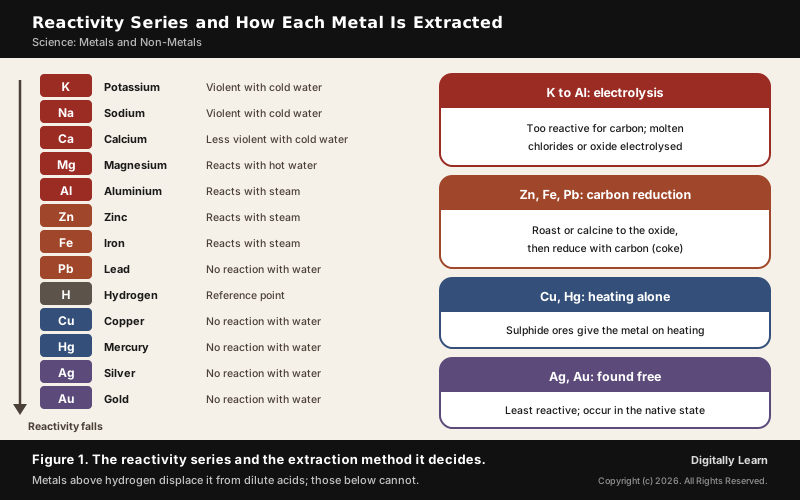
- The order: Potassium, sodium, calcium, magnesium, aluminium, zinc, iron, lead, (hydrogen), copper, mercury, silver and gold.
- Above hydrogen: Metals above hydrogen displace it from dilute acids; those below cannot.
- Why it matters: The same order decides where a metal is found and how it is extracted.
Putting the properties side by side gives the standard comparison. The difference rests on one thing: metals lose electrons to form positive ions, and non-metals gain them to form negative ions.
| Property | Metals | Non-metals |
|---|---|---|
| Appearance | Lustrous | Dull, except iodine |
| Malleable and ductile | Yes | No |
| Conduct heat and electricity | Good conductors | Poor, except graphite |
| State at room temperature | Solid, except mercury | Solid or gas, except liquid bromine |
| Ions formed | Positive, by losing electrons | Negative, by gaining electrons |
| Oxides | Basic; some amphoteric | Acidic or neutral |
| With dilute acids | Give hydrogen if above H | No hydrogen; they form hydrides with hydrogen |
Metallurgy: From Ore to Metal
Occurrence of Metals, Ores and Concentration
The earth's crust is the main source of metals, and seawater holds soluble salts such as sodium chloride. Naturally occurring elements or compounds are minerals; a mineral from which a metal can be extracted profitably is an ore. Oxygen is the most abundant element in the crust (45.5 per cent by mass), then silicon (27.7 per cent); aluminium, at 8.3 per cent, is the most abundant metal.
- Free or combined: Unreactive metals, the least reactive of all, such as gold, silver, platinum and copper, occur free. Those at the top, potassium to aluminium, never occur free. Those in the middle occur mainly as oxides, sulphides or carbonates.
- Gangue: Mined ore carries soil, sand and other impurities, the gangue, which must be removed first by methods based on differences between gangue and ore.
- Froth flotation: Its invention made copper mining profitable even from low-grade ores.
- Leaching: Used when the ore dissolves in a suitable solvent, as in extracting alumina from bauxite, the principal ore of aluminium.
Extraction of Metals: Reduction, Electrolysis and Refining
Metallurgy is the extraction of metals from their ores and their refining for use, and the method depends on the reactivity series. Metals of low reactivity are reduced by heating alone: cinnabar (HgS) gives mercury, and copper sulphide gives copper. Metals in the middle are first converted to oxides, sulphides by roasting in excess air and carbonates by calcination in limited air, and then reduced with carbon.
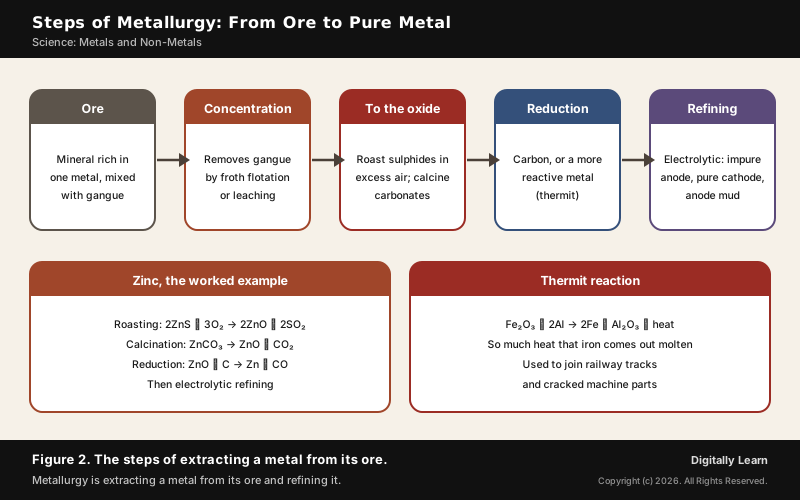
- Thermit reaction: Aluminium reduces iron oxide with so much heat that the iron comes out molten, which is used to join railway tracks and cracked machine parts.
- Electrolysis for the most reactive: Carbon cannot reduce the oxides of sodium, magnesium, calcium or aluminium, because these metals hold oxygen more strongly than carbon does. Sodium, magnesium and calcium come from electrolysing their molten chlorides; aluminium from electrolysing its oxide with cryolite, the Hall-Heroult process, in which about 0.5 kg of the carbon anode burns away for every kilogram of aluminium.
- Electrolytic refining: Impure metal is the anode, a strip of pure metal the cathode; pure metal collects on the cathode and insoluble impurities settle as anode mud. Copper, zinc, tin, nickel, silver and gold are refined this way.
- Forms of iron: Pig iron from the blast furnace holds about 4 per cent carbon; cast iron, about 3 per cent, is hard and brittle; wrought iron is the purest commercial iron.
Mining and the Environment: Hazards and Remedies
Mining supplies the ores, but it is an environmental hazard at every scale. It can cause erosion and sinkholes, cause loss of biodiversity, and contaminate soil, groundwater and surface water with chemicals released by mining; it also adds to carbon emissions. Two problems stand out because they outlast the mine.
- Acid mine drainage: Acidic water flowing out of metal and coal mines, made worse by large-scale disturbance of the ground.
- Tailings: The fine waste left after ore is processed, often dangerous because it carries heavy metals and sulphides, especially when stored in ponds behind tailings dams.
- Mercury in gold mining: Artisanal and small-scale gold mining is a major user of mercury, with serious effects on the health of vulnerable people.
India's remedies combine regulation, restoration and money for affected areas. The Ministry of Mines' Sustainable Development Framework is applied through a Star Rating of Mines, from 1 to 5 stars, and a minimum of 4 stars within two years is a statutory requirement. A Mine Closure Plan is part of every coal mining plan, so that closure is scientific.
- Mining law: The Mines and Minerals (Development and Regulation) Act, 1957 was amended in 2015; since then major mineral concessions are auctioned, and Section 9B lets states set up District Mineral Foundations.
- Reclamation: Mined-out areas are restored as eco-parks and mine tourism sites; in 2023-24 coal and lignite companies brought about 2,782 hectares under green cover.
- Water and waste reuse: Treated mine water is supplied for drinking and irrigation, and sand is extracted from overburden, cutting the land needed for waste dumps.
- District Mineral Foundations: Under the Pradhan Mantri Khanij Kshetra Kalyan Yojana, these funds go to mining-affected areas; the 2024 guidelines require at least 70 per cent to be spent in directly affected areas and high-priority sectors such as drinking water and pollution control, and up to 30 per cent on other priorities such as watershed development.
- Safer gold extraction: WHO urges mercury-free methods in small-scale gold mining.
Alloys and Toxic Metals
Alloys: Steel, Stainless Steel, Brass, Bronze, Solder and Amalgam
An alloy is a homogeneous mixture of two or more metals, or of a metal and a non-metal, made by melting the main metal and dissolving the others in it in definite proportions. Alloying is a very good way to improve a metal. Pure iron is soft and stretches easily when hot, but with a small amount of carbon (about 0.05 per cent) it becomes hard and strong.
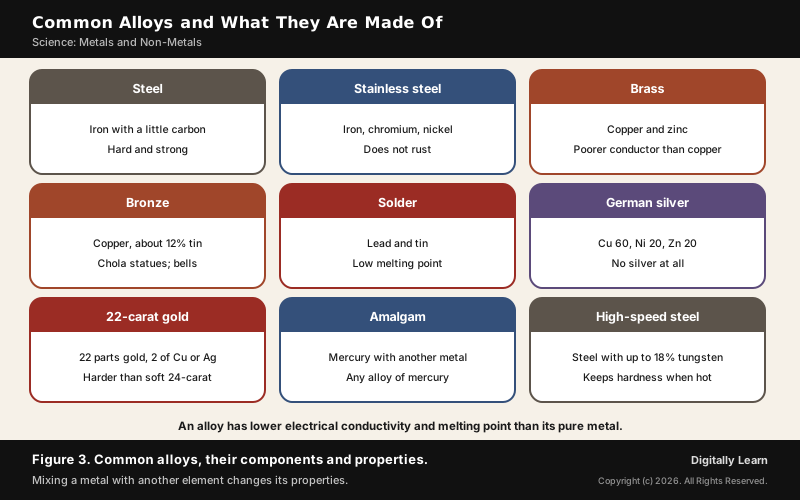
- Stainless steel: Iron with nickel and chromium, hard and rust-free; its resistance comes from 10.5 per cent or more of chromium, which forms a self-healing protective film.
- Brass and bronze: Brass is copper and zinc; bronze is copper with about 12 per cent tin. Both conduct electricity worse than copper, which is why copper is used for circuits. Chola-period artisans in Tamil Nadu cast intricate bronze statues by the lost-wax method.
- Solder: Lead and tin, with a low melting point, used to join electrical wires.
- German silver: Also called nickel silver, it is usually 60 per cent copper, 20 per cent nickel and 20 per cent zinc, and contains no silver.
- Gold jewellery: Pure 24-carat gold is too soft, so Indian jewellery is usually 22-carat: 22 parts gold alloyed with 2 parts copper or silver.
- Amalgam: Any alloy in which one metal is mercury.
- Names that mislead: German silver holds no silver, and hypo is not a metal at all but sodium thiosulphate, once called hyposulphite of soda and used as a photographic fixer; bleaching powder is made from chlorine, as explained under bleaching powder.
- Tungsten steels: Tungsten has the highest melting point of all elements, 3,422 °C, and high-speed steel can contain as much as 18 per cent of it.
Mercury and Lead: Toxic Metals and Their Control
Two heavy metals need special care. WHO counts mercury among the top ten chemicals of major public health concern: it can harm the nervous, digestive and immune systems, the lungs, kidneys, skin and eyes. People are mainly exposed to methylmercury, formed from mercury by bacteria, when they eat fish and shellfish.
- Sources of mercury: Coal-fired power stations, residential coal burning, industrial processes, waste incinerators, and mining for mercury, gold and other metals.
- In lamps: A fluorescent lamp is a mercury-vapour lamp: current excites the mercury vapour to produce ultraviolet light, which makes the phosphor coating glow. Careless disposal of used lamps releases the mercury.
- Minamata Convention: A global treaty on mercury, adopted on 10 October 2013 and in force from 16 August 2017. It is named after the Japanese city of Minamata, which suffered a devastating incident of mercury poisoning.
- Lead: WHO states that there is no level of exposure to lead known to be without harmful effects; it is particularly harmful to young children. Lead travels to the brain, liver, kidneys and bones and builds up in teeth and bones.
- Where lead is used: Most lead goes into lead-acid batteries for vehicles; it is also in pigments, paints, solder, ammunition, ceramic glazes, toys and some traditional medicines.
Corrosion and Its Prevention
Corrosion and Rusting of Iron
When a metal is attacked by moisture, acids or other substances around it, it corrodes. This is corrosion, a slow oxidation of the kind explained under redox reactions. Each metal shows it differently.
- Silver: Turns black as it reacts with sulphur in the air, forming silver sulphide.
- Copper: Reacts with moist carbon dioxide and gains a green coat of copper carbonate.
- Iron: In moist air it gains a brown, flaky coat of rust, hydrated iron(III) oxide.
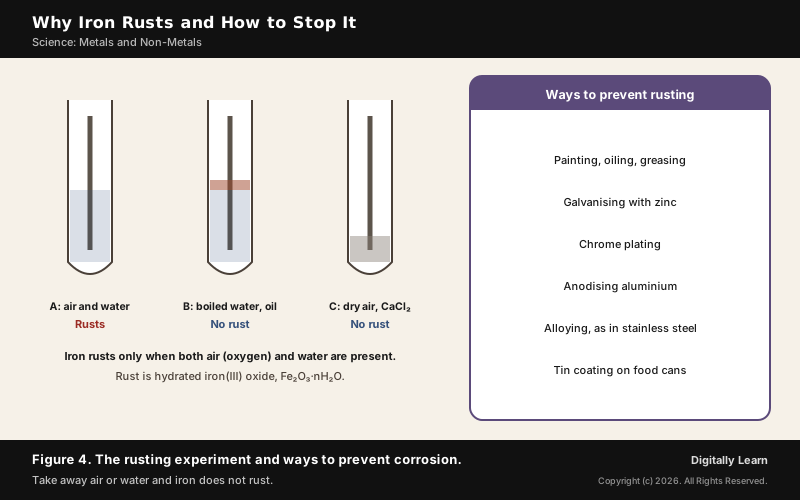
A simple experiment shows what rusting of iron needs. Iron nails in a tube with both air and water rust; nails in boiled water sealed with oil, so that no air dissolves, do not; and nails in air kept dry by anhydrous calcium chloride do not. Rusting needs both oxygen and water.
Corrosion Prevention: Galvanisation, Anodising, Alloying and Painting
Corrosion damages car bodies, bridges, iron railings and ships, and every year an enormous amount of money is spent replacing damaged iron. Since rusting needs air and water, corrosion prevention keeps them away from the metal or changes the metal itself. Iron can be protected by painting, oiling, greasing, galvanising, chrome plating, anodising or making alloys.
- Galvanisation: Coating steel or iron with a thin layer of zinc, often by dipping it in molten zinc. The article stays protected against rusting even if the zinc coating is broken.
- Anodising: Aluminium naturally forms a thin oxide layer that resists corrosion. Anodising makes the aluminium article the anode in dilute sulphuric acid, so the oxygen released thickens the protective layer of aluminium oxide, which can also be dyed.
- Alloying: Stainless steel, iron with nickel and chromium, does not rust.
- Coatings: Paint, oil and grease shut out air and water; chrome plating adds a protective metal layer.
Previous Year UPSC-CSE Questions
Previous Year UPSC-CSE Questions By the end you will be able to draft model answers for the following UPSC questions. Each question carries a collapsible framework showing how to approach it in the exam.
- UPSC Prelims 1997 Prelims-GSWhich one of the following is present in the largest amount in terms of per cent by mass in the earth’s crust?
How to approach this Prelims question
Approach: Recall the order oxygen, silicon, aluminium.
Trap to watch: Silicon is second, not first.
Key facts to recall:
- (a) Silicon: wrong. Silicon is second, at 27.7 per cent by mass.
- (b) Oxygen: right. Oxygen makes up 45.5 per cent of the crust by mass, more than any other element.
- (c) Carbon: wrong. Carbon is a minor part of the crust, far below oxygen and silicon.
- (d) Calcium: wrong. Calcium is well below oxygen, silicon and aluminium.
Answer signal: Oxygen is the most abundant element of the crust by mass, so the answer is option (b).
- UPSC Prelims 1996 Prelims-GSWhich one of the following elements is alloyed with iron to produce steel which can resist high temperatures and also have high hardness and abrasion resistance?
How to approach this Prelims question
Approach: Link high temperature and hardness to the highest-melting metal.
Trap to watch: Chromium and nickel make steel stainless, not heat-hard.
Key facts to recall:
- (a) Aluminium: wrong. Aluminium is a light metal, not the alloying element for heat-resistant hard steel.
- (b) Chromium: wrong. Chromium's main use in steel is resistance to rusting, not to very high temperatures.
- (c) Nickel: wrong. Nickel is not the element that gives steel the highest heat and abrasion resistance.
- (d) Tungsten: right. Tungsten melts at 3,422 °C, so tungsten steel resists high temperatures and is very hard.
Answer signal: Tungsten gives steel heat resistance and hardness, so the answer is option (d).
- UPSC Prelims 2006 Prelims-GSWhich are the materials generally employed as solder in soldering operation in electronics?
How to approach this Prelims question
Approach: Recall the components of solder.
Trap to watch: Aluminium and iron are not solder metals.
Key facts to recall:
- (a) Iron and tin: wrong. Solder uses lead, not iron.
- (b) Lead and tin: right. Solder is an alloy of lead and tin with a low melting point.
- (c) Aluminium and lead: wrong. Aluminium is not used in solder.
- (d) Aluminium and iron: wrong. Neither is a solder metal.
Answer signal: Solder is lead and tin, so the answer is option (b).
- UPSC Prelims 2000 Prelims-GSMatch List I with List II and select the correct answer using the codes given below the Lists: List II: A) Tin, B) Nickel, C) Sodium, D) Chlorine.
- I. German Silver
- II. Solder
- III. Bleaching Powder
- IV. Hypo
Codes:
How to approach this Prelims question
Approach: Pick the tell-tale element of each.
Trap to watch: German silver holds nickel, not silver.
Key facts to recall:
- (a) I-A, II-B, III-D, IV-C: wrong. German silver is matched with nickel, not tin.
- (b) I-B, II-A, III-C, IV-D: wrong. Bleaching powder goes with chlorine and hypo with sodium, not the reverse.
- (c) I-A, II-B, III-C, IV-D: wrong. Both the alloy pairs and the compound pairs are swapped.
- (d) I-B, II-A, III-D, IV-C: right. German silver contains nickel, solder tin, bleaching powder chlorine and hypo sodium.
Answer signal: The pairs are nickel, tin, chlorine and sodium, so the answer is option (d).
- UPSC Prelims 2010 Prelims-GSIndiscriminate disposal of used fluorescent electric lamps causes mercury pollution in the environment. Why is mercury used in the manufacture of these lamps?
How to approach this Prelims question
Approach: Recall what the mercury does and what the phosphor does.
Trap to watch: It is the phosphor, not the mercury, that turns ultraviolet into visible light.
Key facts to recall:
- (a) Mercury coating gives white light: wrong. The white light comes from the phosphor coating, not a mercury coating.
- (b) Mercury emits ultraviolet radiation: right. When the lamp is switched on, mercury vapour gives out ultraviolet radiation, which the phosphor turns into visible light.
- (c) Mercury converts ultraviolet into light: wrong. The phosphor, not the mercury, converts ultraviolet into visible light.
- (d) None of the above: wrong. Statement (b) is correct.
Answer signal: Mercury in the lamp emits ultraviolet radiation, so the answer is option (b).
- UPSC Prelims 2023 Prelims-GSConsider the following statements regarding mercury pollution :
- 1. Gold mining activity is a source of mercury pollution in the world.
- 2. Coal-based thermal power plants cause mercury pollution.
- 3. There is no known safe level of exposure to mercury.
How many of the above statements are correct?
How to approach this Prelims question
Approach: Check each source, then the safety claim.
Trap to watch: The 'no known safe level' line belongs to lead.
Key facts to recall:
- (a) Only one: wrong. Two statements are correct: gold mining and coal-based power plants both release mercury.
- (b) Only two: right. Artisanal gold mining uses mercury and coal-fired power plants release it; the 'no known safe level' wording is WHO's statement about lead, not mercury.
- (c) All three: wrong. Statement 3 describes lead, not mercury.
- (d) None: wrong. Statements 1 and 2 are correct.
Answer signal: Only the first two statements are correct, so the answer is option (b).
- UPSC Prelims 2000 Prelims-GSAluminium surfaces are often “anodized”. This means the deposition of a layer of
How to approach this Prelims question
Approach: Anodising thickens the metal's own oxide.
Trap to watch: Chromium oxide belongs to chrome plating.
Key facts to recall:
- (a) Chromium oxide: wrong. Anodising thickens the metal's own oxide, not a chromium layer.
- (b) Aluminium oxide: right. The aluminium is made the anode, and oxygen thickens its Al₂O₃ layer.
- (c) Nickel oxide: wrong. No nickel is involved in anodising aluminium.
- (d) Zinc oxide: wrong. Zinc coating is galvanising of iron, not anodising of aluminium.
Answer signal: Anodising deposits aluminium oxide, so the answer is option (b).
- UPSC Mains 2025 GS-IIIMineral resources are fundamental to the country's economy and these are exploited by mining. Why is mining considered an environmental hazard? Explain the remedial measures required to reduce the environmental hazard due to mining.
Answer outline: how to structure the answer
What the question asks, the main arguments, relevant examples and the direction of the conclusion. This is not a full model answer.
Introduction: Mining supplies the minerals the economy runs on, but disturbs land, water and air, and some effects, such as acid drainage and tailings, outlast the mine.
Body (sub-themes to develop):
- Hazards: erosion and sinkholes; loss of habitat and biodiversity; contamination of soil, groundwater and surface water; acid mine drainage; toxic tailings; carbon emissions; mercury from gold mining.
- Remedies while operating: Sustainable Development Framework and Star Rating (minimum 4 stars within two years); compliance with environmental clearance conditions; mercury-free methods.
- Remedies at closure: a Mine Closure Plan in every mining plan; reclamation into eco-parks and green cover; overburden turned into sand.
- People: District Mineral Foundations under PMKKKY, with at least 70 per cent for directly affected areas and priorities such as drinking water and pollution control.
Conclusion: Conclude that mining can be sustainable when the land and water are restored and the affected people share the gains.
Sources
- NCERT: Science (Class X), Metals and Non-metals
- NCERT: Chemistry Part II (Class XI), The p-Block Elements (abundance of aluminium)
- NCERT: Chemistry Part I (Class XII), General Principles and Processes of Isolation of Elements
- WHO: Mercury and health (fact sheet)
- WHO: Lead poisoning and health (fact sheet)
- PIB: Year End Review 2018-19, Ministry of Mines (Star Rating of Mines)
- PIB: Sustainable mining practices and innovations (2 December 2024)
- PIB: District Mineral Foundation (4 February 2025)
- Ministry of Mines: Latest guidelines of PMKKKY (5 February 2024)
- Wikipedia: Stainless steel
- Wikipedia: Nickel silver
- Wikipedia: Minamata Convention on Mercury
- Wikipedia: Iron pillar of Delhi
- Wikipedia: Environmental impact of mining
- Wikipedia: Acid mine drainage
- UPSC: Civil Services Examination question papers
Editorial Disclaimer
This article draws on the NCERT science and chemistry textbooks, WHO, the Ministry of Mines through the Press Information Bureau and the other sources listed on this page. Sources differ on the date of the Delhi iron pillar.


