


Overview
Allotropes, hydrocarbons, soaps, polymers and plastics
Carbon and its compounds form the largest family in chemistry: carbon's four valence electrons and its ability to bond to itself in chains and rings, catenation, give allotropes such as diamond and graphite, hydrocarbon fuels, soaps and detergents, and the polymers that make plastics.
Carbon and Its Compounds: Why Carbon Is Special
Covalent Bonding, Tetravalency and Catenation
Food, clothes, medicines and every living structure are built on carbon, yet the earth's crust holds only 0.02 per cent carbon, in carbonates, coal and petroleum, and the atmosphere 0.03 per cent carbon dioxide. Carbon and its compounds matter far beyond these amounts because of two properties of the carbon atom.
- Tetravalency: Carbon has four valence electrons, so it forms four bonds. It reaches a noble gas configuration by sharing them, forming covalent bonds, as in methane, CH₄; the bonding itself is explained under chemical bonding.
- Catenation: Carbon can bond with other carbon atoms to build large molecules: long chains, branched chains and rings. No other element does this to the same extent; silicon forms chains of only up to seven or eight atoms.
- Saturated and unsaturated: Compounds with only single bonds between carbon atoms are saturated; those with double or triple bonds are unsaturated.
- Functional groups: An atom or group such as chlorine, alcohol (-OH), aldehyde, ketone or carboxylic acid (-COOH) gives a compound its characteristic properties, whatever the length of its chain.
Allotropes of Carbon: Diamond, Graphite, Fullerene and Graphene
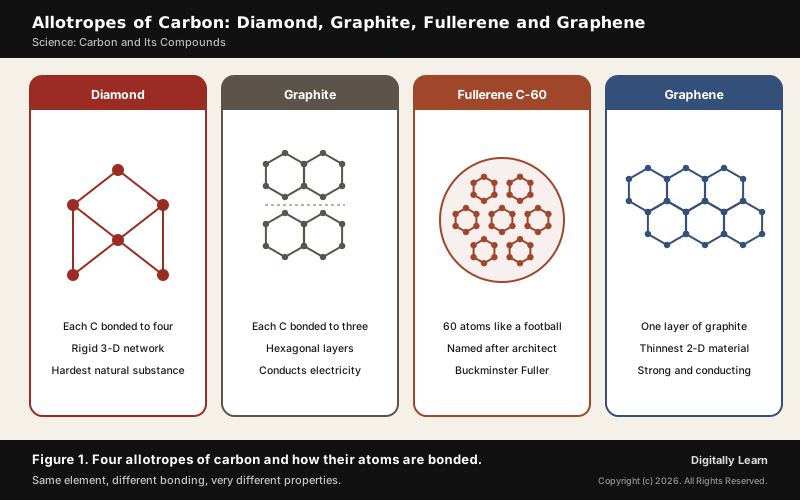
Carbon exists in several forms called allotropes, made of the same atoms bonded in different ways. The bonding decides everything: in diamond each carbon is bonded to four others in a rigid three-dimensional structure; in graphite each carbon is bonded to three others in the same plane, forming hexagonal layers stacked one above another.
- Diamond: The hardest substance known; diamonds can be made synthetically by subjecting pure carbon to very high pressure and temperature.
- Graphite: Smooth and slippery, and a very good conductor of electricity, unlike other non-metals, as noted under metals and non-metals.
- Fullerene: The first identified, C-60, has carbon atoms arranged like a football; it was named after the architect Buckminster Fuller, whose geodesic dome it resembles.
- Graphene: A single layer of carbon, the thinnest two-dimensional material, the strongest material ever measured and a good conductor; isolated in 2004 by Andre Geim and Konstantin Novoselov, who shared the 2010 Nobel Prize in Physics.
Hydrocarbons and Fuels
Hydrocarbons: Alkanes, Alkenes, Alkynes and the Homologous Series
Compounds of carbon and hydrogen alone are hydrocarbons. Saturated ones are alkanes; unsaturated ones with a double bond are alkenes and with a triple bond alkynes. A series of compounds in which the same functional group replaces hydrogen in a carbon chain is a homologous series, and its successive members differ by one -CH₂- unit.
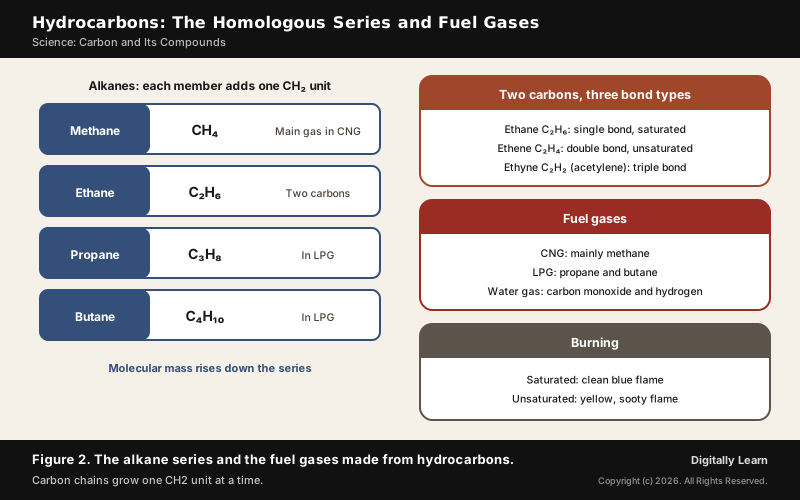
- The first alkanes: Methane CH₄, ethane C₂H₆, propane C₃H₈ and butane C₄H₁₀; molecular mass rises down the series while chemical properties stay similar.
- Two-carbon examples: Ethane has a single bond, ethene C₂H₄ a double bond and ethyne C₂H₂ a triple bond.
- Acetylene: Ethyne, commonly called acetylene, burns with oxygen at over 3,600 K and is used for oxyacetylene welding; it is made industrially by the action of water on calcium carbide, and it is a precursor of vinyl chloride, the monomer of PVC.
- Addition and substitution: Unsaturated hydrocarbons add hydrogen in the presence of a nickel catalyst, which is how vegetable oils are hydrogenated; saturated ones swap hydrogen for chlorine in sunlight, a substitution reaction.
Fuels from Hydrocarbons: LPG, CNG and Combustion
Most carbon compounds burn in air to give carbon dioxide, water, heat and light, which is why carbon and its compounds are used as fuels. Saturated hydrocarbons generally give a clean blue flame; unsaturated ones give a yellow, sooty flame. A limited air supply also gives a sooty flame even with saturated fuels.
| Fuel gas | Main constituents |
|---|---|
| Compressed natural gas (CNG) | Mainly methane, compressed to less than 1 per cent of its volume |
| Liquefied petroleum gas (LPG) | Propane and butane |
| Water gas | Carbon monoxide and hydrogen |
| Coal gas | Hydrogen and carbon monoxide, often with methane |
The difference matters for supply. Natural gas, mostly methane, is carried through pipelines; LPG is a mixture of propane and butane, used in cooking, heating and vehicles.
Ethanol, Ethanoic Acid and Ethanol Blending
Two carbon compounds are especially important. Ethanol, commonly called alcohol, is a liquid at room temperature, a good solvent used in medicines, and the active ingredient of alcoholic drinks. Molasses from sugarcane juice is fermented to give it, and ethanol is added to petrol as a cleaner fuel.
- India’s blending: Under the Ethanol Blended Petrol Programme, blending rose from about 1.5 per cent until 2014 to 10 per cent in 2021-22, 19.2 per cent in 2024-25 and 20 per cent in 2025-26; India met its E10 target in June 2022, five months ahead of schedule.
- The policy: The National Policy on Biofuels, 2018, amended in 2022, set a target of 20 per cent blending by the ethanol supply year 2025-26, with blended petrol of up to 20 per cent sold across the country from 1 April 2023, and an indicative target of 5 per cent biodiesel in diesel by 2030.
- Why it matters: Nearly 20 per cent of every litre of petrol sold is now domestic ethanol, and E20 can cut lifecycle carbon emissions by nearly 40 per cent.
- Ethanoic acid: Commonly called acetic acid, a carboxylic acid; a 5 to 8 per cent solution in water is vinegar, used to preserve pickles. Pure ethanoic acid melts at 290 K and freezes in cold winters, hence its name glacial acetic acid.
- Reactions of ethanol: With sodium it gives hydrogen and sodium ethoxide; heated to 443 K with excess concentrated sulphuric acid it loses water and gives ethene; oxidising agents such as alkaline potassium permanganate turn it into ethanoic acid.
- Weak acid: Unlike hydrochloric acid, which ionises completely, carboxylic acids such as ethanoic acid are weak acids; with sodium hydroxide ethanoic acid gives sodium ethanoate and water.
- Esters: Ethanoic acid and ethanol react to form esters, sweet-smelling substances used in perfumes and flavours; breaking an ester with a base, saponification, is how soap is made.
Cleansing Agents: How Soap and Detergent Work
Soaps and Detergents: Micelles, Hard Water and the Difference
Most dirt is oily, and oil does not dissolve in water. Soap molecules are sodium or potassium salts of long-chain carboxylic acids, with two ends that behave differently: an ionic head that is hydrophilic and dissolves in water, and a long hydrocarbon tail that is hydrophobic and dissolves in oil.
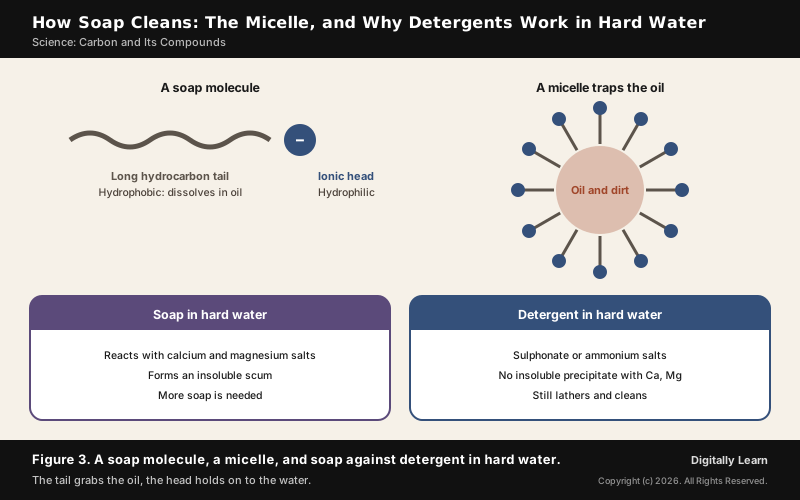
In water, soap molecules gather in clusters called micelles: the tails point inward and trap the oily dirt, while the ionic heads face the water. The micelles stay in solution as a colloid, so the dirt rinses away.
| Soap | Synthetic detergent |
|---|---|
| Sodium or potassium salts of long-chain fatty acids | Ammonium or sulphonate salts of long-chain acids |
| Forms an insoluble scum with calcium and magnesium in hard water | No insoluble precipitate with calcium or magnesium |
| More soap is needed in hard water | Stays effective in hard water |
| Made by saponification of fats | Used in shampoos and laundry products |
Polymers and Plastics
Polymers and Polymerization: Addition and Condensation
The word polymer comes from Greek: poly, many, and mer, unit. Polymers are very large molecules of high molecular mass, 10³ to 10⁷ u, formed by joining repeating structural units, the monomers. They are the backbone of four major industries: plastics, elastomers, fibres, and paints and varnishes.
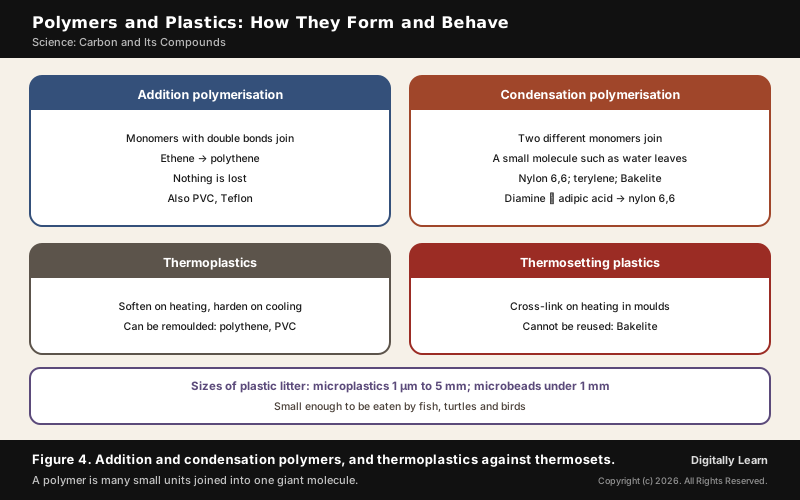
- Addition polymerisation: Monomers with double or triple bonds add to one another, as ethene gives polythene and propene gives polypropene. Teflon, made from tetrafluoroethene, is chemically inert and coats non-stick utensils.
- Condensation polymerisation: Two different monomers join while a small molecule such as water, alcohol or hydrogen chloride is eliminated. Nylon 6,6 comes from hexamethylenediamine and adipic acid; terylene (Dacron), a crease-resistant polyester, from ethylene glycol and terephthalic acid.
- Rubber: Natural rubber is a linear polymer of isoprene, cis-1,4-polyisoprene. Vulcanisation heats raw rubber with sulphur at 373 to 415 K; sulphur forms cross links that stiffen it. Buna-S, a synthetic rubber, is a copolymer made from two different monomers.
| By source | Examples |
|---|---|
| Natural polymers | Proteins, cellulose, starch, resins, rubber |
| Semi-synthetic polymers | Cellulose acetate (rayon), cellulose nitrate |
| Synthetic polymers | Polythene, nylon 6,6, Buna-S |
Types of Plastics: Thermoplastics, Thermosets and Common Polymers
Plastics are classified by how they respond to heat. Thermoplastics are linear or slightly branched chains that soften on heating and harden on cooling, again and again, so they can be remoulded. Thermosetting plastics are cross-linked on heating in moulds and cannot be reused.
| Polymer | Type | Common use |
|---|---|---|
| Low density polythene | Thermoplastic | Squeeze bottles, toys, flexible pipes, wire insulation |
| High density polythene | Thermoplastic | Buckets, dustbins, bottles, pipes |
| Polyvinyl chloride (PVC) | Thermoplastic | Pipes, doors, windows, bottles |
| Teflon | Addition polymer | Non-stick coatings, oil seals and gaskets |
| Nylon 6,6 | Fibre | Sheets, brush bristles, textiles |
| Bakelite | Thermosetting | The oldest synthetic polymer, from phenol and formaldehyde |
| Polycarbonate | Plastic, resin code 7 | Bullet-resistant glass when laminated |
- Polycarbonate and BPA: Polycarbonate products can contain their monomer, bisphenol A (BPA); 65 to 70 per cent of all BPA goes into polycarbonates. BPA mimics the hormone oestrogen, which raises health concerns.
- Resin codes: The numbered triangles on plastic items, created in 1988, identify the resin for recycling; polycarbonate falls under 7, other.
Biodegradable Plastic and Bioplastics
Most polymers are designed to last, which is exactly the problem when they are thrown away. A biodegradable plastic is a polymer that living organisms, mainly microorganisms, can break down. Many are made from renewable raw materials instead of petroleum.
- PHBV: A copolymer of 3-hydroxybutanoic acid and 3-hydroxypentanoic acid that bacteria degrade in the environment; it is used in speciality packaging, orthopaedic devices and controlled drug release.
- Polylactic acid (PLA): Made from fermented plant starch, such as corn, cassava or sugarcane, and usable in compostable products; in 2022 it was the most consumed bioplastic, about 26 per cent of demand.
- Nylon-2-nylon-6: Another biodegradable polymer developed as an alternative to lasting synthetic polymers.
- Not all bioplastics degrade: PLA can be biodegradable or long-lasting depending on how it is made.
The reason for the effort is simple. A large number of polymers resist the processes that break down materials in the environment, so polymeric solid waste accumulates and stays undegraded for a long time, causing acute environmental problems; biodegradable polymers were developed in answer.
Plastic Pollution: Microplastics, Microbeads and India's Single-Use Plastic Ban
Plastic that escapes into the environment breaks into ever smaller pieces. Microplastics are particles from 1 micrometre to 5 mm across; in 2022 about 8 million tonnes of plastic entered the oceans. Microbeads, manufactured plastic particles under 1 mm, were made to exfoliate or cleanse the body in cosmetics.
- Microbeads in wildlife: Insect larvae, small fish, turtles and birds mistake them for food; the United States phased them out of rinse-off cosmetics under a 2015 law, and several other countries have banned them.
- Chewing gum: Its gum base is a polymer, since the 1960s mostly butadiene-based synthetic rubber, and gum is the second most common form of litter after cigarette ends.
India generated about 4.1 million tonnes of plastic waste in 2020-21, on the estimates of 35 states and union territories. The Plastic Waste Management Rules, 2016 are the statutory framework, and the Plastic Waste Management Amendment Rules, 2021 prohibit identified single-use plastic items with low utility and high littering potential.
- Banned from 1 July 2022: Ear buds with plastic sticks, plastic sticks for balloons, plastic flags, candy and ice-cream sticks, polystyrene (Thermocol) for decoration, plastic plates, cups, glasses and cutlery, straws and trays.
- Carry bags: Thickness raised from 50 to 75 microns from 30 September 2021 and to 120 microns from 31 December 2022.
- Extended Producer Responsibility: Producers are responsible for the environmentally sound management of their plastic packaging until the end of its life, under rules notified on 16 February 2022.
Previous Year UPSC-CSE Questions
Previous Year UPSC-CSE Questions By the end you will be able to draft model answers for the following UPSC questions. Each question carries a collapsible framework showing how to approach it in the exam.
- UPSC Prelims 2012 Prelims-GSGraphene is frequently in news recently. What is its importance?
- It is a two-dimensional material and has good electrical conductivity.
- It is one of the thinnest but strongest materials tested so far.
- It is entirely made of silicon and has high optical transparency.
- It can be used as conducting electrodes required for touch screens, LCDs and organic LEDs.
Which of the statements given above are correct?
How to approach this Prelims question
Approach: Check each claim against what graphene is: a single layer of carbon atoms in a hexagonal sheet. Statements 1, 2 and 4 describe it correctly; statement 3 is wrong because graphene is carbon, not silicon.
Trap to watch: Statement 3: graphene is carbon, not silicon.
Key facts to recall:
- (a) 1 and 2 only: wrong. It leaves out statement 4; graphene is a candidate for transparent conducting electrodes.
- (b) 3 and 4 only: wrong. Statement 3 is false, since graphene is made of carbon, not silicon.
- (c) 1, 2 and 4 only: right. Graphene is two-dimensional and conducts well, is among the thinnest and strongest materials, and suits touchscreen and LED electrodes.
- (d) 1, 2, 3 and 4: wrong. Graphene is not made of silicon.
Answer signal: 1, 2 and 4 only, option (c).
- UPSC Prelims 2001 Prelims-GSWhich one of the following is the correct sequence in increasing order of molecular weights of the hydrocarbons?
How to approach this Prelims question
Approach: Count the carbon atoms. Methane has one, ethane two, propane three and butane four, and molecular weight rises with each.
Trap to watch: Do not reverse the order.
Key facts to recall:
- (a) Methane, ethane, propane and butane: right. Each adds one carbon atom: CH₄, C₂H₆, C₃H₈, C₄H₁₀.
- (b) Propane, butane, ethane and methane: wrong. Ethane and methane are lighter than propane, so they cannot come after it.
- (c) Butane, ethane, propane and methane: wrong. Butane, the heaviest of the four, cannot come first.
- (d) Butane, propane, ethane and methane: wrong. This is the decreasing order, the reverse of what is asked.
Answer signal: Methane, ethane, propane, butane, option (a).
- UPSC Prelims 1998 Prelims-GSConsider the following statements about acetylene:
- I. It is used in welding industry.
- II. It is raw material for preparing plastics.
- III. It is easily obtained by mixing silicon carbide and water.
Of these statements:
How to approach this Prelims question
Approach: Check each use and the source. Acetylene burns in oxyacetylene welding and is a starting material for plastics such as PVC, so I and II hold. It is made by adding water to calcium carbide, not silicon carbide, so III is false.
Trap to watch: It is calcium carbide, not silicon carbide, that gives acetylene with water.
Key facts to recall:
- (a) I and II are correct: right. Acetylene is used in welding and as a raw material for plastics.
- (b) I and III are correct: wrong. Statement III is false; acetylene comes from calcium carbide and water.
- (c) II and III are correct: wrong. Statement III is false.
- (d) I, II and III are correct: wrong. Silicon carbide does not give acetylene with water.
Answer signal: I and II, option (a).
- UPSC Prelims 2004 Prelims-GSMatch List I (Fuel Gases) with List II (Major Constituents) and select the correct answer using the codes given below: List I (A) CNG (B) Coal gas (C) LPG (D) Water gas List II
- Carbon monoxide, Hydrogen
- Butane, Propane
- Methane, Ethane
- Hydrogen, Methane, Carbon monoxide Codes:
How to approach this Prelims question
Approach: Match each gas to its main constituents: CNG is mostly methane, LPG propane and butane, water gas carbon monoxide and hydrogen, and coal gas hydrogen with methane and some carbon monoxide.
Trap to watch: Water gas and coal gas both hold hydrogen; water gas pairs it with carbon monoxide.
Key facts to recall:
- (a) A 2, B 1, C 3, D 4: wrong. CNG is methane and ethane, not butane and propane.
- (b) A 3, B 4, C 2, D 1: right. CNG is methane and ethane, coal gas hydrogen, methane and carbon monoxide, LPG butane and propane, and water gas carbon monoxide and hydrogen.
- (c) A 2, B 4, C 3, D 1: wrong. It swaps CNG and LPG.
- (d) A 3, B 1, C 2, D 4: wrong. It swaps coal gas and water gas; water gas is carbon monoxide and hydrogen.
Answer signal: A-3, B-4, C-2, D-1, option (b).
- UPSC Prelims 2005 Prelims-GSConsider the following Assertion (A) and Reason (R):
- Assertion (A): The main constituent of the Liquefied Petroleum Gas is methane.
- Reason (R): Methane can be used directly for burning in homes and factories where it can be supplied through pipelines.
Select the correct answer using the codes given below.
How to approach this Prelims question
Approach: Test A and R separately. LPG is mainly propane and butane, so A is false. Methane is the main part of natural gas and CNG and is supplied to homes and factories through pipelines, so R is true.
Trap to watch: Methane is CNG and piped gas, not LPG.
Key facts to recall:
- (a) A and R true, R explains A: wrong. A is false; LPG is mainly propane and butane.
- (b) A and R true, R does not explain A: wrong. A is false.
- (c) A true, R false: wrong. A is false, and methane can indeed be piped.
- (d) A false, R true: right. LPG is not mainly methane, and methane, as natural gas, is supplied through pipelines.
Answer signal: A false, R true, option (d).
- UPSC Prelims 2002 Prelims-GSConsider the following Assertion (A) and Reason (R):
- Assertion (A): Synthetic detergents can lather well in hard water.
- Reason (R): Synthetic detergents form soluble calcium and magnesium salts with hard water.
Select the correct answer using the codes given below.
How to approach this Prelims question
Approach: Link lathering to what forms with the calcium and magnesium ions of hard water. Soap forms an insoluble scum and wastes itself; a detergent forms soluble salts, so it keeps lathering. Both statements are true and R explains A.
Trap to watch: Soap forms scum; detergent does not.
Key facts to recall:
- (a) A and R true, R explains A: right. Because their calcium and magnesium salts are soluble, detergents leave no scum and keep lathering.
- (b) A and R true, R does not explain A: wrong. The soluble salts are exactly why detergents work in hard water.
- (c) A true, R false: wrong. Detergents do form soluble calcium and magnesium salts.
- (d) A false, R true: wrong. Detergents lather well in hard water, unlike soap.
Answer signal: Both true and R explains A, option (a).
- UPSC Prelims 2021 Prelims-GSBisphenol A (BPA), a cause of concern, is a structural/key component in the manufacture of which of the following kinds of plastics?
How to approach this Prelims question
Approach: Recall the main use of bisphenol A: about 65 to 70 per cent of it goes into polycarbonate plastics.
Trap to watch: PET, PVC and LDPE are not BPA-based.
Key facts to recall:
- (a) Low-density polyethylene: wrong. Polyethylene (polythene) is made from ethene, not bisphenol A.
- (b) Polycarbonate: right. BPA is a key building block of polycarbonate, which takes most of the BPA made.
- (c) Polyethylene terephthalate: wrong. PET is not a BPA-based plastic.
- (d) Polyvinyl chloride: wrong. PVC is made from vinyl chloride, not BPA.
Answer signal: Polycarbonate, option (b).
- UPSC Prelims 2019 Prelims-GSWhy is there a great concern about the 'microbeads' that are released into environment?
How to approach this Prelims question
Approach: Recall where microbeads end up: rinsed off from cosmetics and cleaners, they pass through drains into rivers and the sea, where marine animals swallow them.
Trap to watch: They are not linked to skin cancer or crops.
Key facts to recall:
- (a) harmful to marine ecosystems: right. Microbeads wash into waterways and the sea, where wildlife mistake them for food.
- (b) cause skin cancer in children: wrong. The concern is not cancer from cosmetics but harm once the beads reach water.
- (c) absorbed by crop plants: wrong. The concern is the beads that wash into waterways, not uptake by crops.
- (d) used as food adulterants: wrong. Microbeads are used in cosmetics and cleaners, not to adulterate food.
Answer signal: Harmful to marine ecosystems, option (a).
- UPSC Prelims 2024 Prelims-GSConsider the following statements :
- Statement-I : Many chewing gums found in the market are considered a source of environmental pollution.
- Statement-II : Many chewing gums contain plastic as gum base.
Which one of the following is correct in respect of the above statements ?
How to approach this Prelims question
Approach: Judge both statements, then the link. Many chewing gums use a synthetic polymer, a plastic, as gum base; it does not break down, so discarded gum is a lasting pollutant. Both are correct and II explains I.
Trap to watch: Here II is the reason: the plastic gum base does not break down.
Key facts to recall:
- (a) Both correct, II explains I: right. Many gums use a plastic polymer as gum base, and that plastic does not break down, so discarded gum pollutes.
- (b) Both correct, II does not explain I: wrong. The plastic gum base is exactly why gum persists as litter.
- (c) I correct, II incorrect: wrong. Many chewing gums do have a plastic gum base.
- (d) I incorrect, II correct: wrong. Discarded chewing gum is a common source of litter.
Answer signal: Both correct and II explains I, option (a).
Sources
- NCERT: Science (Class X), Carbon and its Compounds
- NCERT: Chemistry Part II (Class XII), Polymers; Chemistry in Everyday Life
- PIB: Plastic Waste Management Amendment Rules, 2021 (13 August 2021)
- PIB: Ban on identified single use plastic items from 1 July 2022 (28 June 2022)
- PIB: Ethanol Blended Petrol Programme, frequently asked questions (10 July 2026)
- Ministry of Petroleum and Natural Gas: Amendments to the National Policy on Biofuels, 2018 (gazette, June 2022)
- Central Pollution Control Board: Annual Report 2020-21 on implementation of the Plastic Waste Management Rules
- PIB: Generation of plastic waste (27 July 2023)
- Wikipedia: Graphene
- Wikipedia: Acetylene
- Wikipedia: Liquefied petroleum gas
- Wikipedia: Polycarbonate
- Wikipedia: Bisphenol A
- Wikipedia: Microbead
- Wikipedia: Microplastics
- Wikipedia: Chewing gum
- UPSC: Civil Services Examination question papers
Editorial Disclaimer
This article draws on the NCERT science and chemistry textbooks, the Ministry of Environment, Forest and Climate Change and the Ministry of Petroleum through the Press Information Bureau, and the other sources listed on this page.


