


Overview
The Grid Strategy It Needs in 2026
Full electrification could add 900-1,100 TWh a year. Can the grid keep pace with EV adoption?
An electric vehicle (EV) is a road vehicle that uses one or more electric motors for propulsion, drawing energy from a battery or fuel-cell stack that is charged from the electricity grid or from on-board generation. India's electric vehicle transition, in the framework adopted by the National Electric Mobility Mission Plan and the PM-E-DRIVE Scheme, is the staged migration from internal-combustion vehicles to battery-electric and hybrid-electric vehicles, with a stated 30 per cent EV penetration by 2030 as the target.
Why this is in the news in May 2026
The trigger and the headline numbers
On 20 May 2026, an editorial in The Hindu reignited a policy conversation that energy analysts have been pressing through the calendar year. India's electric-vehicle transition, the argument runs, is advancing along the vehicle-side of the equation but is not matched by a power-system plan on the grid-side. The piece quantified the gap with a set of scenario numbers that have become the operative reference points for the discussion.
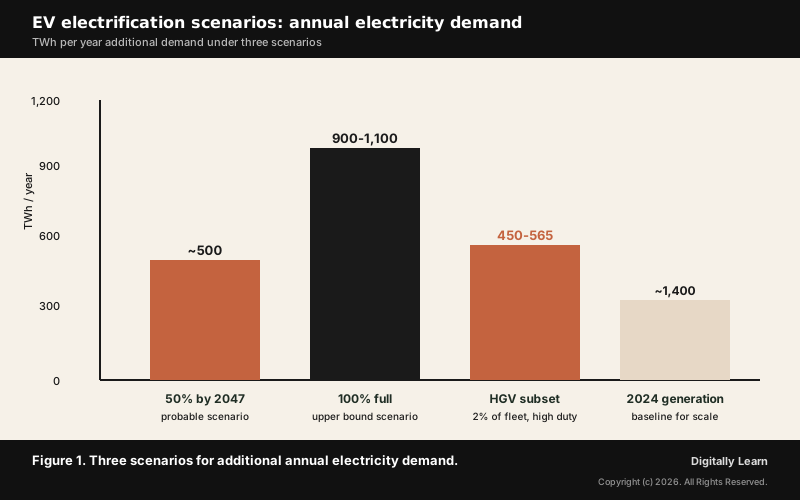
The scenarios are stark, and they are analyst projections rather than government-issued targets. Full electrification of India's roughly 420 million registered vehicles would add 900 to 1,100 terawatt-hours a year to the national electricity demand. Fifty per cent electrification by 2047, which is the more probable trajectory, still adds about 500 terawatt-hours a year, a figure that is close to one-third of India's present generation. Heavy goods vehicles alone, despite being roughly two per cent of the fleet, could absorb 450 to 565 terawatt-hours annually because of their high duty-cycle energy intensity. These figures should be read as scenarios for sizing the grid-investment question, not as policy commitments.
Definition: An electric vehicle (EV) is a road vehicle that uses one or more electric motors for propulsion, drawing energy from a battery or fuel-cell stack that is charged from the electricity grid or from on-board generation. India's electric vehicle transition is the staged migration from internal-combustion vehicles to battery-electric and hybrid-electric vehicles, with the 30 per cent EV penetration by 2030 target set under the National Electric Mobility Mission Plan.
Scale of the grid-side demand
Why the grid-side is the binding constraint
Two tracks, one mismatch
Why it matters: India has been running two tracks. The vehicle-side track gathers demand-side incentives, manufacturer subsidies, and adoption targets, with PM-E-DRIVE as the flagship instrument and a stated 30 per cent EV penetration by 2030 as the public goal. The grid-side track gathers generation capacity, transmission lines, distribution upgrades, storage, and tariffs, with the National Electricity Plan as the principal framework. Both tracks have advanced; they have not advanced at the same pace.
The mismatch becomes operationally visible at three points. The first is the evening peak, when commuters return home and begin simultaneous charging, exactly when solar generation has tailed off. The second is the summer heatwave month, when grid stress is already at its annual maximum and an unmanaged EV-charging spike can tip distribution transformers into failure. The third is the freight corridor, where megawatt-scale truck charging requires dedicated high-voltage substations that the present grid does not provision.
Significance for India's energy and climate policy
The significance of this issue
What is the significance of this issue: The grid-readiness debate sits at the centre of three policy domains and conditions India's posture on each. The first is the climate-and-NDC domain, where the EV transition is the largest single lever on the transport sector's emissions footprint and feeds directly into India's Nationally Determined Contributions. The second is the energy-security domain, where every electrified kilometre displaces imported crude and shifts cost-economics towards domestic generation. The third is the industrial-policy domain, where EV-related demand for batteries, semiconductors, and grid hardware decides whether India captures the manufacturing upside or imports the supply chain.
Structural reading: The grid-side and the vehicle-side are not parallel concerns; they are co-dependent. A grid that cannot reliably deliver the additional 500-to-1,100 terawatt-hours becomes a binding constraint on EV adoption, with charging-induced outages or capacity-driven tariff spikes pushing back consumer adoption curves. Equally, an EV trajectory that fails to materialise leaves stranded grid investment without revenue. The two systems either rise together or stall together, and the strategic question is whether sequencing is coordinated or left to drift.
Distinguishing features of a grid-side strategy
How the grid-side response is structured
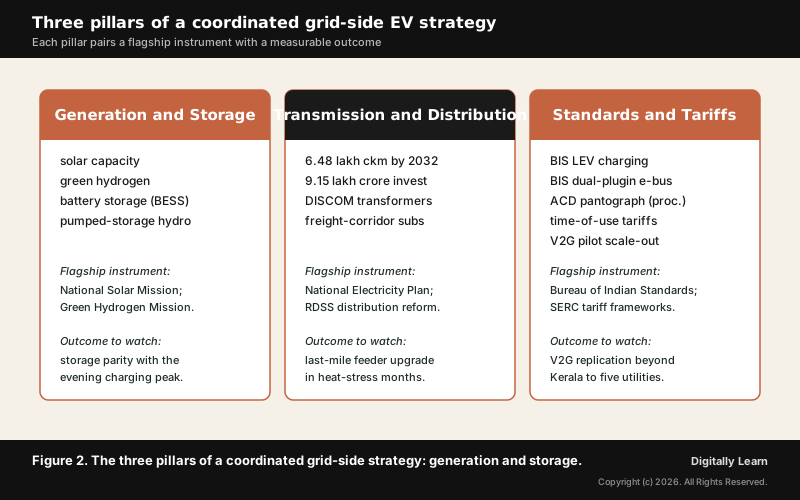
Distinguishing features: A coordinated grid-side strategy rests on three pillars, each pairing a policy instrument with a measurable physical outcome.
- (i) Generation and storage capacity. The pillar requires building incremental generation that is clean enough to keep EV adoption from displacing oil imports with coal imports, and storage that smooths the renewable-output curve against the evening charging peak. Instruments include the National Solar Mission, the National Green Hydrogen Mission, the Bharat Battery Energy Storage Systems rollout, and the pumped-storage-hydro pipeline now under construction across central India.
- (ii) Transmission and distribution upgrades. The pillar carries the additional load from the generation node to the charging socket. The National Electricity Plan targets an expansion of inter-state transmission to 6.48 lakh circuit kilometres by 2032 with an investment of about 9.15 lakh crore rupees. Distribution-side reform under the Revamped Distribution Sector Scheme addresses the last-mile transformer and feeder bottlenecks where charging-induced failures actually materialise.
- (iii) Standards, tariffs, and demand-side management. The pillar shapes when and how vehicles charge. The Bureau of Indian Standards has notified the Light Electric Vehicle Charging Standards and the Dual Plugin Charging Standard for e-buses, while the Automated Charging Device Pantograph standard is in process. Time-of-use tariffs and grid-connected vehicle-to-grid pilots, including the Kerala State Electricity Board pilot, sit within this pillar.
PM-E-DRIVE Scheme allocation in one table
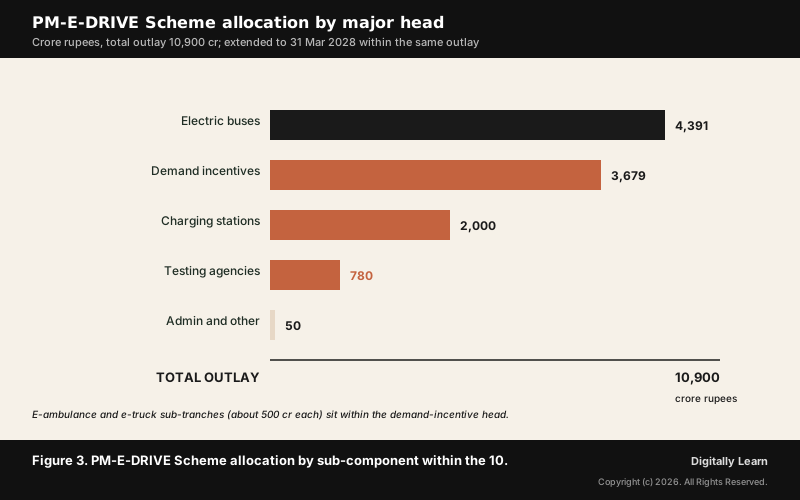
The PM-E-DRIVE Scheme is the flagship vehicle-side instrument that ties the demand subsidy to the supporting infrastructure for charging.
| Scheme component (head) | Allocation (Rs crore) | Purpose and physical outcome |
|---|---|---|
| Demand incentives (e-2W, e-3W, e-ambulances, e-trucks, other EVs) | 3,679 | Per-kWh subsidies through FY 2024-25 and FY 2025-26; sub-tranches of about 500 cr each are earmarked within this head for e-ambulances and e-trucks |
| Electric buses procurement | 4,391 | Procurement of 14,028 e-buses across state transport undertakings |
| EV public charging stations | 2,000 | Charging-infrastructure deployment along highways and in cities |
| Upgradation of testing agencies | 780 | Strengthening of Ministry of Heavy Industries homologation infrastructure |
| Administrative and other heads | 50 | Implementation, monitoring, and contingency |
Scheme period: The PM-E-DRIVE Scheme was notified for 1 October 2024 to 31 March 2026 and, in March 2026, the Ministry of Heavy Industries extended its tenure by two years to 31 March 2028 within the same total outlay of 10,900 crore rupees. The terminal date for two-wheeler incentives is 31 July 2026, while three-wheelers, e-buses, e-trucks, and testing agencies run to 31 March 2028. The per-kilowatt-hour demand incentive is set at 5,000 rupees for the first financial year and 2,500 rupees for the second, capped at the lower of a per-vehicle ceiling or fifteen per cent of the ex-factory price. The major heads above sum to the headline outlay; the e-ambulance and e-truck tranches of about 500 crore rupees each are sub-components within the demand-incentives head and are not separately additive.
Observable outcomes the strategy must deliver
What to watch on the EV-grid rollout
Observable outcomes: A grid-aligned EV strategy is testable against six observable outcomes between now and 2030. Each is concrete and measurable; none requires a policy regime change to deliver.
- (a) Inter-state transmission expansion to 6.48 lakh ckm. The National Electricity Plan target for 2032 builds out the long-haul transmission backbone that high-voltage charging hubs need.
- (b) Public-charging coverage at scale. The national requirement runs into the millions of public chargers by the mid-2030s on industry analyst projections, with the PM-E-DRIVE charging-station tranche of two thousand crore rupees seeding the highway-corridor and city-grid network.
- (c) BIS standards across all vehicle categories. The light-vehicle standard is notified; the dual-plugin e-bus standard is notified; the automated charging device pantograph standard is under processing with the Bureau of Indian Standards.
- (d) Vehicle-to-grid pilots scaled out of Kerala. The Kerala State Electricity Board with the Indian Institute of Technology Bombay launched India’s first vehicle-to-grid pilot in 2025; replication across at least five state utilities is the operational outcome to watch.
- (e) E-bus deployment under FAME, NEBP, and PM-E-DRIVE. The procurement of fourteen thousand twenty-eight e-buses under PM-E-DRIVE complements the National Electric Bus Programme and gives state transport undertakings the operational base for the urban-mobility shift.
- (f) Time-of-use tariff adoption. State electricity regulators are framing time-differentiated tariffs that encourage EV charging in the renewable-surplus hours of the day; adoption across half the state regulatory commissions is a reasonable five-year target.
Contemporary linkages
Climate, freight, and the wider energy transition
Contemporary linkages: Three threads link the grid-side strategy to current Indian policy debates. The first is the climate track: the EV transition is the single most consequential lever on transport-sector emissions, and grid-readiness decides whether the emissions saving materialises or is recaptured by additional thermal generation. The second is the freight track: the Dedicated Freight Corridors, the National Logistics Policy, and the National Highways for Electric Vehicles programme together determine whether long-haul trucking electrifies before the grid can support it or alongside the build-out. The third is the industrial-policy track, where the Production Linked Incentive for advanced chemistry cells, the India Semiconductor Mission for charger silicon, and the renewable-component PLI together decide whether the value addition stays domestic.
PM-E-DRIVE financial architecture in one figure
UPSC Relevance
Where the EV grid-strategy question sits in the UPSC syllabus
UPSC context: The EV grid-readiness question falls within General Studies Paper III under three syllabus heads: infrastructure, including energy; indigenisation of technology and developing new technology; and conservation, environmental pollution and degradation. The same topic touches General Studies Paper II on government schemes through PM-E-DRIVE.
Prelims relevance: The factual surface that Prelims tests here includes the PM-E-DRIVE outlay of 10,900 crore rupees, notified for 2024 to 2026 and extended in March 2026 to 31 March 2028 within the same outlay; the 14,028 e-buses procurement target; the 30 per cent EV penetration by 2030 target under the National Electric Mobility Mission Plan; the National Electricity Plan transmission target of 6.48 lakh circuit kilometres by 2032 with 9.15 lakh crore rupees investment; the Bureau of Indian Standards light-vehicle and dual-plugin e-bus charging standards; and the location of India's first vehicle-to-grid pilot (the Kerala State Electricity Board with IIT Bombay).
Mains relevance: The strongest Mains framing is the systems-engineering question: how does India coordinate vehicle-side incentives with grid-side capacity so that EV adoption and grid-readiness rise together rather than out of phase. A second framing is the climate-and-energy-security framing: what role does the EV transition play in reducing transport-sector emissions and the crude-import bill, and what are the binding constraints. A third framing is the industrial-policy framing: how do PLI schemes for advanced chemistry cells, charger semiconductors, and renewable components combine with EV demand to capture domestic value addition.
Mains practice question: A focused fifteen-mark question would read: India's electric-vehicle transition needs a coordinated grid-side strategy. Examine the principal pillars on which such a strategy must rest, with reference to generation, transmission, and standards-and-tariffs. What are the binding constraints between now and 2030? The answer should treat generation-and-storage capacity, transmission and distribution upgrades, and the BIS standards plus time-of-use tariff framework as the three spokes.
- Past Mains linkage. 2018 GS-III: What are the impediments in disposing the huge quantities of discarded solid wastes which are continuously being generated? How do we remove safely the toxic wastes that have been accumulating in our habitable environment? The end-of-life battery question for EVs is the direct successor to that solid-waste framing.
- Past Prelims linkage. 2022 Prelims tested on Production Linked Incentive Schemes for advanced chemistry cells, the principal industrial-policy instrument backing the EV battery supply chain.
- Adjacent linkage. The 2023 Cabinet approval of the National Green Hydrogen Mission is the supply-side companion to the EV transition on the heavy-vehicle and freight-corridor segments.
Previous Year UPSC-CSE Questions By the end you will be able to draft model answers for the following UPSC questions. Each question carries a collapsible framework showing how to approach it in the exam.
- UPSC Mains 2018 GS-IIIWhat are the impediments in disposing the huge quantities of discarded solid wastes which are continuously being generated? How do we remove safely the toxic wastes that have been accumulating in our habitable environment?
How to structure the answer in the exam
Introduction: Open with the scale of India's solid-waste generation (over 160,000 tonnes per day of municipal waste under MoEFCC reporting), name the four waste streams (municipal, hazardous, biomedical, electronic-and-battery), and frame the answer as identifying impediments by stream and proposing stream-specific remediation.
Body (sub-themes to develop):
- Municipal solid waste: Solid Waste Management Rules, 2016; segregation-at-source gaps; landfill saturation in metros (Ghazipur, Deonar, Bhalaswa); composting and waste-to-energy under the Swachh Bharat Mission 2.0.
- Hazardous waste: Hazardous and Other Wastes (Management and Transboundary Movement) Rules, 2016; treatment, storage, and disposal facility coverage; trans-boundary movement under the Basel Convention.
- Biomedical waste: Bio-Medical Waste Management Rules, 2016; common biomedical-waste treatment facilities; the post-COVID surge and the gap in tier-2 cities.
- Electronic and battery waste: E-Waste (Management) Rules, 2022; Battery Waste Management Rules, 2022; the new end-of-life burden from the electric-vehicle transition through advanced-chemistry-cell batteries; extended producer responsibility under both rule-sets.
- Toxic-site remediation: the Polluter Pays principle in the M. C. Mehta line; National Green Tribunal directions on legacy industrial sites; the National Plan for Conservation of Aquatic Eco-systems for water-borne toxic loads.
Conclusion: Conclude that India's waste-management regime has matured on paper through stream-specific rules but suffers from enforcement and infrastructure gaps, that the EV transition adds a new end-of-life-battery dimension that the 2022 Battery Waste Rules attempt to manage through extended producer responsibility, and that the circular-economy framing offers the most promising forward architecture.
The end-of-life lithium-ion battery question is the direct successor frame to the 2018 toxic-waste directive. Every electric vehicle India puts on the road carries a battery pack of 15 to 100 kilowatt-hours that will reach end-of-life within 8 to 12 years, creating a new hazardous-waste stream at industrial scale. The Battery Waste Management Rules, 2022 frame the regulatory response under extended producer responsibility, and the body sub-theme on electronic and battery waste in the framework above maps directly onto the article's discussion of advanced-chemistry-cell manufacturing and the PLI battery-storage scheme.
- UPSC Mains 2020 GS-IIIDespite India being one of the countries of the Gondwanaland, its mining industry contributes much less to its Gross Domestic Product (GDP) in percentage. Discuss.
How to structure the answer in the exam
Introduction: Open with India's Gondwanan stratigraphic inheritance (the Damodar Valley coalfields, the iron-ore reserves of Singhbhum, Goa, and Bellary), state the puzzle (mining contributes about 2 per cent of gross domestic product despite this endowment), and frame the answer through four explanatory lenses.
Body (sub-themes to develop):
- Resource geography: Gondwana coal in the Damodar, Son, Mahanadi, Pranhita-Godavari, and Wardha valleys; iron-ore in Jharkhand, Odisha, Chhattisgarh, Karnataka, and Goa; bauxite in eastern Ghats; the relative paucity of high-grade ores compared with Australia and Brazil.
- Regulatory framework: Mines and Minerals (Development and Regulation) Amendment Acts of 2015, 2020, and 2023; auction-based allocation under the 2015 amendment; the National Mineral Policy 2019; restrictions on private exploration of critical minerals.
- Ease-of-doing-business friction: forest-clearance overlays in resource-bearing districts; the Forest Rights Act 2006 interface; the Scheduled Areas and Panchayats (Extension to Scheduled Areas) Act 1996; environmental-clearance bottlenecks.
- Global commodity-price exposure: thermal-coal demand under the renewable-energy transition; the captive-mine model and the 2020 commercial-coal-block auctions; the import-dependency on coking coal for steel.
- Critical-minerals strategic shift: the 30-critical-minerals list released by the Ministry of Mines in 2023; the Khanij Bidesh India Ltd joint venture for overseas acquisition; the National Critical Mineral Mission notified in 2024; the role in electric-vehicle batteries (lithium, cobalt, nickel), wind-turbine magnets (rare earths), and solar-panel manufacturing.
Conclusion: Conclude that the under-contribution puzzle is partly geological (grade distribution), partly regulatory (clearance overlays), and partly market (commodity-price cyclicality), but that the critical-minerals dimension introduced by the energy transition reframes the industry from a coal-and-iron commodity sector to a strategic-mineral national-security sector, with the National Critical Mineral Mission as the operative instrument.
The electric-vehicle transition is precisely the policy moment that connects this 2020 Mains directive on mining-share-of-gross-domestic-product to a strategic-mineral question. Every electric-vehicle battery, every wind-turbine generator, and every solar-panel string draws on the 30-critical-minerals list (lithium, cobalt, nickel, rare-earth elements, copper). The article's Contemporary linkages section on the Production Linked Incentive Scheme for advanced chemistry cells and the National Green Hydrogen Mission supplies the load-bearing facts for the body sub-theme on the critical-minerals strategic shift, and the National Critical Mineral Mission notified in 2024 is the standing instrument that makes this Mains question directly testable.
Sources
- Cabinet approves PM Electric Drive Revolution in Innovative Vehicle Enhancement (PM E-DRIVE) Scheme
- Ministry of Heavy Industries press release on PM-E-DRIVE Scheme
- PM E-DRIVE Scheme official portal
- Electric Vehicles Mission, Office of the Principal Scientific Adviser
- Bureau of Indian Standards: charging standards for electric vehicles
- National Electricity Plan (Transmission) 2022-2032
- DD News: Government launches PM E-DRIVE subsidy scheme
- Wikipedia: PM E-DRIVE Scheme
Editorial Disclaimer
This article is compiled from the reference materials listed in the Sources section. It is an explainer for UPSC preparation and is not a substitute for primary documents (NCERTs, GoI ministry releases, IMD bulletins, RBI / CEA / MoEFCC publications, and Standing-Committee reports).


