


Overview
History, groups and blocks, periodic trends and element families
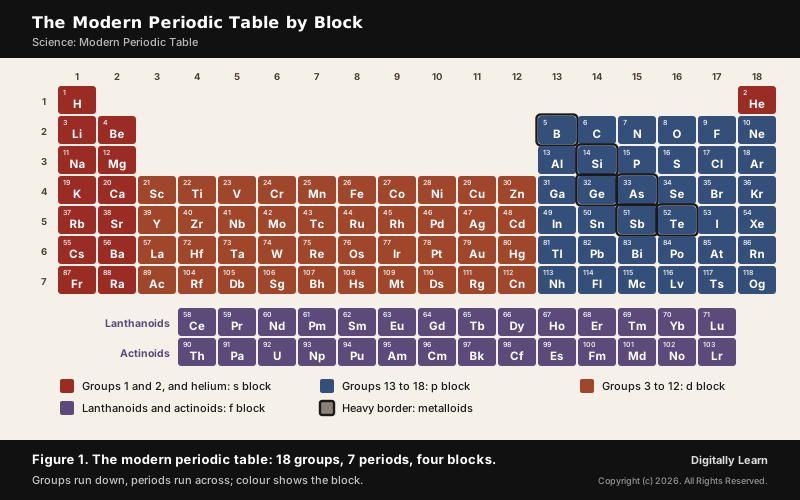
The modern periodic table arranges the 118 known elements in order of increasing atomic number, in 18 vertical groups and 7 horizontal periods, so that elements with similar properties fall in the same group. It rests on the modern periodic law from Henry Moseley's work of 1913: the properties of elements are periodic functions of their atomic numbers.
History of the Periodic Table: Dobereiner to Moseley
Dobereiner Triads and Newlands' Law of Octaves
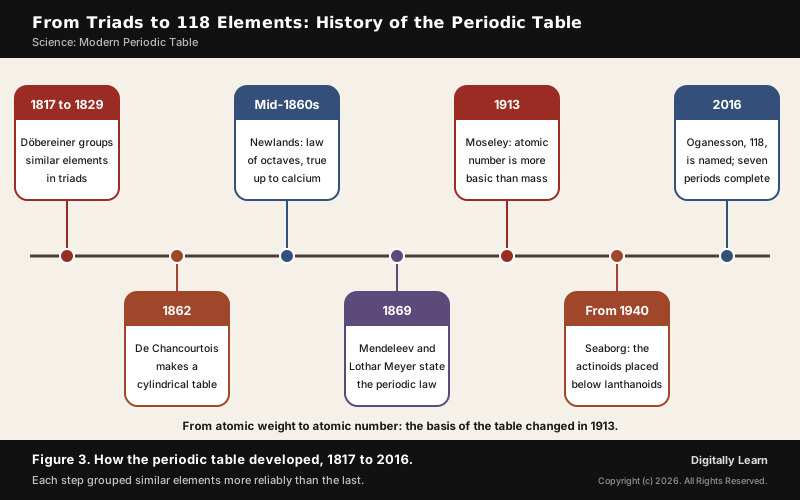
Chemists in the early nineteenth century knew many elements but had no clear way to classify them. The first attempt came from the German chemist Johann Wolfgang Döbereiner, who from 1817 grouped similar elements in threes and by 1829 had noted the pattern in several such triads. In each triad the middle element had an atomic mass roughly the average of the other two, and properties in between.
- Lithium, sodium, potassium: Atomic masses 6.9, 23.0 and 39.0; the average of lithium and potassium is close to sodium.
- Other triads: Calcium, strontium and barium, and chlorine, bromine and iodine, form triads too; nitrogen, phosphorus and arsenic do not.
- The weakness: The law of triads worked only for a few elements, so it was dismissed as coincidence.
In 1862 the French geologist A. E. B. de Chancourtois arranged the known elements by atomic weight on a cylindrical table, but it drew little attention. In the mid-1860s the English chemist John Newlands proposed the law of octaves: arranged by increasing atomic mass, every eighth element resembled the first, like the eighth note in a musical octave.
- Worked only for light elements: The law held only up to calcium.
- Forced fits: Cobalt and nickel shared one slot and sat in the column of fluorine, chlorine and bromine, whose properties are very different, while iron, which resembles them, sat far away.
- Late recognition: The Royal Society awarded Newlands the Davy Medal in 1887.
Mendeleev Periodic Table: Periodic Law, Gaps and Limitations
The periodic law as we know it began in 1869 with the Russian chemist Dmitri Mendeleev and the German chemist Lothar Meyer, working independently. Both found that when elements are arranged by increasing atomic weight, similar properties return at regular intervals. Meyer plotted atomic volume, melting point and boiling point against atomic weight; Mendeleev went further and used the pattern to predict.
- His starting point: Only 63 elements were known when Mendeleev began, and he studied how their atomic masses related to their physical and chemical properties.
- Bold gaps: Where no known element fitted, he left a gap and predicted the missing element, naming it with the Sanskrit numeral Eka, one, before the element above it.
- Predictions confirmed: Scandium, gallium and germanium, found later, matched eka-boron, eka-aluminium and eka-silicon. Eka-aluminium was predicted at atomic weight 68 and density 5.9; gallium came in at 70 and 5.94.
- Room for new groups: When the noble gases were discovered, they fitted into a new group without disturbing the existing order.
- Order over weight: To keep similar elements together he sometimes inverted the order, putting cobalt (atomic mass 58.9) before nickel (58.7).
| Limitation | Why it was a problem |
|---|---|
| Position of hydrogen | Hydrogen's configuration resembles the alkali metals, yet like the halogens it forms diatomic molecules, so no fixed place fits it |
| Isotopes | Isotopes of one element have different atomic masses but the same chemistry, so a table built on mass should separate them, and cannot |
| Inverted pairs | Cobalt before nickel breaks the rule of increasing atomic mass |
Moseley and the Modern Periodic Law
The flaws in Mendeleev's table were solved by a change of basis. In 1913 the English physicist Henry Moseley studied the X-rays given off by different elements and found that their frequency formed a straight line when plotted against atomic number, not atomic mass. The atomic number, the number of protons in the nucleus (see atomic structure), is therefore the more fundamental property.
Mendeleev's law was revised into the modern periodic law: the physical and chemical properties of the elements are periodic functions of their atomic numbers. Arranged this way, cobalt (27) comes before nickel (28) naturally, and isotopes share one place because they share an atomic number. Moseley himself was killed at Gallipoli on 10 August 1915, at the age of 27.
- Seaborg and the actinoids: Glenn T. Seaborg’s work, beginning with the discovery of plutonium in 1940, placed the actinoids below the lanthanoids; he received the 1951 Nobel Prize in Chemistry, and element 106, seaborgium, is named after him.
- Naming new elements: An element above 100 first gets a temporary IUPAC name built from the digits of its atomic number, such as unnilunium for 101, before a permanent name is agreed; 101 became mendelevium.
- The table today: 118 elements are known, and oganesson, element 118, was formally named on 28 November 2016.
Modern Periodic Table: Groups, Periods and Blocks
Long Form Table: 18 Groups, 7 Periods and 118 Elements
The modern periodic table in common use is the long form. Its vertical columns are groups, numbered 1 to 18 on the recommendation of IUPAC, replacing the older IA to VIIA, VIII, IB to VIIB and 0 notation. Its horizontal rows are periods, seven in all.
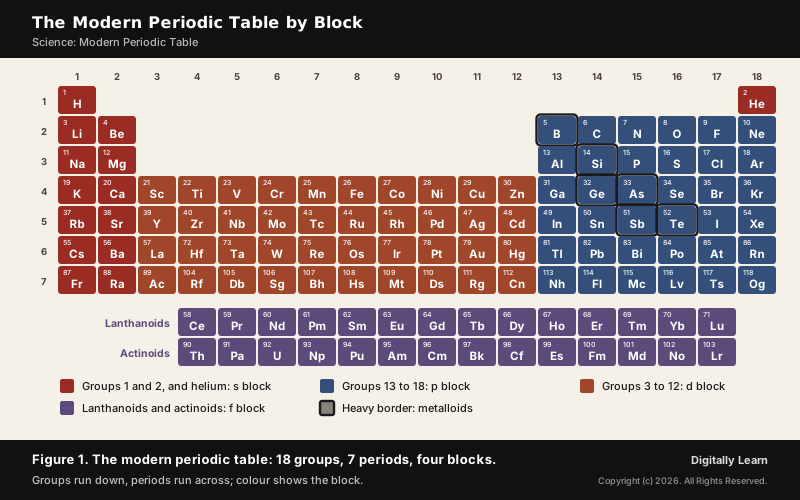
- Period number: Each period number equals the highest principal quantum number, n, of its elements, so period 3 fills the third shell.
- Elements per period: 2, 8, 8, 18, 18 and 32 in the first six periods, twice the number of orbitals in the shell being filled; with all 118 elements known, the seventh period is complete too.
- Separate panels: The 14 lanthanoids and 14 actinoids sit in two rows at the bottom, so that elements with similar properties stay in one column.
- Natural and synthetic: Of the 118 known elements the first 94 occur naturally on Earth; the remaining 24, americium to oganesson (95 to 118), are made only in laboratories.
Two elements need special mention. Hydrogen has one s-electron like the alkali metals, yet can gain an electron like the halogens, so it is placed on its own at the top. Helium belongs to the s-block by configuration (1s²) but sits in group 18 because its full shell makes it behave like the other noble gases.
Main Group Elements: s Block Elements and p Block Elements
The table divides into four blocks, named after the orbital that receives the last electron. The s block is groups 1 and 2, the alkali and alkaline earth metals, with outer configurations ns¹ and ns². They are reactive metals with low ionisation enthalpies, lose their outer electrons easily and are never found pure in nature.
The p block is groups 13 to 18, with outer configurations from ns² np¹ to ns² np⁶. Together with the s block these are the representative elements, or main group elements. Each period ends in a noble gas with a closed ns² np⁶ shell; before it come the halogens (group 17) and the chalcogens (group 16), which gain one or two electrons readily.
| Block | Outer electrons | Nature |
|---|---|---|
| s: groups 1 and 2 | ns¹ or ns² | Reactive metals; compounds mostly ionic, except lithium and beryllium |
| p: groups 13 to 18 | ns² np¹ to ns² np⁶ | Metals, metalloids and non-metals; noble gases at the end |
| d: groups 3 to 12 | (n-1)d¹⁻¹⁰ ns⁰⁻² | All metals: transition elements |
| f: two bottom rows | (n-2)f¹⁻¹⁴ (n-1)d⁰⁻¹ ns² | All metals: inner transition elements |
Transition Elements: d Block Elements and Their Properties
The d block elements fill the centre of the table, groups 3 to 12, and their last electron enters an inner d orbital. They are called transition elements because they form a bridge between the very reactive s block metals and the less active elements of groups 13 and 14.
- All metals: Iron, copper, chromium, nickel, silver, gold and platinum belong here.
- Coloured ions: Most form coloured ions and coloured compounds.
- Variable valence: They show more than one oxidation state.
- Catalysts: Many are used as catalysts: finely divided iron in the Haber process for ammonia and nickel in catalytic hydrogenation.
- Paramagnetism: Unpaired d electrons make most of them attracted by a magnetic field.
- The exceptions: Zinc, cadmium and mercury have a full d¹⁰ shell and do not show most of these properties.
The f block sits below the main table: the lanthanoids, cerium (58) to lutetium (71), and the actinoids, thorium (90) to lawrencium (103). Called inner transition elements, they are all metals whose last electron enters an f orbital, and they are taken up with the element families below.
Metals, Non-metals and Metalloids in the Periodic Table
A second way to read the table is by character. Metals make up more than 78 per cent of the known elements and sit on the left. They are usually solids with high melting points and conduct heat and electricity; mercury is the exception as a liquid, and gallium and caesium melt at only 303 K and 302 K. Non-metals, fewer than twenty, sit at the top right.
Between the two lie the metalloids, elements with properties of both metals and non-metals. They lie along a zig-zag line that runs diagonally across the p block. The six commonly recognised metalloids are boron, silicon, germanium, arsenic, antimony and tellurium. Metalloids are typically semiconductors, which is why silicon and germanium matter so much in electronics.
Periodic Trends in Properties of Elements
Atomic Radius and Ionic Radius
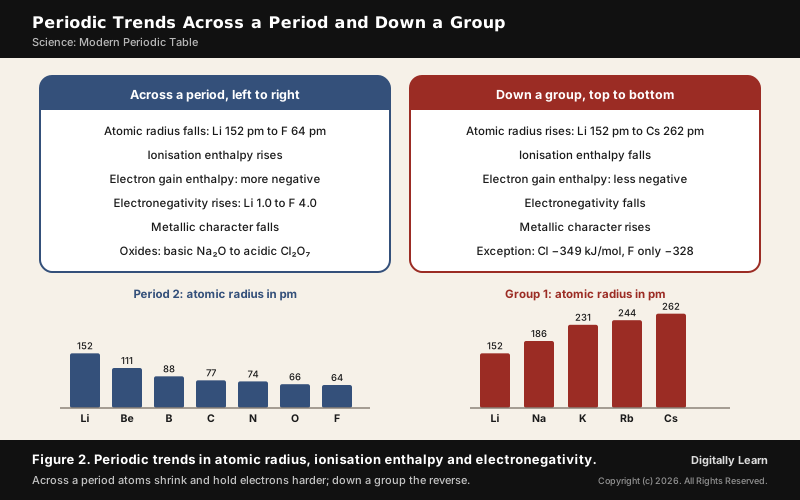
The size of an atom, its atomic radius, decreases across a period. The outer electrons stay in the same shell while the effective nuclear charge rises with atomic number, so the nucleus pulls them closer: in period 2, lithium measures 152 pm and fluorine 64 pm. Down a group the radius increases regularly, because each step adds a new shell: lithium 152, sodium 186, potassium 231, rubidium 244 and caesium 262 pm.
- Cations are smaller: A positive ion is smaller than its parent atom, because it has fewer electrons for the same nuclear charge; sodium is 186 pm but Na⁺ is 95 pm.
- Anions are larger: A negative ion is larger than its parent atom, because the added electrons increase repulsion among the electrons.
- Isoelectronic species: O²⁻, F⁻, Na⁺ and Mg²⁺ all carry 10 electrons, yet differ in size, because their nuclear charges differ; the cation with the greater positive charge is the smallest.
Ionisation Enthalpy (Ionization Energy) and Electron Gain Enthalpy
The energy needed to remove an electron from an isolated gaseous atom in its ground state is its ionisation enthalpy, often called ionization energy. It measures how firmly an atom holds its outer electron. It rises across a period as atoms shrink and nuclear charge grows, and falls down a group as the outer electron sits farther away.
- Peaks and troughs: Plotted against atomic number, ionisation enthalpy peaks at the noble gases, with their closed shells, and dips to minima at the alkali metals.
- Why alkali metals react: Their low ionisation enthalpy lets them lose the single outer electron easily, which is why they are so reactive.
The enthalpy change when an electron is added to a neutral gaseous atom to form a negative ion is its electron gain enthalpy. It is strongly negative for the halogens, which gain one electron to reach a noble gas configuration, and positive for the noble gases (neon +116 kJ/mol), which resist taking one. It generally becomes more negative across a period and less negative down a group.
Electronegativity, Metallic Character and Chemical Reactivity
The ability of an atom in a chemical compound to attract shared electrons to itself is its electronegativity, a qualitative measure. Unlike ionisation enthalpy, it cannot be measured directly, so it is read from scales, of which Linus Pauling's is the most widely used. Fluorine has the highest value and caesium the lowest.
| Period 2 element | Electronegativity |
|---|---|
| Lithium | 1.0 |
| Beryllium | 1.5 |
| Boron | 2.0 |
| Carbon | 2.5 |
| Nitrogen | 3.0 |
| Oxygen | 3.5 |
| Fluorine | 4.0 |
- Across a period: Electronegativity and non-metallic character increase; metallic character decreases.
- Down a group: Electronegativity decreases and metallic character increases.
- Reactivity at the edges: Chemical reactivity is highest in group 1 metals, lower towards the middle of the table and highest again in group 17 non-metals. Among alkali metals reactivity increases down the group; among halogens it decreases.
- Oxides: The oxide of the element on the far left is the most basic (Na₂O) and that on the far right the most acidic (Cl₂O₇); oxides in the centre are amphoteric (Al₂O₃) or neutral (CO, NO).
Element Families: Alkali Metals to Actinides
Alkali Metals and Alkaline Earth Metals
The alkali metals are lithium, sodium, potassium, rubidium, caesium and francium, the metals of group 1. With one outer electron, they react with water and tarnish in air, so they are stored under oil and found in nature only in salts. Reactivity rises down the group, and caesium is the most reactive of all the metals.
- Uses of alkali metals: Sodium chloride is table salt; the sodium-vapour lamp gives light efficiently; lithium is the anode in lithium batteries.
- Alkali metals in the body: Sodium and potassium are essential electrolytes.
The alkaline earth metals are beryllium, magnesium, calcium, strontium, barium and radium, the six elements of group 2, with two outer electrons. They are shiny, silvery-white and somewhat reactive. Magnesium and calcium are essential to all known living organisms: magnesium is part of chlorophyll in plants, and calcium salts build the bones of vertebrates and signal inside cells.
Halogens and Noble Gases
The halogens of group 17 are fluorine, chlorine, bromine, iodine and the radioactive astatine and tennessine. The name means salt former: they combine with metals to give salts such as sodium chloride. With seven outer electrons they gain one readily, and their reactivity falls down the group, so fluorine is the most reactive; it reacts with every element except the light noble gases.
- Uses of halogens: Chlorine, bromine and iodine are often used as disinfectants.
- Halogens in the body: Iodine is needed in trace amounts to make thyroid hormones such as thyroxine.
The noble gases of group 18 are helium, neon, argon, krypton, xenon and radon. Their valence shells are completely filled, so they are chemically unreactive and form very few compounds; they were once called the inert gases. Together they make up about 1 per cent of dry air by volume, most of it argon. Neil Bartlett made the first compound of a noble gas, with xenon, in 1962.
| Noble gas | Use |
|---|---|
| Helium | Weather balloons; liquid helium cools the superconducting magnets of MRI scanners; mixed with oxygen for deep-sea diving, as it dissolves very little in blood |
| Neon | Discharge tubes and fluorescent bulbs for advertising displays |
| Argon | An inert atmosphere for high-temperature work and for filling electric bulbs |
Lanthanides, Lanthanide Contraction and Rare Earth Elements
The lanthanides, or lanthanoids, are the fourteen elements after lanthanum, cerium to lutetium, in which the 4f orbitals fill. They resemble one another more closely than the members of any ordinary transition series; for years mixtures of them were taken for single elements, such as didymium, later found to be neodymium and praseodymium.
Across the series, atomic and ionic radii fall steadily from lanthanum to lutetium. This is the lanthanide contraction, caused by the imperfect shielding of one 4f electron by another. Its result is that the second and third transition series have almost the same radii: zirconium 160 pm and hafnium 159 pm. The two therefore have very similar chemical behaviour.
The rare earth elements are 17 metals: the 15 lanthanides from lanthanum to lutetium, with scandium and yttrium. The name misleads: they are not actually scarce, but occur only in compounds and are difficult to isolate and purify. China dominates reserves and production, supplying about 90 per cent of world demand in 2019, and has restricted supply since around 2010. India holds rare earths in its coastal monazite sands, and rare earth elements are on India's list of 30 critical minerals released on 24 July 2023.
- Magnets: Neodymium, praseodymium, dysprosium and terbium go into neodymium-iron-boron permanent magnets, and electric vehicles and wind turbines have raised demand.
- Screens: Some lanthanide oxides are phosphors in television screens and other fluorescing surfaces.
- Alloys and catalysts: Mischmetall, about 95 per cent lanthanide metal and 5 per cent iron, goes into lighter flints; mixed lanthanide oxides catalyse petroleum cracking.
Actinides as Nuclear Fuel: Fast Breeder Reactor at Kalpakkam
The actinides, or actinoids, are the fourteen elements from thorium to lawrencium, in which the 5f orbitals fill. All are radioactive; the later ones have half-lives as short as 3 minutes for lawrencium and can be made only in nanogram quantities. Naturally occurring uranium and thorium and man-made plutonium are the most abundant actinides on Earth, and they are the fuels of nuclear reactors.
India's three-stage nuclear power programme, planned by Homi J. Bhabha in the 1950s, is built on these actinides. India has only about 1 to 2 per cent of the world's uranium but about 25 per cent of its known thorium. Thorium itself cannot sustain fission, so the programme breeds its way there, one stage feeding the next.
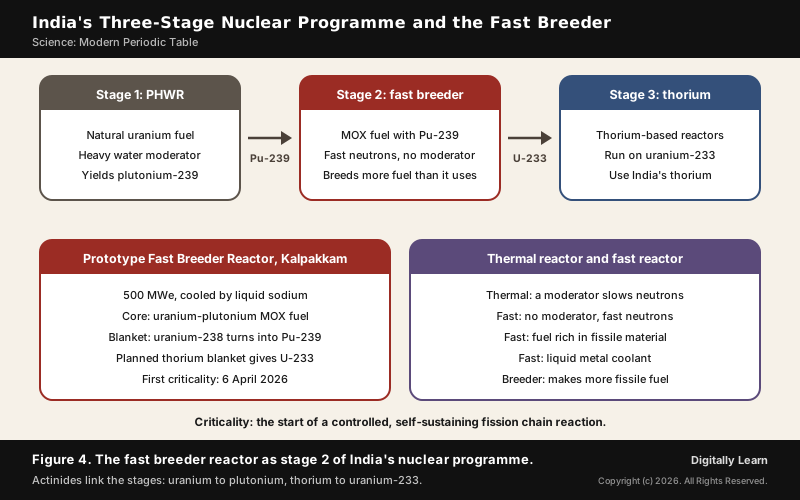
- Stage 1: Pressurised heavy water reactors burn natural uranium, with heavy water as moderator and coolant, and produce plutonium-239 as a by-product.
- Stage 2: Fast breeder reactors burn a mixed oxide (MOX) fuel of plutonium-239 and uranium and breed more fissile fuel than they consume.
- Stage 3: Thorium-232, placed as a blanket in the breeders, turns into uranium-233, the fuel for thorium-based reactors.
A thermal reactor uses a moderator to slow the neutrons from fission, because slow neutrons split uranium-235 readily. A fast reactor has no moderator and runs on fast neutrons, so it needs fuel rich in fissile material. It cannot use water as coolant, since water slows neutrons, and instead uses a liquid metal such as sodium. Fast neutrons also convert fertile uranium-238 into fissile plutonium-239, which is how a breeder makes more fuel than it burns.
| Feature | Prototype Fast Breeder Reactor (PFBR), Kalpakkam |
|---|---|
| Capacity and type | 500 MWe, pool type, cooled by liquid sodium |
| Fuel and blanket | Uranium-plutonium MOX core; uranium-238 blanket that breeds plutonium-239; a thorium-232 blanket planned to give uranium-233 |
| Who built it | Designed by the Indira Gandhi Centre for Atomic Research (IGCAR); built and commissioned by Bharatiya Nabhikiya Vidyut Nigam Ltd (BHAVINI), a Department of Atomic Energy undertaking |
| First criticality | 6 April 2026 at 8:25 pm |
Previous Year UPSC-CSE Questions
Previous Year UPSC-CSE Questions By the end you will be able to draft model answers for the following UPSC questions. Each question carries a collapsible framework showing how to approach it in the exam.
- UPSC Prelims 2001 Prelims-GSConsider the following statements with reference to the Periodic Table of chemical elements:
- I. Ionisation potential gradually decreases along a period.
- II. In a group of elements, electron affinity decreases as the atomic weight increases.
- III. In a given period, electronegativity decreases as the atomic number increases.
Which of these statement(s) is/are correct?
How to approach this Prelims question
Approach: Across a period the nuclear charge grows and the atom shrinks, so ionisation enthalpy and electronegativity both rise: I and III are false. Down a group the atom grows, so the added electron is held less tightly and electron gain enthalpy becomes less negative: II is true.
Trap to watch: Statements I and III reverse the across-a-period trends.
Key facts to recall:
- (a) I only: wrong. Ionisation potential rises, not falls, along a period.
- (b) II only: right. Electron affinity becomes less negative down a group as atoms grow larger.
- (c) I and III: wrong. Both ionisation potential and electronegativity rise across a period.
- (d) II and III: wrong. Statement III is false; electronegativity increases across a period.
Answer signal: II only, option (b).
- UPSC Prelims 2003 Prelims-GSConsider the following Assertion (A) and Reason (R):
- Assertion (A): In the periodic table of chemical elements, electron affinity is always found to increase from top to bottom in a group.
- Reason (R): In a group, the atomic radius generally increases from top to bottom.
Select the correct answer using the codes given below.
How to approach this Prelims question
Approach: Test each statement. Down a group the atom grows larger, so R is true; but a larger atom holds an added electron less tightly, so electron gain enthalpy becomes less negative and A, which says it always increases, is false.
Trap to watch: 'Always increase' is the wrong direction for electron affinity.
Key facts to recall:
- (a) A and R true, R explains A: wrong. A is false.
- (b) A and R true, R does not explain A: wrong. A is false.
- (c) A true, R false: wrong. A is false, and the atomic radius does increase down a group.
- (d) A false, R true: right. Electron affinity does not always increase down a group, and the atomic radius does grow.
Answer signal: A false, R true, option (d).
- UPSC Prelims 1997 Prelims-GSThe most reactive among the halogens is
How to approach this Prelims question
Approach: Recall the reactivity trend in group 17.
Trap to watch: Chlorine has the more negative electron gain enthalpy, but fluorine is more reactive.
Key facts to recall:
- (a) fluorine: right. Halogen reactivity falls down the group, so fluorine, at the top, is the most reactive.
- (b) chlorine: wrong. Chlorine has the most negative electron gain enthalpy, but it is less reactive than fluorine.
- (c) bromine: wrong. It lies lower in the group and is less reactive.
- (d) iodine: wrong. It is the least reactive of the four.
Answer signal: Fluorine, option (a).
- UPSC Prelims 2012 Prelims-GSRecently, there has been a concern over the short supply of a group of elements called ‘rare earth metals’. Why?
- China, which is the largest producer of these elements, has imposed some restrictions on their export.
- Other than China, Australia, Canada and Chile, these elements are not found in any country.
- Rare earth metals are essential for the manufacture of various kinds of electronic items and there is a growing demand for these elements.
Which of the statements given above is/are correct?
How to approach this Prelims question
Approach: China, the largest producer, restricted exports from around 2010, and demand for rare earths in electronics and magnets kept rising, so 1 and 3 are true. Statement 2 is false, because rare earths occur elsewhere too, including India's monazite sands.
Trap to watch: Statement 2 fails because India, among others, has rare earths.
Key facts to recall:
- (a) 1 only: wrong. Growing demand for electronics is also a reason, so statement 3 holds.
- (b) 2 and 3 only: wrong. Statement 2 is false; rare earths are found in other countries, India among them.
- (c) 1 and 3 only: right. China's export restrictions and rising demand for electronics caused the short supply.
- (d) 1, 2 and 3: wrong. Rare earths are not confined to China, Australia, Canada and Chile.
Answer signal: 1 and 3 only, option (c).
- UPSC Prelims 2025 Prelims-GSConsider the following statements:
- Statement I: Some rare earth elements are used in the manufacture of flat television screens and computer monitors.
- Statement II: Some rare earth elements have phosphorescent properties.
Which one of the following is correct in respect of the above statements?
How to approach this Prelims question
Approach: Judge each statement, then whether II is the reason for I.
Trap to watch: Both facts are true; do not assume the second is the reason for the first.
Key facts to recall:
- (a) Both correct, II explains I: wrong. Not every use rests on phosphorescence, so the official key does not treat II as the explanation of I.
- (b) Both correct, II does not explain I: right, as the official key gives it. Rare earths are used in flat screens, and some are phosphorescent.
- (c) I correct, II not correct: wrong. Some rare earth elements do have phosphorescent properties.
- (d) I not correct, II correct: wrong. Rare earths are used in flat television screens and monitors.
Answer signal: Both correct, II does not explain I, option (b).
- UPSC Mains 2026 GS-IIIDistinguish between a Fast Breeder Reactor (FBR) and a thermal nuclear reactor. In the context of first indigenously developed prototype FBR at Kalpakkam, explain the term 'criticality'. What are its implications for clean energy future of our country?
Answer outline: how to structure the answer
What the question asks, the main arguments, relevant examples and the direction of the conclusion. This is not a full model answer.
Introduction: On 6 April 2026 the 500 MWe Prototype Fast Breeder Reactor at Kalpakkam reached first criticality, taking India into stage 2 of its three-stage nuclear programme.
Body (sub-themes to develop):
- Thermal reactor: a moderator slows neutrons so that uranium-235 splits; India's PHWRs burn natural uranium with heavy water as moderator and coolant.
- Fast breeder: no moderator, fast neutrons, MOX fuel rich in fissile material, liquid sodium coolant; breeds plutonium-239 from a uranium-238 blanket.
- Criticality: the start of a controlled, self-sustaining fission chain reaction.
- Implications: more energy from scarce uranium, a closed fuel cycle, and a thorium blanket giving uranium-233 for stage 3 and low-carbon base-load power.
Conclusion: Conclude that the PFBR is the bridge between today's heavy water reactors and India's thorium future.
Sources
- NCERT: Science (Class X), Periodic Classification of Elements
- NCERT: Chemistry Part I (Class XI), Classification of Elements and Periodicity in Properties
- NCERT: Chemistry Part I (Class XII), The p-Block Elements and The d- and f-Block Elements
- PIB: Prototype Fast Breeder Reactor at Kalpakkam attains first criticality (7 April 2026)
- Department of Atomic Energy: PFBR attains first criticality
- IGCAR: Director's message on the first criticality of the PFBR (7 April 2026)
- PIB: Thirty critical minerals list released (Ministry of Mines, 24 July 2023)
- Wikipedia: Periodic table
- Wikipedia: Henry Moseley
- Wikipedia: Metalloid
- Wikipedia: Rare-earth element
- Wikipedia: Lanthanide contraction
- Wikipedia: Prototype Fast Breeder Reactor
- Wikipedia: India's three-stage nuclear power programme
- Wikipedia: Fast-neutron reactor
- UPSC: Civil Services Examination question papers
Editorial Disclaimer
This article draws on the NCERT science and chemistry textbooks, the Department of Atomic Energy, IGCAR and the other sources listed on this page. Some dates in the early history of the periodic table differ slightly between sources.


