


Overview
Bonds, reaction types, redox, catalysts and photochemical smog
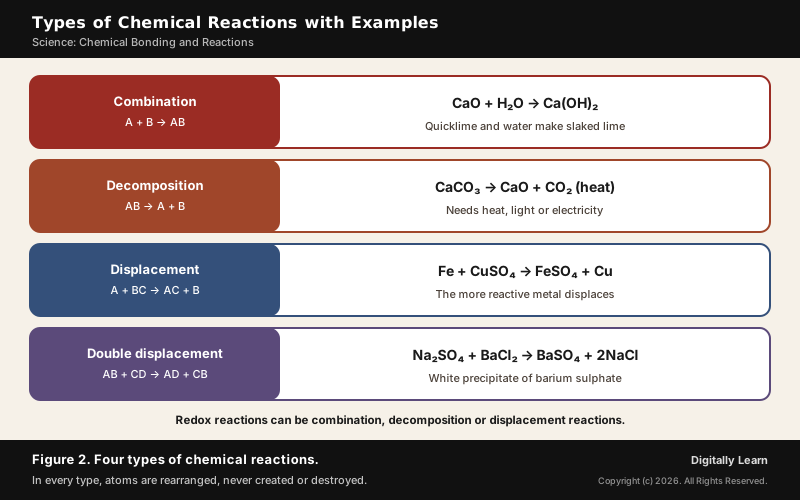
Chemical reactions are changes in which substances break and form bonds between their atoms to make new substances, shown by a change of state, colour or temperature or the release of a gas. Chemical bonding is what holds those atoms together: by transfer of electrons in ionic bonds, by sharing in covalent bonds, and by a sea of electrons in metals.
Chemical Bonding: Why Atoms Combine
Ionic Bond: Formation and Properties of Ionic Compounds
Atoms combine because a bonded arrangement is more stable than separate atoms. In 1916 Kössel and Lewis independently explained this through the inertness of the noble gases: atoms lose, gain or share electrons until each has a stable noble gas configuration, usually eight outer electrons, the octet. The electron arrangement that decides this is explained under atomic structure.
When a metal gives electrons to a non-metal, the resulting charged ions attract each other: an ionic bond, or electrovalent bond. Sodium (2, 8, 1) gives its outer electron to chlorine (2, 8, 7), leaving Na⁺ and Cl⁻, both with noble gas configurations. Removing the electron from sodium costs 495.8 kJ/mol and chlorine gives back only 348.7; what makes sodium chloride stable is the lattice enthalpy, −788 kJ/mol, released as the ions pack into a crystal.
- Hard and brittle solids: Strong attraction between oppositely charged ions makes ionic compounds solid and somewhat hard, but they break into pieces under pressure.
- High melting and boiling points: A great deal of energy is needed to break the strong inter-ionic attraction.
- Solubility: Generally soluble in water and insoluble in solvents such as kerosene and petrol.
- Electrical conduction: They conduct in solution and when molten, because the ions can move; the solid does not conduct, because its ions are held rigidly in place.
Covalent Bond, Polar Bonds and Hydrogen Bond
Two non-metals usually share electrons instead of transferring them. A covalent bond is formed by sharing a pair of electrons between two atoms. Carbon, with four valence electrons, shares them with four hydrogen atoms to make methane. Sharing two pairs makes a double bond, as in carbon dioxide and ethene; sharing three makes a triple bond, as in nitrogen (N₂) and ethyne.
- Low melting points: Covalent molecules have strong bonds within the molecule but weak forces between molecules, so they usually melt and boil at low temperatures.
- Polar bonds: In hydrogen fluoride the shared pair sits closer to fluorine, the more electronegative atom, so the bond is polar and the molecule has a dipole moment. In a molecule of two identical atoms, such as H₂, the pair sits exactly between them: a nonpolar bond.
- Water molecule: The two O-H bonds meet at 104.5°, so water is bent and its bond dipoles do not cancel.
The hydrogen bond is the attractive force that binds the hydrogen atom of one molecule to an electronegative atom, fluorine, oxygen or nitrogen, of another. It is weaker than a covalent bond but strong enough to shape matter: it explains the unusually high boiling point of water, it is greatest in the solid state, and it holds together the base pairs of DNA.
- Intermolecular: Between two molecules, as in hydrogen fluoride, alcohol or water.
- Intramolecular: Between two parts of the same molecule.
Metallic Bond and Shapes of Molecules
Metals hold together in a third way. A metal is an orderly array of positive ions held together by a sea of free electrons, to which each atom contributes one or more electrons. These mobile electrons spread evenly through the crystal and give metals their high electrical and thermal conductivity.
The shape of a molecule follows from how its electron pairs repel one another, the idea behind VSEPR theory. Two, three and four electron pairs around a central atom arrange themselves as a line, a flat triangle and a tetrahedron. Lone pairs push harder than bonding pairs, which squeezes the bond angles.
| Molecule | Shape | Bond angle |
|---|---|---|
| Boron trifluoride (BF₃) | Trigonal planar | 120° |
| Methane (CH₄) | Tetrahedral | 109.5° |
| Ammonia (NH₃) | Pyramidal: one lone pair | 107° |
| Water (H₂O) | Bent: two lone pairs | 104.5° |
Chemical Reactions and Chemical Equations
Chemical Equations: Writing and Balancing
Milk turning sour, iron rusting, grapes fermenting and food being digested all change the identity of a substance: each is a chemical reaction, a chemical change. Reactions break and make bonds between atoms to form new substances; atoms of one element never turn into another. A reaction shows itself through a change of state, a change of colour, the release of a gas or a change in temperature.
A chemical equation writes a reaction in symbols, reactants on the left and products on the right. It must be balanced, because of the law of conservation of mass: mass is neither created nor destroyed, so the number of atoms of each element must be the same on both sides.
- Skeletal equation: Fe + H₂O → Fe₃O₄ + H₂ has unequal atoms on the two sides.
- Balanced by trial: Change only the coefficients, never the formulae, to reach 3Fe + 4H₂O → Fe₃O₄ + 4H₂.
- State symbols: (s), (l), (g) and (aq) mark solid, liquid, gas and a solution in water.
- Conditions: Temperature, pressure or a catalyst are written above or below the arrow; photosynthesis, for example, is written with sunlight and chlorophyll on the arrow.
Types of Chemical Reactions: Combination, Decomposition and Displacement
Reactions fall into a few families, set by what happens to the reactants. Learning the families makes most equations easy to predict.
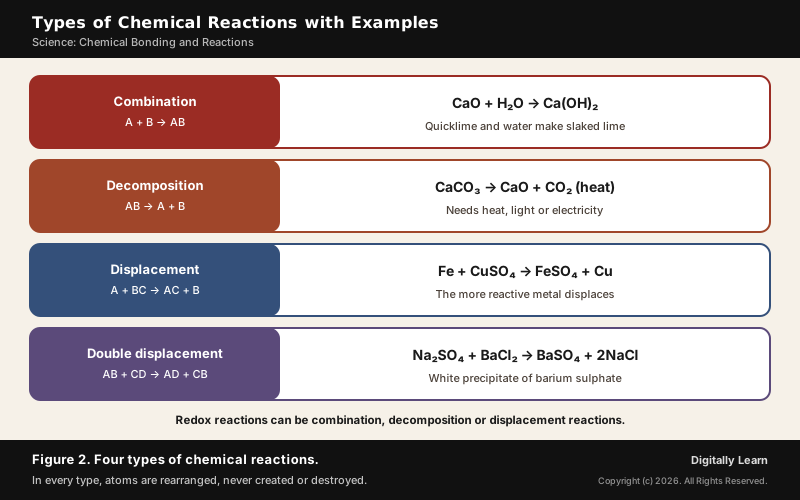
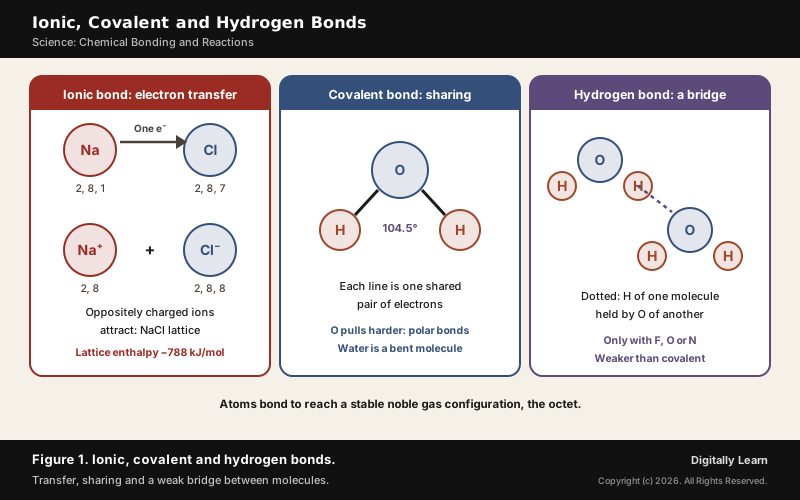
- Combination: Two or more reactants form a single product. Quicklime and water give slaked lime, Ca(OH)₂, used for whitewash; it slowly takes up carbon dioxide to form a shiny layer of calcium carbonate, the same compound as marble. Burning coal is another example.
- Decomposition: One reactant breaks into simpler products. Heating limestone gives quicklime for cement; heating lead nitrate releases brown nitrogen dioxide; silver chloride and silver bromide split in sunlight, the reaction behind black and white photography; and electricity splits water into hydrogen and oxygen.
- Displacement: A more reactive element pushes a less reactive one out of its compound. Iron nails in copper sulphate turn brown and the blue colour fades as copper is displaced; zinc and lead do the same.
- Double displacement: Two compounds exchange ions. Sodium sulphate and barium chloride give an insoluble white precipitate of barium sulphate, so this is also a precipitation reaction.
Exothermic and Endothermic Reactions
Every reaction also moves energy. Reactions that release heat along with their products are exothermic; reactions that absorb energy are endothermic. Combination reactions such as quicklime with water often release heat, while decomposition reactions need energy in the form of heat, light or electricity.
| Exothermic: heat given out | Endothermic: energy taken in |
|---|---|
| Quicklime reacting with water | Decomposition of calcium carbonate by heat |
| Burning of natural gas | Silver chloride splitting in sunlight |
| Respiration: glucose and oxygen give carbon dioxide, water and energy | Electrolysis of water |
| Vegetable matter decomposing into compost | Barium hydroxide mixed with ammonium chloride |
Oxidation and Reduction: Redox Reactions
Redox Reaction and Oxidation Number
When copper powder is heated, it gains oxygen and turns into black copper oxide; passing hydrogen over the hot oxide takes the oxygen away again. The first change is oxidation and the second is reduction, and they always happen together: when copper oxide loses oxygen, hydrogen gains it. A reaction in which one substance is oxidised and another reduced is a redox reaction.
- In terms of oxygen and hydrogen: Oxidation is the gain of oxygen or loss of hydrogen; reduction is the loss of oxygen or gain of hydrogen.
- In terms of electrons: Oxidation is the loss of electrons and reduction is the gain of electrons.
- Agents: The oxidising agent accepts electrons and is itself reduced; the reducing agent donates electrons and is itself oxidised.
- Redox examples: ZnO + C → Zn + CO, where carbon is oxidised; and MnO₂ + 4HCl → MnCl₂ + 2H₂O + Cl₂, where HCl is oxidised to chlorine and MnO₂ is reduced.
For reactions without obvious oxygen or hydrogen, chemists track the oxidation number, the charge an atom would carry if its electrons were assigned by fixed rules. An increase in oxidation number is oxidation; a decrease is reduction.
| Rule | Worked example |
|---|---|
| Alkaline earth metals are +2 in all compounds | Calcium in calcium peroxide (CaO₂): +2 |
| Aluminium is +3 in all compounds | Aluminium in NaAlH₄: +3 |
| Oxygen is −2, but −1 in peroxides and +2 in OF₂ | Manganese in MnO₂: +4, since two oxygens give −4 |
| Hydrogen is +1, but −1 in metal hydrides such as NaH | Sulphur in H₂S₂O₇: +6, since 2(+1) + 2S + 7(−2) = 0 |
| The numbers in a compound add up to zero | Used in every example above |
Rancidity, Corrosion and Everyday Redox Reactions
Oxidation works quietly all around us. Fats and oils left for long are oxidised: they become rancid, and their smell and taste change. This is rancidity, and food makers fight it in three ways.
- Antioxidants: Substances that prevent oxidation are added to foods containing fats and oils.
- Air-tight containers: Keeping out oxygen slows the reaction.
- Nitrogen flushing: Bags of chips are flushed with nitrogen so that the chips do not get oxidised.
Metals suffer the same process as corrosion. A metal attacked by moisture, acids or other substances around it corrodes: iron gets a reddish brown coat of rust, silver a black coating and copper a green one. Corrosion damages car bodies, bridges, railings and ships, and replacing corroded iron costs large sums every year. Burning, too, is oxidation: magnesium burns with a dazzling white flame to magnesium oxide.
Rate of Reaction and Catalysts
Rate of Reaction: Temperature, Concentration and Activation Energy
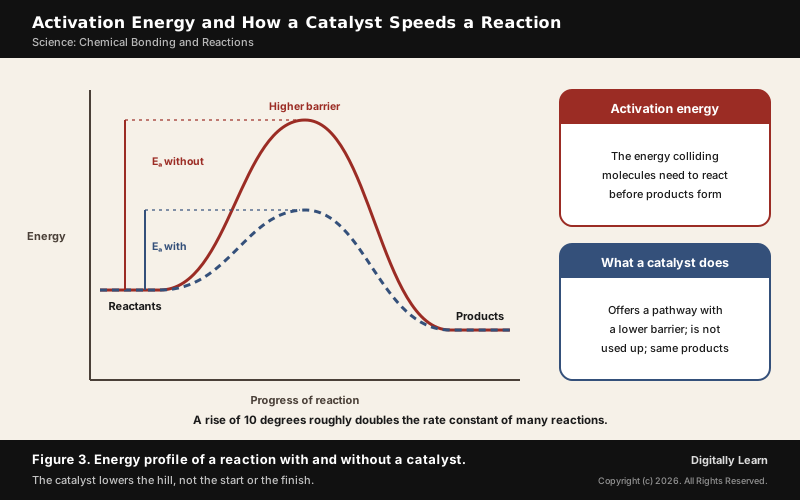
The rate of a reaction depends on the concentration of the reactants, the temperature and the presence of a catalyst. Molecules must collide to react, but only collisions with enough energy, the threshold energy, and the proper orientation break old bonds and form new ones; these are the effective collisions.
The extra energy that reactants need to reach that point is the activation energy. Raising the temperature gives more molecules that energy: for a chemical reaction, a rise of 10 degrees nearly doubles the rate constant. The Arrhenius equation, first proposed by J. H. van 't Hoff and justified by Svante Arrhenius, links the rate constant to temperature and activation energy.
Catalyst and Catalysis: Homogeneous, Heterogeneous and Enzymes
A catalyst is a substance that alters the rate of a reaction without itself undergoing any permanent chemical change; the phenomenon is catalysis. Manganese dioxide, for example, speeds the decomposition of potassium chlorate. A catalyst provides an alternative pathway with a lower activation energy, so a small amount can act on a large amount of reactants.
- What it cannot do: A catalyst does not change the equilibrium constant; it speeds the forward and backward reactions alike, so equilibrium is reached sooner but in the same place.
- Promoters and poisons: Promoters raise a catalyst’s activity and poisons lower it; in the Haber process molybdenum promotes the iron catalyst.
- Homogeneous catalysis: Reactants and catalyst are in the same phase, as when nitric oxide catalyses the oxidation of sulphur dioxide in the lead chamber process.
- Heterogeneous catalysis: A solid catalyst acts on gases or liquids: finely divided iron for ammonia, platinum gauze for nitric acid, and finely divided nickel to hydrogenate vegetable oils into vegetable ghee.
- Zeolites: Porous catalysts used to crack hydrocarbons; ZSM-5 converts alcohols directly into petrol.
Enzymes are nature's catalysts: protein molecules of high molecular mass that catalyse the reactions keeping plants and animals alive. Invertase splits cane sugar into glucose and fructose, zymase turns glucose into ethyl alcohol and carbon dioxide, and diastase turns starch into maltose. Enzymes are highly specific, as urease acts on urea alone, and work best at an optimum temperature of 298 to 310 K and an optimum pH of 5 to 7. Human body temperature, 310 K, suits them.
Industrial Catalysts and the Catalytic Converter
Many reactions of industrial importance use solid catalysts. The Haber process, developed by Fritz Haber and Carl Bosch in the first decade of the twentieth century, fixes nitrogen from the air as ammonia, the raw material of nitrogen fertilisers.
| Process | Product | Catalyst |
|---|---|---|
| Haber process | Ammonia | Finely divided iron, with molybdenum as promoter |
| Ostwald process | Nitric acid | Platinum gauze |
| Contact process | Sulphuric acid | Vanadium pentoxide (V₂O₅) |
| Hydrogenation of oils | Vegetable ghee | Finely divided nickel |
A catalytic converter in a vehicle's exhaust uses a catalyst to drive redox reactions that clean the gas. A two-way converter combines oxygen with carbon monoxide and unburnt hydrocarbons to give carbon dioxide and water; a three-way converter also reduces oxides of nitrogen. Its catalysts are metals such as platinum, rhodium and palladium.
- India’s leap: India skipped the BS-V stage and moved straight from BS-IV to BS-VI emission norms from 1 April 2020, considering rising pollution.
- Cleaner fuel enables cleaner exhaust: BS-VI fuel carries at most 10 ppm of sulphur against 50 ppm under BS-IV, which allows advanced controls such as diesel particulate filters and selective catalytic reduction.
Photochemical Reactions and Photochemical Smog
Photochemical Smog: Formation and Effects
Some reactions are driven by light, and one of them fills city skies. Smog, a blend of smoke and fog, comes in two kinds. Classical smog forms in cool, humid climates from smoke, fog and sulphur dioxide; it is a reducing mixture. Photochemical smog forms in warm, dry and sunny weather, when sunlight acts on unsaturated hydrocarbons and nitrogen oxides from vehicles and factories; it is rich in oxidising agents, so it is called oxidising smog.
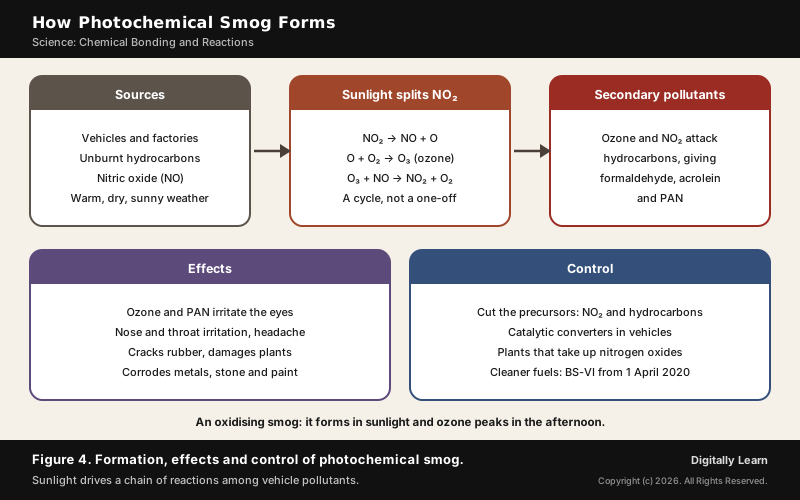
- Step 1: Burning fuel releases unburnt hydrocarbons and nitric oxide (NO), which is converted into nitrogen dioxide (NO₂).
- Step 2: NO₂ absorbs sunlight and splits into NO and a free oxygen atom.
- Step 3: The oxygen atom joins O₂ to form ozone (O₃), which reacts with NO to regenerate NO₂.
- Step 4: Ozone and NO₂, both strong oxidising agents, react with unburnt hydrocarbons to form formaldehyde, acrolein and peroxyacetyl nitrate (PAN).
The result harms people and materials alike. Ozone and PAN are powerful eye irritants; ozone and nitric oxide irritate the nose and throat and, at high levels, cause headache, chest pain and difficulty in breathing. The smog cracks rubber, damages plants and corrodes metals, stone, building materials and paint. Because ozone forms by photochemical reactions of nitrogen oxides and volatile organic compounds, its levels peak in the early to mid afternoon. In Delhi, smog is often made worse by stubble burning in neighbouring farmland.
Control of Smog and the 1999 Gothenburg Protocol
Smog is controlled by cutting what feeds it. If the primary precursors, nitrogen dioxide and hydrocarbons, are controlled, the secondary ones, ozone and PAN, fall too, and the smog with them.
- Catalytic converters: They stop nitrogen oxides and hydrocarbons from reaching the air.
- Trees that take up nitrogen oxide: Pinus, Juniperus, Quercus, Pyrus and Vitis can metabolise nitrogen oxide, so planting them helps.
- Law and fuel in India: The Air (Prevention and Control of Pollution) Act, 1981 underpins India’s air monitoring, and vehicle norms tightened from BS-IV in 2017 to BS-VI in 2020.
- National Clean Air Programme: Its analysis finds that particulate matter exceeds national standards across the country, while sulphur dioxide, nitrogen oxides and ozone are mostly within them.
Air pollution also crosses borders, which is why countries have signed treaties on it. The Gothenburg Protocol, formally the Protocol to Abate Acidification, Eutrophication and Ground-level Ozone, was signed on 30 November 1999 in Gothenburg, Sweden, under the 1979 Convention on Long-Range Transboundary Air Pollution.
- What it caps: National emission ceilings for sulphur dioxide, nitrogen oxides, volatile organic compounds and ammonia, to be met by 2010.
- In force: From 17 May 2005; revised in May 2012 with further reduction commitments for 2020.
- Its reach: Europe, North America and countries of Eastern Europe, the Caucasus and Central Asia; India is not within its scope.
Previous Year UPSC-CSE Questions
Previous Year UPSC-CSE Questions By the end you will be able to draft model answers for the following UPSC questions. Each question carries a collapsible framework showing how to approach it in the exam.
- UPSC Prelims 2003 Prelims-GSWith reference to ionic compounds, consider the following statements:
- Ionic compounds are insoluble in alcohol.
- Ionic compounds in the solid state are good conductors of electricity.
Which of these statements is/are correct?
How to approach this Prelims question
Approach: Statement 1: ionic compounds dissolve in water but not in organic solvents such as alcohol, kerosene and petrol, so it is correct. Statement 2: they conduct only when molten or dissolved, when the ions can move; in the solid the ions are fixed, so it is wrong.
Trap to watch: Solid ionic compounds do not conduct; only molten or dissolved ones do.
Key facts to recall:
- (a) Only 1: right. Ionic compounds do not dissolve in alcohol, and as solids they do not conduct.
- (b) Only 2: wrong. In the solid the ions are fixed in the lattice, so the compound cannot conduct.
- (c) Both 1 and 2: wrong. Statement 2 is false.
- (d) Neither 1 nor 2: wrong. Statement 1 is correct.
Answer signal: Only 1, option (a).
- UPSC Prelims 2001 Prelims-GSConsider the following Assertion (A) and Reason (R):
- Assertion (A): A chemical reaction becomes faster at higher temperatures.
- Reason (R): At higher temperatures, molecular motion becomes more rapid.
Which of the following is correct?
How to approach this Prelims question
Approach: A reaction happens only when molecules collide with enough energy and the right orientation. At a higher temperature molecules move faster, so they collide more often and more of the collisions carry the activation energy. Both are true and R explains A.
Trap to watch: Both being true is not enough; here R is the explanation.
Key facts to recall:
- (a) A and R true, R explains A: right. Faster molecules collide more often and more of them carry the activation energy.
- (b) A and R true, R does not explain A: wrong. Faster molecular motion is exactly why the rate rises.
- (c) A true, R false: wrong. Molecules do move faster at higher temperatures.
- (d) A false, R true: wrong. Reactions do speed up with temperature; a 10 degree rise nearly doubles the rate constant.
Answer signal: Both true and R explains A, option (a).
- UPSC Prelims 2002 Prelims-GSMatch List I (Oxidation number) with List II (The element) and select the correct answer using the codes given below the lists: List I (Oxidation number): A. 2, B. 3, C. 4, D. 6.
- 1. Oxidation number of Mn in MnO₂
- 2. Oxidation number of S in H₂S₂O₇
- 3. Oxidation number of Ca in CaO₂
- 4. Oxidation number of Al in NaAlH₄
Codes:
How to approach this Prelims question
Approach: Work each oxidation number from the rule that the numbers add to the charge. Calcium is +2; in NaAlH₄, sodium +1 and four hydride ions at −1 leave aluminium +3; in MnO₂ two oxygens at −2 leave manganese +4; in H₂S₂O₇ seven oxygens at −2 and two hydrogens at +1 leave each sulphur +6.
Trap to watch: In CaO₂ oxygen is −1 (a peroxide), but calcium is still +2.
Key facts to recall:
- (a) A-3, B-4, C-1, D-2: right. Ca in CaO₂ is +2, Al in NaAlH₄ is +3, Mn in MnO₂ is +4 and S in H₂S₂O₇ is +6.
- (b) A-4, B-3, C-1, D-2: wrong. It gives aluminium +2 and calcium +3; calcium is always +2 in its compounds.
- (c) A-3, B-4, C-2, D-1: wrong. It swaps manganese (+4) and sulphur (+6).
- (d) A-4, B-3, C-2, D-1: wrong. It makes both swaps.
Answer signal: A-3, B-4, C-1, D-2, option (a).
- UPSC Prelims 2013 Prelims-GSPhotochemical smog is a resultant of the reaction among
How to approach this Prelims question
Approach: Photochemical smog needs sunlight, which rules out (c) and (d). Sunlight splits nitrogen dioxide, and the reactions that follow give ozone and peroxyacetyl nitrate.
Trap to watch: Options with CO, low temperature or evening describe the wrong smog.
Key facts to recall:
- (a) NO₂, O₃ and peroxyacetyl nitrate in sunlight: right. Sunlight splits NO₂, and ozone and PAN form in the smog.
- (b) CO, O₂ and peroxyacetyl nitrate in sunlight: wrong. Carbon monoxide is not a component of photochemical smog's chemistry.
- (c) CO, CO₂ and NO₂ at low temperature: wrong. Photochemical smog needs sunlight; it forms on warm, sunny days.
- (d) NO₂, O₃ and CO in the evening: wrong. Without sunlight the photochemical reactions do not run.
Answer signal: NO₂, O₃ and PAN in sunlight, option (a).
- UPSC Prelims 2003 Prelims-GSWhich one of following is produced during the formation of photochemical smog?
How to approach this Prelims question
Approach: Separate what goes in from what is produced.
Trap to watch: Hydrocarbons and nitrogen oxides are inputs, not products.
Key facts to recall:
- (a) Hydrocarbons: wrong. Hydrocarbons are among the pollutants that go in, not a product.
- (b) Nitrogen Oxides: wrong. Nitrogen oxides are also starting pollutants.
- (c) Ozone: right. Sunlight splits NO₂ into NO and an oxygen atom, and the oxygen atom joins O₂ to form ozone.
- (d) Methane: wrong. Methane is not formed in the smog reactions.
Answer signal: Ozone, option (c).
- UPSC Mains 2022 GS-IIIDiscuss in detail the photochemical smog emphasizing its formation, effects and mitigation. Explain the 1999 Gothenburg Protocol.
Answer outline: how to structure the answer
What the question asks, the main arguments, relevant examples and the direction of the conclusion. This is not a full model answer.
Introduction: Photochemical smog is an oxidising smog that forms in warm, sunny weather when sunlight acts on nitrogen oxides and hydrocarbons from vehicles and factories.
Body (sub-themes to develop):
- Formation: NO₂ splits in sunlight; the oxygen atom forms ozone; ozone and NO₂ react with hydrocarbons to give formaldehyde, acrolein and PAN.
- Effects: eye irritation from ozone and PAN; nose and throat irritation, headache, breathing difficulty; cracked rubber, damaged plants, corroded metals and stone.
- Mitigation: cut the precursors; catalytic converters; plants that take up nitrogen oxides; India's BS-VI norms from 2020 and the National Clean Air Programme.
- Gothenburg Protocol: signed 30 November 1999 under the 1979 transboundary air pollution convention; ceilings for SO₂, NOx, VOCs and ammonia; in force 2005, revised 2012.
Conclusion: Conclude that because ozone forms in the air instead of being emitted, cutting its precursors is the way to control it, the approach the protocol takes.
Sources
- NCERT: Science (Class X), Chemical Reactions and Equations; Metals and Non-metals
- NCERT: Chemistry Part I (Class XI), Chemical Bonding and Molecular Structure
- NCERT: Chemistry Part II (Class XI), Redox Reactions and Environmental Chemistry
- NCERT: Chemistry Part I (Class XII), The Solid State, Chemical Kinetics and Surface Chemistry
- PIB: Government decides to directly shift from BS-IV to BS-VI emission norms (6 January 2016)
- PIB: Fuel quality improved from BS-IV to BS-VI norms (25 July 2022)
- Central Pollution Control Board: National Ambient Air Quality Status and Trends in India, 2010
- Ministry of Environment, Forest and Climate Change: National Clean Air Programme
- Wikipedia: Hydrogen bond
- Wikipedia: Catalytic converter
- Wikipedia: Rancidification
- Wikipedia: Haber process
- Wikipedia: Smog
- Wikipedia: Gothenburg Protocol
- UPSC: Civil Services Examination question papers
Editorial Disclaimer
This article draws on the NCERT science and chemistry textbooks, the Central Pollution Control Board, the Press Information Bureau and the other sources listed on this page.


