

Overview
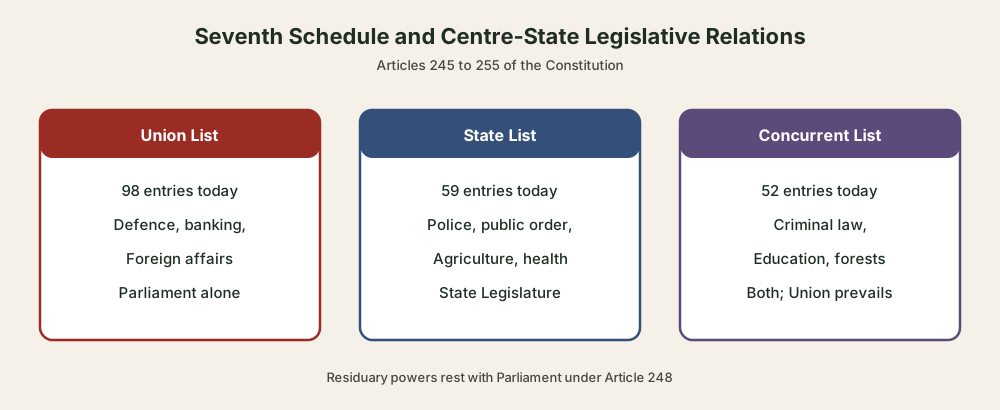
The Seventh Schedule of Indian Constitution divides law-making subjects between Parliament and the State Legislatures in three lists: the Union List, the State List and the Concurrent List. Articles 245 to 255 set out how the lists work, give residuary powers to Parliament, settle conflicts in the Union's favour and let Parliament legislate on State subjects in five special situations.
Legislative Relations Between Centre and State: Articles 245 to 248
Territorial Extent of Laws Under Article 245
The Constitution creates two sets of government: one for the entire nation and one for each State, both with constitutional status. How law-making power is shared between them is set out in Articles 245 to 255, which form Chapter I of Part XI. The wider federal design is explained in the article on the federal features of the Constitution.
Where each legislature's laws run is fixed by Article 245. Parliament may make laws for the whole or any part of the territory of India, and a State Legislature for the whole or any part of its State. No law of Parliament is invalid because it has extra-territorial operation, so only Parliament can legislate beyond India's borders, for Indian citizens and their property abroad. A state law does not apply outside the State unless there is a sufficient nexus between the State and the object.
- Union Territories without legislatures: The President can make regulations for the Andaman and Nicobar Islands, Lakshadweep, and Dadra and Nagar Haveli and Daman and Diu; a regulation has the force of an Act of Parliament and may repeal or amend one.
- Scheduled areas: The Governor may direct that an Act of Parliament does not apply to a scheduled area in the State, or applies with modifications.
- Tribal areas: The Governor of Assam has the same power over autonomous districts in Assam, and the President over those in Meghalaya, Tripura and Mizoram.
Union List, State List, Concurrent List: How Many Subjects
Article 246 divides legislative subjects into three lists in the Seventh Schedule. Parliament has exclusive power over the matters in List I, the Union List. The Legislature of a State has exclusive power, for that State, over List II, the State List. Both may legislate on List III, the Concurrent List. Under Article 246(4) Parliament may also legislate for any area not included in a State, even on State List matters.
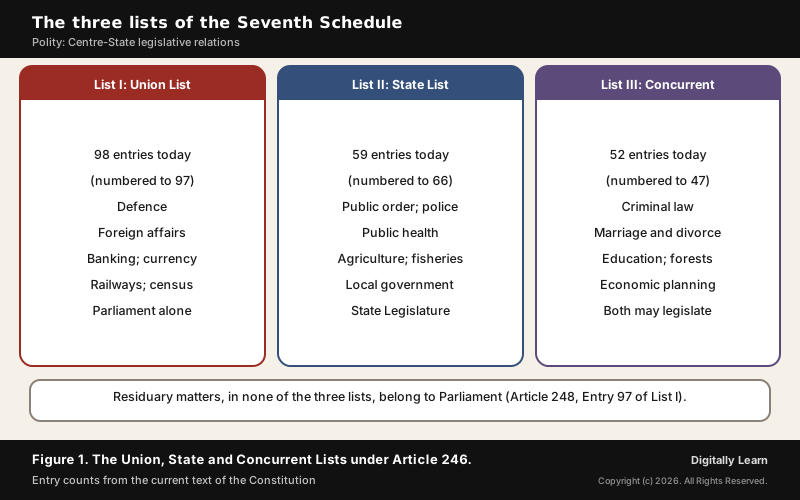
The division follows a simple logic. Matters of national importance that need one law across the country go to the Union List; matters of regional and local importance that allow diversity go to the State List; and matters where uniformity is desirable but not essential go to the Concurrent List, which permits diversity along with uniformity.
| List | Examples with entry numbers |
|---|---|
| List I: Union | Defence (1); foreign affairs (10); treaties (14); railways (22); currency (36); banking (45); regulation of labour and safety in mines and oilfields (55); census (69) |
| List II: State | Public order (1); police (2); prisons (4); local government (5); public health and sanitation (6); agriculture (14); fisheries (21) |
| List III: Concurrent | Criminal law (1); criminal procedure (2); marriage and divorce (5); economic and social planning (20); population control (20A); education (25) |
Forty-Second Amendment: Five Subjects Moved to the Concurrent List
The 42nd Amendment Act of 1976 moved five subjects from the State List to the Concurrent List: education, forests, weights and measures, protection of wild animals and birds, and administration of justice, meaning the constitution and organisation of all courts except the Supreme Court and the High Courts. It also added population control and family planning as a new concurrent entry.
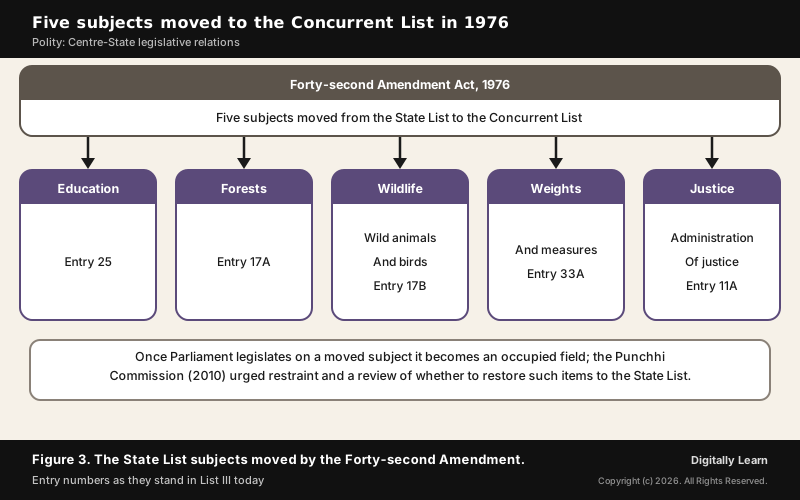
A transferred subject does not return automatically. Once Parliament legislates on it, the matter becomes an occupied field and the States' room to act shrinks. The Punchhi Commission (2010) asked the Union to be extremely restrained in asserting parliamentary supremacy over matters assigned to the States, and suggested a joint review of whether each transferred item should go back to the State List.
Residuary Powers Under Article 248 and the GST Exception
Residuary powers are the power to legislate on any matter not named in any of the three lists. Under Article 248 they belong to Parliament alone, and they include the power to levy any tax not mentioned in the State or Concurrent Lists. Entry 97 of the Union List says the same thing: any other matter not enumerated in List II or List III.
Federations handle the residue differently. The United States and Australia list only the federal powers and leave the rest to the states. Canada lists federal and provincial powers and gives the residue to the Centre. The Government of India Act, 1935 used three lists but gave residuary powers to the Governor-General; the Constitution kept the three lists and, following Canada, gave the residue to Parliament. The Sarkaria Commission recommended moving residuary powers, other than taxation, to the Concurrent List.
Since 2016, Article 248 has been subject to Article 246A, added by the 101st Amendment for the goods and services tax. Notwithstanding Articles 246 and 254, Parliament and every State Legislature can make laws on GST, but Parliament alone legislates where a supply takes place in the course of inter-State trade or commerce.
Union Supremacy and Conflicts Between Central and State Laws
Predominance of the Union List Under Article 246
The wording of Article 246 sets an order of priority. Parliament's power over the Union List applies "notwithstanding" the other two clauses, and the State's power over the State List is "subject to" them. The legislative scheme rests on the supremacy of the Union over the States.
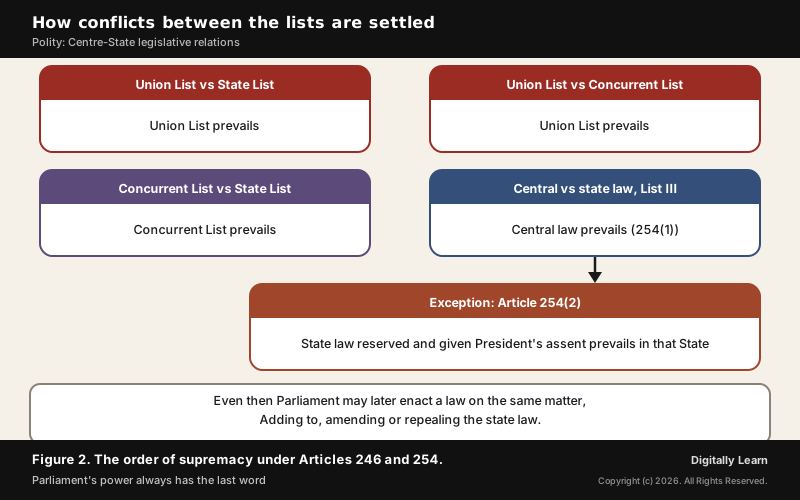
In practice this gives three rules. Where the Union List overlaps the State List or the Concurrent List, the Union List prevails. Where the Concurrent List overlaps the State List, the Concurrent List prevails. The rule is about subjects; a clash between two laws on the same concurrent subject is settled by Article 254.
Repugnancy Under Article 254 and the Presidential Assent Exception
Article 254(1) deals with repugnancy on a Concurrent List matter. If a state law conflicts with a law Parliament is competent to make, the central law prevails, whether it was passed before or after the state law, and the state law is void to the extent of the repugnancy.
Article 254(2) is the exception. A state law on a concurrent matter that conflicts with an earlier central law prevails in that State if it was reserved for the President's consideration and received his assent. Even then Parliament may at any time enact a law on the same matter, adding to, amending, varying or repealing the state law.
Federal Supremacy, Harmonious Construction and Pith and Substance
Because the entries in the three lists are related, laws often overlap. Such conflicts are resolved by the judiciary with reference to legislative competence, and three principles of interpretation do most of the work.
- Federal supremacy: Where a Union and a state law genuinely conflict, the Union law prevails. The Sarkaria Commission called this rule a technique to avoid absurdity, resolve conflict and ensure harmony between Union and state laws, and indispensable for the federal system.
- Harmonious construction: When two provisions seem to conflict, they are read so that each has a separate effect and neither is made redundant.
- Pith and substance: A law is judged by its true nature. If in substance it relates to a subject within the legislature’s competence, it is valid even if it incidentally trenches on a subject outside it.
- Colourable legislation: A legislature cannot, in the guise of making a law within its competence, in truth make a law on a subject beyond it.
The rule of pith and substance came from the Privy Council's rulings on the Canadian constitution and was carried into India to give flexibility to an otherwise rigid division of powers: if every law that encroached on another list were struck down, legislative power would be drastically circumscribed. Courts have also used it to decide repugnancy in cases on education, a concurrent subject.
Parliament's Power to Legislate in the State Field
Article 249: Rajya Sabha Resolution in the National Interest
Under Article 249, if the Rajya Sabha declares by a resolution supported by not less than two-thirds of the members present and voting that it is necessary or expedient in the national interest, Parliament may make laws on a State List matter named in the resolution, and since 2016 on GST as well. The Rajya Sabha alone has this power; the Lok Sabha has no part in the resolution.
- Duration: The resolution remains in force for up to one year and can be renewed any number of times, a year at a time.
- End of the law: The law ceases to have effect six months after the resolution lapses.
- State power kept: The State Legislature can still legislate on the matter, but the parliamentary law prevails while it lasts (Article 251).
The provision has drawn criticism. Rajya Sabha seats were shared among the States in proportion to population, so a resolution lacking the support of almost two-thirds of the States could pass with the votes of the larger States and nominated members, a risk the Sarkaria Commission pointed out and the Punchhi Commission called unfair to the smaller States.
Article 250 and President's Rule: Legislation in Emergencies
Under Article 250, while a Proclamation of National Emergency is in operation, Parliament may make laws on any State List matter for the whole or any part of India. Such a law ceases to have effect six months after the Proclamation ends. The Proclamation itself must be approved by resolutions of both Houses of Parliament within one month; the Lok Sabha cannot approve it alone, which made the second statement of the 2006 question false.
Under Article 356, President's Rule works differently. The Proclamation may declare that the State Legislature's powers are exercisable by Parliament, and Article 357 lets Parliament confer the power of making laws for the State on the President. A law made this way continues in force after the Proclamation ends, until a competent legislature alters, repeals or amends it. The emergency provisions are covered in the article on the President's emergency powers.
Article 252: Parliament Legislating at the Request of States
Under Article 252, if the legislatures of two or more States pass resolutions, through all their Houses, asking Parliament to regulate a State List matter by law, Parliament may do so. The Act applies to those States and to any other State that adopts it later by its own resolution.
- Amendment and repeal: Only Parliament can amend or repeal the Act; the legislature of a State to which it applies cannot.
- Effect on the State: The resolution works as a surrender of the State’s power over the matter, which passes entirely to Parliament.
- Examples: The Prize Competition Act, 1955; the Wild Life (Protection) Act, 1972; the Water (Prevention and Control of Pollution) Act, 1974; the Urban Land (Ceiling and Regulation) Act, 1976; and the Transplantation of Human Organs Act, 1994.
Article 253: Laws to Implement International Agreements
Under Article 253 Parliament may make any law for the whole or any part of India to implement a treaty, agreement or convention with other countries, or a decision of an international conference or body, notwithstanding the division of subjects. No State's consent is needed. Entering into and implementing treaties is itself Entry 14 of the Union List.
The provision lets the Union meet its international obligations even on State subjects. Laws made under it include the United Nations (Privileges and Immunities) Act, 1947, the Geneva Convention Act, 1960, the Anti-Hijacking Act, 1982, and environmental laws.
| Provision | Trigger | What happens to the law |
|---|---|---|
| Article 249 | Rajya Sabha resolution, two-thirds present and voting | Lapses six months after the resolution ends |
| Article 250 | Proclamation of National Emergency | Lapses six months after the Proclamation ends |
| Article 252 | Resolutions of two or more State legislatures | Only Parliament can amend or repeal it |
| Article 253 | A treaty, agreement or international decision | Ordinary law; no State consent needed |
| Article 357 | President's Rule in a State | Continues until a competent legislature changes it |
Centre's Control Over State Legislation and Reform Proposals
Reserved Bills, Previous Sanction and Financial Emergency Controls
Besides legislating directly, the Centre can check state legislation in three ways. The Governor's role in assent is covered in the article on the powers of the Governor.
- Reservation (Articles 200 and 201): The Governor can reserve a Bill for the President, who either assents or withholds assent, an absolute veto; for a Bill that is not a Money Bill the President may send it back for reconsideration.
- Previous sanction (Article 304): A Bill imposing reasonable restrictions on trade and commerce in the public interest cannot be introduced in a State Legislature without the President’s previous sanction.
- Financial emergency (Article 360): The President may direct that all Money Bills and other financial Bills be reserved for consideration after the State Legislature passes them.
Article 255 treats these requirements as procedure. An Act is not invalid only because a required recommendation or previous sanction was not given, if the proper authority later gave assent. On 20 November 2025 the Supreme Court held that it would not be appropriate for courts to prescribe timelines for assent under Articles 200 and 201. The Punchhi Commission had proposed that the President decide on a reserved Bill within six months, the period a State Legislature has to reconsider a returned Bill.
Amending the Seventh Schedule: Ratification by Half the States
Because the lists define the States' own powers, Parliament cannot change them on its own. Under the proviso to Article 368(2), an amendment that changes any list in the Seventh Schedule, Chapter I of Part XI, Article 162 on the extent of a State's executive power, or the representation of States in Parliament must also be ratified by the legislatures of not less than one-half of the States before the Bill goes to the President.
Sarkaria and Punchhi Recommendations on Legislative Relations
States have long argued that the Union enriched its powers at their cost and asked for the State List to be enlarged on the principle of subsidiarity. The Sarkaria Commission found some merit in the grievance, but recommended changes in how power is used rather than in the scheme itself; the Venkatachaliah Commission also found the division of powers justified.
- Consultation (Sarkaria): Before legislating on a concurrent subject, the Union should consult the States, and a summary of their views with the Inter-State Council’s comments should accompany the Bill.
- Limited occupation (Sarkaria): The Union should occupy only as much of a concurrent field as uniformity in the national interest requires.
- Residuary powers (Sarkaria): Move them, except taxation, to the Concurrent List.
- Institutional consultation (Punchhi): Route consultation on concurrent Bills through the Inter-State Council, which should also audit matters of concurrent jurisdiction.
- Restraint (Punchhi): Review transferred subjects and consider restoring them to the State List.
Previous Year UPSC-CSE Questions
Previous Year UPSC-CSE Questions By the end you will be able to draft model answers for the following UPSC questions. Each question carries a collapsible framework showing how to approach it in the exam.
- UPSC Mains 2019 GS-IIFrom the resolution of contentious issues regarding distribution of Legislative powers by the courts, ‘Principle of Federal Supremacy’ and ‘Harmonious Construction’ have emerged. Explain.
How to structure the answer in the exam
Introduction: The Seventh Schedule divides legislative subjects into three lists whose entries often overlap, and courts have evolved principles to settle the resulting conflicts.
Body (sub-themes to develop):
- Federal supremacy: the non obstante wording of Article 246 and Article 254(1); the Union law prevails in a genuine conflict.
- Harmonious construction: read overlapping provisions so each has a separate effect and neither is redundant.
- Pith and substance and colourable legislation as allied tools.
- Article 254(2) as the one place a state law can prevail, with the President's assent.
Conclusion: Conclude that these principles keep a strong-Centre scheme workable without emptying the State List.
- UPSC Prelims 2025 Prelims-GSConsider the following subjects under the Constitution of India:
- List I – Union List, in the Seventh Schedule
- Extent of the executive power of a State
- Conditions of the Governor’s office
For a constitutional amendment with respect to which of the above, ratification by the Legislatures of not less than one-half of the States is required before presenting the Bill to the President of India for assent?
How to approach this Prelims question
Approach: Check each item against the proviso to Article 368(2).
Trap to watch: The Governor's office sounds federal but is not in the proviso.
Key facts to recall:
- Lists of the Seventh Schedule need ratification.
- Article 162 needs ratification.
- Conditions of the Governor's office do not.
Answer signal: I and II only, option (a).
- UPSC Prelims 2018 Prelims-GSIn the Federation established by The Government of India Act of 1935, residuary powers were given to the
How to approach this Prelims question
Approach: Recall where the 1935 Act placed the residue.
Trap to watch: India today gives it to Parliament, which tempts option (a).
Key facts to recall:
- 1935: Governor-General.
- Today: Parliament, Article 248.
Answer signal: Governor-General, option (b).
- UPSC Prelims 2016 Prelims-GSThe Parliament of India acquires the power to legislate on any item in the State List in the national interest if a resolution to that effect is passed by the
How to approach this Prelims question
Approach: Recall the House and the type of majority.
Trap to watch: Total membership against present and voting.
Key facts to recall:
- Rajya Sabha only.
- Two-thirds of members present and voting.
Answer signal: Option (d).
- UPSC Prelims 2013 Prelims-GSThe Parliament can make any law for whole or any part of India for implementing international treaties
How to approach this Prelims question
Approach: Recall the wording of Article 253.
Trap to watch: Consent options sound federal.
Key facts to recall:
- Notwithstanding the lists.
- No consent requirement.
Answer signal: Without the consent of any State, option (d).
- UPSC Prelims 2006 Prelims-GSWhich one of the following subjects is under the Union List in the Seventh Schedule of the Constitution of India?
How to approach this Prelims question
Approach: Place each subject in its list.
Trap to watch: Public health sounds national.
Key facts to recall:
- Mines and oilfields labour: Entry 55, List I.
- Agriculture, fisheries, public health: List II.
Answer signal: Option (a).
- UPSC Prelims 2006 Prelims-GSConsider the following statements:
- The Rajya Sabha alone has the power to declare that it would be in the national interest for Parliament to legislate with respect to a matter in the State List.
- Resolutions approving the Proclamation of Emergency are passed only by the Lok Sabha.
Which of the statements given above is/are correct?
How to approach this Prelims question
Approach: Test each House's role.
Trap to watch: The Lok Sabha's special powers elsewhere make statement 2 tempting.
Key facts to recall:
- Article 249: Rajya Sabha alone.
- Article 352(4): both Houses approve.
Answer signal: Only statement 1, option (a).
Sources and Further Reading
- Legislative Department, Ministry of Law and Justice: The Constitution of India
- Inter-State Council Secretariat: Report of the Commission on Centre-State Relations (Punchhi), Volume II, March 2010
- NCERT: Indian Constitution at Work, Class 11, Chapter 7, Federalism
- Supreme Court of India: The Constitution (enactment of laws)
- Supreme Court of India: Opinion on the presidential reference under Article 143, 20 November 2025
- Wikipedia: Seventh Schedule to the Constitution of India
- Wikipedia: Union List
- Wikipedia: State List
- Wikipedia: Concurrent List
- Wikipedia: Pith and substance
- Wikipedia: Harmonious construction
Editorial Disclaimer
This article explains the Seventh Schedule and Articles 245 to 255 from the text of the Constitution and the other sources listed.


