


Overview
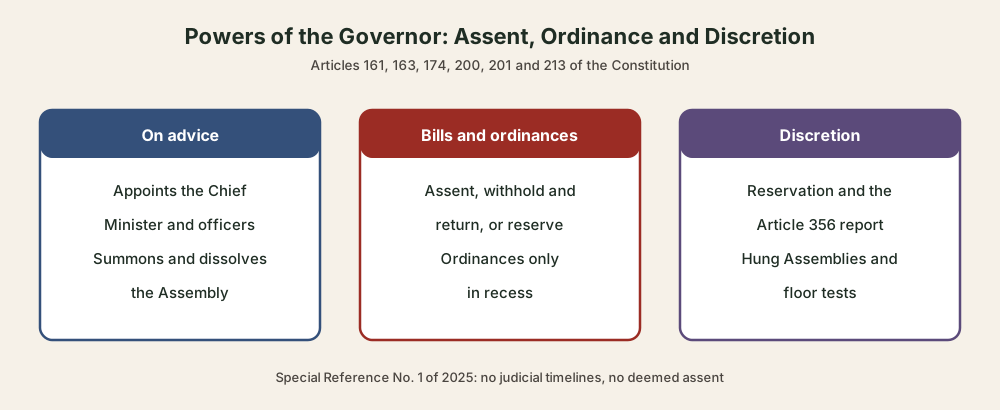
The powers of the Governor are the executive, legislative, financial, judicial and discretionary powers that the Constitution gives the head of a State. Most are exercised on the advice of the Council of Ministers; assent to Bills under Article 200, ordinances under Article 213 and a narrow discretion are the most contested.
Powers of the Governor: Scope and Constitutional Basis
Governor's Powers and the Rule of Aid and Advice
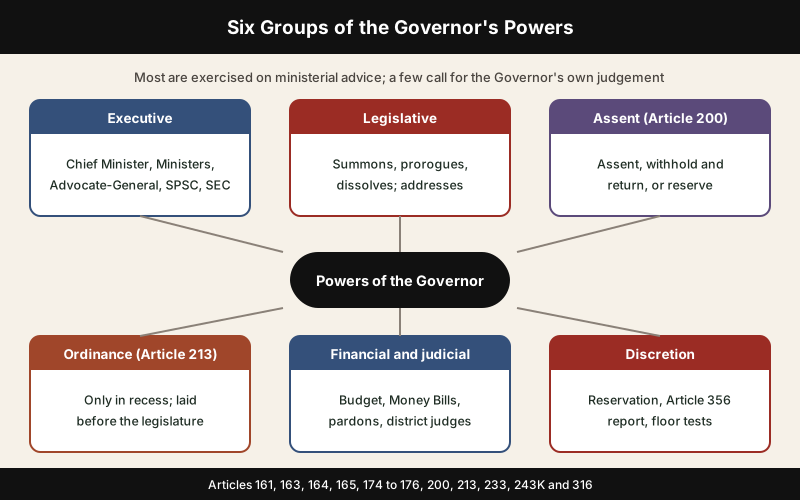
The Governor's powers flow from Article 154, which vests the executive power of the State in the Governor, and are exercised under Article 163 on the aid and advice of the Council of Ministers, except where the Constitution requires the Governor to act in discretion. They fall into executive, legislative, financial, judicial and discretionary groups.
The powers matter because the most contested of them, over Bills, ordinances and floor tests, decide whether an elected State government can govern. Since 2017 the Supreme Court has ruled on each of these, most recently in the advisory opinion of 20 November 2025 on Articles 200 and 201.
The significance of these powers lies in three functions:
- Formal authority: The Governor’s name and assent turn the State government’s decisions and the legislature’s Bills into law.
- Check and balance: Reservation, return of Bills and the Article 356 report let the Governor refer matters to the Union.
- Crisis role: In hung Assemblies and disputed majorities the Governor must decide who governs, subject to the floor of the House.
The office itself, from appointment to removal, is explained in Governor of a State: Appointment, Tenure, Removal and Special Responsibilities, and the President's parallel powers in Powers of the President of India: Executive, Legislative, Assent and Veto and Ordinance, Pardon and Emergency Powers of the President.
Executive Powers of the Governor
Chief Minister, Ministers, Advocate-General and Business Rules
Under Article 164(1), the Governor appoints the Chief Minister and, on the Chief Minister's advice, the other Ministers. Under Article 165, the Governor, not the President, appoints the Advocate-General for the State from persons qualified to be High Court judges, to hold office during the Governor's pleasure.
Under Article 166(3), the Governor makes rules for the more convenient transaction of the State Government's business and its allocation among Ministers, except business in which the Governor acts in discretion. These rules, like other executive action, are made on ministerial advice, not in the Governor's own judgement.
Appointments to State Commissions and the Subordinate Judiciary
The Governor appoints the chairman and members of the State Public Service Commission under Article 316, and the State Election Commissioner, who conducts Panchayat elections, under Article 243K. Under Article 233, the Governor appoints, posts and promotes district judges in consultation with the High Court, choosing from outside the service only advocates or pleaders of at least seven years' standing.
The Governor does not appoint High Court judges: under Article 217 they are appointed by the President, the Governor being among those consulted. Nor does any High Court have an advisory jurisdiction; the power to advise the President belongs to the Supreme Court under Article 143. In a Union territory with a legislature such as Delhi, the Chief Minister is appointed by the President under Article 239AA(5), not by the Lieutenant Governor.
Two features of the office itself complete the picture. The same person may be Governor of two or more States under the proviso to Article 153, and the Constitution lays down no procedure for removing a Governor, who holds office at the President's pleasure.
Legislative Powers of the Governor
Summoning, Prorogation and Dissolution of the Assembly
Under Article 174, the Governor summons the House or Houses of the State legislature, and six months may not pass between the last sitting of one session and the first sitting of the next. The Governor may also prorogue a House and dissolve the Legislative Assembly.
These powers are ordinarily exercised on advice. In Subhash Desai (2023), the Supreme Court held that the power to summon the House must be exercised on the aid and advice of the Council of Ministers, but that if the Speaker and the government try to circumvent a no-confidence motion, the Governor would be justified in summoning the House without that advice.
Addresses, Messages and Nominations to the Council
Under Article 175, the Governor may address the legislature and send it messages on pending Bills or other matters, which the House must consider with all convenient despatch. Under Article 176, the Governor must address the Assembly at the start of the first session after each general election and of the first session of each year, informing it of the causes of its summons.
In States with a Legislative Council, the Governor nominates members with special knowledge or practical experience of literature, science, art, the co-operative movement and social service under Article 171(5). The Sarkaria Commission noted that Article 171 gives the Governor no discretion here, so the nomination follows ministerial advice.
Assent to State Bills Under Articles 200 and 201
Three Options Before the Governor on a Bill
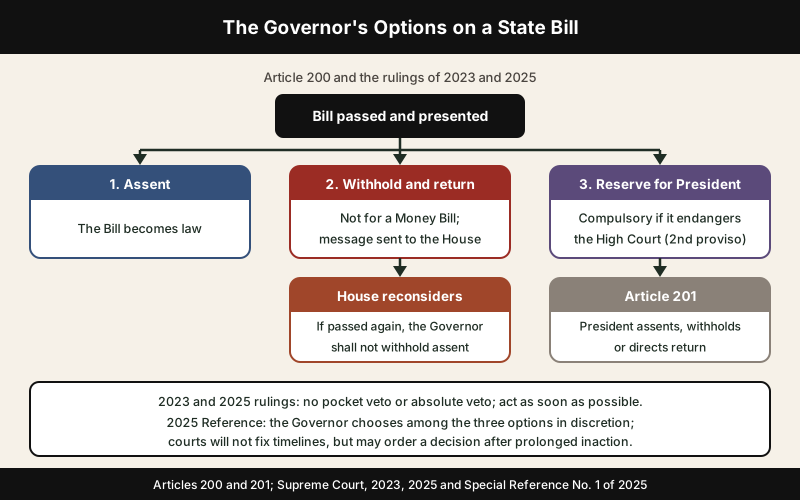
When a Bill passed by the State legislature is presented, Article 200 requires the Governor to declare that the Governor assents, withholds assent, or reserves the Bill for the President. Under the first proviso, the Governor may, as soon as possible, return a Bill that is not a Money Bill with a message asking the House to reconsider it; if the House passes it again, the Governor shall not withhold assent.
The second proviso makes reservation compulsory for any Bill that would so derogate from the powers of the High Court as to endanger its constitutional position. For a reserved Bill, Article 201 lets the President assent, withhold assent, or direct the Governor to return a non-Money Bill, which the House must reconsider within six months.
Reservation is the Governor's act alone. Article 201 applies only when a Bill is reserved by a Governor, so the President cannot, on the President's own, take up a State Bill that the Governor has not reserved.
Punjab (2023) and Tamil Nadu (2025): The Rule Against Delay
In State of Punjab v. Principal Secretary to the Governor, decided on 10 November 2023, the Supreme Court held that the Governor is a symbolic head who cannot withhold action on Bills. If the Governor withholds assent, the Governor must follow the first proviso and return the Bill with a message as soon as possible, an expression that conveys a constitutional imperative of expedition.
In State of Tamil Nadu v. Governor of Tamil Nadu, decided on 8 April 2025, the Court held that neither a pocket veto nor an absolute veto has any place in Article 200, and that a Bill passed again after return must, as a rule, be assented to rather than reserved. It prescribed timelines:
- One month: To withhold assent or reserve a Bill on the Council of Ministers’ advice.
- Three months: To return a Bill, or to reserve it, against that advice.
- One month: To assent to a Bill presented again after reconsideration.
Finding that the Governor had acted without bona fides, the Court declared ten Tamil Nadu Bills deemed to have been assented to on the date they were presented after reconsideration. One of them would have let the State Government, instead of the Governor, appoint Vice-Chancellors of State universities.
Special Reference No. 1 of 2025: The Current Position
On a reference by the President under Article 143, a Constitution Bench gave its opinion on 20 November 2025. It said the Governor has three constitutional options under Article 200: to assent, to reserve the Bill for the President, or to withhold assent and return it with comments, the last not available for a Money Bill. The Governor chooses among them in discretion, not bound by the Council of Ministers' advice.
The Court added four further points, which now govern practice:
- Not justiciable: The Governor’s decision under Article 200 cannot be reviewed on its merits.
- Limited mandamus: For prolonged, unexplained and indefinite inaction, a court may direct the Governor to decide within a reasonable time, without comment on the merits.
- No judicial timelines: In the absence of constitutional time limits, courts should not prescribe them for the Governor or the President.
- No deemed assent: Article 142 cannot substitute for the Governor’s or the President’s constitutional function.
Ordinance-Making Power Under Article 213
Conditions for Promulgating an Ordinance
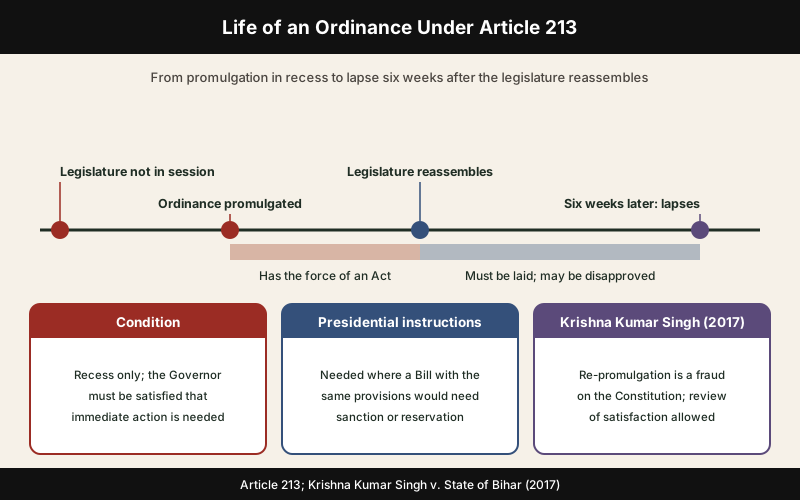
Under Article 213(1), the Governor may promulgate an ordinance at any time except when the Legislative Assembly is in session or, where there is a Council, both Houses are in session, and only when satisfied that circumstances exist which make immediate action necessary. The Governor needs the President's instructions where a Bill with the same provisions would have required the President's previous sanction or reservation, or would have been invalid without the President's assent.
An ordinance has the same force as an Act of the State legislature. Under Article 213(2), it must be laid before the legislature and ceases to operate six weeks after the legislature reassembles, or earlier if a resolution disapproving it is passed, and the Governor may withdraw it at any time.
Re-promulgation and Krishna Kumar Singh (2017)
Bihar showed how the power could be abused. Between 1967 and 1981 the Governor of Bihar promulgated and re-promulgated 256 ordinances, some of them kept alive for up to fourteen years. In D. C. Wadhwa, decided on 20 December 1986, a Constitution Bench held re-promulgation to be a colourable exercise of power.
In Krishna Kumar Singh v. State of Bihar, decided on 2 January 2017, a seven-judge bench held that repeated re-promulgation is a fraud on the Constitution, because it overreaches the legislature, the primary source of law-making. It also held that the Governor's satisfaction under Article 213 is not immune from judicial review, the test being whether it rests on some relevant material, not whether that material is sufficient.
The majority read Article 213(2)(a) as making it mandatory to lay an ordinance before the State legislature. Justice Madan B. Lokur disagreed on this point, holding that laying is not mandatory under Article 213(2).
Financial and Judicial Powers of the Governor
Budget, Money Bills and the Contingency Fund
Under Article 202, the Governor causes the annual financial statement, the State budget, to be laid before the legislature each year. Under Article 207, a Money Bill or amendment on the matters listed in Article 199 may be introduced only on the Governor's recommendation.
The State's Contingency Fund, an imprest set up by State law under Article 267(2), is placed at the Governor's disposal so that advances can be made for unforeseen expenditure. The Punjab case of 2023 arose partly because the Governor had not given the recommendation needed to introduce certain Money Bills.
Pardoning Power Under Article 161
Under Article 161, the Governor may grant pardons, reprieves, respites or remissions of punishment, or suspend, remit or commute the sentence of any person convicted of an offence against a law to which the executive power of the State extends.
The President's power under Article 72 is wider: it alone covers sentences by a court martial, and it covers every sentence of death. Article 72(3) keeps the Governor's power to suspend, remit or commute a death sentence under any law in force, so the two powers overlap there. The President's power is explained in the article on the President's pardoning power.
| Power | Governor | President |
|---|---|---|
| Ordinance | Article 213, at any time except when the State legislature is in session | Article 123, at any time except when both Houses of Parliament are in session |
| Bills | Assent, withhold and return, or reserve for the President (Article 200) | Assent, withhold, or return a non-Money Bill (Article 111) |
| Pardon | Offences against State laws; may commute a death sentence (Articles 161, 72(3)) | Also court-martial sentences and every death sentence (Article 72) |
| Discretion | Expressly contemplated (Article 163) | Acts on ministerial advice; may require it to be reconsidered (Article 74(1)) |
| Emergency | Reports to the President (Article 356(1)) | Proclaims President's Rule (Article 356) |
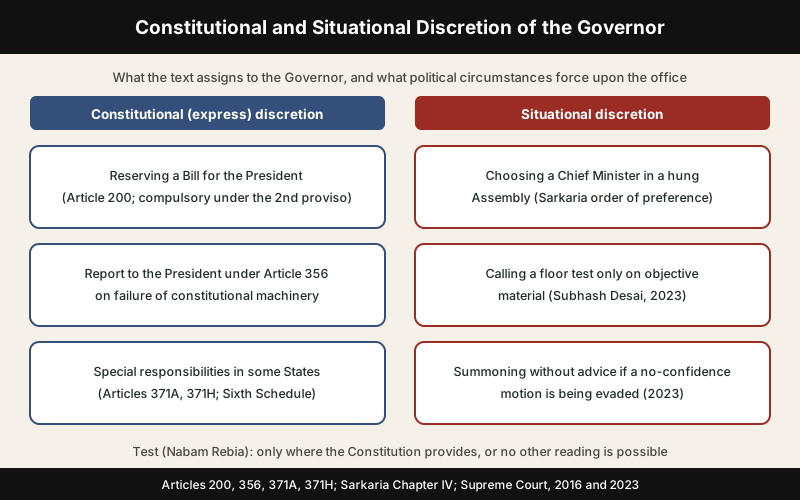
Discretionary Powers: Constitutional and Situational
Express Discretion: Reservation, the Article 356 Report and Special Responsibilities
The Constitution itself assigns some decisions to the Governor's judgement. Reserving a Bill for the President is one, compulsory in the case of the second proviso to Article 200; another is the report under Article 356(1), on which the President may act if satisfied that the State's government cannot be carried on in accordance with the Constitution.
Special responsibilities in some States, such as law and order in Nagaland and Arunachal Pradesh, form a third category. The Punchhi Commission warned against reading Article 163(2) as creating a wide, undefined discretion beyond these express cases, and the 2025 Reference now adds the choice among the options under Article 200 to the list of discretionary functions.
Situational Discretion: Choosing a Chief Minister and Calling a Floor Test
When no party has a majority, the Governor must choose a Chief Minister. The Sarkaria Commission advised calling the party or combination with the widest support, and, failing a single-party majority, sounding in turn a pre-poll alliance, the largest single party with outside support, a post-poll coalition whose partners all join the government, and a post-poll alliance with some partners supporting from outside.
The floor of the House is the test. In S. R. Bommai (1994), the Supreme Court said the proper course for a Governor doubting a Chief Minister's majority was to await the test on the floor of the House.
In Subhash Desai (2023), it held that the Governor of Maharashtra was not justified in asking the Chief Minister to prove his majority, because he had no reasons based on objective material, though the earlier position could not be restored since the Chief Minister had resigned.
The same judgment held that the Governor was justified in inviting the new claimant to form the government, and it referred to a larger bench of seven judges the correctness of Nabam Rebia on the Speaker's powers. The decision to call a floor test is therefore reviewable: it must rest on material relevant and germane to the power, not on extraneous considerations, and may not be used to destabilise an elected government.
Governor as Chancellor of State Universities
State university laws generally make the Governor, by virtue of office, the Chancellor of State universities, with powers such as appointing Vice-Chancellors. The Sarkaria and Punchhi Commissions both asked whether these functions fall under Article 163(1), which would bind the Governor to ministerial advice except where the statute itself requires discretion.
The Punchhi Commission noted instances in which Governors, as Chancellors, chose Vice-Chancellors in their own discretion, overruling the advice of the Council of Ministers. The Tamil Nadu Bill of 2022 that would have transferred those appointments to the State Government was one of the ten Bills in the 2025 case, which shows the question is still live.
Assessment of the Governor's Powers
Distinguishing Features, Observable Outcomes and Current Debates
Three features distinguish the Governor's powers from the President's:
- Written discretion: The Constitution expressly contemplates discretion for the Governor, and Article 163(2) makes the Governor’s view of it final.
- Reservation: A Governor can send a State Bill to the Union for the President’s decision.
- Union reporting: The Governor’s report can start President’s Rule in the State.
Three observable outcomes follow:
- Litigation over Bills: Punjab in 2023 and Tamil Nadu in 2025 reached the Supreme Court over delayed assent.
- Shifting rules: The 2025 Reference took a different view from the Tamil Nadu judgment on timelines and deemed assent.
- Floor tests as the answer: From Bommai to Subhash Desai, disputed majorities are settled in the House, not in the Governor’s office.
The current debate concerns how to keep a Governor from delaying Bills indefinitely without courts fixing deadlines. The 2025 opinion answers with a limited mandamus for prolonged inaction; commissions from Sarkaria to Punchhi answer with clearer conventions and narrower discretion.
UPSC Relevance and Previous-Year Questions on the Governor's Powers
Where the Governor's Powers Fit in the UPSC-CSE Syllabus
This topic belongs to General Studies Paper II, under the executive and legislature of the States and Centre-State relations. The linked questions from the preliminary examination test precise textual points:
- Discretion: Reservation and the Article 356 report are discretionary; appointing Ministers and framing business rules are not.
- Appointments: The Governor appoints the Advocate-General; High Court judges are appointed by the President.
- Jurisdiction: Only the Supreme Court has an advisory jurisdiction.
- Removal: The Constitution lays down no procedure for removing a Governor.
The linked question from the main examination asks for the conditions governing the Governor's legislative power of ordinance-making and for the legality of re-promulgation. The section on Article 213 and Krishna Kumar Singh supplies that answer.
Previous Year UPSC-CSE Questions
Previous Year UPSC-CSE Questions By the end you will be able to draft model answers for the following UPSC questions. Each question carries a collapsible framework showing how to approach it in the exam.
- UPSC Prelims 2014 GS-IWhich of the following are the discretionary powers given to the Governor of a State?
- Sending a report to the President of India for imposing the President’s rule
- Appointing the Ministers
- Reserving certain bills passed by the State Legislature for consideration of the President of India
- Making the rules to conduct the business of the State Government
Select the correct answer using the code given below.
How to approach this Prelims question
Approach: Sort each item into discretion or advice by its Article.
Trap to watch: Appointing Ministers sounds like personal power but follows the Chief Minister's advice.
Key facts to recall:
- Article 356(1): the Governor's report.
- Article 200: reservation.
- Article 164(1): Ministers on the Chief Minister's advice.
- Article 166(3): business rules.
Answer signal: Items 1 and 3 are discretionary, so option (b) is the answer.
- UPSC Prelims 2009 GSConsider the following statements :
- The Advocate General of a State in India is appointed by the President of India upon the recommendation of the Governor of the concerned State.
- As provided in Civil Procedure Code, High Courts have original, appellate and advisory jurisdiction at the State level.
Which of the statements given above is/are correct ?
How to approach this Prelims question
Approach: Check the appointing authority in Article 165 and the Articles that confer advisory jurisdiction.
Trap to watch: The Attorney-General is appointed by the President, which makes statement 1 look parallel.
Key facts to recall:
- Article 165: Governor appoints the Advocate-General.
- Article 143: Supreme Court alone advises.
- Article 76: President appoints the Attorney-General.
Answer signal: Neither statement is correct, so option (d) is the answer.
- UPSC Prelims 2025 GS-IConsider the following statements:
- The Constitution of India explicitly mentions that in certain spheres the Governor of a State acts in his/her own discretion.
- The President of India can, of his/her own, reserve a bill passed by a State Legislature for his/her consideration without it being forwarded by the Governor of the State concerned.
Which of the statements given above is/are correct?
How to approach this Prelims question
Approach: Test statement I against the words of Article 163(1) and statement II against Articles 200 and 201.
Trap to watch: Statement II sounds plausible because the President has the final say on a reserved Bill, but the Bill reaches the President only through the Governor.
Key facts to recall:
- Article 163(1): 'in his discretion' is written into the text.
- Article 200: the Governor reserves.
- Article 201: applies to a Bill reserved by a Governor.
Answer signal: Only statement I is correct, so option (a) is the answer, as in the official UPSC answer key.
- UPSC Prelims 2013 GS-IWhich one of the following statements is correct?
How to approach this Prelims question
Approach: Eliminate each option against its Article.
Trap to watch: Option (d) looks natural by analogy with a Governor appointing a Chief Minister.
Key facts to recall:
- Article 153 proviso: two or more States.
- Article 217: President appoints High Court judges.
- Article 239AA(5): President appoints Delhi's Chief Minister.
- Article 156(1): pleasure of the President.
Answer signal: Only option (c) is correct.
- UPSC Mains 2022 GS-IIDiscuss the essential conditions for exercise of the legislative powers by a Governor. Discuss the legality of re-promulgation of ordinances by the Governor without placing them before the Legislature.
How to structure the answer in the exam
Introduction: Article 213 lets the Governor legislate by ordinance only when the State legislature is not in session and immediate action is necessary.
Body (sub-themes to develop):
- Conditions: recess; satisfaction that circumstances require immediate action; presidential instructions where a Bill would need sanction or reservation.
- Life of an ordinance: force of an Act; laid before the legislature; lapses six weeks after reassembly or on a disapproving resolution; may be withdrawn.
- Abuse: Bihar's 256 ordinances between 1967 and 1981, some kept alive for fourteen years; D. C. Wadhwa (1986) held re-promulgation colourable.
- Krishna Kumar Singh (2017): re-promulgation a fraud on the Constitution; satisfaction open to review on relevant material; laying before the legislature held mandatory by the majority.
Conclusion: Ordinance-making is an emergency power; re-promulgating ordinances without placing them before the legislature subverts legislative supremacy and is unconstitutional.
Sources and Further Reading
- Legislative Department, Ministry of Law and Justice: The Constitution of India
- Supreme Court of India: State of Punjab v. Principal Secretary to the Governor of Punjab, 2023 INSC 1017 (10 November 2023)
- Supreme Court of India: Special Reference No. 1 of 2025, 2025 INSC 1333 (20 November 2025)
- Supreme Court of India: Krishna Kumar Singh v. State of Bihar (2 January 2017)
- Supreme Court of India: Subhash Desai v. Principal Secretary, Governor of Maharashtra (11 May 2023)
- Supreme Court of India: S. R. Bommai v. Union of India (1994), leading-case text
- Wikipedia: State of Tamil Nadu v. Governor of Tamil Nadu (2025 INSC 481; the official judgment is on the Supreme Court website)
- Inter-State Council Secretariat: Sarkaria Commission Report, Chapter IV, Role of the Governor
- Inter-State Council Secretariat: Commission on Centre-State Relations (Punchhi), Volume II, March 2010
- NCERT: Indian Constitution at Work, Class 11, Chapter 6, Judiciary
- Department of Legal Affairs: NCRWC consultation paper, The Institution of Governor under the Constitution (further reading)
Editorial Disclaimer
This article is for UPSC preparation and explains the Governor's powers as the Supreme Court has interpreted them. The advisory opinion and the judgments discussed are summarised from their official texts, which govern any question of law.


