


Overview
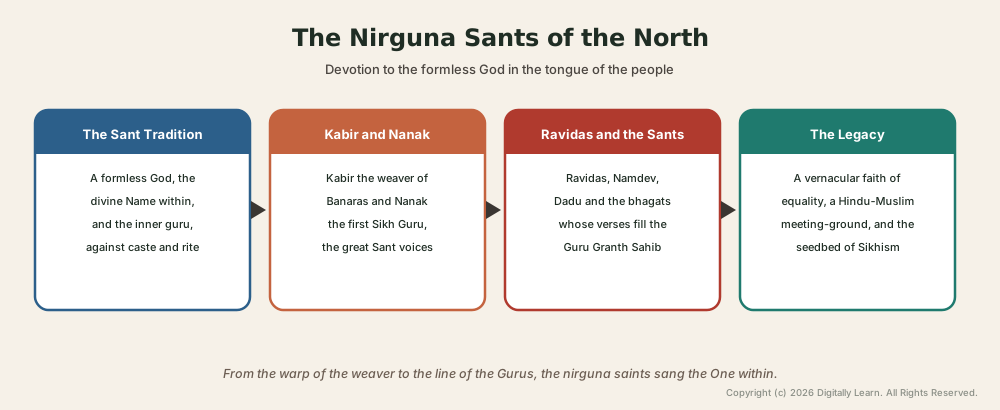
The nirguna stream of the medieval Bhakti movement worshipped one God who is formless and without attributes, beyond every Hindu or Muslim image, and its saint-poets are remembered together as the Sant tradition, or Sant Mat. Where the saguna saints adored Ram and Krishna in their forms, the Sants taught that the Absolute, whom Kabir often called Ram, dwells within the heart and is reached through the divine Name, not through idol, temple or rite. Singing in the plain vernacular, they attacked caste, ritual and priestly authority alike. Kabir the weaver of Banaras, Guru Nanak the first of the Sikh Gurus, the cobbler-saint Ravidas, and saints such as Namdev and Dadu Dayal gave this current its enduring voice.
The Nirguna Stream of North Indian Bhakti and the Sant Tradition
Nirguna Bhakti: Devotion to the Formless, Attributeless God
The nirguna saints worshipped a God who has no form and no quality, and this is the first thing to grasp about them.
The word nirguna means without quality or attribute. The nirguna saints held that the supreme reality, Brahman or God, cannot be pictured, named or housed in any image, for it is beyond all form. Their devotion was therefore not to a deity carved in stone or sung in story, but to an unseen Absolute that dwells within the heart of every person and is reached by turning inward. As the previous parts of this series showed, the wider Bhakti movement carried both a saguna stream, which loves God in a form such as Vishnu or Shiva, and this nirguna stream, which loves the formless; this part takes up the nirguna saints of the north.
Because their God was formless, the nirguna saints set little store by the outward apparatus of religion. They turned away from the idol and the temple, the pilgrimage and the holy bath, the fast and the sacrifice, and from the priest who presided over them all. What mattered was the inward remembrance of God by his Name, a discipline these saints called nam-simran, and the guidance of a true teacher. In this they stood close to one another across the centuries, and the tradition they form is the subject of the next section.
The Sant Tradition (Sant Mat): A Connected Current of Nirguna Saints
The nirguna saints of the north are remembered together as the Sant tradition, a connected current of devotion that scholars call the Sant Mat.
The word sant is best rendered not as 'saint' in the European sense but as one who knows the truth, one who has touched the ultimate reality. The Sant tradition, or Sant Mat, the way of the Sants, is the body of nirguna saint-poets who flourished in northern India in the fifteenth and sixteenth centuries and after. They were not an organised church with a single founder, but a loose and living current, each saint learning from those before him and singing in the same spirit. The figure below sets out the marks that hold this current together.
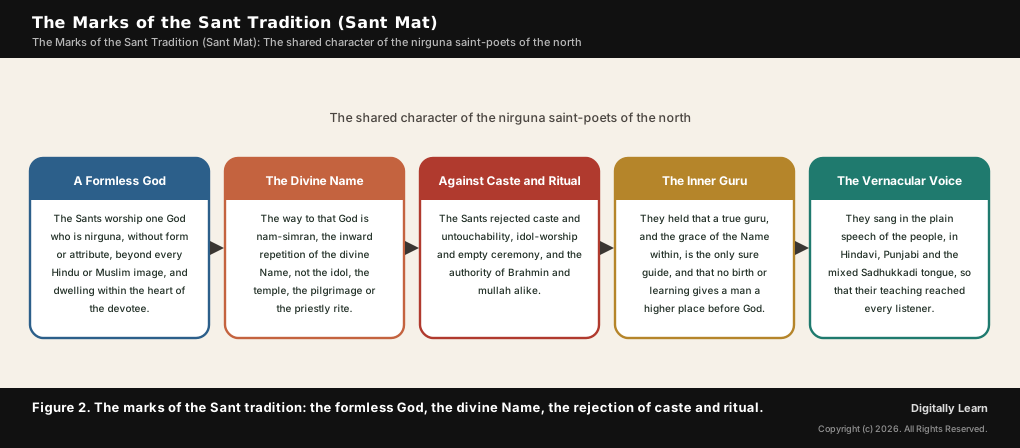
Several features run through the whole tradition and bind its saints together. They worship a formless God and reach him by the divine Name; they reject caste, untouchability and the outward forms of both Hinduism and Islam; they honour the guru, the true teacher and the grace of the Name within, above any priest or scripture; and they sing in the vernacular, the everyday speech of ordinary people. From these common roots grew a poetry of great power, plain in word and bold in thought, that is treasured across northern India to this day.
Nirguna and Saguna: The Formless Absolute and the Ram of the Sants
Nirguna Against Saguna: Two Streams of the Bhakti Movement
The bhakti of the north flowed in two great streams, the nirguna of the formless and the saguna of the form, and the two must be told apart with care.
The saguna saints, whose story is the subject of the next part of this series, loved God in a definite and lovable form: Rama the son of Dasharatha, or Krishna the cowherd of Vrindavan, worshipped through image, song and the retelling of the deity's life. The nirguna Sants, by contrast, would have no image at all, holding that the moment God is given a form he is made smaller than he is. For them the only worship worthy of the Absolute was the inward one, by the Name and the surrendered heart. The figure below sets the two streams side by side.
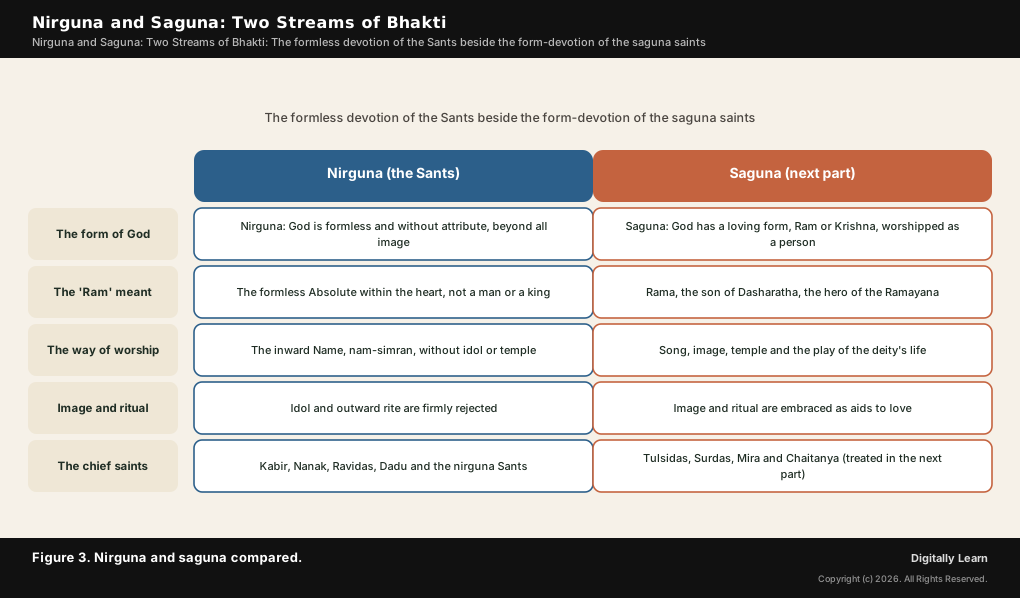
The two streams were not sealed off from one another, and a single saint could lean toward both. Yet the difference was real and deep. The saguna way led toward the great temples, the festivals and the devotional epics of Tulsidas and Surdas; the nirguna way led away from all of these, toward a stark and inward faith that owed nothing to temple or idol. It is the nirguna way, the way of Kabir and Nanak, that this part follows.
The Ram of the Sants: The Formless Absolute, Not Dasharatha's Son
When Kabir sang of Ram, he did not mean the prince of Ayodhya, and to read him so is to miss the whole of his teaching.
The nirguna Sants often used the name Ram for God, and this has misled many a reader. Their Ram was not Rama, the son of Dasharatha and the hero of the Ramayana, who belongs to the saguna stream and to the devotion of Tulsidas. The Ram of the Sants was a name, no more, for the formless Absolute, the God beyond all form who dwells within. Kabir would say that his Ram was not the Ram of the ten avatars, but the unborn, unbounded reality that the name merely points toward.
This use of a familiar word for an unfamiliar idea was deliberate. By taking the most loved of names and emptying it of its story, the Sants taught their hearers to seek God not in any image but within themselves. The same freedom let them borrow words from Islam, calling God by names such as Allah, Hari and Sahib alike, and insisting that the reality behind every such name is one and the same. To hold the formless meaning of their Ram is the key to reading the nirguna saints rightly.
Ramananda and the Centres of the Sant Movement in North India
Ramananda: The Vernacular Bridge from the South to the Northern Sants
Ramananda is remembered as the bridge by which devotion crossed from the south into the north, and as the teacher from whom the northern Sants are traced.
Ramananda was a Vaishnava saint of the Gangetic plain who lived and taught at Banaras; his dates are uncertain, but he is placed between the fourteenth and the middle of the fifteenth century. Tradition holds that he drew his devotion from the southern school of Ramanuja, the acharya whose Sri Vaishnava tradition the previous part of this series described, and so carried the warm bhakti of the south into the northern plains. His great innovation was to teach not in Sanskrit, the closed tongue of the learned, but in the vernacular Hindi of the common people, so that his message might reach the many.
Ramananda took disciples, the tradition says, without regard to caste, gender or birth, and from his circle the later nirguna saints are traditionally descended. It is widely held that Kabir and Ravidas were among his pupils, though these links are matters of pious tradition rather than firm history, and some modern scholars doubt them; the chronology is difficult, and the lineage should be held loosely. What is not in doubt is that Ramananda stands at the head of the northern devotional movement as the one who made it speak in the people's tongue.
The Geography of the Sant Tradition: Banaras, the Punjab and Rajasthan
The Sant tradition was spread across the whole of northern India, from the holy city of Banaras to the Punjab and the deserts of Rajasthan.
Its oldest heart was Banaras, the ancient city of Kashi on the Ganga, where both Kabir the weaver and Ravidas the cobbler lived and taught. Far to the north-west lay the Punjab of Guru Nanak, with his birthplace at Talwandi, his awakening at Sultanpur Lodhi and his community at Kartarpur, and later the city of Amritsar where the Sikh scripture was gathered. In the deserts of Rajasthan, at Naraina, Dadu Dayal founded his own order, while far to the south, in the Deccan, the older sant Namdev linked the northern current to the Varkari devotion of Maharashtra. The map below sets out these centres.
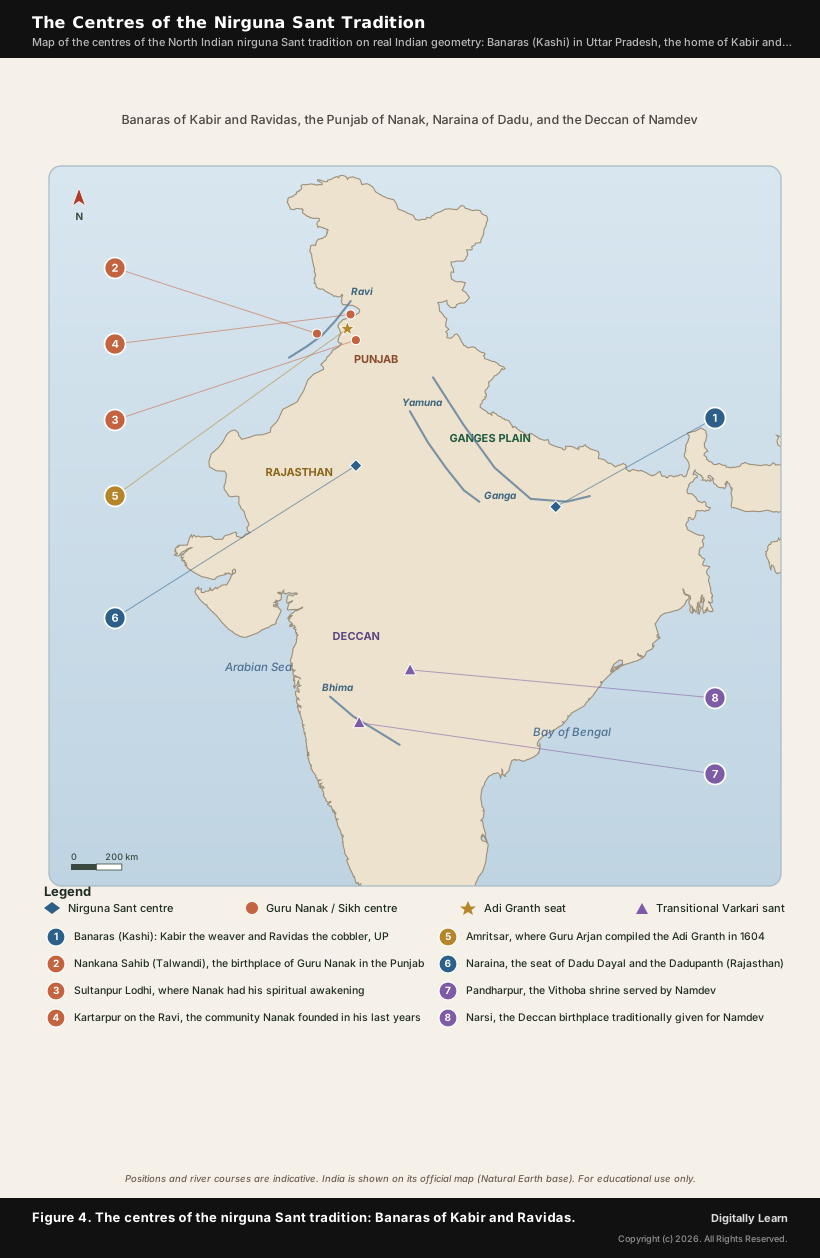
This wide spread, across regions and tongues, is itself important. The Sant tradition was not the affair of one kingdom or one language but a movement of the whole northern plain, carried by wandering saints and their songs from the Ganga to the Ravi and beyond. That a weaver of Banaras, a Khatri of the Punjab and a leather-worker of Kashi could be counted in one tradition shows how far the nirguna faith reached across the bounds of place and caste.
Kabir: The Weaver-Saint of Banaras and the Bijak
Kabir's Life, Contested Dates and the Weaver (Julaha) Tradition of Kashi
Kabir is the sharpest and most famous voice of the nirguna way, a poor weaver of Banaras whose verses still cut to the heart of religion.
The years of Kabir's birth and death are uncertain, and no two accounts agree. He is most commonly placed from about 1440 to 1518, though some scholars argue for an earlier span of about 1398 to 1448; his dates should be given as genuinely contested. He lived at Banaras, the city of Kashi, then within the Jaunpur Sultanate, in what is now Uttar Pradesh. By tradition he belonged to a family of Muslim weavers, the julahas, and a famous legend tells of his being found as an infant by a weaver named Niru; this birth-story is pious legend, but the weaver's calling is firmly part of his memory and colours his plain, working-man's imagery.
Tradition makes Kabir a disciple of Ramananda, and the link is dear to the Sant tradition, but the chronology is uncertain and the discipleship is contested rather than proven. What is certain is the man's stance: born a Muslim by community yet steeped in the Hindu devotion around him, Kabir belonged wholly to neither and judged both. The very fact that a low-born weaver of an outcaste trade became the most quoted saint of medieval India is itself a measure of how the nirguna movement overturned the order of caste and learning.
The Bijak and Kabir's Verse-Forms: Sakhi, Ramaini and Shabad
Kabir's teaching survives in short, stinging verses, gathered after him into collections of which the Bijak is the most famous.
Kabir himself, it is thought, did not write; his verses were carried by memory and song and set down only later. The chief collection of his followers, the Bijak, was compiled in writing in the seventeenth century and survives in two main recensions; it is the central scripture of the Kabir Panth, the order that looks to him as its founder. His verses also passed into other collections, and a large body of them was gathered into the Guru Granth Sahib of the Sikhs. The figure below sets out the forms in which his teaching was carried.
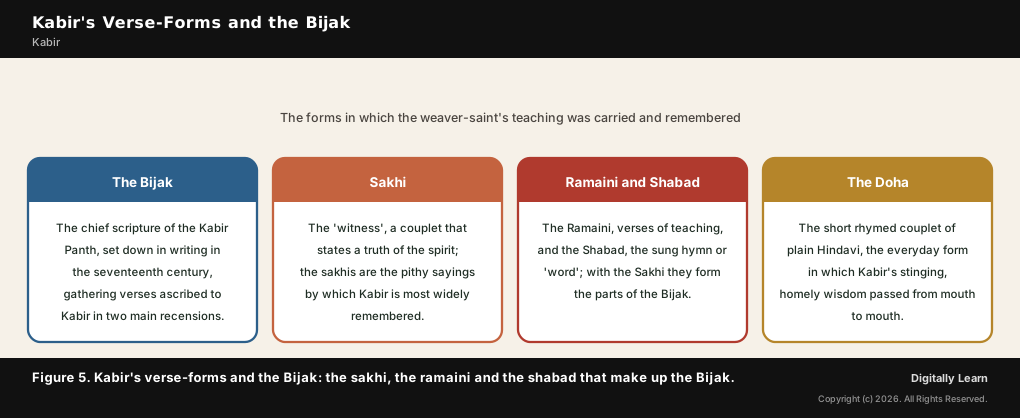
His verse took a few simple forms. The sakhi, meaning 'witness', is a short couplet that states a truth of the spirit; the ramaini is a longer verse of teaching, and the shabad the sung hymn or 'word'; these three are the parts into which the Bijak is arranged. Above all Kabir is remembered for the doha, the rhymed couplet of plain Hindavi, homely and sharp, in which he caught a whole argument in two lines. The plainness of the form was the message: truth needed no Sanskrit and no learning, only an open heart.
Kabir's Critique of Hindu and Muslim Externalism, and the Kabir Panth
Kabir turned his sharpest words against the outward forms of both religions, sparing neither the Hindu nor the Muslim in his search for the God within.
Kabir questioned what he saw as the empty and unethical practices of every faith, and above all the wrong practices he found in both Hinduism and Islam. He mocked the Brahmin's thread and the idol in the temple as readily as the mullah's call and the pilgrimage to Mecca; he asked why, if God is one, the Hindu should seek him in the east and the Muslim in the west, when he dwells in the heart of both. His was not a blending of two religions into a third but a clearing-away of the outward forms of each, to lay bare the one formless God whom both, he held, were truly seeking.
After his death his memory was claimed by both communities, and the legend that Hindus and Muslims quarrelled over his body, only to find flowers in its place, captures the way his life refused every boundary. His followers formed the Kabir Panth, a sect of the Sant tradition that reveres him as its founder and keeps the Bijak as its scripture. Through that order, and through the songs that every village knew, Kabir's nirguna message outlived him and spread across the whole of northern India.
Guru Nanak and the Foundations of the Sikh Tradition
Guru Nanak: Talwandi, the Udasis and the Community at Kartarpur
Guru Nanak carried the nirguna faith into the Punjab, and from his teaching there grew, in time, the tradition of the Sikhs.
Guru Nanak lived from 1469 to 1539, and his dates, unlike those of Kabir, are firmly known. He was born at Rai Bhoi Ki Talwandi, the village now called Nankana Sahib in the Punjab, west of Lahore. As a young man at Sultanpur Lodhi he passed through the spiritual awakening that set the course of his life, declaring his message in the famous words that there is no Hindu and no Muslim, by which he meant that before the one God the labels of birth and creed fall away. He then set out on long journeys, the udasis, that carried him across the length of the subcontinent and, by tradition, beyond it, teaching and debating as he went.
In his later years Nanak gathered his followers at Kartarpur, a settlement he founded on the bank of the river Ravi, and there he lived among his disciples, a working farmer who taught the way of the Name. He is reckoned the first of the line of ten Gurus; this part introduces him as a nirguna sant and the founder of that line, while the long growth of the Sikh tradition into a distinct community belongs to the later Gurus and lies beyond this part. His own teaching was wholly of the Sant kind: one God, formless and without rival, worshipped by his Name and not by idol or rite.
Sangat, Pangat and Langar: Nanak's Institutions of Equality
Nanak did not only preach equality but built it into daily practice, in three institutions that outlived him.
At Kartarpur, Nanak gave his teaching of equality a living shape. The sangat was the congregation, the gathering of all followers without distinction of caste to worship and to hear the divine word together. The pangat was the practice of sitting in a single line, side by side, so that the high-born and the low-born ate as equals with no one set above another. And the langar was the free community kitchen, in which food was cooked and shared by all and offered to every visitor, breaking at a stroke the caste rule that forbade the sharing of food across its lines.
These were not gentle gestures but a direct assault on the order of caste, made part of the ordinary life of the community. To sit in one line and eat from one kitchen was, in the India of that age, a revolutionary act, and it bound Nanak's followers together as a body of equals. In these institutions the social radicalism of the nirguna saints, which Kabir and Ravidas voiced in verse, was turned into a settled way of living that the later Sikh tradition would carry forward.
Nam-Simran, the Japji and the One Formless God
At the centre of Nanak's teaching stood the one formless God and the remembrance of his Name, set down in hymns of great beauty.
Nanak taught that there is one God, without form, without birth and without rival, the maker and sustainer of all, who is known not through idol or image but through his Name. The way to him is nam-simran, the loving remembrance and repetition of that Name, joined to honest work and open-handed sharing. His hymns gave this teaching its lasting form; the Japji, his morning prayer, opens with the affirmation of the One and stands at the head of the Sikh scripture. The whole of his message can be heard in its measured, luminous verses.
It was Nanak's successors who gathered these hymns, with those of the later Gurus and of many other saints, into the great scripture; the fifth Guru, Guru Arjan, completed that compilation, the Adi Granth, in 1604 and installed it at Amritsar. In it the nirguna teaching of Nanak was fixed for all time, set beside the verses of Kabir, Ravidas, Namdev and other Sants whom the Gurus honoured. The next section turns to that remarkable act of gathering, the bhagat bani, after taking up the other great Sants of the tradition.
Ravidas, Namdev, Dadu Dayal and the Wider Body of Sants
Ravidas: The Cobbler-Saint of Banaras and the Vision of Begumpura
Ravidas is the saint who turned the lowest of births into a throne of devotion, a leather-worker of Banaras whose hymns are sung to this day.
Ravidas, also called Raidas, was born at Sir Gobardhanpur near Banaras, in what is now Uttar Pradesh; his dates are contested, for the records of his age are thin, and he is placed across the fifteenth and early sixteenth centuries. He came of a Chamar family, a leather-working community held to be untouchable, and he worked as a cobbler. That a man of so despised a calling should become a revered teacher, his hymns later set in the Sikh scripture, is one of the clearest signs of how the nirguna movement broke the bonds of caste.
Ravidas is remembered above all for his vision of Begumpura, the 'city without sorrow', a place where there is no suffering and no fear, where none is high and none is low, and all are equal. In this imagined city he gave the Sant teaching of equality a shape that has inspired the oppressed across the centuries. His devotion, like Kabir's, was to the formless God within, reached by love and the Name and not by birth or rite; and his memory lives on both among his own followers and, in modern times, in the Ravidassia tradition that looks to him.
Namdev, Dadu Dayal and the Other Nirguna Sants
Around Kabir, Nanak and Ravidas stood a wider company of Sants, each adding a strand to the nirguna tradition.
Namdev, the earliest of them, was a Marathi sant of the Deccan, traditionally placed in the thirteenth and fourteenth centuries though his dates too are disputed. A devotee of Vithoba at Pandharpur and a leading voice of the Varkari tradition of Maharashtra, he is by tradition remembered as a calico-printer or tailor; his fame spread north into the Punjab, and a large body of his hymns was taken into the Guru Granth Sahib, so that he forms a living bridge between the devotion of the Deccan and that of the north. The figure below presents the chief saints of the tradition together.
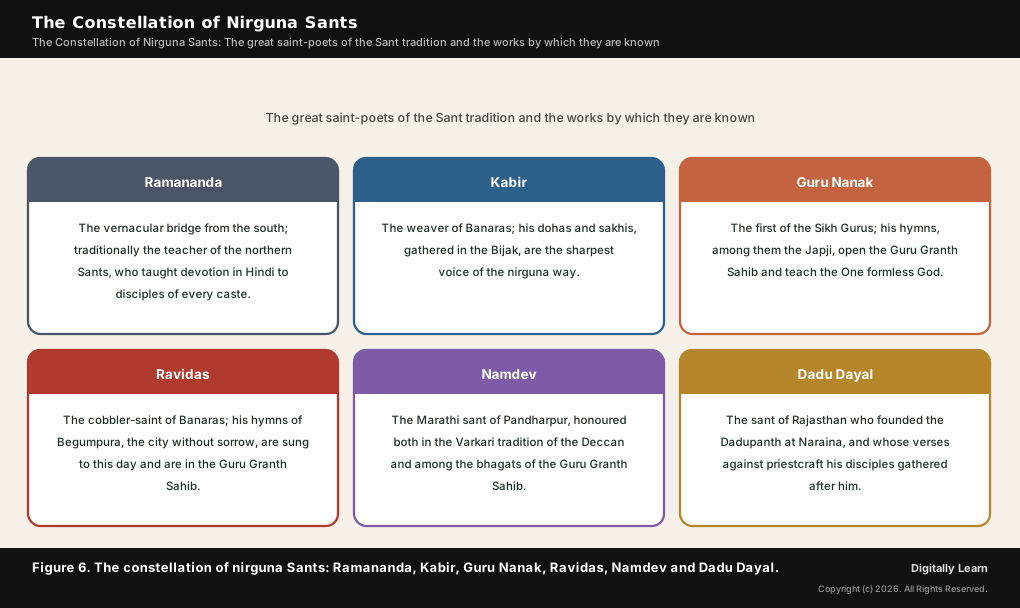
Dadu Dayal, who lived from 1544 to 1603, was a sant of Gujarat and Rajasthan who spoke against formalism and priestcraft in the true nirguna spirit. He settled at Naraina, near Jaipur, and founded the Dadupanth, an order that long outlived him and whose followers gathered his verses after his death. Around these greater names stood many lesser Sants, among them the barber-saint Sena, the Jat farmer Dhanna and the devotee Pipa, men of every humble calling, several of whose verses were also honoured in the Sikh scripture. Honesty requires that for some of these minor saints the firm record is thin, and the tradition rests as much on memory as on history.
| Saint | Dates (as given) | Region and centre | Traditional calling |
|---|---|---|---|
| Ramananda | Fourteenth to mid-fifteenth century (uncertain) | Banaras, the Gangetic plain | Vaishnava teacher and vernacular preacher |
| Kabir | About 1440 to 1518 (contested) | Banaras (Kashi), Uttar Pradesh | Weaver, the julaha |
| Guru Nanak | 1469 to 1539 (firmly known) | The Punjab: Talwandi and Kartarpur | First of the Sikh Gurus |
| Ravidas | Fifteenth to early sixteenth century (contested) | Banaras, Uttar Pradesh | Cobbler, of the Chamar caste |
| Namdev | About the thirteenth to fourteenth century (disputed) | Pandharpur, the Deccan | Calico-printer or tailor (traditional) |
| Dadu Dayal | 1544 to 1603 | Naraina, Rajasthan | Reformer-poet, founder of the Dadupanth |
The Bhagat Bani: Sant Verses in the Guru Granth Sahib
The Sikh scripture gathered into itself the verses of saints who were not Sikhs, and this act of inclusion is one of the most striking facts of the whole tradition.
When the Gurus compiled their scripture, they set within it not only their own hymns but the verses of a number of earlier saints, Hindu and Muslim alike, whom they revered. These saints are the bhagats, and their gathered verse is the bhagat bani, the 'word of the devotees'. By the standard reckoning the Guru Granth Sahib carries the verse of fifteen such bhagats: fourteen Hindu sants and one Muslim Sufi, Sheikh Farid. The figure below shows how many hymns the chief bhagats contributed.
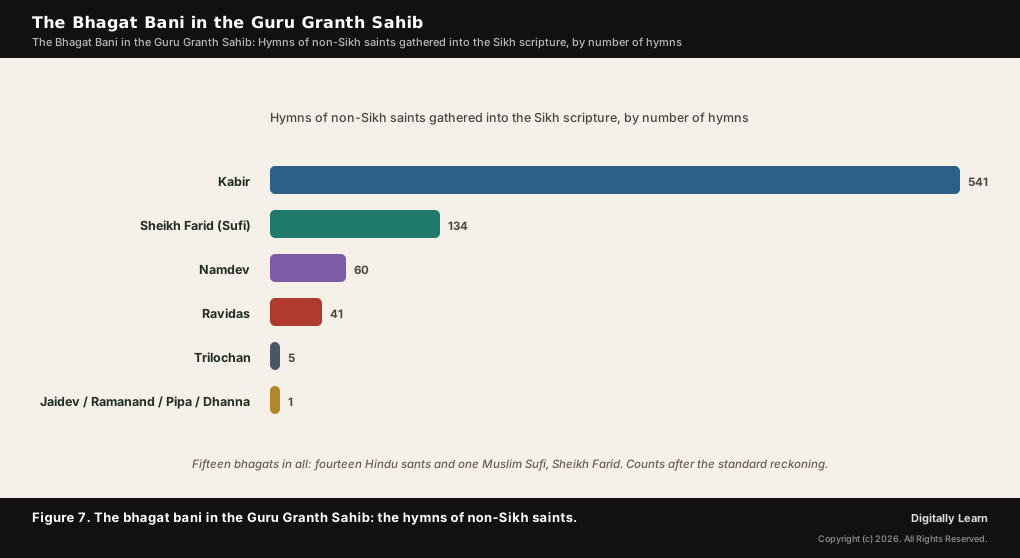
The largest share by far is Kabir's, with several hundred hymns, followed by the Sufi Sheikh Farid, by Namdev and by Ravidas, and then by a number of saints with only a hymn or two apiece. That a scripture should honour a Muslim Sufi and a string of low-born Hindu saints, setting their words beside those of the Gurus, is a powerful witness to the nirguna spirit that the religion of one God, formless and shared, has no use for the walls of caste and creed. The bhagat bani is, for the examiner and the student alike, the most concrete record of how closely the nirguna Sants were bound together.
Social Radicalism, Vernacular Voice and the Legacy of the Nirguna Sants
The Assault on Caste, Ritual and Idolatry
At their heart the nirguna Sants were a revolt against caste and the religion of forms, and this is the source of their lasting power.
The Sants taught, with one voice, that no one is high or low by birth, and that the leather-worker and the Brahmin stand wholly equal before the one God. They struck at caste and at untouchability, the cruellest of its edges, not by argument alone but by the plain fact of their own lives, for the most honoured among them were a weaver, a cobbler and a barber. They turned away from the idol and the temple, the holy bath and the pilgrimage, and from the Brahmin priest and the Muslim cleric who lived by such rites, holding all of it to be outward show that hid the God within.
This was a faith that needed no priest and no scripture in a dead tongue, only the Name and an honest heart, and so it was open to the poorest and the most despised. In place of ritual it set inward devotion; in place of caste, the equality of all before God; in place of the idol, the formless reality within. The social radicalism of the Lingayats, treated in the Vedanta acharyas and the Lingayat reform, found in the nirguna Sants of the north a parallel and a continuation, carried this time in the great tongues of Hindustan.
Vernacular Literature and the Partial Hindu-Muslim Rapprochement
The Sants gave northern India both a vernacular literature and a meeting-ground between Hindu and Muslim, and in this lies much of their importance for history.
By choosing to sing in the vernacular, in early Hindi, Punjabi and the mixed speech of the saints, rather than in Sanskrit or Persian, the Sants created a devotional literature that ordinary people could understand and treasure. The dohas of Kabir and the hymns of Nanak and Ravidas became part of the common memory of the north, shaping its languages and its imagination. In doing so they carried learning and devotion out of the hands of a priestly class and gave them to the people, a service to vernacular culture whose effects long outlived the saints themselves. The figure below traces this social and religious legacy.
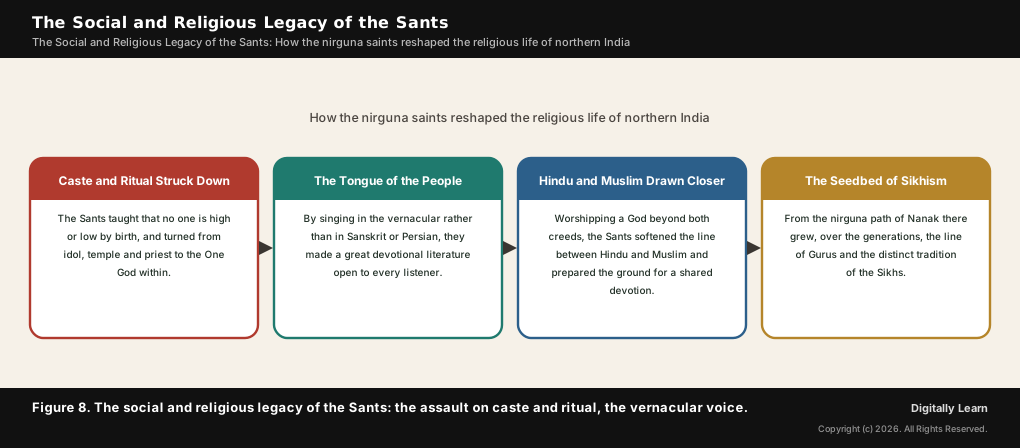
Worshipping a God who was beyond both Hinduism and Islam, the nirguna Sants also softened the hard line between the two communities. By honouring a Muslim Sufi such as Sheikh Farid beside the Hindu bhagats, and by drawing Hindu and Muslim alike to a shared, formless devotion, they prepared a ground on which the two could meet. This was a partial and an uneven rapprochement, not a union of faiths, and it should not be overstated; but it ran alongside the parallel work of the Sufis, treated in later parts of this series, and together the two currents gave medieval India its enduring tradition of a shared, composite devotion.
The Seedbed of Sikhism and the Place of the Nirguna Stream
The greatest single fruit of the nirguna stream was the birth of the Sikh tradition, which grew from the teaching of Guru Nanak.
From the nirguna devotion of Guru Nanak there grew, over the generations that followed, the line of ten Gurus, the great scripture of the Guru Granth Sahib, and in time the distinct community of the Sikhs. The nirguna stream of bhakti was thus not only a movement of saints and songs but the seedbed of a major religious tradition of India, a fact that sets it apart from the other currents of the Bhakti movement. The full unfolding of that tradition, through the later Gurus, lies beyond this part, but its root in the Sant teaching of the formless God is plain.
Set in its place, the nirguna stream stands beside the other currents of this series: the saguna devotion of Ram and Krishna that the next part takes up, the southern bhakti of the Alvars and the Vedanta acharyas of the earlier parts, and the Sufism with which it shares so much, including the Sufis and the Bhakti movement under the Delhi Sultanate. Together these movements remade the religious life of medieval India; and within them the nirguna Sants hold a place of their own, as the boldest voice of the formless God and the most thorough enemies of caste and idol that the age produced.
UPSC Relevance and Previous-Year Questions
Where the Nirguna Sants Fit in the UPSC-CSE Syllabus
This topic belongs to General Studies Paper I: medieval Indian history and culture, and the nirguna Sants are a recurring theme, tested both as fine factual pairings in Prelims and as a subject of religion and society in Mains.
The questions most often test the saints and their attributes, the meaning of the nirguna way, the dates of the great Sants, and the place of their verse in the Guru Granth Sahib. The following points are worth holding in working memory:
- Nirguna and saguna: the nirguna Sants worship a formless God by the Name, the saguna saints a God in form such as Ram or Krishna; Kabir’s Ram is the formless Absolute, not Dasharatha’s son.
- The saints and their callings: Kabir was a weaver of Banaras, Ravidas a cobbler, and Sena a barber; their low birth is central to the movement’s meaning.
- Ramananda: traditionally the first Bhakti saint to use Hindi to spread his message, and the teacher from whom the northern Sants are traced.
- Guru Nanak: 1469 to 1539, the first Sikh Guru, with the institutions of sangat, pangat and langar and the prayer called the Japji.
- The bhagat bani: the Guru Granth Sahib carries the verse of fifteen bhagats, fourteen Hindu sants and the Sufi Sheikh Farid, with Kabir’s the largest share.
A 2013 Prelims question asked which of three saints, Dadu Dayal, Guru Nanak and Tyagaraja, were preaching when the Lodi dynasty fell and Babur took over. This part supplies the dates to answer it: Guru Nanak alone (1469 to 1539) was active in 1526, when the Lodis fell at Panipat; Dadu Dayal was not born until 1544, and Tyagaraja was a composer of the Carnatic tradition of the eighteenth and nineteenth centuries, far outside the period, so the answer is Guru Nanak only. The chronology of the great Sants, set out in their sections, is the key to such questions.
A 2002 Prelims question asked who was the first Bhakti saint to use Hindi to spread his message. This part teaches that it was Ramananda, the vernacular bridge from the south, who broke with Sanskrit to teach in the people's tongue, as the section on him explains; the other names offered, Kabir, Dadu and Tulsidas, all came after him. A 2019 Prelims question tested, among other things, whether Kabir was greatly influenced by Shaikh Ahmad Sirhindi; this part shows why that is false, for Kabir of the fifteenth century long predates Sirhindi, a Naqshbandi Sufi of the late sixteenth and early seventeenth centuries, and Kabir's critique owed nothing to him.
A Mains question of 2023 asked for the major teachings of Guru Nanak and their relevance in the world of today. This part teaches those teachings directly: the one formless God worshipped by his Name; the equality of all before God, built into the sangat, the pangat and the langar; honest work and open sharing; and the setting-aside of caste, idol and empty ritual. Their relevance to a world still divided by creed and birth, in the call to human equality and to a devotion above sectarian forms, follows readily from the teachings the section on Nanak sets out, though a full answer would carry that argument into the present day.
Previous Year UPSC-CSE Questions
Previous Year UPSC-CSE Questions By the end you will be able to draft model answers for the following UPSC questions. Each question carries a collapsible framework showing how to approach it in the exam.
- UPSC Prelims 2013 GS-IConsider the following Bhakti Saints:
- Dadu Dayal
- Guru Nanak
- Tyagaraja
Who among the above was/were preaching when the Lodi dynasty fell and Babur took over?
How to approach this Prelims question
Approach: Fix the date of the event (the fall of the Lodis and Babur's victory at Panipat, 1526), then test each saint's life-span against it. Only the saint alive in 1526 qualifies.
Trap to watch: Tyagaraja sounds like a bhakti saint but belongs to the much later Carnatic tradition; Dadu Dayal, though a genuine nirguna sant, was born in 1544, after 1526. Do not select a saint merely because he is famous.
Key facts to recall:
- Guru Nanak lived 1469 to 1539 and was active in 1526 when the Lodi dynasty fell.
- Dadu Dayal lived 1544 to 1603 and was not yet born in 1526.
- Tyagaraja was a composer of the Carnatic tradition of the eighteenth and nineteenth centuries, far outside the medieval period.
Answer signal: Only the second saint, Guru Nanak, was preaching when the Lodi dynasty fell, so the answer is 2 only.
- UPSC Prelims 2002 GS-IWho among the following was the first Bhakti saint to use Hindi for the propagation of his message?
How to approach this Prelims question
Approach: Recall who first broke with Sanskrit to preach devotion in Hindi, and test the four names against that fact and their relative dates.
Trap to watch: Kabir and Tulsidas are more famous for their Hindi verse, but Ramananda is traditionally credited as the first to use Hindi to spread his message, and he precedes them.
Key facts to recall:
- Ramananda taught devotion in vernacular Hindi rather than Sanskrit.
- Ramananda is traditionally placed before Kabir and is regarded as the teacher of the northern Sants.
- Tulsidas belongs to the later saguna stream and Dadu Dayal to the sixteenth century, both after Ramananda.
Answer signal: Ramananda was the first Bhakti saint to use Hindi for the propagation of his message.
- UPSC Prelims 2019 GS-IConsider the following statements:
- Saint Nimbarka was a contemporary of Akbar.
- Saint Kabir was greatly influenced by Shaikh Ahmad Sirhindi.
Which of the statements given above is/are correct?
How to approach this Prelims question
Approach: Test each statement against the saint's dates. Kabir (fifteenth century) predates Sirhindi (1564 to 1624); Nimbarka's traditional date is far earlier than Akbar. Both statements are false.
Trap to watch: Both statements pair a bhakti saint with a later figure to suggest influence or contemporaneity; the guard is to hold each saint's date firmly.
Key facts to recall:
- Kabir is placed in the fifteenth century, commonly about 1440 to 1518.
- Shaikh Ahmad Sirhindi was a Naqshbandi Sufi of the late sixteenth and early seventeenth centuries, long after Kabir.
- Nimbarka's traditional date is centuries before Akbar, so he was not Akbar's contemporary.
Answer signal: Neither statement 1 nor statement 2 is correct.
- UPSC Mains 2023 GS-IVWhat were the major teachings of Guru Nanak? Explain their relevance in the contemporary world.
How to structure the answer in the exam
Introduction: Guru Nanak, the first of the Sikh Gurus and a nirguna saint, taught the worship of one formless God and the equality of all before him, teachings whose moral force still speaks to a divided world.
Body (sub-themes to develop):
- One formless God and nam-simran: a devotion above image and sect, relevant to communal harmony and inter-faith respect today.
- Equality before God, made real in sangat, pangat and langar: a standing rebuke to caste and social hierarchy, relevant to social justice and the dignity of all.
- Kirat karo, honest work, and vand chhako, sharing: the dignity of labour and the duty of charity, relevant to ethical livelihood and welfare.
- Rejection of empty ritual and hypocrisy in favour of inward sincerity: relevant to integrity and the critique of mere outward observance.
- Service and humility (seva) as the path of the devotee: relevant to compassionate and selfless public conduct.
Conclusion: Nanak's teachings, joining a formless devotion to a lived equality and honest service, retain a clear relevance in a world still troubled by sectarian division, social inequality and the gap between profession and practice.
Sources and Further Reading
- NCERT, Themes in Indian History and Medieval India (the nirguna saints and the Bhakti movement)
- Wikipedia: Kabir
- Wikipedia: Guru Nanak
- Wikipedia: Ravidas
- Wikipedia: Sant (religion) (the Sant tradition and Sant Mat)
- Wikipedia: Ramananda
- Wikipedia: Dadu Dayal (the Dadupanth)
- Wikipedia: Namdev
- Wikipedia: Guru Granth Sahib (the bhagat bani)
- Ministry of Culture, Indian Culture portal: the saints of the bhakti tradition
- Sahitya Akademi (the vernacular devotional literature of medieval India)
- Indira Gandhi National Centre for the Arts (IGNCA): the bhakti and sant traditions
Editorial Disclaimer
This article is for UPSC preparation. The account of the nirguna Sants follows the standard scholarship on medieval Indian religion. Many dates of these saints, the dates of Kabir and Ravidas above all, are traditional and contested, as are several biographical legends and discipleship links, and these are flagged in the text.